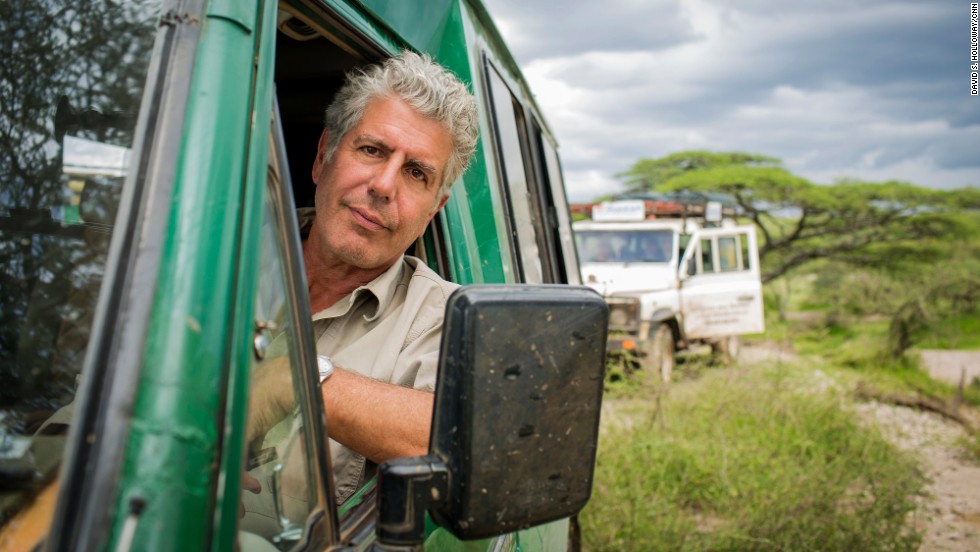
Digital Nomads: Connecting to Wifi and Communities Around the Globe

With an uptick in digital nomad lifestyles and coworking tourism, how are digital nomads positively or negatively impacting the world?
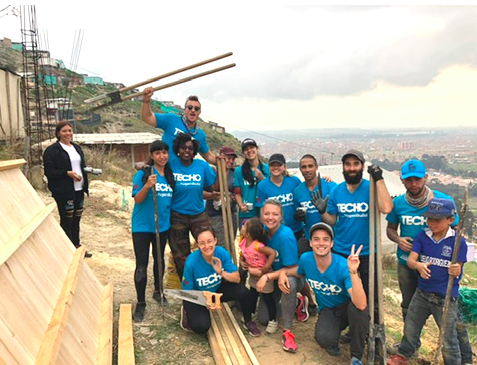
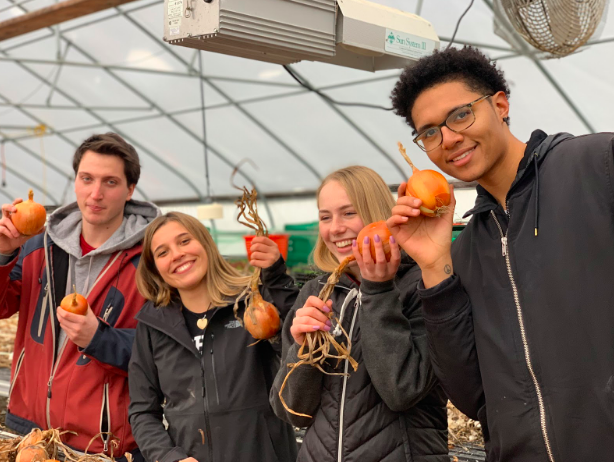
Remote Year Kahlo group volunteering in Bogota, Colombia with former partner, TECHO, a Latin American organization that seeks to overcome poverty through the help of locals and volunteers. Photographer and CC Travis King.

Birds sing melodically against the white-washed backdrop on a sunny Greek isle as Travis King shares, over Zoom, how his passion for purposeful travel evolved into his role. King collaboratively runs social impact projects across the globe at the digital nomad program, Remote Year.

“I fell in love with the world and the way we can connect with new people and cultures,” King says. For close to five years, he did everything - from working on an Alaskan fishing boat to attaining a one year work VISA in Australia in order to extend the adventure.

“I kept working and volunteering and realized I wanted more,” King says.

When King started out as a Remote Year Program Leader, he found the group he led shared a deep interest in doing good. Each Remote Year community is a group of digital nomads that will stay together throughout the year, sharing experiences, lodging, and coworking spaces in 12 different cities around the world. 

“My community’s identity was connected to giving back. We made a commitment - every month we would do one big service event in each new city.”

Digital nomads, defined as people who choose to embrace a location-agnostic, technology-enabled lifestyle that allows them to travel and work remotely globally are increasing in numbers, according to MBO Partner's research. As of 2019, 4.8 million remote workers currently describe themselves as digital nomads, and upwards of 17 million aspire to someday become nomadic. 

“I think we’re on the tipping point of this cloud-based revolution where most laptops can connect to the internet anywhere - it gives us ultimate freedom,” King says.

As location-agnostic lifestyles continue to grow, how are digital nomads positively or negatively impacting the places they travel and how are these programs addressing social and environmental impact? 
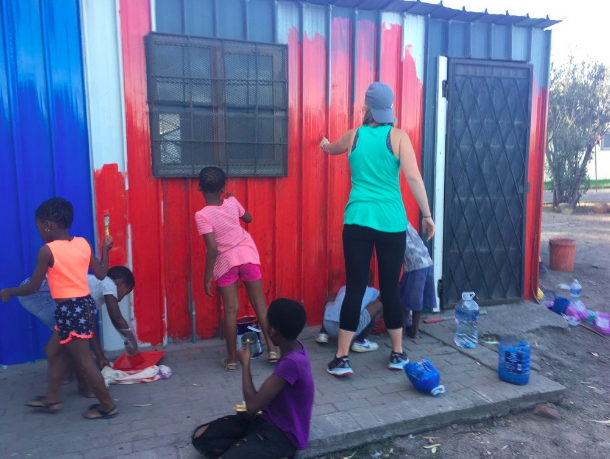
Remote Year Ohana group volunteering in Cape Town, South Africa with partner, Phillipi Music Project, a social enterprise aiming at offering an infrastructure to the musicians from the townships. Photographer and CC Travis King.

Making an impact is in the fabric of Remote Year, according to King, but it began as one-off projects that lacked sustainable results. “The early groups were doing great things with intention and heart - but everything was scattered,” King says. 

According to King, one group would go to Buenos Aires, Argentina and plant trees in the mangroves and the next group would find an orphanage to sponsor in Cambodia, while another group would paint families’ homes outside of Medellín, Colombia. 

“We realized if we connect the efforts, our impact overtime will be magnified,” King says. 

“A lot of problems with social and environmental impact programs are it’s a one time experience and then you’re gone,” says recent Remote Year participant, Rebecca Stone. 

“The cool thing about Remote Year is my group could start working on a project, and when we left at the end of the month, there’s a new group that came to take our place,” says Stone.

Stone completed first-hand reporting and travel industry data for Skift during her Remote Year. Like the 40 others in her group, she didn’t want to put her career on hold to travel the world. Remote Year took care of the infrastructure so she could pursue her other interests, including studying tourist impact on cities.

Since Remote Year runs several long-term programs, new groups arrive on a rotating basis to the same 12 to 15 cities, which, according to Stone, mitigates unnecessary negative tourism impact. “I’m in a city like Split, Croatia for one month. I don’t take jobs away from locals. All I do is add my income into the city via eating out, participating in activities, volunteering, all while knowing my tourism dollars are going into the city.”

Now, Remote Year impact projects focus on long-term partnerships. These partnerships touch on a diverse array of social issues. “You’ll get to see a different layer of each city you wouldn’t necessarily be exposed to,” says King about those who get involved.

With a rise in volunteering while traveling among digital nomads, some argue that this can do more harm than good. Medium contributor, Paris Marx writes in an article, “Digital nomads are far less likely to work toward positive local change or halt the gentrification that displaces long-term residents .” 

When asked whether he thinks this is changing, Marx responds, “there are some people trying to ‘give back’ in various ways, but the people taking part in these programs don't actually spend much time in these cities. They consume them; they don't live in them.”
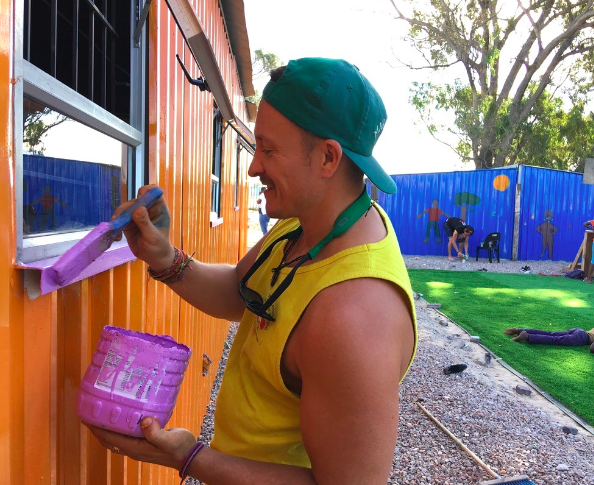
Remote Year’s Director of Community Development and Positive Impact, Travis King, volunteering with the RY Ohana group in Cape Town, South Africa, with partner, Phillipi Music Project. Photographer and CC Travis King.

When asked about the criticism of volunteering abroad, King responds, “My biggest concern is that the conversation has gone too far and people would do nothing than do something, because they worry it may be considered hurtful.” He sees this as a hurdle and encourages people to always research viable organizations and causes to put energy and funding toward while traveling. 

As of 2019, Remote Year communities have volunteered 14,842 hours, worked on 312 service projects and fundraisers, raised $134,390 and engaged 2,063 locals in their efforts.

With an uptick in coworking tourism, companies like Remote Year, Unsettled, Venture with Impact, and Nomad Cruise are growing rapidly as more people seek innovative ways to take their profession on the road. 

What’s next? 

“I would love to see our net cast wider to people of a variety of socioeconomic backgrounds so everyone has an opportunity to be part of Remote Year,” says King. He shares his last stories from Valencia, Spain where they are launching a new program to help nomadic communities preserve and share their arts with the larger Spanish population. 

Lasting impact is challenging to measure. According to Marx, real impact abroad “means getting politically involved in one's community to fight for and enact social change in the interests of working-class people. There is hope for positive change but digital nomadism isn't a vehicle for broad-based political action.”

While some people, like Marx, believe digital nomads are a highly individualized group of privileged Westerners who make little positive impact on local communities, others, like King, believe in a broader approach to giving back.

A traveler who can explore and live in new countries and cultures has a unique opportunity. Some will give back, while others may not. 

In the end, whatever one is seeking abroad, an excellent way to find yourself is to lose yourself in the service of others. 


JULIA KRAMER is a New York-based writer and avid traveler who addresses systems changes to social challenges through storytelling and community building. When she’s not writing or on the road, you will find her cooking something from her urban garden or hiking. Read more of her articles on travel and social impact at julia-roos.com.

Welcome to the Jungle: Badaling’s Wildlife Park

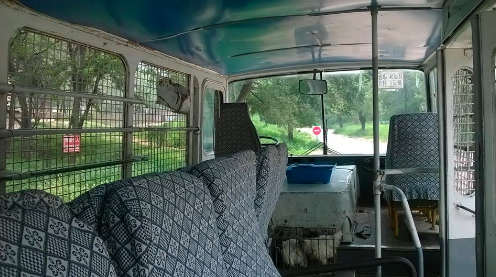
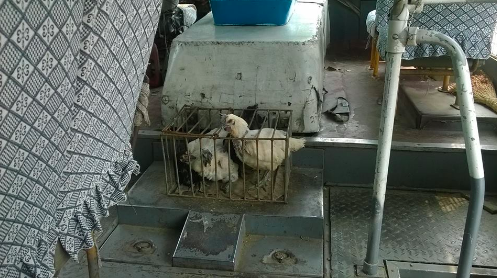
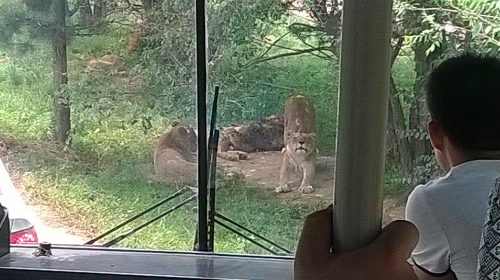
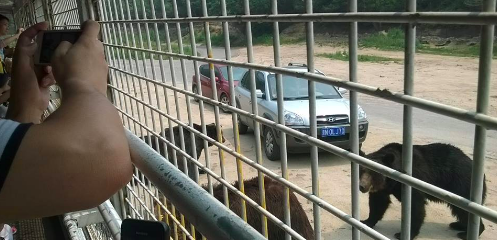
You can't just stroll into the park. You have to take one of its special "zoo buses"...and pay for it. The initial ride is fairly benign, but after passing through a security checkpoint, you can literally see lions, tiger and bears swirling around the bus you are riding in. These animals spend their lives here at the park and have grown accustomed to vehicles passing through their enclosures—they know you're coming long before you do. As your fellow passengers pull out their phones and snap pictures, you notice a steel cage riveted to the floor of the bus. It’s filled with chickens. For 40 yuan ($6.30) you can buy one of these chickens and toss it to the animals outside. It’s not an option for the squeamish, of course, but an option nonetheless.

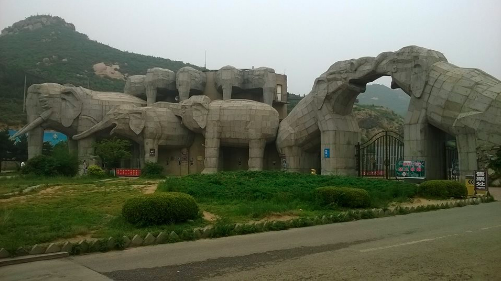
The entrance to the Badaling Wildlife Park. Jonathan Robinson.

The zoo bus. Jonathan Robinson.

The Badaling Wildlife Park outside of Beijing is known for giving its guests an up-close-and-personal experience with exotic animals. If you've got the funds, the park staff can also arrange for live chickens, sheep, even cows to be served to those animals for your viewing pleasure. Critics call this practice cruel and inhumane, but live animal feedings are fairly common at zoos and wildlife parks throughout China.

Every bus comes with its own chicken cage. Jonathan Robinson.

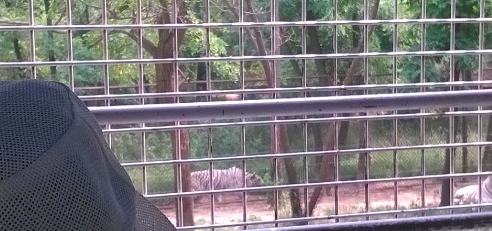
A white tiger. Jonathan Robinson.

If tourists aren't careful, they can find themselves on the menu as well. Two years ago, a woman was attacked when, after an argument with her husband, she decided to exit the car that she, her husband, and her mother were riding in and make the rest of the trip on foot. Surveillance videos show her being dragged away by a Siberian tiger, as her husband and mother look on in horror. The woman’s mother eventually exited the vehicle and jumped on the tiger, saving her daughter's life at the cost of her own. The park paid out a settlement of 1.2 million yuan ($299,917.52) following the incident. Last year, a male patron was bitten by a bear as he fed the animal through the driver's side window of his car. Despite these and other incidents, the park is still as popular as ever and continues to admit new patrons looking for an adventure.

A group of lions. Jonathan Robinson.

Bears looking for a snack. Jonathan Robinson.

A cardinal rule when traveling is to expect differences from one's country of origin. Not everyone will have the same beliefs and values as those of the traveler. The Badaling Wildlife Park is a prime example of this. While controversial, none of the activities that occur in the park are illegal in China. Nor do they pose an immediate threat to the population of any particular animal. Respecting things that we do not necessarily support is a vital part of the international, intercultural education that world travel gives us, and though the temptation may be great at times, we must weigh the validity of imposing our values in countries that we are admitted to as guests. For now, the park hovers in its own moral space. It cannot be labeled definitely as “right” or “wrong.” It simply is.


JONATHAN ROBINSON is an intern at CATALYST. He is a travel enthusiast always adding new people, places, experiences to his story. He hopes to use writing as a means to connect with others like himself. 


Threads of Hope and Beauty: Capturing the Resilience of Life and Culture

For more than two decades, through the lens of my camera, I have sought out the hope and beauty woven into the fabric of all life and all peoples, from forest to ocean. In the face of the myriad unrecognized plights and urgent truths of our shared human and planetary condition, these shimmering threads promise change.

Images / Words © Cristina Mittermeier / Words © Kim Frank

National Geographic photographer and co-founder of SeaLegacy, Cristina Mittermeier, releases her new book this month, Amaze, published by teNeues. An intimate collection of over 25 years, Amaze combines impassioned poetic storytelling, indigenous wisdom, and an urgent plea to protect our planet. Amaze takes you on a insightful and hope-filled journey where the human spirit lifts from every page. Here is a glimpse into the book’s luminous world.

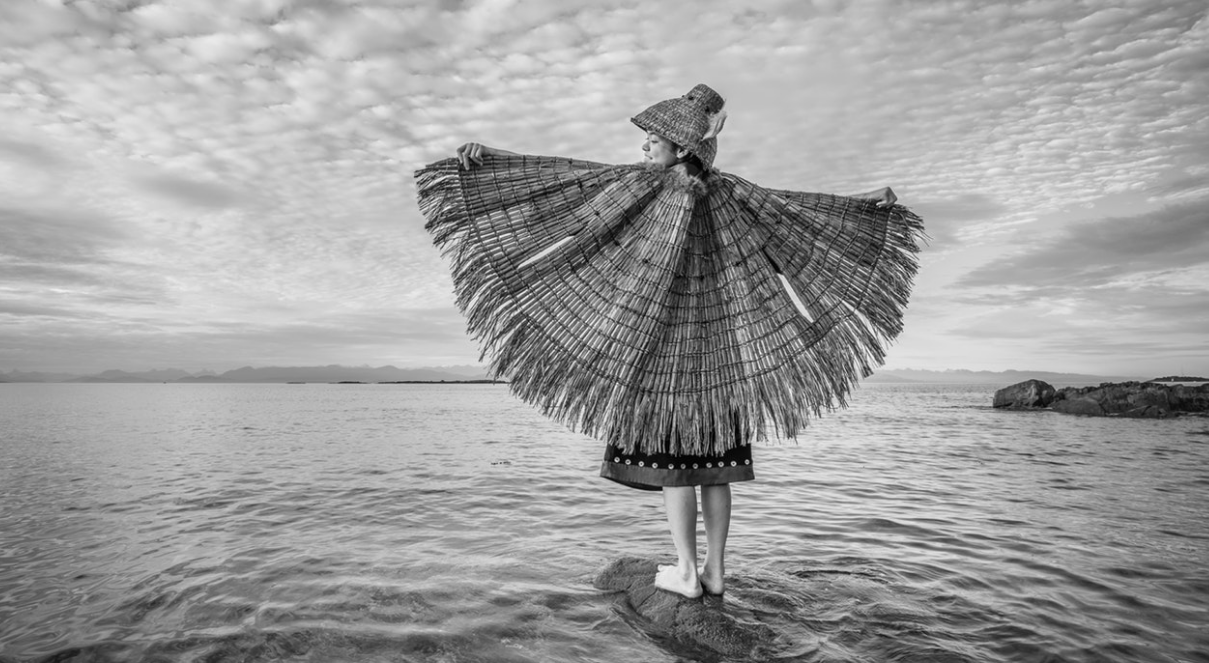
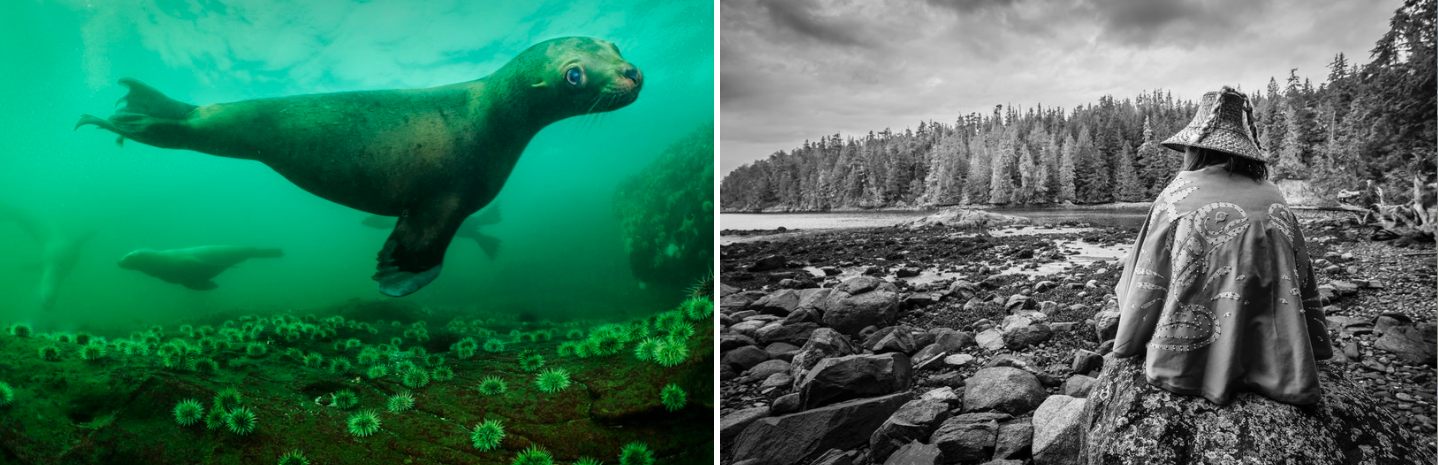
Ta’kaiya Blaney, a singer, songwriter, and drummer for her people, the Tla’amin First Nation of British Columbia, is seen in a cedar cape. The youngest speaker at the United Nations Indigenous Forum, she is a fierce advocate of indigenous rights and environmental protection.

Canada

AS WITH MANY IMPASSIONED JOURNEYS, MY LIFE AS A CONSERVATIONIST AND ARTIST BEGAN WITH A LESSON.

A lesson that rattles in my soul like a grain of sand in a chambered nautilus shell. Urging me onwards; reminding me why I do this work. Curled deep within this hidden spiral is the unwavering memory of one of the most powerful photographs I never took.

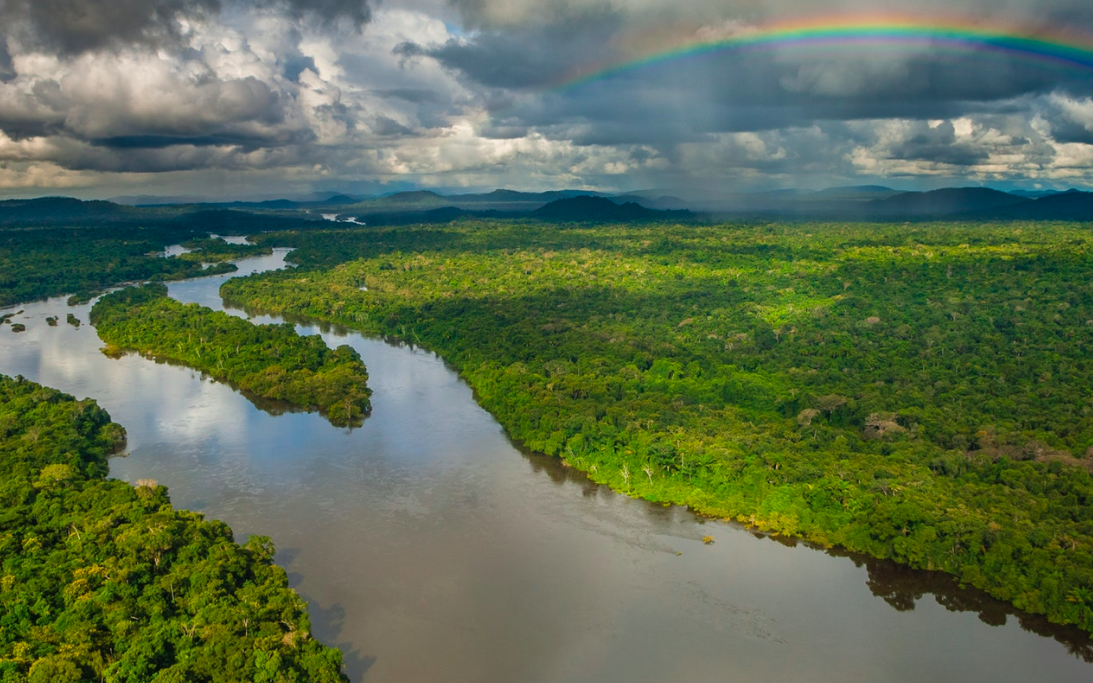
The densely knit Amazon rainforest; home to countless indigenous peoples and the once-mighty Xingú River, now forever tamed.

Brazil

When I was a young and inexperienced photographer, I was sent on an assignment to a remote corner of the Brazilian Amazon. Flying from town to town, over vast stretches of rainforest, and in increasingly small airplanes, I finally arrived at the Kayapó village of Kendjam; home to one hundred and fifty individuals. My mission was to give a face and a name to the thousands of indigenous people whose lives were soon to be impacted by the construction of the Belo Monte dam.

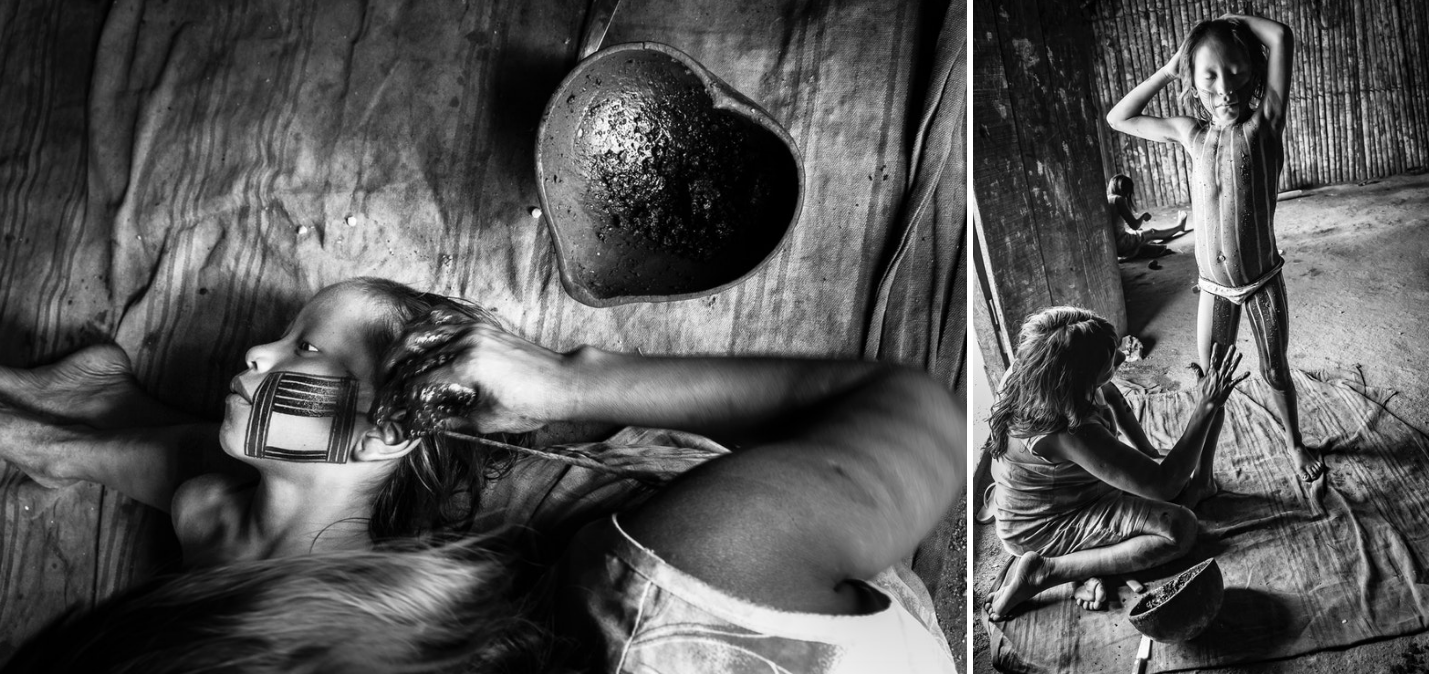
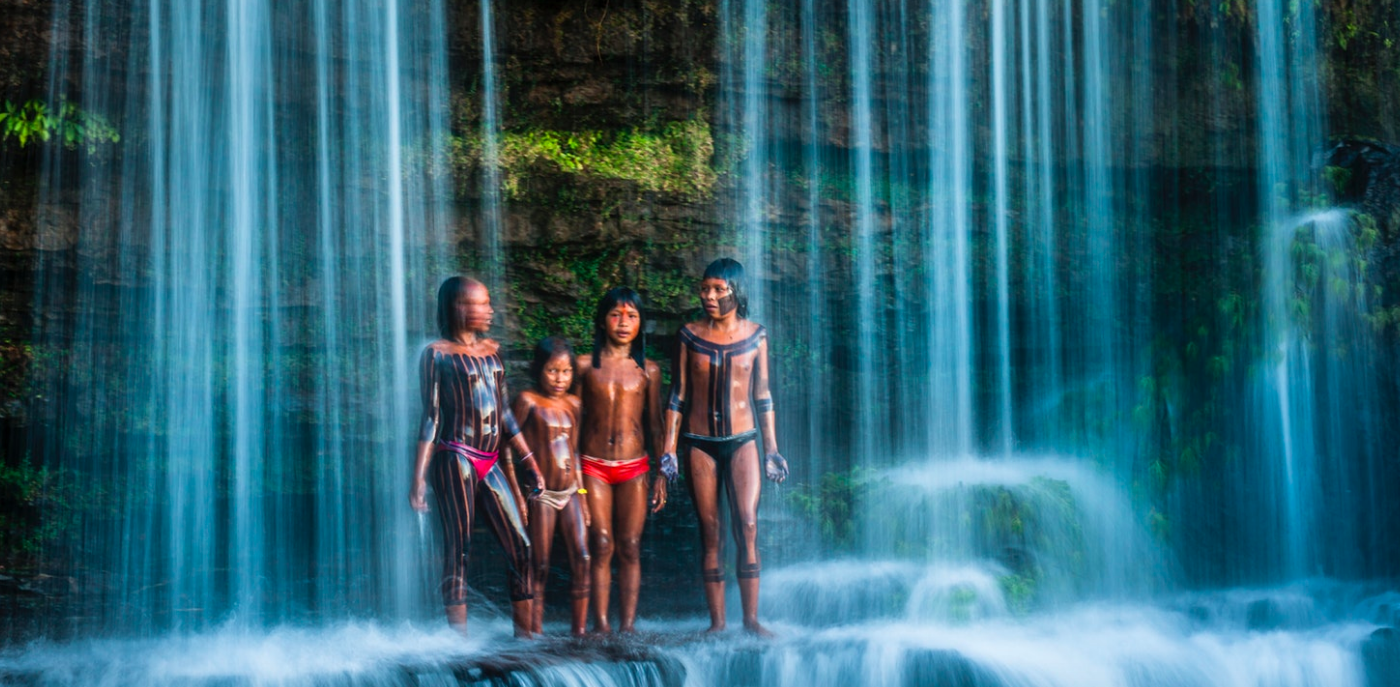
Young Kayapó children will sit or stand patiently for hours, as their mothers paint their bodies with genipap, a dye made from a forest fruit of the same name. Being painted, and painting others, is a very important form of social bonding in these remote Amazonian villages.

Brazil

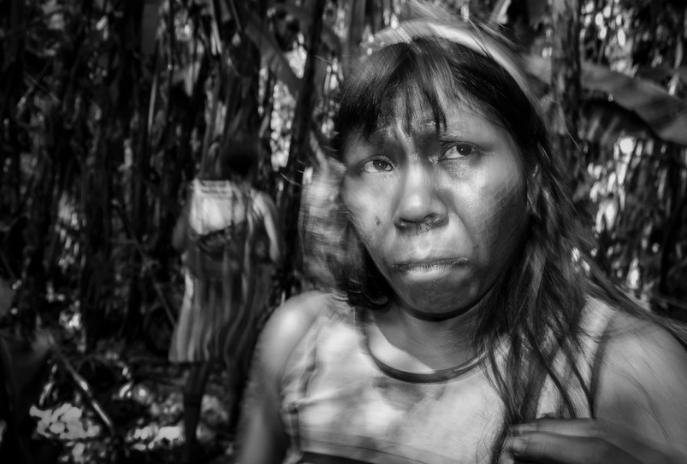
Late one afternoon, I saw a group of women coming up from the river; one of them carrying a tiny baby in her arms. It dawned on me that they had just given this newborn his first bath in the river; a vital ritual bath that ties a person’s fate to the fate of the river. And I had missed it. I consoled myself, naively thinking I that could find the mother in the morning and ask her to bring her baby back down to the water, hoping to recreate what I had missed. Tragically, we woke to the news that the infant had not lived through the night. By the time I had figured out what was happening, the women had already buried the tiny body, and I had missed that ritual as well.

Dismayed, I began to wonder if I was up to the challenge of this assignment, wishing the editors had sent a more experienced photographer, when out of the corner of my eye I saw a figure approaching. It was the mother of the baby, walking straight towards me and bawling. Nobody was going near her. As she came closer, I saw that she was cradling a dirty bundle.

In her sorrow, she had dug out the body of her dead child, and was carrying him around. Clutching a machete in her hand, she was hitting her forehead with the blunt edge as she screamed out her sorrow. Her face, her dress, her dead son; all were covered in mud and blood.

I stood there, gripping my camera with frozen fingers; paralyzed.

I could think only of my children back home and how I would feel if a stranger shoved a camera in my face just after I had lost my child. I am ashamed to admit that I did not take any photos.

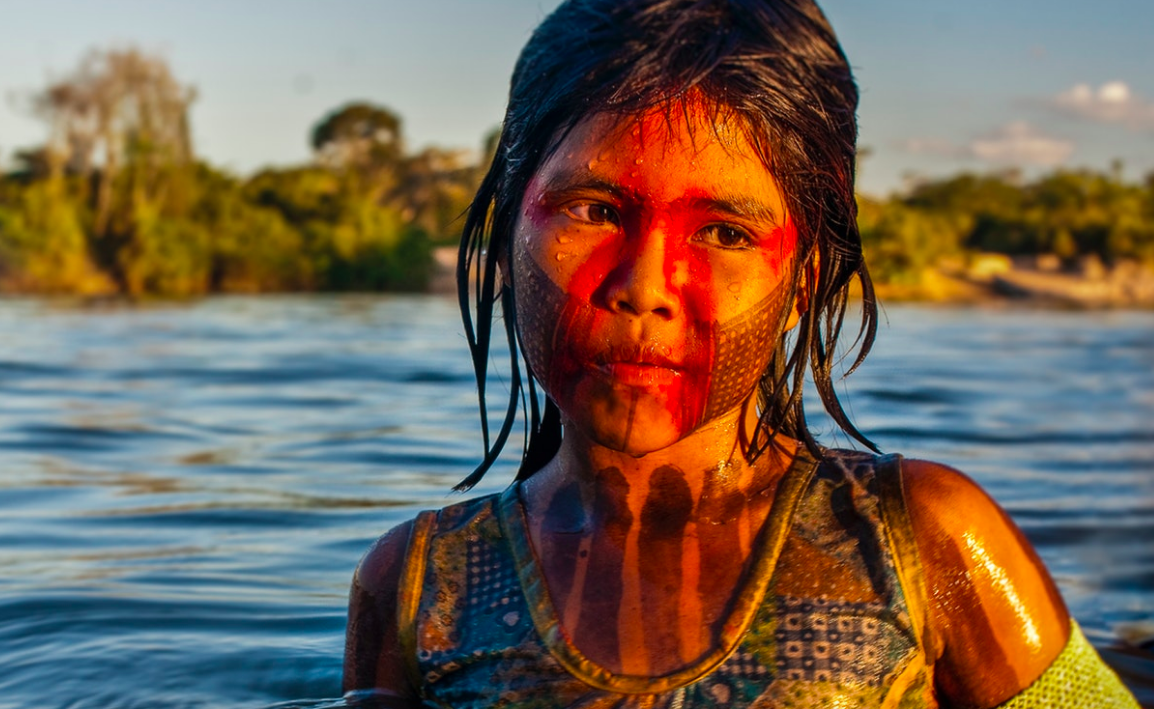
The Xingú river is intimately woven into the fabric of Kayapó life. This young girl’s eyes speak of a beloved waterway about to be dammed forever, of pride in her people’s traditions, of fear for a future unknown, and of the innocence that every child deserves to live with.

Brazil

A few months later we learned that the dam had been approved and construction was to begin immediately. I thought about the beautiful, generous people I had met and how their lives would be changed forever.

To this day, I am haunted by this question:

Would their fate have been been different if I had dared to do my job and take those difficult photographs? What if my images had been beautiful enough, or dramatic enough, to change the conversation?

The Kayapó people believe that if they are good to the forest and to the river, they will be provided with everything they need to sustain themselves.

I will never know, because that day I lacked the courage to press the shutter: a mistake I never made again. From that moment forwards, I pledged never to hesitate and to make images that matter.

For centuries the Kayapó way of life has been deeply entwined with the rivers that flow through the forest. For me, this image is a powerful symbol of nature’s familial hold on the human spirit, reminding us that nature is so much more than a commodity to exploit.

Over the course of my career I have witnessed photography’s ability to shape perceptions, help societies pause and reflect, and inspire change. Being a photographer allows me to share my deepened understanding of the truth that all things in nature are part of one vast ecosystem.

Unlike people, the Earth’s diverse waterways, wildlife, and forests are intricately woven into the fabric of the whole; not claiming a separate existence. My hope is that my images will inspire a stronger connection with the nature that lies within and around us, as it is infinitely worthy of our deepest respect and care.

In a raw world that seems to bleed everyday with shriveling resources, human tragedy, and environmental ruin. Where every moment with a press of a button or a swipe of a screen, we are assaulted with distressing news, stories and images that threaten our sense of security and dim our lights, we must find ways to remain optimistic.

We must work to remove the physical and metaphorical barriers that block our meaningful connection to one another and to our planet. In my twenty five years documenting remote tribal communities around the world I have learned important lessons from their collective wisdom.
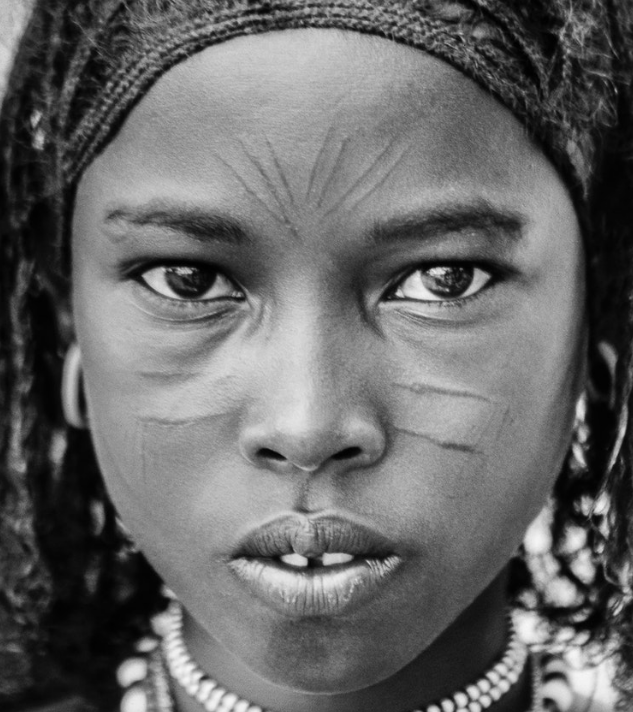
A young girl of the Afar tribe, from Ethiopia. Her people are fiercely proud and independent, having lived forever in the harsh deserts of the Horn of Africa, as semi-nomadic cattle and camel herders.

Ethiopia

Spending time with Indigenous peoples has taught me that abundance is not measured in the things that we own, but in the strength of our human spirit, and in the depth of our connection to the natural world.

From the Amazon to the Arctic, these communities nurture an intimate awareness of the web of relationships that have sustained them in harmony with nature, for millennia. I have long thought about how I could share my own interpretation of this intuitive wisdom. Among the Kayapó, the Gitga’at, the Inuit, and the many other Indigenous communities I have photographed, I have witnessed a myriad of common strands — spiritual and physical; past and future. Woven together, they become the exquisite and universal fabric of something that I have come to call “enoughness”.
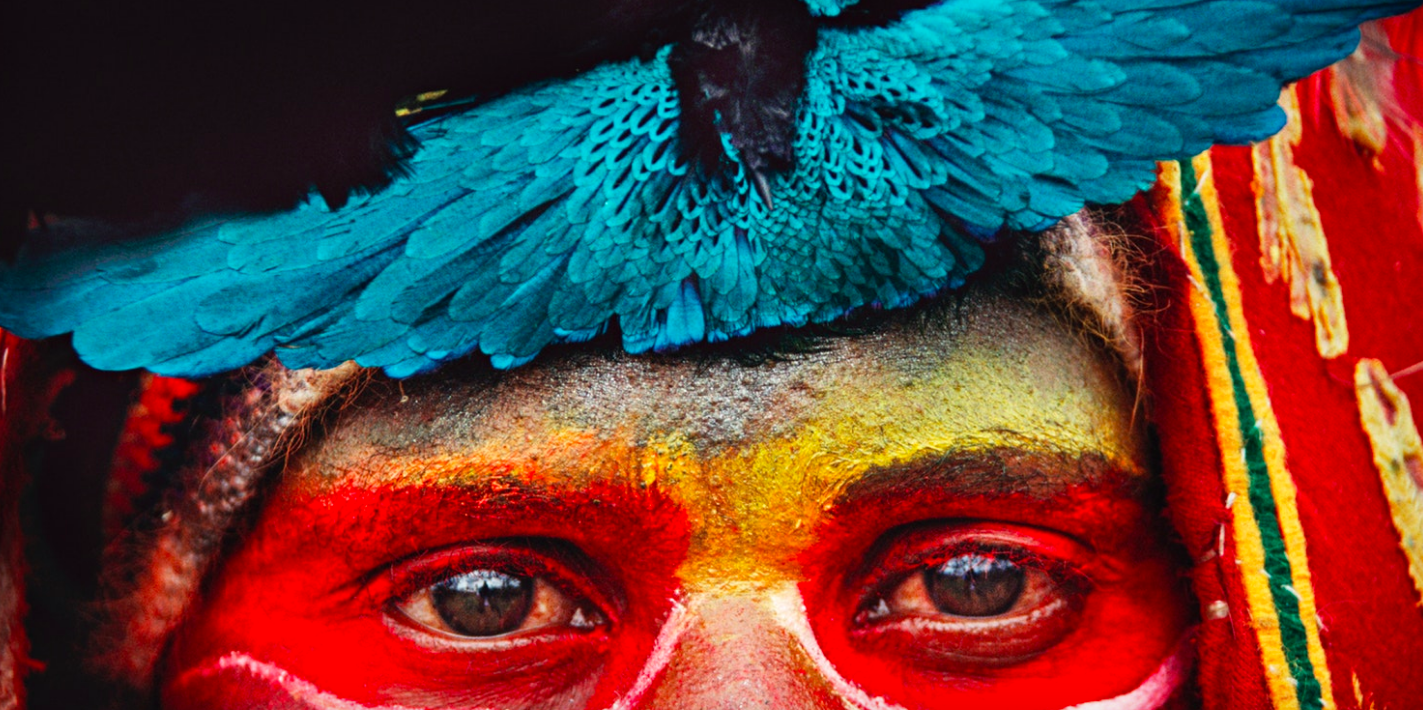
Made from the feathers of birds of paradise, the Indigenous peoples in the highlands of Papua New Guinea pride themselves on elaborate personal decoration. This woman’s spectacular headdress had been passed down from generation to generation.

Papua New Guinea

My personal true north for navigating the complexities and contradictions of modern life with more planetary integrity, I search for these threads of enoughness: belonging, purpose, sacred ecology, spirituality, and creative expression in the people I meet, and the experiences I have.

I describe and show enoughness within the words and images in the first part of my book, Amaze, and I share an excerpt with you here. It is my hope that enoughness can be recognized as a path to a more fully expressed life, as we seek to entwine these threads more deeply into our own personal tapestry.

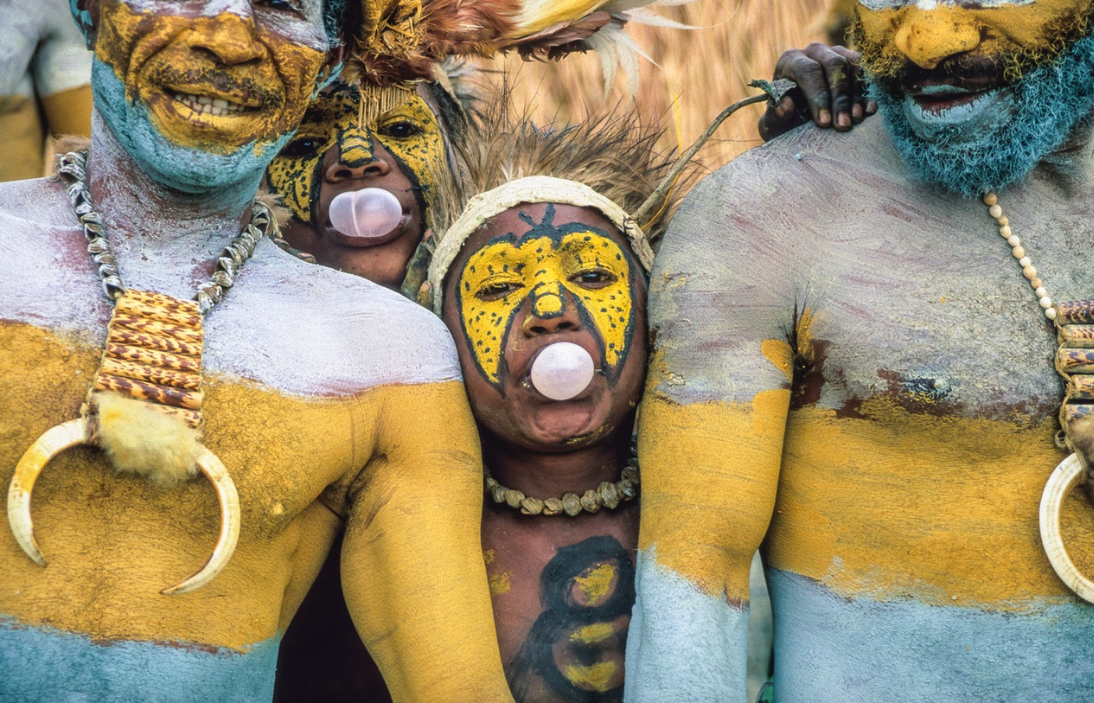
I am often asked if I gave gum to these boys from the highlands of Papua New Guinea, but the answer is no. They were at the Mount Hagen Sing-Sing, a festival that celebrated the most culturally-intact tribe, and delighted in surprising me with their bubbles.

Papua New Guinea

We all yearn to belong, whether it be to a people, or to a place.

On the spray-soaked shorelines of the Pacific Northwest, a part of the world that I am now fortunate enough to call home, the Sundance Chief of the Tsleil-Wuatuth First Nation shared with me what belonging means to him. For his people, the land is not something that you own, nor is it a commodity to be bought and sold. Instead, it is something that you belong to.

For over 30,000 years the Tsleil-Waututh First Nation and their ancestors have lived in the region we now call Burrard Inlet.

Canada

Rock, tree, river, or hill, crow, bear, or human, all were formed from the same elements by the Ancestors long ago. Their land is alive with relations, no matter the shape that relation may take. When you love, need, and care for the land, in return, the land will love, need, and care for its people. For the Tsleil-Waututh, the land is both family and self.

It is the ultimate expression of belonging.

Wearing his people’s traditional headdress, Will George, of the Tsleil-Waututh First Nation, screams out his frustration at the Canadian government for allowing the expansion of another destructive oil pipeline across his people’s ancestral lands.

Over the years I have observed that irrespective of culture and our place within the world, the path to true fulfillment often lies in finding joy and meaning through purpose. Living a life of purpose may mean intentionally raising your children wholeheartedly as compassionate, courageous citizens, of planet Earth, or it may mean developing your unique skill or talent so that you can contribute to your community. For me, it is the feeling that my passion lines up with what the world needs. Regardless, it is about recognizing your own inner value.

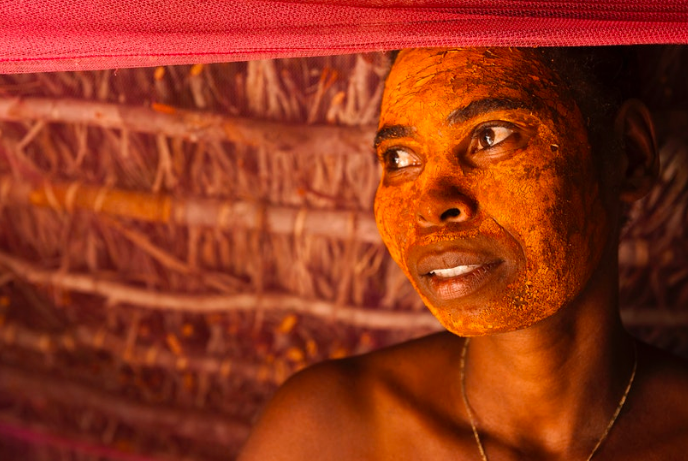
Seeking shelter from the relentless sun, I was invited in by this beautiful Antandroy woman, who was wearing a traditional mask made of powdered bark, a natural mosquito repellent and sunblock. She too was feeling unwell and I was moved by her humble hospitality and grace.

Madagascar

I marvel at how when we treat one another with compassion, and respect the creatures and land we rely on, our sense of personal nourishment grows in direct relationship. The elements that make up enoughness help us cultivate fulfillment from within. Rather than needing or expecting the world to give us something, enoughness naturally inspires us to give back, to others and to the planet. Cultivating a sense of belonging, embracing spirituality, and intentionally finding purpose. Tapping into existing sacred ecologies and embracing our natural gifts for creative expression. This is how we can nurture enoughness, as individuals, and as an intimately connected global community.

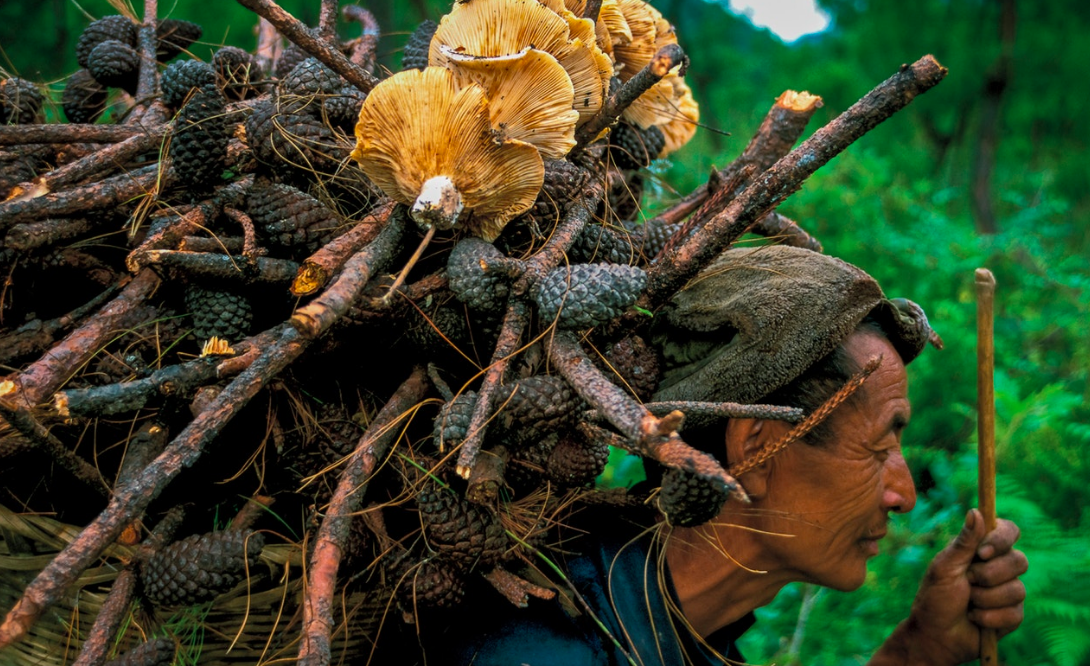
In northwestern Yunnan, each village has a sacred forest where the locals believe the gods reside, along with the spirits of their ancestors. People are not allowed to cut down trees, but they can collect fallen branches, mushrooms, and medicinal plants.

People's Republic of China

Enoughness is the feeling of something central being restored. It is a luminous path to a fully expressed life.

What a joy it has been to find the purposeful focus of living from enoughness in my own life; by looking carefully and listening closely to the lessons shared with me by the people who still live close to the land and who know how to carve a living from the Earth without destroying it.

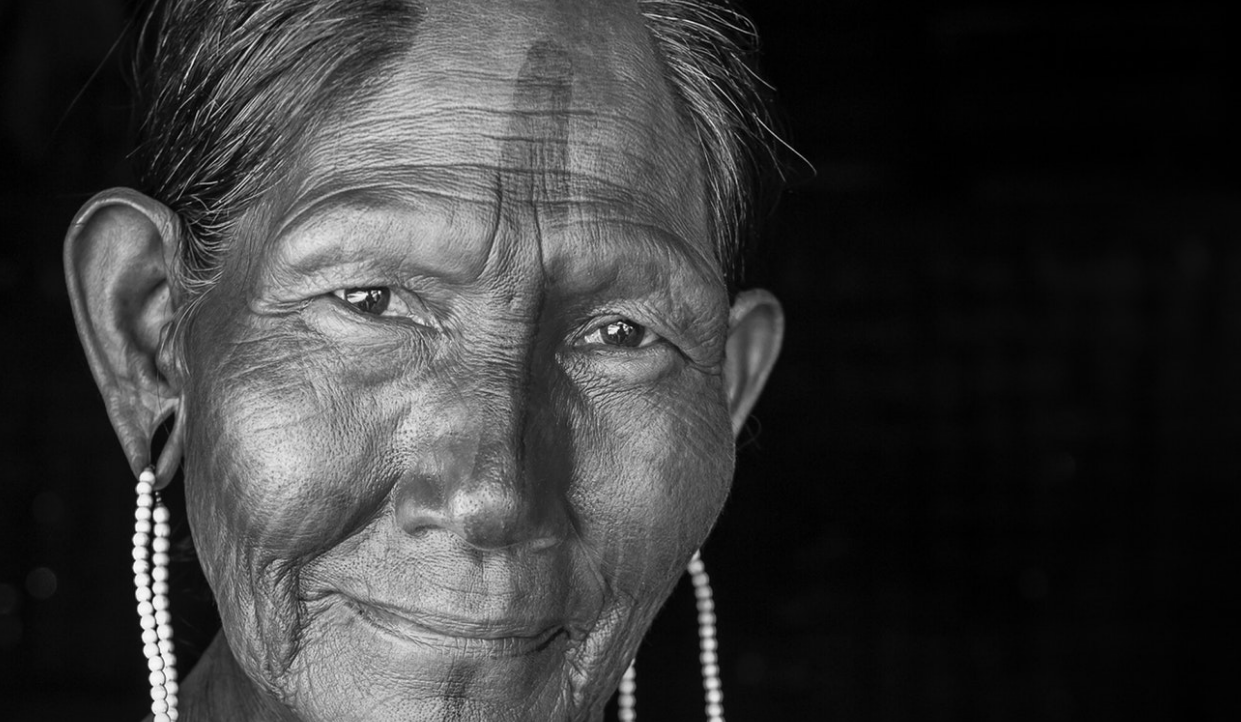
The embodiment of strength, knowledge, and the rich cultural heritage of her people, who have lived in the rainforests of Brazil for millenia, this Kayapó elder is a leader in her community and a proud keeper of their traditional knowledge.

Brazil

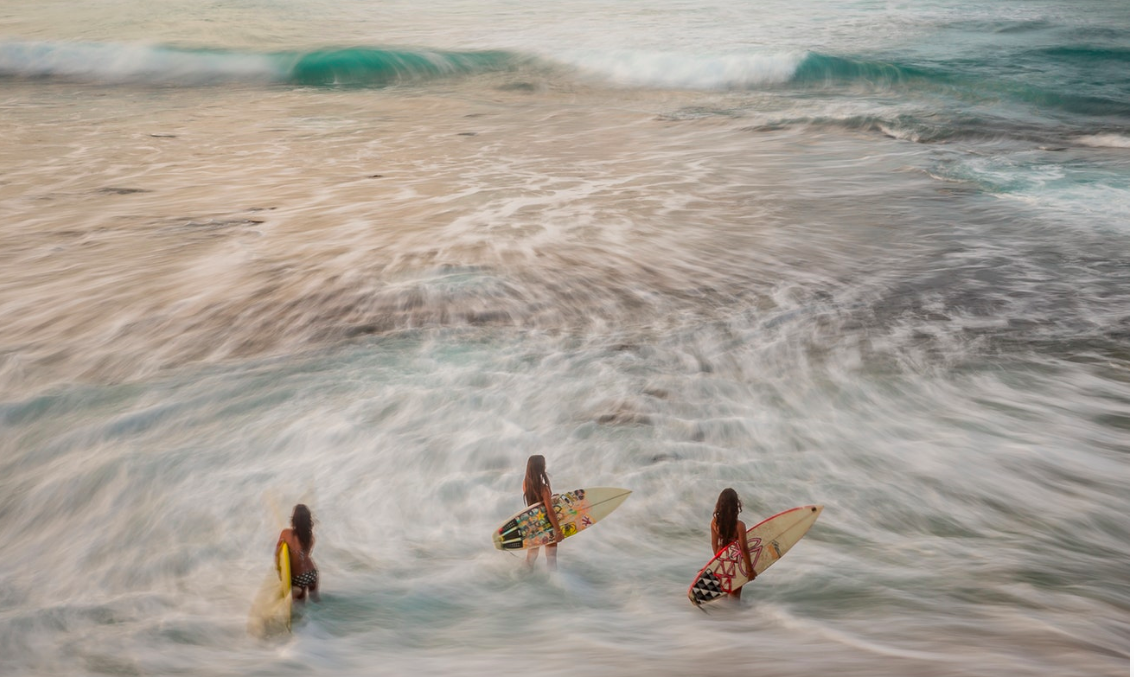
Eyes on the horizon, Miracle, Virtuous, and Heavenly Kaahanui float with their surfboards, waiting for the next set of waves to roll in. For centuries their ancestors have practiced this art, perfecting their prowess in the water, and nurturing a deep connection with the life-giving grace of the sea. In that moment, soaked in the glittering spray of the vast Pacific Ocean once again, I know for certain that long-lasting change will only come when we feel more connected to the surge of life that is beating on our shores.

Three Hawaiian sisters wait for the waves in Makaha Beach, Oahu.

Hawaii, United States of America

Over millennia, the tireless swing of the tides has given shape to the continents and character to our coasts; morphed and bent to the will of the sea. Every day, for a few precious hours, the shore belongs to the land. Then under the gravitational spell of the moon, it is once again reclaimed by the waves. To us, however, it never truly belongs.

There is an invisible line between the familiar feeling of our feet on solid ground and the inky abyss, often foreign and fearsome, where creatures with gills, scales, and fins are better suited to survive.

[1] A curious Stellar sea lion in the rich waters of the Salish Sea. [2] Molina Dawson, a young Musgamagw Dzawada’enuxw warrior, is occupying the polluting open-net fish farm that was placed in her people’s ancestral territory without their consent.

Canada

Though bound to the land, humans have benefited from the riches of the sea since the beginning of time. We should know by now that if our oceans thrive, so do we. Why then, are we collectively failing to nurture and protect the cornerstone of all life on Earth?

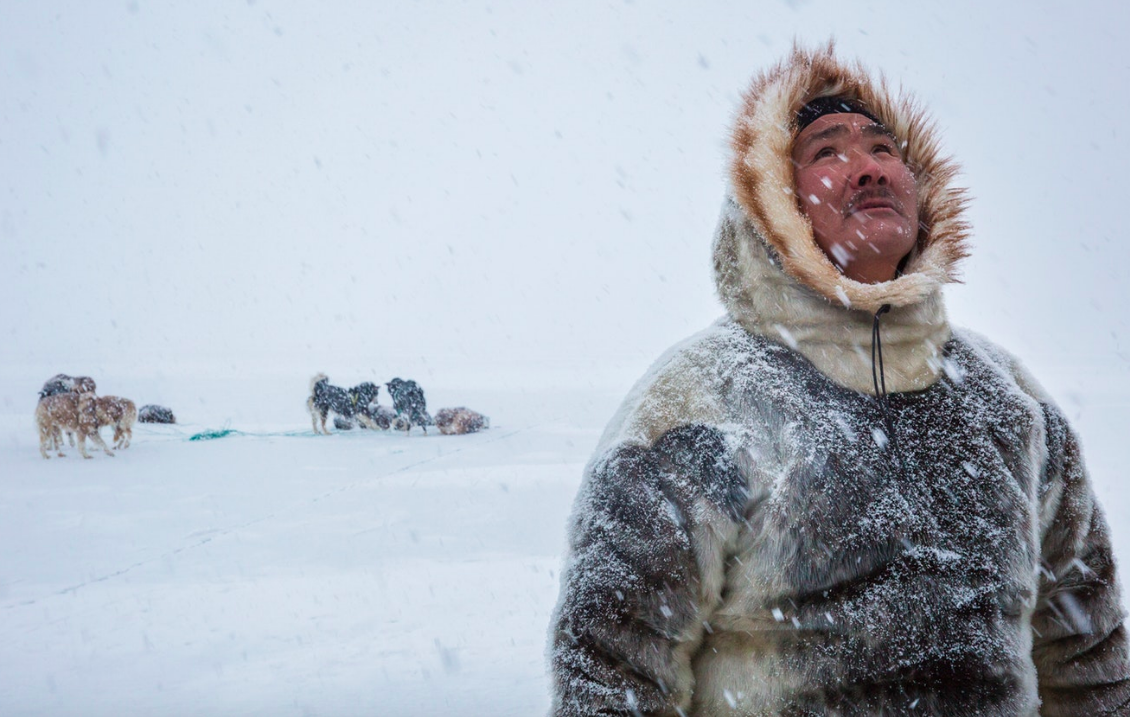
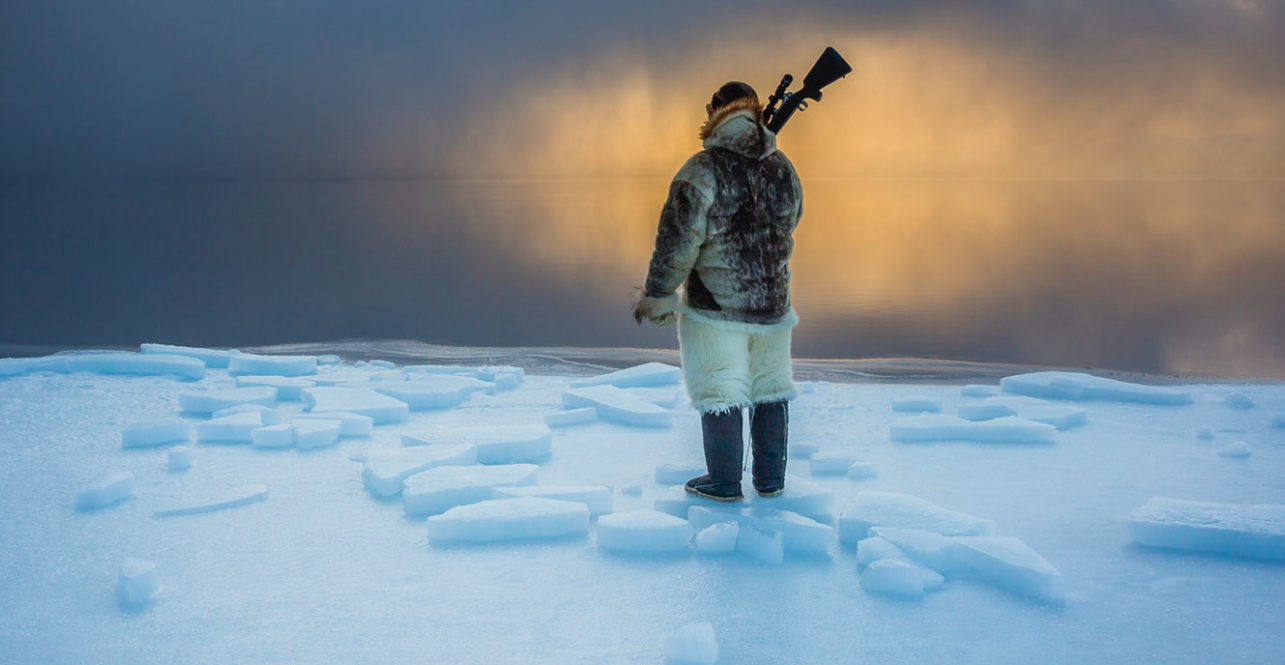
As he lifts his eyes to the falling snowflakes, Naimanngitsoq Kristiansen, a traditional Inuit hunter from Greenland, reminds me that nature is a spiritual sanctuary, made all the more hallowed by the first flurry of snow in Spring.

Greenland

Knowingly or not we have abused the generosity of the sea. Perhaps we have been walking on land for so long, we have forgotten that our very existence depends on a healthy ocean. Every second breath we take comes from the sea; the oceans are the watery lungs of our planet, producing vast amounts of oxygen and absorbing countless tons of carbon dioxide.

One billion people, including many of the world’s poor, rely on fish for their daily protein. The rain and snow that falls over distant mountains, irrigating fields many miles from the shore, originates at sea. Immense ocean currents regulate our planetary climate, maintaining the perfect conditions for our fragile existence. Today, human-induced global warming and exploitation of our environment are threatening to destabilize all of this.

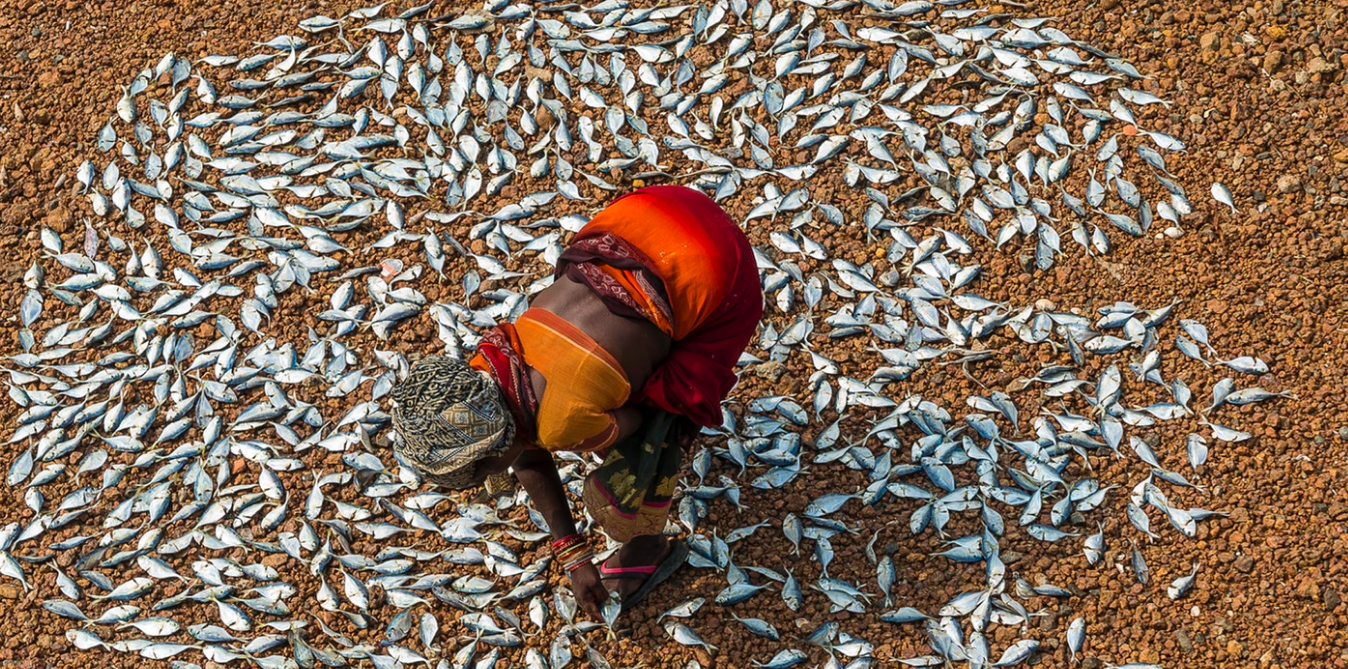
On a three-week long expedition from the southernmost tip of India to Chennai, I stopped in every coastal town to see what the fishermen were bringing in. The women I met told me that the fish are getting smaller and smaller, and many species are disappearing.

India

HOWEVER, ALL IS NOT LOST. WE STILL HAVE TIME TO NURTURE THE OCEAN’S INCREDIBLE RESILIENCE.

From Mexico to the Pacific Northwest, I have witnessed entire ocean ecosystems spring back to life when local communities are empowered to sustainably manage and restore their waters. Slowly but surely, communities around the world are harnessing the political will necessary to bring our oceans back to health. When we act together, we can inspire great change. This is why I co-founded SeaLegacy with my life partner, Paul Nicklen.

Zah, an artisanal fisherman, harpoons fish in the Abrolhos Reef to feed his family. Because they live in a Marine Protected Extractive Area, fishermen like Zah are committed to complying with fishing regulations and no-take zones, which benefit their local ecosystem.

Brazil

With a mission to create healthy and abundant oceans for our planet, SeaLegacy is a strong, collective voice of organizations, social media influencers and individuals working together to spark the kind of global conversation that inspires people to act. Through powerful media and art we deliver hope — the kind of hope that empowers and generates solutions. Hope can be a game changer, and hope for our planet is empowering.

I watched as the sun dipped below the horizon, and the molten gold of sunset saturated the twilight. Just as his ancestors have done for centuries before him, Naimanngitsoq Kristiansen waits patiently for harp seal or walrus at the ice edge.

Greenland

Extraordinary opportunities exist to restore and thoughtfully develop our oceans in order to protect them and sustain life on this planet.

Our team at SeaLegacy works with an international council of experts to identify projects that are helping to create healthy and abundant oceans. We engage a groundswell social audience of over six million followers with compelling storytelling and invest in community-centered solutions, rallying global support through our massive media network.

Through vibrant digital campaigns, we take on projects such as influencing policy makers to protect whale habitats in the Norwegian fjords, filmmaking to show the critical ecological value of keeping the Antarctic Peninsula wild and free, and partnering with indigenous First Nations communities to ban harmful fish farming in northern Vancouver Island, Canada.

Every day, through our vital work, I experience hope in action. Co-founding SeaLegacy gifts me with the ability to align the rich elements of enoughness with my deep concern for life beneath the thin blue line of our ocean.

From the air we breathe, to the food we eat, to the climate we live in, we all depend on our oceans. Today, they are more important than ever. Healthy oceans absorb vast amounts of carbon from our atmosphere and help reduce the impact of climate change.

Honduras

On nights when the opalescent moon brings waves crashing against the rocky shoreline of the coast that I call home, I rejoice in the pungent scent of saltwater. The sea is like a forgotten womb from which all life emerged. It is here, at the water’s edge, that my heart beats its loudest.

Perhaps it is the reassuring cadence of the tidal rhythms or the way that the waves roll in from the open ocean with playful, operatic grace, carrying dreams of faraway underwater kingdoms. Or perhaps it is the way that the ocean’s low, sacred rumble rests in my soul, long after the last grain of sand has washed from between my toes.

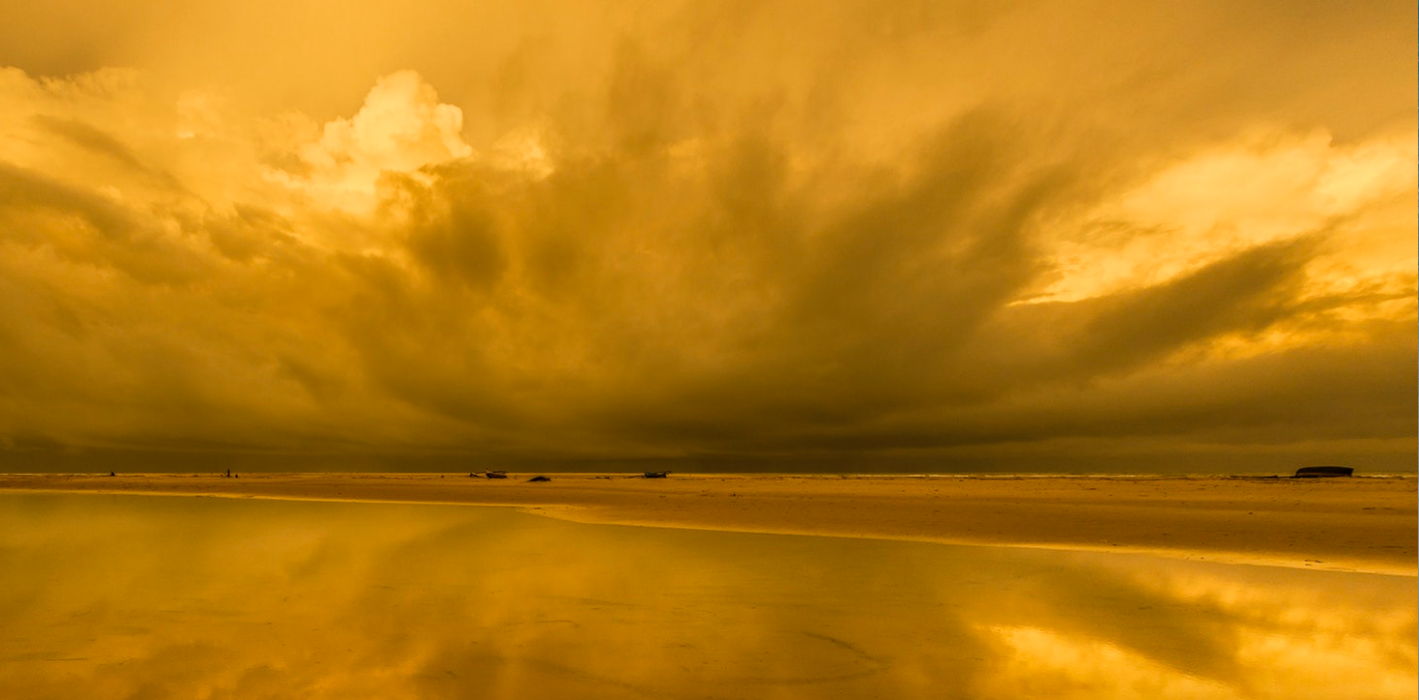
A shimmering sunset is reflected in these shallow waters, as traditional Vezo fishermen draw up their boats for the night.

Madagascar

As a photographer, I feel an urgency to remind my fellow humans that our destiny is inexorably tied to the fate of the sea. As a scientist, I am motivated by the knowledge that continuing to ignore the failing health of our oceans now, while we ponder the consequences later, is an invitation for disaster.

Combining the two, I am a fierce advocate for our planet and strive every day to make a tangible difference. With hope as a beacon, my dream is that together we can turn the tide and achieve healthy, abundant oceans for all.

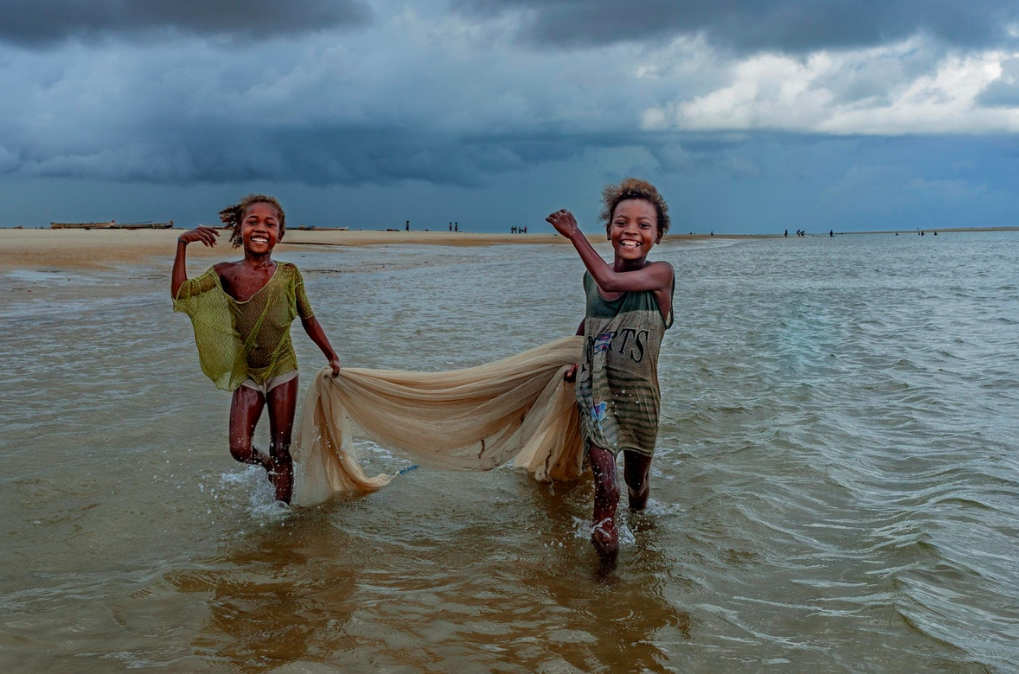
Two young Vezo girls, like water nymphs more at home in the ocean than on land, gather fish for their family’s dinner.

Madagascar

CRISTINA MITTERMEIER is a photographer, writer and conservationist documenting the intersection of wild nature and humans. Co-founder at SeaLegacy.

THIS ARTICLE WAS ORIGINALLY PUBLISHED ON MAPTIA

Abstract Australia from Above

“The real voyage does not consist in seeking new landscapes, but in having new eyes.” — MARCEL PROUST

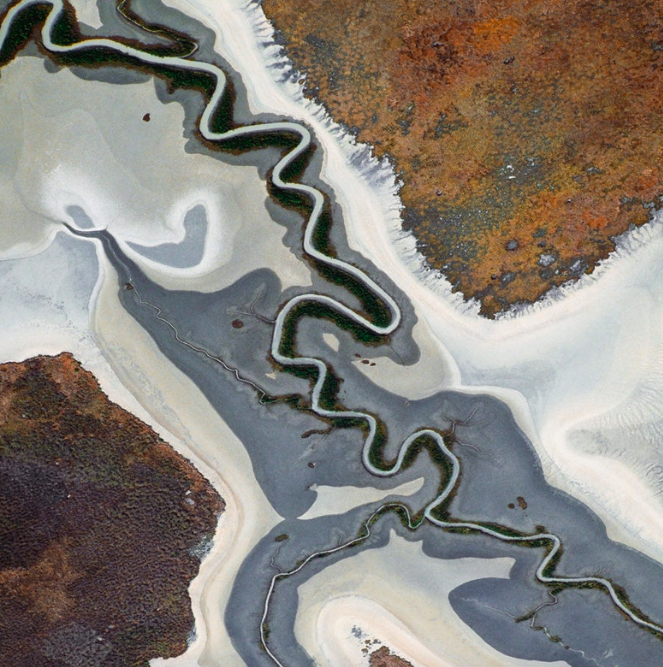
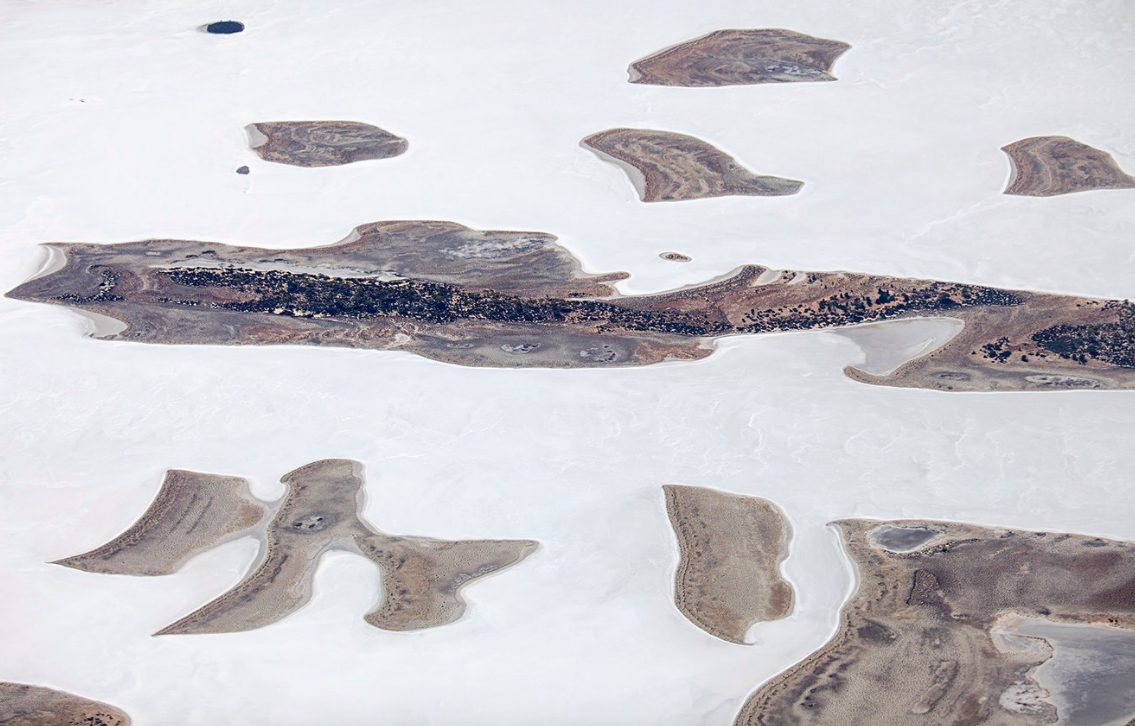
Islands on natural salt lake, Lake Johnston, north of Esperance, in Western Australia. (Taken 2014)

I have been attracted to the Australian landscape because of its size and subtle differences — a sense of wonderment, how it all came about, the evolution of the landscape. Like the rest of the world it has gone through many stages to be what it is today — uniquely Australian. But it also is a very old landscape. It is the flattest and driest continent, which compared with other countries, does not manifest itself in grandeur as we know it; large rivers, large mountains and the dramatic changes of the seasons.

The Pinnacles. Limestone formations, Nambung National Park. (Taken 2009)

However, I found that by looking at the landscape from the air, many natural characteristics revealed themselves much better, showing the evolution and the geographical variations. Nature is a great teacher. Observing and experiencing it can stimulate our creative senses which in turn is beneficial to ourselves and our environment.

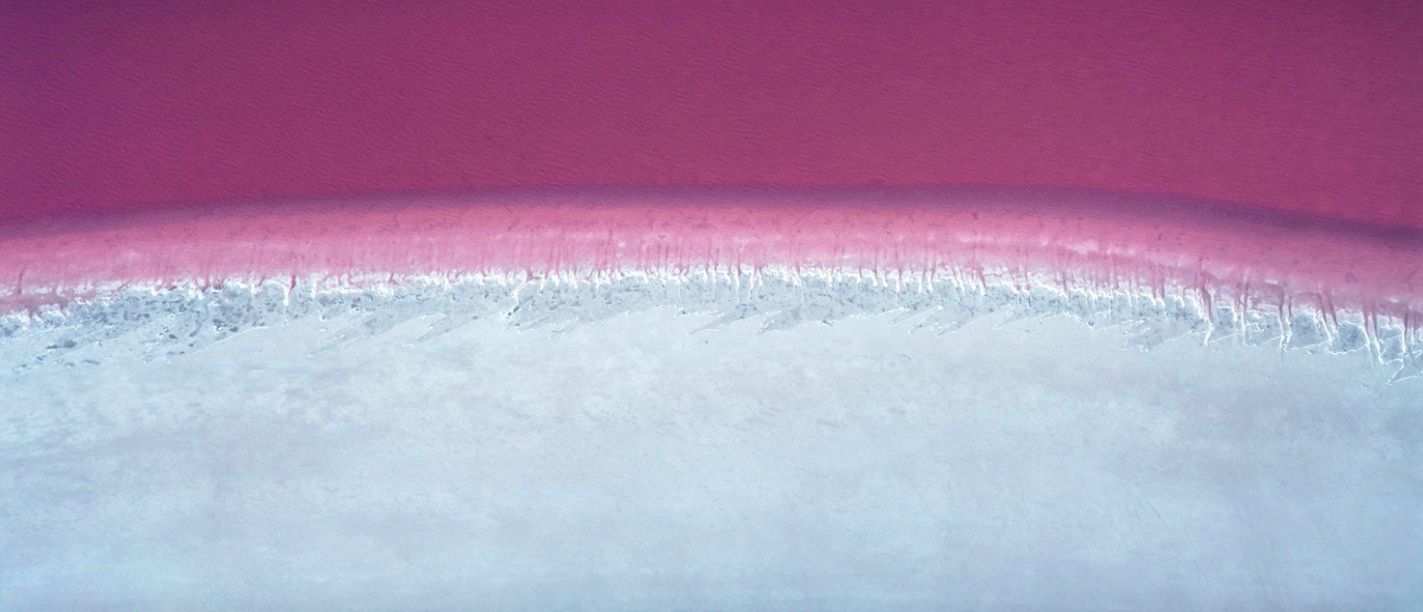
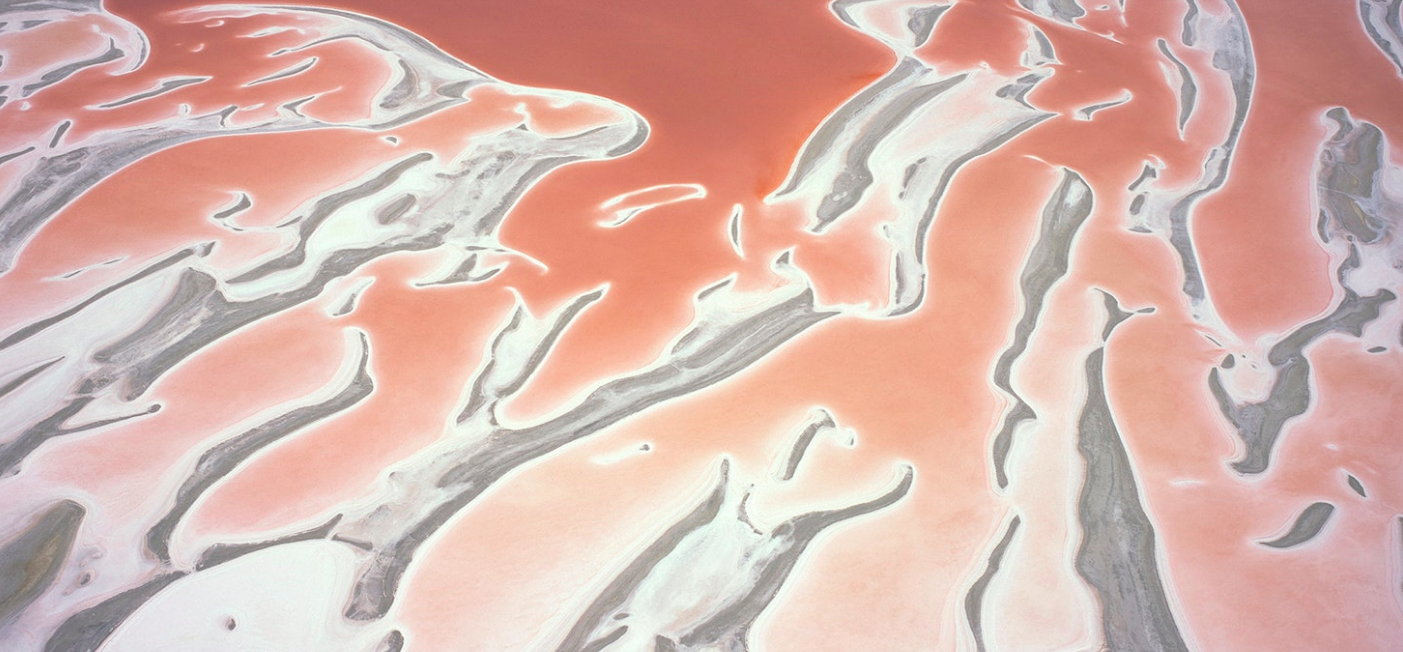
Pink Lake, north-west of Esperance, Western Australia. This is the natural colouration of the salt lake. (Taken 1988)

It was in 1955 that I bought my first camera, and this was the beginning of a long association with photography. Intrigued by the unusualness of the Australian landscape, I became a landscape photographer with a strong bias for aerial photography, which I felt captured the vastness of the outback best — each flight became a flight of discovery.

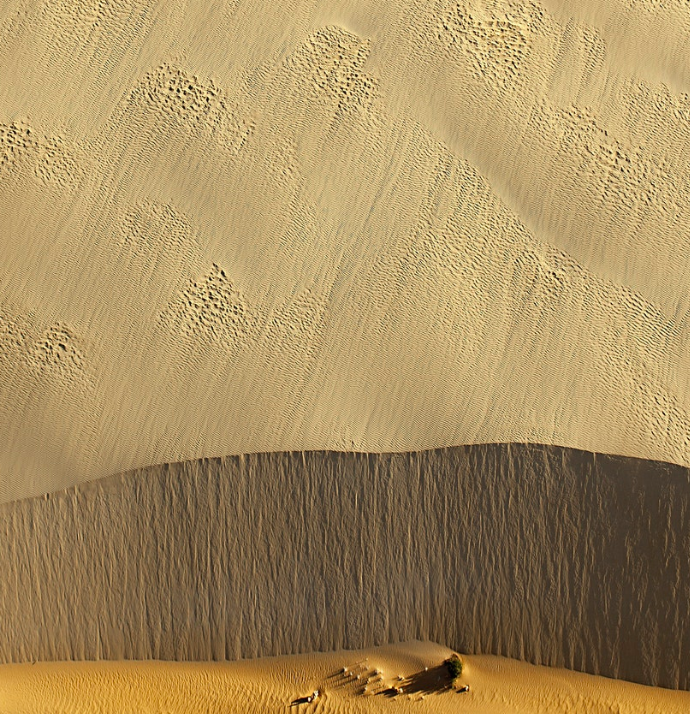
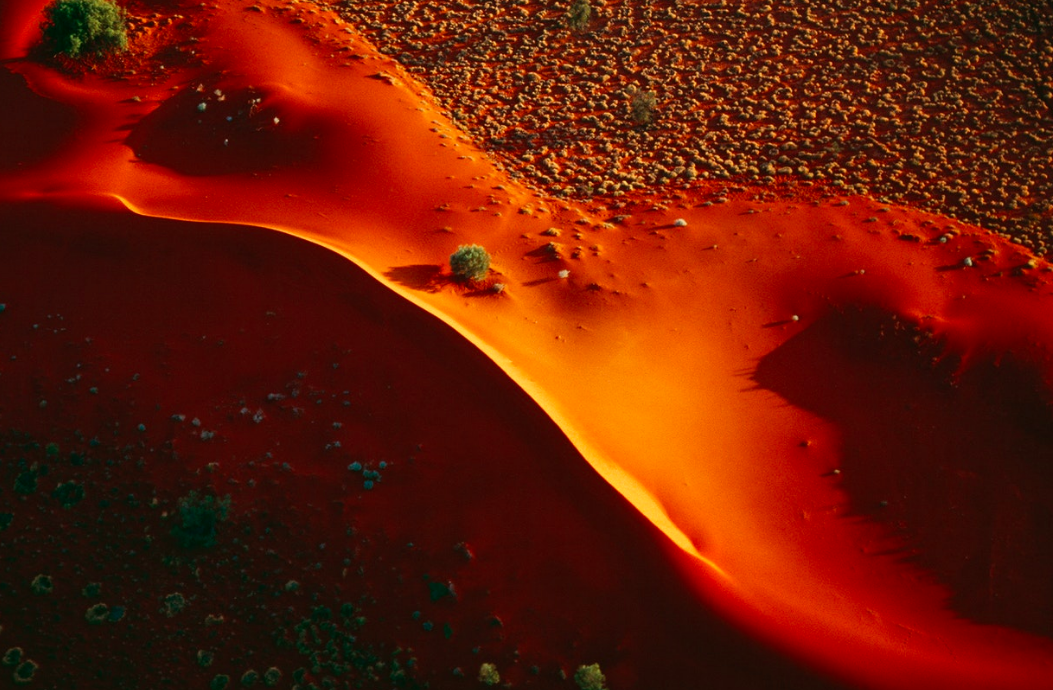
Late light on a drifting sand dune, Windorah, south east Queensland. (Taken 1994)

There are so many Australian landscapes worthy of consideration whether they be rivers, coastal plains or deserts — all of which vary seasonally and at different times of the day. As much as possible I like to be inspired by what I see and this is where I experience a sense of wonderment of a world so complex, varied and beautiful.

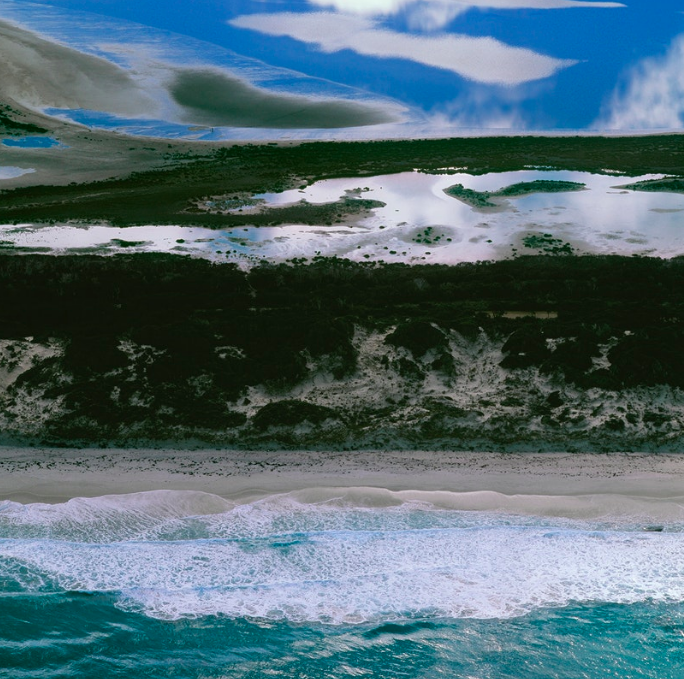
Coastline between Esperance and Cape Arid, in Western Australia. This shows the reflection of the clouds in the lake, with the beach and ocean in the foreground. (Taken 2006)

Of course there are many ways to appreciate the landscape. My own involvement is to photograph the highlights and to interpret them with the camera in a painterly way. I emphasise these highlights by pointing the camera down and focussing on the subject, excluding the horizon so one looses a point of reference and the reality often takes on an abstract view. I hope that the character of the subject is enhanced and that it reveals more through isolation by the camera angle.

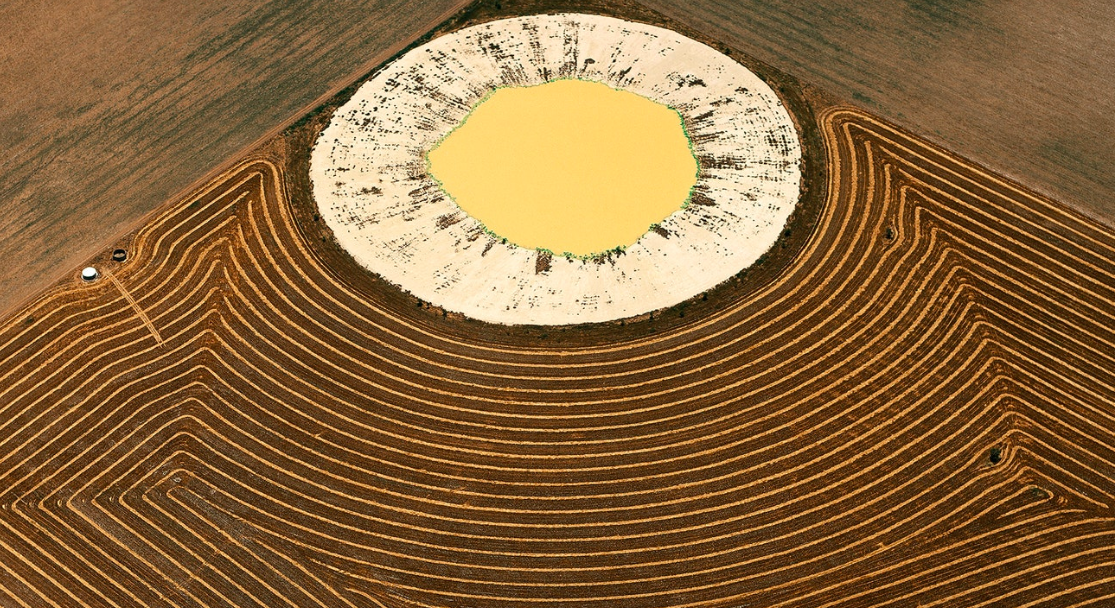
A turkey nest dam near Newdegate, Western Australia, contrasts against the ploughed fields. (Taken 1994)

The aerial point of view also allows us to examine the impact of humanity on Earth. There is a beauty in the man made landscape which takes on a relationship beyond the form as we know it. Certain subjects such as mining dumps, industry and farming look mundane at ground level, but from above my eye begins to recognise a gratifying order in the chaos — crops, paddocks and ploughed fields become masterpieces in abstraction often unknown to their creators. Simultaneously, the aerial perspective can also indicate the abuse and destruction that has taken place.

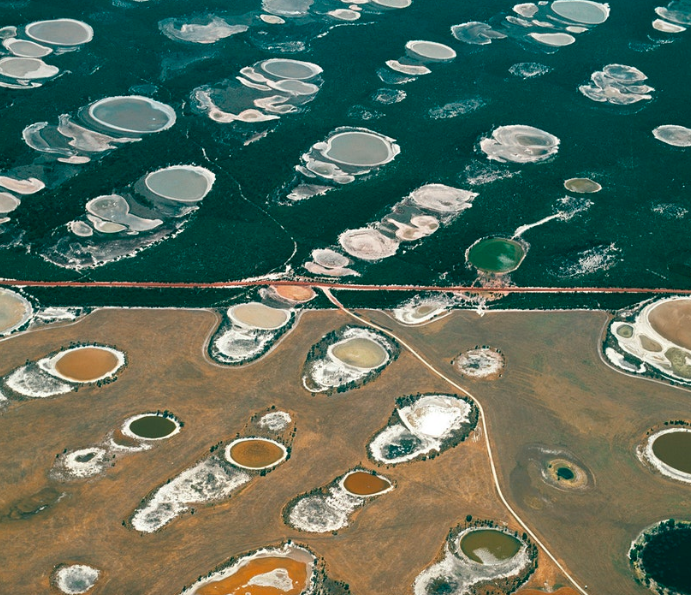
Salt lakes surrounded by wheat fields, 50 kilometers north east of Esperance, Western Australia. (Taken 1994)

At all times, I take a very personal approach to my work, but I also take great care to retain the optical reality. There are a million pictures out there. I am the only limitation. I can tune in and absorb the reality of the variations, combined with my way of seeing and my attitude. The older I get the harder it becomes, and the more I am drawn to nature. It is the creation of all life and matter that appeals to me now. Maybe I can make a small contribution to its well being which is in jeopardy. If beliefs in eternity are formed, nature is a great catalyst. I often feel intimidated by a great outback landscape, but also inspired by it.

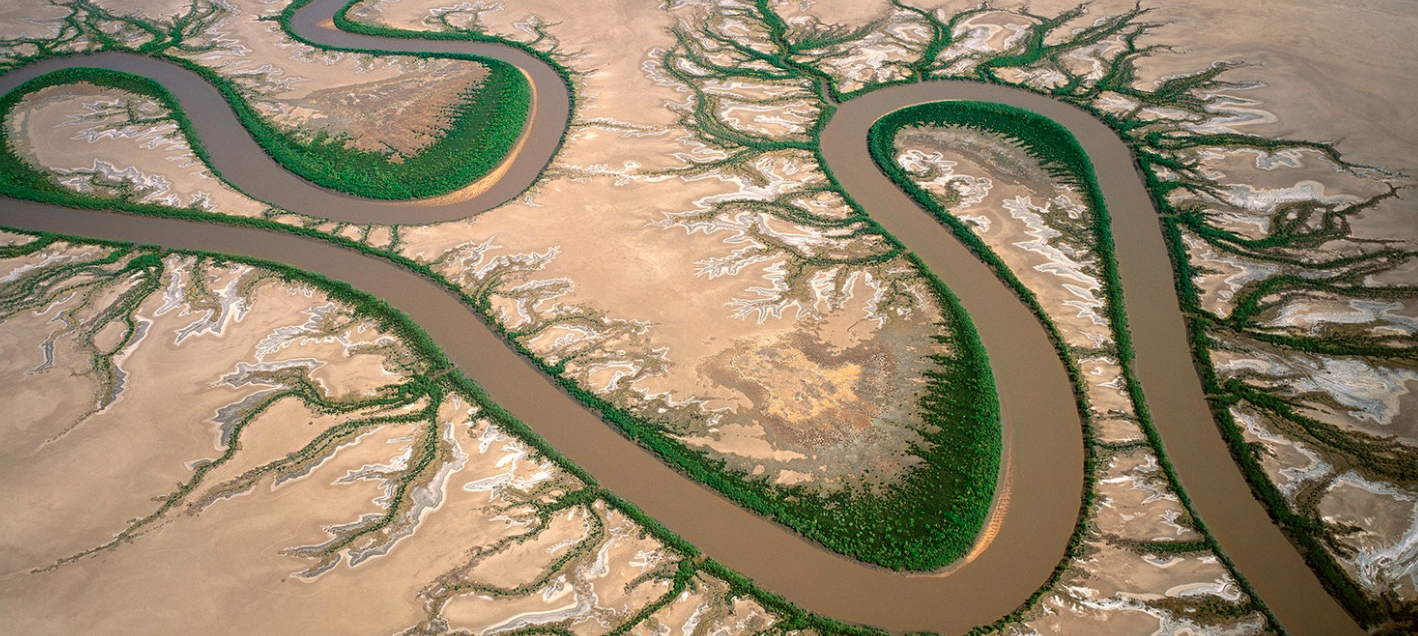
Forrest River, Kimberley, Western Australia. A tidal river system, north-west of Wyndham. (Taken 2003)

We now have more technical gadgetry at our disposal and there is no doubt it can help us to get a better photograph. But that in itself means little unless it enhances our understanding of the world around us. It is more important to use our creative spirit and gain wisdom than purely use it as a tool. Today in our digital age we have Photoshop with its possibility to enhance or to completely distort or create our own image using photographic components. We have become so image conscious that we often forget the beauty of reality.

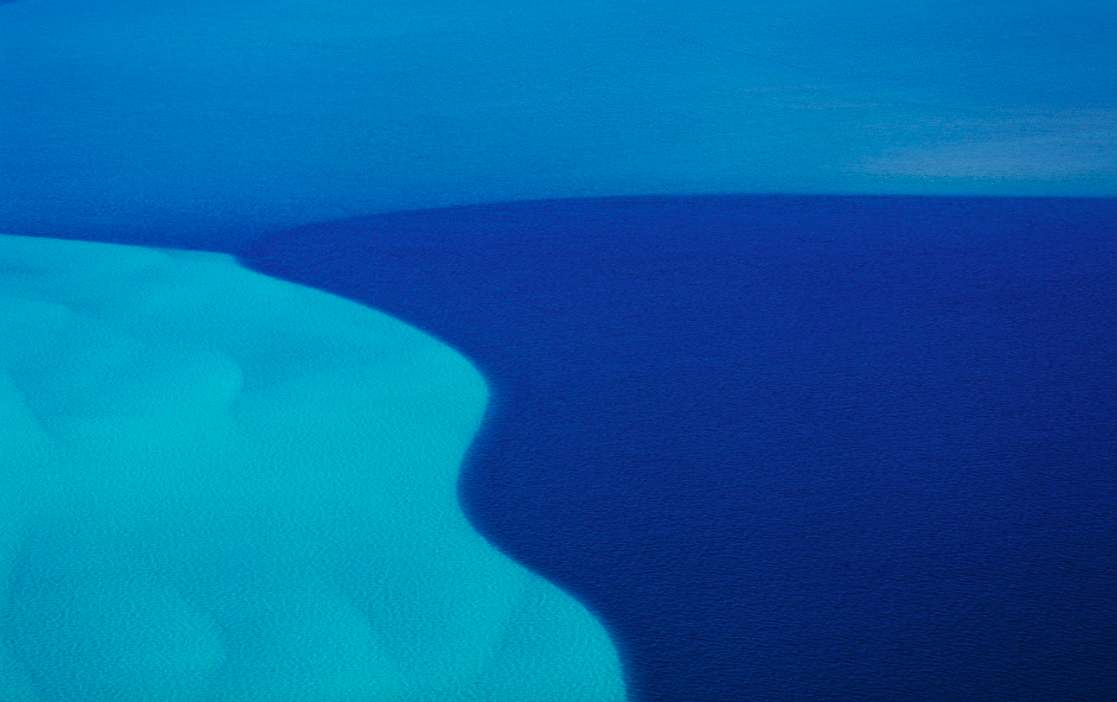
Ocean between Ningaloo Reef and Coral Bay, Western Australia. The blue variation is due to the ocean’s floor level. (Taken 2006)

The subject of photography can either be concrete or intangible. In the first case the picture is basically realistic, where as in the latter case it is essentially abstract. But what makes photography so interesting is that by combining both we can introduce creativity in the subject and have the best of both worlds.

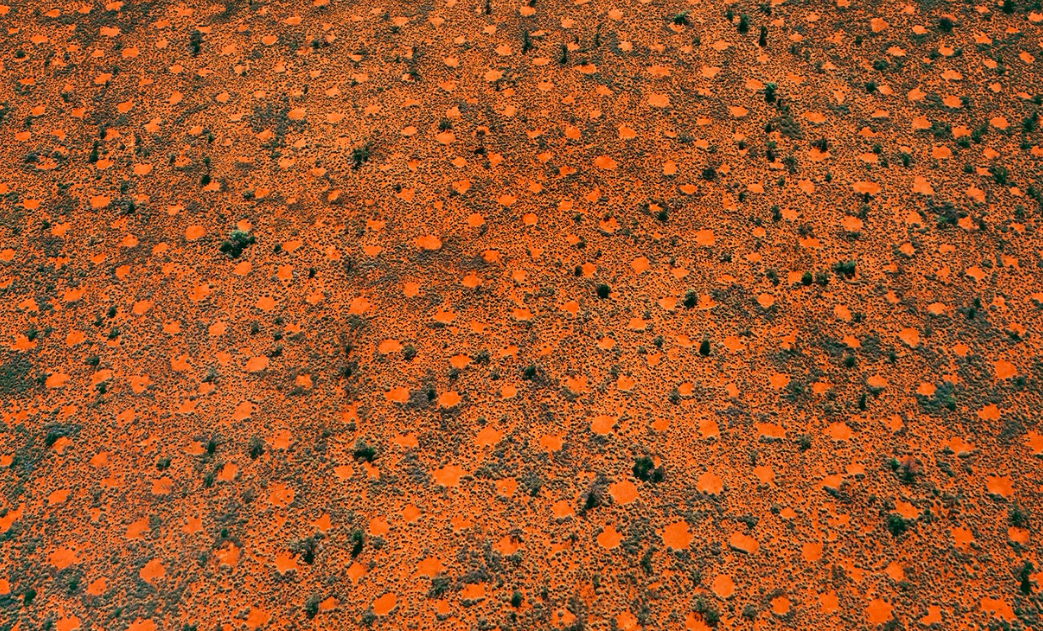
Ant clearings approx. 4–5 metres across, Great Sandy Desert, Pilbara, Western Australia. (Taken 2003)

Although many photographers can take photographs and do it well, it is work done in the full utilization of that creative spirit that stands out. It should be influenced by the subject itself and come from within oneself.

Tidal variations result in a coastal river pattern, Northern Territory. (Taken 2004)

“I still can’t find any better definition for the word Art, than this. Nature, Reality, Truth, but with a significance, a conception, and a character which the artist brings out in it and to which he gives expression, which he disentangles and makes free.” — VINCENT VAN GOUGH

Lake Dumbleyung, Wagin, Western Australia. Affected by farming this natural lake has become saline. After the first rains, it turns pink. (Taken 2005)

We do not always appreciate the aerial point of view. People regard the landscape as something you fly over. But in reality it is an opportunity to see the landscape from a different perspective. I never cease to marvel at the natural variations in the Australian landscape and although I value what is there photographically, in the end it is the observation and appreciation of the diversity that is the reward.

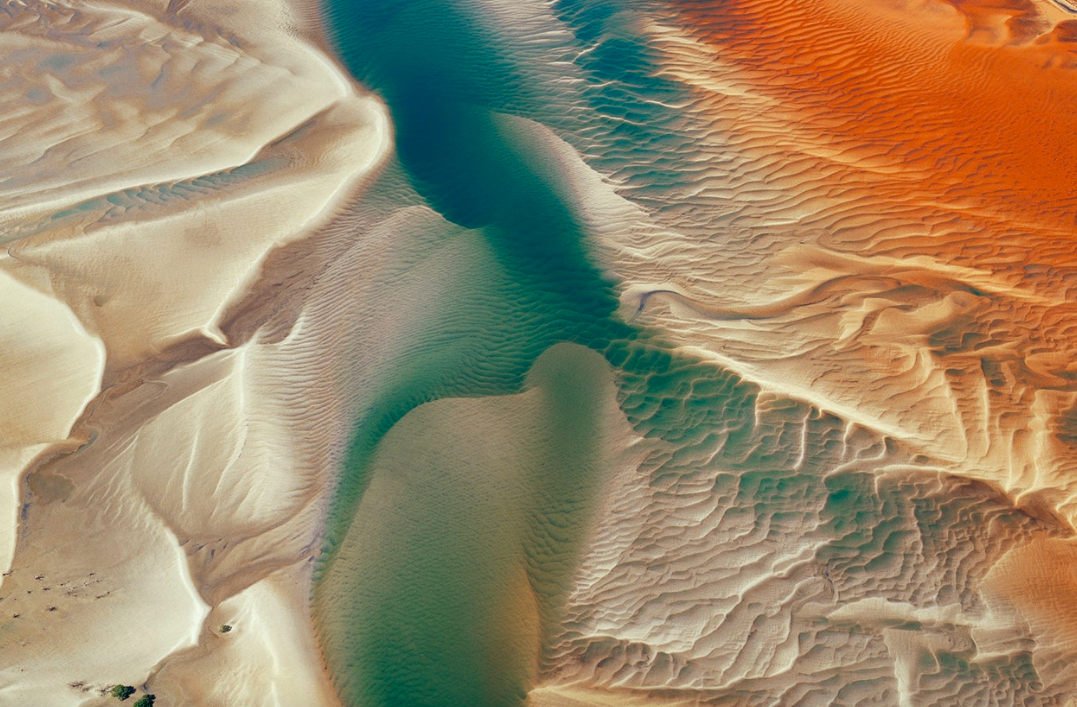
Top of Curtis Island, Cape Capricorn, north-east of Gladstone, Queensland. An estuary with sand banks. (Taken 1997)

Postscript — All of my photographs are as seen from the air and are not manipulated. I feel that the beauty, colours, and uniqueness of the Australian landscape is complete and needs no enhancing.

RICHARD WOLDENDORP is a Dutch-born Australian landscape photographer, with a focus on the aerial perspective. Appointed the Order of Australia in June 2012, “For service to the arts as an Australian landscape photographer.”

THIS ARTICLE WAS ORIGINALLY PUBLISHED ON MAPTIA