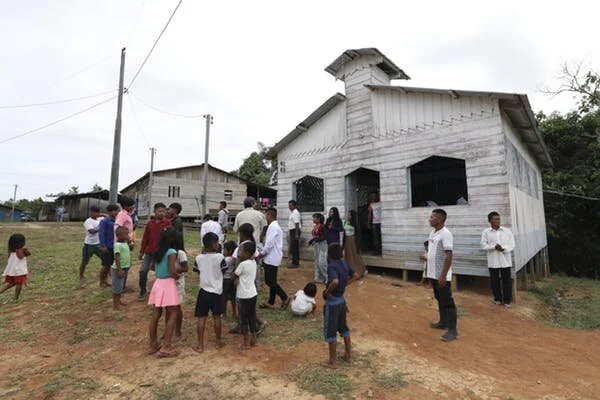
Bringing Humanity to Asylum Seekers' Journey

Sra. Sánchez’s Albergue del Jesus el Buen Pastor has offered medical care and support to asylum seekers who have fallen ill or become injured during the dangerous trek to the U.S. Sánchez aids hundreds of individuals each month, and for her service has been recognized by a number of human rights organizations. 

Read More

World’s Youngest Prime Minister Will Head Women-Led Government in Finland

FINLAND IS GETTING a new prime minister, and she’s about to become the world’s youngest leader. Not only that, but she will also head a coalition government of five parties, all of them led by women. Sanna Marin, 34, was nominated by her party on Sunday and will be sworn as prime minister later this week.

Finland’s previous government resigned last week after the Centre Party lost confidence in then-Prime Minister Antti Rinne’s handling of a postal strike.“I myself have never thought about my age or gender,” said Marin, “but rather about the issues for which I took on politics and about the reasons for which we were trusted in the elections.”

For many countries, like the US, electing its first female leader would be a historic occasion. For Finland, however, this isn’t exactly news — the first Finnish female prime minister was elected in 2003 and after elections this year, women make up 47 percent of its parliament. 

Eben Diskin is a staff writer for Matador Network

THIS ARTICLE WAS ORIGINALLY PUBLISHED ON MATADOR NETWORK

Pope Affirms Catholic Church’s Duty to Indigenous Amazonians Hurt by Climate Change

The Catholic Church “hears the cry” of the Amazon and its peoples. That’s the message Pope Francis hopes to send at the Synod of the Amazon, a three-week meeting at the Vatican that ends Oct. 27.

Images from Rome show tribal leaders in traditional feather headdresses alongside Vatican officials in their regalia. They are gathered with hundreds of bishops, priests, religious sisters and missionaries to discuss the pastoral, cultural and ecological struggles of the Amazon.

The densely forested region spans nine South American countries, including Brazil, Colombia and Peru. Its more than 23 million inhabitants include 3 million indigenous people.

The Amazon meeting is part of Pope Francis’s efforts to build a “Church which listens.” Since taking office in 2013, Francis has revitalized the Catholic Church’s practice of “synods” – a Greek word meaning “council” – expanding decision-making in the church beyond the Vatican bureaucracy to gather input from the entire church, including from laypeople.

Voting on synod decisions, however, remains restricted to bishops and some male clergy.

The Amazon synod is the first such meeting to be organized for a specific ecological region. Media coverage of this event has emphasized its more controversial debates – such as the possibility of easing celibacy requirements in the rural Amazon, where priests are in extremely short supply.

But its focus is much broader: listening to the suffering of the Amazon – particularly the environmental challenges facing the region – and discerning how to respond as a global church.

Amazon in crisis

After more than a decade of environmental policies that successfully slowed deforestation in the Amazon, logging and agricultural clearing have begun to increase rapidly again. The fires in the Brazilian rainforest that captured headlines in early September are symptoms of much broader destruction.

Up to 17% of the Amazon rainforest has already been eliminated – dangerously close to the 20% to 40% tipping point that experts say would lead the entire ecosystem to collapse.

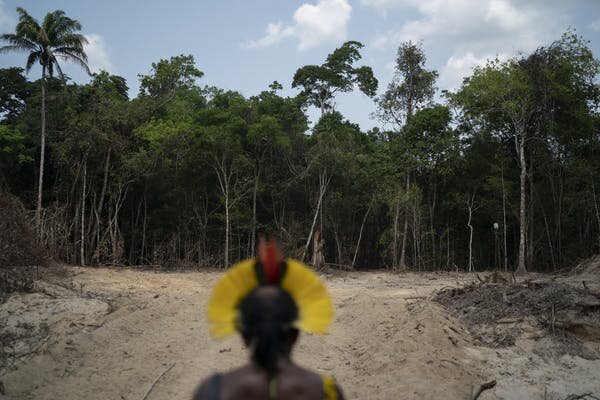
Deforestation of the Amazon is rapidly approaching the tipping point that, experts say, could lead to total collapse of the rainforest ecosystem. AP Photo/Leo Correa

Stories of deforestation can seem insignificant against the vastness of the Amazon, a region two-thirds the size of the lower 48 United States.

But for the 390 indigenous ethnic groups who inhabit the region, each burned forest grove, polluted stream or flooded dam site may mark the end of a way of life that’s survived for thousands of years.

Deprived of their land, many indigenous Amazonians are forced into an exposed life on the edge of frontier towns, where they are prey to sex trafficking, slave labor and violence. In Brazil alone, at least 1,119 indigenous people have been killed defending their land since 2003.

The Catholic Church recognizes that it still has to address the “open wound” of its own role in the colonial-era violence that first terrorized the indigenous peoples of the Americas, according to the synod’s working document. The church legitimated the colonial confiscation of lands occupied by indigenous peoples and its missionaries often suppressed indigenous cultures and religions.

For this reason, according to the Vatican, organizers of the synod have sought input through 260 listening events held in the region that reached nearly 87,000 people over the past two years. Indigenous leaders have been invited as observer participants in the meeting itself.

Learning from indigenous peoples

As a theologian who studies religious responses to the environmental crisis, I find the pope’s effort to learn from the indigenous people of the Amazon noteworthy.

The Vatican sees that the Amazon’s traditional residents know something much of humanity has long forgotten: how to live in ecological harmony with the environment.

“To the aboriginal communities we owe their thousands of years of care and cultivation of the Amazon,” the 58-page synod working document reads. “In their ancestral wisdom they have nurtured the conviction that all of creation is connected, and this deserves our respect and responsibility.”

Pope Francis has expressed his respect for indigenous peoples before.

At a meeting of indigenous leaders in Peru in January 2018 he said, “Your lives cry out against a style of life that is oblivious to its own real cost. You are a living memory of the mission that God has entrusted to us all: the protection of our common home.”

Global problems, local solutions

Environmental destruction isn’t the synod’s only concern.

Catholicism – long the dominant religion in Latin America – is rapidly losing members to evangelical Protestantism. Evangelicals are projected to eclipse Catholics in Brazil by 2032.

One advantage evangelical churches have in Amazonian countries is that they can appoint local indigenous pastors to minister to their communities. Meanwhile, with less than one priest per 8,000 Catholics in the Amazon, some isolated communities might see a priest only once a year.

Catholic churches are in short supply in rural Brazil, where many people will go a year without seeing a priest. AP Photo/Fernando Vergara

The scarcity of priests in rural Latin America is behind a proposal to the synod to ordain older married men as priests in isolated Amazonian communities.

In the the U.S., the celibacy question is easily mapped onto a familiar divide. Progressive Catholics argue that clerical celibacy should be optional, while conservative Catholics insist this discipline is fundamental to the faith.

The issue is far less politicized in the Amazon, where, in the words of one bishop, the Catholic Church remains a “visiting church” with limited day-to-day presence in indigenous communities.

Some might dismiss this synod as just a meeting. But, in my judgment, it is an attempt to apply Francis’ vision of a “listening Church” to the environmental crisis. The Synod of the Amazon marks a significant shift from high-minded papal exhortations about taking climate action to a global religious community that gives voice to those living on the front lines of ecological destruction.


Vincent J. Miller is a Professor of Religious Studies, University of Dayton

THIS ARTICLE WAS ORIGINALLY PUBLISHED ON THE CONVERSATION
The Dangers of Depicting Greta Thunberg as a Prophet

She came from obscurity and ignited a global movement. Beginning with a small but persistent act of protest outside the Swedish parliament, she inspired millions to join her. Her fiery speech to the United Nations in September 2019 warned of the end of the world. Her unfailing determination and passion makes her appear otherworldly, even uncanny, an affect largely attributed to her diagnosis of Asperger’s syndrome.

So it’s no surprise that many people – along with media outlets like The Irish TimesThe Telegraph and The Washington Times – have cast Greta Thunberg as a prophet.

When Time announced her as “Person of the Year,” it continued the trope, using an evocative photograph of Thunberg standing on a rocky shoreline, staring at the heavens, for the cover.

As a researcher on the history of childhood, I’ve been disturbed to see Thunberg described and depicted as a prophet. To me, it risks distorting her message. And it can easily be exploited by climate deniers seeking to counter the appeal of her activism.

Is a climate messiah even necessary?

To some, Thunberg resembles Joan of Arc, the teenage visionary who led the French army into battle in the 15th century and was later canonized as a saint.

To others, Thunberg exemplifies the Judeo-Christian tradition of prophets who speak truth to power; according to one Christian blogger, she offers “a prophetic voice to shake us out of our complacency.”

Yet presenting Thunberg as a prophet is deeply misleading. Classically, prophets are messengers who communicate the voice of God. They convey divine revelation that was previously unknown or misunderstood. Ezekiel predicted the destruction and restoration of Jerusalem. Moses received the Ten Commandments. Muhammad revealed the Quran. Prophets, in other words, see truths that others cannot. They bring us messages that often defy human comprehension.

Thunberg, on the other hand, is simply telling us what we already know. Within the scientific community, there is an overwhelming consensus – going back decades – that humans are causing global warming.

Framing her as a prophet has opened the floodgates to all sorts of messianic theories. This recently took a bizarre turn when a 120-year-old photo with a girl resembling Thunberg surfaced. Now conspiracy theorists are calling Thunberg “a time traveler sent to save us.”

Depictions like this are fodder for her opponents who dismiss what they call her “doomsday activism.” To them, she is a false prophet, and they can portray the people inspired by her as brainwashed cult followersDavid Koresh, the leader of the Branch Davidians who died alongside his followers in Waco, Texas in 1993, after all, called himself a prophet. So did Jim Jones, the founder of the Peoples Temple and orchestrator of the 1978 Jonestown Massacre.

To Thurnberg’s credit, even she recoils at the idea that she should be viewed as some sort of savior.

“I don’t want you to listen to me,” she told Congress in September. “I want you to listen to the scientists.”

Being a kid carries enough weight

I would argue that the best way to think of Thunberg is to simply think of her as a child.

This is not demeaning. Far from it. In recent years, young people have offered numerous examples of their ability to exercise independent thought, visionary thinking and leadership. Melati and Isabel Wijsen were 10 and 12 when they began a successful campaign to ban single-use plastics in their native Bali. Malala Yousafzai was 11 when she began to advocate against the Taliban for girls’ right to education. The list goes on: Jazz JenningsXiuhtezcatl Martinezthe Parkland activists. Like Thunberg, they challenge our culture’s view of children as powerless and dependent.

Thunberg memorably began her September 2019 UN speech with the words, “This is all wrong. I shouldn’t be up here. I should be back in school on the other side of the ocean.” As Thunberg well knows, the fact that a child needs to scold grown-ups to act on an issue that threatens all of humanity is a powerful example of a political system gone horribly wrong.

Even more critically, focusing on Thunberg’s youth highlights a central tenet of her message: fairness. As any parent can tell you, children tend to view the world in terms of moral absolutes – good and bad, right and wrong, fair and unfair. Indeed, researchers have recently shown that expectations of fairness are deeply ingrained in children, appearing in infants as young as 12 months old.

Ideas of fairness underlie many aspects of Thunberg’s message, from her emphasis on how climate change will affect the poor and marginalized, to her comments about how unjust it is to expect young people to fix a catastrophe caused by generations of political inertia. Her forceful call – “How dare you!” – is not the enraged cry of a petulant child. It is the determined statement of a girl who has not yet developed the moral flexibility that is so often the refuge of adult inaction.

Thunberg is not unraveling the mysteries of our era, or a time traveler sent to stop climate change. Rather, she is a child admonishing selfishness and pleading for fairness.

That’s not prophetic. It’s common sense.

Ellen Boucher is an Associate Professor of History, Amherst College

THIS ARTICLE WAS ORIGINALLY PUBLISHED ON THE CONVERSATION

The Environmental Cost of Entertainment

We often look forward to when we can slip from reality into the atmosphere provided by a movie, concert, or football game. But what is the real cost behind the $60 ticket?

As the COP25 summit comes to an inconclusive close and the number of scientific reports being released on the urgency behind climate change continue to increase, action is necessary or disaster is imminent. Some activities are more glaringly environmentally unfriendly. You know driving your car releases pollutants, you can even see it leaving your vehicle. But there is a whole industry built around letting us all escape, being entertained through sports, or movies and music, so we don’t have to think about our problems for a moment. Only these activities have a huge environmental cost.

 Hollywood is an obvious place to start. Movies not only cost millions of dollars to make but are extremely resource dependent. A study found that a single hour of television produced in the UK emits 13 metric tons of carbon dioxide. That is just carbon emissions, separate from food waste from catering, large energy uses on generators, resources used in building sets, and environmental degradation from filming in remote locations. For example, sets are often made out of lauan, a lightweight plywood that is harvested from rainforests. A UCLA study in 2006 found that a single sound stage results in the destruction of 4000 hectares of rainforest. In the US, over 1200 films and television series are produced in a single year. Solutions exist. Non-resources intensive options could be redistributing waste though donations, recycling, and composting. Reducing energy use or finding alternatives, minimizing transportation, and reusing wastewater. Even getting rid of plastic water bottles on film sets would decrease the environmental footprint.

 The music and sport industries do little better. Events that revolve around stadiums, world-class concerts, super bowls, even your average Saturday afternoon college football game, leave wakes of endless energy use, transportation fumes, and trash cans full of uneaten hotdogs and coke cans. A study done by Julie’s Bicycle found that 43% of the music industry’s environmental impact is from audience transportation to the venue. This is even more true at music festivals or sporting events that span multiple days or even weeks. Estimations say that average numbers for a well-attended music festival produce 212,000 pounds of waste per day, use upwards of 16,000 gallons of fuel just to power generators, and over 78,000 metric tons of CO2 emissions just in attendee travel (could be doubled if included staff, artist, vendors, engineering etc.).  For sports, the Olympics are a major environmental question. Not only do more than a half million people travel to one location from every corner over the world, cities take on major reconstruction projects for one event. In Rio, the 2016 Olympics emitted over 3.5 million tons of C02, not including the 7 years of construction, and had major issues with water pollution.

 Even entertainment in our own homes can have a negative environmental effect. Studies show that watching 30 minutes of Netflix is equivalent to driving almost 4 miles. That might not seem like a lot, but if you binge watch all of Harry Potter, that is almost 20 hours of screen time or 160 miles. Maybe on average you stream an hour of television every day that is almost 3000 miles in one year or the equivalent of driving all the way across the US. Spotify is not much better. Transmitting music to streaming sites is thought to generate between 200 to 350 million kilograms of greenhouse gases.  A large portion of Spotify’s carbon footprint comes from data centers, basically the energy that powers the internet. They have recently reduced their emissions by relocating servers to the Google Cloud which uses more renewable energy and buys carbon offsets. Even so, data centers as a whole account for 2 percent of the world’s greenhouse gas emissions.

 The entertainment industry is only growing. The increase in access to movies and music through streaming services has dramatically changed the culture surrounding live events. Let’s be conscious about how we choose to consume entertainment. 

DEVIN O’DONNELL’s interest in travel was cemented by a multi-month trip to East Africa when she was 19. Since then, she has continued to have immersive experiences on multiple continents. Devin has written for a start-up news site and graduated from the University of Michigan with a degree in Neuroscience.

Why Food Waste is a Major Issue

And what you can do about it.

Produce is commonly wasted as there is a high preference to purchase based on aesthetics. David Schofield. CC BY-NC-SA 2.0.

Globally, one-third of all food that is produced goes to waste. That is equivalent to 1.3 billion tons of food a year. This is food that is still edible yet is disposed at many points in the supply chain. Food can be commonly lost during harvesting due to lack of infrastructure, poor storage, or unfavorable weather. This is more common in developing countries. In most Western countries the opposite is true, with a higher percentage of losses at the consumer and retail level.

 Consumer losses in the US are often due to inconsistencies in food labeling, improper storage or over-purchasing. The dates placed on food products, often accompanied by a “best by” or a “use by” label, are not regulated by the FDA and vary greatly between states. Often these dates are promoting a level of food quality not food safety, meaning that the food is still safe to eat after the date; it just won’t be at its peak quality. A study done by the Harvard Food Law and Policy Clinic found that more than a third of people always dispose of food by the date and up to 84% occasionally do. A different study estimates that having a standardized food labeling system could reduce food waste in the US by 400,000 tons a year. Additionally, about half of states have restrictions or completely prevent food donations after the “best by” date leading to even more waste from grocery stores with no choice but to discard food. A federal bill first introduced in 2016 would change both of these, if it could get passed into law.

 Another major area of waste in the US is the prepared food industry. This spans past restaurants to include other institutions such as hotels, college cafeterias, and hospitals. A single restaurant makes between 25,000 to 75,000 pounds of waste in a year. 84% of this waste ends up in landfills instead of composting or food donations. In addition, $57 billion is lost by consumer-facing businesses due to food waste.  

 A goal introduced by the UN to cut food waste in half by 2030 would help carbon emissions considerably. Food waste globally contributes to 8% of GHG emissions, putting it on par with road transportation. Cereals, vegetables, and meat have the highest potential for change on a consumer level based on the combined value of carbon footprint and waste percentage. This is especially true in high-income countries. The US has the second highest GHG emissions in the world. Putting in an effort to buy less food, cook less food, and compost waste is an easy way to make a difference on an individual level. As well as supporting organizations that work to redistribute food and restaurants that follow more sustainable practices.

 Food waste is a problem on many levels. It is not just left-over food, but also the accumulation of all the energy, labor, and emissions that went into the product. It is wasted money and lack-of-profit for businesses and the economy. It is food that is not reaching those that need it and it is a major contributor to climate change, but it doesn’t have to be. 

DEVIN O’DONNELL’s interest in travel was cemented by a multi-month trip to East Africa when she was 19. Since then, she has continued to have immersive experiences on multiple continents. Devin has written for a start-up news site and graduated from the University of Michigan with a degree in Neuroscience.