The Cape Town Water Crisis: Delaying Day Zero

In the Broadway musical Urinetown, people line up to use the toilet because a 20 year old drought has made private toilets a thing of the past. And when the protagonist rises up finally and allows unrestricted toilet use, the water supply completely evaporates. The final scenes ominously hint at more worrisome issues for the citizens, who, once concerned only with toilet use, most grapple with dying of thirst among other problems.

Although Urinetown is a satire, residents of Cape Town might see it as a scary prediction of their future if Day Zero arrives. As apocalyptical as it sounds, it does accurately embody the looming doomsday scenario: Day Zero is when the taps run dry. How? An unexpected three year drought, starting in 2014, drastically depleted the six dams that serve Cape Town. Whereas 20 years ago water management in Cape Town could rely on seasonal rainfall patterns and small conservation measures, it is now relying on unreliable rain and big changes.

Since Day Zero has been first predicted in early 2018, it has been continuously delayed. Projections now suggest Day Zero will occur in 2019. And in recent weeks, many are rejoicing in water returning to the dry dams. In the words of Anton Bedell, minister of Local Government, Environmental Affairs, and Development Planning:  “It’s…good to see Clanwilliam dam at 20.4%. A few weeks ago the dam was below 6%.” The other dams have reflected similar increases, but the relief is only temporary as the dams await more rain—if it will come.
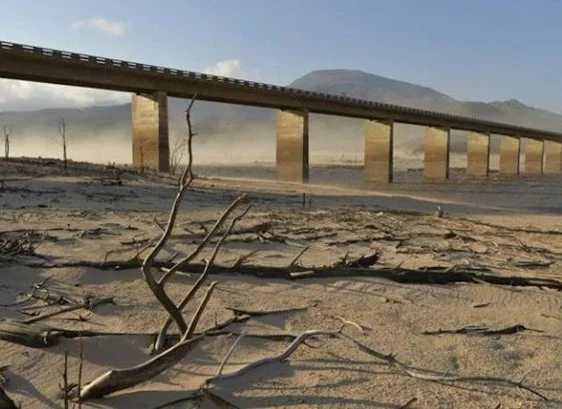
Theewaterskloof dam in February 2018 (source: 2oceanvibes)
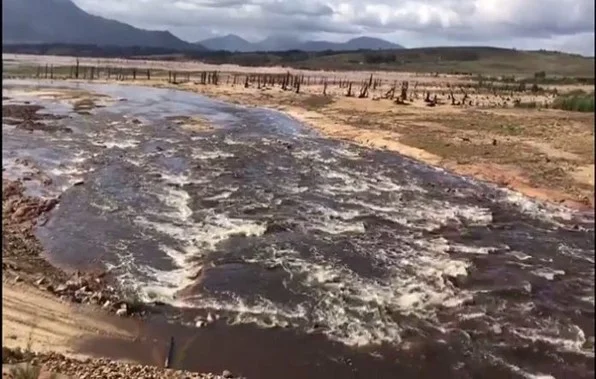
Waters return in early June (source: Storm Report)

The biggest assistance in delaying Day Zero is restrictions implemented on February 1st. The main restriction was the allowance of 50 liters, a little more than 13 gallons, of water per person. Comparatively, the average individual in the United States uses 80-100 gallons of water a day and the average family over 300 gallons a day.  The question of how Americans end up using so much illustrates just how little 13 gallons is for a Capetonian. For example, imagine the average bathroom break. A toilet flush requires at least 1.6 gallons with water efficient models, but if it is an older model it will need up to 4 gallons. Then you will wash your hands with about 3 gallons of water. Considering most people take at least four bathrooms breaks a day, that’s already 18.4 gallons used in one day (on a water efficient toilet): more than what one Capetonian is allowed in a single day.

So it is no wonder people are following the “if it’s yellow, let it mellow” rule and putting reminders in bathroom stalls around Cape Town. Even restaurant and bar washroom taps are shut off. But it is not just in the bathroom that changes are being made. Any use of municipal drinking water for irrigation, watering, hosing down paved surfaces, washing vehicles, or filling a private pool is not allowed. Agricultural users have to decrease water usage by 60% and commercial places by 45% compared to their pre-drought usage in 2015. And for residential units that use too much, you’ll face a fine or have to install water management devices.

And globally, Cape Town is a sign of the future. As population increases, especially in urban centers, water resources are straining to accommodate.  This is against a backdrop of climate changes that favor extreme weather events like frequent droughts. What might have worked in the past, is not necessarily the solution for the future.  California, Beijing, Sao Paulo, Jakarta, Mexico City are just some cities that may be the next unwilling host of Day Zero. And water shortages lead to other problems such as famine and violence. The International Panel on Climate Change predicts the Middle East and North Africa will face the most severe water shortage problems. And already, many Somalis have become climate change refugees—leaving their rural farms for the capital, Mogadishu, in hope of different sources of income with farming no longer possible. Millions more are projected in the years to come as climate change makes itself even more apparent.

It is a bleak picture, but subtle changes are happening as global leaders are becoming more aware of the looming water crisis. But we can also start at home with our own water usage. Maybe you don’t need to take a long bath after a hard day and use 36 gallons of water simply to unwind. Instead, take a quick shower and find something else to help you relax. The small changes might sound silly but it is the little things that matter as Capetonians will tell you.


TERESA NOWALK is a student at the University of Virginia studying anthropology and history. In her free time she loves traveling, volunteering in the Charlottesville community, and listening to other people’s stories. She does not know where her studies will take her, but is certain writing will be a part of whatever the future has in store.

A World Cup for the Overlooked

CONIFA Offers a Humanitarian Alternative to FIFA.

Conifa World Cup, Group C, Padania v Székely Land, Bedfont Sports Centre, London/England. By Ungry Young Man from Vienna, Austria. 3 June 2018. Photo Credit: Confifa

Soon, the eyes of the world will be on the FIFA World Cup. There will be all the usual pomp and spectacle, feats of athleticism, and celebration of unity. And yet, FIFA’s large-scale corruption is no secret to fans and players alike. Recurring scandals have tainted the name of soccer’s governing international organization, culminating in the arrest of seven top officials for claims of corruption in 2015. But FIFA also has a somewhat less known history of excluding the many teams that do not meet its participation requirements. To play in FIFA, the team’s nation must be recognized by the international community, and only one football team from each country is allowed to participate.

In 2013, the Confederation of Independent Football Associations, otherwise known as CONIFA, was formed with the intention of providing a world stage for these unrecognized teams to compete on. In a poetic opposition to FIFA, CONIFA was founded as a non-profit and represents teams comprised of people without a state, unrecognized nations, minorities, people who prefer representing their cultural identity over country of birth, and anyone else who cannot, or prefers not to meet FIFA’s requirements. CONIFA now includes 47 member teams and represents 334 million people worldwide. “We have nothing against FIFA,” CONIFA General Secretary Sascha Düerkop told the press shortly before the opening of the CONIFA World Football Cup, “They are very great to learn how not to do things.”

The 2018 CONIFA World Football Cup opened on May 31 in South London, and was hosted by the London-based Barawa team of Somali refugees. Among those represented at the cup was the Pandania team, comprised of players from eight different regions of northern Italy, and winners of the past two CONIFA European Football Cups as well as ending fourth in the 2016 World Football Cup. Another notable team is Abkhazia, the former title holders representing their semi-recognized Eastern European state. Representing Matabeleland, a war-torn area in western Zimbabwe, are the Warrior Birds, who successfully raised the 25,000 dollars necessary to make the trip to England entirely through crowd funding and selling jerseys. “No one ever believed we would make it to London but we made it,” said captain Praise Ndlovu, “I'd like to say thank you to everyone.”

The final match of game was between Northern Cyprus, a state recognized only by Turkey, and Karpatalya, representing the Hungarian minority in Ukraine. While in the end, Karpatalya won the match 3-2, CONIFA is about more than just winning, it’s about inclusivity, about allowing everyone to participate on the world stage.

“As long as FIFA has existed, there has always been a non-FIFA world of teams who want to play on a global stage but can’t for a variety of reasons,” Per-Anders Blind, the president of CONIFA, told The New Yorker. “What we have done is fill a gap, a white spot on the map that nobody cared about.” CONIFA represents a more honest, somewhat purer version of football, which has returned to FIFA’s original intention of supporting the world-wide football community and organizing truly international competitions.

EMMA BRUCE is an undergraduate student studying English and marketing at Emerson College in Boston. She has worked as a volunteer in Guatemala City and is passionate about travel and social justice. She plans to continue traveling wherever life may take her.

ICE’s Wandering Children

Where Are They? Are They Really Gone?

Recently the news that ICE lost track of nearly 1,500 children stormed headlines on news and social media. At a glance, the way this news was being pushed to the front lines of every outlet made it seem that this was something very recent and nobody had known about it until now; however, that is not the case. The most minor of internet searches will show that this actually happened in the last few months of 2017, and it has only become major news as of late. Why? Nobody is completely sure, but what remains known is that this is something important and regardless of why it has suddenly come to light, it cannot be ignored.

The current administration has a known stance on immigration, and it is no secret that they hold fast to a virtually nonexistent tolerance policy for people in the United States illegally; yes, children too. An article from CNN written by Dakin Andone states that, “The federal government has placed thousands of unaccompanied immigrant children in the homes of sponsors, but last year it couldn't account for nearly 1,500 of them.” These children that were taken by the government and placed with sponsors were unaccompanied by adults or separated from their family when they crossed into the United States. The children were brought to sponsors that were typically people that had ties to the children specifically, whether it be by blood or otherwise. However, in and after the process of all of this being done, around 1,500 children became unaccounted for. 

These children were dismissed by officials as not legally their problem to deal with, and claimed some of them were merely runaways. The same article from CNN by Dakin And one states, “An additional 28 had run away” after quoting Steven Wagner, who is said in the article to be an official in the department of Health and Human Services, on his stance on the situation. When this headline broke out recently, a lot of people talking on the subject on social media heavily suggested that some sort of trafficking issue could be at play here. The idea that the government had purposefully lost these children was becoming more and more talked about with each day, but there was never any concrete evidence to back these theories, just thoughts and ideas rooted in past government activity. 

While the whole truth has yet to be concretely proven, one can only wonder just how much is at play here, and what will happen next with this story.

ANNA LOPEZ is a rising sophomore at Ithaca college. She is a writing major with aspirations of heading to law school after completing her undergraduate years. She loves animals, art, and travel; she can't wait to see where writing takes her!

South Sudan Continues to Face Starvation Crisis

100,000 are starving in the worst humanitarian crisis since 1945

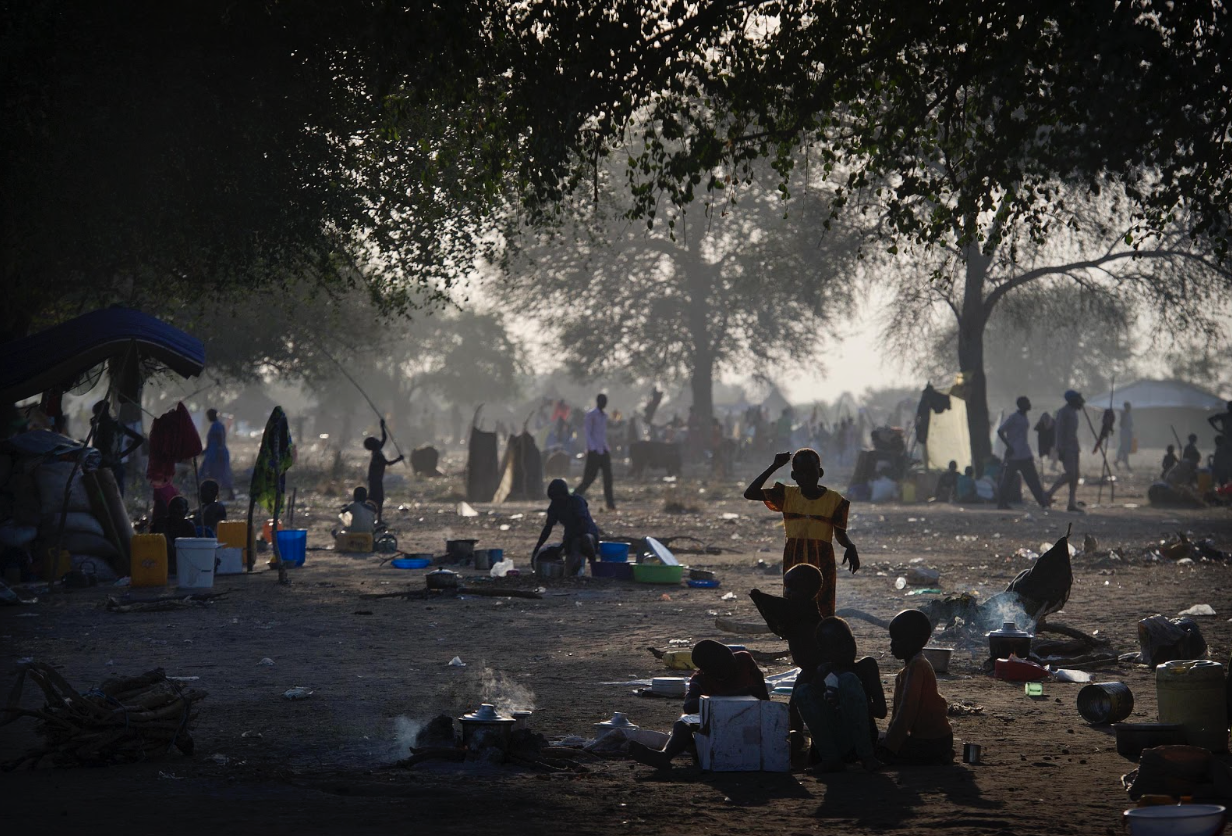
A refugee camp in Minkaman, Awerial County, home to those who have fled due to fighting in Bor. Geoff Pugh 1/13/2014.

     In 2011, South Sudan declared independence from Sudan, following over 50 years of civil war. Despite what were then high hopes for the new nation, South Sudan fell again into civil war, only two years after its new-found independence. The conflict experienced a brief respite do to a peace agreement in 2015, only to be followed by more violence as president Salva Kiir clashed with vice president Riek Machar. The conflict continues to have an incredibly destructive presence in the lives of everyday South Sudanese citizens, many of whom have been caught up in the conflict, forced to leave their country, or joined the 3.5 million displaced from their homes.

    Because of these circumstances, South Sudan is currently experiencing what has been called the worst famine since World War II. Due to scarcity, food has become almost completely unaffordable, making it incredibly difficult for people to buy the bare minimum of nutrition necessary for survival. Poor roads, more than half of which become inaccessible during South Sudan’s rainy season, make it difficult for aid agencies to reach people by ground via trucks or barges. This means that aid must be delivered by airdrop, which is considerably more expensive and less affective, not to mention hazardous for those receiving it. Patricia Danzi, head of operations for Africa of the International Committee of the Red Cross, estimates that humanitarian aid is seven times more expensive in South Sudan then in nearby Somalia.

    This makes it increasingly difficult for aid agencies to reach the 100,000 people currently experiencing starvation. The UN estimates that 5 million more people (42% of the population) lack adequate access to food, and have no knowledge of when they will be able to eat, or where their next meal will come from.

    Despite the severity of the crisis in South Sudan, awareness and media coverage in the US and globally is incredibly low. Ashley McLaughlin, media and communications officer for the International Organisation for Migration (IOM) South Sudan writes that “in America, in all of 2015, there was no mention of South Sudan in the weekly evening news shows.” It is not difficult to trace the lack of media attention to the lack of humanitarian aid. In fact, as of 2016 the UN reported that only 3% of it’s appeal for humanitarian aid to South Sudan had been met. What funding has been provided is largely reactionary, despite what Zlatko Gegic, country director for Oxfam South Sudan cites as the “need to shift from a short-term approach to a more sustainable and transformative one.” In short, it is impossible to address South Sudan’s starvation crisis without also dealing with the violence and displacement that prove major factors in its existence. While funding is desperately needed, it must be applied holistically. The Department for International Development, for instance, is moving toward a “multi-year” funding model that enables the aid agencies it funds to offer better long-term support to those without adequate access to food.

    This is a crisis that can no longer be ignored. In a world where one third of the food produced is never eaten, and around six billion pounds of fruits and vegetables go unharvested in the US alone, it is clear that we can do better.

EMMA BRUCE is an undergraduate student studying English and marketing at Emerson College in Boston. She has worked as a volunteer in Guatemala City and is passionate about travel and social justice. She plans to continue traveling wherever life may take her.

Meghan Markle and What She Means for People of Color

A Beacon of Light from the Royal Family

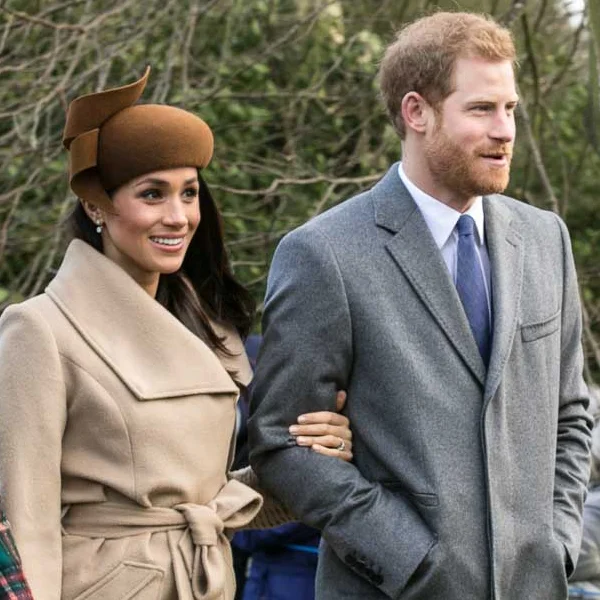
    The royal wedding; an event celebrated far and wide. The union of a prince and a princess in holy matrimony is something the world stops and stares at in awe each time it occurs. This past royal wedding however, is a bit different than those that have come before it. This year, Meghan Markle has married Prince Harry, and Meghan is biracial. Once the news of Harry and Meghan’s engagement went live, the first thing to be talked of was that Meghan is the daughter of a white man and a black woman.

     Meghan Markle has never shied away from her background. At her wedding this past Saturday, she made sure to represent her status as a woman of color. One article written for the Guardian by Afua Hirsch, called the wedding a, “rousing celebration of blackness” in the title of her article.         

    While the celebration was rich with praise and excitement for the new princess and her proud heritage, complete with photos being shared of her and her overjoyed mother after the ceremony, an all-black gospel choir performing, the beautiful performance of Sheku Kanneh-Mason, and more; there were those who took to Twitter to bash the new princess and the ceremony. A tweet from the verified account of Katie Hopkins showed two pictures, one of princess Kate in her wedding dress and the other of now princess Meghan in hers, captioned, “No competition. You can’t buy class. #RoyalWedding2018” Clearly meaning to say that Kate was the “classier” bride and insulting Meghan. This tweet got tons of backlash and very little support, but the tweets with negative connotation and outright insults towards Meghan were not hard to find.

    While the tone was mostly upbeat about the ceremony, but the insults being thrown brought another conversation to light; what does Meghan Markle’s blackness mean to and for the royal family? Well, according to an article in Newsweek, some who are celebrating Meghan’s arrival into the family as a woman of color are going to be sorely disappointed. In an article from Newsweek published on November 27th of 2017, a professor of sociology at Birmingham City University is quoted saying, “She won’t be allowed to be a black princess. The only way she can be accepted is to pass for white” she then goes on to call the people celebrating her “naïve”. This was written before the wedding took place, and the clear representation of Meghan’s background was shown during the celebration front and center. Many people of color are coming forward saying how excited they are to see a woman of color in the royal family, and there is becoming less and less criticism of the situation, but it is not completely gone.

    Nobody knows what will happen in the future, but seeing a woman of color in such a powerful family could be an amazing thing. Meghan is by no means the first black princess, but she is, as of now, the most talked of one in current events. This could mean great things for people of color in the United Kingdom, with the possibility of Meghan using her now lofty platform to advocate for marginalized communities and shine lights on injustices that are swept under the rug or ignored. The hope is that Meghan will stand tall as a forward step for the royal family, and that only good will come of this beautiful union.

ANNA LOPEZ is a rising sophomore at Ithaca college. She is a writing major with aspirations of heading to law school after completing her undergraduate years. She loves animals, art, and travel; she can't wait to see where writing takes her!