A Refugee-Run Restaurant in Lisbon's Mercardo de Arroios

Mezze: Rebuilding, with Food

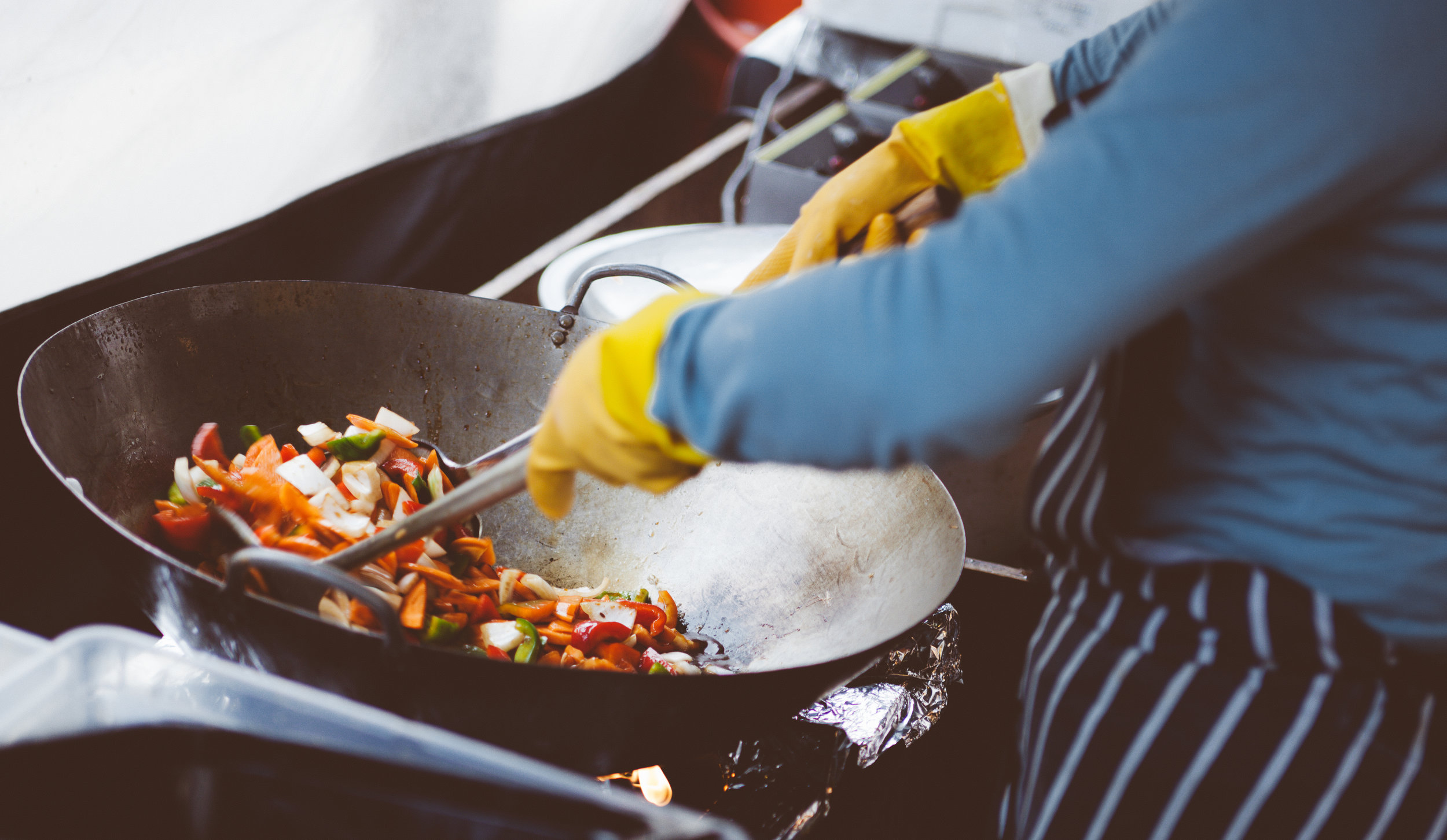
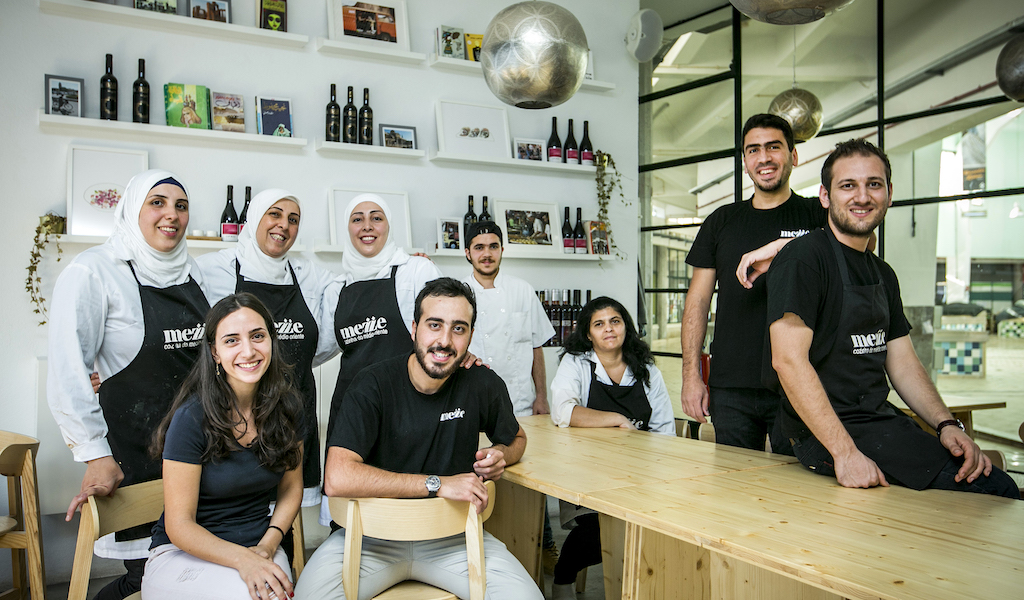
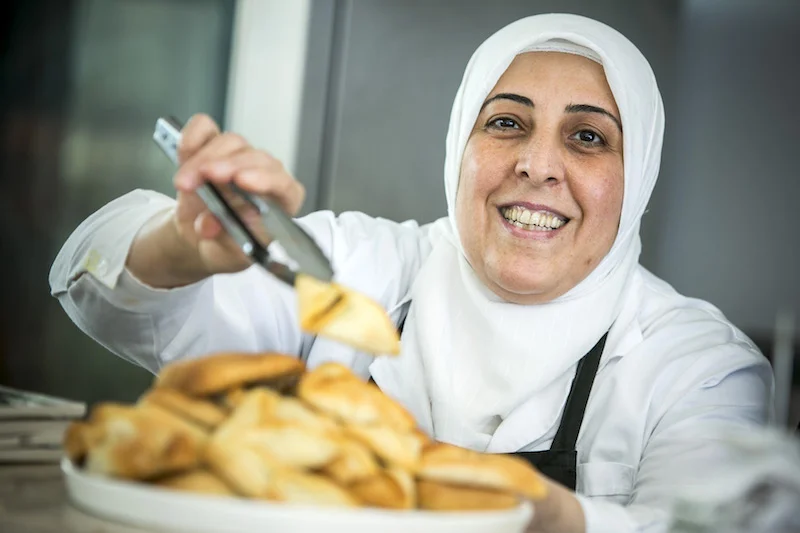
In a market as diverse as Lisbon’s Mercado de Arroios, where people from all over the world shop, Mezze doesn’t seem out of the ordinary. But the small restaurant deserves a closer look: it’s not only one of Lisbon’s few Middle Eastern restaurants, but, more importantly, its staff is almost entirely made up of recently arrived Syrian refugees. For them Mezze represents both a link back to the country they left behind and a crucial aid for putting down roots in their new home.

The idea behind Mezze is one that’s being tried out in other countries. Refugees, particularly those fleeing the war in Syria, are given the chance to earn a living and get established by sharing their culinary heritage, either by opening or working at a restaurant or catering business. The benefit is not just for the refugees, who are able to earn some money while at the same time preserving a taste of home, but also for their new communities, who can support those displaced by war and gain insight into their cultural heritage through the universal language of food.

Mezze’s start, though, was motivated by something simpler – the desire for bread. Alaa Alhariri, a 24-year-old Syrian woman who came to Portugal to study architecture in 2014 after a brief time spent studying in Egypt and Istanbul, was missing the flatbread she used to buy back home. “Bread is the beginning of everything, it exists in every culture,” she says. “In the Middle East it means family, it means sharing. Syrians open bakeries as soon as they arrive in Turkey and in other countries as well.”

Alaa is one of the four founders of the non-profit Pão a Pão, which means “Bread by Bread,” a name inspired by the Portuguese saying “Grão a Grão” (“Grain by Grain,” which has a similar meaning to “step by step”). The organization was the brainchild of Alaa and Francisca Gorjão Henriques, another cofounder and Pão a Pão’s current president. Francisca and Alaa met by chance – Alaa was living with Francisca’s aunt. Pão a Pão was originally created with the intention of opening a bakery.

“Refugees [from Syria] started to arrive in Portugal in 2015 under the European Union program to relocate them,” explains Alaa, whose eyes shine with enthusiasm when talking about the project (while she’s heavily involved in behind-the-scenes work, she doesn’t work at the restaurant). “They only receive state assistance for two years, after which the funds stop.” The aim of Pão a Pão is to help young people and women, in particular, integrate into the work force. “Some of these women have never worked before,” says Alaa. “They’ve been housewives all their lives.”

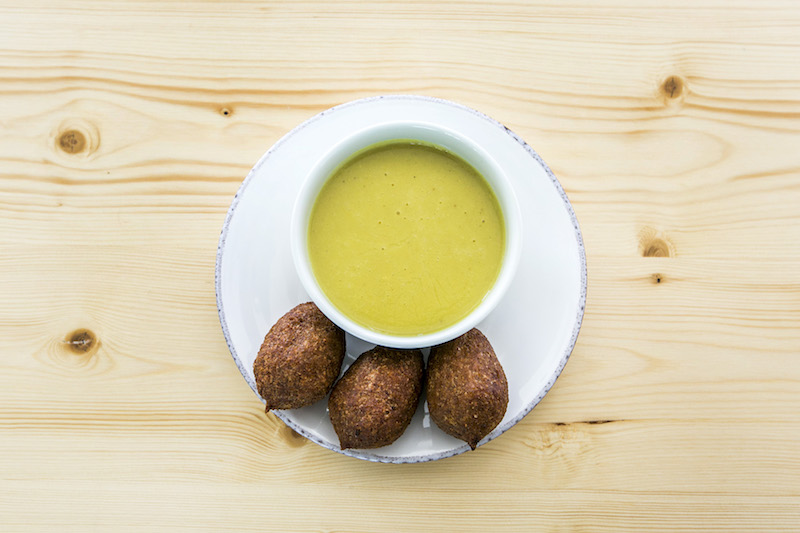
But the team at Pão a Pão began to think bigger; the bakery plan was scrapped and their new aim was to open a restaurant. They organized a series of successful test dinners in December 2016, which took place in an old covered market that had been converted into an events space. Buoyed by the positive response, Pão a Pão felt confident in taking the plunge. They were able to crowdfund just over 23,000 euros (around $30,000) – almost 10,000 euros more than the initial goal – over the course of 2017, with the restaurant finally opening its doors in September, serving such classic Syrian dishes as moussakakibbeh (fried balls made of bulgur, minced meat and walnuts), kabseh (rice with vegetables and chicken) and baba ganoush.

“The people working here feel like they’re doing something useful. So the more people we can help feel this way, the better.”

“People’s reactions have been amazing, it is better than we could expect, we’re always busy,” says Francisca, who recently left her job as a journalist at the Público newspaper to concentrate on her work with the organization. “We have improved a lot since our first test dinners, especially considering that 90 percent of the team had no prior experience.”

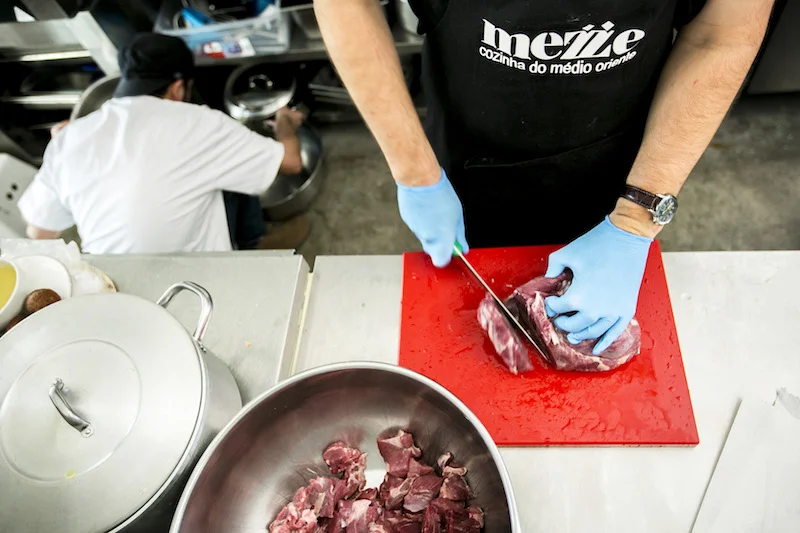
Mezze has also been extremely well received by the Mercado de Arroios’s neighboring shops and stalls, which supply the restaurant with its ingredients. Everything Mezze cooks with comes from the market except the meat, which is sourced from a halal butcher in Almada, south of Lisbon.

Perhaps more significantly, the refugees employed by Mezze take pride in their work. Serena, a 24-year-old from Palestine who has been living in Lisbon for one year now, loves the atmosphere at the restaurant. But, more importantly for her, she values the chance to show that refugees are the same as everyone else: “We work hard, we love life and want to be part of society as much as anyone.”

While we talk, she welcomes people to the restaurant and explains the menu. “The Portuguese ask a lot of questions because they don’t know these dishes but everyone loves the food,” she says. Although she finds the language difficult, she considers Portugal to be her home now. “It’s my home, where I find myself,” she explains. “It still has traditional a family structure, family bonds, and at the same time, more freedom of movement and speech.”

Rafat Dabah, 21 years old, has been in Portugal for just under two years, after being relocated with his family from Egypt, where they first moved after leaving Syria. “My father had a restaurant in Syria and in the school holidays I would work there with him,” he tells us. “Here in Portugal I worked in a kebab place in a shopping center.” This experience seems to have served him well. He began working as a waiter at Mezze, but is now the restaurant’s manager – he eagerly explains the improvements they have made at the restaurant and the positive feedback they’ve received from diners.

Originally from Damascus, he lives in Lisbon with his younger brother and his mother, who also works at Mezze. His older brother, 24, lives in Turkey. His father died in the war. Living in Loures, a suburb north of Lisbon, Rafat can’t image going back home to Damascus anytime soon. “It’s tough there. Sadly things are still dangerous.”

As for life in Portugal, he doesn’t feel quite at home yet, although it’s getting better. He tells us how he’s enjoying learning so much, including the Portuguese language. “To integrate you need to learn the language, I’ve learned a lot and I’m practicing more now,” he says. “Once I could communicate, life became much easier.”
This isn’t the first time refugees have made Portugal their home. Because of its neutrality during the Second World War, the country saw a large influx of exiles from other European countries as well as North Africa. Likewise, hundreds of thousands fled to Lisbon after the independence of Angola and Mozambique in 1975. More recently, 1,659 refugees took shelter in the country as a result of the Balkan wars in the early 1990s.

In the last two years, 1,507 refugees (mostly Syrians but also some from Iraq and Eritrea) were relocated to Portugal from Greece and Italy, according to the Portuguese Council for Refugees. The Portuguese Government announced recently that they would receive 1,000 more currently residing in Turkey (again, mostly Syrians but also some from other Middle Eastern countries). Although small in number compared to the massive number of refugees being sheltered in the countries bordering Syria, they are being welcomed warmly. The extraordinary success of Mezze speaks to that.

The support of the Portuguese people has been fundamental to the realization of this project, which leads us to wonder if this openness would have been possible, say, even 20 years ago. “Maybe 20 years ago, without social media amplifying this disaster at the gates of Europe, this wouldn’t be possible,” admits Francisca. “At the same time, today’s Lisbon is much more cosmopolitan than it was 20 years ago. Diversity is now a prime feature in some parts of the city, like in the Arroios neighborhood.”

The ongoing support of Lisboetas, many of whom felt a wave of solidarity with the refugees after Europe initially bungled the refugee crisis, has inspired Alaa and her colleagues to think bigger. “We’re thinking of opening another location. The Portuguese love to eat and we’re lucky that they love our food,” says Alaa.

Francisca confirms the plans to open another place. “We’ve developed this project with the hope of replicating it in Lisbon and other cities in the country. We’re still starting out and we want to improve, but we think we might be able to open in other locations in a year. We also hope to expand our current Mezze to include a take-away and catering service.” They also have plans for debates and workshops, with Pão a Pão hosting a conference on integration at Mezze on Friday, January 26.

According to Alaa, the people working at the restaurant “feel happy, they feel like they’re doing something useful. So the more people we can help feel this way, the better.”


This article originally appeared in Culinary Backstreets, which covers the neighborhood food scene and offers small group culinary walks in a dozen cities around the world.


AUTHOR

CÉLIA PEDROSO

Célia, CB’s Lisbon bureau chief, is a freelance journalist, writing mostly about travel and food, and is the co-author of the book "Eat Portugal", winner of a Gourmand World Cookbook Award. Her work can be seen in such publications as The Guardian, Eater, and DestinAsian. In 2014 she started leading food tours in Lisbon through Eat Portugal Food Tours and now does the same with CB. She wrote the Portuguese entries for the book "1001 Restaurants you Must Experience Before you Die" and keeps searching for the best pastéis de nata so you don't have to.

PHOTOGRAPHER

RODRIGO CABRITA

Photographer Rodrigo Cabrita was born in Oeiras, Portugal in 1977. He started his career at the daily newspaper Diário de Notícias in 2001 and has worked at a variety of publications since then. He is now a freelance photographer and takes part regularly in exhibitions. Rodrigo has won several photojournalism awards, most notably the Portuguese Gazeta award. You can see more of his work at his website and his Instagram page.


The Meaning of Travel: A New Guide For Millennials

In today’s highly connected and accessible world, to go anywhere is easy.
But to be a true traveler? That’s the daunting task.

Many of us have taken planes, and have gone to exotic places outside of where we grew up and live. Be it a backpacking trip to India, a short weekend holiday spent in Bali, or a work-related trip to Johannesburg, the act of going somewhere outside of our personal zone of familiarity and comfort is often seen as an opportunity offering some form of inner transformation.

Indeed, the act of exposing ourselves to the foreign and unknown can evoke a plethora of new feelings in us. Sometimes, this experience leads us to new perspective, or even new decisions about ourselves and our lives.

Don’t be mistaken though, not all journeys that we take will lead us to a new self at the end of the road.

More often than not, we return home as the same person as we were before, just with a few more stories to tell and a few more memories to reminisce about during our mundane 9-to-5 job.

So, you may ask, what differentiates a trip that leaves us unchanged, from a travel experience that can potentially transform us from the inside out? How can I make my travels mean more? How do I get more out of them?

Well, there is no one way to achieve it, that’s for sure. We are all different individuals, from different backgrounds and with our own interpretation of the world.

Having said so, we are all similar in so many ways too. A genuine smile, a simple greeting, or an act of kindness may be all it takes for two persons separated by their backgrounds and languages to relate and connect with each other.
Photo by Laura Grier

Hear someone out. Listen to their story.

To travel is not just to see and to experience, but also to listen. I think many people missed out on that, and therefore, on a great learning opportunity. To listen is to try to empathise, to put yourself in the other person’s shoes.

By listening to the stories of the strangers we meet on the roads, about their lives, about their view of what’s happening in the world, about their dreams for the future, we gained not just the knowledge and viewpoint of another human being, but also learn of the value and validity of our own pre-existing views and beliefs.

“Perhaps travel cannot prevent bigotry, but by demonstrating that all peoples cry, laugh, eat, worry, and die, it can introduce the idea that if we try and understand each other, we may even become friends.”
Maya Angelou

That’s how we gain human perspective I think — not by looking at the endless Himalayan mountain range, or the ebb and flow of the sea by the beach. You’ll never know, sometimes it’s the most unexpected persons who impart us with the most valuable lessons in life.

Photo by Prashant Ashoka

Also, tell your story.

I often hear people say that they travel to feel free again. They explained that traveling helps them escape temporarily from the realities back at home — their old problems, burdens and responsibilities.

True enough, being in a foreign land where nobody knows anything about you does have its unique liberating quality. You can be anybody, and you can be nobody. There, I think, is where you find your most authentic self, and then be it.

“… sometimes one feels freer speaking to a stranger than to people one knows. Why is that? Probably because a stranger sees us the way we are, not as he wishes to think we are.”
Carlos Ruiz Zafón

Photo by Laura Grier

How do you start? Well, relax. Don’t overthink it. Instead, try to enjoy the process of letting go of your insecurities, your fears and inhibitions. What better ways to get things off your chest than to confide in a stranger whom you know you’ll never meet again? There! You just save yourself a costly trip to a therapist.

Jokes aside, it does take time and a few tries before you learn to open yourself up, not just to strangers, but to the world as a whole. But trust me, once you’ve reached that point, you will begin to see the world in a more fearless and unprejudiced manner.

Last but not least, leave your mark.

Make your travel different and more meaningful by contributing to the local cause. And no, I’m not talking about volunteering here. Neither am I talking about donating old clothes, books and stuff that people might not really need.

By contributing, I mean helping locals who want to help themselves. By aiding them in creating a positive outcome that is both tangible and sustainable. That’s what I think a real positive impact entails. That’s how we truly help.

Some local businesses may be starting up or in the process of renovation and need some funding. One easy way to get in touch with these people — the entrepreneurs, designers or small business owners living/working in the area you’re traveling to — is through online crowdfunding platforms like Kickstarter and Indiegogo, which have thousands of projects coming in from all across the globe.

To skip the hassle of searching through the tons of projects which may not be relevant to your needs, you can also try TravelStartera travel-specific crowdfunding platform with a growing array of travel and tourism business projects from different parts of the world.

Want to help a Croatian instructor rebuild his sailing boat and be rewarded with a sailing course? Or help a New Zealander living in the Philippines rebuild his Con-Fusion Cafe after typhoon Yolanda destroyed the restaurant? Or are you headed down to San Diego anytime soon? Help a new B&B at Pacific Beach in their funding raising efforts to refurnish the hostel. For a contribution of $80, you will be rewarded with a two-night stay, a three-hour whale watching tour and also a brewery tour!

Photo by San Diego Whales And Dolphins

With the help of platforms like TravelStarter, travelers are encouraged and enabled to engage in more locally instigated experiences.

That’s not only a good way to help somebody, it’s probably the best way to make a local friend too. Definitely an experience that’s worth more than what you fork out of your pocket.

Photo by Ivon Domingo

At the end of the day,

Or at the end of your life, you will realise that it’s not the places you have seen, the crazy adventures you have gone through, or the pictures that you have taken that matters the most.

It’s the people that you have met along the way — those whom you have helped, those whom you have loved, those whose lives you have touched — that really mean the most. They are what made you a true traveler of life.

Lastly, always remember:

“A journey is best measured in friends, rather than miles.”
— Tim Cahill

The world’s waiting for you. Now GO!


THIS ARTICLE WAS ORIGINALLY PUBLISHED ON THE COFFEELICIOUS.


KEAY NIGEL

Keay Nigel is an independent writer/designer currently based in San Francisco. He has lived in the Hongkong, China, India and various parts of the United States. Travel is his passion and he's been documenting his overseas adventures through YouTube videos. Check out more of his writings here.