
Africa saw the rise and fall of diverse societies, cultures, and civilizations that thrived long before colonization.
Read MoreUncovering the Diversity of African Music
If you are a music buff looking to expand your horizon, check out these 5 African music genres.
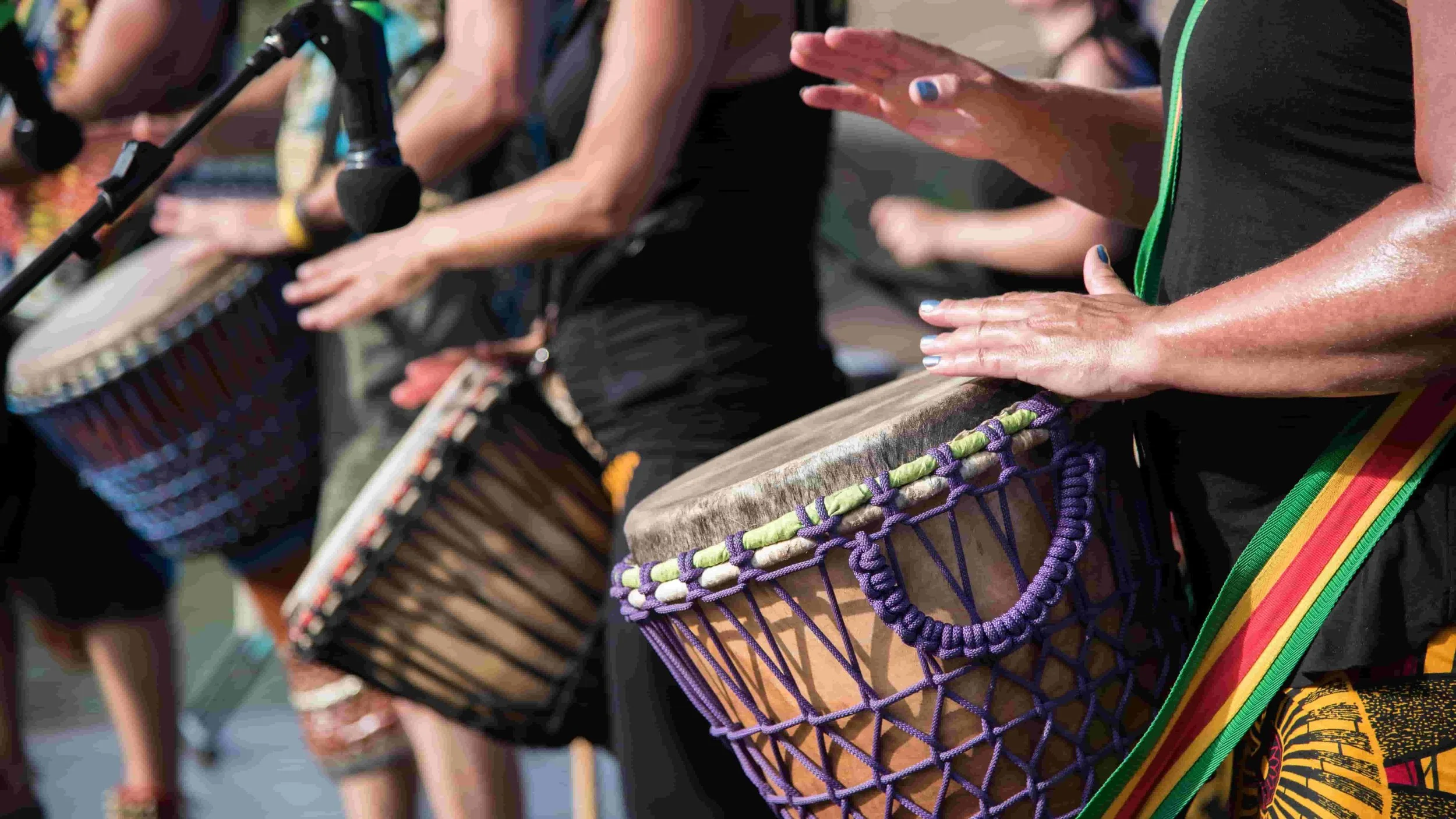
African drums. Lee Pigott. Unsplash.
People all across the African diaspora share a love for music, which connects everyone to the same frequency. Many are familiar with Afrobeats, a style of music from Nigeria, but there are many different and diverse genres to explore the sounds of, from the likes of Amapiano to Chimurenga.
Amapiano

Two people singing Amapiano together.. The Charles Gallery. Unsplash
Amapiano is a genre of music originating from South Africa characterized by a mixture of jazz, house and Gospel music. Amapiano is composed heavily of synthesizers, percussion, soulful vocals, and repetitive melodies. This genre of music is relatively new, coming into being in the early 2010’s. Amapiano is a Zulu word meaning “the pianos.” Amapiano is a form of music South Africans believe can bridge people together, and a musical escape for the younger generations.
Listen to a Youtube playlist of Amapiano music
Juju
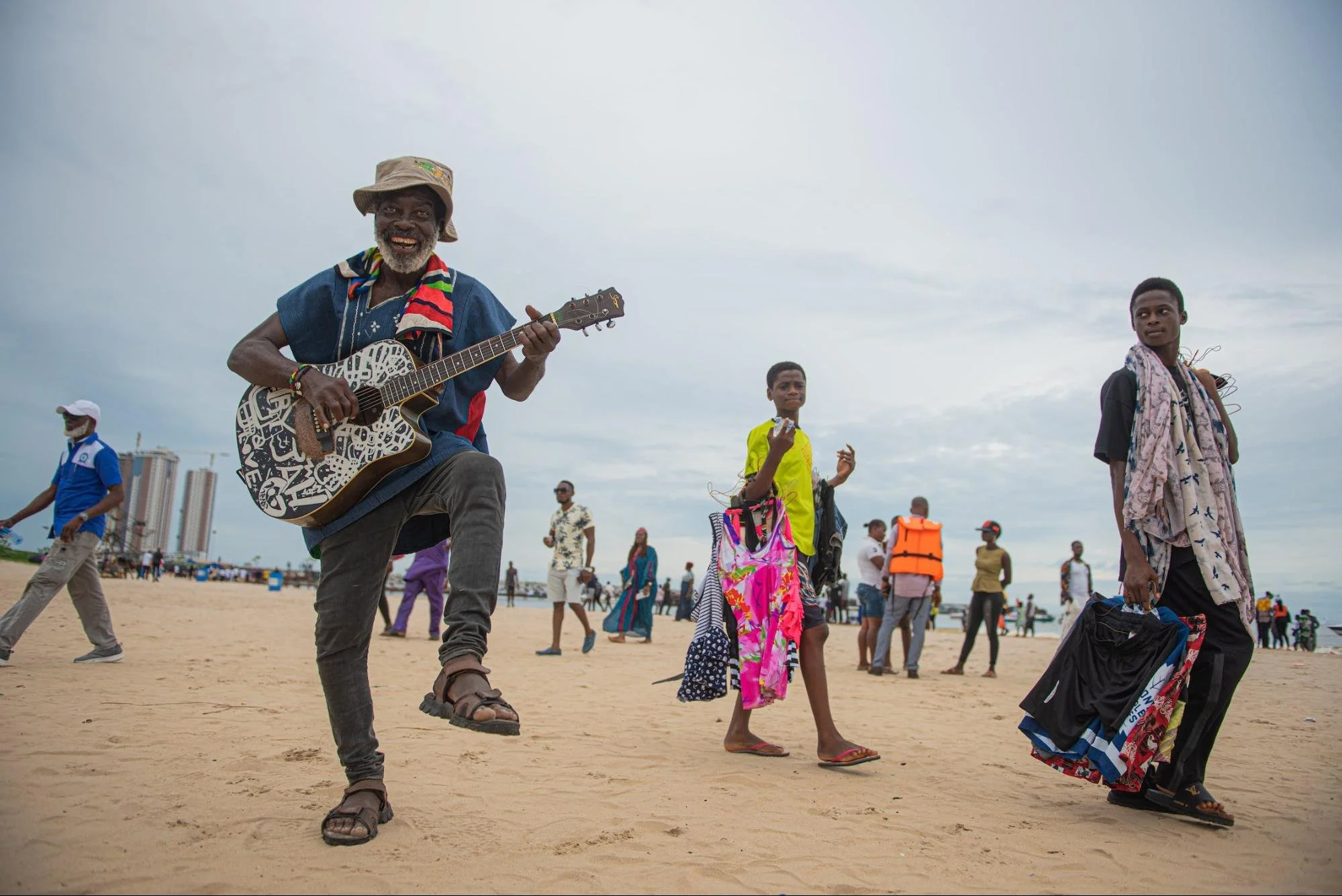
Man playing music on the beach. Seun Adeniyi-CCO.
Juju is a genre of music that originates from Nigeria, specifically its Yoruba region. It’s a musical style that is composed of praise-singing accompanied by a guitar or banjo and a gourd shaker. This genre of music was traditionally played in taverns or during festivals as dance music, but became modernized and generally popular by the 1980’s. As it grew in popularity, it led to the birth of many other genres of music like Highlife or Afrobeats, as we know of them today.
Listen to a Youtube playlist of Juju music
Coupe decale
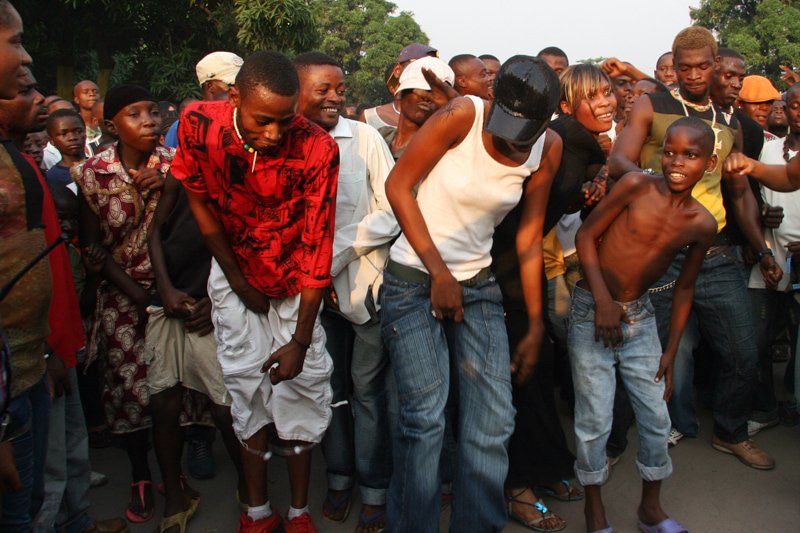
A group dances to Coupe Decale. Tommy. CC 2.0
Coupe Decale is a genre of music created by Cote D'ivoirians living in France in the early 2000’s. It’s a musical style composed of ‘computerized circular beats’ mixed with Ivorian rhythms . The lyrics themselves are inspired by the West African griot tradition of story-telling, and the genre’s primary message focuses on providing a space for many people to dress nice, go clubbing, and forget their problems during a time of economic and political crisis.
Listen to a Youtube playlist of Coupe Decale music
Gnawa–saharan Folk music
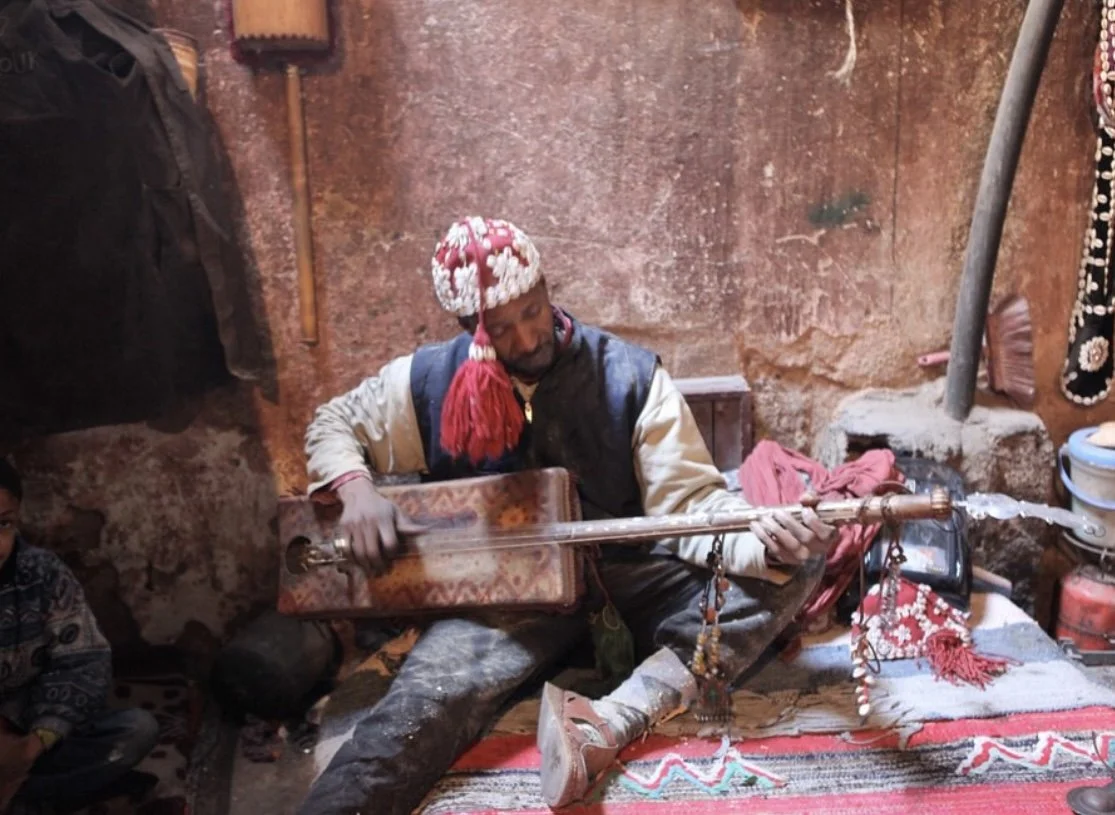
Man playing Moroccan bass lute. Marrakech Riad-CCO.
Gnawa is a folk genre that originates from Morocco. It’s a musical style that has its roots in ancient African tradition, as it’s the result of formerly enslaved black Africans integrating into Moroccan life. It serves as a preservation of the folkloric music of their ancestors, as well as a means to heal from collective trauma. Interestingly it is also said to have healing properties for those that are possessed by ‘genie spirits.’ Its musical style is composed of African percussion, metallic castanets, and bass lutes.’ Gnawa at its core is a combination of poetry, music and dancing. This genre shares many similarities with its American counterparts Jazz and the Blues, as all three share the same purpose. The genre’ songs consist of references to the singer’s origins and history regarding enslavement.
Listen to a Youtube playlist of Coupe Decale music
Chimurenga
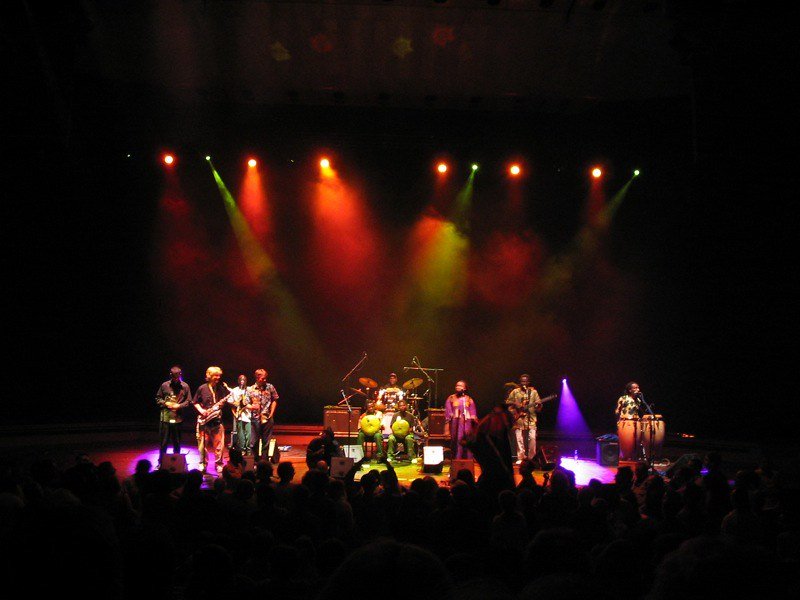
Thomas Mapfumo, the creator of Chimurenga music performs. Cultrvultr-CC BY NC-SA 2.0
Chimurenga is a genre of music that was developed in Zimbabwe. It was used to protest colonial rule in the 70s, and more generally is used to discuss and inform on societal issues and movements important to the singer. Because of this, it is recognized as ‘music for the people’s struggle’. This musical genre can be accredited to the Shona musician Thomas Mapfumo. He was inspired by the rock bands he heard playing growing up and his Shona background to create a political movement through music.
Listen to a Youtube playlist of Chimurenga music

Kadija Diallo
Kadija is a student at Georgia State in Atlanta, Ga. She is a creative spirit who loves traveling and seeing new places. She also enjoys using her love for writing/storytelling to make an impact on the world. One day she hopes to make new connections and share stories as she travels to every continent.
How to Score Cheap International Flights
International travel doesn't have to break the bank - learn how to find the best deals.
Read MoreSleep Around the World
How do country and age affect how we sleep?
Read More7 Real-Life Atlantises Hidden Around the World
Exploring the hidden history of sunken sites.
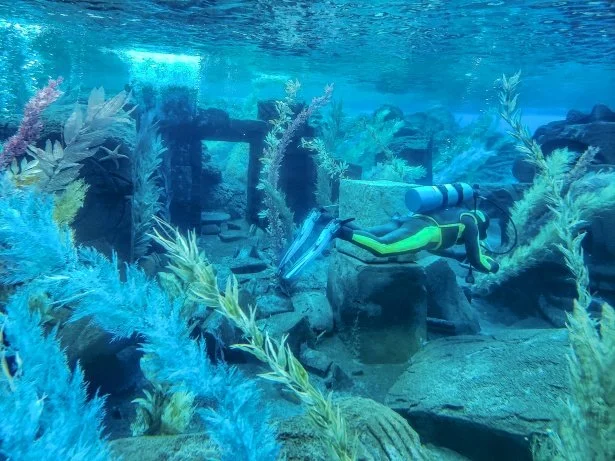
Diver exploring a sunken city. Linnaea Mallette. CC0 1.0
Although travel traditionally highlights cultural landmarks, distinctive experiences, and historical sites on land, much history lies where our eyes alone cannot take us – particularly under the sea. Underwater cities and towns which have been immersed in the soaking abyss of seas, lakes, and reservoirs through natural disaster or human shenanigans provide a time capsule into the defining characteristics of their era. The corpse of the city including its many artifacts can be explored through diving and even glass bottom boats. Here are seven of the most intriguing sunken cities to visit around the world.
1. Baiae, Italy
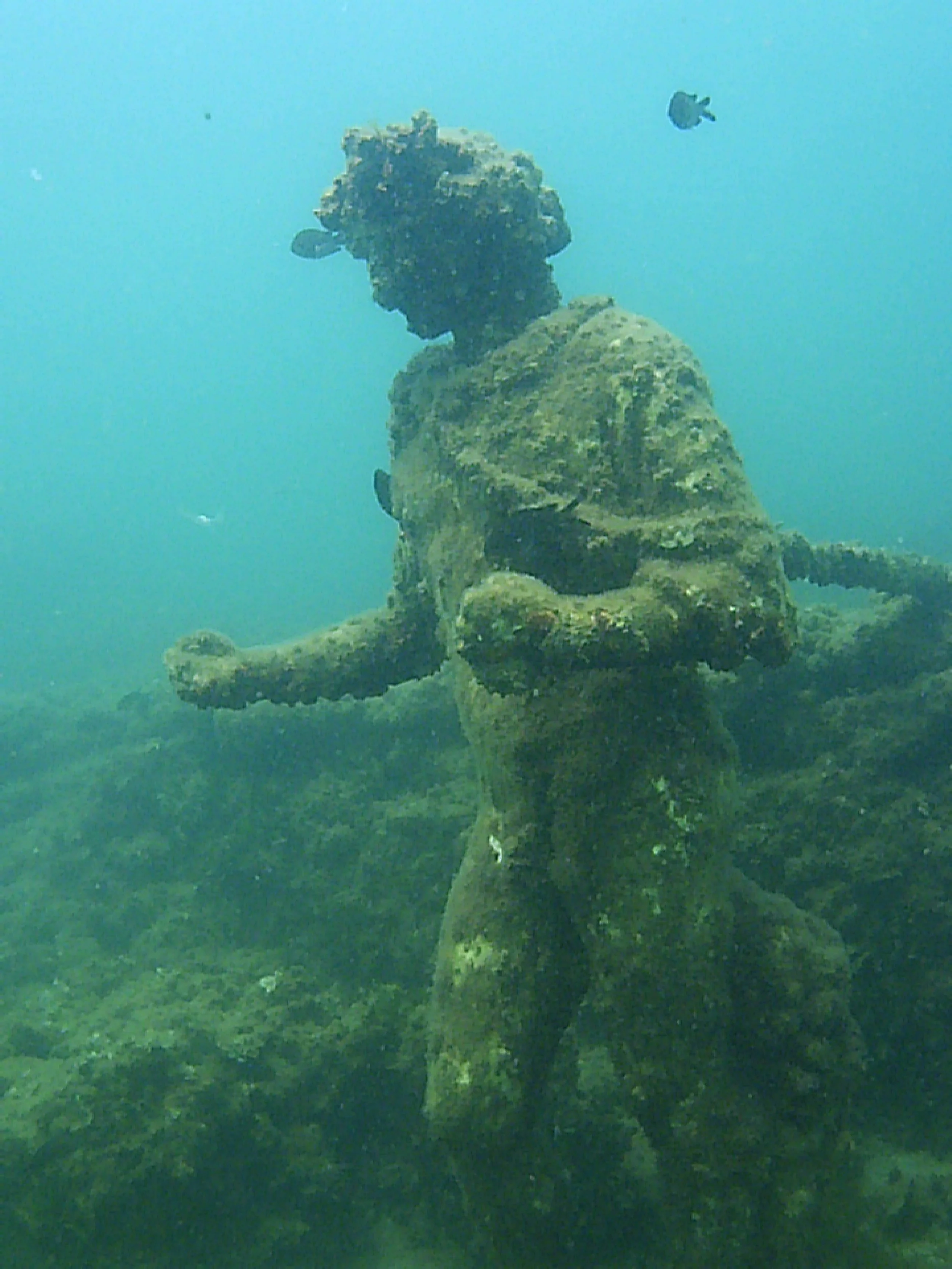
Emperor Claudius; nymphaeum submerged in Baiae, Italy. Ruthven. CC0 1.0
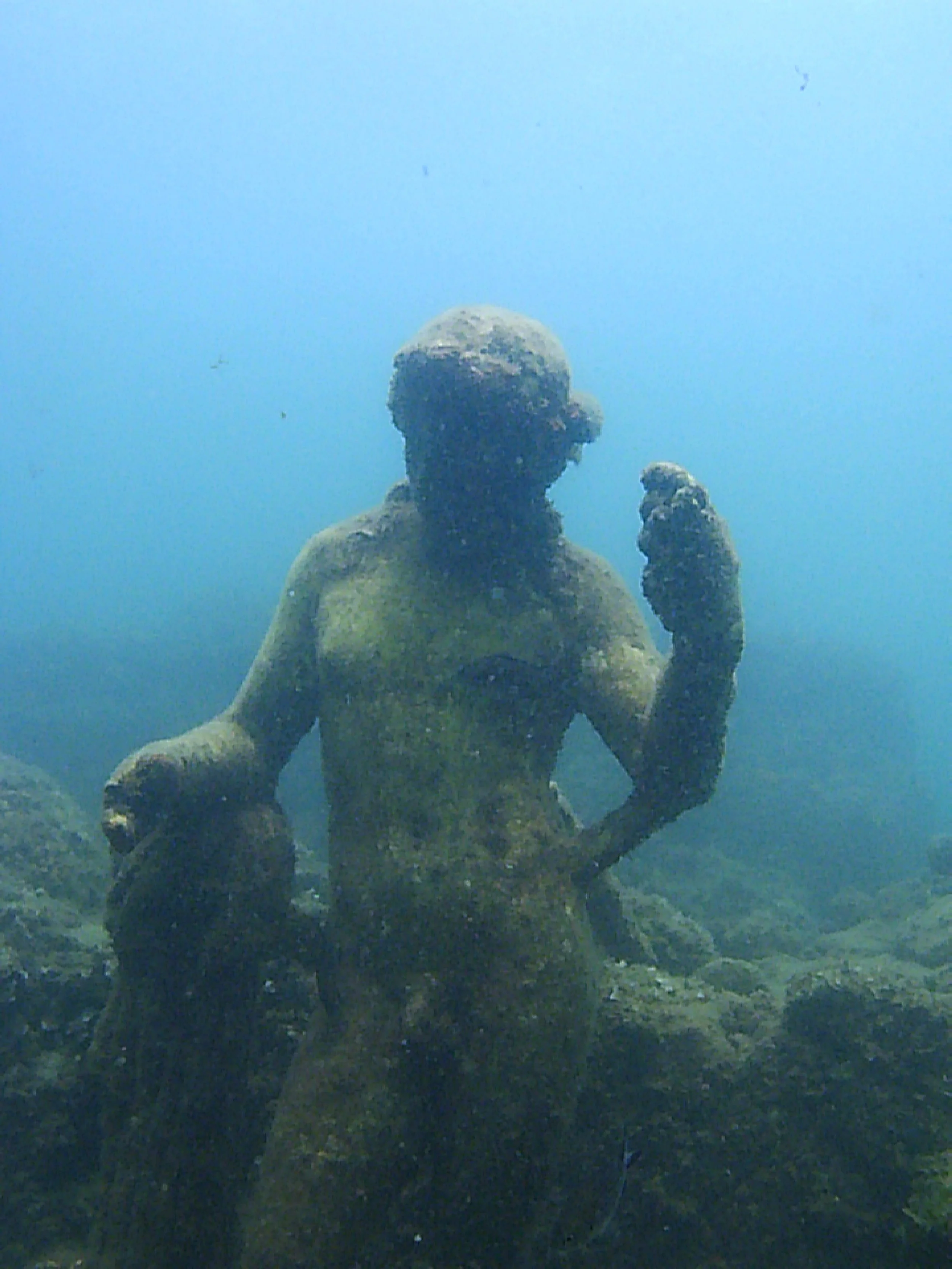
The ancient Roman town of Baiae overflowed with luxuries in its time: Roman elites built villas and spas fed its famous hot springs, and palace parties proliferated. That is, until an army of the Muslim Caliphate army sacked the resort city in the 8th century. By 1500, the luxuries had faded away and the town was left abandoned. The volcanic vents that had once been the joy of Roman bathers led to a steadily increasing water level and eventually, the majestic city was submerged. Now, the once-present luxuries of the city–its marble statues, mosaics, sculptures–can be viewed through glass bottomed boats and on snorkeling or scuba diving tours.
2. San Roma de Sau, Spain
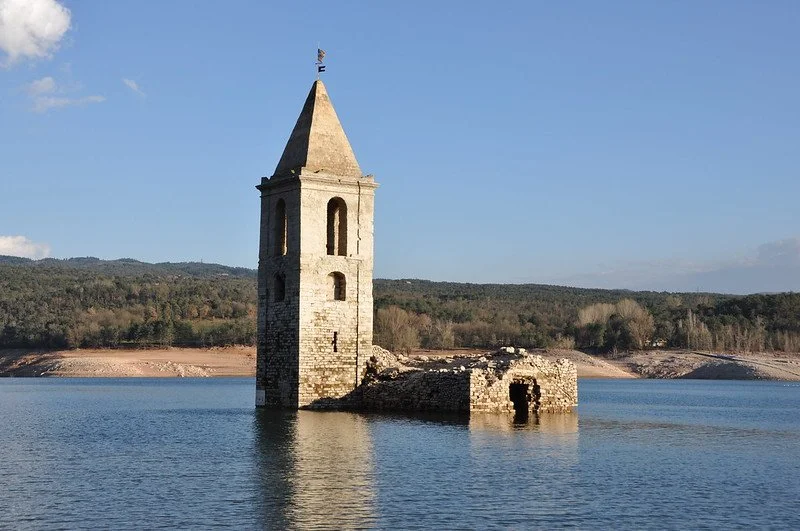
The half-submerged church of San Roma de Sau. Josep Bracons. CC BY-SA 2.0
All that remains to be seen of San Roma de Sau, a thousand year old village in Catalonia, is the spire of its Medieval Romanesque church. The church, now reemerging due to drought and low water levels in Spain, reminds visitors of the artificial flood in the 1960s that sank the lightly populated town. The Catalonian government’s decision to create a reservoir forced the townspeople to leave their land, taking their valuables and their dead with them. The reservoir’s beginning led inevitably to the end of San Roma de Sau.
3. Dwarka, India
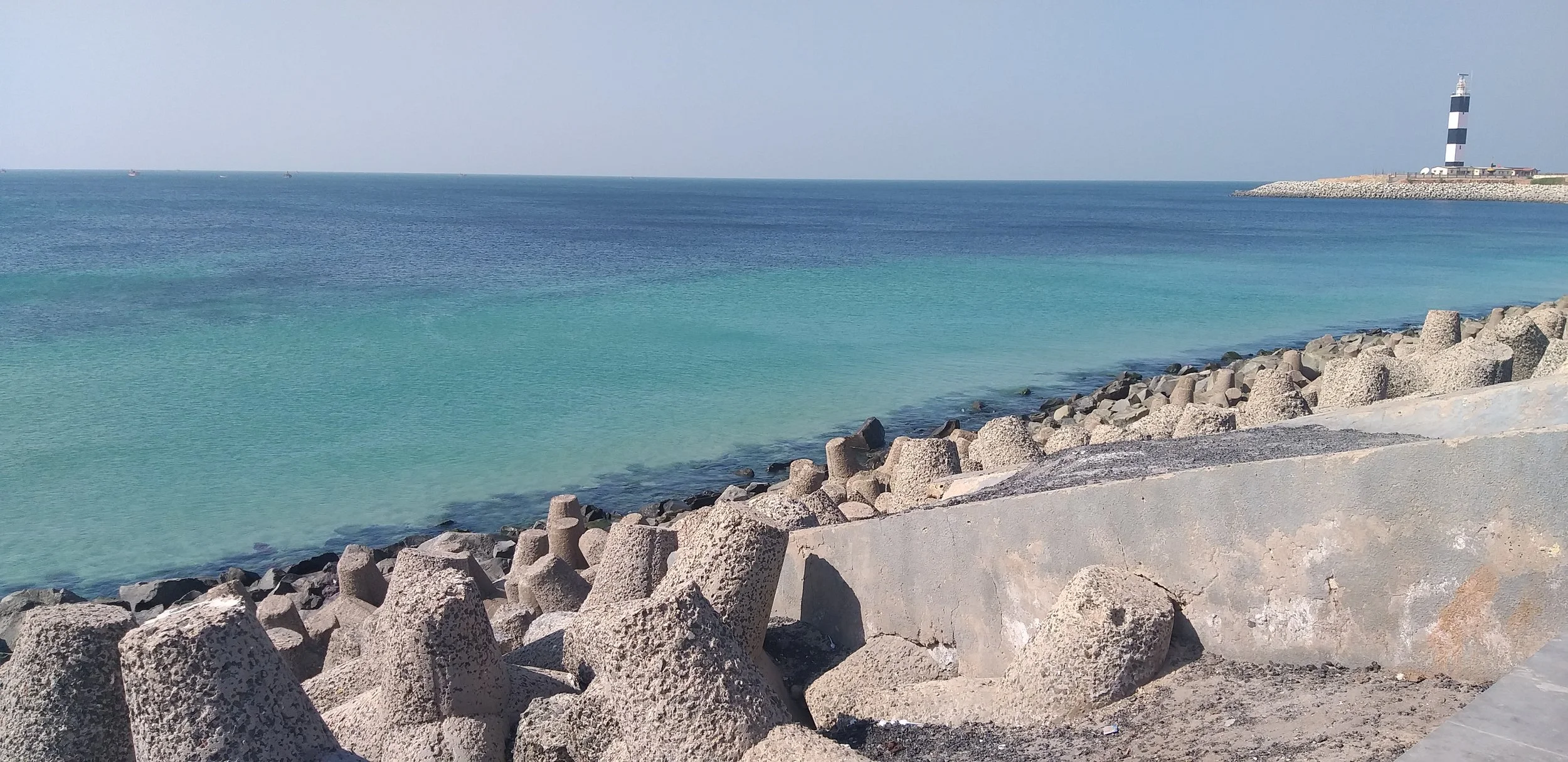
The Dwarka lighthouse on the coast of Gujarat India overlooks the submerged city of Dwarka. VasuVR. CC BY-SA 4.0
Known as “India’s Atlantis,” Dwarka is not only an intriguing travel spot, but also a religious relic. This ancient sunken city located in modern-day Gujarat appears in the Mahabharata as Krishna’s city; the city supposedly sunk in the Arabian sea after Krishna’s death according to the text. 20th century marine archaeological explorations proved its existence outside of literary myth and have uncovered stone anchors, pillars, bastions, pottery, inscriptions, stone sculptures, as well as bronze, copper, and iron objects in Dwarka. Visitors can dive off the coast of Beyt Dwarka, a neighboring island, to view the submerged city.
4. Shi Cheng, China
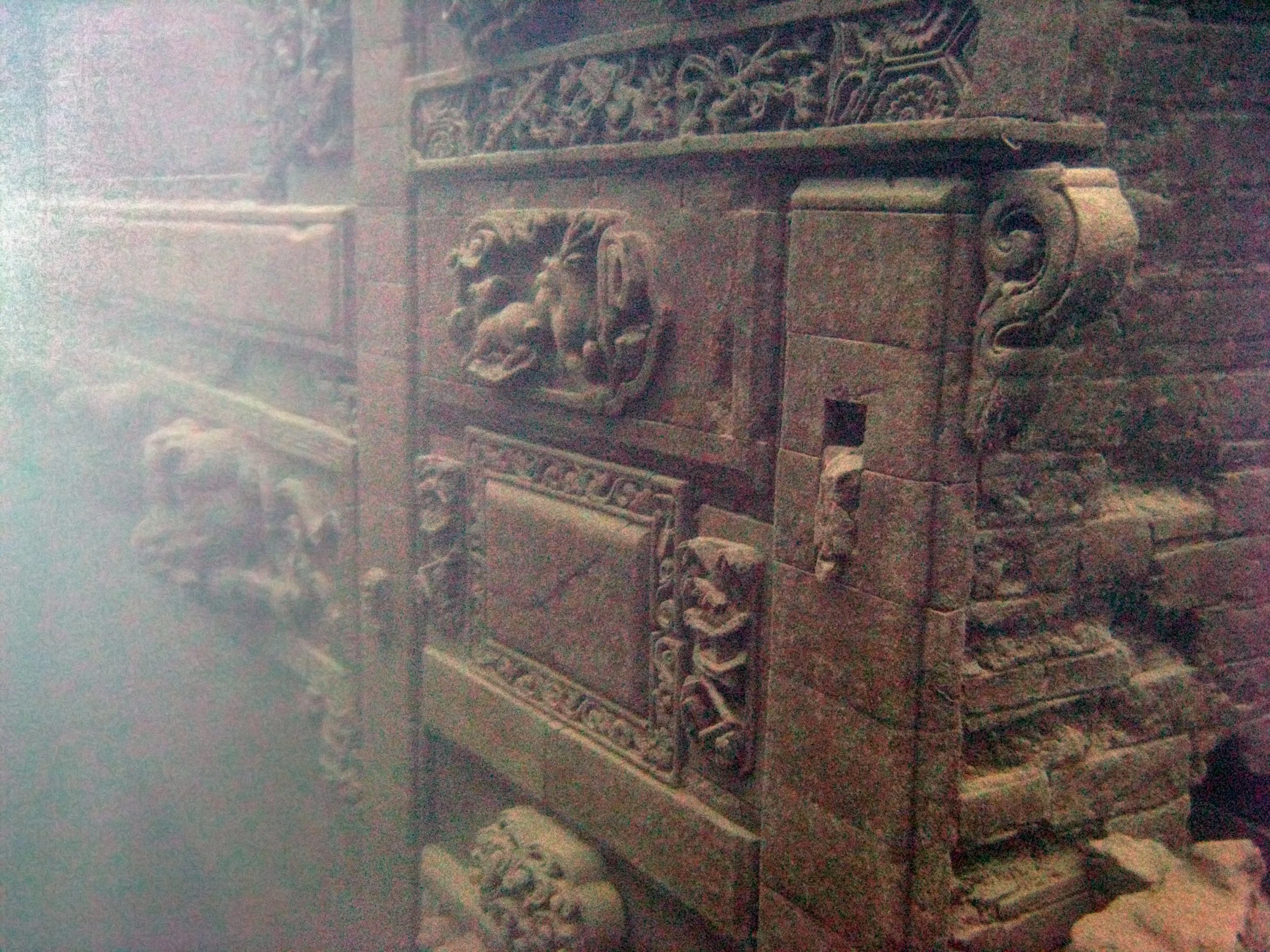
A sunken artifact in Shi Cheng. Nihaopaul. CC BY-SA 3.0
Shi Cheng, much like many other of the sunken cities on this list, was flooded deliberately. The ancient city was the casualty of a 1959 hydroelectric dam and consequent artificial lake, , which now envelops and obscures this “Atlantis of the East.” Located 40m under Qiandao Lake, Shi Cheng offers a snapshot of Imperial China. The city brims with stone architecture of the Ming and Qing dynasties; stonework of lions ( fitting, as the city’s name means “lion city” in Mandarin), dragons, phoenixes, and historical inscriptions lay within the five entrance gates of the sunken city.
5. Port Royal, Jamaica
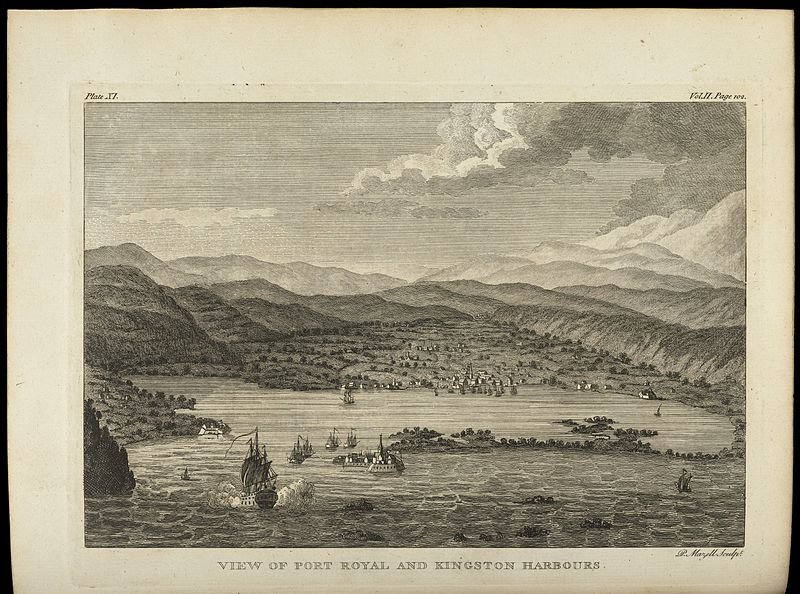
An image of Port Royal before the city was sunk. Wellcome Library, London. CC BY 4.0
The 1692 7.5 magnitude earthquake that submerged Port Royal did nothing to erase its rich history. The town, captured by the British from Spain in 1655, became the center of English life in Jamaica. The Englishmen brought the slave trade to the region, as well as an abundance of merchant and artisan activity. The town also possessed a strong scene for sex workers and pirates. Now, the submerged town still maintains its buildings and artifacts like skillets, pots, barrels, ceramics, and a pocket watch found by Edward Link in 1950–all underwater. Travelers can explore the 40 feet deep city through diving.
6. Thonis-Heracleion, Egypt
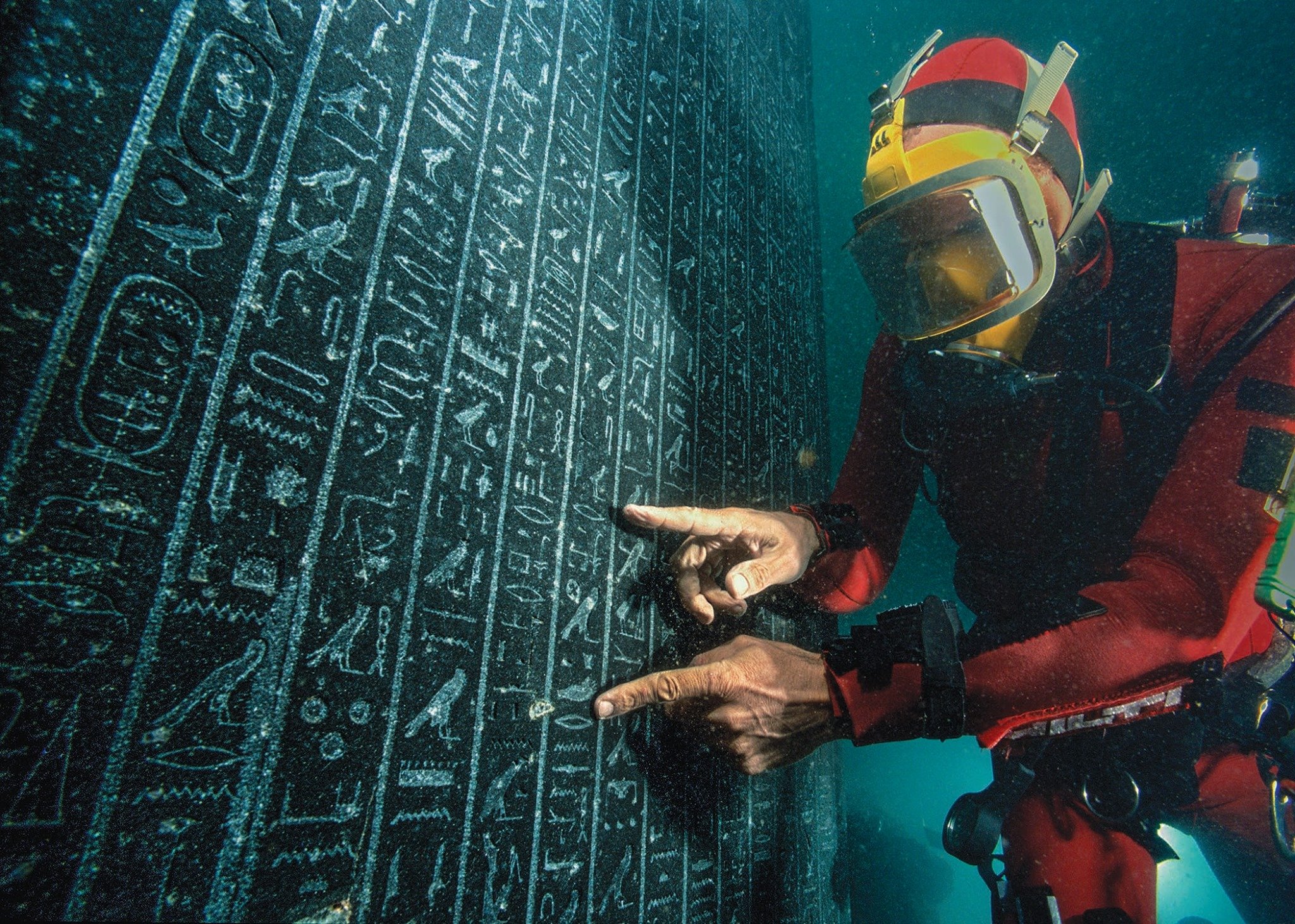
Thonis Heracleion. Courtesy of Virginia Museum of Fine Arts
Founded around the 8th century BC, Thonis-Heracleion was a distinguished city, one of great importance especially for merchants who frequently passed through the port to enter Egypt. The liquefaction of the city’s clay soil and ultimately the city itself resulted from various natural disasters including an earthquake, tsunami, rising sea levels, and subsidence. As a consequence of these catastrophes, the city eventually collapsed into the surrounding water. Much of the city’s culture and lifestyle remain preserved in watery depths, however. Temples, colossal statues - the most famous being the 5.4 meter tall God of Hapy - inscriptions, jewelry, coins, ritual objects, ceramics, goblets, and the sarcophagi of animals all endure, frozen in time.
7. Potosi, Venezuela
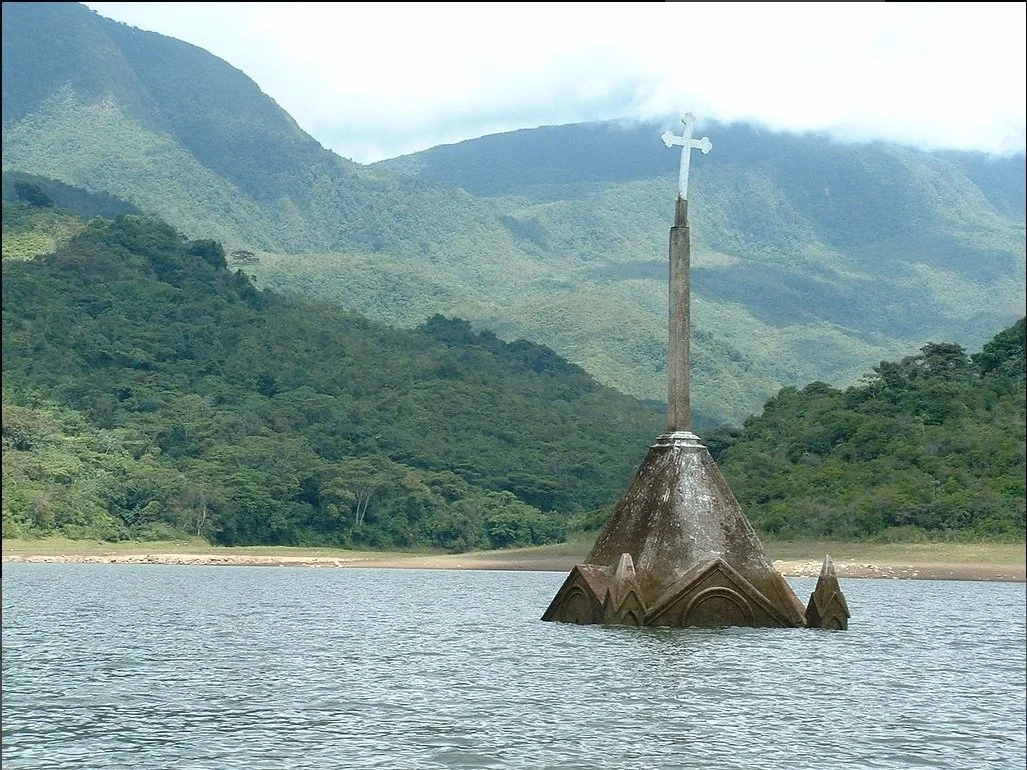
Underwater church of Potosi. Juan Tello. CC BY 2.0
Much like San Roma de Sau, only a part of a gothic church spire juts out from the underwater city of Potosi. The waters of the Uribante Reservoir flooded the town in 1985; the Venezuelan government hoped that a hydroelectric dam could replace the 1200 residents of the town. Houses and churches were abandoned in 1985 for the scheduled flooding. Yet, the gothic church of Potosi has re-emerged due to severe droughts in Venezuela, most probably a result of the natural disaster, El Niño. 30 years after the flooding of the city, its church’s structure has been uncovered.

Su Ertekin-Taner
Su Ertekin-Taner is a first year student at Columbia University majoring in creative writing. Her love for the power of words and her connection to her Turkish roots spills into her satire, flash fiction, and journalistic pieces among other genres. Su hopes to continue writing fearless journalism, untold stories, and prose inspired by her surroundings.
How Quechua Women Keep Stories Alive Through Their Hats
Having long been mistreated, Indigenous Quechua women have found ways to honor their ancestors and stories with their unique hats, which form an integral part of Peruvian culture.
Read MoreFree Airline Tickets To Hong Kong?
To bring back tourism, 3 airlines are offering 500,000 free air tickets.
Read MoreThe 10 Most Pet-Friendly Cities Around the World
From the solemn streets of Berlin to the lively waterways of the Netherlands, here are 10 places to visit with your beloved furry friend by your side.
Read MoreHow Ancient Ghanaian Culture Shapes Sea Turtle Conservation
Ghana’s ancient admiration for sea turtles has inspired a modern conservation movement to protect these ecologically vital animals.
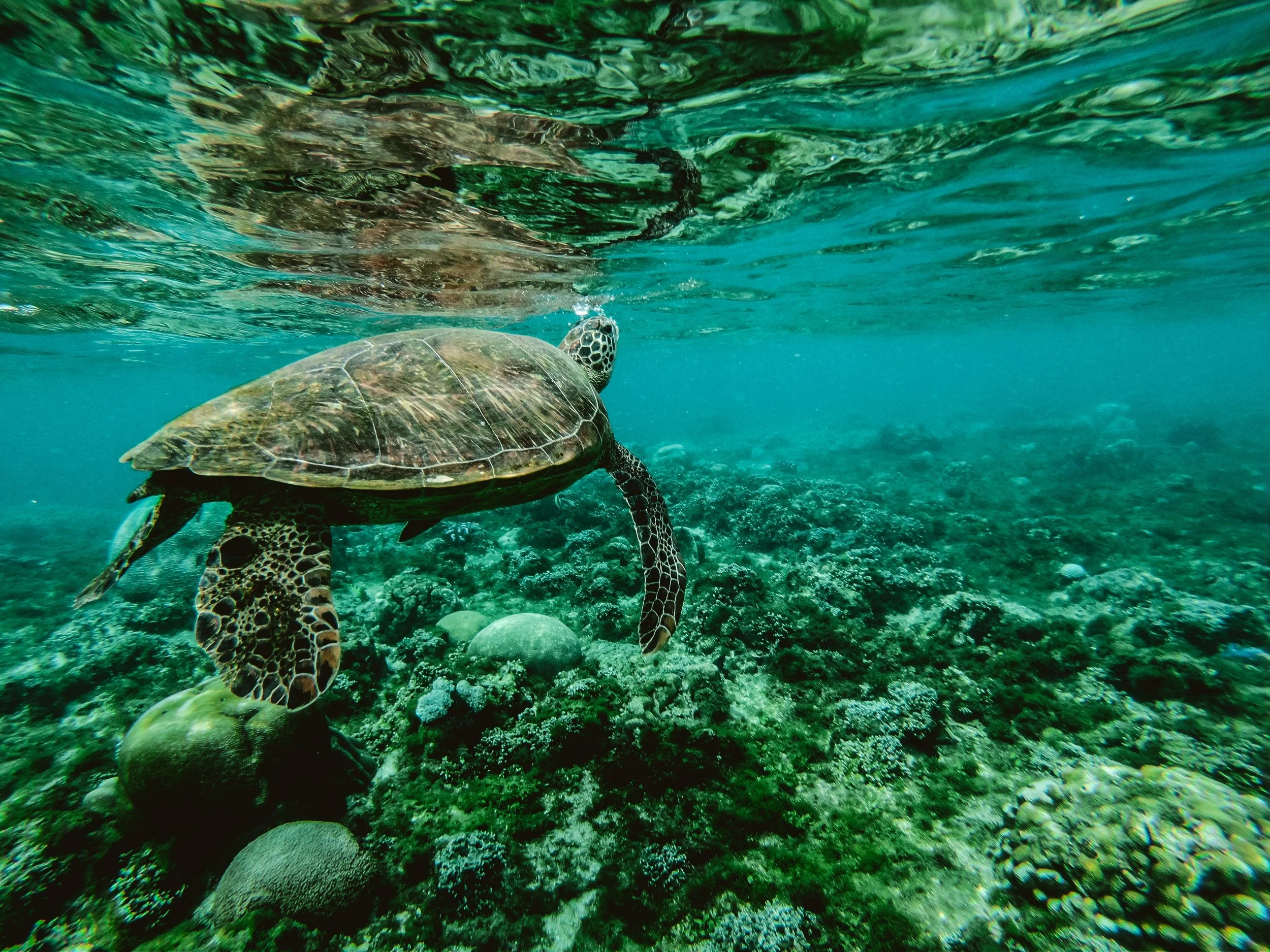
Sea turtle swimming in the ocean. Belle Co. CC0.
Ghana is a vibrant country located in West Africa, bordered by Côte D’Ivoire, Burkina Faso and Togo. It is known for its rich culture, stunning beaches, and diverse wildlife. As a traveler, you would likely find Ghana to be a lively country, full of colorful markets, bustling streets, and a unique mix of traditional and modern cultures. Perhaps most importantly, Ghana is known for the warmth and hospitality of its people, where you’ll be met with a welcoming and friendly nature.
Ghanaian people are also very spiritually attuned, whether it’s native African spirituality or more newly introduced Christianity. They are very fond of their cultural and religious traditions, one of which is long-standing is their long standing connection to sea turtles.
Sea turtles have been a part of Ghana’s culture and folklore for centuries, with oral literature depicting these animals as protectors, helpers or even guides. Moreover, the reptiles are integral to Ghana’s ecology, as they help to maintain coral reefs and seagrass, which in turn ensure continued biodiversity.
It wasn’t always this way, as with Urbanization came poverty, and with poverty came poachers. These poachers saw the Sea turtles not as protectors but as a source of profit. Now, having returned to their traditions, Ghanaians are more determined than ever to protect and conserve these animals in hopes to prevent their extinction.
All over Ghana, there are different recorded myths and stories that show the ancient connection between Ghana and sea turtles.
The Ga and Akan ethnic groups of central Ghana have a story about their ancestors and how they once were caught in a storm while fishing, in which their boat had sunk. It is said that as the men were struggling in the choppy waters, the sea turtles arrived and helped them get back to shore.
The Dange people of eastern Ghana have a story in which their ancestors were trying to retreat after Ashanti armies had them cornered against the Volta River. They recount how both the crocodiles and the sea turtles helped them safely cross the river, by having the crocodiles form a bridge, while sea turtles helped heal the injured and guided the elderly across. It is said that to this day, both animals are fully protected in this region of Ghana.
Sea turtles in Ghana have been protected by law since 1971. Even then, there are still poachers, so just that isn’t enough. The Ghana Turtle Research Project (GTRP) has been around for more than 10 years. The organization encourages community members to participate in sea turtle conservation and to embrace their culture and traditions. By doing so they were able to get more than fifty community members to form a volunteer network. They also helped to tag and identify where turtle species reside most often in order to make sure that fishermen avoid those areas and to ensure they are safe-guarded.
Additionally, the Environmental Justice Foundation (EJF) is an organization that was focused on protecting nesting sites in the fishing communities of central Ghana. In 2019, during the first turtle nesting season (of that year), they were successfully able to deter poachers from the Goma Fetteh region.
As more and more Ghanaian communities return to their traditional and spiritual beliefs, more people are caring about the sea turtles. It’s due to the oral traditions in Ghanaian culture that these conservation efforts were possible, as they make people care more about these creatures of the sea. They helped form an everlasting connection between the sea turtle and man.
Kadija Diallo
Kadija is a student at Georgia State in Atlanta, Ga. She is a creative spirit who loves traveling and seeing new places. She also enjoys using her love for writing/storytelling to make an impact on the world. One day she hopes to make new connections and share stories as she travels to every continent.
How Fast Food Adapts to Local Tastes Around the World
Exploring unique regional items from KFC, McDonald’s, Pizza Hut and other fast food giants.

Fast Food Mull. Tim Reckmann. CC BY 2.0.
Fast food is a universal language that transcends borders and cultures. Whether you are craving a burger in Beijing or a pizza in Paris, you can always rely on fast food chains to provide a consistent, reliable experience. However, in the modern world, fast food chains are constantly adapting to local tastes and incorporating unique ingredients to create various flavor combinations. Here below is a flavor adventure that explores the wacky and wonderful world of region-exclusive fast food items.
1. Kentucky Fried Chicken

Kentucky Fried Chicken in Shanghai. Gwydion M. Williams.CC BY 2.0.
Kentucky Fried Chicken, or KFC for short, has come a long way since its humble beginnings in Corbin, Kentucky. Today, the iconic fast food chain can be found in almost every corner of the globe, serving up crispy fried chicken to hungry customers worldwide. But while the Colonel’s original recipe may be the same everywhere, KFC has become famous for its wildly creative region-exclusive items. For example, in the United Kingdom, KFC has introduced the “Scoff-ee Cup”, a creation that combines a biscuit cup with white chocolate to keep coffee hot and fingers crispy. Meanwhile, in Asia, KFC has rolled out some innovative treats, like the Brown Sugar Boba Tea Tart, a pastry filled with milk tea custard and boba jelly, inspired by the popular Taiwanese drink.
But KFC’s regional items are not just about sweet treats. In Korea, the chain offers Tender-Rice, a combo of crispy chicken tenders and seasoned rice. And in Malaysia, customers can try the Wasabi Rice Wrap, a fusion of Japanese and Vietnamese flavors that is designed for people on the go. According to Ling Mee Jiuan, Senior Vice President of KFC Malaysia, the Wasabi Rice Wrap was designed specifically with young, busy consumers in mind. The local team wanted to create something that was quick, convenient, and bursting with flavor for people who are always on the move.
2. McDonald’s

McArabia. Tracy Hunter.CC BY 2.0.
McDonald’s is the poster child for the rapid spread of Western fast food across the globe. The term “McDonaldization” was coined to describe what started as a Speedee Service System, which prioritized efficiency, predictability, calculability, and control by offering a limited menu of 15-cent hamburgers, fries, and shakes. However, McDonald’s has slowed its pace and started introducing region-exclusive items that cater to local taste buds. For instance, in 2001, McDonald’s added the McFalafel sandwich to its menu in Egypt. This sandwich features three pieces of falafel, a patty-shaped fritter of Arab origin that is deep-fried and served with garnishes like tomatoes, lettuce, onions, and pickles, all wrapped in a freshly baked tortilla wrap and topped with Tahini sauce.
But McDonald's is not just adding local twists to its burgers - the company also creates entirely new menu items for specific regions, you can find the Teriyaki Burger, which features a savory teriyaki sauce and is served on a rice bun instead of a traditional burger bun. In South Korea, McDonald's offers the Bulgogi Burger, which features marinated beef and a spicy sauce made from Korean chili paste.
McDonald’s has also tailored its famous bread to suit local palates. In China, for instance, McDonald’s introduced the distinctive Black and White Burgers. These “half burgers” were packaged in a small box and were possibly inspired by the yin-yang symbol. The black burger consisted of a beef patty with chopped onions, black pepper sauce, and a black bun topped with white sesame seeds. The white burger, in contrast, featured a chicken patty with sweet and spicy sauce and a white bun with black sesame seeds. While some of these attempts at innovation were mocked, they demonstrate a willingness to experiment and accommodate local tastes.
3. PizzaHut

Pizza Hut Pizza in Japan.Yoko Nekonomania.CC BY 2.0.
Founded in 1958 by two Wichita University students, Pizza Hut has grown to become the world's largest pizza company, with over 11,000 restaurants in 90 countries. But Pizza Hut's success isn't just due to its massive size - the company’s commitment to innovation and customer service has set it apart from competitors.
However, some of Pizza Hut’s more unconventional offerings have raised eyebrows, and possibly even the ire of traditionalists. Weirder items, such as the “Double Sensation” in Singapore, may seem like two pizzas squished into one. The outer crust is stuffed with a melange of melted mozzarella, Parmesan, and cheddar cheeses that ooze out of holes in the crust, while the outer pie is topped with turkey ham, bell peppers, mushrooms, and salsa sauce. And for reasons beyond comprehension, a single cherry adorns the center of the pizza.
Meanwhile, Pizza Hut in China has added Peking duck as a meat topping to its menu, alongside specialized pizzas crafted with different veggies to complement the duck’s unique flavors. For many, duck is not a meat that adapts easily to other dishes. But for the daring foodies who are willing to try new things, Pizza Hut in China offers a delicious and adventurous take on traditional pizza.
4. Burger King

Burger King Halloween Whopper Black Bun. Mike Mozart. CC BY 2.0.
In 1953, Keith Kramer and his wife’s uncle Matthew Burns were struck with inspiration after visiting the original McDonald's in California. Their brainchild, Insta-Burger King, was born from their desire to create a unique restaurant experience. Equipped with a special grill machine, the Insta-Broiler, the duo set out to make their mark in the fast-food industry.
Now, with over 19,000 locations worldwide, Burger King is a force to be reckoned with in the fast-food world. While its competitors strive to innovate their international menus, Burger King takes a different approach—stuffing as much as humanly possible between two buns. Take, for example, the Bacon Lover, available in France and Switzerland, which boasts two flame-grilled beef patties, onions, tomatoes, cheese, bacon, and smoked sauce, all served between two bacon-studded buns.
But the Garlic Meat Beast in Japan takes the cake for the most outrageous offering. This monstrosity features a quarter-pound beef patty, teriyaki chicken breast, and garlic pork patty, all slathered in scallion miso sauce and topped with lettuce, tomato, onion, and bits of fried garlic. And if that’s not enough to satisfy the consumers, Burger King‘s Windows 7 Whopper hit Japanese locations for a limited time, featuring a whopping seven beef patties, plus all the usual fixings, for the price of $5.94, a nod to the release of Microsoft's Windows 7 operating system.
5. Taco Bell
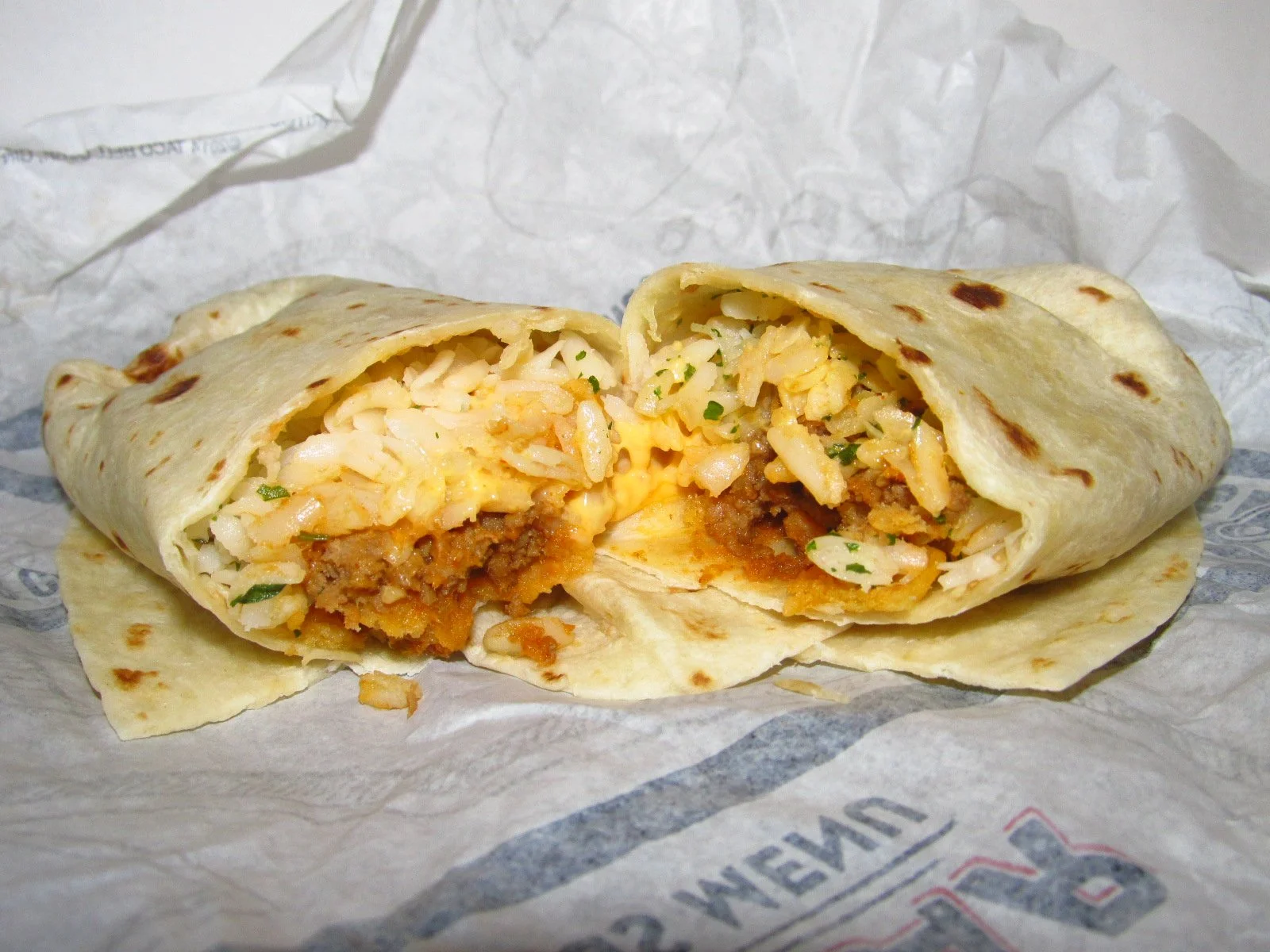
Taco Bell Beefy Fritos Burrito. Willis Lam.CC BY-SA 2.0.
Taco Bell is the new kid on the block when it comes to multinational fast food chains, but it has made its presence known around the world with its Mexican-inspired menu. The company’s catchy slogans, from “Think Outside the Bun” to “Live Mas,” have resonated with customers in Asia, Europe, and beyond. But Taco Bell’s true innovation lies in what's inside the bun (or wrap). Take, for instance, the Kimchi Quesadilla, which can be found at Taco Bell locations in Korea. This fusion dish combines the traditional Korean dish of spicy fermented cabbage with spicy chicken and a blend of melted cheeses, creating a unique flavor that is all its own. Or consider the Chicken Tikka Masala Burrito in India, where grilled chicken, Mexican rice, onion, cilantro mix, and Tandoori Mayo Sauce are wrapped in a grilled flour tortilla, showcasing Taco Bell's willingness to experiment with unorthodox flavor combinations. Other region-exclusive menu items include the Shrimp and Avocado Burrito in Japan and the Chili Cheese Burrito in the United States.
6. Domino’s

Domino’s pizza in Japan with Lazagniano and Super Deluxe. Puamelia. CC BY-SA 2.0.
Domino’s, the pizza giant with over 17,644 restaurants around the world, has managed to achieve a global presence with its menu. However, their international menu seems to be an experimental playground that has no bounds. Japan’s Boba Tapioca Pizza is a clear demonstration of the chain’s willingness to embrace bizarre combinations that cater to local tastes. The pizza’s blend of black tapioca pearls and mozzarella cheese has gotten mixed reactions from customers. While it is true that some of Domino’s experiments are not well-received, the Lotta-Chocca Pizza in the United Kingdom has won the hearts of many, thanks to its unique fusion of pizza and milk chocolate. Domino's New Zealand has also managed to make an impact with its Apricot Chicken Deluxe, a delicious combo of chicken and apricot sauce.
From rice and curry to kimchi to Beijing duck, the amalgamation of western industrialization and local cuisine gives rise to region-exclusive fast food items that are uniquely flavorful, providing a glimpse into the cultural diversity that exists across the globe. The presence of such multicultural menus in fast food chains not only reflects the dynamism of global markets but also serves as a testimony to the importance of inclusivity and open-mindedness in our increasingly interconnected world.

Hope Zhu
Hope is a Chinese international student at Wake Forest University in North Carolina studying sociology, statistics, and journalism. She dreams of traveling around the globe as a freelance reporter while touching on a wide range of social issues from education inequality to cultural diversity. Passionate about environmental issues and learning about other cultures, she is eager to explore the globe. In her free time, she enjoys cooking Asian cuisine, reading, and theater.
9 Historical Women Adventurers Who Pushed Exploration in the Last 100 Years
Despite facing prejudice and skepticism, these intrepid women adventurers conquered the world’s toughest terrain.
Read MoreThe Concept of Time in Different Cultures
How where you live and the language you speak affects your view of time.

Self portrait - Ticking away, MattysFlicks, CC BY 2.0.
Over the summer I would get up at about 7:00 am every morning. By 8:30, I’d have eaten breakfast, showered, gotten dressed, and left for work. When work ended, I’d make sure to always have a plan for what to do after, whether that was hang out with friends, work out, or write something. I’d usually be done with that by around 8, at which time I’d heat something up for dinner, usually a meal I prepared in bulk on the weekend. Afterwards, I’d watch shows until I fell asleep. The next day, I would get up, and repeat.
Like most other English speaking Americans, I view time as linear, heading from a defined beginning to a final end. Every moment is something that I can spend, save, or waste. And, I believe that if I waste too many of these moments, it could have a disastrous impact on my future.
However, this is just one of many ways to view time. Depending on where you live, what you believe, and what language you speak, you may view time in a completely different way.
Monochronic Time and Polychronic Time

Business Calendar & Schedule, photosteve101, CC BY 2.0.
Monochronic Time is divided into small segments, allowing it to be managed and scheduled easily. It is treated as a resource, just like any other. Being used by countries such as the United States, Japan, and Germany, monochronic time is essentially the time model of industrialization. People in monochronic societies tend to be on time to meetings; similar to the schedule I described above, every moment has a distinct purpose. Wasted time can cause great stress, and going off-schedule can mean that all necessary tasks may not get completed. This causes countries with monochronic time to typically have a faster pace of living. Even times of rest are often scheduled, regulating them to certain days or hours.
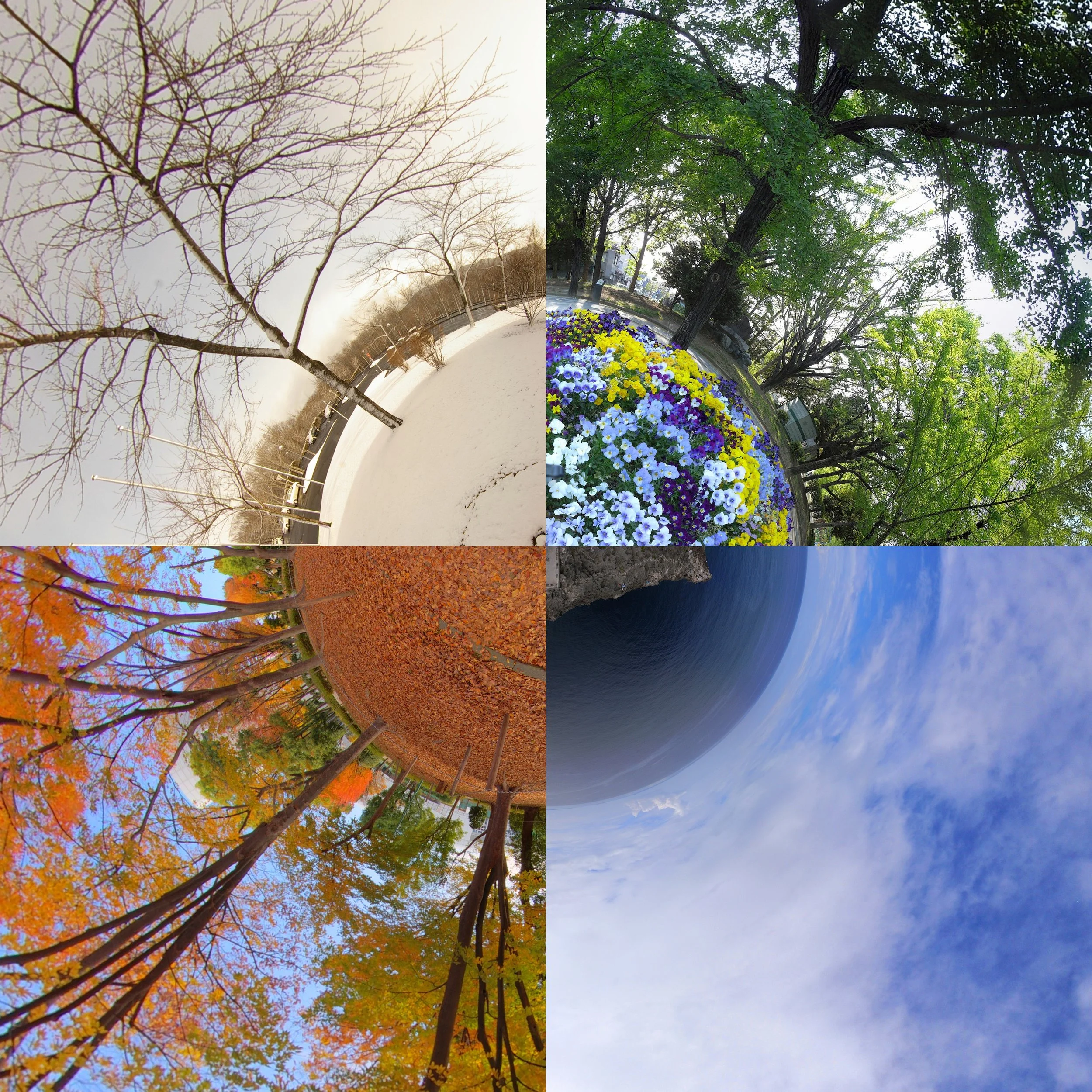
Four seasons in Japan, vitroid, CC BY 2.0
Polychronic time is much more fluid, where many things can be done at once. Rather than emphasizing the efficient use of each and every moment, people in polychronic societies tend to focus more on their relationships and traditions. Instead of organizing time through rigid schedules, for people in these cultures the seasons, religious calendars, and community life serve as the main signs of the passage of time. India, Mexico, and many other countries in Latin America are Polychronic.
I am currently studying abroad in Ecuador, a largely polychronic country, where I have had to adapt to the different view of times. Unlike the United States, deadlines are rarely strict. I’ve frequently been told lunch is at 1, and then ended up not eating until 2:30. In addition, planning is often more last second. I have lived with two host families, and we often have weekend plans. In each case, I have rarely known said plans until I’m on the way to my destination. While this was stressful for me at first, I have come to appreciate it, as my host families have seemed to have a much easier time living in the present because of it.
Past, Future and Present Oriented Societies
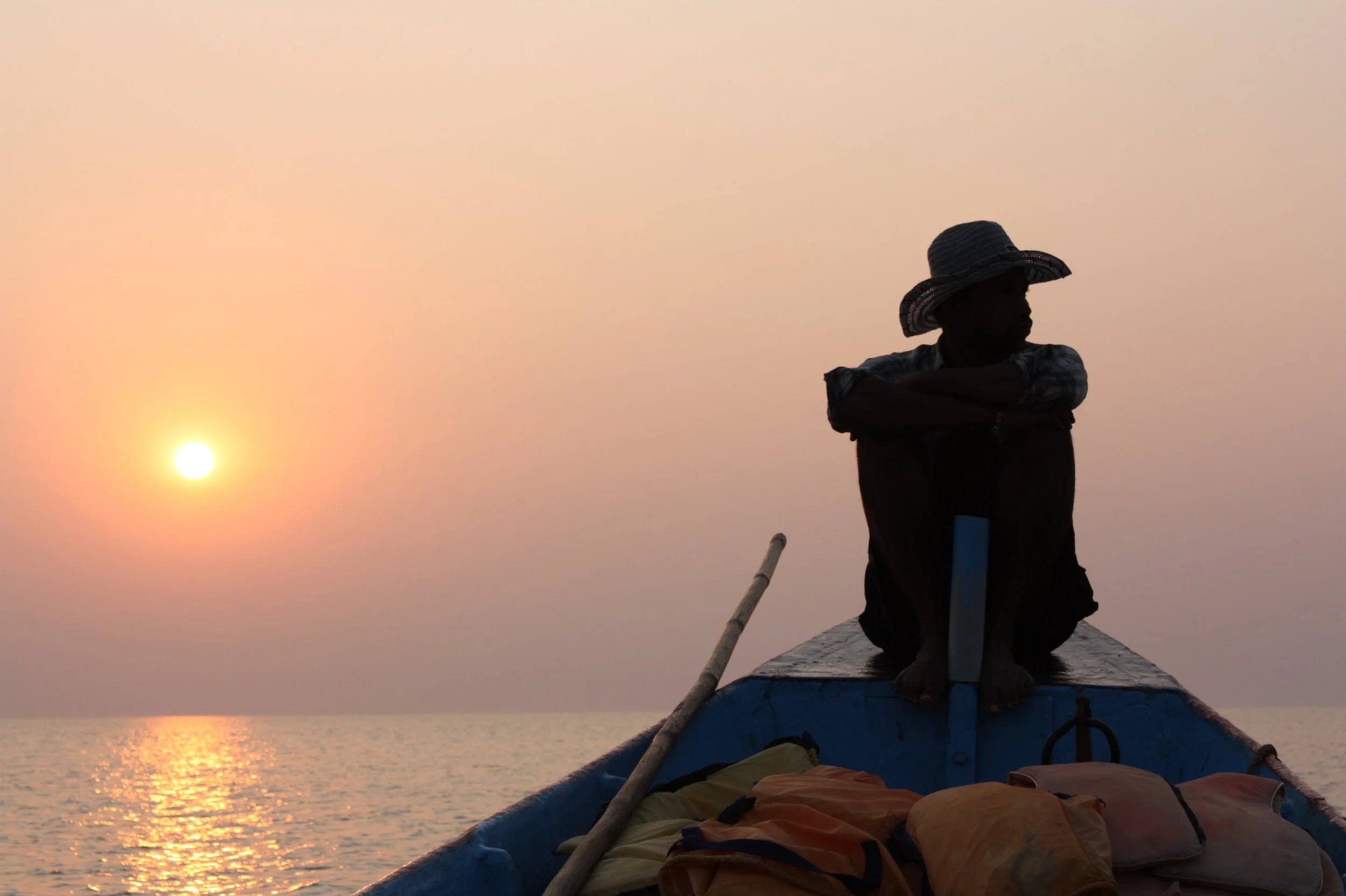
Go Fisherman go - Gokarna India 2011, rundenreisen.org, CC BY 2.0
Past Oriented Countries, like the UK or India, have incredibly long and storied histories. Instead of living for the present alone, past oriented societies see themselves as only the newest iteration of an incredibly old tradition. This causes them to view time in a more casual manner, as the waste of an hour or a day is inconsequential when compared with thousands of years of history.
In addition, many eastern past oriented countries adhere to what is called cyclic time. This is the idea, that like the seasons, time repeats itself, and events are bound to happen again. This means that, whenever considering a major decision, it is critical to evaluate the events of the past.
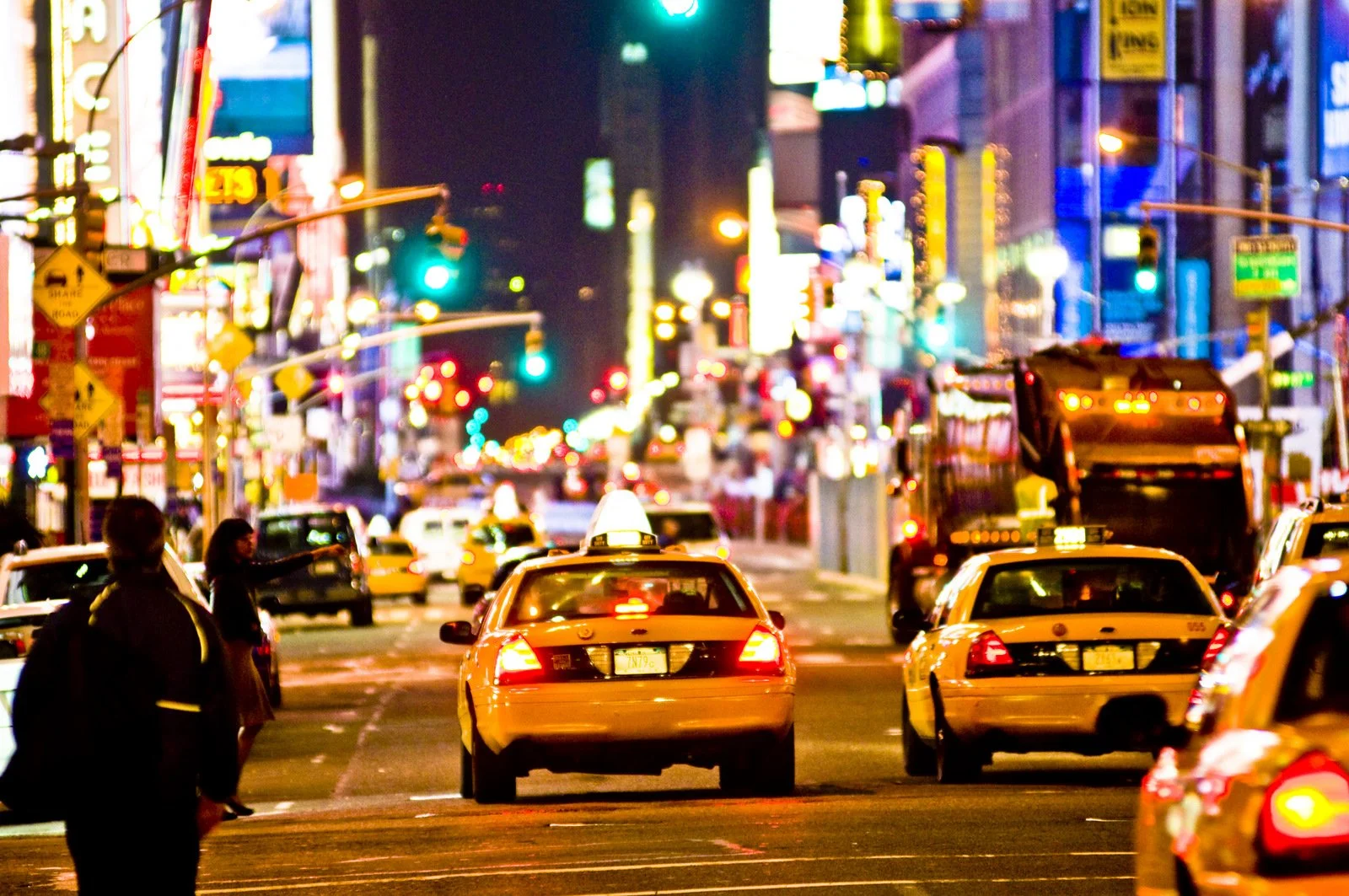
Getting cab times square, new york, andre stoeriko, CC BY-NC-ND 2.0
Future oriented countries, like the United States, are young and hungry. Without thousands of years of culture to fall back on, citizens of the United States tend to look forward. In future oriented countries, every moment matters, as only by maximizing these moments can a person truly succeed.
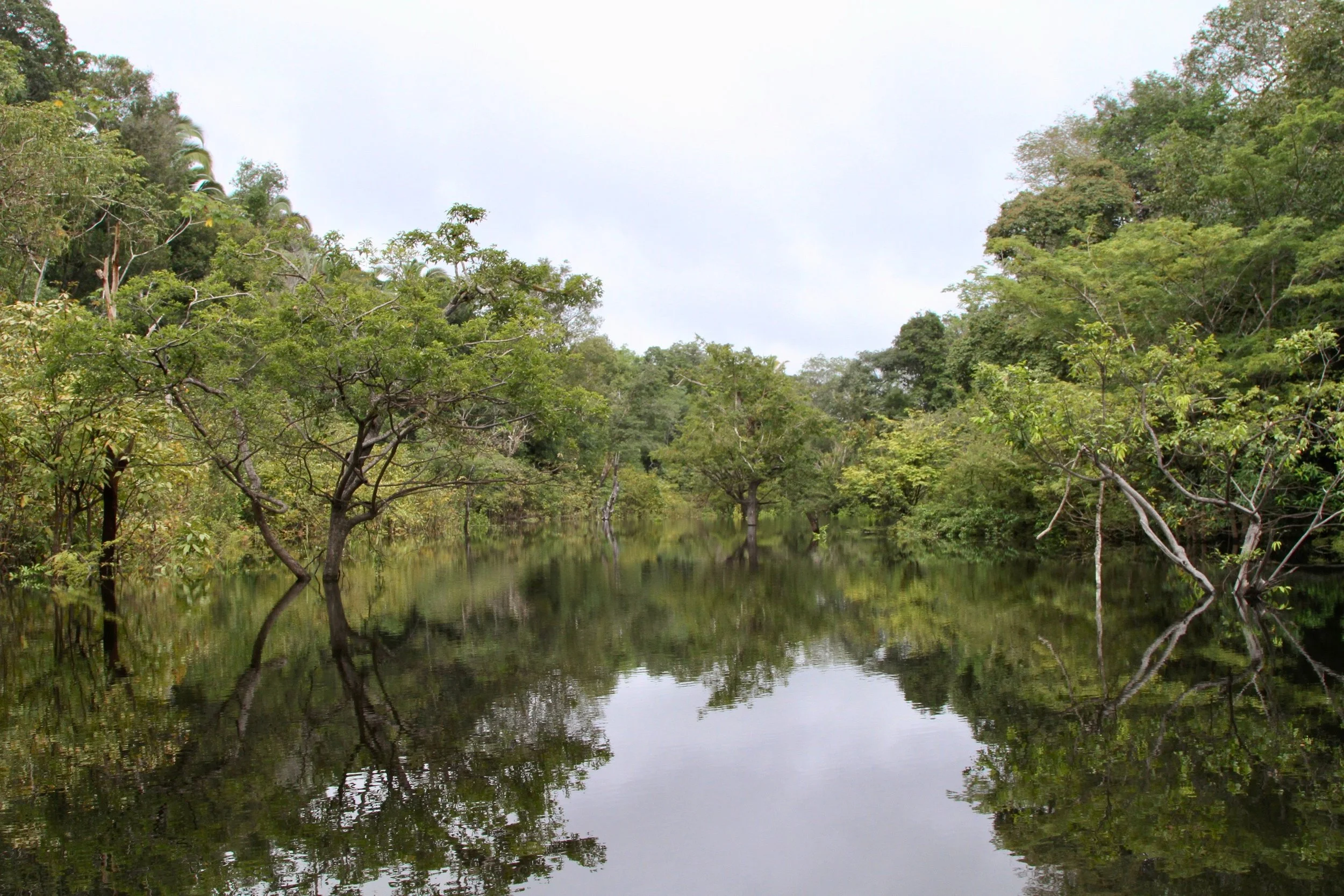
Juma River, Amazonas, Brazil, Alexey Yakovlev, CC BY-SA 2.0
Present Oriented Societies are rare, but they do exist. The Indigenous Piraha tribe of the Amazon Rainforest has no past tense in their language. They have no origin story or particular religious beliefs, no reverence for their ancestors, and tell no stories. For them, things just are. What has happened in the past is not relevant.
Language and Time

Washing line, Kate#2112, CC BY 2.0.
Anglophones usually think about time as something that has length. Phrases such as “a long day” or “a never-ending year” are common. In Swedish, time is viewed in this same way.
In Spanish, days are described as “full,” instead of long. Rather than as a line, time is visualized as a container waiting to be filled.
This is most interesting when it comes to bilingual speakers, as it has been proven that they have the ability to, in switching languages, change how they view time. If someone bilingual is spoken to in English, they will view time as a line, and if they are spoken to in Spanish, they will visualize it as a container, giving them a foot in both worlds.

Jeremy Giles
Jeremy is a Writing Seminars and International Studies major at Johns Hopkins University. He is an avid writer and the Co-Founder of Writers’ Warehouse, Johns Hopkins’ first creative writing group. He is an advocate for Indigenous rights, and studies how Indigenous philosophies can be used to help prevent climate change. Using his writing, he hopes to bring attention to underrepresented voices in today’s world.
Travel to NYC, Not for Times Square, but for the Parks
Check out the many green areas in NYC where culture and nature abound.
Read MoreSkellig Michael: Monks, Star Wars, and More
The island where fantasy meets reality.
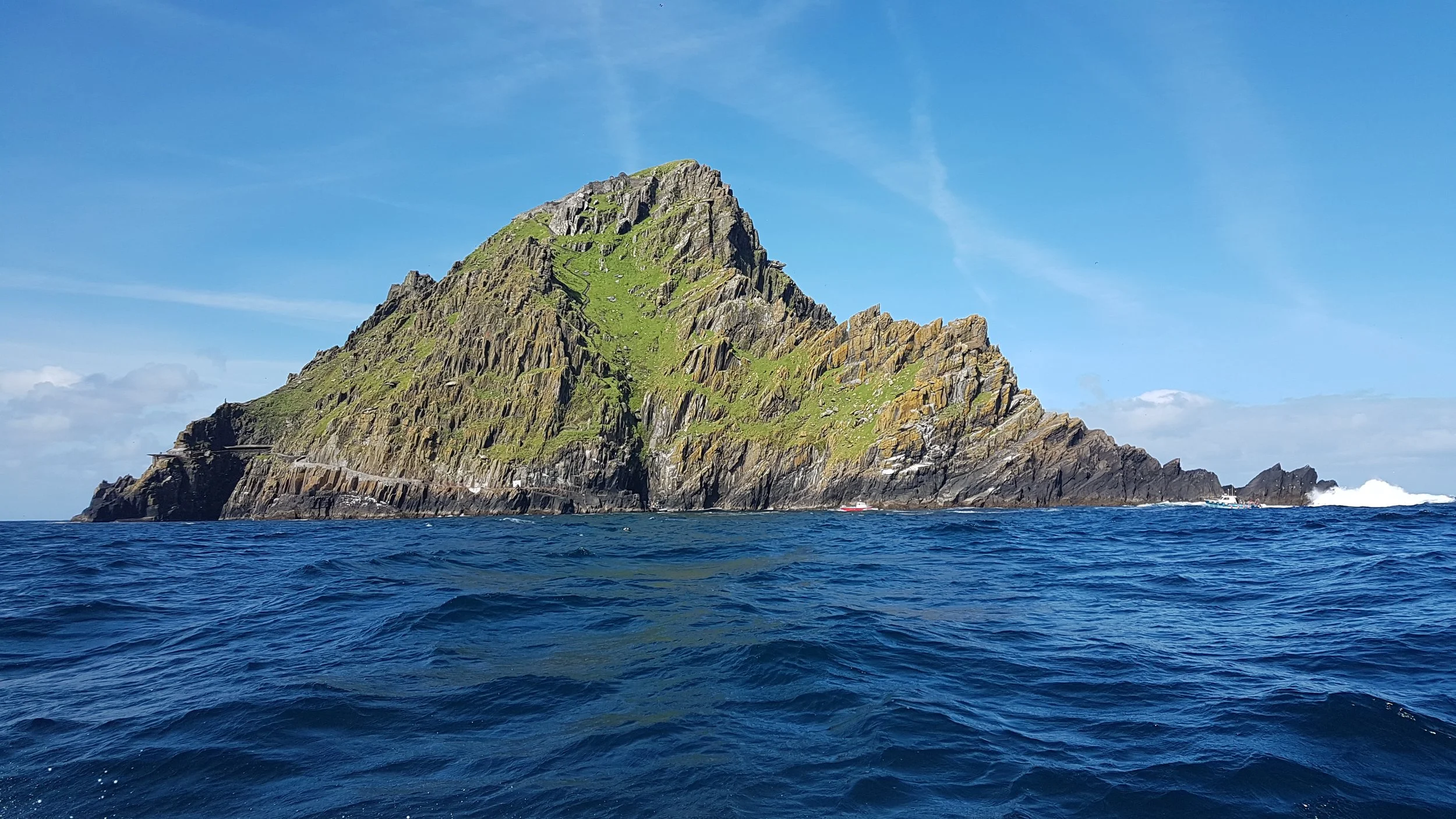
Skellig Michael, Stinglehammer, CC BY-SA 4.0
Between the 6th and 8th century, about a dozen monks devoted to St. Fionán sailed 8 miles away from the Irish coast through unpredictable and often violent weather to reach their new home, the jutting rock of Skellig Michael. Once there, they scaled the steep mountain all the way to the top, building beehive-shaped huts out of stone to live in. Once on that lonely isle they centered their lives around God, praying seven times a day. Without cattle or other sources of food they survived off of fish, seabirds, and the vegetables they could grow in their monastery gardens. Generations of determined monks lived there for over 600 years, surviving multiple viking raids, before climate change forced them to leave.They built their homes so well that even today, over 1,400 years later, their original stone huts still stand on the island.
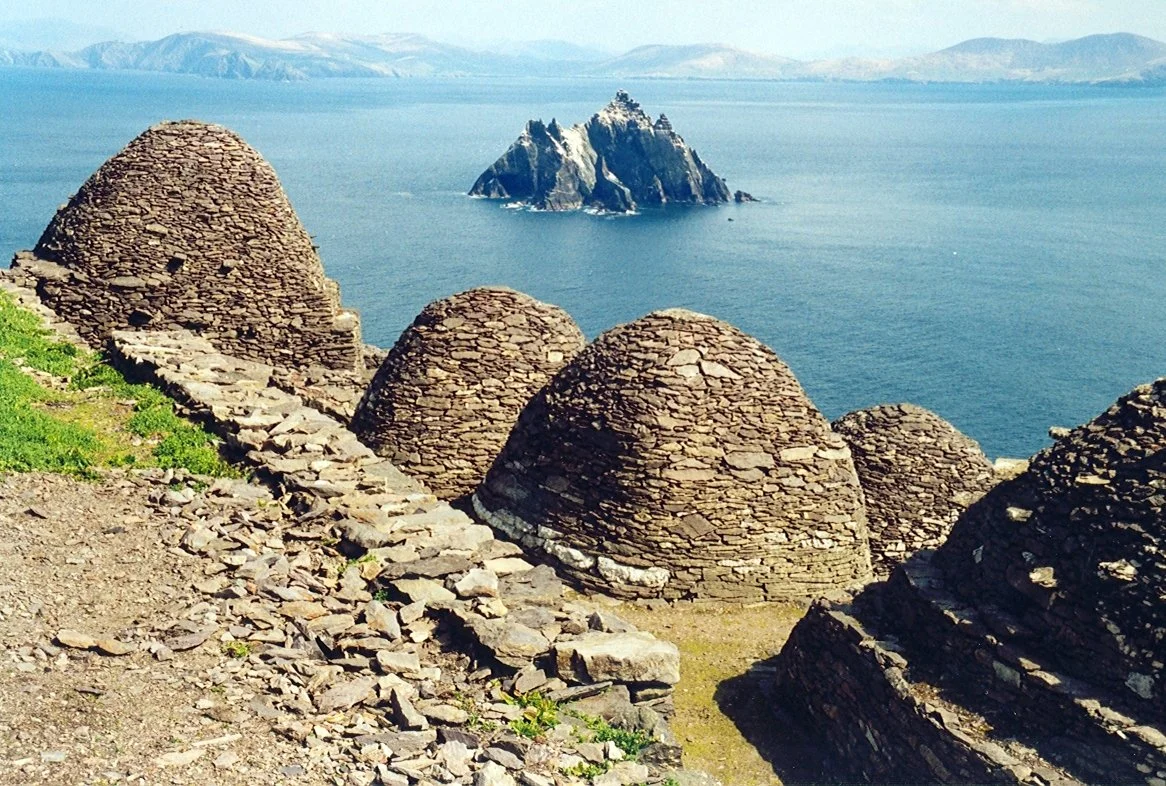
Skellig Michael Beehive Cells, Arian Zwegers, CC BY 2.0
In the far away world of Star Wars, Skellig Michael, renamed to Ahch-To, is where the monastic Jedi Order was born. It is there that the ancient Jedi texts are located. Longtime protagonist Luke Skywalker spent many years searching for the birthplace of the Jedi, eventually realizing it was Ahch-To. It became the natural place to seek exile once his Jedi Temple was destroyed. At least, until he was found by next-generation hero Ray at the end of Star Wars VII: The Force Awakens.
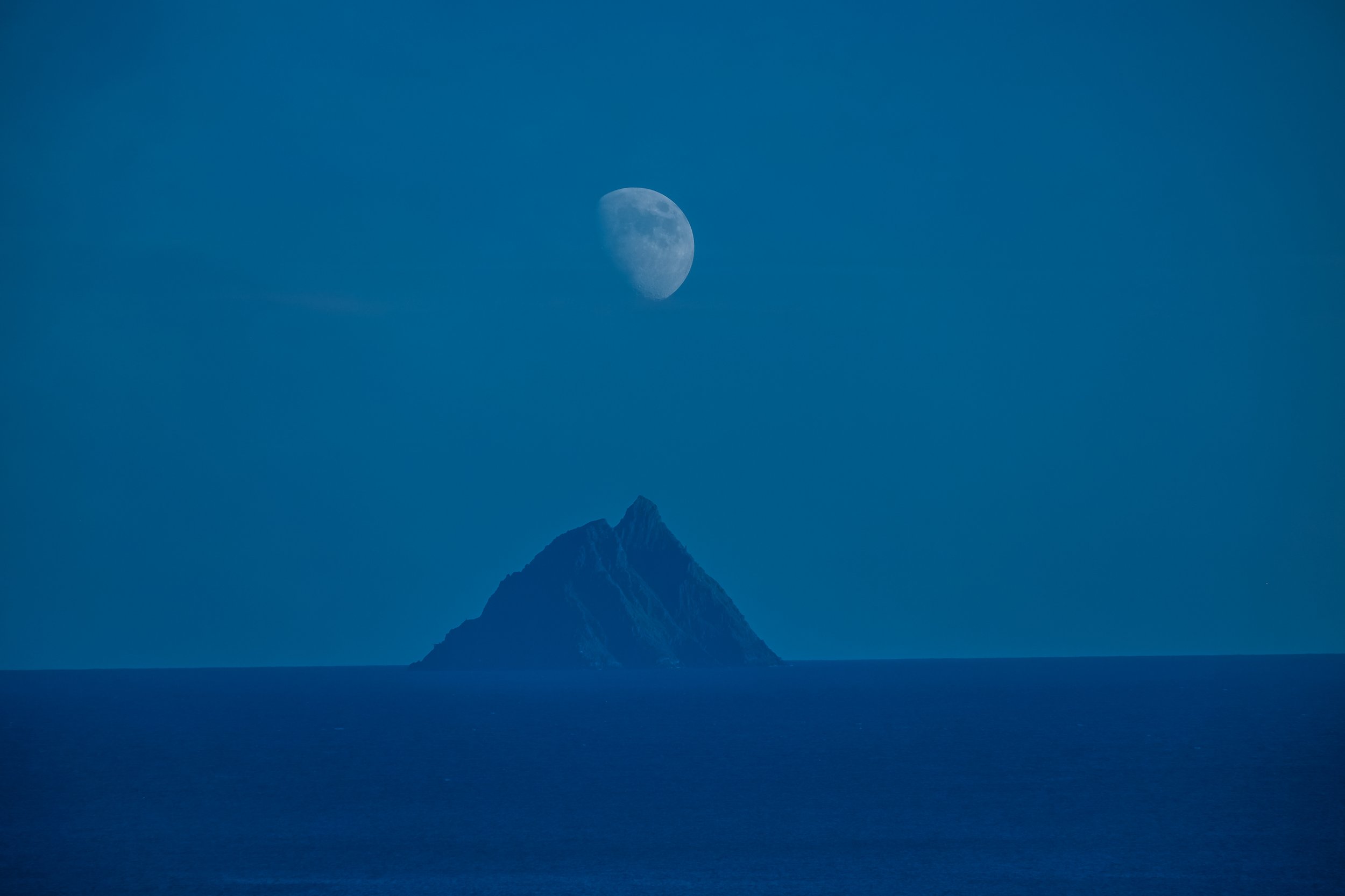
Mystical Skellig Michael, Beyourbest2, CC BY-SA 4.0
Today, Skellig Michael, or “Ahch-To” as it's affectionately known by Star Wars fans, is both a UNESCO World Heritage Site and likely the most stunning film location in one of the highest grossing movies in U.S. box office history.
When he was first sent a picture of Skellig Michael JJ Abrams, the creator of the three newest Star Wars films, immediately emailed back “this is the best,” He quickly decided to film there, despite incredible difficulties. Due to the island’s unstable weather conditions only the most iconic shots were done on Skellig Michael itself, with the rest being filmed in different locations throughout Ireland. In addition, Abrams used more than the island’s physical structures. He based the adorable birdlike Porgs on the island in the Star Wars movies on the real life puffins that scamper all over Skellig Michael in real life.
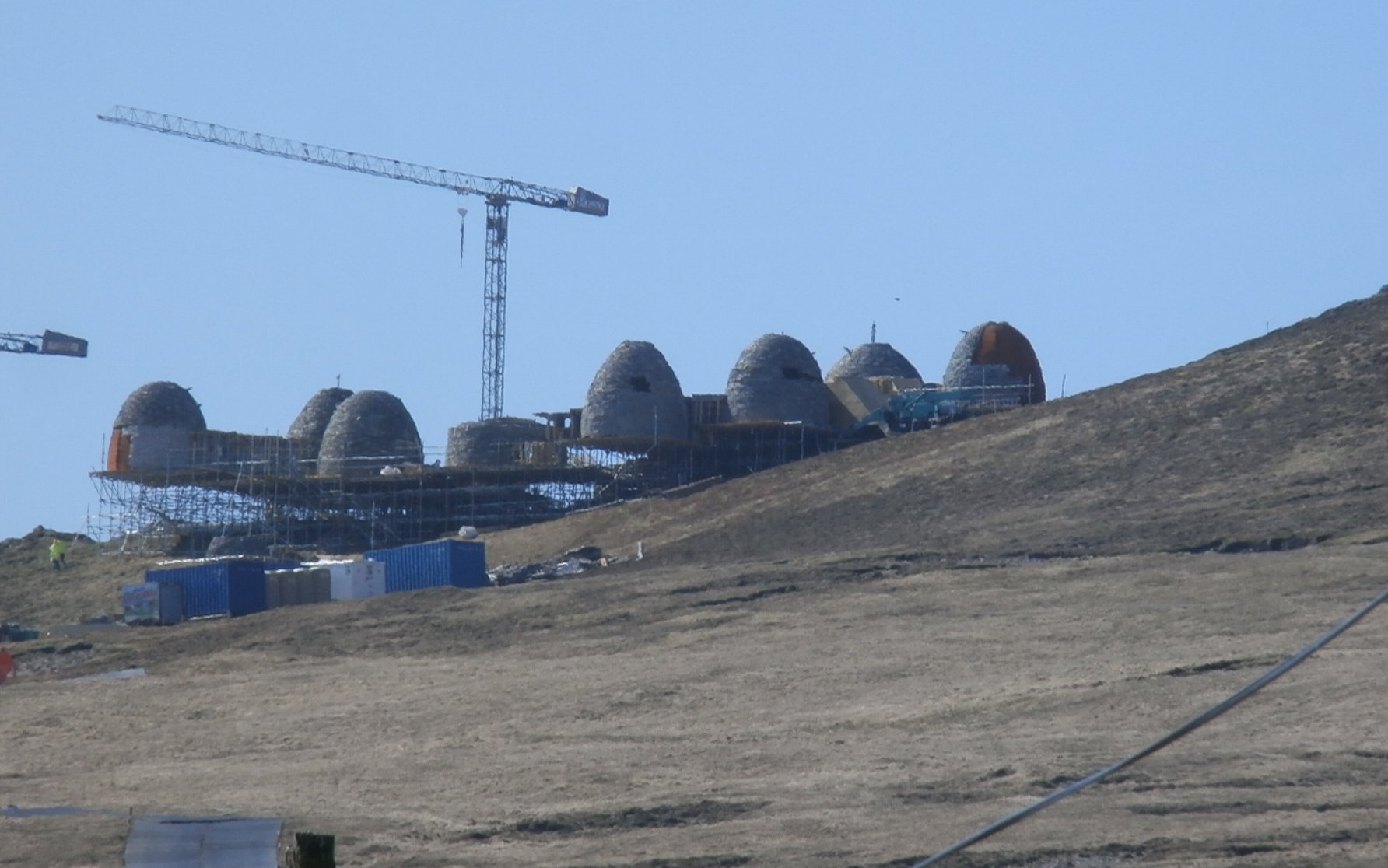
Star Wars Filming Location, Myrtle26, CC BY-SA 2.0
It's important to note that while shooting Star Wars on Skellig Michael gave the island a lot of publicity, it came at the cost of damage to the local ecosystem. Little Skellig, the sister island of Skellig Michael, is home to the second largest gannet colony in the world, and any helicopter used to fly in equipment risks knocking gannets out of the air. Skellig Michael itself is the home of rare seabirds. The first time the Star Wars crew shot on Skellig Michael was in July 2014, in the middle of seabird breeding season. By the time filming was done four of the sixteen conditions set to protect the island had been breached.
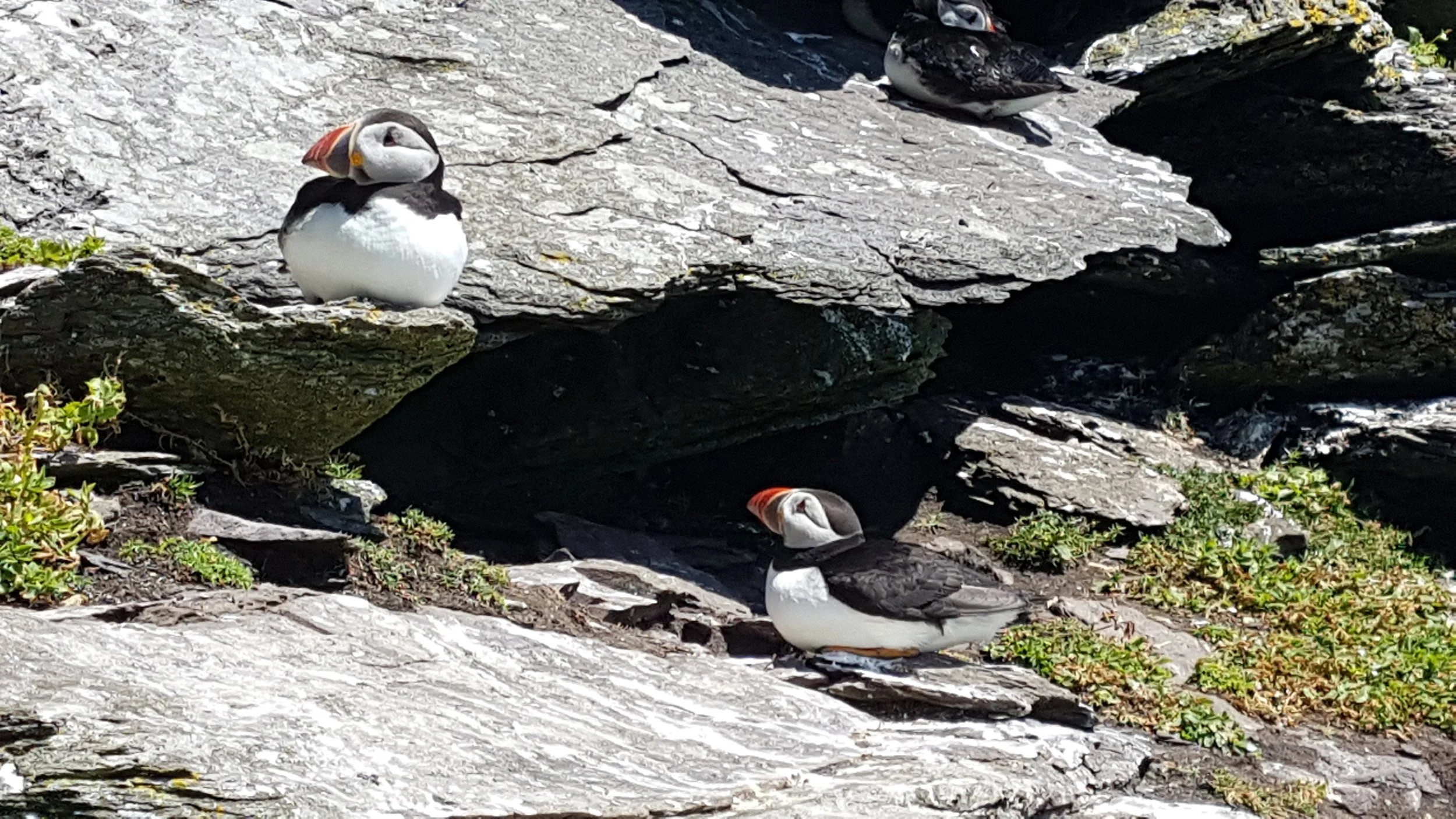
Puffins on Skellig Michael, Stinglehammer, CC BY-SA 4.0
Today, Skellig Michael can be visited between the Months of May and September. It is not, however, easy to reach. Only 180 people are permitted to visit Skellig Michael each day. Beyond that, about two days per week trips to Skellig Michael are canceled due to poor weather; due to scarcity, canceled voyages are almost impossible to reschedule.
Despite all of this, those persistent and lucky few who are able to venture to Skellig Michael are rewarded with the opportunity to see the spot where history and nature met Star Wars.
Jeremy Giles
Jeremy is a Writing Seminars and International Studies major at Johns Hopkins University. He is an avid writer and the Co-Founder of Writers’ Warehouse, Johns Hopkins’ first creative writing group. He is an advocate for Indigenous rights, and studies how Indigenous philosophies can be used to help prevent climate change. Using his writing, he hopes to bring attention to underrepresented voices in today’s world.
Yakutia: One of the Coldest Places on Earth
This Russian region experiences temperatures as low as -70F and its residents live drastically differently than people who live in warmer climes.
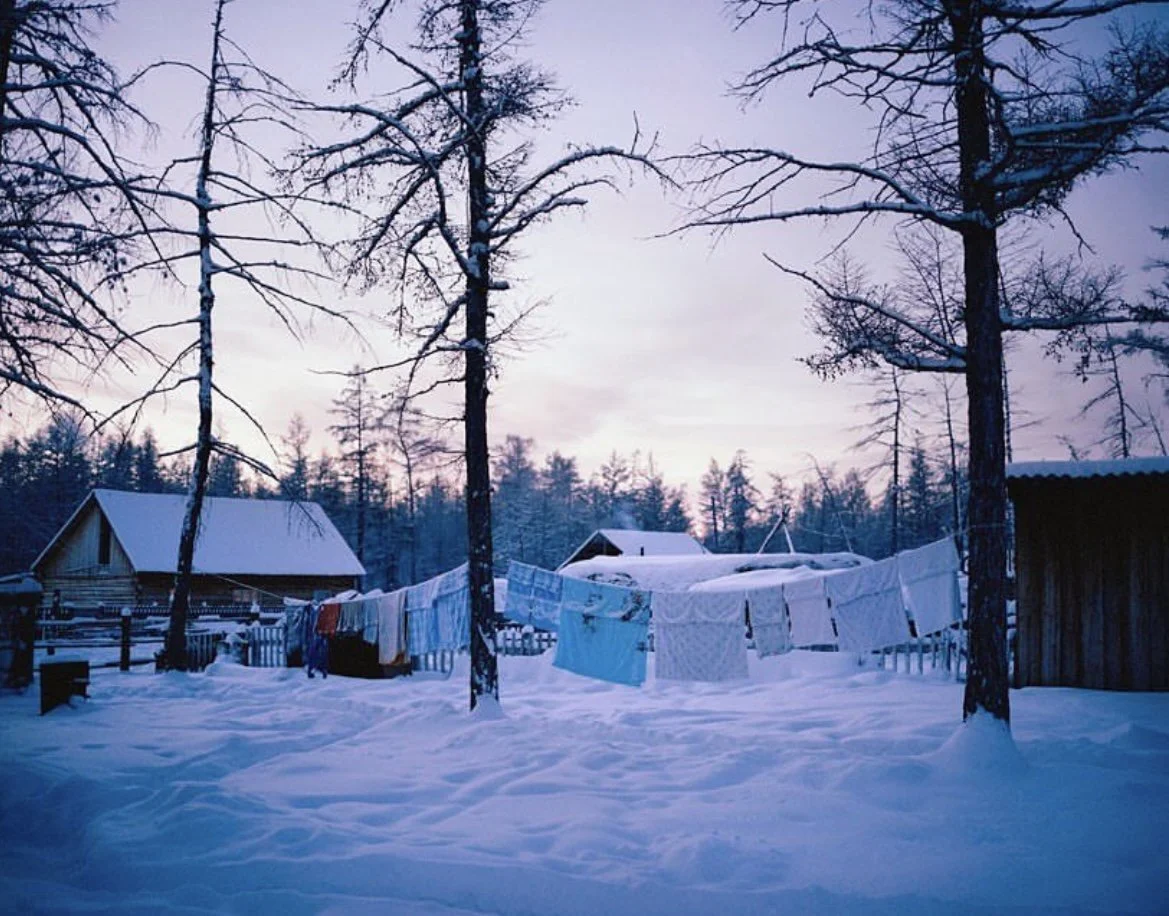
A village in Yakutia during the winter. @simoncroberts. Instagram.
It is seven AM. The sun hasn’t risen yet, but you’ve already gathered enough wood to heat your house for 9 months straight, in anticipation of the severe climate outside. You head to the back shed to grab the ice you harvested last November and put it in a giant tub of water to melt, ensuring that your family has something to drink when the water pipes will freeze. Now it’s time to make breakfast and wake your child up for school — because even though winter has finally arrived it’s warmer than -65 degrees Fahrenheit, which means it is safe to go outside.
This is how residents of the northern reaches of the Sakha Republic, common name Yakutia, live during the long winter months. Yakutia is located in Russia and is home to some of the coldest continuously inhabited places in the world. In villages like Oymyakon, located in the far north, the sun doesn’t rise until approximately 9am and sets at 2:15pm, meaning students have to walk to and from school in darkness.
Ten minutes in the cold, fresh air is enough to cause fatigue, stinging pain in any of the exposed parts of your face, and long-lasting aches in the fingers and toes. This is why many houses in the region are made of wood and built to withstand the extreme temperatures by filling every gap with oakum, a sealant made from plant fibers and tar, or even just the abundant snow, although the cold still finds its way through at times.
The Yakut people have learned to be productive in these conditions. Most men in the Republic’s far north have traditional jobs like cattle ranching, hunting, or making crafts, living lives that hardly resemble those of urban Russians. Knife-making plays an important role in the Yakut culture, with the blades known around the world for their strength and beauty.
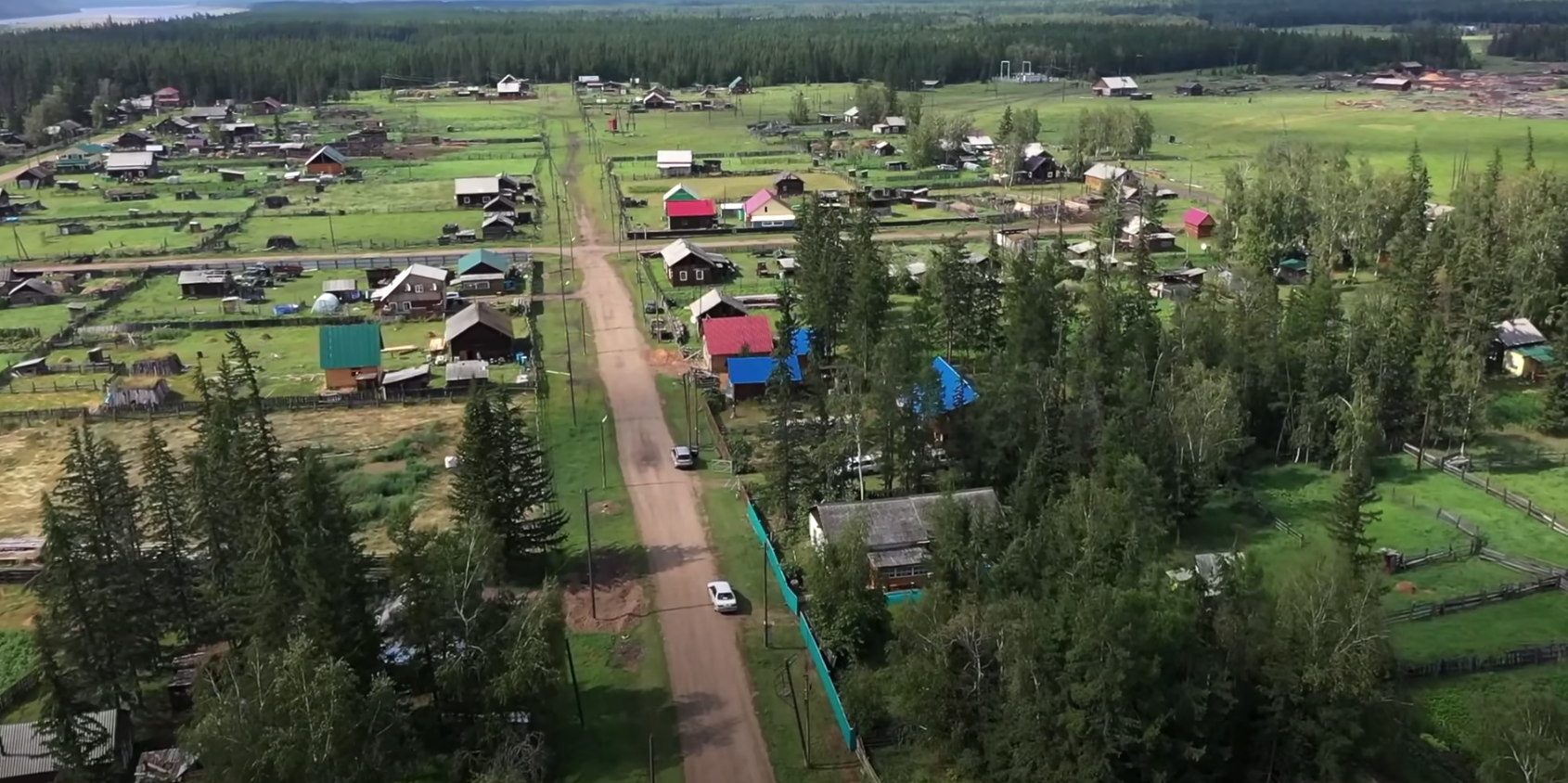
Summer in a Yakutian village. @Kiun B. YouTube.
When summer comes around, Yakutia becomes a completely different place. While winter temperatures can plunge down to -70 degrees Fahrenheit, in the dog days of summer the weather can get to around 86 to 95 degrees, particularly at the end of July. Summers may be short-lived — only lasting 2.5 months — but it is also the busiest time of the year for Yakut people.
It is crucial to harvest berries before the frost sets in if one wants to eat fruit during the winter., A failure to harvest the hay needed to feed the cattle in time can lead families to lose their valuable livestock.
But with hard work comes a refreshing reward. During the summer, Yakutia turns from a snowy kingdom into a lush meadow full of dense forests. Many Yakuts take advantage of the balmy heat, and head straight to the nearest lake for a swim.
Yakutia is often called the land of rivers and lakes. There are over 700,000 rivers and 800,000 lakes that are rich with aquatic life, which is the perfect opportunity for Yakut people to stock up on food for the winter months.
Although Yakutia is by no means a popular tourist destination, the region is gaining more attention on YouTube and has fascinated viewers around the world. With increased visibility facilitated by modern communications technology , it will be no surprise if curious minds begin to pay attention to Yakutia.

Michelle Tian
Michelle is a senior at Boston University, majoring in journalism and minoring in philosophy. Her parents are first-generation immigrants from China, so her love for different cultures and traveling came naturally at a young age. After graduation, she hopes to continue sharing important messages through her work.
15 African Travel Influencers To Follow
These influencers and creators share a love of two things–travel and the African continent.
Read More8 of the World’s Most Stunning Train Journeys
From Harry Potter’s Hogwarts Express to Australia’s Ghan, here is a list of the most picturesque landscapes by train.
Read More7 Sustainable Ways To Travel Green
If you are reading CATALYST you probably have a passion for travel. Here are some ways to make your journeys as sustainable as possible.
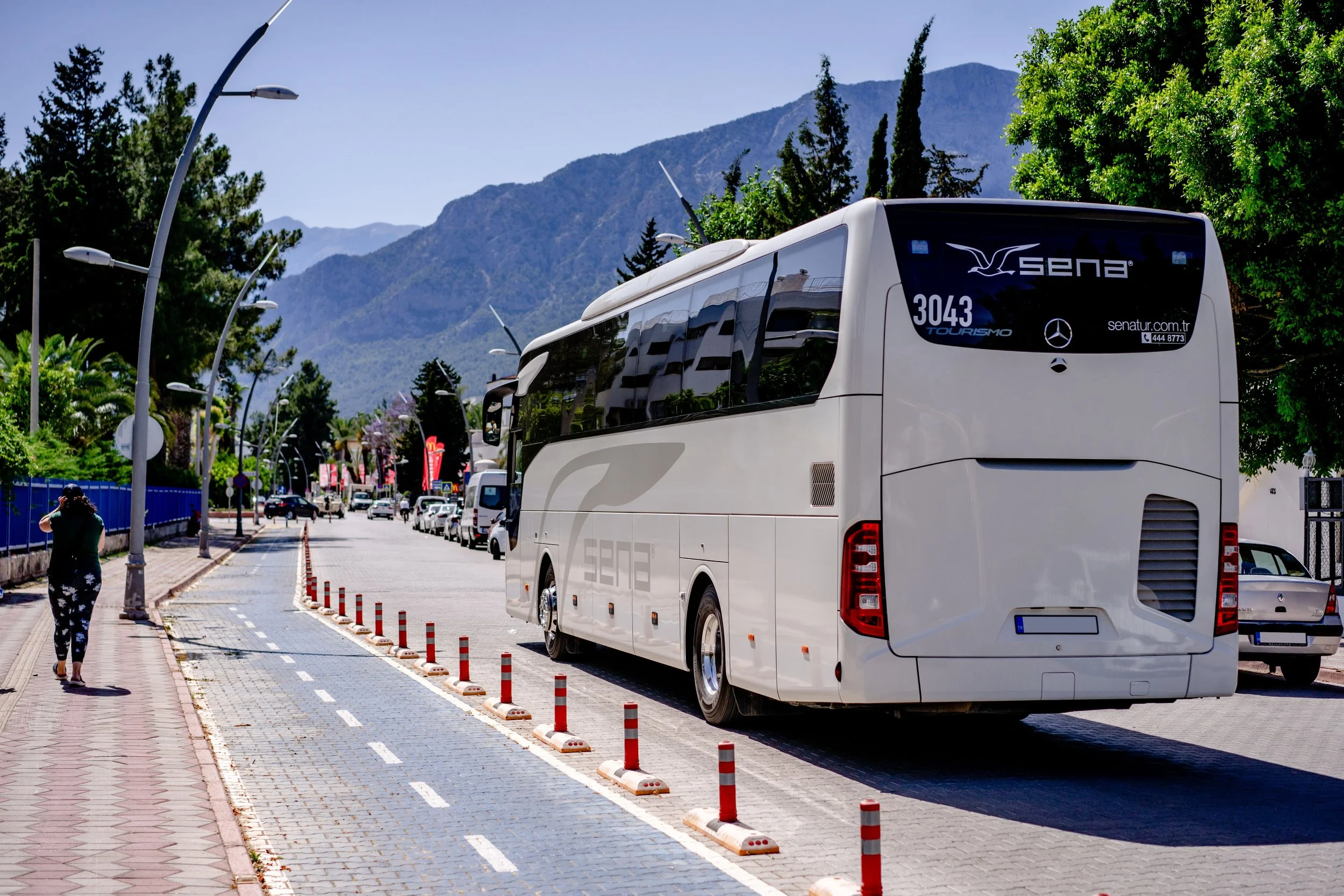
White bus on the road. Oleksandr Pidvalnyi. CC BY 2.0.
Traveling around the globe alone or with a few friends can do wonders for your inner peace. It’s self-care at its finest. Seeing new places, meeting interesting people, and experiencing a novel culture can give you a broader perspective on life. And let’s not forget all the memories you’ll fondly look back on years from now.
However, despite all the positive effects of travel, one thing that might not cross your mind is how everything we do while globetrotting deeply affects the environment.
As travelers, we often forget that we have a responsibility to travel with care, not only for ourselves and the people around us but also for the places we visit.
Remember, we humans are the ones depleting Earth’s natural resources. So whenever you’re going somewhere, do your best to practice sustainable travel.
Here are some ways to travel green:
1. Choose Off-The-Beaten-Path Locations

Woman walking on a path in the forest. Erik Mclean. CC BY 2.0.
Right now, one of the biggest threats that the travel industry faces is over-tourism. In fact, according to the World Economic Forum, about 80% of travelers visit the same five to ten locations in each country.
Popular cities may have up to 70% population growth during peak season, placing strain on the environment and infrastructure.
As much as possible, opt to avoid adding to this over-tourism phenomenon. Get creative when determining where to go next. This way, you won’t have to deal with crowds, and you’ll get to enjoy more genuine and lasting experiences than you could get in the overdone tourist traps.
2. Public Transportation Is Earth’s Best Friend (And Yours, Too)

Silhouette of a person riding a bike on top of the mountains. Jahangeer Bm. CC BY 2.0.
Sometimes the fastest way to your destination isn’t always the better option. Instead of speeding through a checklist or an itinerary, why not slow down a little bit? Allocate more time to your journey to discover more than you could ever ask for.
Slowing down can be beneficial for the environment, and it will allow you to soak in every sensation and experience. Travel by train so you can visit towns and cities you would normally miss if you took a direct route.
For shorter distances or if you’re just going to explore cities, take a walk or cycle to your destination. These two activities won't consume energy and are also pollution-free. They’re also a great way to stay healthy while traveling.
3. Don’t Use Single Use & Cleanup Wherever You Go

Woman drinking from a tumbler. PNW Production. CC BY 2.0.
The image of plastic bottles littering beaches, parks, and waterways has grown alarmingly common in many tourist places. The plastic waste we humans produce poses a serious health risk for all living things, particularly marine life.
Avoid using plastic bags as much as possible. Try to refill and bring your travel-size containers whenever possible.
Carry a refillable water bottle with you at all times to avoid purchasing single-use plastic water bottles. Don’t forget to pack an extra cloth bag in case you need to buy something.
Additionally, if you’re visiting the beach (or any other natural area), pick up some of the trash that you see. Beach cleaning is a great way to meet new people while traveling. You can also look for local clean-up events to meet locals while preserving the environment.
4. Support The Local Economy

Person buying fruit from a local vendor. Erik Scheel. CC BY 2.0.
Always buy products from businesses that support sustainability. A great place to start is with cafes and restaurants that use locally sourced ingredients and avoid single-use plastics. You'll often find that these kinds of restaurants donate a certain amount of their earnings to a deserving cause.
Avoid going to multinational chain restaurants for meals or shopping at supermarkets. Instead, support local entrepreneurs and small businesses to boost the local economy. By doing this, you're keeping people employed and reducing the need for transportation across far distances.
You can also purchase handmade souvenirs and crafts created by indigenous artisans to help preserve the location’s authentic cultural heritage.
Another way to help boost the local economy is to select a local guide. You can reduce the harm that your trip would otherwise cause by selecting a tour operator who cares about preserving the environment and the local people.
Lastly, you can stay in neighborhood guest houses rather than big resorts and hotels. Not only are they typically the more environmentally friendly option, but they’re also more affordable.
5. Pay Attention To The Local Resources You Use

Man brushing his teeth. Tima Miroshnichenko. CC BY 2.0.
Consider taking shorter showers rather than longer ones and shutting off the water while shaving or brushing your teeth to reduce the amount of water you use while traveling. Fill your refillable and reusable travel containers with eco-friendly biodegradable soap and shampoo, especially when camping.
Don’t forget that necessities like hospital beds and emergency services are also local resources. So before hiking or taking a road trip, always check weather conditions and terrain to avoid getting lost or injured and the subsequent rescue mission, which can consume valuable public resources and tax dollars.
6. Respect The Natural Places You’ll Visit

Man taking in the view on top of a mountain. Jaime Reimer. CC BY 2.0.
Keep in mind that well-marked hiking trails are there for a reason, mainly to protect the surrounding area and the local flora from harm. So don't litter. As for wildlife, distance yourself from them as much as possible and never feed or touch them. This is for the protection of both you and the animals.
If you’re going on a beach or diving trip, use reef-safe sunscreen without oxybenzone and octinoxate and avoid stepping on coral.
7. Share Your Sustainable Travel Knowledge With Others

Women conversing near a bonfire. Oleksandr Pidvalnyi. CC BY 2.0.
Inform your friends, family, and fellow travelers about sustainable travel options, and remind them that even small changes can have a big impact.
Travel helps us better understand the world by exposing us to various cultures and customs that are different from our own.
Humans have a natural need to explore. That’s why tourism will always be a massive industry. We can highlight the positive aspects of tourism and lessen its drawbacks if we can come together and share strategies to make travel more ethical, respectful, and sustainable.
Travel Mindfully For Yourself & For The Environment
As regular travelers, we must find a balance between lowering our carbon footprint and helping places that depend on tourism.
We can all contribute to the preservation of our beautiful planet by making a commitment to travel more thoughtfully and go to locations where delicate ecosystems are protected and local communities are helped.

Myrtle Bautista
Myrtle is a journalism major, a social media marketer and is now exploring freelance writing. She's fond of anything related to health and wellness, and when she's not writing, you'll find her doing long-distance cycling, ultramarathons, hiking, or in a local cafe enjoying a good cold brew.
7 Reasons Why Kenya Should Be On Your Ecotourism Travel List
As eco-consciousness grows among travelers, Kenya welcomes them as a beacon of sustainability and natural wonder.
Read MoreThe Gris-gris Wrestlers of Senegal
Wrestling — la lutte in French, or lamb in native Wolof — is by far the most popular sport in Senegal, even more beloved than football.
The entire population, from toddlers to grandmothers, follows the big wrestling matches either in the stadium, on the television, or on the street. Senegalese wrestling differs from that practised more commonly in western and Asian countries — mostly because of the traditional rituals practised by competitors. In western countries, these mystic rituals are often colloquially called voodoo, but the Senegalese call it gris-gris.

These unusual rituals are usually performed with the presentation and veneration of traditional amulets, the use of magic potions, and hypnotic drumming, songs and dance — all as an integral part of the wrestling match. The wrestler above is presenting his magic amulets to the crowd before a fight in the Adrien Senghor arena. Meanwhile, below you see a wrestler training before a final fight in the Iba Mar Diop stadium, located in the Medina district in Dakar. To prepare, he dances alone in a trance-like state to ear-deafening hypnotic drums and repetitive beats.
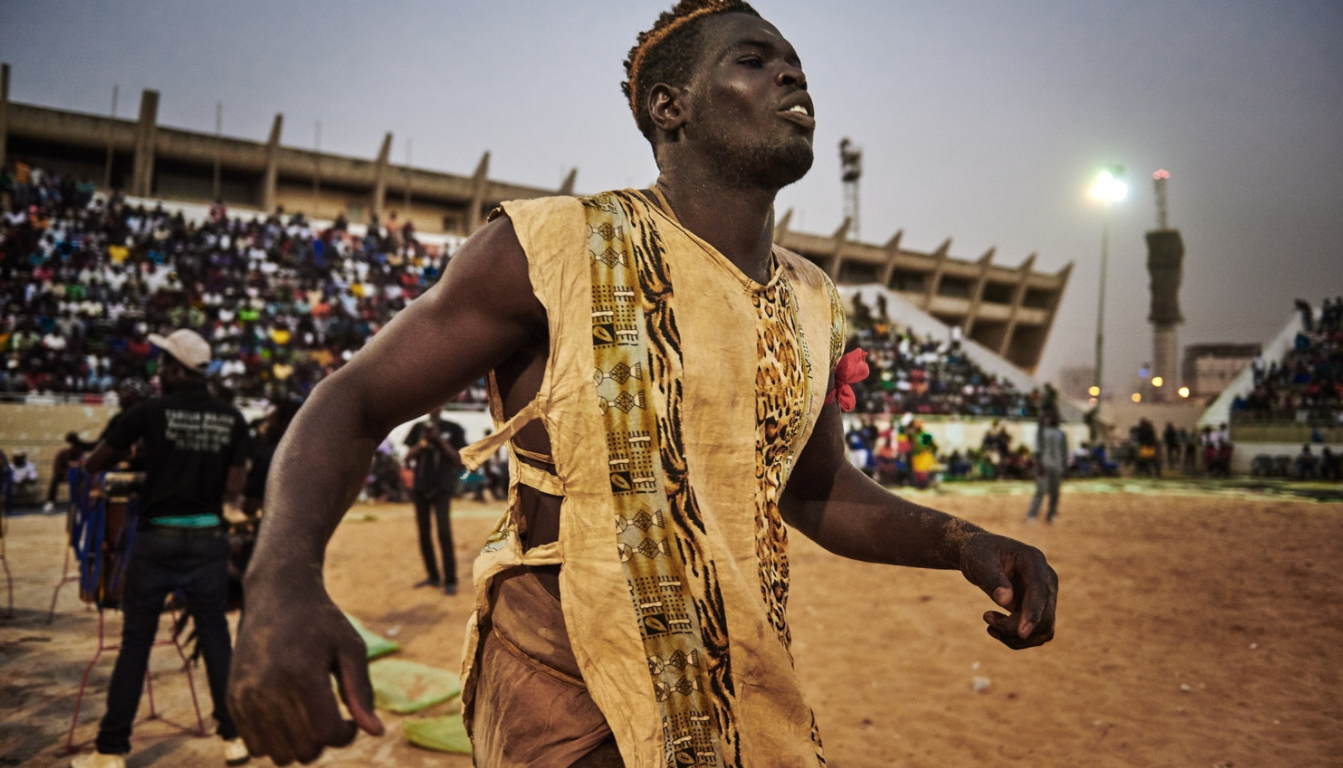
During the last ten years, the traditional sport of La Lutte Sénégalaise has become a million dollar spectacle, mostly because of big telecom sponsors, TV stations, and new media channels. This has led to the most successful wrestlers becoming media-stars and billionaires, giving young men in this African country a very different perspective. For wrestlers who succeed there is not only social recognition, along with high value prizes into the hundreds of thousands of US dollars for the highest profile fights, but also the chance of well-paid jobs in the security industry or as a trainer in a wrestling school.
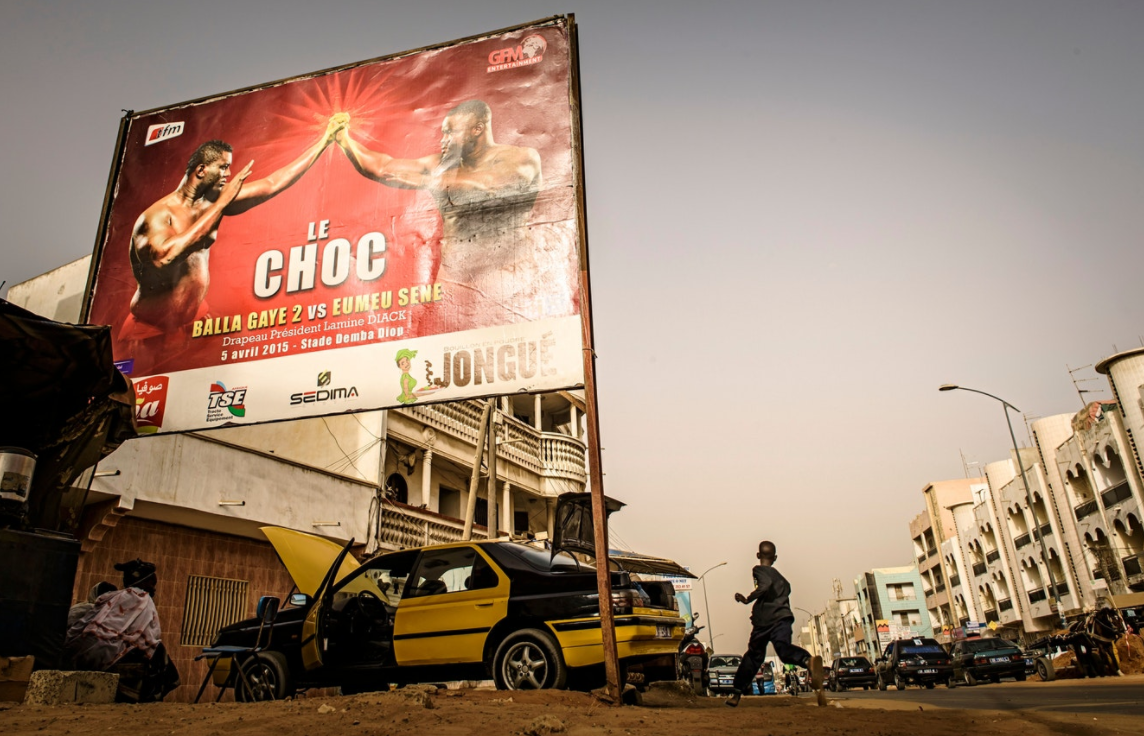
THE BIG FIGHT
While in Dakar, I attended a huge fight between two superstars of Senegalese wrestling — Balla Gaye 2 and Emeu Sene — along with more than 20,000 other fans at the sold out soccer stadium called Demba Diop, on April 5, 2015. With over 200 million CFA (around USD $300,000) at stake, this was a serious match. In the weeks beforehand, large billboards and posters appeared all over the city, advertising the event. Below you see fans and street vendors gathering outside the stadium before it began.

At the start of the competition, Adam Ngom, a well-known drummer, fired up the audience to welcome the champion wrestler Balla Gaye 2. An important mystical element, the deafening sound of the drums is never absent from a fight, not even at small wrestling matches in local villages.
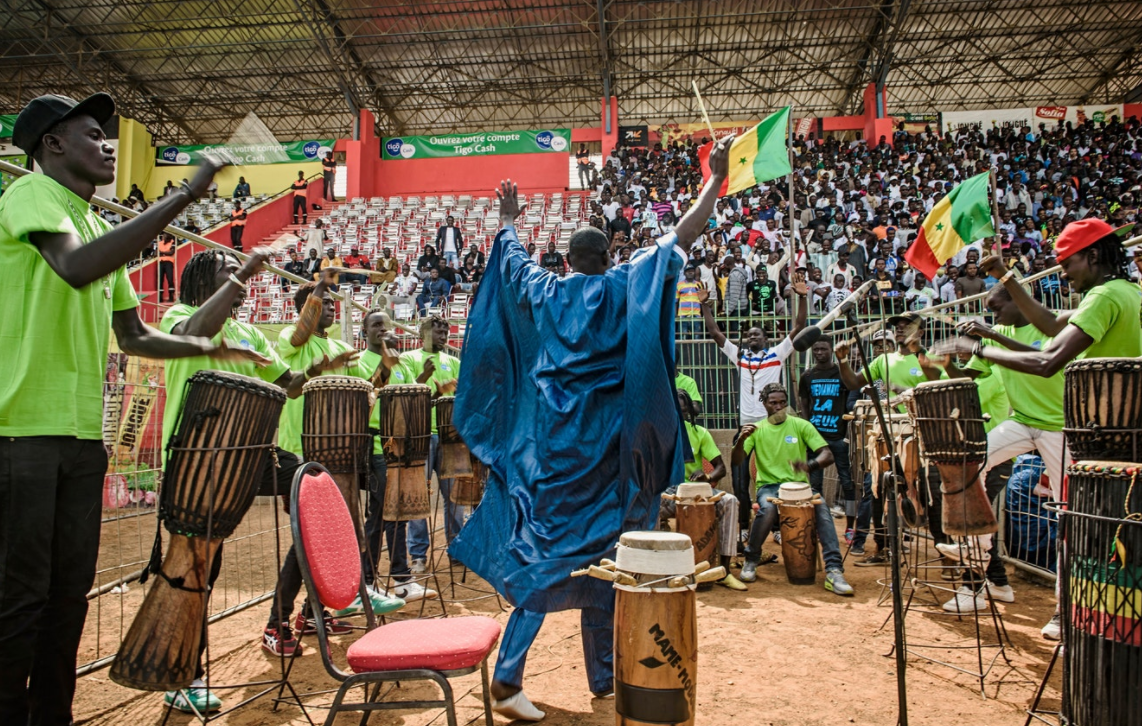
One of many mystical rituals performed by the wrestlers, releasing pigeons is believed to bring the wrestler luck. Balla Gaye 2, whose real name is Sakko, became a superstar in Senegal after he dethroned the reigning champion Yekini in 2012, who had remained unbeaten for fifteen years.
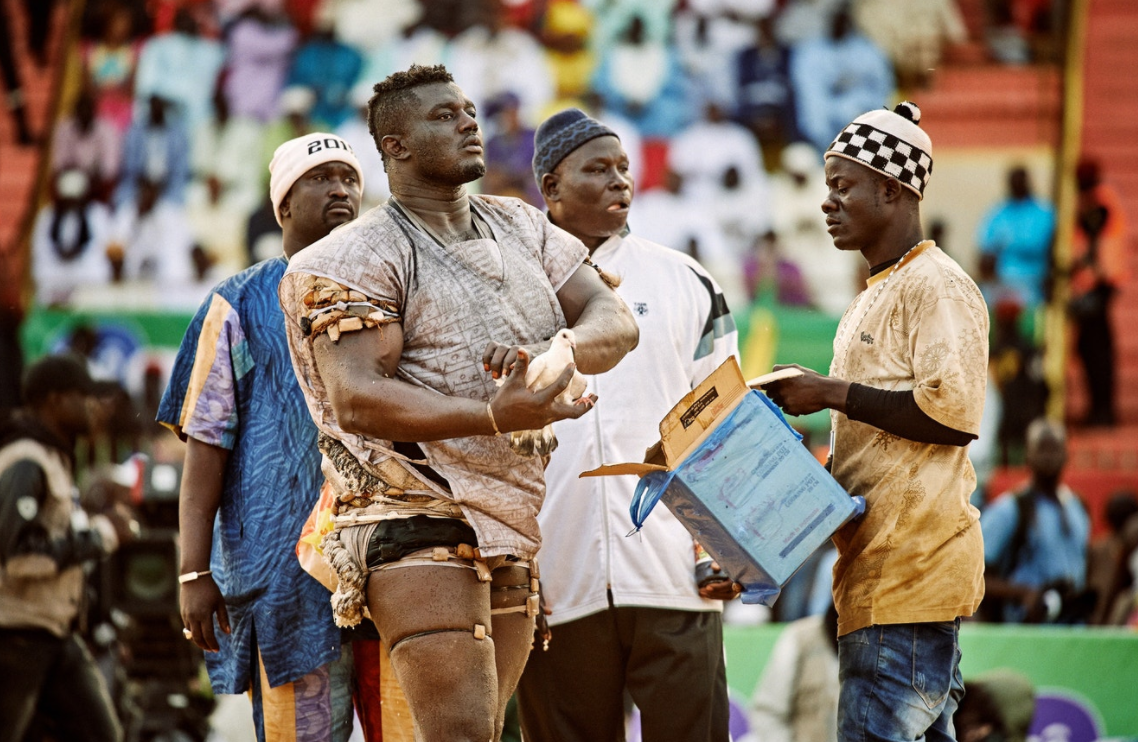
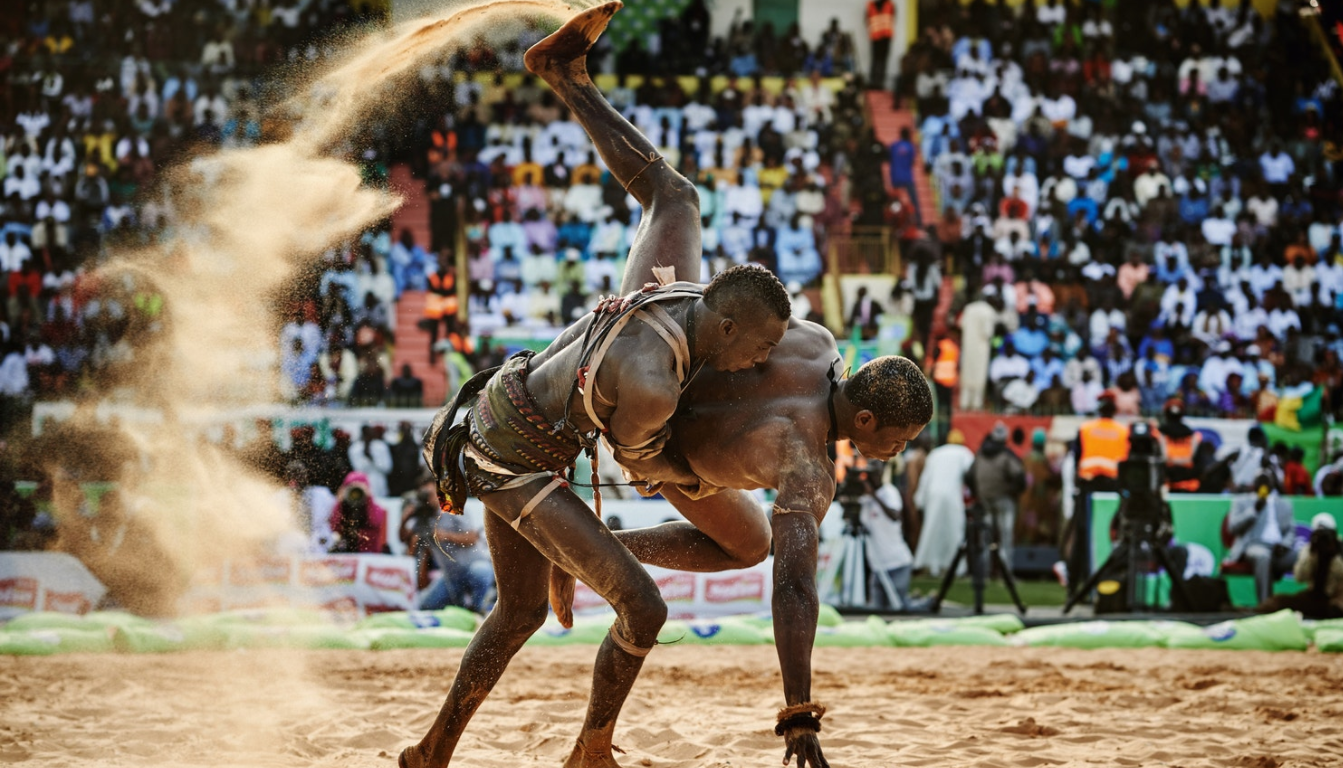
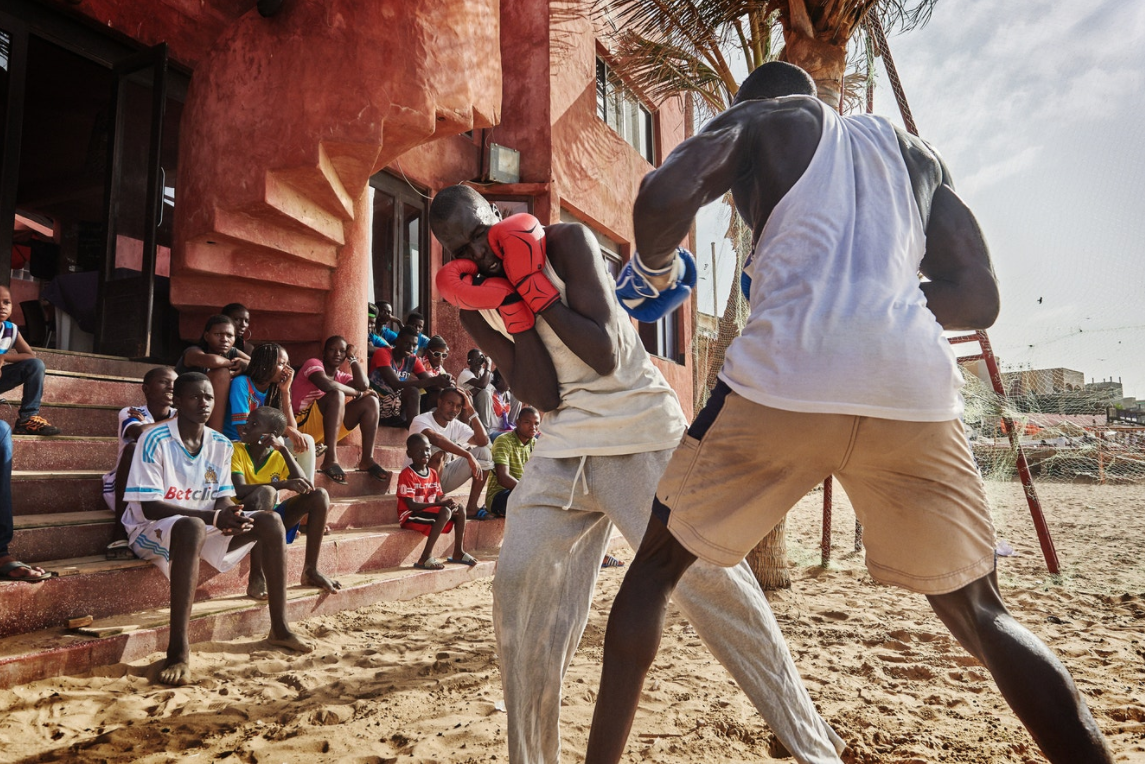
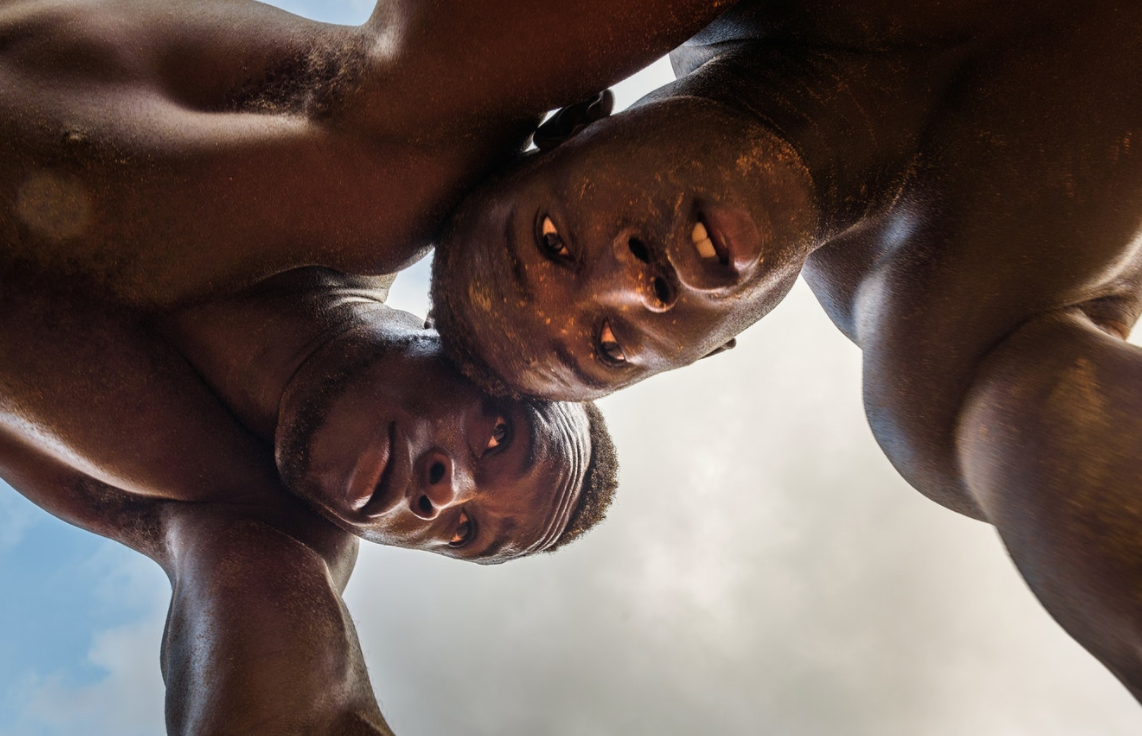
Similar to wrestling styles in other countries, a Senegalese fighter will try to grab their opponent by legs, and unbalance him. Nowadays a wrestling match that also involves boxing is the king’s discipline of the Senegalese sport, but the more traditional forms of wrestling are still performed without boxing in many of the villages. Below you see wrestler BB Bismi Ndoye defeating his opponent Maraka Dji, during another fight in the Demba Diop stadium on April 5, 2015. Some fights will last no longer than 90 seconds and only very rarely do they go on longer than fifteen minutes.
RITUAL & RHYTHM
Senegal’s climate is too hot for wrestling during the day, so competitions always take place in the evening, often lasting until well after midnight.
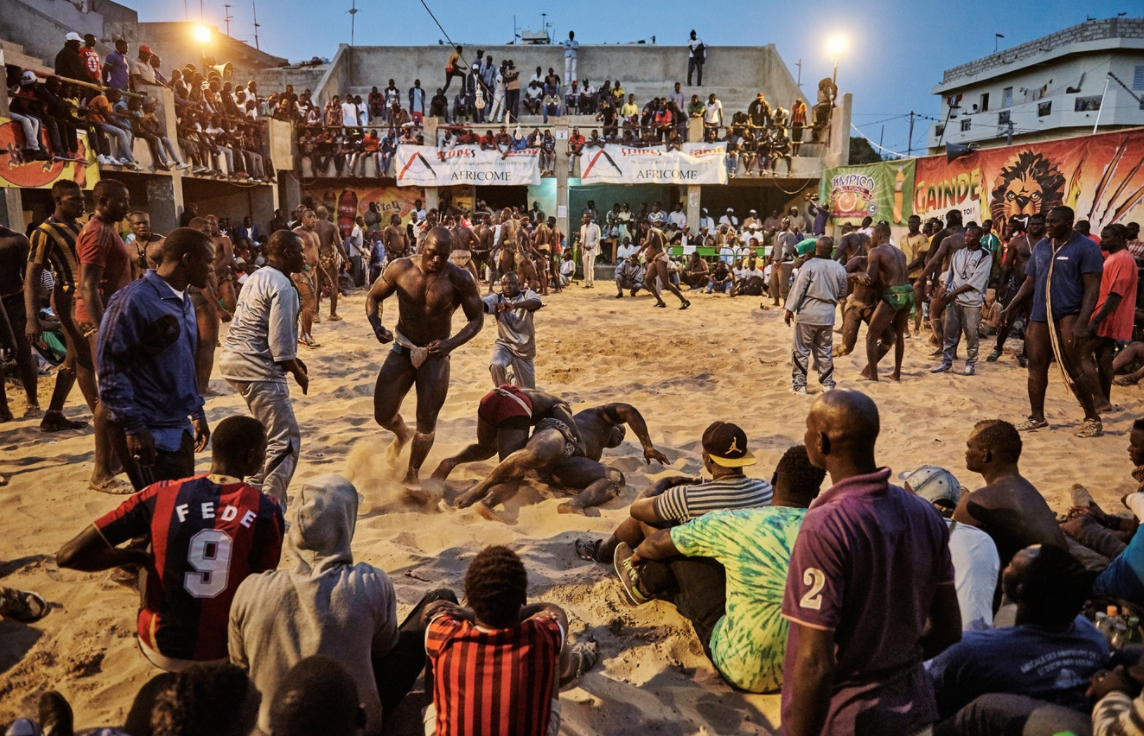
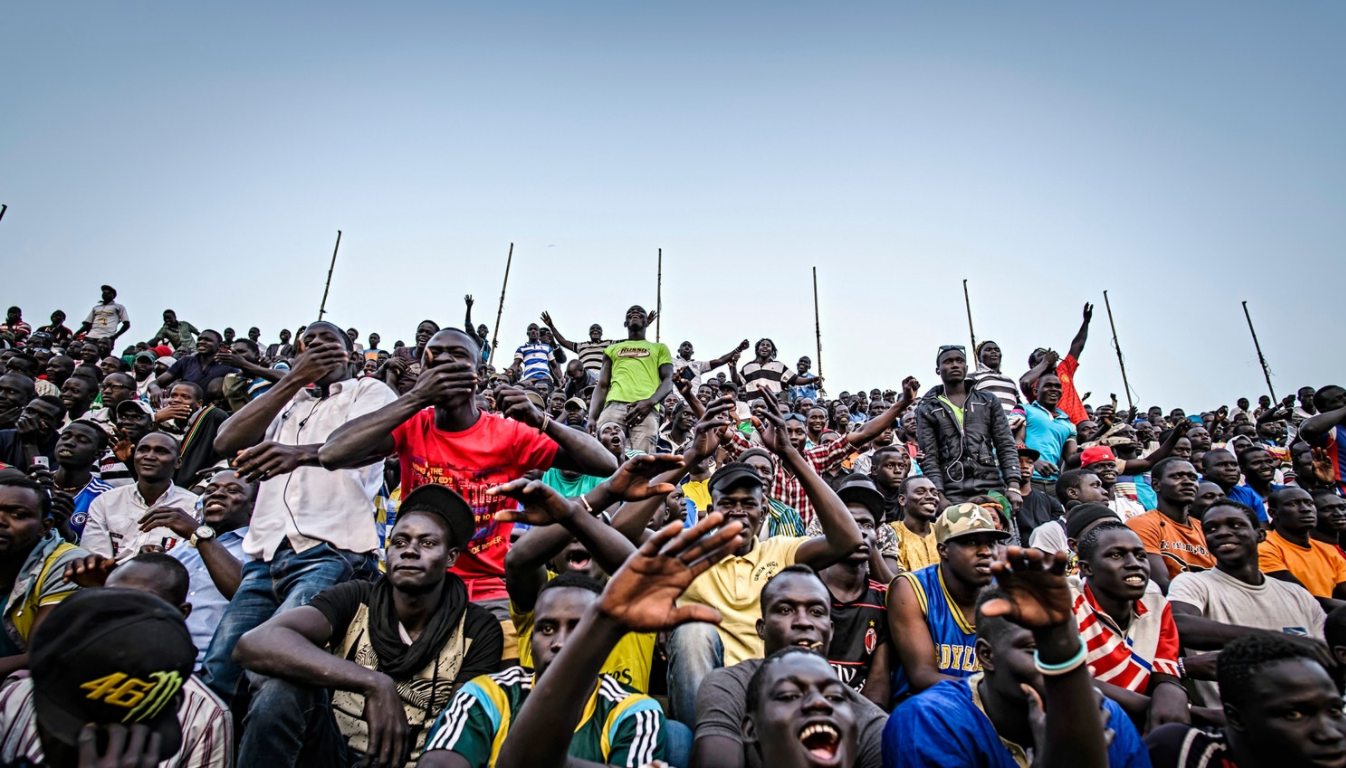
Attending these late night competitions, the atmosphere and mood often evoked is that of an ancient gladiatorial fight, with plenty of wild drumming and singing. Below you see the contrasting enthusiasm and frustration of rival supporters in the Iba Mar Diop stadium — every well-known wrestler has his own loyal supporters who spur him on during a fight.
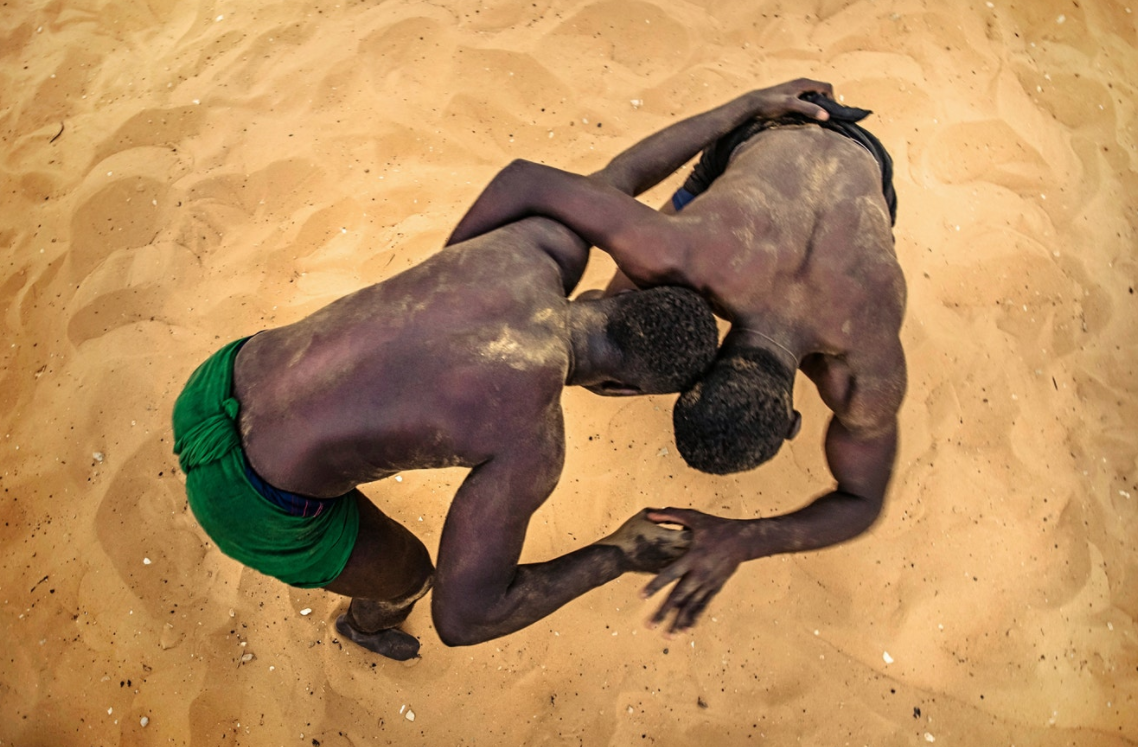
Senegalese wrestling matches always take place on sand and many wrestling stars will head out to train on the public beaches of Dakar, which also provides a welcome source of entertainment for the locals.
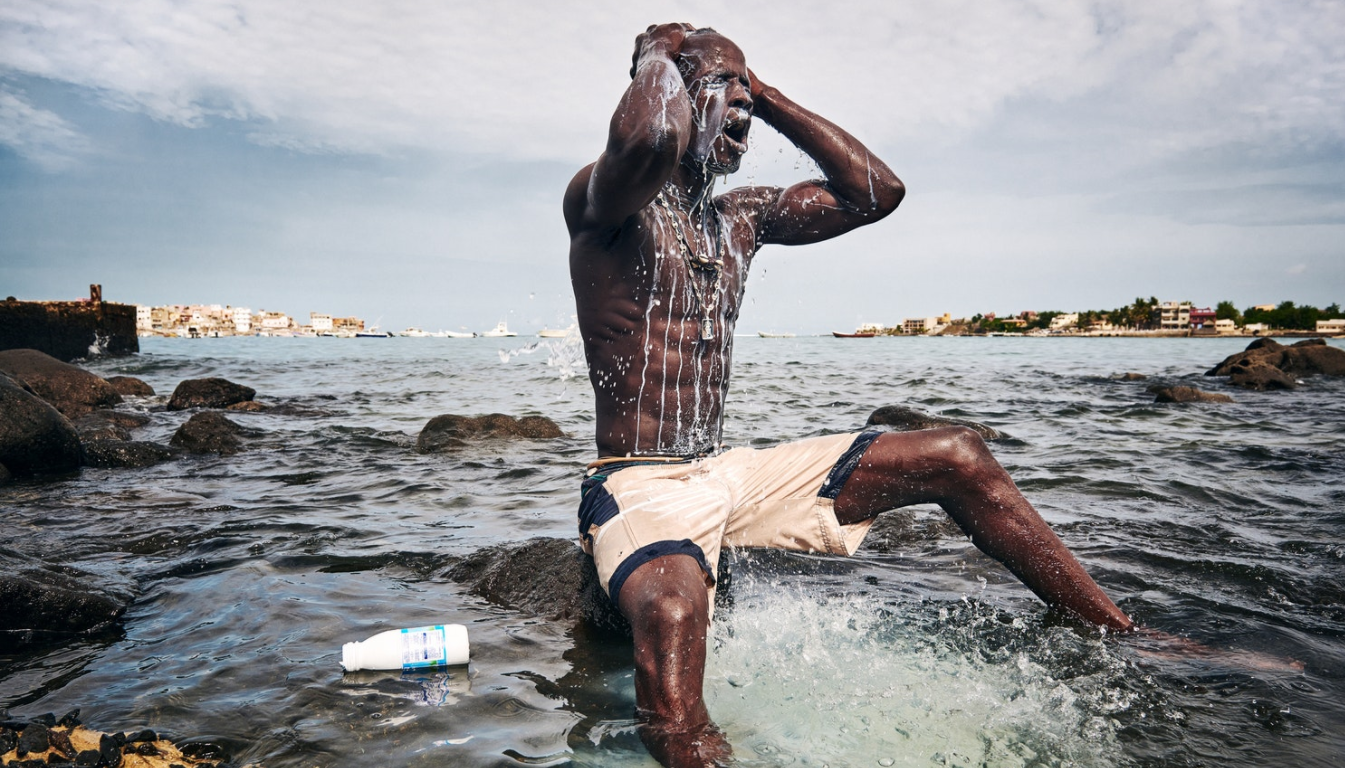
Witchcraft and magic play a very important role in Senegalese wrestlers’ preparations. Below you see Kherou Ngor, a young lightweight wrestling champion, washing himself with milk on the shore of Ngor in Dakar. Kherou performs this traditional ritual as he believes that he will gain strength and support from a ghost who lives among the stones on the shore.
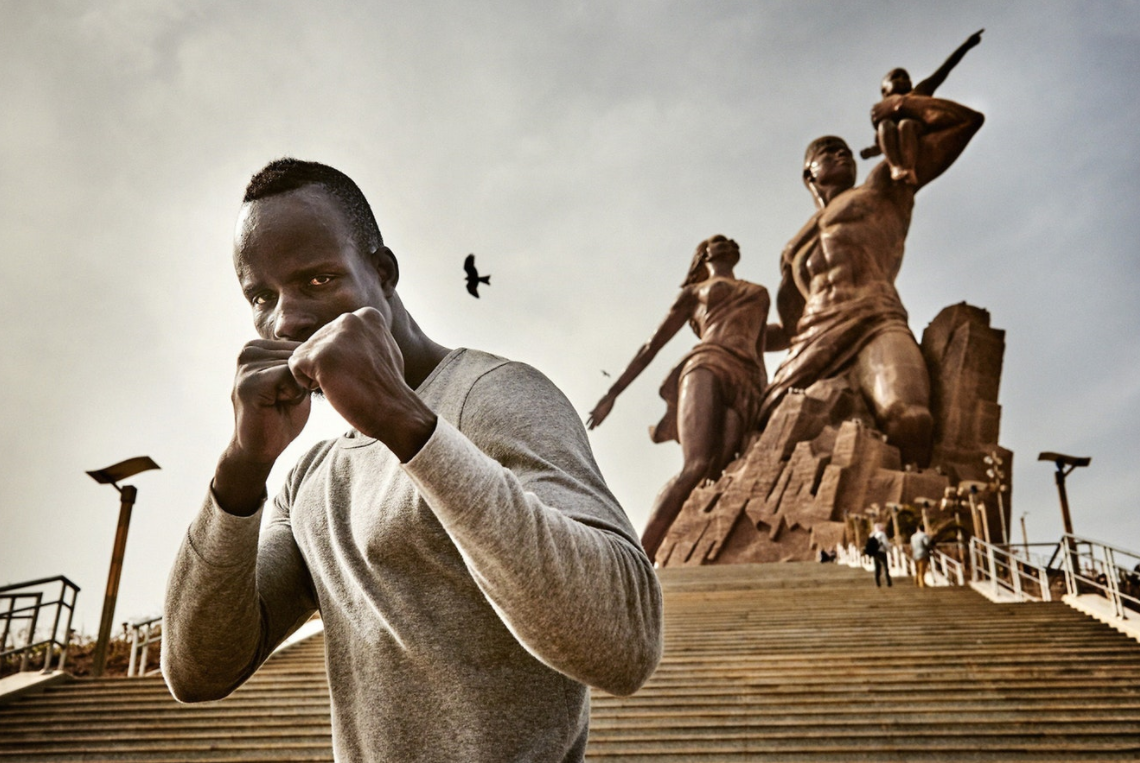
At least three times a week, Kherou will also train on the long stairway in front of the “monument of the African Renaissance”, one of the biggest bronze statues in the world. Ultimately, the North Korean aesthetic and the statue’s insane building cost prevented the former Senegalese president Abdoulaye Wade from being re-elected.
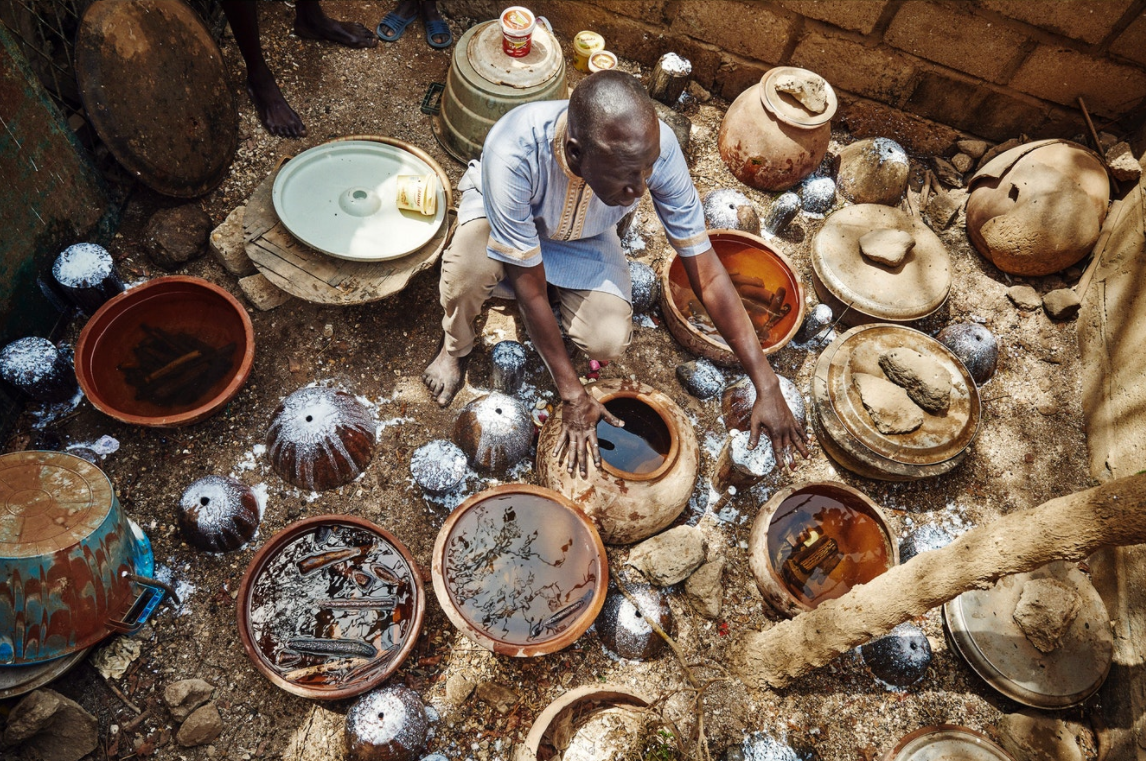
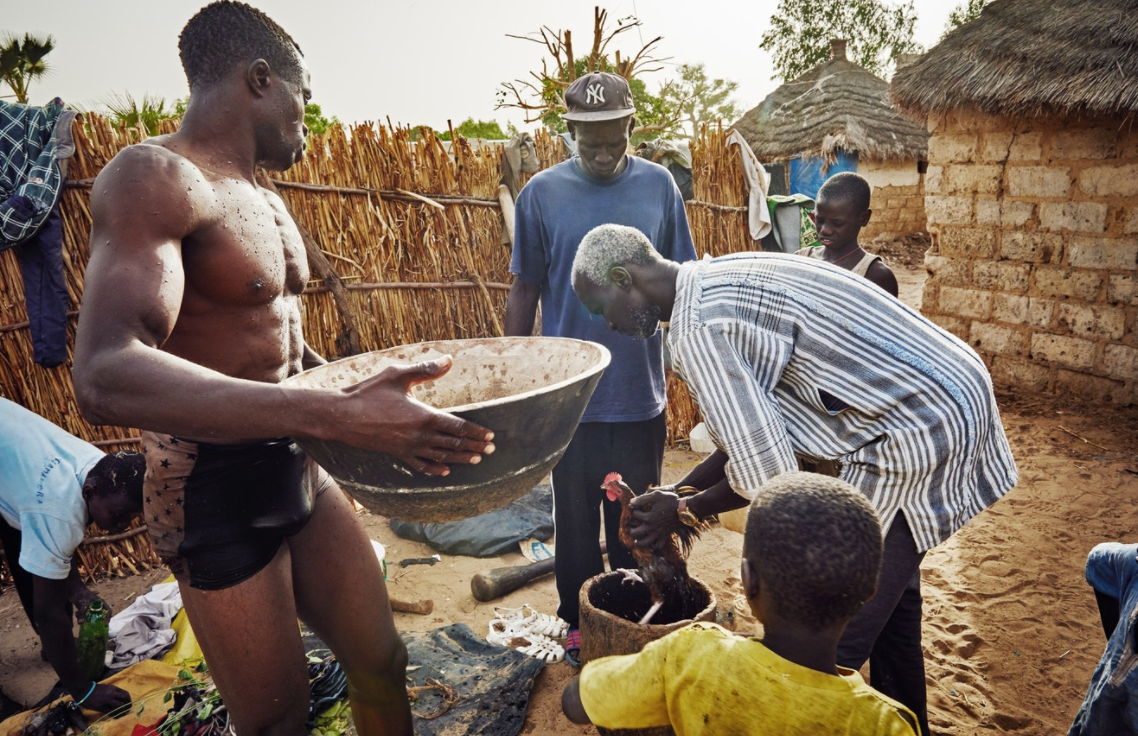
Before a fight, it is also common for a marabout — a religious leader and teacher — to conduct rituals, believed to give the wrestler supernatural powers. Marabouts also make and sell amulets, called Gris-gris, and magic potions to the wrestlers, which they then take to the matches in bottles. Traditional shamans also play a part in the preparations. Every wrestler has an assistant who takes care of his Gris-gris amulets and prepares him for each fight. Below you see one of those assistants sacrificing milk at a cham, a special place of worship for the ancestors of the wrestler’s family.
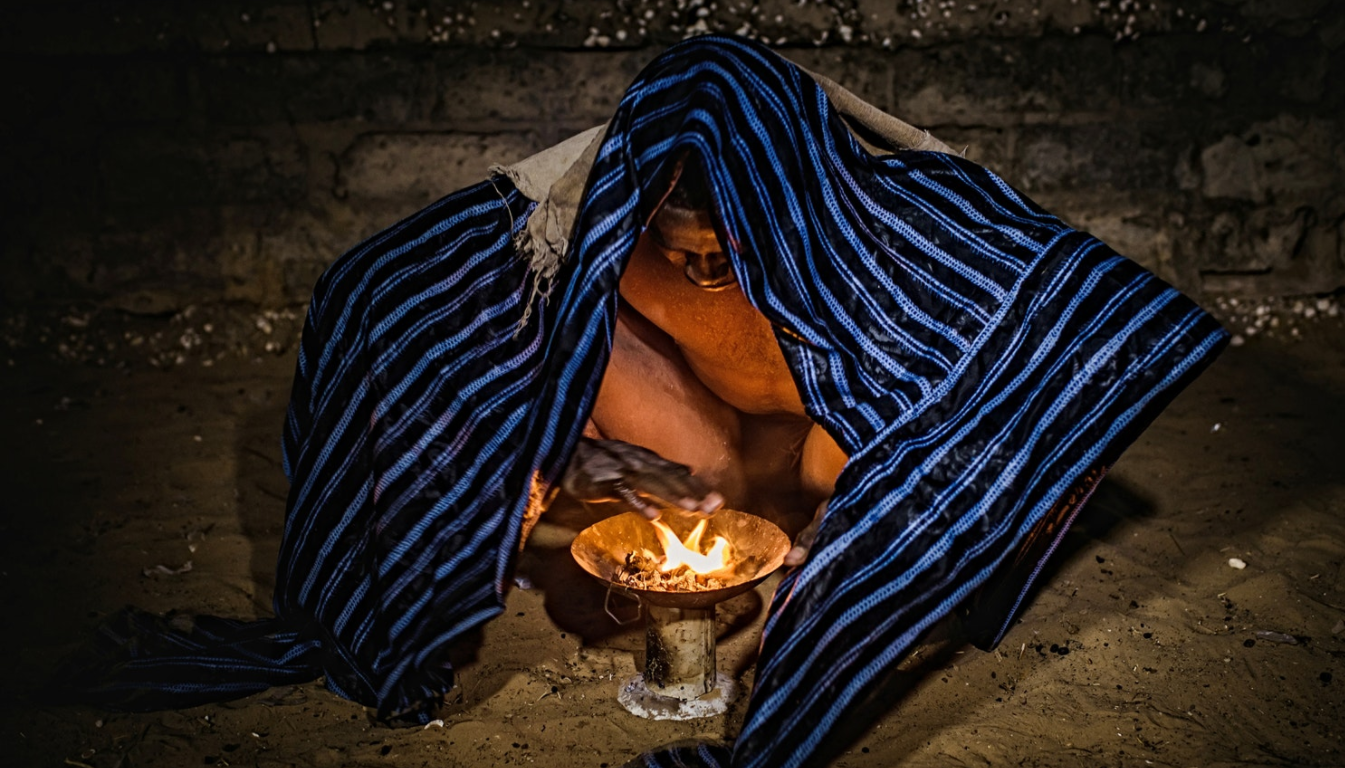
Another important ritual wrestlers often celebrate before a fight is the inhalation of holy smoke. Each wrestler uses a special cloth to waft the smoke, which he will then wear on his abdomen during the fight.
EVOLUTION OF A SPORT
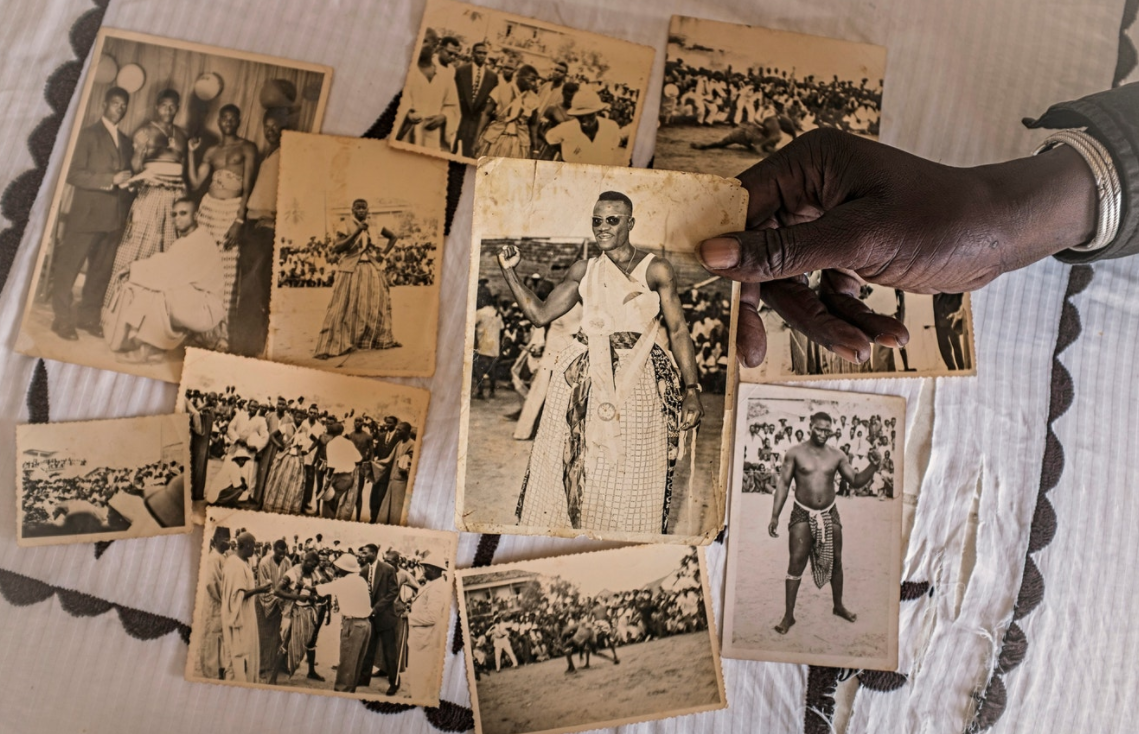
Wrestling has a centuries-long traditional history as part of popular culture and tradition in Senegal and I met photographer Freekis Ndoye from Dakar, who shared his historical pictures of wrestlers from the 1950s. The first celebrated wrestler in the region of Senegambia was called Boukar Djilak Faye and he lived during the 14th century in the kingdom of Sine.
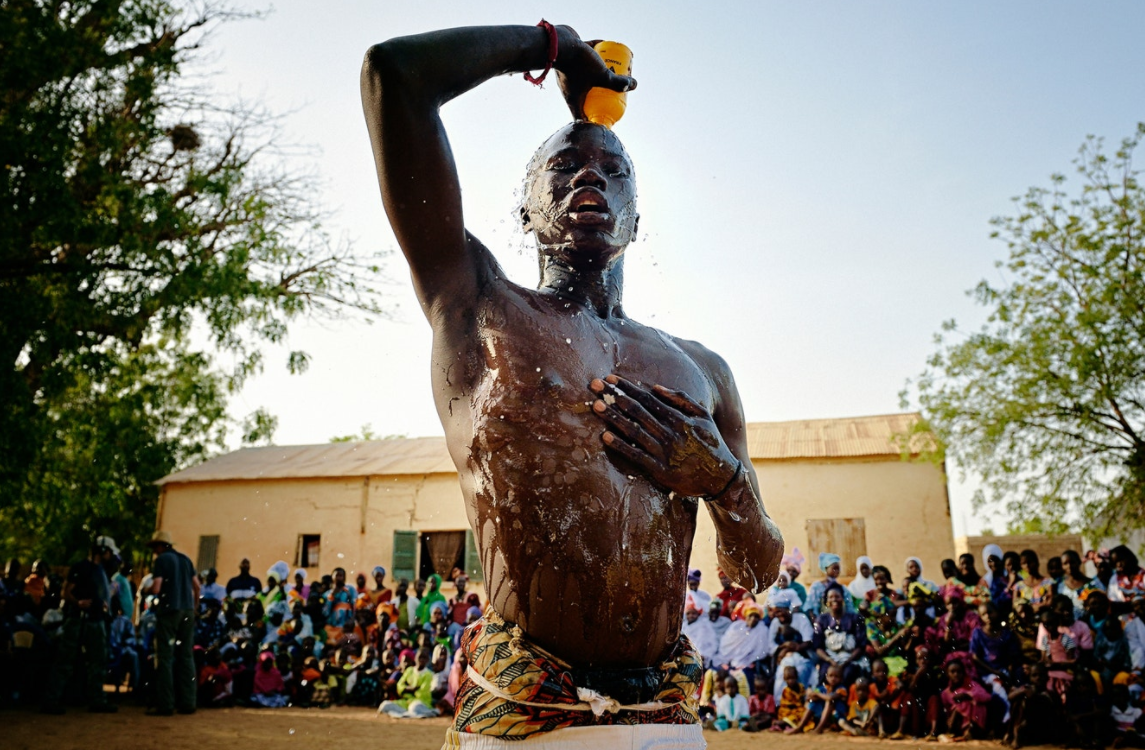
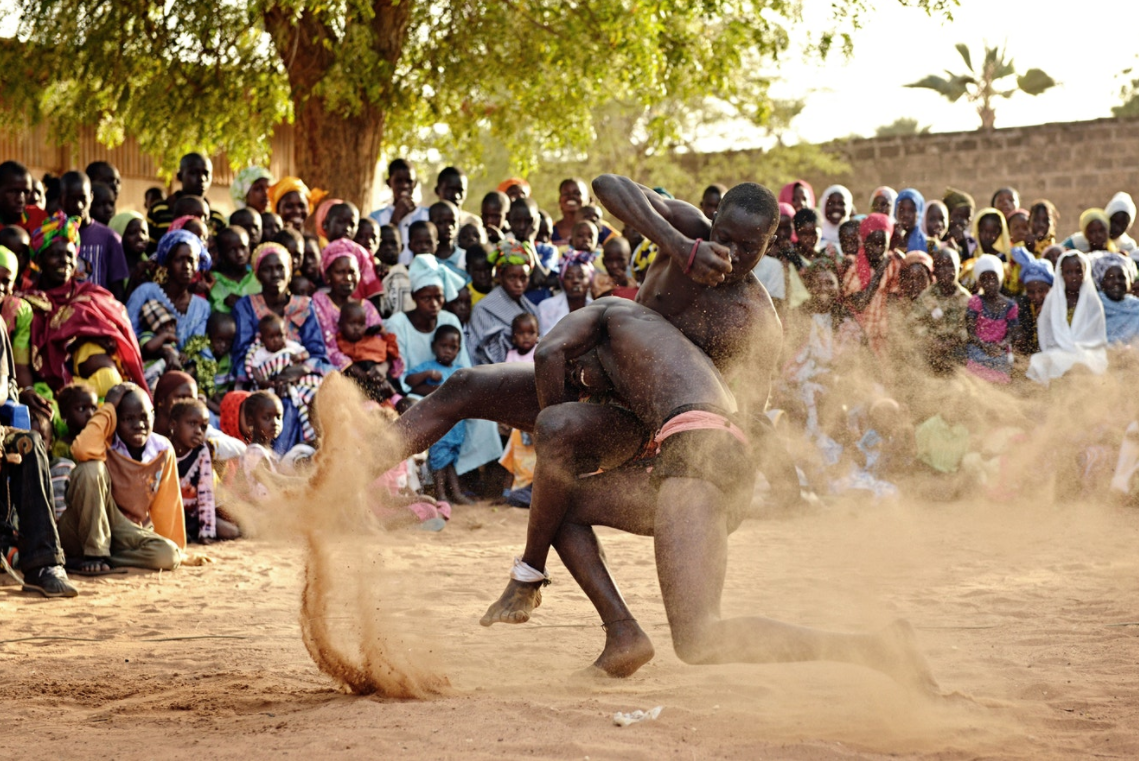
Almost every village in rural Senegal organizes regular wrestling tournaments, often to accompany a communal celebration or party. Below, in the small village of Soune, you see women and children gathering to watch the men fight in a wrestling match, as a young wrestler pours a magic potion over himself, prepared by a shaman to lend him supernatural forces.
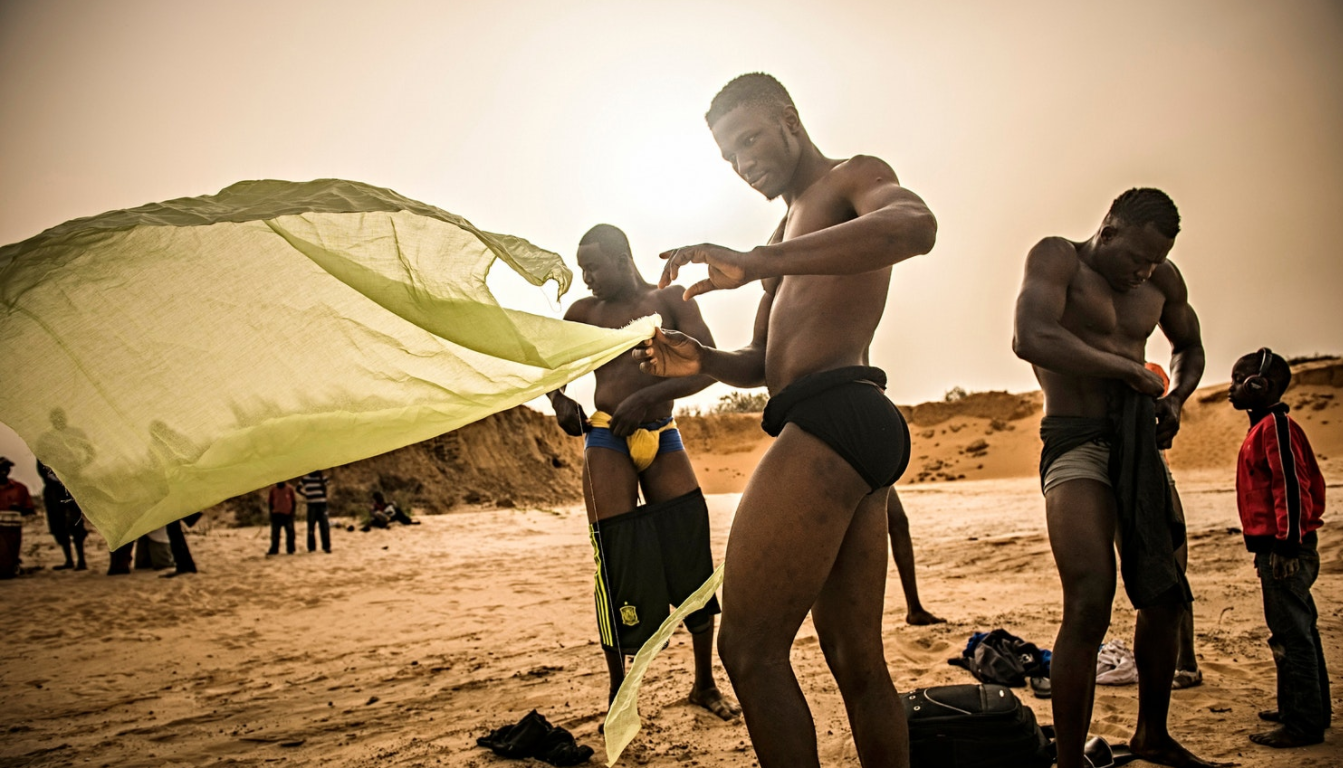
Before each fight, the wrestlers must wrap a special cloth around their abdomens, which they can use to grab hold of each other during the fight.
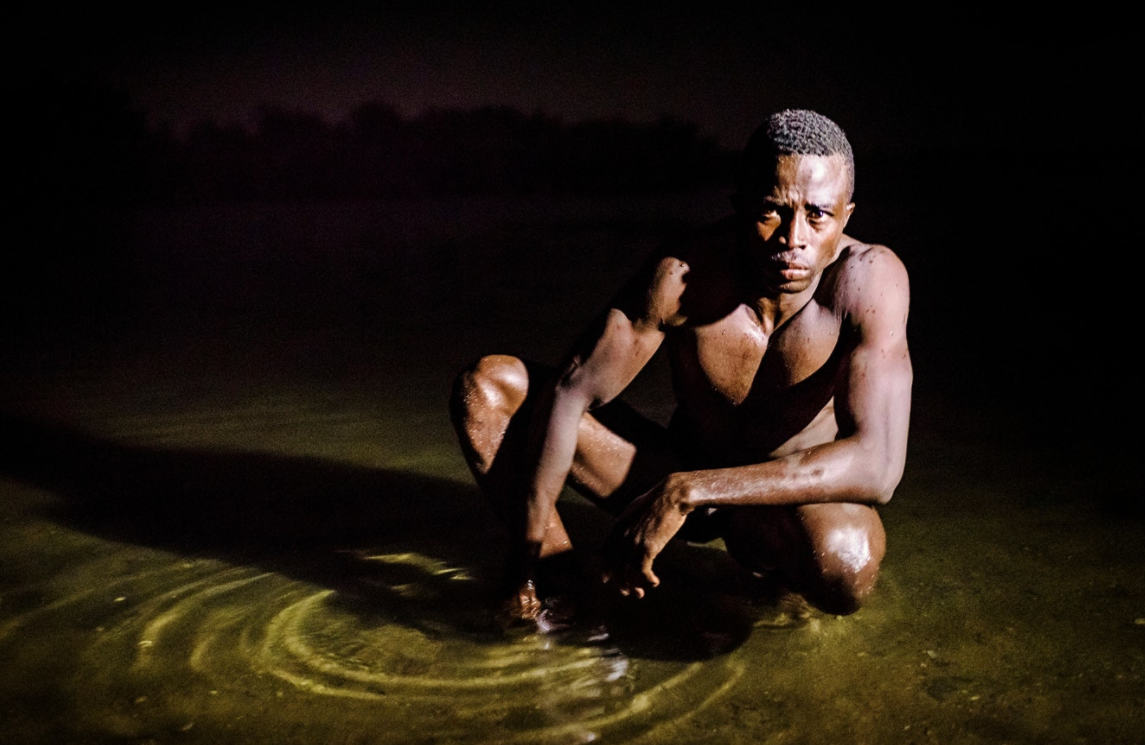
Below you see a wrestler from the small village of Djilass, during a ritual river washing before a regional fight competition. The captial city of Dakar attracts many wrestlers who are successful in rural areas, as it is only at the bigger competitions a fighter can win significant prize money.
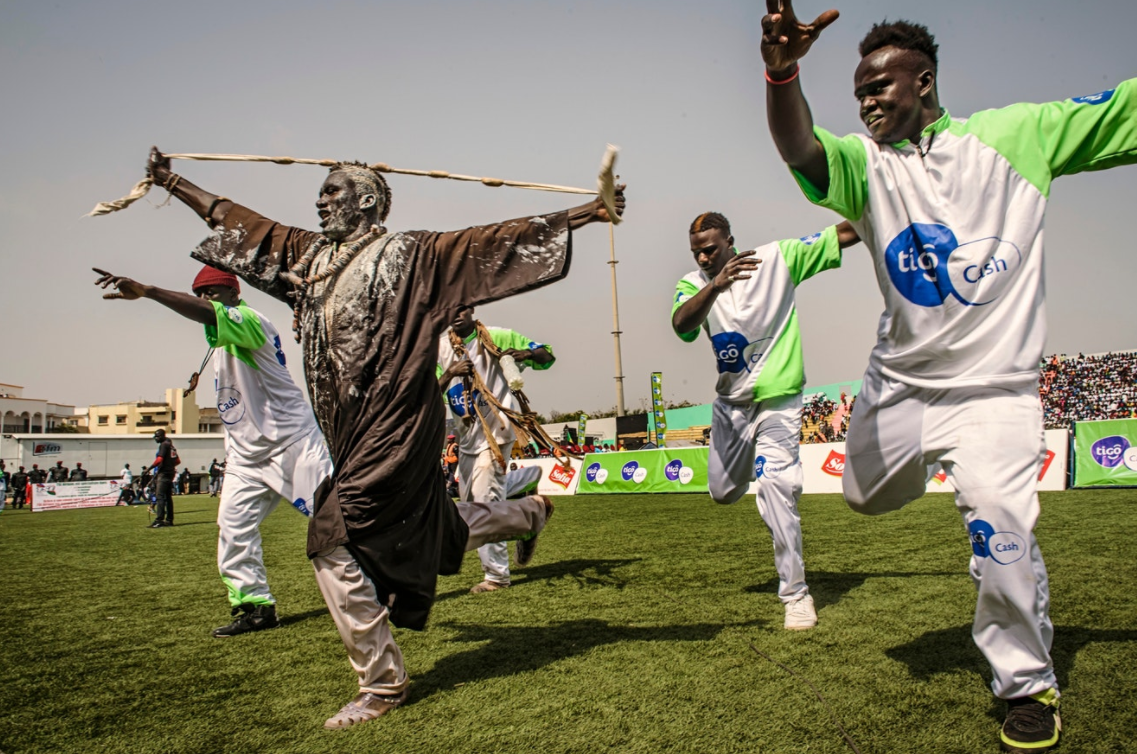
Today, especially at the bigger matches in Dakar, many of the traditional costumes once worn by wrestlers during the dances and gris-gris ceremonies that are held before a fight, have been exchanged for high-tech sports gear emblazoned with the bold logos of modern telecommunication brands. Here you see a group of young wrestlers performing a dance at the Demba Diop stadium in Dakar.
With the influence of big sponsors, wrestling has become a very trendy sport and is no longer seen as a sport only for old men. Even young girls like 23-year-old Aissa, who is a waitress at the “Black and White” bar on the beach of Ngor, read the Sunu Lamb newspaper — a daily publication dedicated exclusively to Senegalese wrestling matches.
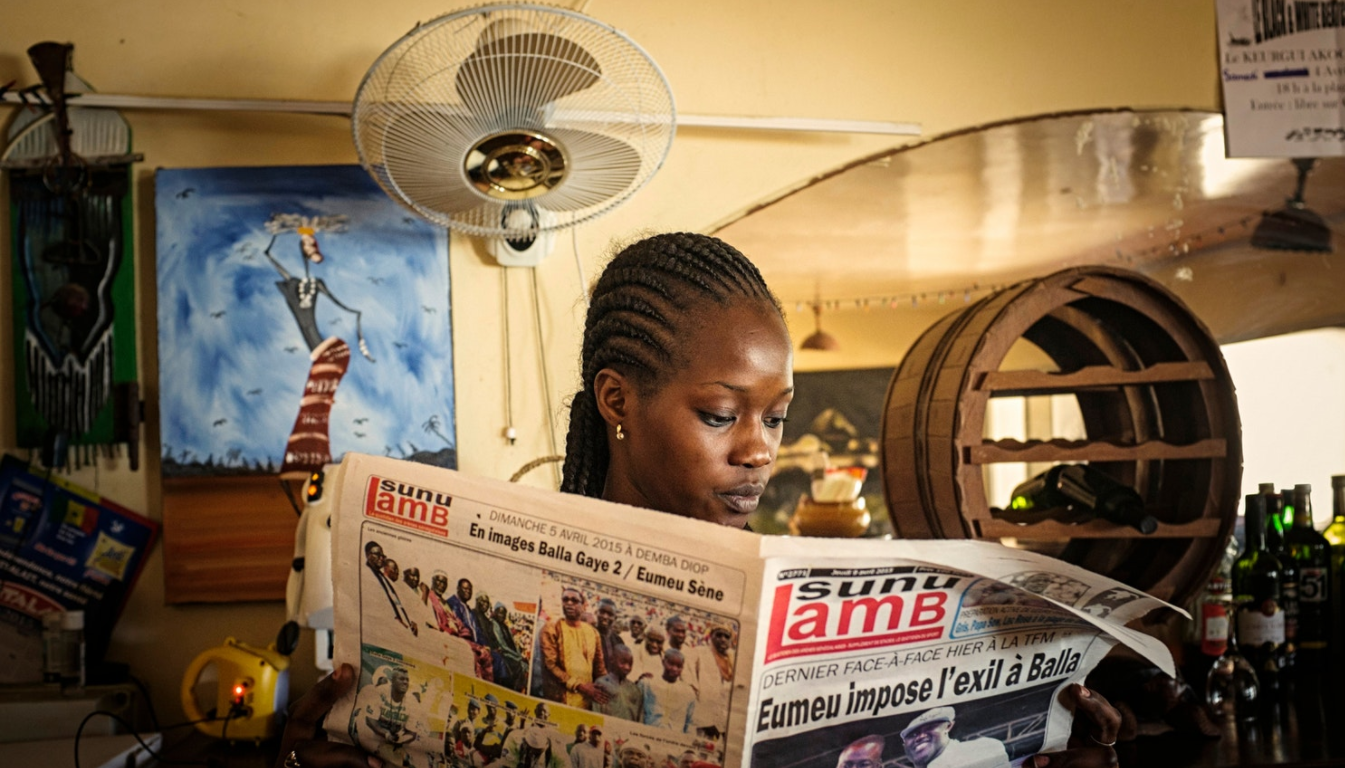
The faces of top wrestlers are also becoming a popular subject for t-shirts and the superstars of wrestlers gather many adoring young followers.

THE NEXT GENERATION
Tens of thousands of young men in Senegal now dream of making wresting their future career, in the hope of becoming rich and famous. Every evening, as the heat of the sun begins to lessen, you will find the next generation of wrestlers training hard on the beach of Ngor in Dakar.
Most of the young hopefuls have very little money to their names, so they must be resourceful with their training — only the top wrestlers can afford to train at the city’s dedicated wrestling gymnasiums.
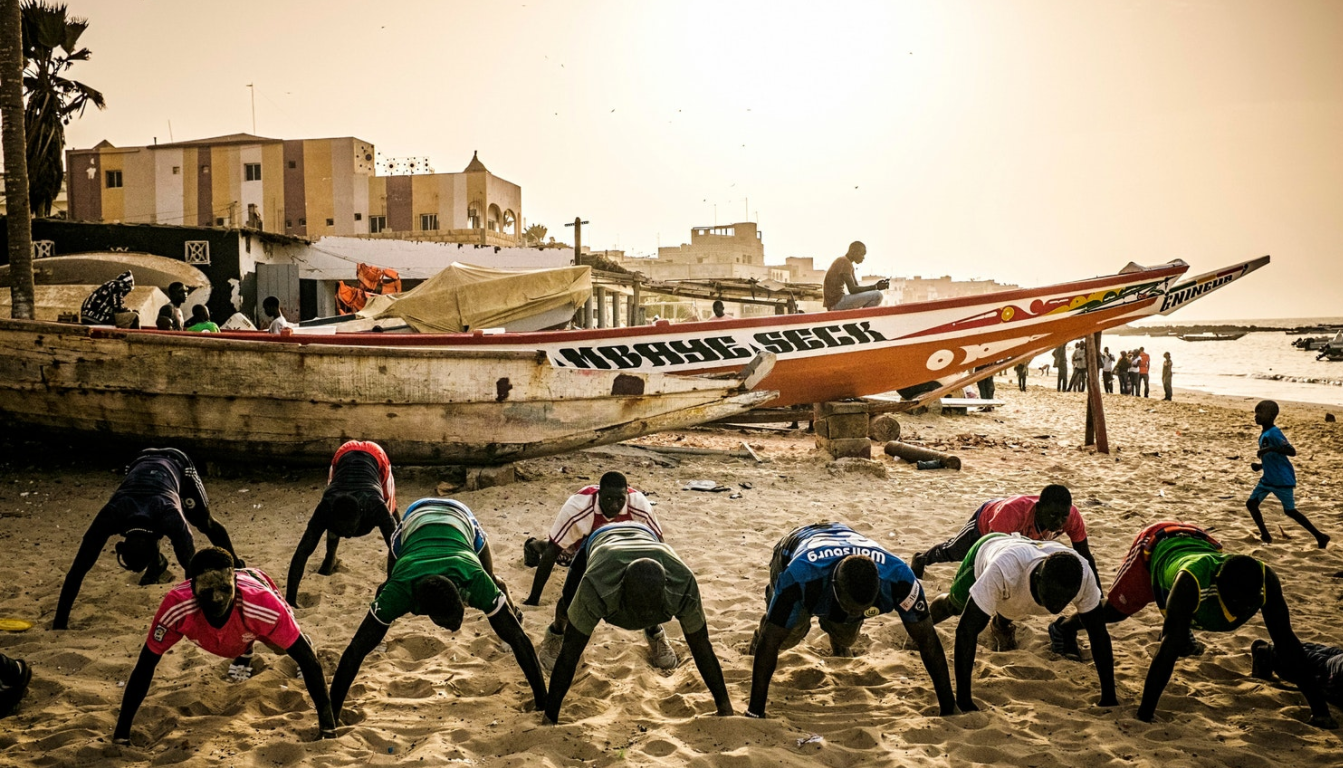
The young men with the most talent will go on to train at one of the famous wrestling schools run by ex-fighters like Balla Gaye, who opened the first official wrestling school in Senegal. Many successful wrestlers have graduated from his school, including the superstar Balla Gaye 2.
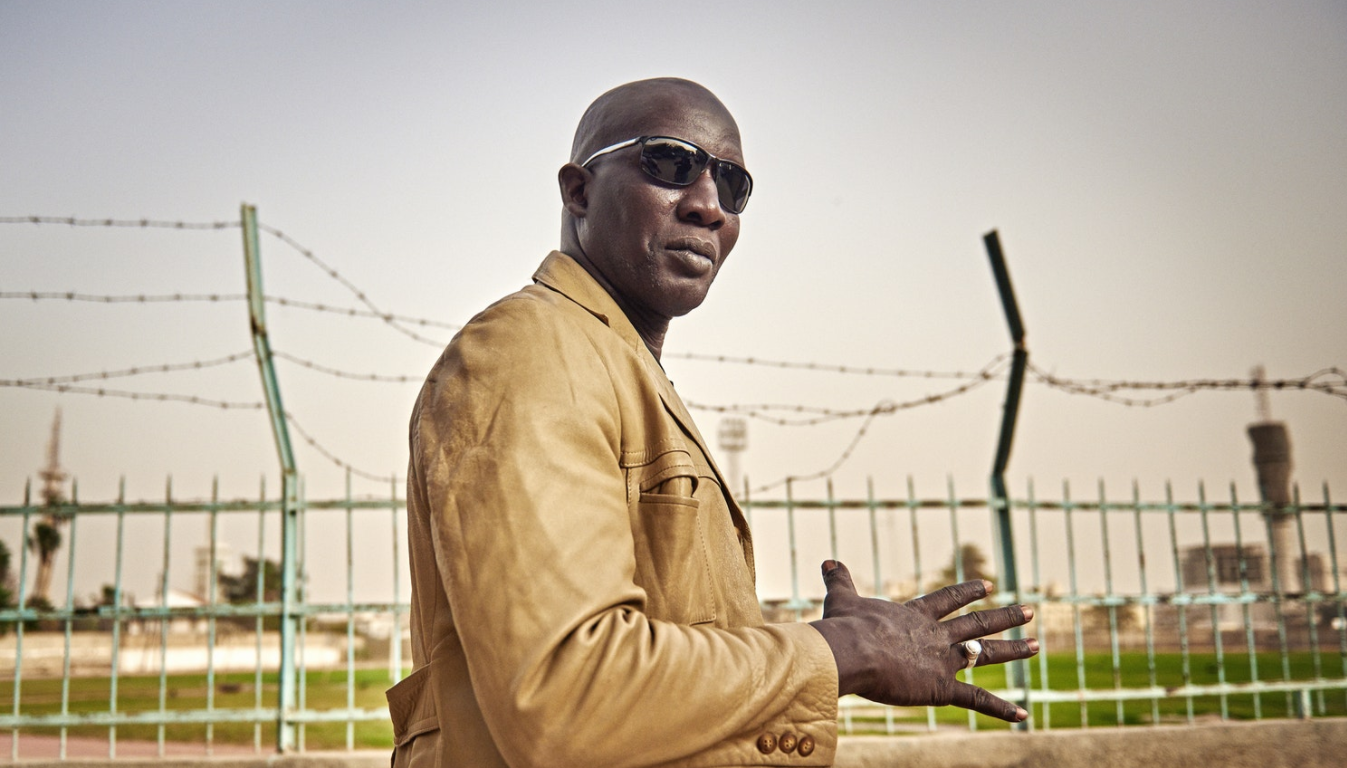
Now retired from competition, below you see another famous wrestler, Lac de Guiers, posing in front of the Mar Diop stadium. It was in this very arena that his fight against the wrestler Commando made wrestling history. With a series of targeted, hard punches, Lac de Guiers defeated the much taller favourite and sent him tumbling out cold to the ground.
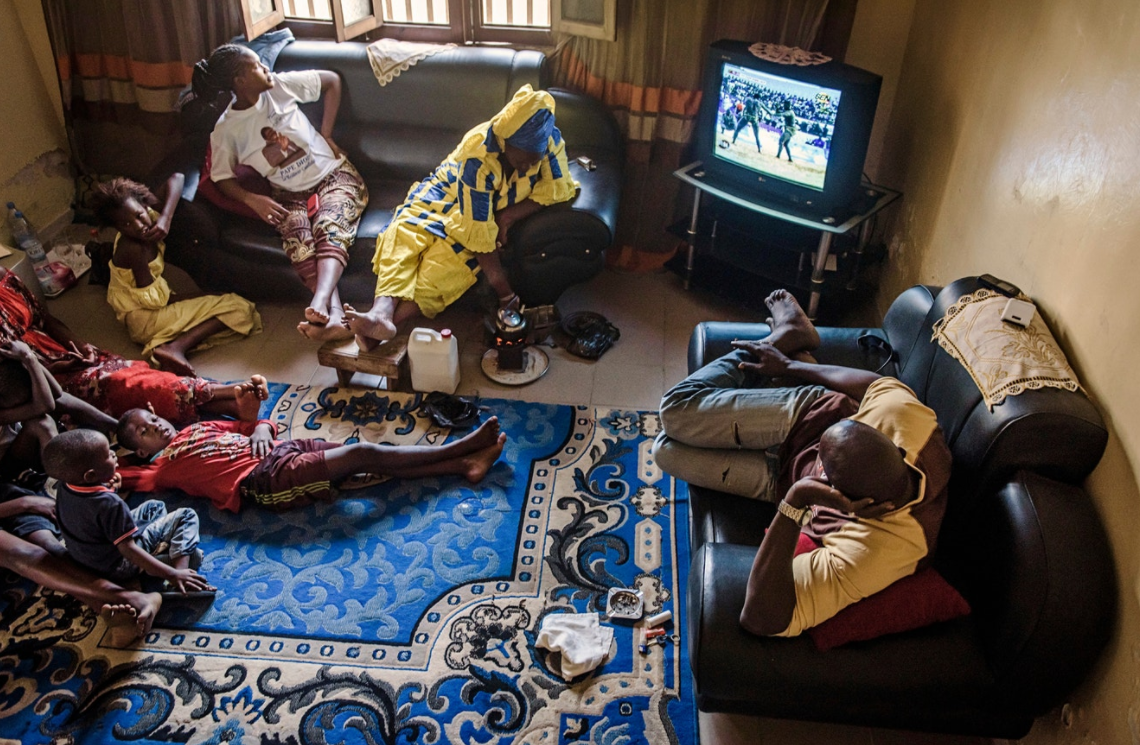
These days, Lac de Guiers owns a wrestling school and lives peacefully with his family, a sheep, a few pigeons, and his parrot. Here you see him relaxing and watching an important weekend match with his family on TV, just like a hundred thousand other Senegalese people on a Saturday afternoon.
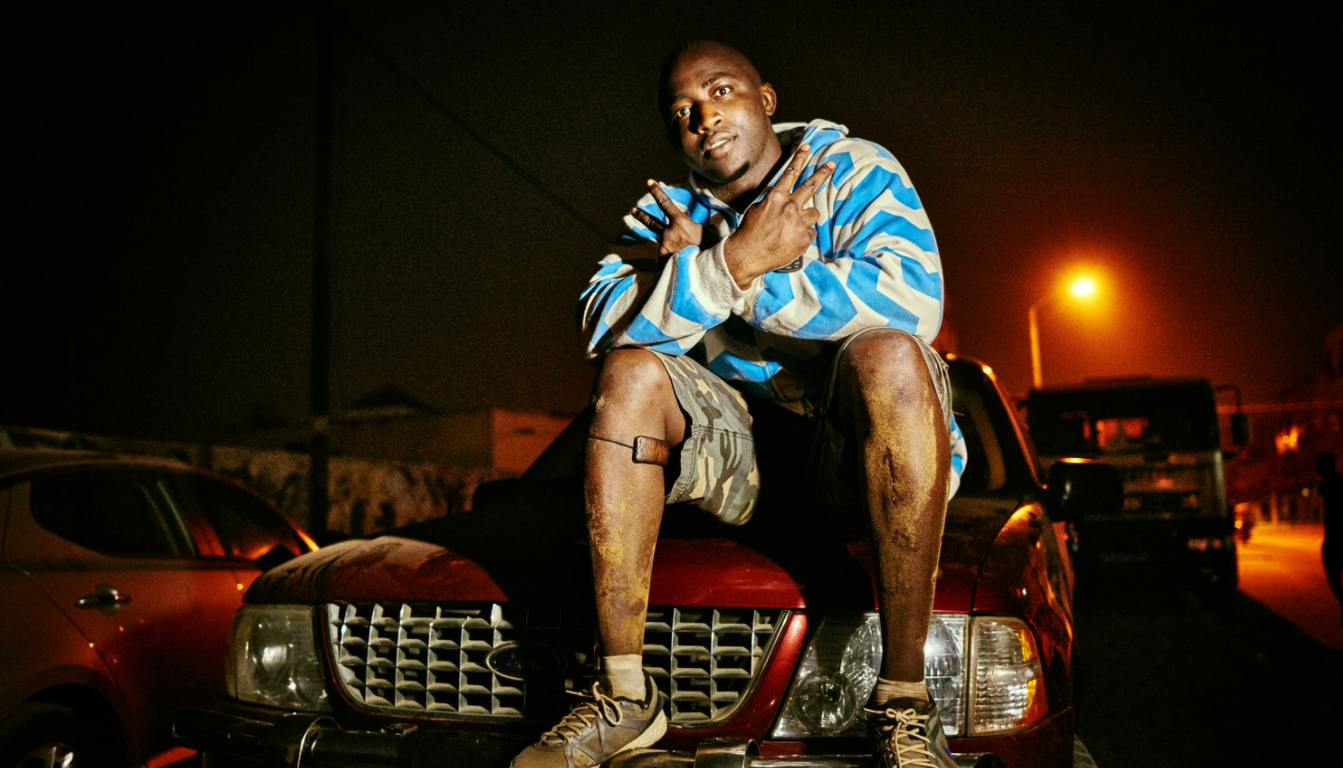
Named in honour of his mentor and trainer, below you see the wrestler Lac de Guiers 2, pictured after a training session on the bonnet of his car, which he was able to buy using some of the prize money he has won. A rising star, on April 12, 2015, he followed in his predecessor’s footsteps and defeated the strong favorite, Papa Sow, in a sensational fight at Demba Diop stadium.
For now, the future of this traditional sport looks set to be filled with ever higher profile competitions and tantilising promise for Senegal’s next generation of aspiring young wrestlers.
Christian Bobst is a documentary and travel photographer who is based in Zürich, Switzerland. You can explore more of his work at christianbobstphotography.com.
THIS ARTICLE WAS ORIGINALLY PUBLISHED ON MAPTIA.