
On April 30th, 2018, Hawaii’s Puʻu ʻŌʻō crater collapsed after erupting for 35 years.
How Solar Energy Is Bringing Power Back to Puerto Rico
After watching Hurricane Maria devastate his native Puerto Rico, New York City-based architect Jonathan Marvel knew he needed to do anything he could to give back. He banded together a group of friends to launch Resilient Power Puerto Rico, hoping to use the strength of renewable, solar energy to provide a steady source of electricity back to the island.
Just two weeks after the ambitious initiative was born, Marvel was back in Puerto Rico installing solar panels and batteries on the rooftops of community centers. The storm had wiped out power lines and had left people without electricity. Solar-powered energy would allow them to live and operate off the grid, without reliance on fossil fuel-burning power plants. Suddenly, these solar-powered community centers were able to provide spaces where people could refrigerate medication, filter water and gather together to rely on one another in the midst of a humanitarian crisis.
At last count, Marvel and Resilient Power Puerto Rico were able to bring solar power to 20 community centers across the island—helping over 100,000 people in the process.
Still, Marvel’s work is far from over. It took nearly a year before the Puerto Rico Electric Power Authority restored power to most of the island’s residents, and, according to reports, the electricity system is in not in a much better state than it was before Maria wiped out the island.
Longer term, Marvel dreams of a day when Puerto Rico is able to shift to 100-percent renewable energy sources. He believes it is an achievable goal, and Resilient Power Puerto Rico is working to make it a reality.
“We can no longer rely on large fossil fuel burning power plants distributing energy and wires that are going to get blown down every year,” Marvel says. “We have all this power from the sun that needs to be harnessed.”
The Threat to America that’s been Growing Inside America
While the Middle East and the border crisis get all the attention, Charlottesville and El Paso remind us that America’s worst threat is right here at home.

White supremacists gathered for the Unite the Right rally in Charlottesville, Virginia. By Anthony Crider. CC by 2.0.
August 12th 2017, fresh out of my first year at the University of Virginia, I sat in front of my TV horrified, watching white supremacists marching through a place I had recently starting calling home. Headlines on every major paper ran with Trump’s quote regarding “fine people on both sides.”
When classes started in the fall, my peers and I returned to Charlottesville deeply unsettled by what had happened on our grounds. Our community was rocked to its core. However, the rest of the world quickly moved on without us.
The past two years, this weekend has marked a time for remembrance, but also caution and fear in Charlottesville. The dates, August 11th and 12th, have become something of the towns very on 9/11, and the police presence during these two days isn’t easy to ignore. The events that took place to years ago are on our minds, however, not on the mind of the nation.
The march on Charlottesville was the last time I saw white supremacy dominate all the major headlines, that is, until this weekend’s mass shooting in El Paso. We, as a nation, let ourselves become distracted and forgetful of a real problem that’s been growing in the heart of our country. We can point to how the nation has so eagerly embraced the narrative of the “dangerous outsider” to explain why.
A decade ago, the Department of Homeland Security released a report on the growing threat of right wing extremism, correctly predicting “the potential emergence of terrorist groups or lone wolf extremists capable of carrying out violent attacks.” However, this warning was not given serious merit by the Trump administration. President Trump’s transition team made it clear to the DHS that it wanted to focus on Islamic terrorism and reorient programs meant to counter violent extremism to exclusively target international threats like al-Qaeda and ISIL. These Islamic terrorist groups have stayed in the headlines, despite the fact they no longer pose a serious domestic threat. It should come as no surprise that this June the FBI reported a significant rise in white supremacist domestic terrorism in recent months.
President Trump’s rhetoric has also turned American’s attention away from the alt-right matter at hand, and turned our attention to what he would call an “infestation.” Searching through theTrump Twitter Archive, I failed to find one mention of domestic terrorism, white nationalists or the growing menace they pose to our country. After all, why shouldn’t Trump protect his loyal voter base? It’s no secret that white nationalists are Trump supporters; alt right leaders have even been spotted at his rallies.
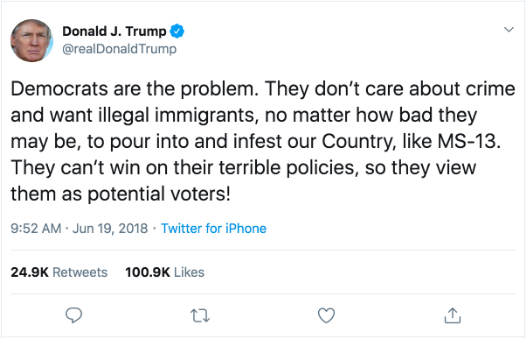
President Trump says immigrants “infest” our country. Via Twitter. June 19, 2018.
The president has protected these terrorists by turning the national discussion elsewhere -the southern border. As a result, liberals have kept themselves busy investigating the disgusting conditions of border control centers and “children in cages,” while conservatives call for further border restrictions. These leaves no one time for anyone to wage war against the real domestic threat --white supremacy.
Trump denounced “racist hate” Monday after the shooting this weekend. He blamed violent video games, mental health and, ironically, internet bigotry from prompting the Dayton and El Paso attacks. He failed to make mention of any real action that might be taken against white supremacist terrorism, let alone endorse gun law reform.
Had the attackers been Black, Hispanic or Middle Eastern, the White House would surely be taking extreme action. However, just like during the aftermath of Charlottesville, nothing serious is being done to combat alt-right violence.
Now,in light of the two year anniversary, I can’t help but wonder if our country truly took notice of the event that shook our little community two years ago. I still pass by the street where Heather Heyer was killed by a domestic terrorist who drove his car into a crowd of people two years ago. The street, now named Heather Heyer Way, remains adorned with chalk writing, flowers and crosses dedicated to her memory. How many more memorials must we lay in El Paso, and the rest of the world, before we address the white supremacist threat?
EMILY DHUE is a third year student at the University of Virginia majoring in media. She is currently studying abroad in Valencia, Spain. She's passionate about writing that makes an impact, and storytelling through digital platforms.

Mexico
The videographer is Face du Monde and these are his comments on the video:
Read MoreThe LGBTQ Migrant Caravan that Sought Asylum in the US
LGBTQ migrants from Central America seeking asylum in the US faced hardship and discrimination not only from gangs that prey on migrants as they travel, but also from their fellow travelers. They were a part of a “caravan” of 3,600 asylum seekers that started to journey from San Pedro Sula, Honduras, in October 2018, traveled through Mexico, and reached the Northern Mexican city of Tijuana, bordering the US, in November 2018. The members of the caravan were escaping all kinds of violence in their home countries of Honduras, Guatemala, and El Salvador.
Read MoreExplore the Melting Ice Caves of Alaska’s Mendenhall Glacier
Mendenhall Glacier is a spectacular 12-mile-long glacier near Juneau, Alaska. Ice caves make up its surreal interior. Only the truly adventurous can access its icy walls, as the trip to see them requires a kayak trip, an ice climb and—once you're inside—the faith that the glacier’s melting walls won't give way. But this natural wonder is under threat. The glacier has been retreating incredibly quickly in recent years due to warmer temperatures and rising sea levels. Since 1958, it has receded by almost two miles. What remains, however, is an utterly breathtaking fantasyland.
Protecting Our Oceans from Ghost Traps
At any given time, there are thought to be over 360,000 tons of loose fishing gear floating through our oceans. These disregarded pieces of debris are a danger to our aquatic ecosystems, trapping fish, turtles, birds and even whales. Kurt Lieber assembled the Ocean Defender Alliance, a group of volunteer divers cleaning California’s coasts of ghost nets and traps.
Turning Plastic Trash Into Cash in Haiti
What would our world look like without plastic? From life-saving medical devices to computers to Tupperware, it’s changed the way we live, work and understand the world around us. But the same wonder material that has revolutionized so much is choking our oceans. It’s estimated that, every minute, an entire garbage truck worth of plastic hits our oceans. Otherwise put, 8 million tons of once-useful items find their way to global waters each year. There, over time, they break into tiny pieces called “microplastics,” which end up consumed by marine life.
For David Katz, fighting plastic pollution should start long before a soda bottle hits the tide. What’s more, he believes the very plastic waste that litters our shores and seas is anything but waste. In 2014, David launched the Plastic Bank, “a global network of micro-recycling markets that empower the poor to transcend poverty by cleaning the environment,” according to its website. The organization currently operates in Haiti, the Philippines, Indonesia and Brazil, and works like this: community members collect plastic waste (much of it post-consumer products like milk containers, detergent bottles and plastic bags) and bring it to Plastic Bank centers where it’s weighed and exchanged for cash. In Haiti, for example, more than 2,000 collectors have recovered around 7-million pounds of plastic since the organization arrived in 2015.
What was once considered waste can now be sold to major brands like Marks and Spencer and Henkle, who will use it to package and distribute their products in a more sustainable manner. As David Katz puts it, this “social plastic” is “empowering and precious”—something that bonds collectors in places like the Philippines and Haiti to brands and consumers around the world.
For Native Americans, US-Mexico Border is an ‘Imaginary Line’
Immigration restrictions were making life difficult for Native Americans who live along – and across – the U.S.-Mexico border even before President Donald Trump declared a national emergency to build his border wall.
Read More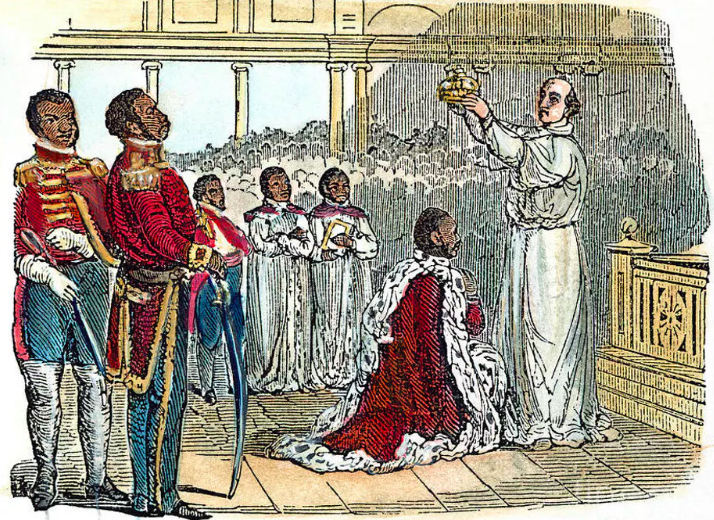
An 1811 wood engraving depicts the coronation of King Henry. Fine Art America
Inside the Kingdom of Hayti, ‘the Wakanda of the Western Hemisphere’
Marvel’s blockbuster “Black Panther,” which recently became the first superhero drama to be nominated for a Best Picture Academy Award, takes place in the secret African Kingdom of Wakanda. The Black Panther, also known as T’Challa, rules over this imaginary empire – a refuge from the colonialists and capitalists who have historically impoverished the real continent of Africa.
Read MoreDeath Toll Rises in Tijuana
A few miles south of San Diego lies Tijuana, a favorite weekend getaway for Americans. Some Californians have even taken to living in Tijuana permanently to escape their state’s rising housing costs. However, life in Tijuana has changed drastically over the last few years as conflicts between rival drug cartels have caused the city’s murder rate to skyrocket. The situation presents a new set of risks for those wanting to visit the ever-popular tourist trap.
Read More
America’s public schools were meant to bring together children from all walks of life. Monkey Business Images/www.shutterstock.com
America’s Public Schools Seldom Bring Rich and Poor Together – and MLK Would Disapprove
Five decades after the assassination of Martin Luther King Jr., many carry on his legacy through the struggle for racially integrated schools. Yet as King put it in a 1968 speech, the deeper struggle was “for genuine equality, which means economic equality.” Justice in education would demand not just racially integrated schools, but also economically integrated schools.
The fight for racial integration meant overturning state laws and a century of history – it was an uphill battle from the start. But economic integration should have been easier. In the mid-18th century, when education reformers first made the case for inclusive and taxpayer-supported education, they argued that “common schools” would ease the class differences between children from different backgrounds.
As Horace Mann, the most prominent of these reformers, argued in 1848, such schools would serve to counter the “domination of capital and the servility of labor.” Learning together on common ground, rich and poor would see themselves in common cause – a necessity for the survival of the republic.
More than 150 years later, the nation has yet to realize this vision. In fact, it has been largely forgotten. Modern Americans regularly scrutinize the aims and intentions of the Founding Fathers; but the early designs for public education – outlined by Mann, the first secretary of education in Massachusetts, as well as by leaders like Henry Barnard, Thaddeus Stevens, and Caleb Mills – are mostly overlooked. Today, the average low-income student in the U.S. attends a school where two-thirds of students are poor. Nearly half of low-income students attend schools with poverty rates of 75 percent or higher.
Education historians, like myself, have generally focused their research and attention on racial segregation, rather than on economic segregation. But as income inequality continues to deepen, the aim of economically integrated schools has never been more relevant. If we are concerned with justice, we must revitalize this original vision of public education.
Shared community
Early advocates of taxpayer-supported common schools argued that public education would promote integration across social classes. They thought it would instill a spirit of shared community and open what Horace Mann called “a wider area over which the social feelings will expand.”
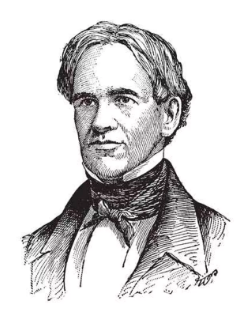
Horace Mann (1796-1859) was an early advocate of public education in the U.S. Fotolia/AP
And, generally speaking, it worked. The ultra-rich mostly continued to send their children to private academies. But many middle- and upper-income households began to send their children to public schools. As historians have shown, economically segregated schools did not systematically emerge until the mid-20th century, as a product of exclusionary zoning and discriminatory housing policies. Schools weren’t perfectly integrated by any means, particularly with regard to race. They were, however, vital sites of cross-class interaction.
Many prominent Americans – including U.S. presidents – were products of the public schools. Commonly, they sat side by side in classrooms with people from different walks of life.
But over the past half-century, students have been increasingly likely to go to school with students from similar socioeconomic backgrounds. Since 1970, residential segregation has increased sharply, with twice as many families now living in either rich or poor neighborhoods – a trend that has been particularly acute in urban areas. And segregation by income is most extreme among families with school-age children. Poor children are increasingly likely to go to school with poor children. Similar economic isolation is true of the middle and affluent classes.
Contemporary Americans commonly accept that their schools will be segregated by social class. Yet the architects of American public education would have viewed such an outcome as a catastrophe. In fact, they might attribute growing economic inequality to the systematic separation of rich and poor. As Horace Mann argued, it was the core mission of public schools to bring different young people together – to consider not just “what one individual or family needs,” but rather “what the whole community needs.”
Many parents do continue seek out diverse schools. A number of school districts have worked to devise student assignment plans that advance the aim of integration. And some charter schools are reaching this market by pursuing what has been called a “diverse-by-design” strategy. As demonstrated by research, diverse schools can and often do improve achievement across a range of social and cognitive outcomes, such as critical thinking, empathy and open-mindedness.
Largely overlooked, however, has been the political benefit of integrated schools. One rarely encounters the once-common argument that the health of American democracy depends on rich and poor attending school together. This is particularly surprising in an age of tremendous disparities in wealth and power. Members of Congress, on average, are 12 times wealthier than the typical American. Moreover, lawmakers are increasingly responsive to the privileged, even at the expense of middle-class voters.
If elites are isolated from their lower- and middle-income peers, they may be less likely to see a relationship of mutual commitment and responsibility to those of lesser means. As scholars Kendra Bischoff and Sean F. Reardon have argued, “If socioeconomic segregation means that more advantaged families do not share social environments and public institutions such as schools, public services, and parks with low-income families, advantaged families may hold back their support for investments in shared resources.”
What can be done?
Today more than 100 school districts or charter school chains work to integrate schools economically. Cambridge, Massachusetts, for instance, has four decades of experience balancing enrollments by social class, seeking to match the diversity of the city as a whole in each school.
This, of course, is only possible in a diverse place. Median family income in Cambridge is roughly US$100,000, while 15 percent of city residents live below the poverty line. It is also made possible through heavy investments in public education in the city. After all, it is far easier to convince middle-class and affluent parents to send their children to the public schools when per-pupil expenditures rival the highest-spending suburbs, as they do in Cambridge.
But not every district has Cambridge’s advantages. Nor does every district have similar political will.
The latter of those two constraints, however, may soon begin to change. Faced with a growing divide between rich and poor, Americans may begin to demand schools that not only serve young people equally from a funding standpoint, but also educate them together in the same classrooms.
Common schools by themselves are not enough to solve the problem of economic inequality. Yet if Americans seek to create a society in which the rich and the poor see themselves in common cause, common schools may be a necessary – and long overdue – step. We must come to see, in the words of Martin Luther King, that, “We are caught in an inescapable network of mutuality, tied in a single garment of destiny.”
Jack Schneider is an Assistant Professor of Education at the University of Massachusetts Lowell.
THIS ARTICLE WAS ORIGINALLY PUBLISHED ON THE CONVERSATION
Fighting Food Waste in Los Angeles
When Rick Nahmias realized that fresh produce in his community was routinely being tossed out for minor bruising or browning, he knew something needed to be done to end the unnecessary waste. He founded Food Forward, a non-profit dedicated to ending hunger by sharing abundance. The organization recovers fresh produce that may otherwise go to waste, collecting from farmers markets, wholesale food suppliers, and even residential backyards. Within the past year, they’ve already fed 1.5 million people across Los Angeles.
Americans and Mexicans Living at the Border are More Connected Than Divided
In 2002, I began traveling the entire length of the U.S.-Mexico border on both sides. From the Pacific Ocean to the Gulf of Mexico, the border measures almost 2,000 miles.
Read More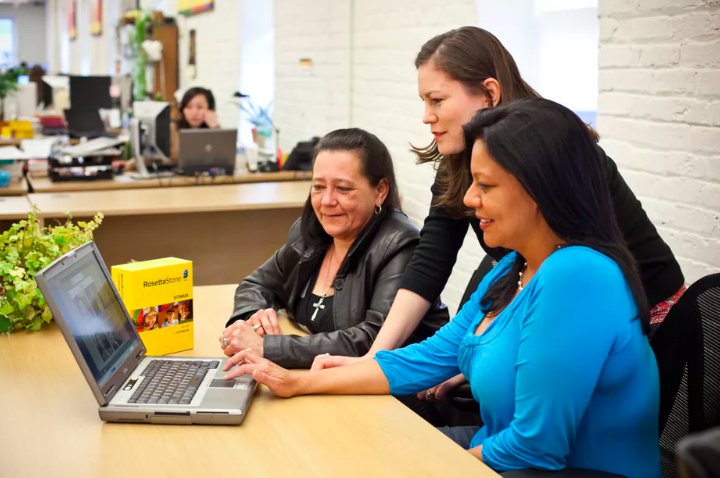
Members of the Chitimacha language team (from left to right) Sam Boutte, Kim Walden and Rachel Vilcan use the new language software for the first time. Author provided
Renaissance on the Bayou: The Revival of a Lost Language
In the summer of 1930, at the dawn of the Great Depression, a 21-year-old linguist named Morris Swadesh set out for Louisiana to record the area’s Native American languages, which were disappearing rapidly.
Morris and his peers were in a race against time to document them, and in the small town of Charenton on the Bayou Teche, he encountered Benjamin Paul and Delphine Ducloux, members of a small tribe called Chitimacha – and the last two speakers of their language.
But today, if you visited the Chitimacha reservation, you’d never know that their language went unspoken for half a century.
Over the past several decades, many Native American tribes have participated in what has become a robust language revitalization movement. As their populations of fluent speakers dwindle and age, tribes want to ensure that their heritage languages are passed on to the next generation – before it’s too late.
But because the Chitimacha tribe had no living speakers for a number of decades, it made the challenge that much greater. In the end, the story of the language’s decline, loss and rebirth is a remarkable example of cultural survival.
Why document a language?
Unlike some other cultural legacies, languages leave no trace in the archaeological record. There’s often no trace in the written record, either.
Only a small portion of the world’s estimated 7,000 languages are well-documented in places like dictionaries and grammar books. Those that are least well-documented are the most endangered.
Many dead or dying languages contain exotic features of verbal and written communication. Chitimacha, for example, doesn’t use a word “be” in phrases like “she is reading.” Instead, speakers must use a verb of position, such as “she sits reading” or “she stands reading.” These are things that challenge linguists’ understanding of how language works.
By working with Ben and Delphine, Morris was trying to capture a small piece of that linguistic diversity before it vanished.
One day, with Morris sitting on Ben’s porch dutifully scribbling down his every word in a composition notebook, Ben finished a story (a riveting tale of how the Chitimacha first acquired fire by stealing it from a mythical old blind man in the west). He then went on to tell Morris:
There were very many stories about the west. I believe I am doing well. I have not forgotten everything yet. When I die, you will not hear that sort of thing again. I am the only one here who knows the stories.
Ben passed away three years later, and Delphine not long thereafter. After their deaths, it seemed the Chitimacha language was doomed to silence.
Why do languages die?
How does a language come to have only two speakers? Why have so many Native American languages become endangered? The causes are manifold, but there are two main ones: sharp reductions in the population of the community that speaks the language, and interruptions in the traditional means of transferring the language from one generation to the next.
In the past, the former caused the most damage. Native American peoples were decimated by European diseases and subject to outright warfare.
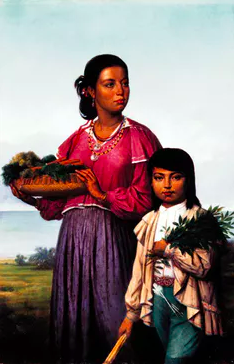
A portrait of two Chitimacha by French-born painter François Bernard (1870). Wikimedia Commons
Prior to European contact, the Chitimacha were lords of the bayou, with a territory stretching from Vermillion Bay in the west to present-day New Orleans in the east. They were expert canoe-makers and wielded extensive knowledge of the region’s labyrinthian network of waterways.
But by the time the French arrived in present-day Louisiana in 1699, the tribe’s numbers had dwindled to around 4,000, their communities gutted by European diseases that spread faster than the Europeans themselves.
After a protracted war with the French, they retreated deep into the bayou, where the their reservation at Charenton sits today. The 1910 census recorded just 69 people living there.
Only later did the second cause of language decline occur, when children on the reservation were sent to the infamous Carlisle Indian School in Pennsylvania, which interrupted the transmission of the language to the next generation.
Ben and Delphine, born in the latter half of the 1800s, were part of the last generation to learn the language at home. Eventually their parents and many of their peers passed away, leaving them as the last two speakers of the language.
Renaissance on the bayou
Ben probably never imagined that the efforts of him and Delphine would spark the tribe’s linguistic renaissance, awakening their language from 60 years of silence.

Delphine Ducloux was one of the two last speakers of the Chitimacha language, prior to its revival. State Library of Louisiana
In the early 1990s, cultural director for the tribe Kim Walden received a call from the American Philosophical Society Library informing her that they had all of Morris’ notebooks, and even his drafts for a grammar manual and dictionary, which totaled hundreds of pages in all. Thus began the herculean effort to revive the language.
The tribe put together a small-but-dedicated team of language experts, who set out to learn their language as quickly as possible. They began to produce storybooks based on Ben and Delphine’s stories, and word lists from the dictionary manuscript.
In 2008, the tribe partnered with the software company Rosetta Stone on a two-year project to create computer software for learning the language, which today every registered tribal member has a copy of. This is where I came in, serving as editor and linguist consultant for the project, a monumental collaborative effort involving thousands of hours of translating, editing, recording and photographing. We’re now hard at work finishing a complete dictionary and learner’s reference grammar for the language.
Today, if you stroll through the reservation’s school, you’ll hear kids speaking Chitimacha in language classes, or using it with their friends in the hall. At home they practice with the Chitimacha version of Rosetta Stone, and this past year the tribe even launched a preschool immersion program.
The kids even make up slang that baffles adult ears, a sure sign that the language is doing well – and hopefully will continue to thrive, into the next generation and beyond.
Author Danny Hieber presents the story of the Chitimacha language at the University of California’s Grad Slam competition.
DANIEL W. HIEBER is a PhD Candidate in Linguistics at the University of California in Santa Barbara.
THIS ARTICLE WAS ORIGINALLY PUBLISHED ON THE CONVERSATION
Swimming with Whale Sharks in Mexico: Ecotourism or Exploitation?
Whale Shark ecotourism in Cancun, with tour companies recruiting the very fishermen who killed sharks in the past as tour operators working toward their preservation.
Read MoreBorder Crisis: Where American Myth Meets Reality
Once upon a time, there was a highway that stretched 2,448 miles across the American landscape, from Chicago, Illinois to Santa Monica, California. Constructed in 1926, Route 66 actually no longer exists—having been replaced by the Interstate Highway System over the years. This ghostly road, which exists only in historical snapshots, relics, and memories, once represented the heart of American folklore.
Read MoreLiteracy… for Whom?
The significance of the Gary B. v. Snyder lawsuit dismissal.

Detroit students opened up the conversation on who has the right to education (Source: Steve Neavling).
On June 29, 2018 US District Judge Stephen J. Murphy III dismissed a federal class-action lawsuit, Gary B. v. Snyder. The lawsuit, filed in 2016 by Public Counsel and Sidley Austin LLP on behalf of a class of students, claimed the plaintiffs were deprived of the right to literacy. The decision will be appealed at the US Sixth Circuit Court of Appeals.
Although Judge Murphy agreed a degree of literacy is important for such matters as voting and job searching, he did not say it was fundamental: constitutional. The central reasoning for the dismissal of the case was the suit failed to show overt racial discrimination by the defendants in charge of the Detroit Public Schools: the state of Michigan. The other reasoning Judge Murphy provided was that the 14th amendment’s due process clause does not require Michigan provide “minimally adequate education.”
Meanwhile the case brings up an important question its initial filing gave rise to: is literacy a constitutional right? One could argue the importance of literacy goes back to Reconstruction. According to Professor Derek Black, Southern states had to rewrite their constitutions with an education guarantee in addition to passing the 14th amendment before they could be readmitted into the US. Black states “the explicit right of citizenship in the 14th Amendment included an implicit right to education.”
The theme of education and citizenship is a central component to the complaint’s argument for literacy as a fundamental right. It appeared in the 1954 Brown v. Board of Education case too, which emphasized that education was “the very foundation of good citizenship.” The complaint drew on this citizenship theme to argue the importance of establishing elementary literacy tools—about the equivalent of a 3rd grade reading level. These can then develop into adolescent literacy skills, which allow an individual to comprehend and engage with words. Such engagement is what democratic citizens need when they are making decisions on who to vote; even more importantly, literacy is essential to understanding the often complex ballots voting requires. Further, literacy allows one to take part in political conversations.
The schools in question also “serve more than 97% children of color,” according to the complaint. Many of these students also come from low income families. On the 2017 Nation’s Report Card the average score out of 500 for reading was 182 for Detroit 4th graders, compared to the national average of 213 in other large city school districts. If the 1982 Pyler v. Doe case argued children could not be denied free public education that is offered to other children within the same state—in line with the 14th amendment—then why the disparity in scores?
The plaintiffs believe the disparity lies in deeply rooted issues in the Detroit Public Schools. They argue literacy tools that are first taught in elementary school are not only unavailable to them but that their schools are also not adequate environments for fostering education.The complaint mentions unsanitary conditions, extreme classroom temperatures, and overcrowded classrooms as environmental stressors. They also mention inadequate classroom materials as well as outdated and overused textbooks.
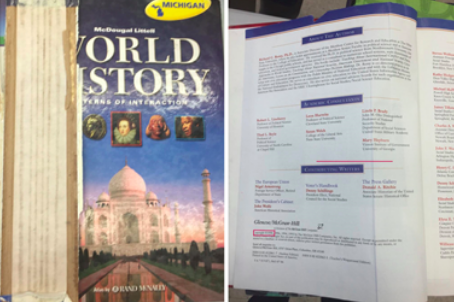
Worn history textbook from 1998 (source: Public Counsel).
Not only is the school environment not conducive to learning for these students but their teachers are often not the proper facilitators for learning. The complaint mention such issues as high teacher turnover, frequent teacher absences, lack of short term substitute teachers, inadequate teacher training, and allowance of non-certified individuals. The complaint also states students at these schools may also have unaddressed issues related to trauma teachers are not trained for.
And the solution to these discrepancies could very well be what the plaintiffs are arguing for: make literacy, education, a fundamental right. In a 2012 Pearson study on global education systems, the US was number 17. All the countries ahead of the US had either a constitutional guarantee of education or a statue acknowledging the role of education. According to Stephen Lurie, this creates a baseline ruling of what education entails: a culture of education around which laws can form.
Such a baseline ensures education is not a question of privilege. Indeed such conditions as the complaint mentions, as lawyer Mark Rosenbaum stated, would be “unthinkable in schools serving predominantly white, affluent student populations.” What Gary B. v. Sanders is asking for is a safe school environment, trained teachers, and basic instructional materials. It is asking that Detroit students are guaranteed a minimum of education that will at least give them the chance other students in Michigan have at becoming informed citizens and adults.



Teresa Nolwalk
Teresa Nolwalk is a student at the University of Virginia studying anthropology and history. In her free time she loves traveling, volunteering in the Charlottesville community, and listening to other people’s stories. She does not know where her studies will take her, but is certain writing will be a part of whatever the future has in store.
Bringing Indonesian Cuisine to New York, One Table at a Time
Every Tuesday, Indo Java in Queens, New York, turns into the hottest spot in town for traditional Indonesian cuisine. And the best part? You’re always guaranteed the best seat in the house. With only one table, Warung Selasa is one of the smallest restaurants in the city, located inside a tiny, two-aisle grocery store. Owned and operated by Dewi Tjahjadi, Warung Selasa has been spreading the flavors of Indonesia in Queens for the past 10 years.
Inside an Apache Rite of Passage Into Womanhood
For the Mescalero Apache Tribe, girls are not recognized as women until they have undergone the Sunrise Ceremony- an ancient, coming-of-age ceremony that lasts for four days. Last May, VICE got rare access to the ceremony for Julene Geronimo - the great, great grand-daughter of the renowned Apache leader, Geronimo. We followed Julene through each day of her arduous rite-of-passage to better understand what womanhood means for the Apache tribe, and how these ceremonies play a significant role in preserving a way of life that almost became extinct.