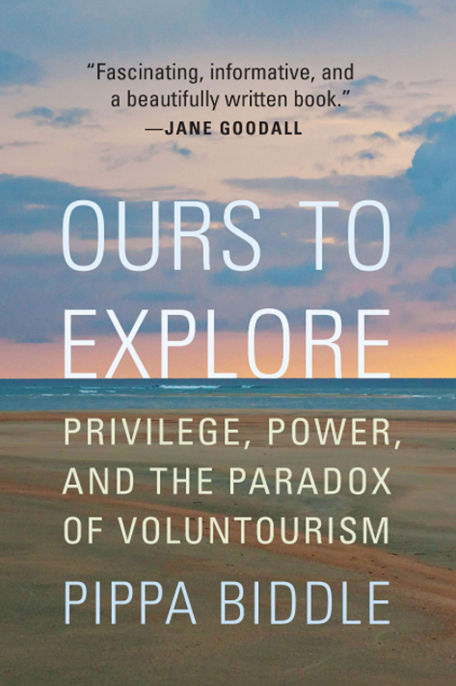
In her new book, “Ours to Explore: Privilege, Power, and the Paradox of Voluntourism,” Pippa Biddle asks travelers and volunteers to look at the ways their actions affect the global community.

Biddle sat down with CATALYST Sarah Leidich to discuss her latest book and offer her take on voluntourism.
Q: What inspired you to write this book?
A: For me, so much of working on the book was trying to call people into a conversation and call out the industry and not the individual. With voluntourism, so much of the critique has been focused on specific people.
It actually wasn’t my idea. I wrote a piece called “The Problems of the White Girls” that went viral and a literary agent reached out who suggested that there was a book in it. I spent about a year working with them on a proposal before I realized the book they wanted me to write was not the book I was interested in writing. They really wanted me to write a how-to-do-it-better, and I didn’t want anyone to do it. So why would I take an entire book to do that? But the process of working with them really showed me that there was a book in this—that there was enough material, enough research, enough interest to have a book.
Q: Before we talk about avoiding it or preventing it, can you define contemporary colonialism? How does it function today?
A: To me, contemporary colonialism is the continuation of colonial ideologies and empires into today. The reason that I use the phrase “contemporary colonialism” as opposed to neocolonialism is because oftentimes, the way we think about colonialism today is informed by and yet somehow held separate from the colonialism of the past and empire-building of the past, specifically empire-building done by Western European and North American powers. In North America, primarily the United States. To me, that differentiation between past and present is completely false.
It actually allows us to de-implicate ourselves, and by ourselves I mean people who are residents of powerful nations, beneficiaries of power dynamics, and travelers and voluntourists. Contemporary colonialism is simply a different phrase that refers to colonialism that I hope better amplifies the fact that there is that unbroken thread between past colonialism and present colonialism—it’s just modified itself for the present-day environment.
Q: Is it possible for volunteers to travel abroad without engaging in contemporary colonialism?
A: I don’t think it’s possible for anyone to travel anywhere without engaging in contemporary colonialism, but engaging with something isn’t in and of itself necessarily problematic. However, you have to recognize it to begin to address the problems with it when it is problematic. Just the fact that some people can travel for leisure and some cannot is an engagement with contemporary colonialism. The fact that I can, pre-pandemic and probably still right now, go to Tanzania and arrive and get a tourist visa for probably $100 and be in the door, but someone from Tanzania cannot reciprocate that action in the United States, is an example of contemporary colonialism, regardless of whether I’m going there to be a volunteer or go on a safari.
Q: What steps can travelers, especially privileged travelers, take to avoid acts that perpetuate the harmful side effects of travel?
A: I think that one of the biggest things we need to ask ourselves before booking a trip somewhere is “why are we going there?” I think a lot of travelers don’t take that moment to ask themselves “why do I need to go to this place?” And once they answer that question, to make decisions that fulfill their “why” in the most respectful way possible, which sometimes means not going. For example, if I were to say I really want to go to Ecuador because I’m really fascinated by Ecuadorian cuisine, then if I were to go to Ecuador, I should be focused on eating at restaurants that are owned and run and staffed by Ecuadorians. This sounds like an obvious thing, but most tourists don’t do that extra step. They go somewhere and eat at the places that are easy, that have the menu in English, that the resort has on their short list. The resort is probably foreign-owned, so the restaurants are probably owned by people associated with the resort.
The whole idea that travel should be something leisurely is really off-base. Travel is not a leisure activity. Travel is an activity that demands conscious engagement and thoughtful consideration, and as long as we treat it as something that is in the same realm as a relaxing day on the beach in your hometown—if you happen to live by the beach—we’re going to be doing it in ways that are disrespectful.
Q: You write about the tension between communities sometimes believing that voluntourists and missionaries are actually doing good work and then the harmful reality of this kind of travel, volunteering and missionary work. Is there a way to reconcile the relationship between intention, perception and outcome?
A: In the book I use the term “pathological altruism.” Pathological altruism really speaks to this tension, because it is the inability to see that something you are doing with the intention of the impact being positive is having a negative impact, and through that inability to see it, insisting on continuing to do it regardless. I think that the intention to do good is a very good core intention and stripping back to that core intention is a really positive thing, but the idea that intention should be immediately followed by action is misguided.
I used to work for the Jane Goodall Institute doing educational programming, and one of the things that we brought into classrooms a lot was a thing we called the “Knowledge-Compassion-Action Cycle.” The Knowledge-Compassion-Action Cycle is basically the idea that when we learn about something, we begin to care about it, and once we care about it, we are able to act in the best possible way, and through action you will learn more knowledge. I think a lot of people are skipping that middle part of true, deep knowledge and care. For example, with children in orphanages, if people who chose to volunteer in an orphanage cared about child welfare, and they’re jumping to the idea of volunteering at orphanage, that shows me that they haven’t gone through the knowledge procession and they haven’t gone through the compassion process, because there is no way you go from child welfare to orphanage if you’ve actually gone through that process. It’s trying to integrate more time and education and slowness into what we care about so that we have that time for knowledge and compassion to develop before we choose to take action.
Q: So if knowledge is developed and compassion is developed, and travelers are moving through the communities with intent, are there changes to the voluntourism industry you would like to see?
A: Something that makes me nervous about suggesting changes to the voluntourism industry is that it could be misconstrued as me saying that if the industry were to make those changes, it would be OK. That is not what I’m saying. However, there are things that can be done to mitigate the harm as we slowly dismantle voluntourism. The first thing, hands down, is to stop working with kids. Unfortunately, a lot of the trip providers that have stopped working with orphanages have simply pivoted and now take volunteers to work with youth groups, so the only thing that’s changed is that it’s not a residential environment, but so many of the same issues still exist. Honestly, if voluntourism stops working with kids, a fair amount of the market for voluntourism will dry up because the number one thing people want to do on these trips is work with kids. If that is not an option, the industry will shrink.
Parallel to that, I am adamant that prospective voluntourists deeply engage in the education around what they’re taking part in. One of the things I write about in the book is the “EdGE” platform by Omprakash, which is a nonprofit. EdGE is their learning platform, and EdGE is not perfect and Omprakash is not perfect, and Willy Oppenheim, the founder, is the first to admit that. But it provides trip providers and educational institutions that are facilitating voluntourism, as well as individual travelers that are going on their own, with a curriculum that attempts to educate them on some issues like White privilege and the White savior complex prior to them getting on the ground, so they go through the learning curve that I had years after going before they even go. Does that mean they will not be part of the White savior complex and White privilege? No, but it is a really important step.
Q: How would you encourage people who are looking to be philanthropic or looking to help? What would you say to them?
A: Think global, act local. Learn about global issues, engage in global conversations, learn about places, travel as a tourist who is respectful and thoughtful, but you have to remember that even the opportunity to travel is a privilege. If we have this idea that the only way to help is by going somewhere else, we are discounting billions of people on this planet who simply don’t have access to that opportunity. So think global, and then when you choose to act, look locally.
Sarah Leidich
Whatever it is, the way you tell your story online can make all the difference.
Sarah is currently an English and Film major at Barnard College of Columbia University. Sarah is inspired by global art in every form, and hopes to explore the intersection of activism, art, and storytelling through her writing.