Meet the Women in Pink Saris Fighting Gender Discrimination in India

Pink sari-wearing and bamboo stick-wielding feminists are fighting against a culture of rape and gender inequality in India.
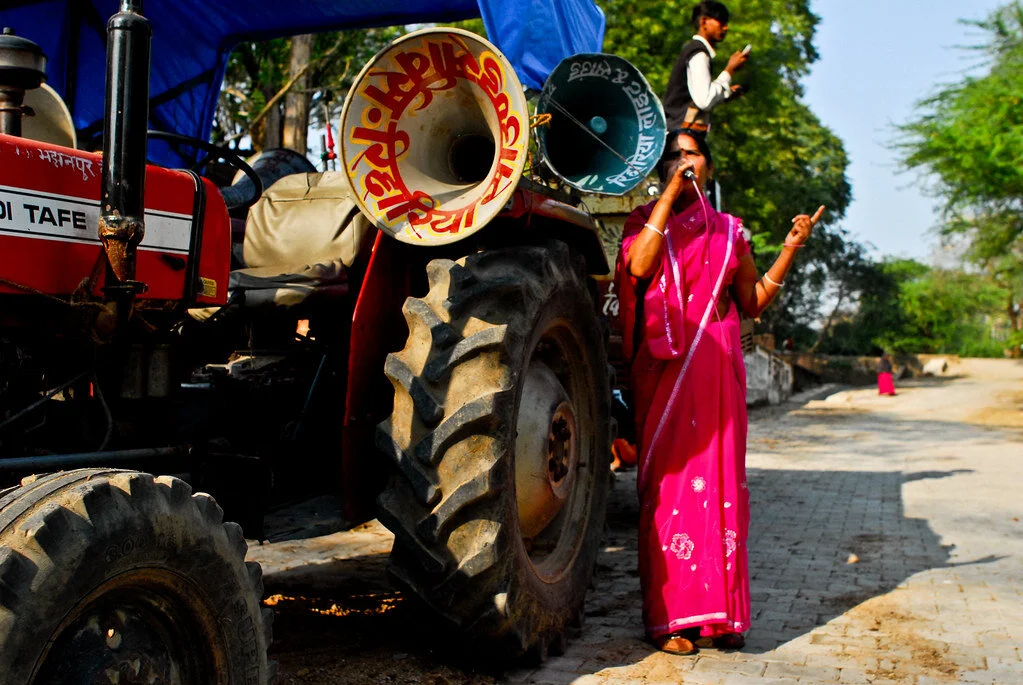
Sampat Pal Devi, founder of the Gulabi Gang. Iecercle. CC BY-NC-SA 2.0

India’s rape crisis was brought to light back in December 2012 when a 23-year-old female student was raped and beaten to death by five men and a teenage boy. Protesters flooded India’s capital of New Delhi and forced authorities to seek the death penalty for the perpetrators. But the crisis lingers as cases of rape and neglect by corrupt government officials still plague India, especially in rural areas. 

Approximately 70% of India’s population lives outside of major cities in the rural areas where it is even harder to seek out justice in the name of the law. Uttar Pradesh state is notorious for its high rate of sexual violence against women, even being named the “rape capital of India.” According to the National Crime Records Bureau, crimes against women in Uttar Pradesh increased by 20% from 2016 to 2019.

But there is hope for Uttar Pradesh, and it comes in the form of women wearing hot pink saris and wielding large bamboo staffs called lathis. Sampat Pal Devi is the founder and was the first leader of the Gulabi Gang, which translates to the “Pink Gang.” Their pink saris represent sisterhood and unity as they come together in droves to fight corruption and to ensure the basic rights of women and poor people in rural areas.

Devi’s story began when she was a single woman living in Uttar Pradesh’s Banda district and witnessed a man savagely beating his wife. She attempted to help, but he beat her as well. She returned a few days later with five other women and beat him with lathis. The story quickly spread throughout the town and more women came to Devi for help. In 2006, after the selection of the pink sari as their uniform, they officially established the Gulabi Gang. Their initial intention was to punish abusive men and combat domestic violence, but it has expanded into a much larger movement of feminism. The Gulabi Gang now fights for socioeconomic, cultural and political equality in order to enhance the basic skills of women to develop confidence and protect themselves from abuse through sustainable livelihoods.
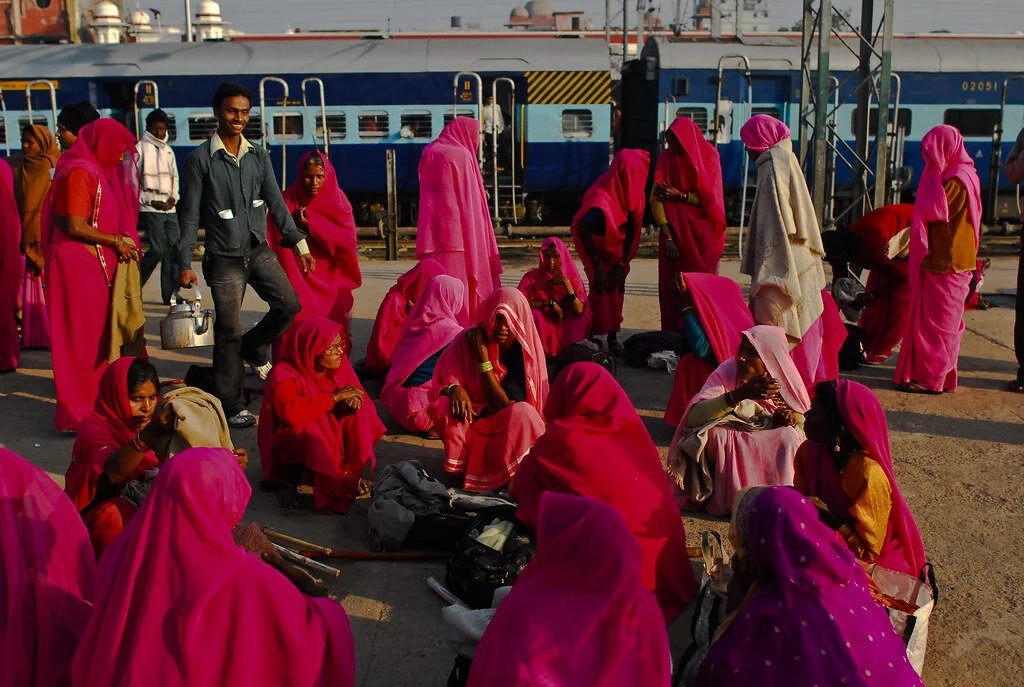
Gulabi Gang resting during a protest. Iecercle. CC BY-NC-SA 2.0

Fast forward 14 years since its establishment and the Gulabi Gang has grown exponentially. Almost 100,000 women and men have banded together to join what is now a mass movement in northern India. In an interview with Vice News, Devi stated that, “The purpose of the Gulabi Gang was to unite women, because until women unite, we will never get what we believe are our rights.” She spent a great deal of her time intimidating and shaming government officials into making the correct choices and abiding by the law.

Although she made many achievements, Devi was removed from her position as leader of the Gulabi Gang for alleged self-promotion at the cost of the organization’s mission. Her removal caused quite a stir until the group’s assistant commander, Suman Singh Chauhan, was elected as its next leader. Even with the change in leadership, the Gulabi Gang stands strong as the organization continues to emphasize its mission.

The Gulabi Gang not only leads and protects but also teaches women a variety of skills necessary to be independent. Through its website, the group has raised enough money to build a school in an impoverished area. In the school, girls learn how to sew in order to earn money and delay the chance of their parents marrying them off. The group’s leaders teach new members how to defend themselves with lathis in free self-defense courses. Finally, they teach the world that through common sense and compassion one can start a revolution, even when the soldiers are wearing pink.

Yuliana Rocio

Yuliana is currently a Literature/Writing major at the University of California San Diego. Yuliana likes to think of herself as a lover of words and a student of the world. She loves to read, swim, and paint in her free time. She spent her youth as part of a travel-loving family and has grown up seeking adventure. She hopes to develop her writing skills, creating work that reflects her voice and her fierce passion for activism.

The Sexism Woven into Language

Subtle sexism in language emerges when the male gender is prescribed as default, contributing to gender inequalities and linguistic biases.

Language Across the World. Emma Howard. CC BY 2.0

Language shapes and reflects the cultural norms and values of its speakers. Unfortunately, many languages around the world include subtle forms of sexism which have historically prescribed the male gender as their default. From grammatical structures to the usage of words that perpetuate unequal dynamics, language can unintentionally serve as a vehicle for sexism.
Most languages around the world fall into three categories: gendered languages—nouns and pronouns have a gender (Spanish—el es pequeno/ella es pequena—he/she is little, French—il est petit/elle est petite—he/she is little), genderless languages—nouns and pronouns do not have a gender (Mandarin—他很小 / 她很小—he/she is little) and natural gender languages—gendered pronouns and genderless nouns (English, he is little/she is little). Of the gendered languages listed, the two share patterns of a masculine grammatical default, mixed-gender groups taking masculine endings and feminine nouns derived from masculine ones. In Spanish and French there is a male default that applies when the gender of a subject is unclear or if a group is mixed-gender. A male friend in French is ami while a female friend is amie. In French, there is no gender neutral pronoun for ‘they’ and the masculine is considered the dominant plural form. Therefore, if there is a group of French girls who are amies; add one male and they become amis. Aside from grammar, some words in French did not have a feminine form until official guardians of the French language approved the feminisation of certain titles to eliminate male linguistic dominance. Insistence on calling female presidents Madame le president was subsequently dropped in an attempt to end the bias putting women at a disadvantage.

Mandarin, unlike some European languages, does not assign gender to its nouns, but some of its written characters ascribe negative stereotypes to women. Chinese characters are made up of phonetic and semantic radicals that are listed together in dictionaries. The Chinese radical for “woman” (女) can be found in characters such as “mother,” (妈) “sister” (姐) and “safety” (安) but is also found in more negative characters including “jealousy,” (妒) “slave” (奴隶) and “rape” (强奸). The contrast between these positive and negative connotations are stark but even those that are positive are representative of gender stereotypes themselves; “safety” (安) is thought to represent a woman under a roof. Conversely, the word for “man” (男) is made by the radicals for “field” (田) and “power” (力). Aside from the makeup of the characters themselves, grammatical word order has been said to favor men, for example, in instances where the word “parents” means literally “father and mother.” Ironically, even the phrase for “gender equality” places the male character before the female one (男女平等).

Globally, some languages are representative of a time where the patriarchy was more powerful. They serve as a reminder that words and grammar can sustain sexism covertly and can also impose particular worldviews on their speakers. Some words have different meanings depending on whether they are used in a masculine or feminine form. Others have no male equivalent for a derogatory female word. For instance in Italian, un passeggiatore is a man who loves to walk. Make this word feminine and the definition drastically changes to have a sexual connotation. Alternatively, in English, there is no male equivalent of a “spinster,” the closest being “bachelor” which tends not to carry the same negative, undesirable connotations.

Negative connotations have made their way into technology as well, with one study finding that Google Translate often assumes that, when translating from other languages into English, the subject is male. Male default has also shown up in translator applications where gender bias shows up most in “fill in gender” translations. One tweet focused on Turkish and its gender-biases when translating to English. Sentences like o bir ascı translated to “she is a cook” while others like o bir muhendis translated to “he is an engineer.” Because Turkish is a gender neutral language it becomes clear that Google Translate filled in genders based on stereotypes and bias. Modern neural network-powered machines derive meaning from the statistical patterns of large texts during training, meaning that if our data is biased, machines will be as well.

Women already face barriers to their participation in society, but now with gendered languages playing a role. One research project examined the grammatical structure of over 4,000 languages spoken by 99% spoken by the world’s population, finding that nearly 40% of people speak a gendered language. From this it was found that grammatical gendered language is associated with roughly a 15% gap in female labor force participation. Consequently, gendered languages have become associated with worse labor market participation for women and regressive gender norms. Recognizing how linguistic sexism is causing quantifiable effects is a crucial step in creating more inclusivity in language and society. Efforts to challenge sexist vernacular have gained momentum in the form of gender-neutral language or inventing female-gendered nouns, as opposed to the old practice of adding suffixes onto male ones. In Spanish, the masculine “o” and feminine “a” endings are being replaced by a gender-neutral “e” to create more inclusion for women and those who identify as non-binary. Similarly, in Russia women are advocating for female-gendered nouns which are not mere add-ons to male nouns. In Russian, “doctor” is vrach but becomes vrachinia in its feminine forms, roughly translated as “doctoress,” housing some sexist undertones.

As to be expected, there has been some backlash over leaving behind current gender structures and deviating from the original languages, but speech is not a stagnant entity. Language, to be inclusive, must evolve and change over time in order to progress and mitigate pervasive forms of gender inequality. Recognizing and challenging these linguistic biases is crucial for dismantling the systematic disadvantages and stereotypes that women face.


Mira White

Mira is a student at Brown University studying international and public affairs. Passionate about travel and language learning, she is eager to visit each continent to better understand the world and the people across it. In her free time she perfects her French, hoping to someday live in France working as a freelance journalist or in international affairs.

Stolen Childhoods: Unveiling Orphanage Tourism Across the Globe

Traffickers exploit the vulnerability of children for financial incentives from donors in orphanages and child residential homes.

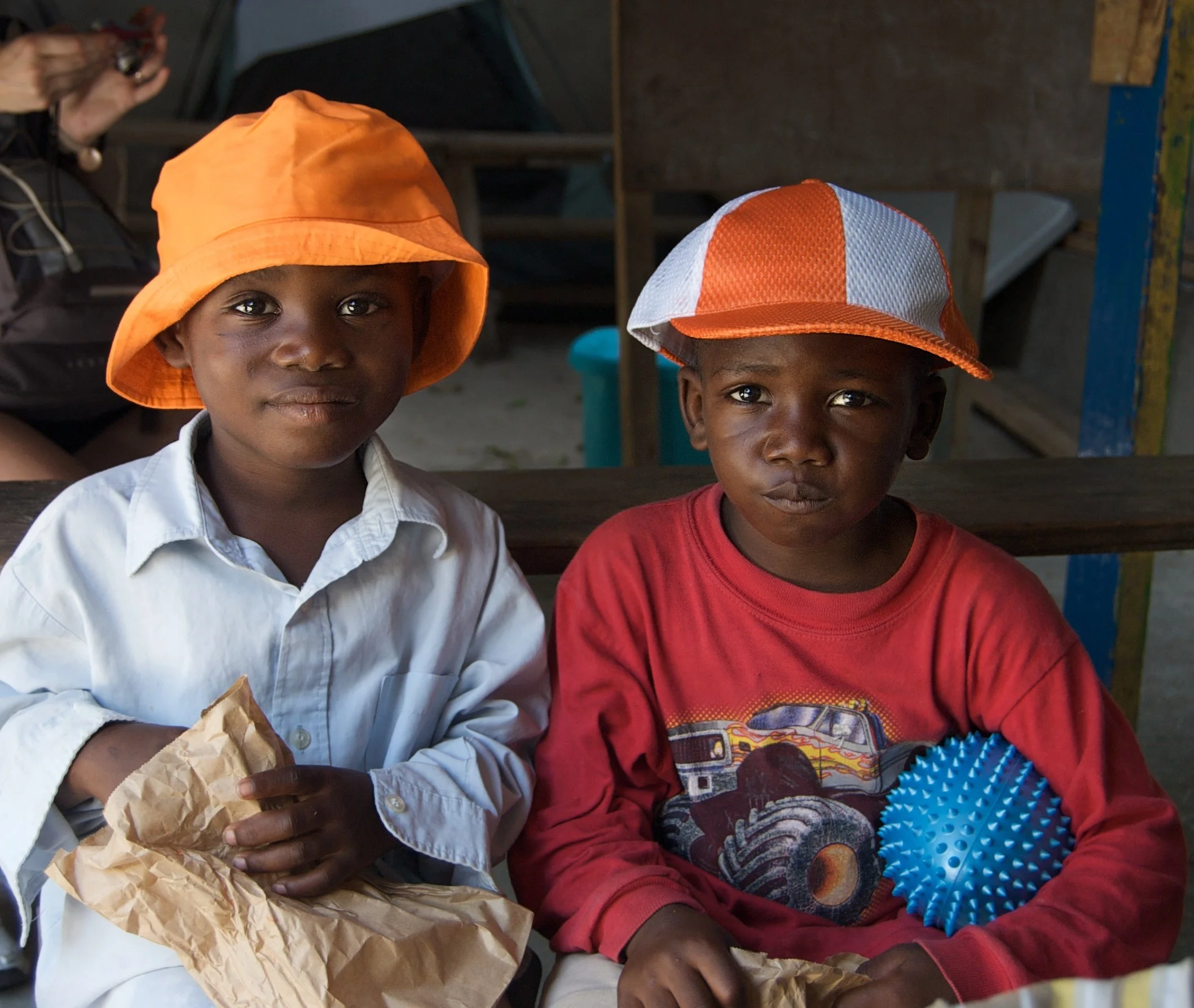
Two young Haitian children. CC0

Across the globe, there are an estimated eight million children living in orphanages. Of this, 80% are not actually orphans and have at least one living parent. These children have been taken from their families and placed into children’s residential homes so that the caretakers can make a profit.

Orphanages, which are often viewed as a place of refuge for children, have begun using foreign generosity to profit off of their vulnerability. “Orphanage trafficking” involves children being recruited into residential care institutions for profit or exploitation and is not confined to any one country. This has sparked a new industry — orphanage volunteering — that has created a demand for institutions that will present children as ‘in need’ to make a profit from foreign donors. In Cambodia, for example, residential care institutions have increased by 75% in the last decade despite a decrease in the number of “real orphans.” Similarly, in Uganda, residential homes have increased the number of children under their care from 1,000 to 55,000 even with the subsequent decline in the prevalence of orphans themselves. This rise in residential institutions has taken place primarily in tourist hotspots so that orphanages can capitalize on financial incentives.

As a system that takes advantage of the international market and tourism business, this has become a global problem. A significant rise has been observed in post-conflict Nepal, beginning in 2006. During the Nepalese Civil War, traffickers posed as boarding school representatives and promised children and their families better living conditions in Nepal’s capital, Kathmandu. Rather than being taken to educational institutions, children were taken to under-resourced orphanages and declared “paper orphans.” This sales pitch has evolved accordingly, shifting from inter-country adoption alone to running orphanages in tourist areas to attract donations — 90% of homes being in the top 5 tourist districts. In 2015, Next Generation Nepal (NGN) and UNICEF released statements warning about the increase in child institutionalization. The government of Nepal subsequently passed a directive prohibiting children to cross district borders unless they were with their parents or had government approval. There are still hundreds of children living in orphanages in Nepal today, although the COVID-19 pandemic restricted operational space and allowed local governments to better implement their child protection mandates, contributing to the strengthening of the overall system.

In China, there is also an opaque relationship between trafficking and adoption. It was discovered in 2012 that Americans alone adopted almost 3,000 Chinese children who were taken from their parents and sold into orphanages. As a country that is aware of the existing issue, parents often have to take matters into their own hands to conduct searches because local law enforcement will silence anyone who is publicly discontent. Aside from the financial incentive of orphanage volunteering alone, scammers have even gone as far as to request large sums of money from parents for information on their child’s whereabouts, information that is ultimately fake.

Aside from the vulnerabilities of the children, traffickers also prey on those of their parents. In Haiti particularly, parents placed their children into orphanages after the 2010 earthquake. They were pressured to believe that their children would be better off; they would have a roof over their heads, food and access to education. One woman, struggling to provide for her sons, was approached by Jonathas Vernet who offered to help her. Vernert, previously running the Four Winds Spirit orphanage, was found to have subjected children to cooking, cleaning and abusively harsh discipline. The children did not attend school and lived in distressed conditions, but Vernet justified this by blaming American donors for neglecting to offer sufficient financial support. An estimated $100 million a year is donated to all orphanages in Haiti by churches and nonprofits in the United States for the purpose of providing food, water, medical care and education. However, most of this money is used to drive the continuation of profit from orphanage volunteering and further expand the business. To end the institutionalization of children, Lumos, an to replace orphanages with foster care systems and advocates for local adoption practices. The organization also advises donors to ensure that the projects they are supporting have a sustainable care vision.

Today, orphanage trafficking in Haiti has not changed much. As of 2021, it was estimated that there were 30,000 children in 750 orphanages, with only 35–50 of those being licensed. Despite efforts to develop and regulate the foster care system in Haiti, attempts to combat orphanage tourism have been static as a result of continued high poverty and unemployment rates.


Globally, orphanages have become hubs where child exploitation for profit can thrive, so long as there are still unmonitored donations and vulnerable children. To better curb the proliferation of child trafficking into orphanages, it is recommended that governments prioritize community-based care and better inform philanthropists how their donations to orphanages may be misused. By combating this issue with strengthened child protection systems, increased awareness and the promotion of family-based care over institutionalization, the root causes of this problem can be mitigated and children better protected.


Mira White

Mira is a student at Brown University studying international and public affairs. Passionate about travel and language learning, she is eager to visit each continent to better understand the world and the people across it. In her free time she perfects her French, hoping to someday live in France working as a freelance journalist or in international affairs.

The Life Changing Power of Global Literacy

For the millions of people around the world who cannot read or write, creating educational opportunities for literacy can help close economic and health inequalities.

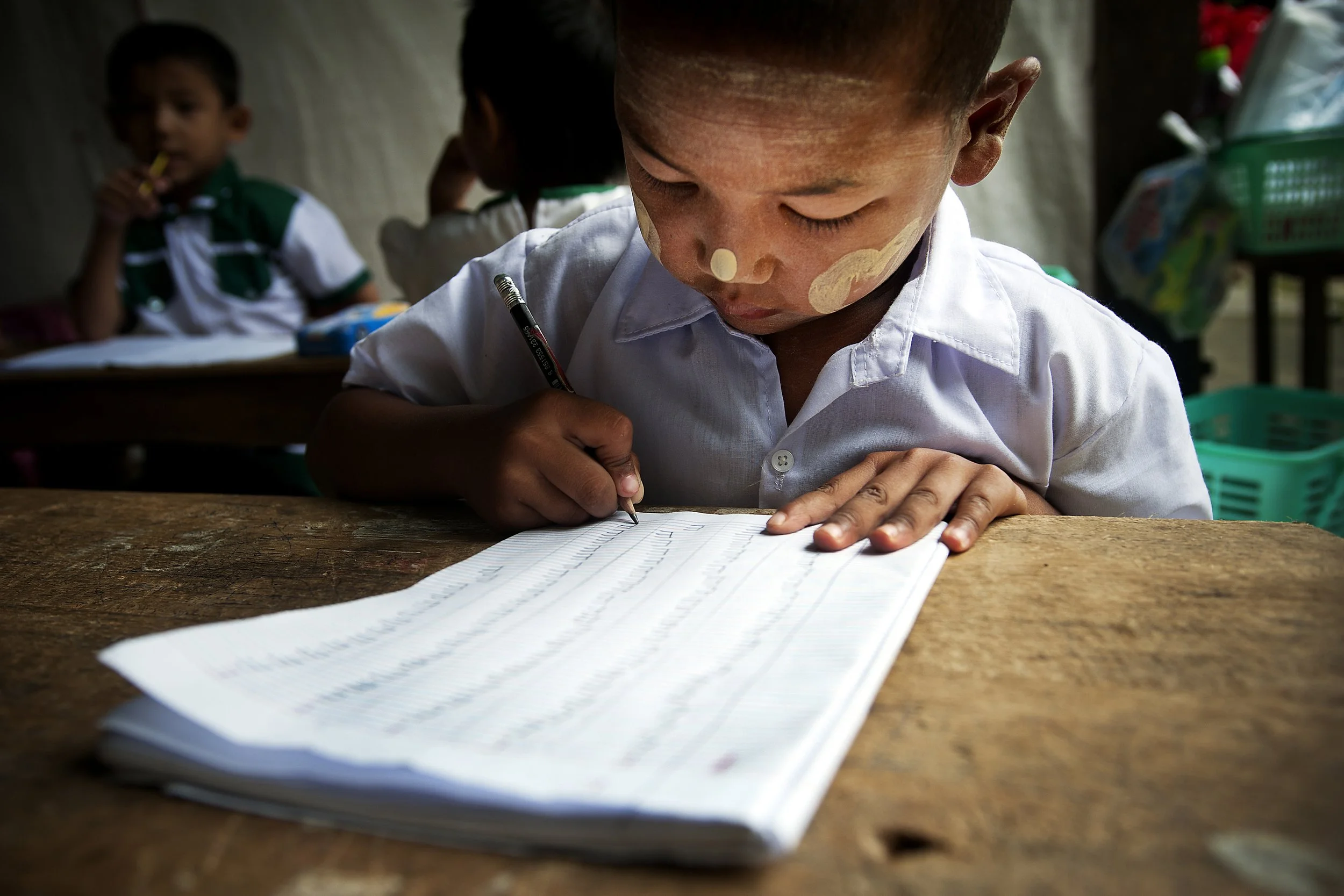
A child practicing writing in Myanmar. United Nations Photo. CC BY-NC-ND 2.0. 

Within the last five decades, the world has been reading more. Literacy rates have increased around the world, growing from 67% to 86.8% between 1976 and 2020.

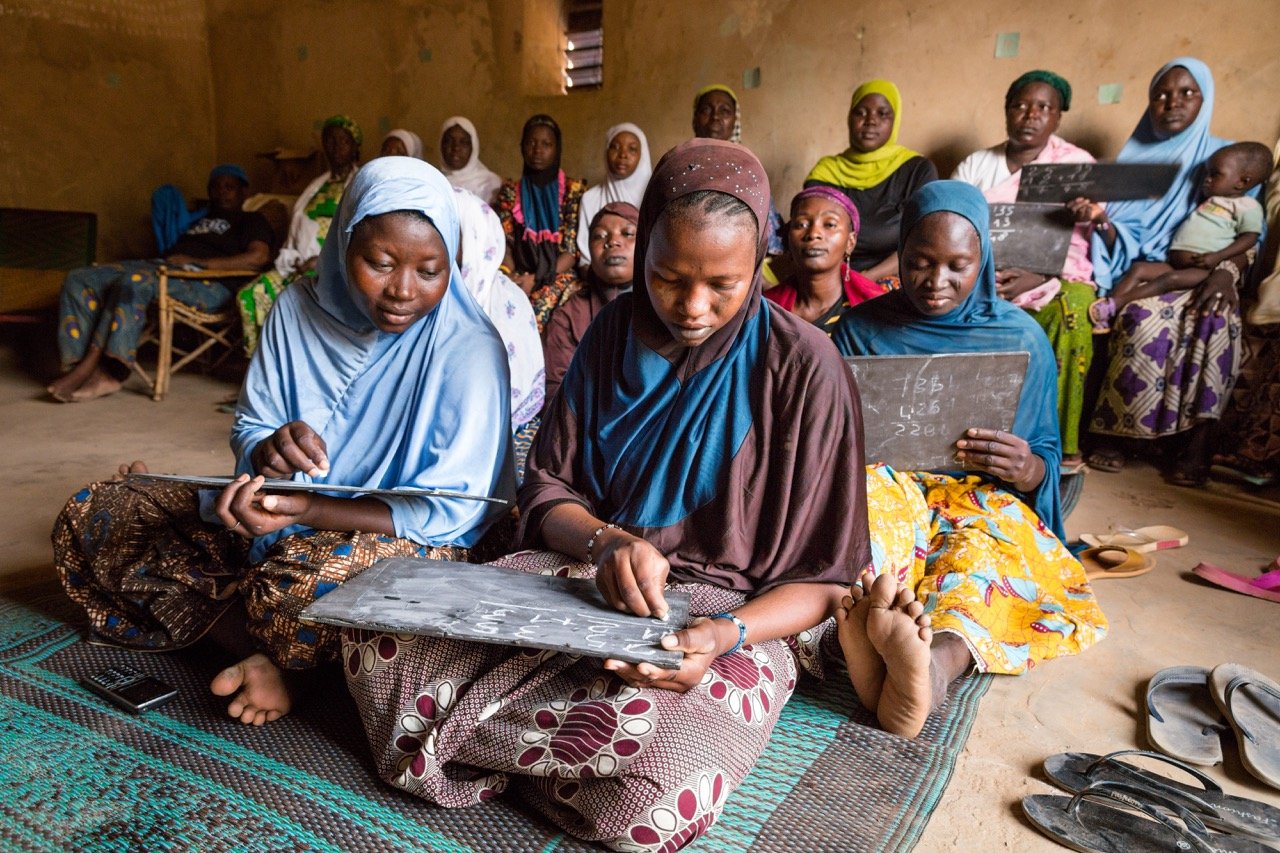
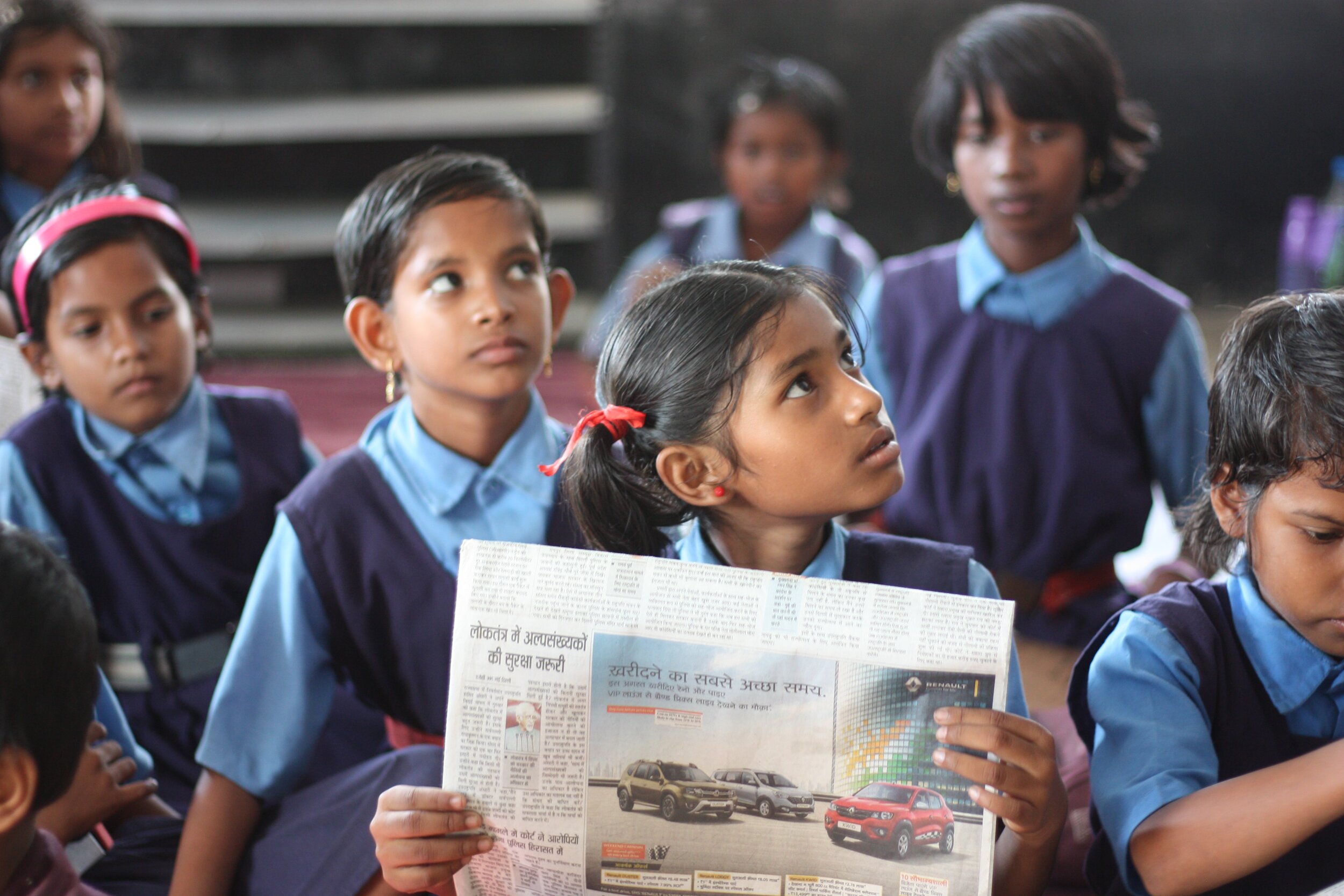
However, despite global improvements, there are still some 781 million people around the world who cannot read or write. These numbers do not exist in a vacuum, but rather are intrinsically tied to economic and gender disparities. About 95% of the world’s illiterate population lives in developing countries, and nearly two-thirds are women. Such statistics reflect global gender disparities in which women are more likely to be defined by traditional domestic roles and childcare, roles that — especially in countries where educational opportunities are already limited — cut off women’s access to literacy. 

Child marriages can also derail young girls' education. On Earth today around 650 million women were married before the age of 18.  While child marriages rip young girls of education opportunities, access to education itself actively combat rates of child marriage. Each year of secondary education that a girl completes reduces her risk of marrying before the age of 18 by 5%

Benefits of ReadingWomen attend school in Niger. Global Partnership for Education - GPE. CC BY-NC-ND 2.0.

The benefits of reading and writing skills extend way beyond the pages, as globally literacy works to make the world a healthier, richer and more democratic place. 

Increasing women’s literacy does not just impact lives on an individual level, but entire communities and economies. Every 10% increase of female students in a country leads to a 3% increase in gross domestic product. The real world economic power of literacy plays a crucial role in lifting communities out of poverty. Concern USA estimates that if every student in a low-income country had literacy skills, some 171 million people would escape extreme poverty. 

Opening up educational opportunities, specifically for women, creates a ripple effect among communities. Because women are more likely to be the primary caretakers to children, their own literacy influences whether or not they decide to send their children to school. 

Increasing access to information through literacy can also have long-standing health benefits. Not only does literacy encourage individuals to read and understand medication and treatment options, but it also empowers individuals to seek out medical attention when necessary.  

A study from 2002 found that women in Bolivia who attended literacy programs were more likely to seek out medical help when needed, as well as be more open minded towards receiving vaccinations — both for themselves and their children. Another study found that if a woman was literate she was four times more likely to know how to protect herself from AIDS, while in Nepal literacy has been connected to a more open mind towards family planning.  

In measuring the effects of literacy and its economic and health impacts in communities, UNESCO estimated that infant mortality rates decrease 9% for every year of education that women attend

In addition to increasing access to education and medical knowledge, literacy also strengthens democracy by combating political marginalization and exclusion. Reading and writing are necessary skills for individuals to fill out voting forms necessary in any democratic system, and can also help increase political engagement by granting access to newspapers and written political material. 

Education and Empathy 

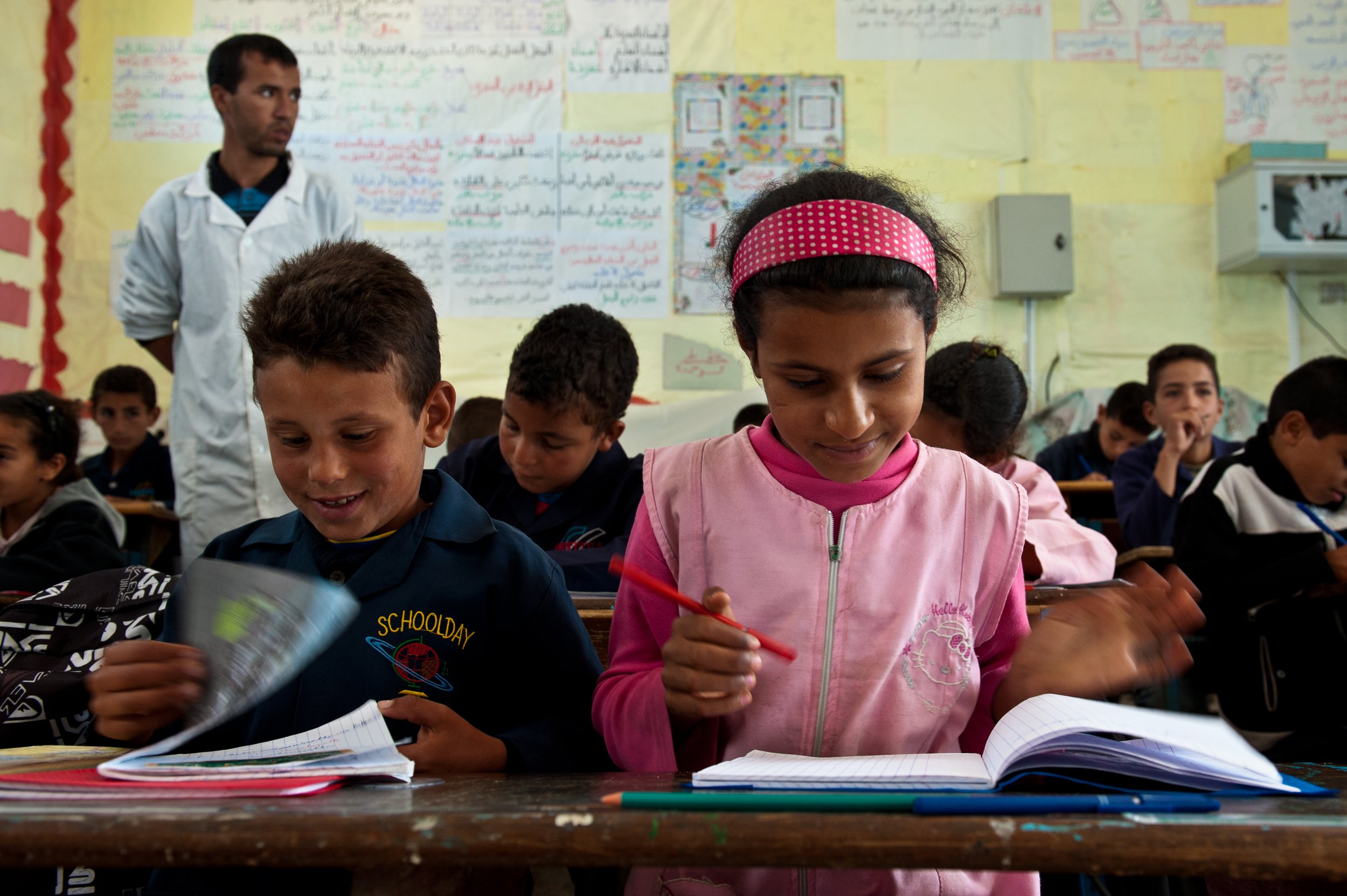
Students reading in a classroom in Sejnane. World Bank Photo Collection. CC BY-NC-ND 2.0.

One of the greatest psychological and social benefits of reading is in the way it builds empathy and fosters opportunities for communication and connection. Fiction in particular has been connected to empathy-building. One study in 2006 found that people who read more fiction scored higher in empathy tests. Another study from 2013 found that those who studied fiction improved on empathy tests that measure one’s ability to understand other people’s beliefs and desires that are different from one’s own. 

The effect of fiction on reader’s emotional intelligence stems in part from the way it forces readers to use their imagination and view the world from another’s perspective and life. Fiction writing forces readers to grapple with choices and scenarios that disrupt their expectations and practice empathy towards characters in order to understand their thoughts and actions.

Get Involved

Organizations all around the world are doing their part to make literacy accessible, encouraged, and achievable globally. 

The World Bank seeks to combat global illiteracy through educational interventions, with the goal of reducing the number of children who cannot understand a simple story to half of what it is to today by 2030. The World Bank encourages the public to share information on the global literacy crisis, encourage government officials to invest in literacy programs, and understand the impacts of learning poverty around the world.

Save the Children’s Literacy Boost works to increase literacy rates around the world through individual and communal efforts. The program relies on schools and teacher training as well as community initiatives that support literacy through Book Banks, reading clubs and workshops for parents. A Stanford study found the average child who went through Save the Children’s Literacy Boost program in Rwanda scored higher on reading comprehension tests than 63% of children who did not go through the program.


Jessica Blatt

Jessica Blatt graduated from Barnard College with a degree in English. Along with journalism, she is passionate about creative writing and storytelling that inspires readers to engage with the world around them. She hopes to share her love for travel and learning about new cultures through her work.

Barbie Across Borders

Around the world, countries censure or celebrate Barbie, a film that violates localized beliefs about feminist expression and the satirization of patriarchy.

Barbie Movie Billboard. Brecht Bug. CC BY 2.0

“Barbie” premiered around the world late last month, quickly becoming a global sensation in the weeks that led up to its release. The film follows protagonist Barbie as she ventures on a journey of self-discovery that causes her to question the values  of a patriarchal society. The United States, China, Saudi Arabia and other Middle Eastern countries had mixed reactions to the film, ranging from dissatisfaction with its promotion of women's empowerment to the celebration of female independence and capability. 

The film has caused discourse in China, where movies still include considerably outdated gender roles. Media like Mr. Six and Gentlemen From Eastern 8th are reminders of the sexist normalcies that still exist in Chinese entertainment and society, including the objectification and oppression of women in the roles that they play. Barbie has been praised and disparaged for calling attention to these instances of gender inequality with many women appreciating the film’s recognition of such an “objective reality” and depiction of strong rather than objectified women. In recent years, China’s involvement in the political landscape of feminism has been backsliding, with rejections of sexual harassment lawsuits and arrests of those protesting for greater feminist representation. Because of this, China is not entirely dissimilar to the conservative politics in the United States, both of which believe that the film succeeds at emasculating men. Regardless, across the U.S., the debut of the film was largely met by fans with outfits of pink and reviews acknowledging the film as a “cinematic and emotional masterpiece.” Not long after, fans of the film in China also began to express support for the film by wearing pink and complimented the film as the best expression of feminism

Latin and South American countries have also embraced pink, specifically through food. Vendors in Mexico and Guatemala have sold pink tacos while Venezuela, Chile and El Salvador have created arepas with beet dough for pink coloring. Support for the film has been widespread across the region, as it has reinvigorated radical public protest and prompted movements like “Barbie Buscadora.”

Across countries in the Middle East, “Barbie” has been banned as it was found to promote subversive elements that distort the values of society, namely the protection of public ethics and social traditions. Because of loyalty to these values, the most severe restrictions were issued in Kuwait and Lebanon, where the film was completely banned from theaters as opposed to the more targeted censorship of scenes that challenged social norms around male guardianship and homosexuality. As cultures with heavy importance placed on gender roles within a family, those with a vested interest in the current system find their values contradicted by the film’s feminism. In Lebanon, Mohammed Mortada asked that the film be banned saying that it, “challenges the guidance of the father … ridiculed the role of mothers.” 
Despite aversion to the film’s release in Kuwait and Lebanon, “Barbie” premiered in Saudi Arabia and the United Arab Emirates. With men and women alike flooding theaters to view the film, many felt that the movie had important lessons for everyone regarding their  roles in the world. Saudi Arabia’s perception of the film has reflected the broader changes occurring in the country’s cultural and entertainment landscape. As a country that is steeped in patriarchal gender traditions, specifically repressive guardianship and the imposition of domestic responsibilities on women, the immersion of Western-influenced media into the nation is expected to be regulated. However, the current reception of the film suggests a society capable of combining tradition and progress.

“Barbie” has brought forward an interplay between cultural normalities and evolving societal attitudes across a variety of countries. In some ways, the film could be perceived as a step towards female empowerment, while conversely approached with caution to avoid disrupting traditional values. As a testament to how global media can challenge and align perspectives, the film is one that illustrates the ability to challenge universal themes despite differences in local interpretations. The global tendency in the 21st century has been to encourage the feminist movement across progressive and conservative countries alike, and with such a broad range of perspectives, it’s a film that has caused considerable ripple effects.


Mira White

Mira is a student at Brown University studying international and public affairs. Passionate about travel and language learning, she is eager to visit each continent to better understand the world and the people across it. In her free time she perfects her French, hoping to someday live in France working as a freelance journalist or in international affairs.

Afghanistan’s Only Female Tour Guide Hosts Virtual Tours

This is the story of 24-year-old Fatima Haidari’s love and dedication to her country — from 3,000 miles away.

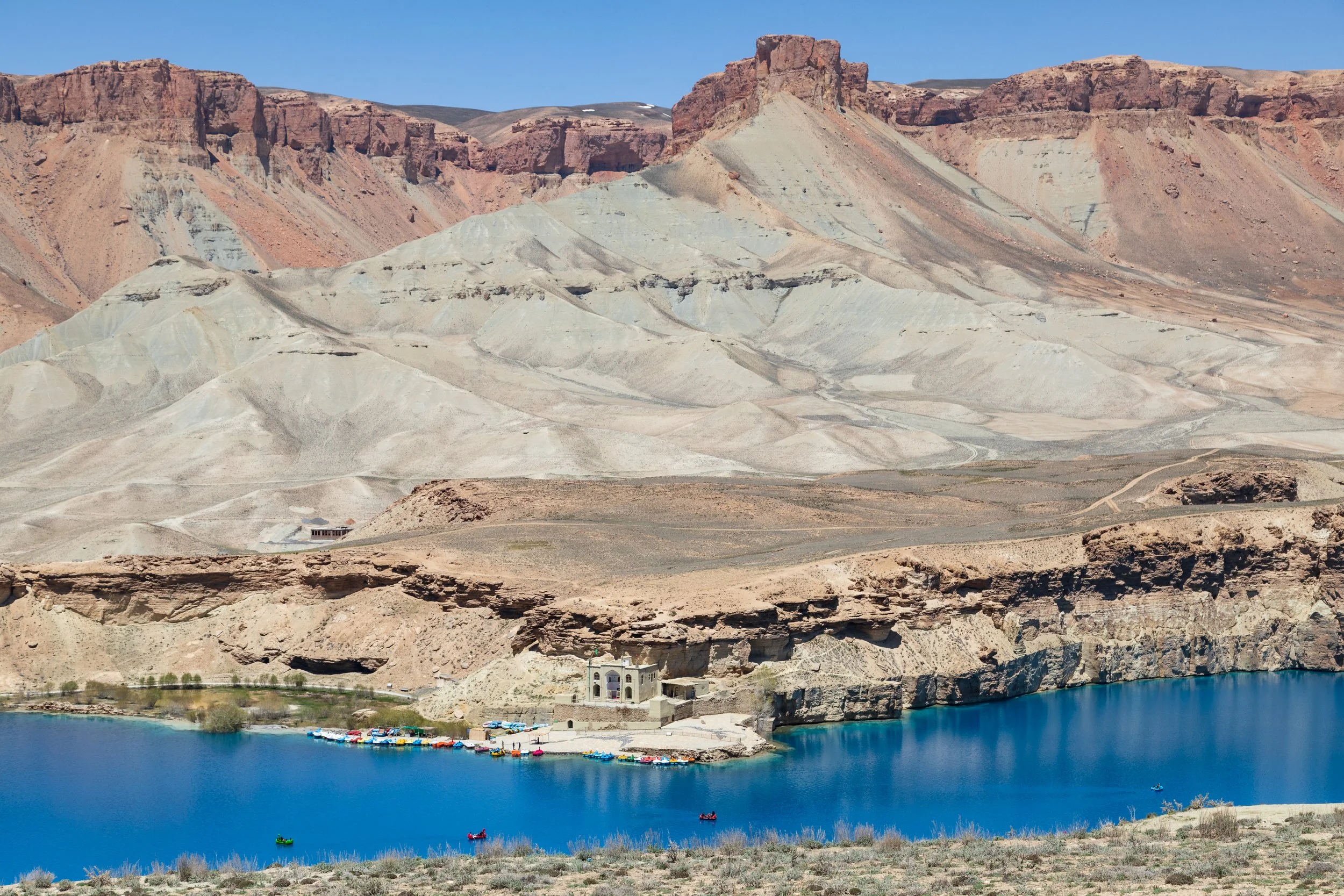
Bamyan Province, Afghanistan. Untamed Borders.

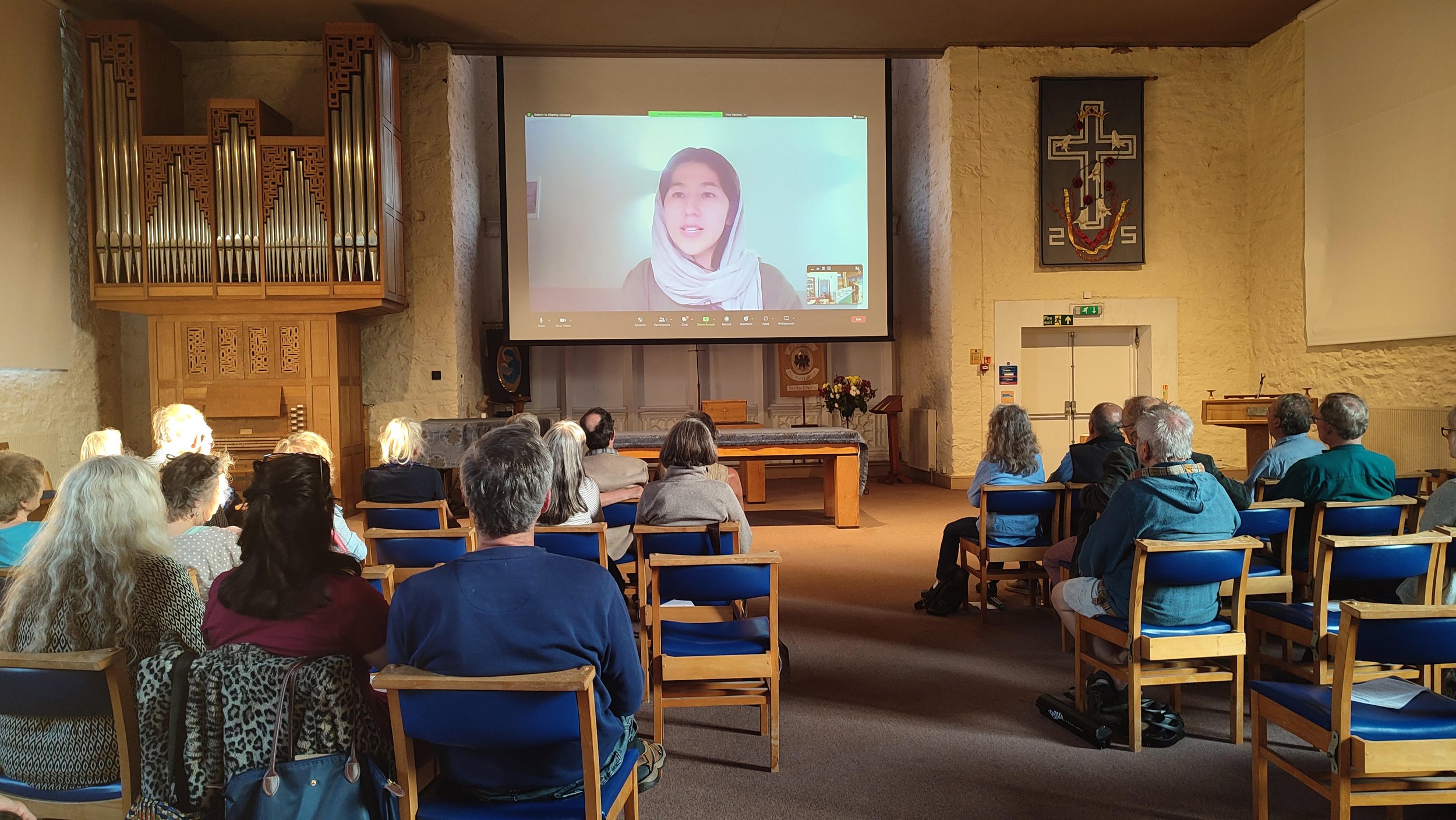
Meet Fatima Haidari: a 24-year-old guide who offers virtual tours of her country, Afghanistan. Forced to flee by the Taliban, Fatima now resides in Milan, Italy and provides a detailed tourist experience through Zoom of the Afghan city of Herat — taking visitors through sites such as the Citadel and the Central Blue Mosque.

Before the Taliban seized power in August 2021, Fatima worked as a local tour guide in Herat, using the job as a means to pay for her education, where she studied journalism and mass communication at university. Fatima is also the first ever female tour guide in Afghanistan, recognized in headlines in 2020. While she is no longer able to offer those in-person tours of her homeland, she continues to do what she can to show Herat off to the world — not just because the city is a beautiful and interesting place to explore, but because she doesn’t want outsiders to associate Afghanistan only with war and terror. Rather, its culture and history are what matter to her, and should take center stage.
But her passion and love for her country isn’t the only place Fatima’s heart lies. Growing up in the mountains in the central region of Ghor, Fatima was the youngest of seven children and was denied a rightful education, because she was a woman and because her family lacked the money. She worked for three years, making items such as traditional clothes to earn her way into an education, and was finally able to convince her parents to allow her to go to university in Herat in 2019, where she studied journalism.
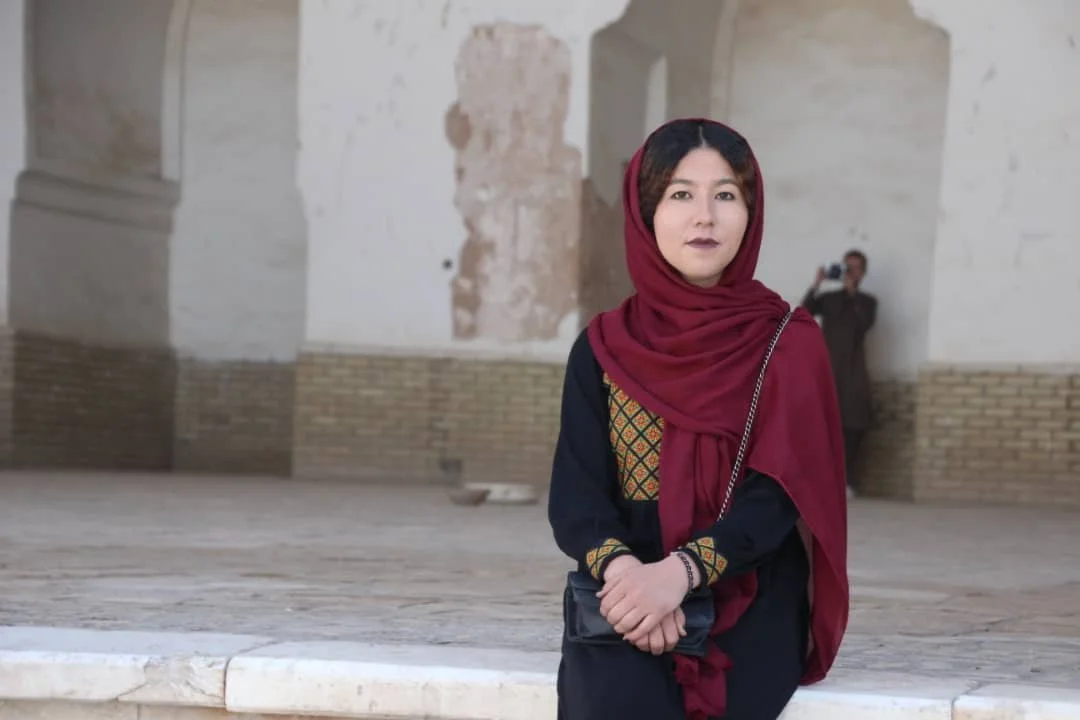
Fatima in Herat. Untamed Borders.
Through years of hard work, Fatima was able to get an education. But many girls back home in Afghanistan do not have the same privilege. Considered one of the lucky ones to have fled, Fatima will use a portion of the money she earns from the Afghan virtual tours to donate to a women's education charity, which currently operates in Afghanistan.

Fatima partners with Untamed Borders — a travel operator dedicated to taking groups to some of the most interesting and inaccessible places — to make these virtual tours possible. The approximately 1.5 hour tour will take guests to see the 1,400-year-old Great Mosque, the Herat Citadel and through the city’s bazaars and traditional teahouses, while Fatima narrates stories about Afghanistan that focus on its people, culture and extensive history. 

But this event is a milestone itself. There has never been a virtual tour of Herat, and as Afghanistan’s first-ever female tour guide, this is a groundbreaking step to inspire other women in the nation. As Fatima says, she wants to be a changer, not a victim.
Fatima leading a virtual group tour. Untamed Borders.
And, of course, there can be no frank and open discussion about the people of Afghanistan without mentioning its women. Not only are they denied an education, Fatima has said the reascendant Taliban forces women to marry and perpetrates sexual or physical abuse against them. Things are more expensive for women, even though they are losing their jobs and forced to become housewives. By shining a light on the current situation in Afghanistan, Fatima is able to talk about her homeland while also spreading awareness to those able to make a difference.

Fatima’s next virtual tour will take place on September 12. Guests are able to book through Untamed Borders, and tickets will cost $60. 

Through her own personal experiences and ties to a country seized by tyranny, Fatima hopes to share what makes Afghanistan so distinct and worthy of exploration while also fighting for justice, so that the women there will grow up knowing what it’s like to go to school. 


Michelle Tian

Michelle is a senior at Boston University, majoring in journalism and minoring in philosophy. Her parents are first-generation immigrants from China, so her love for different cultures and traveling came naturally at a young age. After graduation, she hopes to continue sharing important messages through her work.

Women at the Western Wall

This organization is working to break down traditional gender barriers to create a communal space for women and men to pray together at Jerusalem’s Western Wall.

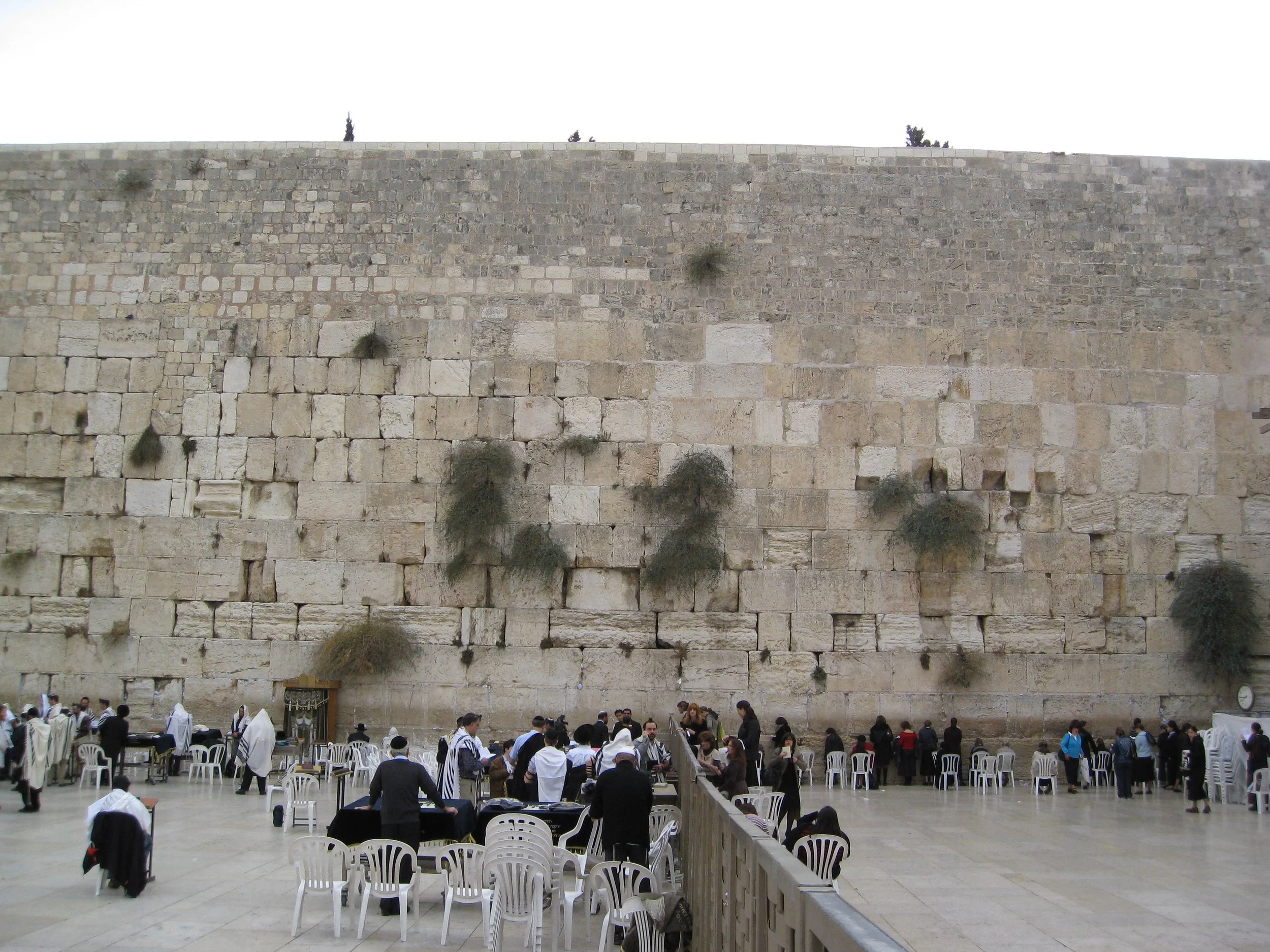
The Western Wall Chris Yunker. CC BY 2.0

Located in Jerusalem’s ancient Old City, the Western Wall marks a central point of religious and spiritual life for millions of Jews, Christians, and Muslims across the world. The wall is believed to mark the only remaining structure of the Temple Mount, the place of the original Temples for the Jewish people, the first of which was destroyed by the Babylonians in 586 BCE and the Second Temple by the Romans in 70 CE.

The Western Wall is also referred to as the Kotel, which is just the Hebrew word for “wall,” and as the Wailing Wall in reference to the manner in which the Jewish people wept at the site during the Roman domination of the Levant. The Wall remains a pivotal place of Jewish history and religious life, with thousands visiting the site daily and leaving prayer notes in the stone crevices.

However, in recent years, the Western Wall has also been at the center of religious debates concerning traditional gender separation. For generations, men and women have visited and prayed at the Western Wall in separate sections, the measures of which are not equal. Stretching just 12 meters in width, the women’s section 36 meters short of-the male side.

Women of the Wall

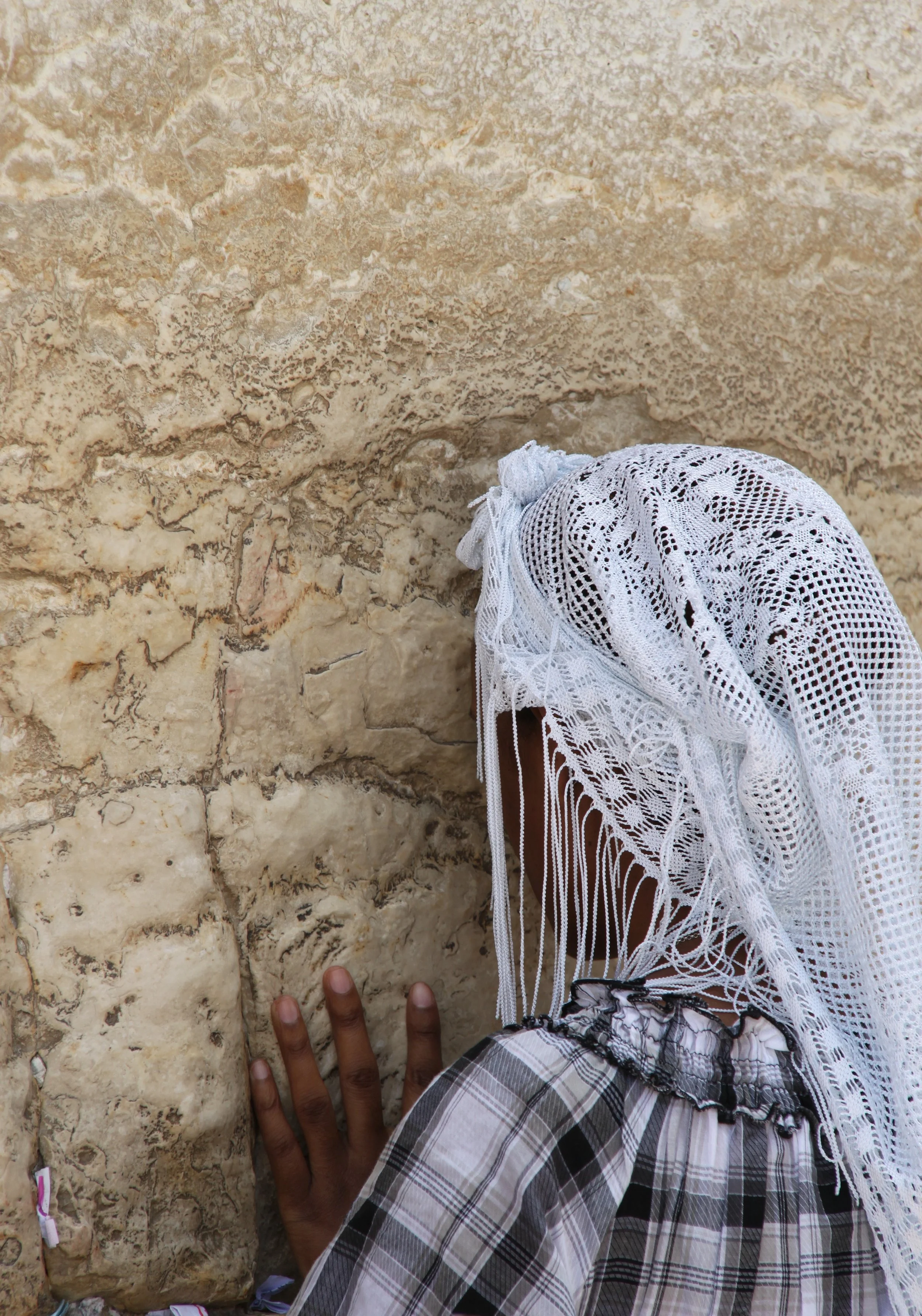
Woman praying at the Wall. it is elisa. CC BY-NC-ND 2.0

An organization called Women of the Wall (WOW) is working to increase women’s rights and equality at the Western Wall. The organization’s first meeting occurred in 1988, with 70 Jewish women gathering at the Western Wall to join together in prayer and the Torah reading, where they were met with stark disapproval and verbal assaults from Orthodox Jewish men and women. The event led to WOW’s founding and beginning of its legal fight to empower women to pray at the Western Wall, going against Orthodox norms.

By drawing on systems of social advocacy, education and empowerment WOW is seeking social and legal acceptance of women’s right to wear prayer shawls and to pray and read aloud from the Torah. The group’s mission advocates for women’s right with regards to the four t’s: the right to say a prayer, or Tefillah, the right to wear traditional leather wraps, or Tefillin, that are inscribed with verses from the Torah, the right to wear prayer shawls known as Tallit, and finally the right to read aloud from the Torah.

Along with its advocacy work, WOW regularly gathers together in community at the Western Wall. The group commemorates Rosh Chodesh, a Jewish holiday that marks the new moon at the beginning of each month in the Hebrew calendar, with a collective morning prayer at the Kotel. The holiday is traditionally connected to a celebration of women, with origins dating back to the time of Moses when wives refused to give up their jewelry to build the golden calf, a symbol of sin and idolatry in the Torah.

While these monthly prayer gatherings are a means of celebrating Jewish women’s spiritual life and collective community, they are often met with violence and aggression. The women of WOW are often double searched at the entrance to ensure that they are not smuggling in a Torah, and the group regularly face physical and verbal aggression from the Ultra Orthodox community, an experience that often leaves them with scars and bruises after their day of prayer.

Members of WOW are accustomed to receiving verbal and physical pushback against their cause, and even being spit on by those who view their message as sacrilegious.

A Legal Battle

In 1988 the Ministry of Religion established The Western Wall Foundation, a government body responsible for the care and administration of the Western Wall. Rabbi Shmuel Rabinovitch has served as chairman of the foundation since 1995 and has been known for his efforts to maintain traditional Orthodox customs at the Wall. Rabbi Rabinowitz has criticized WOW’s work in the past, including in 2014 when he spoke out against  activists efforts to smuggle a Torah into the women’s section of the Wall

In spite of women’s legal right to read the Torah, Rabbi Rabinovitch has created regulations that prevent women from bringing in Torahs into the Plaza. Furthermore, Rabbi Rabinovitch’s regulations prevent women from borrowing one of the 200 Torah scrolls kept within the Plaza, which are freely offered to men. 

In April 2013, a decision written by Judge Moshe Sobell in the case of Israel Police v. Lesley Sachs, Bonnie Riva Ras, Sylvie Rozenbaum, R. Valerie Stessin, & Sharona Kramer, found that the Israeli Supreme Court’s 2003 case which prohibited women from wearing prayer shawls or reading from the Torah had been misinterpreted, and could not be applied to WOW. Judge Sobell also found that WOW had not endangered the public peace, nor had it violated the Law of Holy Places governing the Western Wall that demands visitors adhere to the local customs. Instead, the ruling dictated that local customs should be determined by the public through  nationalistic and pluralistic lenses in addition to the Orthodox one.

The 2013 court decision helped spur ongoing discussions regarding communal prayer spaces at the Wall. In 2013, Prime Minister Benjamin Netanyahu appointed a committee chaired by Natan Sharansky to resolve the issue of communal prayer at the Wall. Sharansky proposed to extend the Western Wall plaza to an area known as Robinson’s Arch in order to provide a pluralistic prayer space for both men and women. The area can accommodate some 450 people, and was seen in many ways as a temporary solution to the question of mixed-gendered prayer. 

In January 2016, the Israeli government approved a plan to set up a communal space in which both men and women could pray together. The plan will also give women who want to pray alone but not in accordance with Orthodox rules the option to set up a temporary barrier. 

The new area is expected to double the size of the temporary communal prayer area set up in 2013 under Netanyahu, in order to accommodate 1,200 worshippers. 

The fight for communal prayer spaces remains a contentious issue between Orthodox and Reformed communities. Although the plan for a pluralistic prayer space was passed by the Knesset, Israel’s legislature, in 2016, as of 2023 the construction and implementation have not yet begun. The issue remains a top priority for members of WOW, who will continue to pray at the Wall’s women’s section until a pluralistic prayer space is constructed.

Get Involved

Other organizations in Israel have come out in support of WOW and embraced a pluralistic perspective towards religious traditions. 

Rabbi Danny Rich, a chief executive of Liberal Judaism, celebrated the decision for a communal prayer space as one that represented Judaism’s inclusivity. Through education opportunities, social action campaigns, collaborative interfaith work, and its provision of programming and library of historical archives, Liberal Judaism engages with social justice issues such as climate change, inequality, and poverty.  

The Israel Movement for Reform and Progressive Judaism has also praised the women’s representation at the Western Wall, as an exemplification of pluralism and diversity within Jewish community. The Movement seeks to increase the accessibility of progressive and pluralistic Judaism through education programming as well as legislation changes as part of their Israel Religious Action Center (IRAC). Along with their advocacy work, the IRAC offers resources and publications that engage with modern social issues through a progressive and religious lens. 


Jessica Blatt

Jessica Blatt graduated from Barnard College with a degree in English. Along with journalism, she is passionate about creative writing and storytelling that inspires readers to engage with the world around them. She hopes to share her love for travel and learning about new cultures through her work.

The Game of Activism: The Impact of 6 FIFA Women’s World Cup Players

From record-breaking seasons and legendary careers to equal pay activism and supporting girls in sport, these six women are proof that you really can do it all.

Players from the Norwegian and Dutch women’s football teams battle it out on the pitch. Ailura. CC BY-SA 2.0

By far the world’s most popular sport, soccer is enjoyed by over a billion players and spectators. International events such as the Europa League Championship and of course the quadrennial FIFA World Cup draw incredible crowds both in person and digitally, uniting the world in patriotic pride and love for a beautiful game. This year, soccer fans have once again been drawn together by the 9th edition of the FIFA Women’s World Cup, considered to be the biggest women’s sporting event in the world, with more than 30 nations competing during July and August in stadiums across Australia and New Zealand. The importance of this event for advancing and promoting professional female athletes and tournaments, both in soccer and otherwise, can not be understated, especially with equal pay and female representation being such hot button issues in today’s social discourse. As such, in addition to achieving the celebrity of household name status, many of the athletes playing in this year’s tournament are also avid activists when not on the pitch. Here are six Renaissance women to keep an eye out for during the game.

1. Marta, Brazil

Soccer legend Marta taking a penalty against South Korea at the World Cup in 2015. Phillippe Bouchard. CC BY-NC 2.0

This mononymous veteran of the game is playing in her sixth Women’s World Cup this year at 37 years of age. Marta is widely considered to be among the greatest female footballers of all time, as a two-time Olympic medallist, six-time recipient of the FIFA World Player of the Year award and record holder for the most goals in any men’s or women’s World Cup with 17 to her name. In addition to her role as a star player in Brazilian national women’s team, Marta plies her trade for the Orlando Pirates in the National Women’s Soccer League (NWSL). When not scoring goals, she is a strong proponent for increasing female participation in sport and champions equal opportunities for girls to get active from a young age. In July 2018, she was appointed UN Women Goodwill Ambassador for women and girls in sport and has continued to further gender equality and female empowerment, encouraging girls to pursue their dreams and overcome barriers in sport. She was also appointed Sustainable Development Goals Advocate to the UN in May of 2019 and has since worked to raise awareness and call for greater global commitment to achieving the project’s targets by 2030. All of this goes to show that Marta’s footballer status as the GOAT applies to her activism as well.

2. Sam Kerr, Australia

Sam Kerr is considered Australia’s greatest hope at a World Cup title this year. Adam Davy. CC BY-NC-ND 2.0

You might know her for her iconic backflip goal celebration, but Australia’s Sam Kerr has accrued an impressive number of accolades since debuting internationally at the age of 15. She was named Australian Sports Personality of the Year in 2017, and won the NWSL’s Golden Boot award both that year and the following one. Kerr was also nominated for FIFA’s Best Player Award in 2018, and has been nominated for the Ballon d’Or Féminin four times. In short, fans have big expectations for the Australian captain, especially since the World Cup is on her home turf. As determined as she is to cinch the gold, she has also been equally dogged with her support of LGBTQ+ rights, and has been a role model to countless young women and girls as an openly gay athlete, spearheading The Matildas’ partnership with Sydney WorldPride just earlier this year. She spoke publicly for the first time about her new relationship with fellow Sky Blue FC player Nikki Stanton in a pre-World Cup sponsorship video for Nike, and pushed back against the incredible number of hateful comments she received in the aftermath. Kerr continues to speak publicly about her sexuality and the importance of being proud and passionate about who she is in an effort to inspire a sense of community among LGBTQ+ athletes.

3. Asisat Oshoala, Nigeria

Asisat Oshoala playing at the Champions League tournament in 2019 for FC Barcelona. Steffen Prößdorf. CC BY-SA 2.0

Asisat Oshoala is definitively the most successful African female footballer in history, and she is only 28 years old. Aside from being the first African woman to both score in and win the UEFA Women’s Champions League, she is also a two-time nominee for the Ballon d’Or and five-time winner of the African Women’s Footballer of the Year award. After playing at a club level in England, China and Spain, Oshoala joined FC Barcelona in 2019 and has quickly risen the ranks to become a key player on the team. As such, the star forward is acutely aware of how her story has inspired many girls that share her ethnic and religious background. In 2015, Oshoala created her namesake foundation in partnership with Women Win of Germany and Nike that runs a number of sport, humanitarian and educational initiatives for girls across Africa. The most prominent is the Asisat Oshoala Academy, which provides tri-weekly football training sessions for young girls in marginalized communities across Africa. As an ambassador for Nike, Oshoala also founded the Football4girls tournament in Lagos, Nigeria, an annual occurrence which brings together teams from schools across the country to compete for a significant cash prize. Oshoala’s talent and passion for her sport is undeniable, rivaled only by her dedication to social work.

4. Ada Hegerberg, Norway

Ada Hegerberg celebrates on the pitch with her Lyon club team. Steffen Prößdorf. CC BY-SA 2.0

When on the pitch, Norwegian soccer legend Ada Hegerberg plays for both Olympique Lyon in France’s Division 1 Féminine league and Norway’s national team. At just 28 years old, Hegerberg is the all-time highest scorer in the UEFA Women’s Champions League with 59 goals to her name and is also the current record holder for the most goals scored in a UEFA Women’s Champions League season. In 2018, she was the inaugural recipient of the Ballon d’Or Féminin and has been named as BBC Women’s Footballer of the Year twice. Off the pitch, however, Hegerberg is most well known for taking a five year hiatus from the Norwegian national team in protest of the lack of equal pay between the men’s and women’s teams, and the Norwegian Football Federation’s (NFF) poor treatment of female players. Her absence was a huge blow to Norway’s chances of victory, and is recognized as being a significant factor in the NFF’s 2022 decision to give the women’s team equal pay. Hegerberg has also been a vocal supporter of LGBTQ+ rights and raised a rainbow band during a match against New Zealand in June 2022 in solidarity with victims of a shooting at a gay nightclub in the Norwegian capital of Oslo earlier that year. With the rest of the Grasshoppers by her side, Hegerberg will be spearheading Norway’s attack at the World Cup this year.

5. Khadija “Bunny” Shaw, Jamaica

Khadija Shaw is captaining the Reggae Girlz at this year’s World Cup. Jorge Martinez, Mexsport. CC BY-NC 2.0

Khadija Shaw went to her first World Cup at only 21 years of age as part of the first Caribbean team to qualify for a Women’s World Cup, and has returned this year as captain of Jamaica’s national team at the same competition. Khadija, or Bunny as she is affectionately known by her fans, made a smashing debut in Bordeaux back in 2019 tallying a whopping 32 goals in 35 games. She has since continued to build her lead as Jamaica’s all-time leading goal scorer among both the men’s and women’s teams after moving to Manchester City in 2021 where she has also broken the record for most goals scored in a single season. Soon after that fateful World Cup qualification in 2019, however, Shaw took to social media to express her discontentment with the Jamaican Football Federation over not being paid to compete, joining the movement for equal pay rights. She is also a big proponent of encouraging girls to participate in sports, and has been very vocal about the lack of opportunities and role models for young girls in Jamaica and the Caribbean, having faced plenty of challenges in trying to pursue her passion while at home. Shaw and Jamaica’s Reggae Girlz, as the team is fondly known, will be appearing for their second World Cup this year in the hopes of inspiring even more funding and investment in grassroots soccer initiatives in Jamaica.

6. Megan Rapinoe, USA

Megan Rapinoe on the victory tour with the US Women’s National Team in 2019. Lorie Shaull. CC BY-SA 2.0

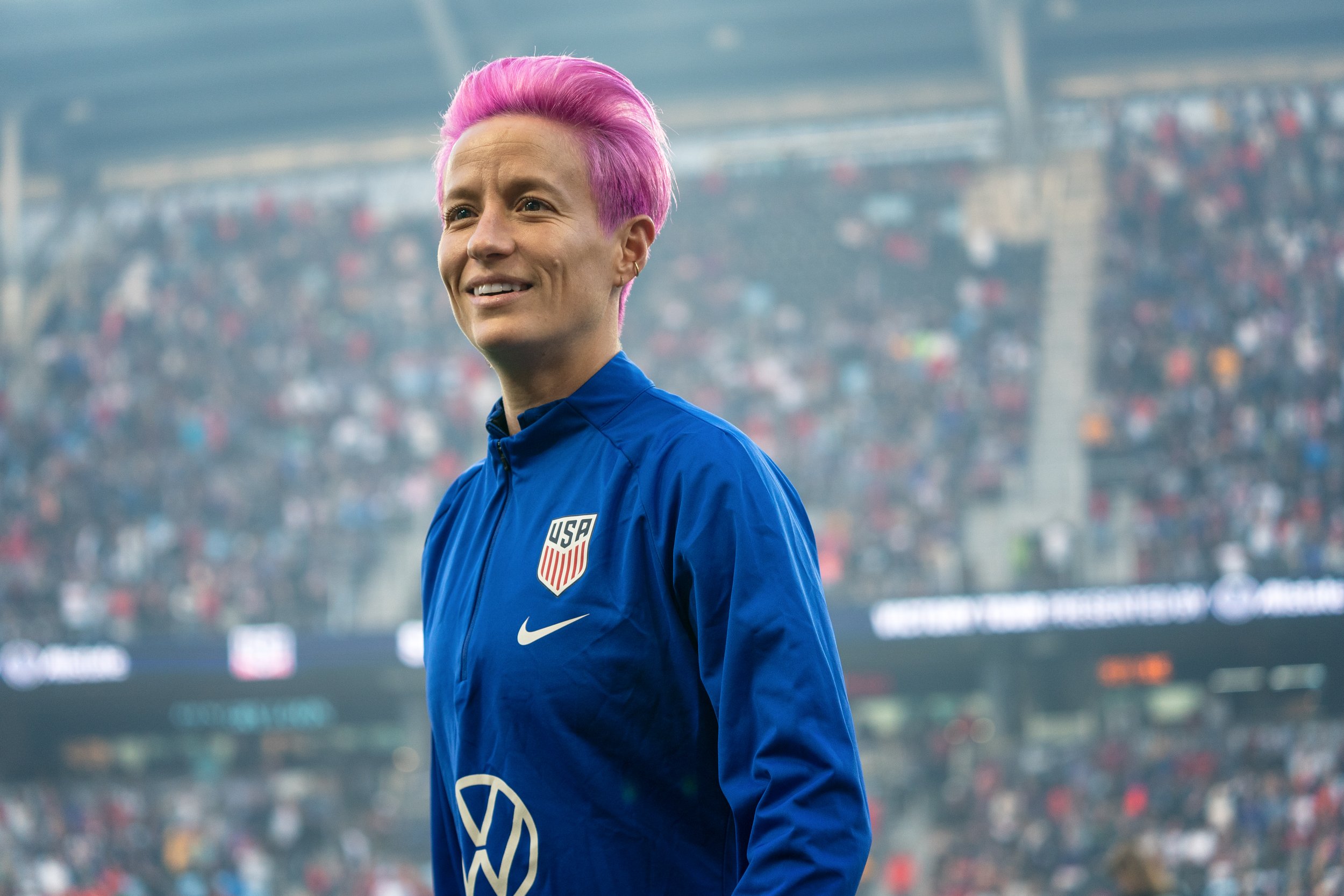
No list of women soccer players is complete without the iconic colorful-haired Megan Rapinoe. At 38 years of age, Rapinoe is a two-time World Cup champion, an Olympic gold medallist and has also won both the Best FIFA Women’s Player award and the coveted Ballon d’Or Féminin in 2019. She first made headlines in activism when she joined fellow athlete Colin Kaepernick in kneeling during the American National Anthem, which she followed up soon after in her role as an extremely outspoken proponent of the successful fight for equal pay in American soccer led by the US Women’s National Team. Rapinoe has also been a notable critic of the overturning of Roe v. Wade last year, and has publicly called on the Supreme Court to support abortion rights. As one of, if not the most, popular American women’s soccer players of our time, many will be showing their support for Rapinoe after her announcing that this World Cup will be her last, as she plans to retire at the end of the NWSL season. Given her extensive involvement in a variety of activist movements, however, there is no doubt that she will continue to remain involved in the sport even after she leaves the pitch.


Tanaya Vohra

Tanaya is an undergraduate student pursuing a major in Public Health at the University of Chicago. She's lived in Asia, Europe and North America and wants to share her love of travel and exploring new cultures through her writing.

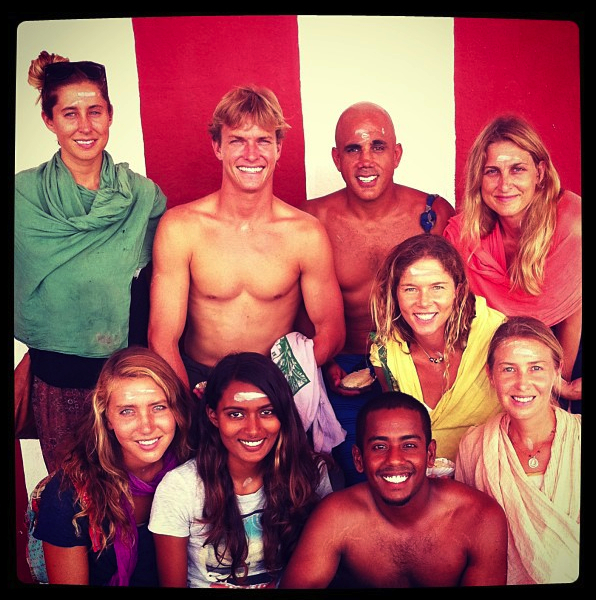
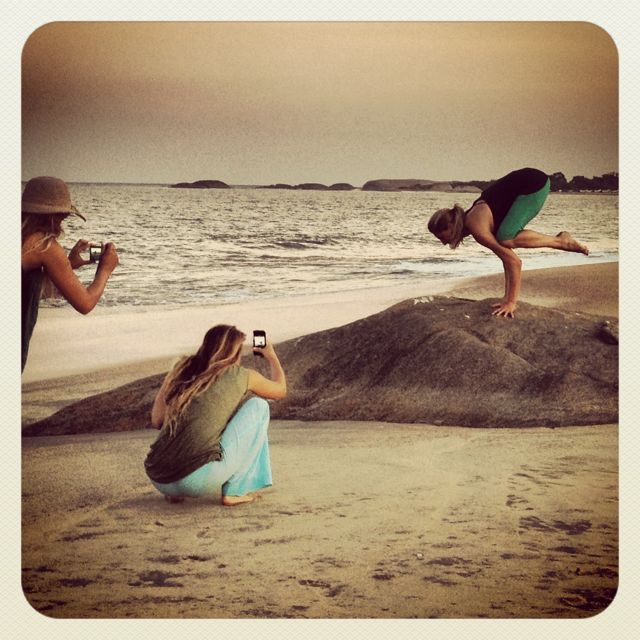
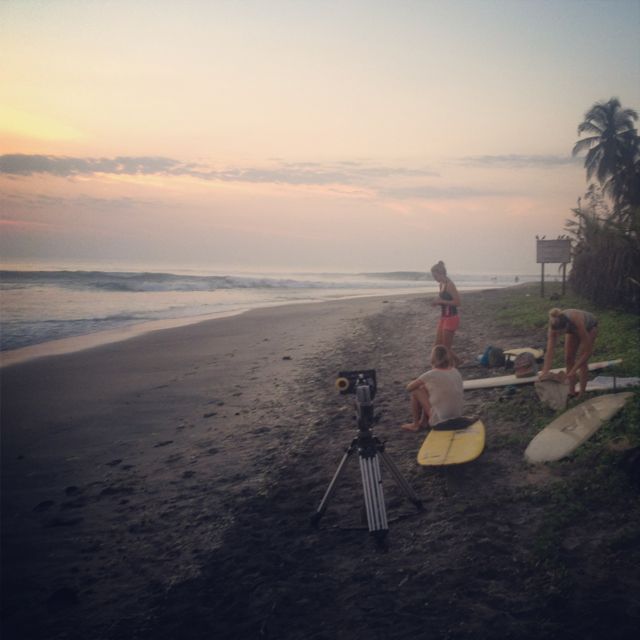
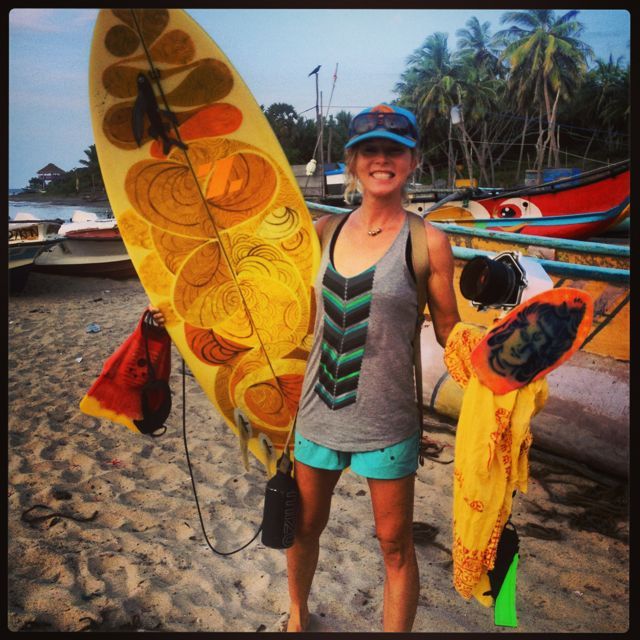
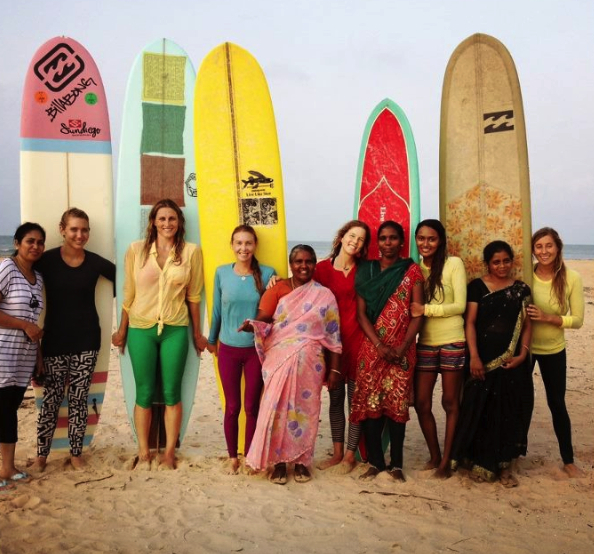
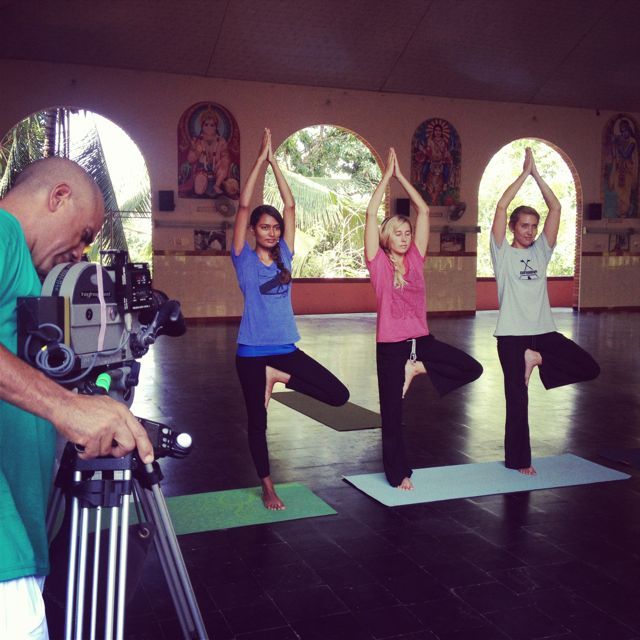
Filming "Beyond the Surface" in India

“Unite those with positive minds and compassionate hearts and good things happen…” I thought to myself, after meeting Emi Koch in San Diego and chatting with Crystal Thornburg-Homcy about her idea to make a unique surf film in India.

She and her husband, renowned filmmaker, Dave Homcy, planned to document Emi’s work in India under her NGO, Beyond the Surface International, and other inspiring cases of youth and women’s empowerment through surfing, yoga, and ecological creativity. 

On a scouting mission, they serendipitously met Ishita Malaviya, India’s first female surfer and a powerful voice for Indian women, who happily agreed to accompany us on the adventure. Shortly after, Damian Handisides of Free Theo Productions joined the team and the project’s momentum became unstoppable. I was honored to be a participant, along with Lauren Hill who is the founder of The Sea Kin, and Kate Baldwin, yogini extraordinaire. 

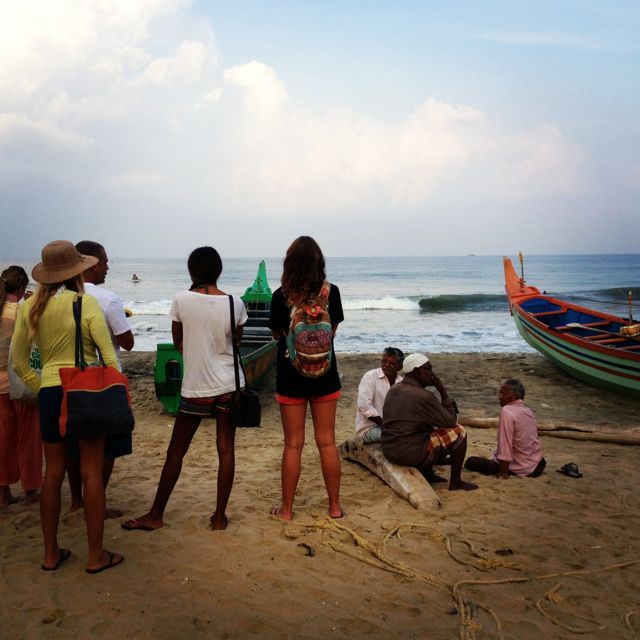
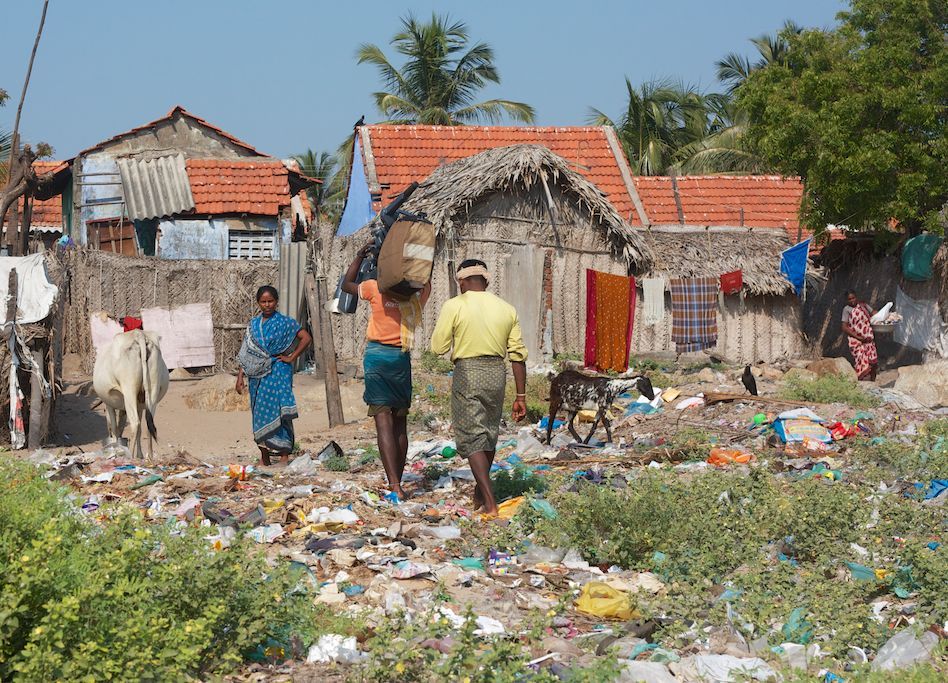
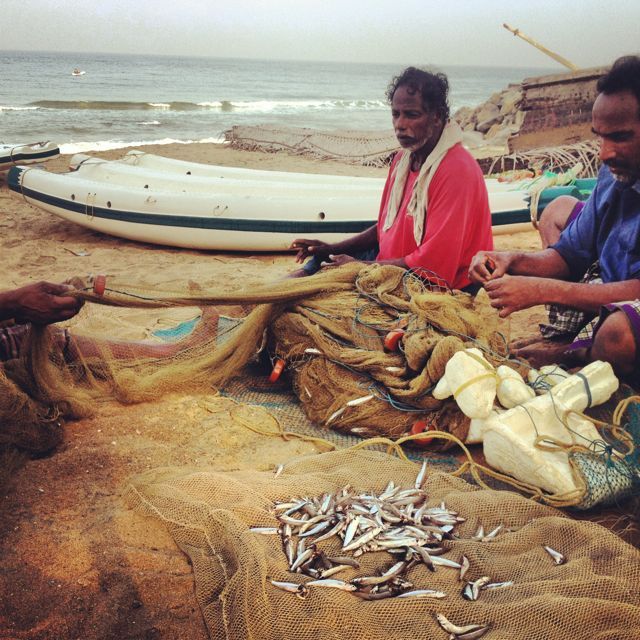
We all met in India from our various points on the globe this past April with the hope of exchanging light and love with the people we met along the way, especially those facing poverty, gender inequality, and social disparity. At the same time, the adventure would be a platform of growth for our own individual paths of self-realization. Our three unforgettable weeks were abound with surprises, beauty, surf, and new friendships while touring and filming in southern India. We explored together in search of a deeper connection to our fellow humans and Mother Nature.

Learn more about Beyond the Surface here.


Liz Clark

Liz is a professional free surfer, writer, environmental activist and adventurer who has captained her 40ft sailboat, Swell, over 18,000 miles on a surfing expedition in the Pacific since 2005. Through her website/blog, she shares her journey with the world in an effort of inspire people to live out their passions, spend more time in nature, engage in self-awareness and personal growth, and develop a consciousness of their everyday planetary impact.

Affirmative Action: An International Perspective

The US Supreme Court struck down affirmative action in college admissions, but across the world other countries maintain programs to diversify higher education.

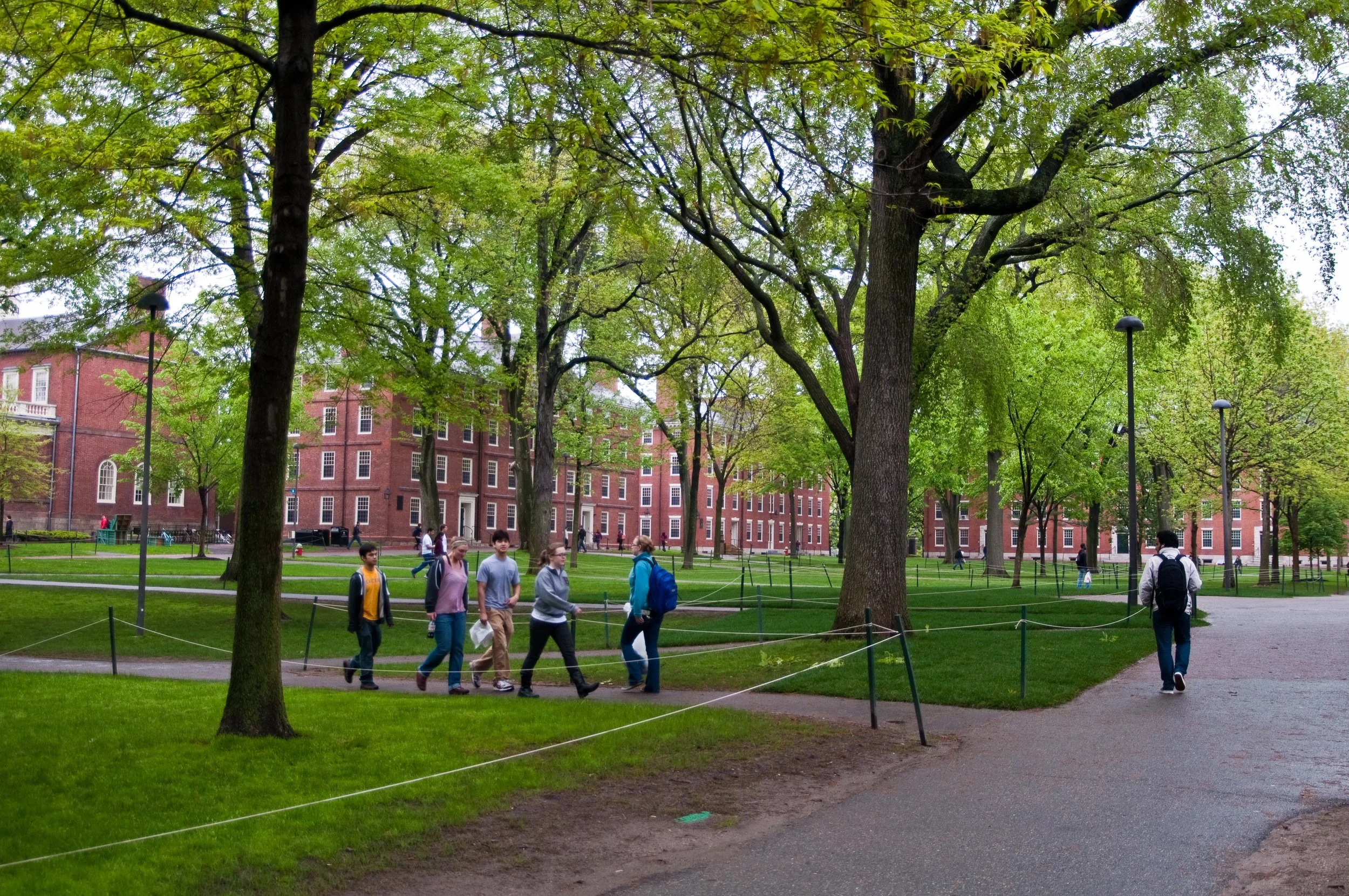
Harvard campus. Anne Helmond. CC BY-NC-ND 2.0

On June 29, 2023, the U.S. Supreme Court, led by a conservative majority, struck down the use of affirmative action in college admissions. The ruling prevents colleges from considering race as a factor when deciding whether to admit applicants. The Supreme Court ruled in favor of The Students For Fair Admission, which sued Harvard and University of North Carolina on the claim that the schools' affirmative action policies discriminate against Asian Americans. The case was seen by supporters of affirmative action as an example of using Asian Americans as a wedge group for a conservative agenda, and a poor representation of the wide spectrum of Asian Americans’ views on affirmative action. 

The story of affirmative action in the U.S. is a fraught one, emerging from generations of racial inequality and discrimination. However, it is not a story that exists in a vacuum. About 25% of all countries have some form of affirmative action with the goal of opening up higher education to students from different backgrounds.

History of Affirmative Action in The U.S.

Affirmative action encompasses any program that actively improves job and educational opportunities for minorities or women. The belief was adopted by president Kennedy in 1961 through Executive Order 10925, which sought to use "affirmative action to ensure that applicants are treated equally without regard to race, color, religion, sex, or national origin,” and established the Committee on Equal Employment Opportunity. President Johnson’s 1965 Executive Order 11246 helped cement affirmative action by requiring government and contractors and subcontractors to expand opportunities to minorities.

During the Civil Rights movement, and following the assassination of Dr. Martin Luther King Jr., student groups and advocates implored universities to make education more accessible, and to establish class demographics that were indicative of American society. In the weeks following Dr. King’s death, the Dean of Admissions at Harvard announced his commitment to enroll more Black students, a decision that led to a 76% increase in black students enrolled at Harvard between 1968 and 1969. Harvard’s stance was soon followed by other elite institutions including Princeton, Yale and Columbia. 

While universities individually pledged to embrace student diversity and increase enrollment among racial minorities, it wasn’t until a 2003 Supreme Court case that affirmative action became established as a national precedent. The 2003 case of Grutter v. Bollinger determined that affirmative action did not violate the Constitution’s Equal Protection Clause, and created a precedent in which a desire for increasing diversity could be used as a means of using racial preferences within admissions. 

India

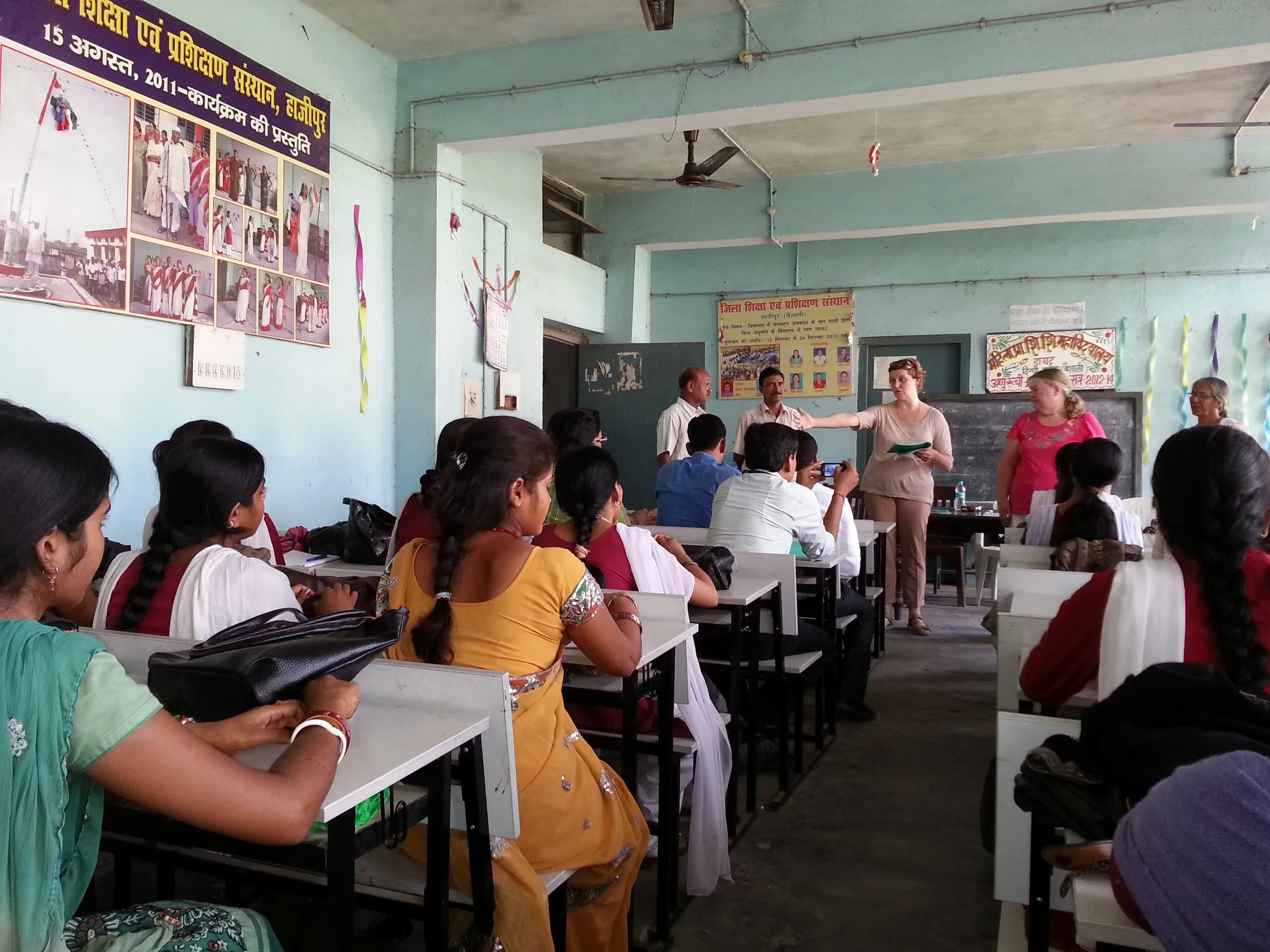
Classroom in Patna, India. TESS India. CC BY-SA 2.0

One of the earliest examples of affirmative action was adopted in India during British colonial rule in the 19th century. Under the programs, reservations were created as a means of establishing educational opportunities for the Dalit, commonly (and offensively) known as the “untouchables.” India’s modern affirmative action program seeks to expand opportunity by reserving 22.5% of all spots in educational institutions for lower caste youth. In 2005 the program was expanded to include private higher education institutions as well. These programs have led enrollment by targeted low caste disadvantaged groups to increase by three times

India’s affirmative action system has contributed to a national increase in Dalit’s social and economic standing. In 1965, only 1.6% of the most senior service positions were held by Dalits, a number that rose to 11% by 2019, making it more representative of India’s demographics as 25% of the country is Dalit. 

France

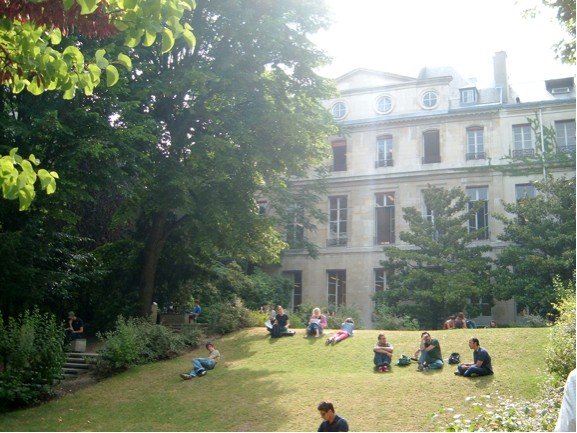
Garden at the Sciences Po. that ambitious girl. CC BY-NC 2.0

In France, affirmative action measures target specific neighborhoods as priority education areas, or Zones d’Education Prioritaires, which are often characterized by low income, many residents of immigrant background, and a high percentage of the population for whom French is a second language. In place of quotas some elite institutions, including Sciences Po, have sought to reach out directly to students coming from these disadvantaged neighborhoods, asking secondary schools in these areas to send over their best applicants, with the university providing necessary financial aid. The program seems to have had limited effects, and since its establishment in the early 2000s only 860 students have been admitted in through this specific channel. However, the number of students on financial aid has increased by roughly 20% in recent years. 

Brazil

Students in Brazil. World Bank Photo Collection. CC BY-NC-ND 2.0

In 2012, the Brazilian government adopted a bill to reserve half of the spots in elite federal education institutions for students from state schools. The bill, supported by President Dilma Rousseff, also set up racial quotas for universities to allocate spots for black, mixed race, and indigenous populations according to the demographics of each state. The bill was proposed with the aim of combatting education and economic inequalities, as only about 10% of Brazilian students graduate from the elite private schools that act as feeders for the country’s top universities; the majority of private school students are White, despite the country’s racial diversity. 

The use of such affirmative action policies in Brazil have been met with criticism, in part because the country’s demographics are racially mixed, with many seeing themselves unreflected in Black and White binary. Despite this, racial inequality is widespread, and a 2021 survey found that White Brazilians earned an average of 75% more than Black Brazilians and 70% more than Brown Brazilian workers. 

In 2023, President Luiz Inácio Lula da Silva signed a decree that reserves 30% of federal government positions for candidates who are Black or of mixed race.


Jessica Blatt

Jessica Blatt graduated from Barnard College with a degree in English. Along with journalism, she is passionate about creative writing and storytelling that inspires readers to engage with the world around them. She hopes to share her love for travel and learning about new cultures through her work.

Where Are All the Women Pastors?

The Southern Baptist Convention’s recent rule to prohibit women ministers is part of a long history of gender exclusion in Christian churches.

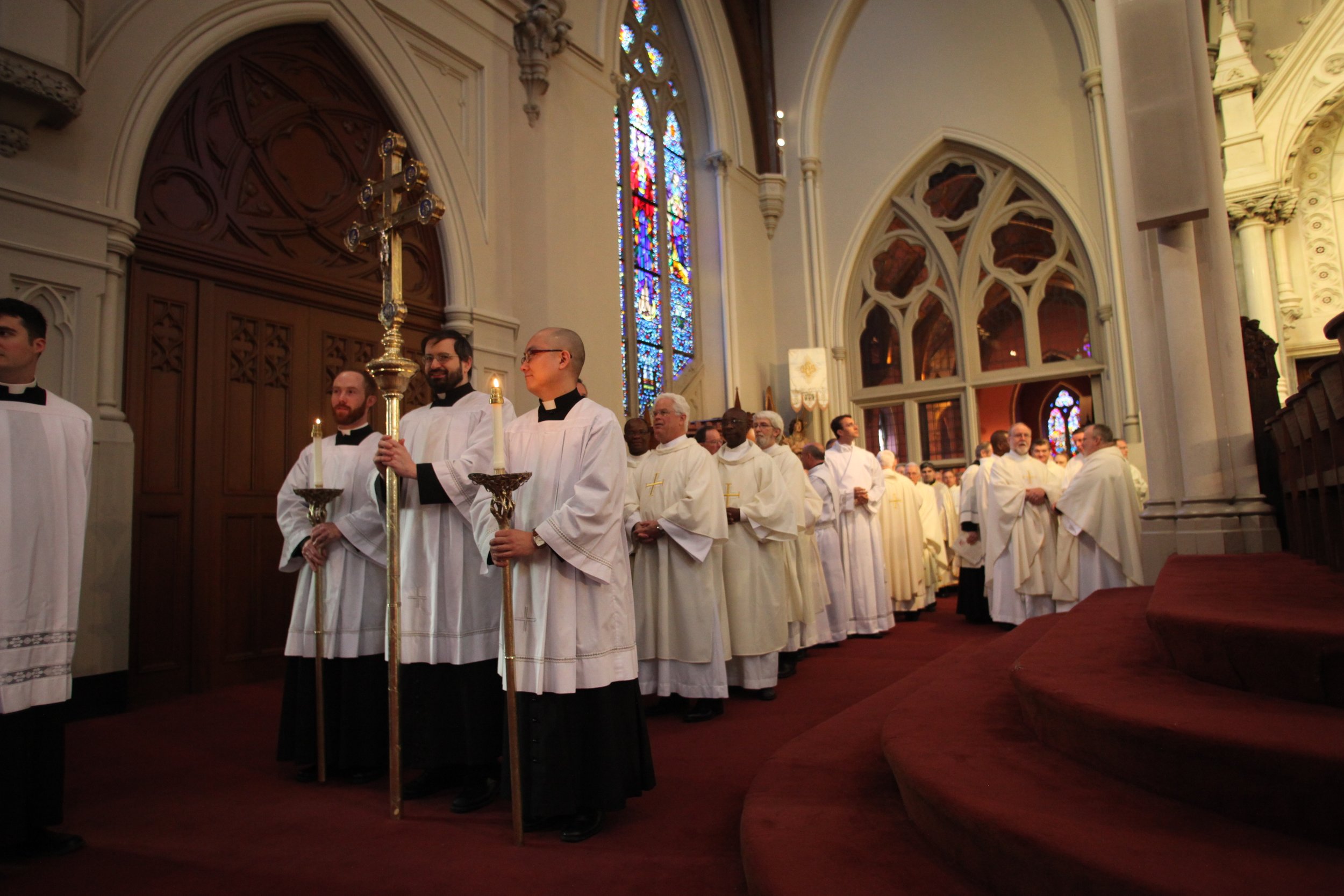
Men being ordained at the Cathedral of the Holy Cross, Boston. Roman Catholic Archdiocese of Boston. CC BY-ND 2.0

On June 14, 2023 the Southern Baptist Convention met in New Orleans for its annual conference and voted in favor of the church’s long-standing prohibition of women serving as pastors. The vote ruled overwhelmingly in favor of upholding the rule, a decision that led two congregations with women pastors to be expelled from the denomination: Saddleback Church in Southern California and Fern Creek Baptist Church in Louisville, Kentucky.

The vote reaffirms the Southern Baptists’ conservative focus and comes at the heels of a 2022 report detailing the church’s attempt to cover up sexual abuse by staff and pastors.

With 47,000 churches and 13.7 million members, the Southern Baptist Convention is the largest Protestant denomination in the United States. However, SBC’s decision to continue its exclusion of women from pastoral roles within the church is not unique within the Christian world. The Roman Catholic Church, along with the Church of Latter Day Saints (commonly called Mormons), and the Orthodox Church, all prohibit women’s ordination

The question centered at the debate around female ordination is a complicated one. While many women make up a majority of congregants and are often heavily involved in Church life and activities, taking on secondary leadership roles, there remains a stark cut-off in women’s degree of power in these religious spaces, a phenomenon that has been dubbed the “stained-glass ceiling.”  

In 2021, Duke University published research examining the reality of these “stained-glass ceilings.” Their findings highlighted a disproportionate lack of female leaders across a survey of Catholic, Evangelical, Black Protestant, Mainline Protestant, and Non-Orthodox Jewish communities. The study found that women lead only 14% of American congregations. The numbers varied across communities, with women leading 30% of white evangelical congregations and 16% of Black Protestant congregations. Contrastingly, within predominantly white Evangelical congregations only 3% were led by women, and only 2% of Roman Catholic Churches had female leadership. 

However, even when women are able to serve as church clergy, they lag behind men when it comes to equal pay. Female clergy earn 76 cents to each dollar made by their male counterparts. The Church Law and Tax Compensation Handbook reported that male senior pastors earned a salary that was 40% higher– or $25,000 more– than female senior pastors between 2014 and 2015. While the pay gap appears to be shrinking, it is still present. From 2016 to 2017 men who worked as full-time senior pastors received 27% more earnings and benefits, or approximately $15,000 more, than their female counterparts. 

Along with a measurable pay gap, women clergy members also face the same insidious sexism that harasses all women in leadership roles, leaving female clergy in a position of intense scrutiny through which through their authority, intelligence, and ability are routinely questioned and mocked.  

Despite being barred from top roles, women play a crucial role in supporting the structures and community of the church. Out of all secondary ministerial staff, 35% of full-time and 46% of part-time staffers were female

Women have long played a crucial role in religious life, serving as nuns, teachers, religious teachers, and deacons. But the very top positions are still out of reach. 

A study found that only four out of nine major U.S. religious organizations that ordain women had a woman in the top leadership role. Those four churches– The American Baptist Churches, The Episcopal Church, The Evangelical Lutheran Church in America, and the United Methodist Church– each had only one woman in a top position. 

In many ways women still serve as the backbone of the church, leading the charge behind community organizing, childcare, and volunteer services. When Pope Francis formally allowed women to serve in lay ministerial roles such as lectors and acolytes, he failed to acknowledge that women have been informally taking on the work and responsibilities of these positions for some time. Instead, he emphasized the difference between these positions and the ordained roles open only to men.

While women are the vital essence powering many churches, when it comes to access to the podium or microphone, they face categorical silencing. 

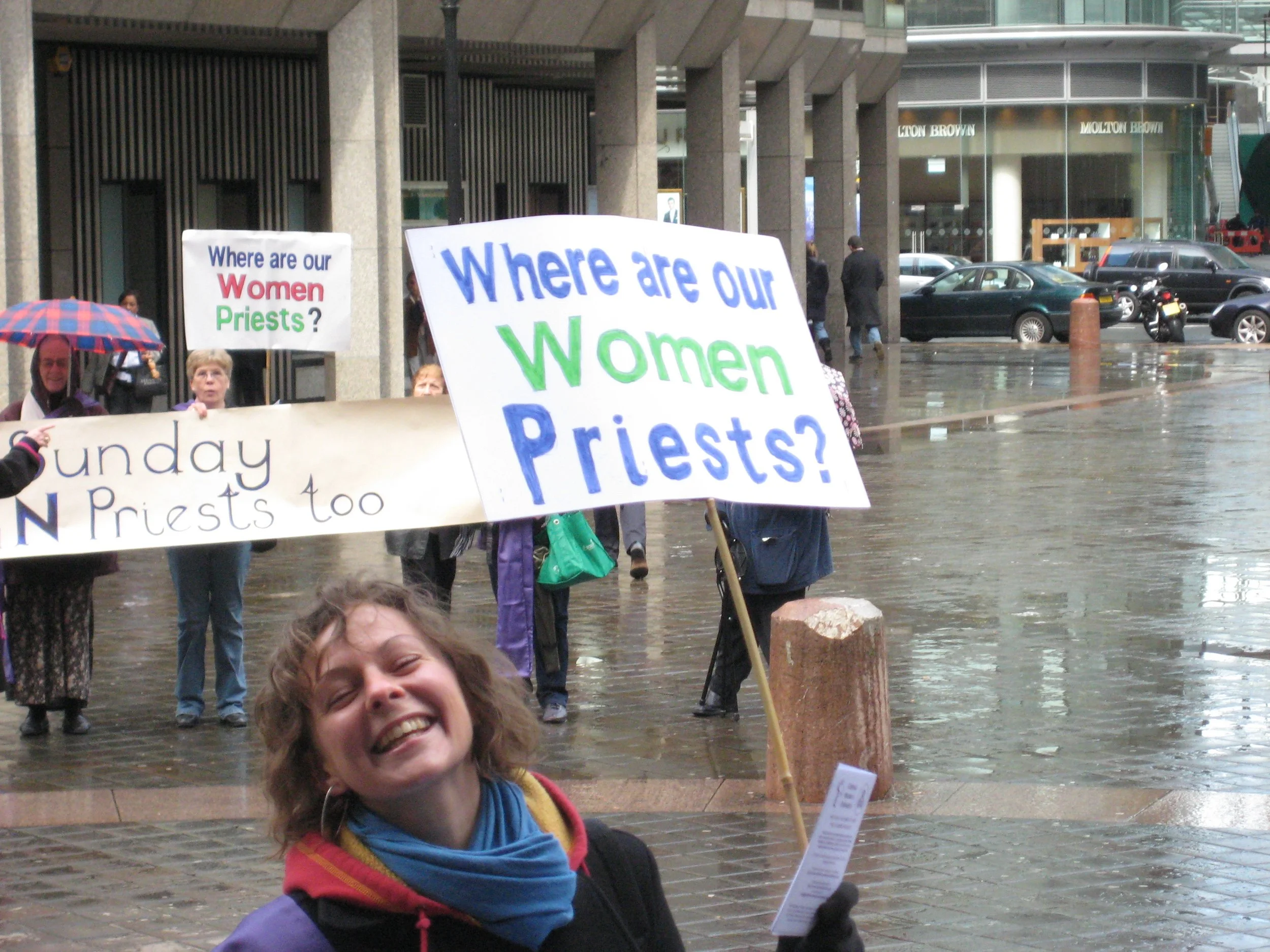
Protest outside Westminster Cathedral. Catholic-womens-ordination.org.uk. CC BY-NC-ND 2.0

Why does female religious leadership matter?

Female leadership in the church not only allows religious spaces to better serve the specific spiritual needs of their congregation, but the opportunity to see examples of women in positions of power and respect also has a significant impact on young girls. 

A 2018 study found that the presence of female congregational leaders can lead to better self esteem in the young girls who grow up in their church, an impact that reverberates into adulthood. Compared to women who had grown up with some female clergy members, women who had never had female congregational leaders were 10% less likely to agree and 30% less likely to strongly agree to having high self esteem. 

Additionally, the study found a link between young girls' access to female congregational leaders and their future employment opportunities. Women who grew up with a female role model as their most influential leader were just as likely to be employed full time as men, in contrast to those who did not.

Female leadership in church marks an important benchmark of gender equality that extends beyond religious divisions into social and political life as well. Church leaders oftentimes serve as influential figures in their communities, with the opportunity to serve as a powerful voice in discussions on timely social issues, including abortion and LGBTQ+ rights. Elevating women’s pastorship would also elevate women’s roles as community leaders, local activists, and engaged political informers. 

Stained glass from from the Basilique de Sacré Couer in Paray-le-Monial. Lawrence OP. CC BY-NC-ND 2.0

Get Involved

Harnessing the power and advocacy of their women congregants, there are many organizations working tirelessly to advocate for women’s ordination and religious empowerment. 

Women’s Ordination Conference (WOC) is a grass-roots movement that has been working to increase female leadership opportunities within the Catholic Church since 1975. The activist group advocates for women’s ordination and increased power within the Catholic Church. In 2018, WOC members protested outside the Vatican in order to advocate for women’s right to vote in synods, a body that makes up the advisory board to the Pope. Along with advocacy work, the organization provides a network aimed at building a community of empowerment for young women in the Catholic Church. Working alongside their goals for gender equality, WOC also seeks to dismantle systems of oppression through anti-colonialism and anti-racist work that champions inclusivity.

For over 100 years, the International Association of Women Ministers has been supporting women’s ministry and advocating for women’s ordination, with members across 22 countries. IAWM offers annual assemblies that have been hosted both within the United States and abroad in Canada, England, Cuba, New Zealand, Germany, Scotland, and Hungary, with the mission of cultivating an international forum for female ministers from all backgrounds, countries, and cultures to develop relationships and provide a community of support for women’s professional growth within ministry.


Jessica Blatt

Jessica Blatt graduated from Barnard College with a degree in English. Along with journalism, she is passionate about creative writing and storytelling that inspires readers to engage with the world around them. She hopes to share her love for travel and learning about new cultures through her work.

Underground Schools for Women and Girls in Afghanistan

The Taliban reconquest of Afghanistan brought an education ban for women and girls, but secret schools have emerged.

A burqa-clad woman in Kabul in September 2021, Milad Hamadi for the Tasnim News Agency. Public domain, via Wikimedia Commons

The life of every Afghan citizen changed on August 15, 2021, when Taliban forces seized the capital city of Kabul and, for the first time in decades, were able to impose the group’s severe intolerance on the whole nation. Those most affected have been young girls and women, who are limited in going about their daily lives and barred from many activities that they previously were able to enjoy freely. As the Taliban continue to ban women from  schools and universities, a new generation of young Afghan girls are left wondering what their future will look like. Recently underground school operations have opened up, taking place both virtually and in person, allowing many Afghan girls the ability to continue their education despite the repression, keeping hope alive in a society that faces deep political and societal challenges.

According to the Taliban’s Minister for Higher Education, Neda Mohammad Nadeem, women are not allowed to go to school because they weren’t following the rules of how “proper ladies” should act in a public setting, including not adhering to the Emirate’s strict dress code. However, this issue transcends  the regime’s hijab policy. The Taliban use religion to justify their strict policies, arguing that it goes against Islamic principles to have girls and women go to school, even stating that the sciences as a whole are no place for them. The Taliban is able to impose its own interpretation of Sharia Law, the traditional Islamic legal code, which is known for including strict guidelines for how girls and women should live. Many professional Muslim scholars have rebutted the Taliban, asserting there is no justification for banning women from having an education, including that “gender-based denial of education has no religious justification.”

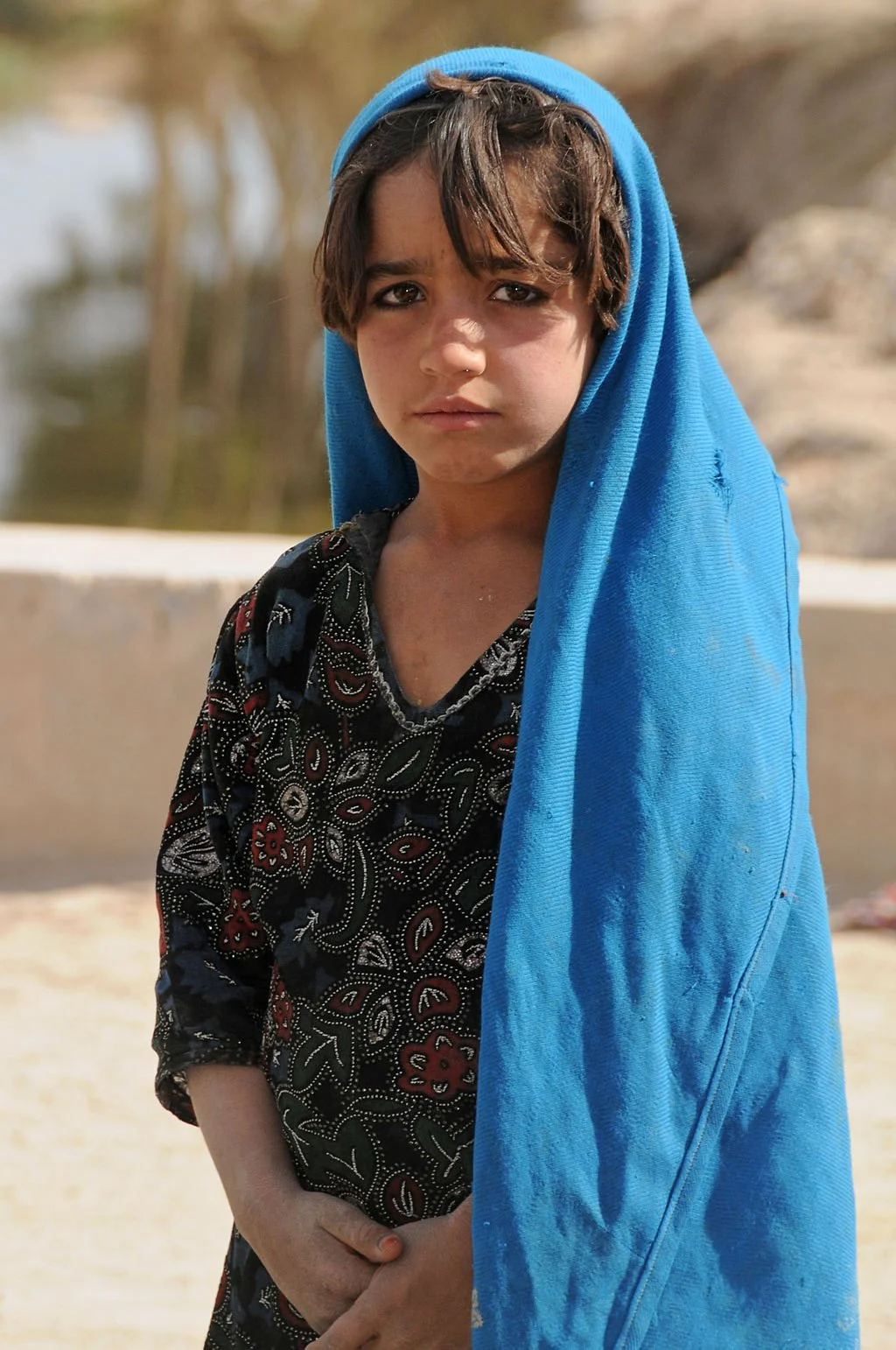
An Afghan girl in Oruzgan Province, John Scott Rafoss. Public domain, via Wikimedia Commons

Despite these obstacles, women and young girls across Afghanistan are fighting for their rights not only to obtain a just education, but to be recognized as important parts of society and claim back their dignity and honor. In an effort to help girls achieve their dreams and achieve literacy, underground schools have started taking shape across the nation, even holding virtual classes. In order to keep an entire generation of young girls thriving, parents are finding alternative means, going as far as risking their lives to create a hidden education system that will serve as primary education and even providing university level courses for older students. One of the pioneer women behind this movement, Sodaba Nazhand, told The Associated Press that “when the Taliban wanted to take away the rights of education and the rights of work from women, I wanted to stand against their decision by teaching these girls.” 

While girls and women are able to pursue knowledge and obtain skills through these underground schools, there is much fear among family members and the students themselves, who know the consequences of getting caught disobeying the Taliban. Several of these schools are held virtually for safety and easier access, although not everyone has access to electronics or wifi. Taliban rule has led to  widespread poverty across Afghanistan, leaving families and individuals unable to support themselves economically, making internet access unattainable for many. Some schools have even begun to be held in person, as houses become secret classrooms. Nafeesa is a young girl that attends an underground school in her small, rural village in the Eastern part of the country. When asked by reporters how she is able to get away with attending a secret school, she said that “Boys have nothing to do in the kitchen, so I keep my books there. If my brother comes to know about this, he will beat me." Despite the fear that she feels in going against rigidly enforced new social norms, Nafeesa and many others continue to defy the status quo to make a better future for themselves, using education as a portal to freedom. 

TO GET INVOLVED

Women For Women International - Women For Women has created an Afghanistan program to help women in the nation discover their power and ways they can pursue a brighter future ahead. For more info, click here.

Malala Fund - Malala Yousafzai has created an Afghanistan fund that provides on-the-ground support to help young girls access education. To learn how you can donate, click here.


Kimberly Hidalgo Hernández

Having obtained a MA in International Policy, Kimberly seeks to bridge the gap between global development and government legislation. Growing up between the United States and Spain, she believes that travel is the best way to discover yourself and understand the world. Her goal is to promote a deeper awareness of the effects of climate change in society and politics.

A Grassroots Youth Movement Is Changing the Political Narrative in Peru

Recent political instability in Peru has resulted in violent uprisings led by the nation’s youth, who are fed up with longstanding corruption. 

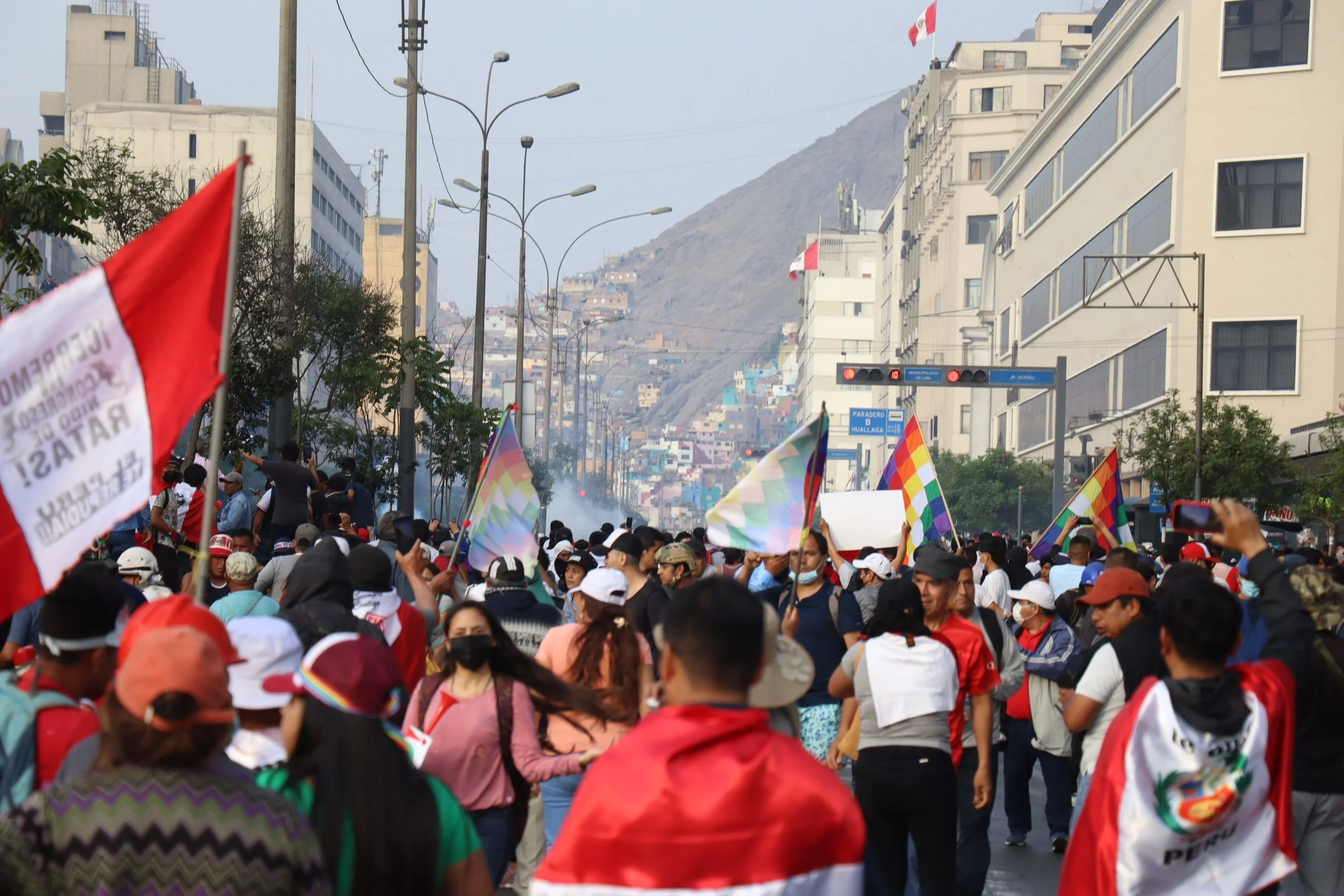
Protesters Take the Streets in Lima, Peru CC BY-SA 4.0

Over the past few months Peru’s political system, and especially its President Dina Boluarte, have come under the scrutiny of protestors demanding fair and just elections. A country that ranks 101 out of 180 on the 2022 Corruption Perceptions Index, Peru is categorized as one of the nations with the most public sector corruption. Facing regional criticism with polarization, impeachment threats, and violent manifestations across the country, Peru’s current turmoil is opening a path towards a new Peruvian identity for young citizens who wish to set their nation on a different course. Seeking democracy and transparency, a group of Peruvian students are increasing awareness of structural changes that they feel must take place in their country.

Former Peruvian President Pedro Castillo was arrested in January 2023 after an attempted coup from above, resulting in the ascension of the then Vice President Dina Boluarte to head of state. Many citizens, however, especially those outside of the capital Lima, felt that this was an attack on their freedom because there was no democratic input in the transition. Throughout the pandemic Peru suffered an economic downturn that reduced access to basic services, especially for health care and education. Triggered by the political unrest, civilians have since taken to the street in violent anti-government protests, demanding that their nation allow transparent elections and eliminate elite privilege.

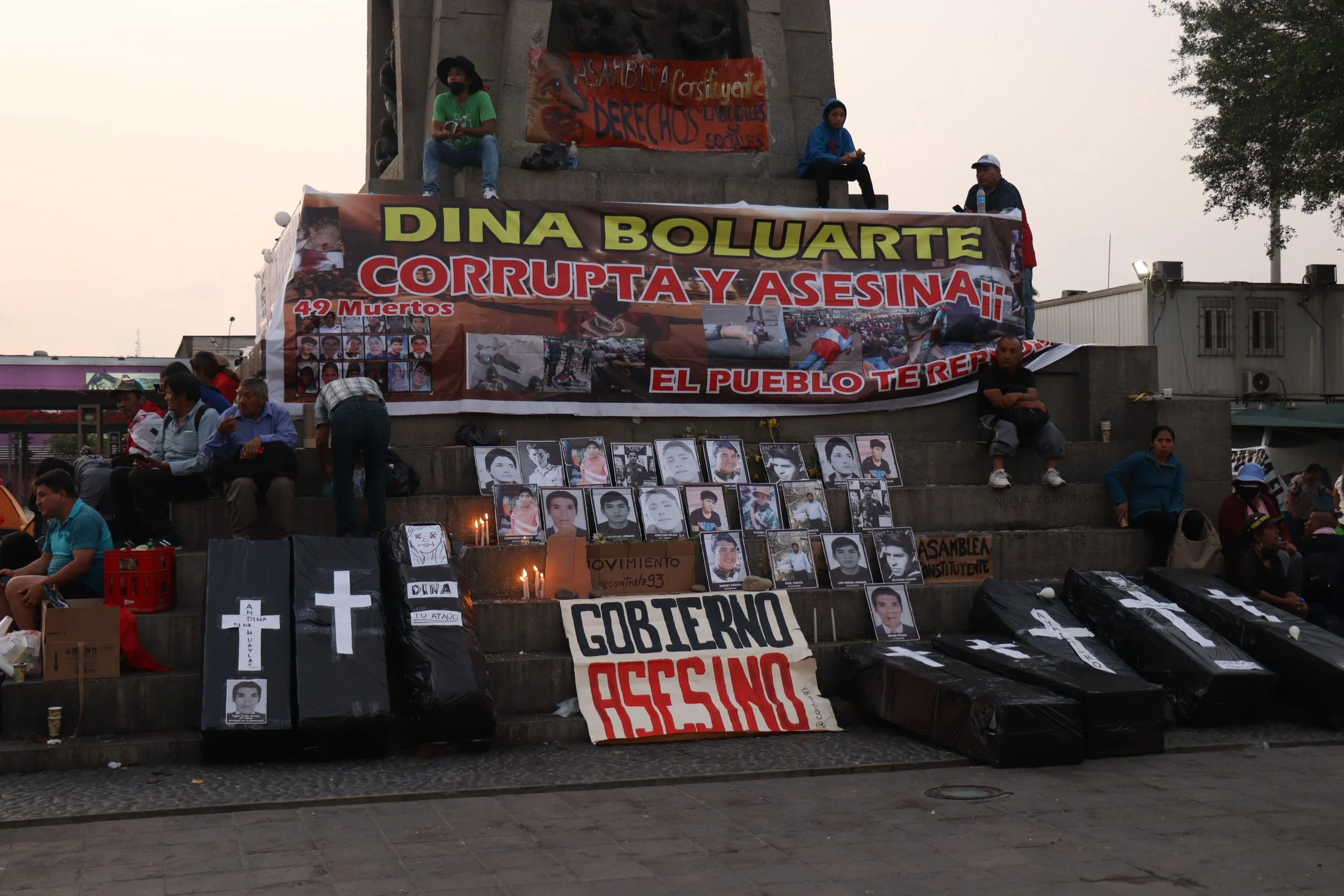
Demonstrations at Plaza Manco Capac following the Ayacucho massacre CC BY-SA 4.0

Peru’s youth  have been key to these protests, taking a stand and raising their voices to demand what they view as a better future free of corruption with access to quality basic services. Creating their own slogan, #TheyMessedWithTheWrongGeneration, Peru’s younger population warns authorities that they will not rest, and plan on continuing the fight for an end to systematic dishonesty and fraud. Considered a grassroots movement, the non-partisan group is gaining momentum as even some among the older generations feel that the current government no longer represents them and that their country deserves better. One activist in the movement, a 33-year-old publicist named Diego Cruz, gave the following statement to reporters at a march, “It’s not just one generation marching here, it’s everyone, because we feel outraged that [congress] is carving up the country.” 

The youth movement also demands university reform, adherents arguing that access to college is not possible for everyone, especially those that live in rural communities far from the cities. Politicians and traditional political analysts mistook the youth’s dissatisfaction of the old ways for political apathy, a supposition which has now proven woefully false. Members hope that their movement can pave the way to a better, more transparent Peru.  It remains to be seen whether they will achieve this.


Kimberly Hidalgo Hernandez

Having obtained a MA in International Policy, Kimberly seeks to bridge the gap between global development and government legislation. Growing up between the United States and Spain, she believes that travel is the best way to discover yourself and understand the world. Her goal is to promote a deeper awareness of the effects of climate change in society and politics.

Photo Essay: On the Ground with Waves For Water in the Philippines

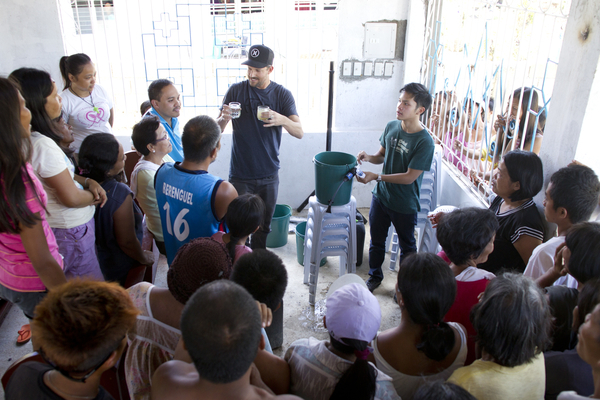
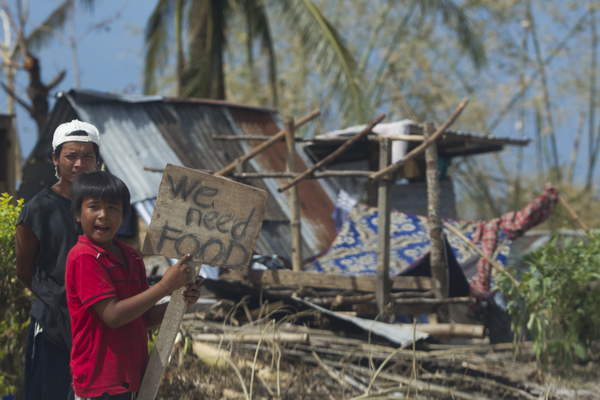
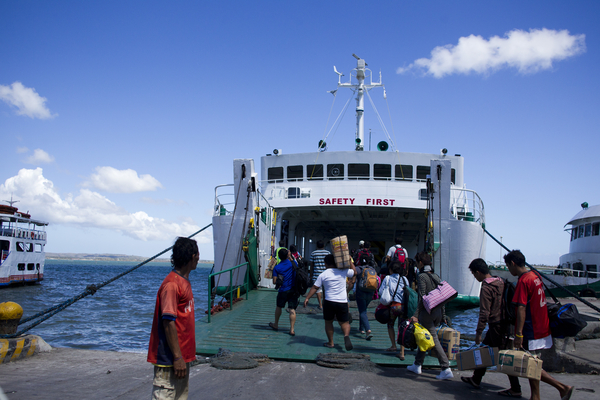
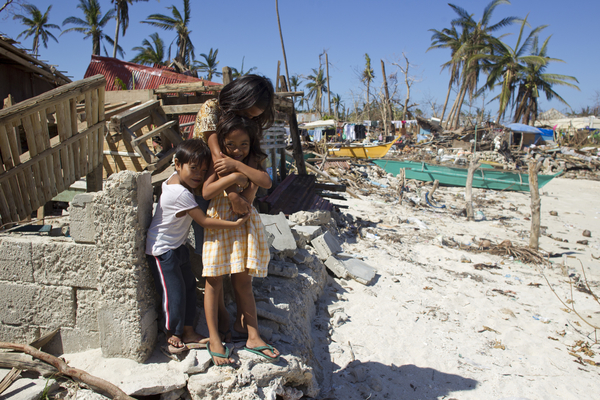
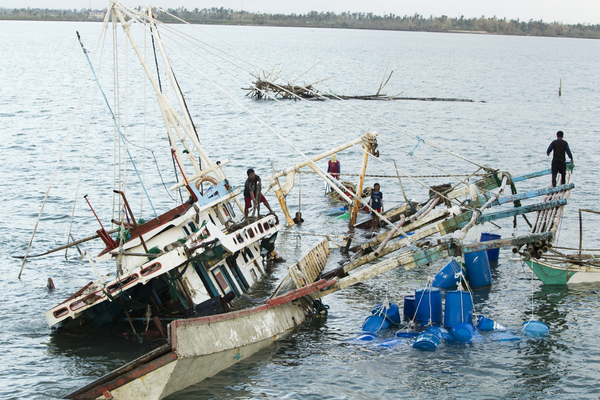
While the Philippine Islands were being struck by Super Typhoon Haiyan’s wrath, Jon Rose, Founder of Waves For Water, was already hatching his plan to help.

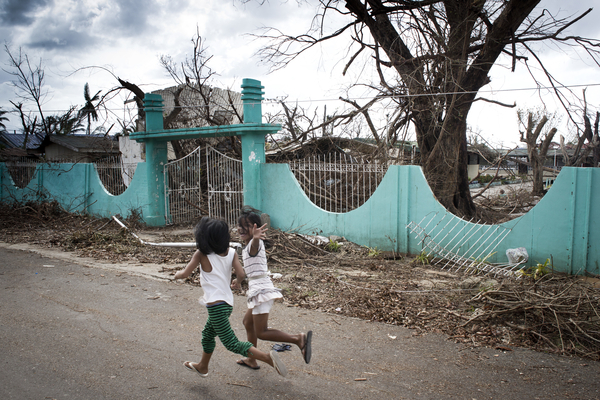
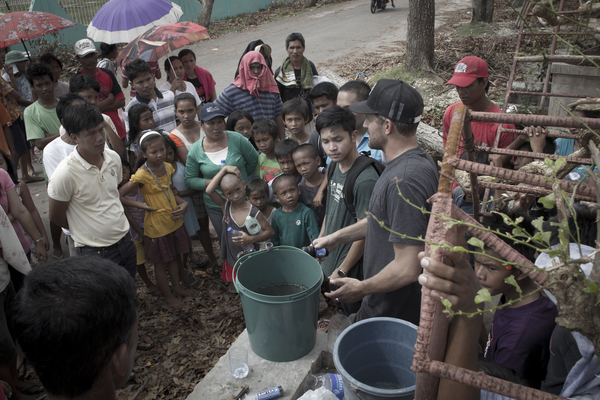
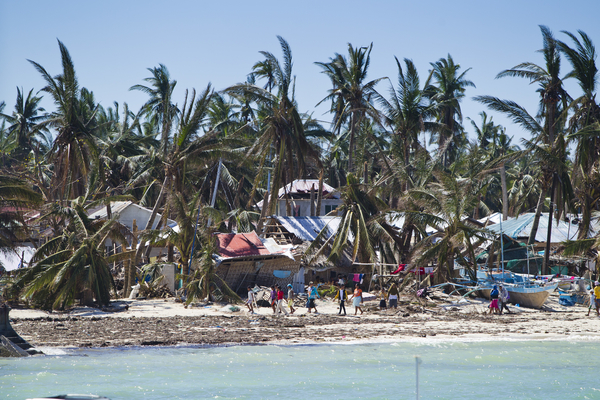
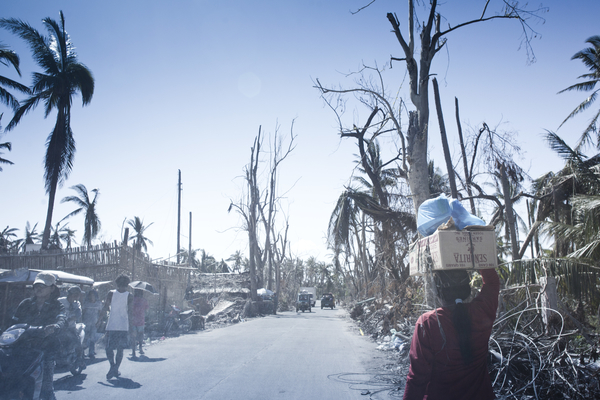
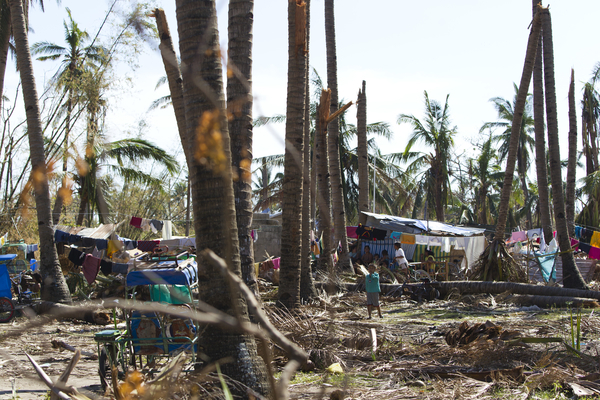
W4W began work in the Philippines in response to Typhoon Haiyan and continues to support areas with water shortages. 

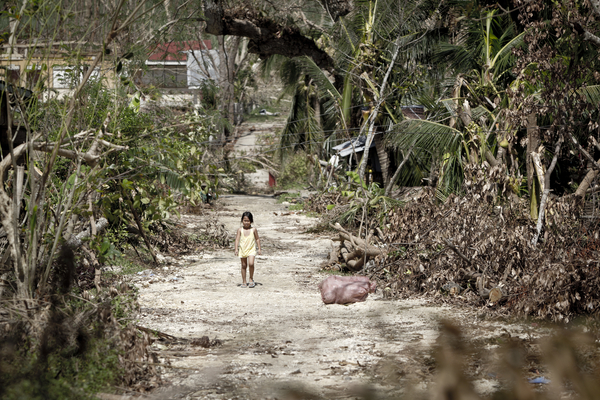
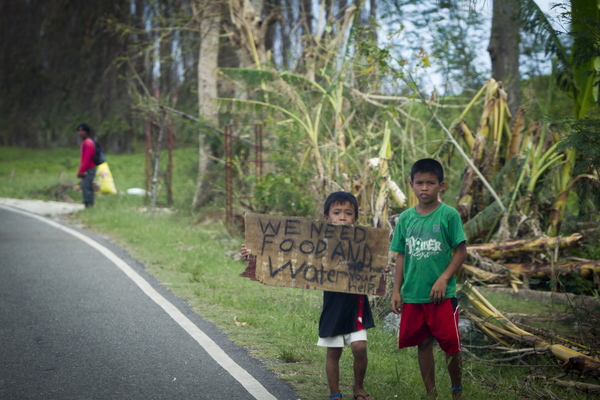
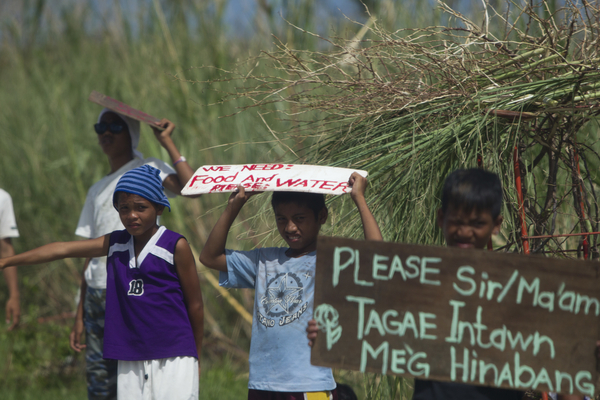
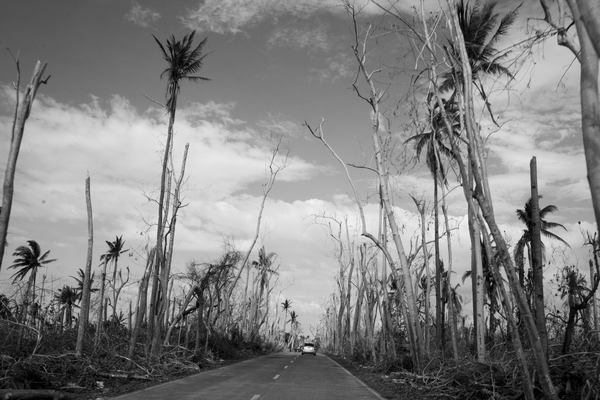
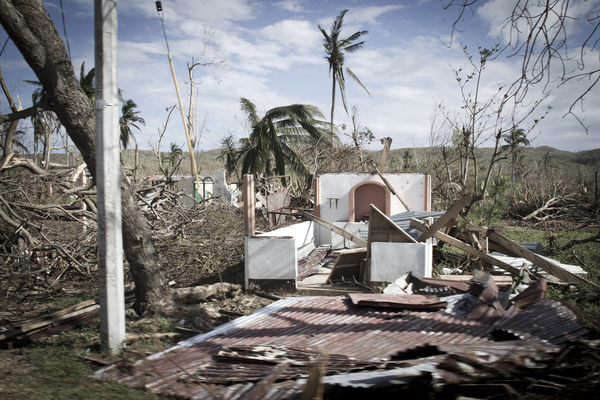
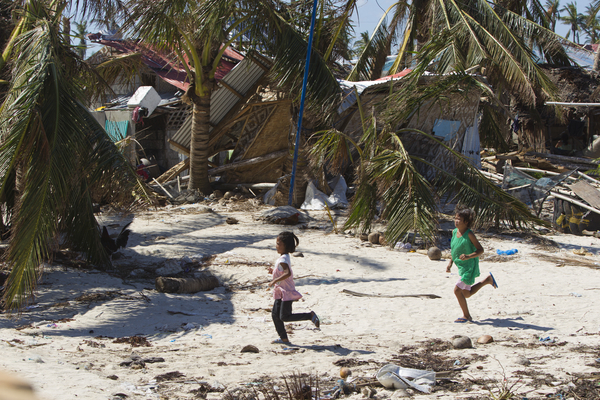
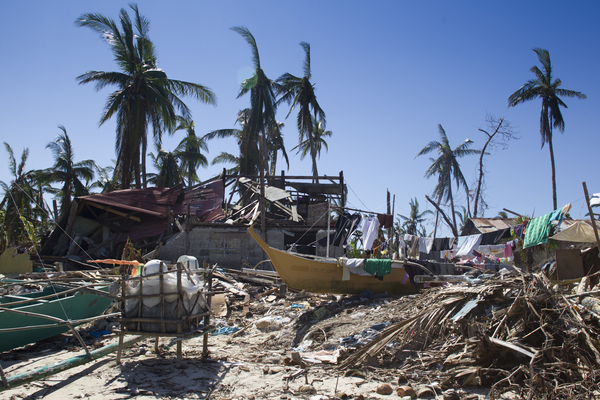
In 2013, the Philippines was hit by one of the most devastating typhoons ever recorded: Typhoon Haiyan. The natural disaster affected people throughout Southeast Asia and killed 6,300 people in the Philippines alone. Throughout the country, over 4.3 million people were affected. One major impact of the typhoon was its obstruction of access to clean water. 

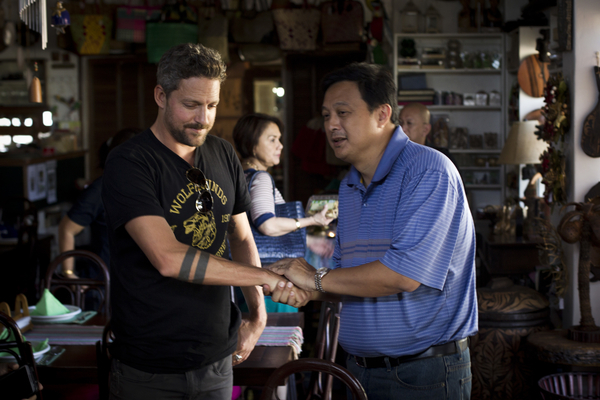
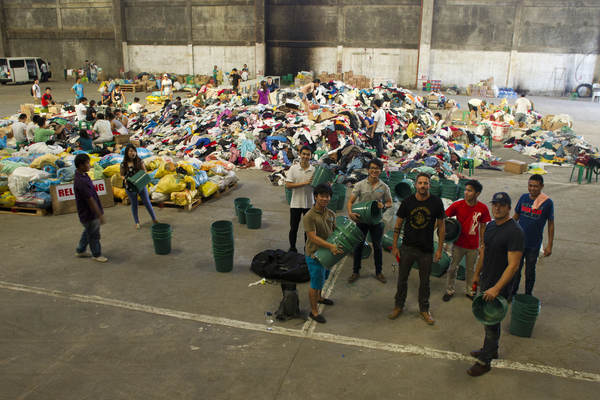
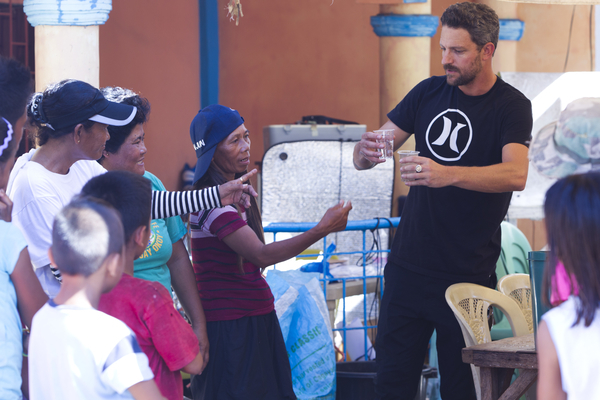
To address this problem, Jon Rose, founder of Waves for Water (W4W), arrived in the Philippines ready to distribute his organization’s water filters among “forgotten pockets,” communities that were not “the focal point of major relief efforts.” His method of distribution and relief relied on the “train-the trainer, local-based model” in which W4W organizers “empower” and “facilitate” for local people rather than decide “who gets what, when, where and how.” Two years after the typhoon, W4W established an office in the Philippines, where it is currently registered as a non-profit organization. Since 2015, W4W has built 66 rainwater catchment systems and provided over a million Filipinos with access to clean water. In December of 2021, the organization helped to address the devastation caused by Hurricane Odette in Siargao, Philippines through a partnership with Billabong. Currently, W4W is providing aid for those impacted by Tropical Depression Agaton, which has displaced 1.9 million people in Visayas and Mindanao, Philippines. You can contribute to this specific effort here

W4W’s humanitarian efforts are not limited to the Philippines. Since its inception in 2009, the organization has made an impact in 44 countries, including Mozambique, Ecuador, Sierra Leone and Chile, and has helped 3.75 million people gain reliable access to clean drinking water. W4W currently has 24r active programs helping to address water access issues. These programs seek to provide aid to citizens of Ukraine, Australia, Haiti and Guatemala. You can learn more and help out here.


Jon Rose

As a pro surfer of 13 years, Jon Rose traveled the world in pursuit of perfect waves. It was this passion that led him to development of Waves for Water in 2009. He hopes to see W4W enlist and empower travers to help solve the world water crisis.