Overpopulated Indonesia Fears Baby Boom Due to Coronavirus

After months of telling its citizens to stay at home, Indonesia is now facing fears of a potential baby boom.
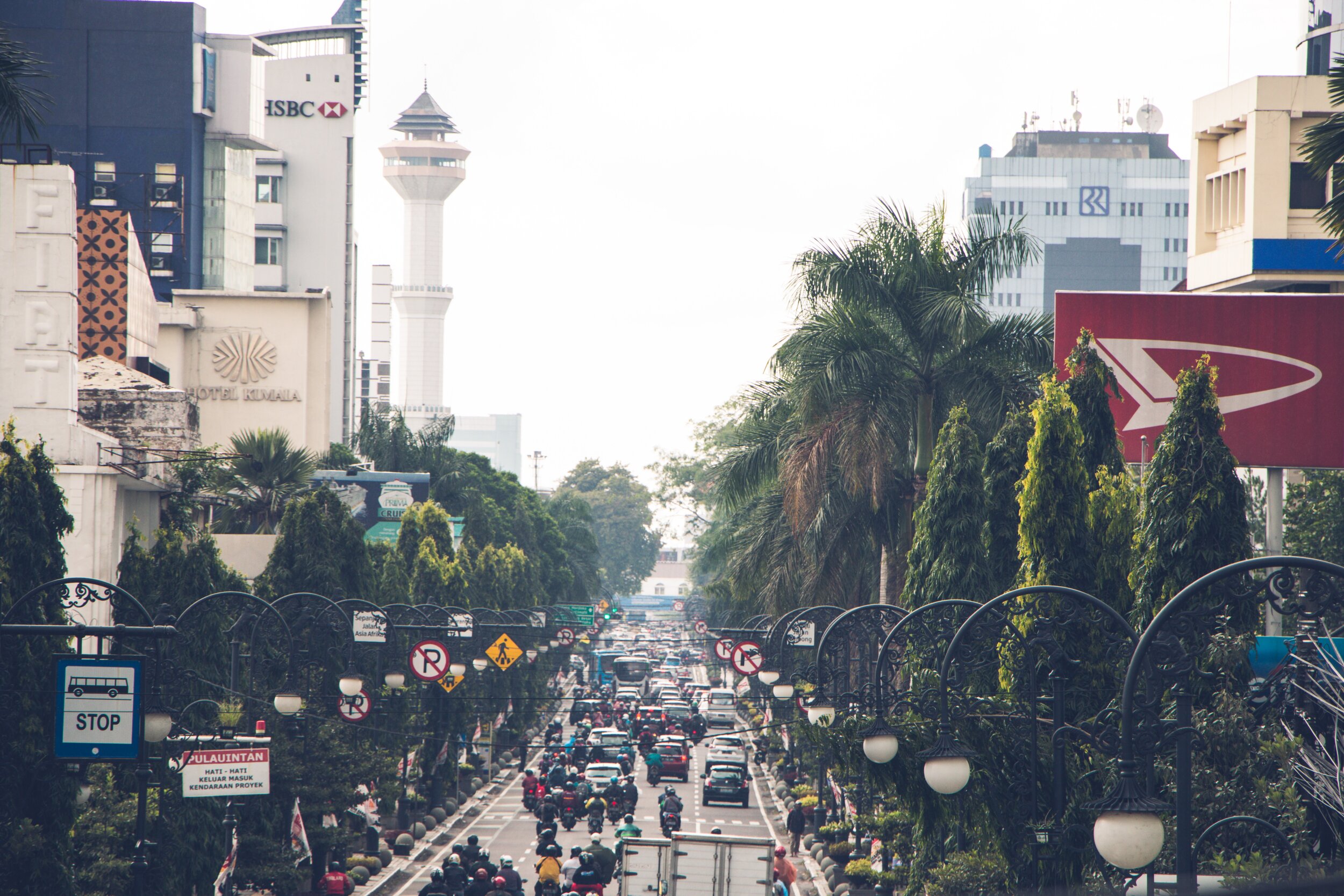
Traffic in Bandung, Indonesia. Ikhsan Assidiqie. Licensed by Unsplash.

With the country under quarantine from COVID-19, many people have stopped going to clinics to get contraceptives out of fear of catching the virus. This projected increase in pregnancies comes after extensive efforts by the country to encourage smaller families, an action taken in order to fight against the concern of child malnutrition. This problem is so severe that government vehicles drove around the cities and pleaded with the public through loudspeakers: “You can have sex. You can get married. But don’t get pregnant. Dads, please control yourself. You can get married. You can have sex as long as you use contraception.”  

The National Population and Family Planning Board (BKKBN) is Indonesia’s government-backed family planning program tasked with helping married couples manage the creation of their families. BKKBN is widely successful and employs 24,000 counselors to help execute their mission, much of which includes distributing free contraceptives to the public. 

The agency recently determined that there had been a significant decrease in the use of contraception between March and April of 2020 and that about 10 million couples in the country no longer had access to a form of birth control. An increase in pregnancy rates is deeply concerning for the Indonesian government because the country is struggling to manage the current population size given its available space and resources. In order to try and alleviate some of these effects, the government has openly discouraged people from having large families for years and freely provided various forms of birth control. About half of those who use contraceptives receive monthly or trimonthly hormone injections, 20% use birth control pills and many use IUDs. Condoms remain unpopular, though, across the country. It is worth noting that abortion in Indonesia is only permitted if it is “to save the woman’s life.” There are many possible contributors to the drop in contraceptive use during this quarantine period, such as a fear of leaving the house to acquire contraceptives (especially from hospitals), closed contraception clinics and other closed health care providers. 

One significant consequence of Indonesia’s population struggles is child malnutrition, a problem that Indonesian President Joko Widodo promised to alleviate within 4 to 5 years. More severe cases of child malnutrition (especially when paired with poor hygiene) can result in child stunting, a condition where the child is more than two standard deviations below the median of child growth standards as determined by the World Health Organization. If children are experiencing stunting then they are more susceptible to pneumonia, diarrhea and a weakened immune system. Given that COVID-19 is known to be more fatal for those with compromised immune systems, this is an especially pertinent concern. Long-term effects include an increased chance of experiencing chronic diseases such as hypertension and a lowered IQ. According to the organization 1,000 Days Fund, a group dedicated to the elimination of stunting, children with stunting can miss about a year of school because of the sickness. While Widodo has found some success in lowering the number of child stunting cases in the past few years, this period of quarantining may prove to be a major setback.

BKKBN announced that Indonesia should expect about 420,000 more babies than the average 4.8 million in the upcoming year. One demography expert at the Indonesian Institute of Sciences, Dr. Augustina Situmorang, believes pregnancy spikes are most likely to occur in low-income families who relied on the previously-accessible birth control provided by BKKBN in addition to young women who lost their jobs, had to return to their hometowns, and then had to get married due to social pressures. 


Indonesia’s health care system is already working overtime and has suffered considerably from COVID-19, registering more than 33,000 cases and over 1,900 deaths. Nevertheless, the government is attempting some preventive measures to combat more potential pregnancies. This includes allowing access to multiple months of birth control pills at a time, making door-to-door deliveries of contraceptives along with emergency supplies, and hoping to distribute contraceptives to 1 million people on June 29, dubbed “National Family Day.” Going forward, the Indonesian government will have to move efficiently if it wants to limit the burden felt by the Indonesian health care system with future generations.

Phoebe Jacoby

is a Media Studies major and Studio Art minor at Vassar College who believes in the importance of sharing stories with others. Phoebe likes to spend her free time reading, drawing, and writing letters. She hopes to continue developing her skills as a writer and create work that will have a positive outward effect.

Gender Matters in Coastal Livelihood Programs in Indonesia

Significant investments have been made in improving the well-being of Indonesian coastal communities in recent decades. However, most of these programs have not tackled gender inequalities.

Projects based on comprehensive understanding of gender norms in coastal communities will contribute to improved community wellbeing. www.shutterstock.com

Our team studied 20 coastal livelihood programs implemented across the Indonesian archipelago from 1998 to 2017. Our aim was to see how gender issues were considered in project design and implementation.

The Indonesian government, international governments, international development and lending agencies and non-government conservation organisations funded these projects.

Most projects included women in activities to enhance or introduce new livelihoods. However, 40% of the projects were gender-blind with respect to the design and impact of their activities. This means that activities may have further entrenched processes that disadvantage women by limiting their ability to pursue their own livelihood goals.

Only two projects (10%) used an approach that sought to challenge entrenched gender norms and truly empower women.

We recommend future projects be developed with a comprehensive understanding of gender norms within coastal communities. Participatory approaches that address and challenge these norms should be implemented. This will more effectively contribute to improvements in community well-being.

What we found

Our study, which assessed livelihood programs from various regions throughout Indonesia – including Bali, Sulawesi and West Papua – found 95% of programs had directly or indirectly included women. They did so through activities such as providing training and equipment to support alternative sources of income – e.g. making fish or mangrove-based food products.

Only three of the 20 projects provided gender awareness training for staff members and community facilitators. Only one provided similar training at the community level. In addition, two projects included a gender quota for community facilitators (30-50% female).

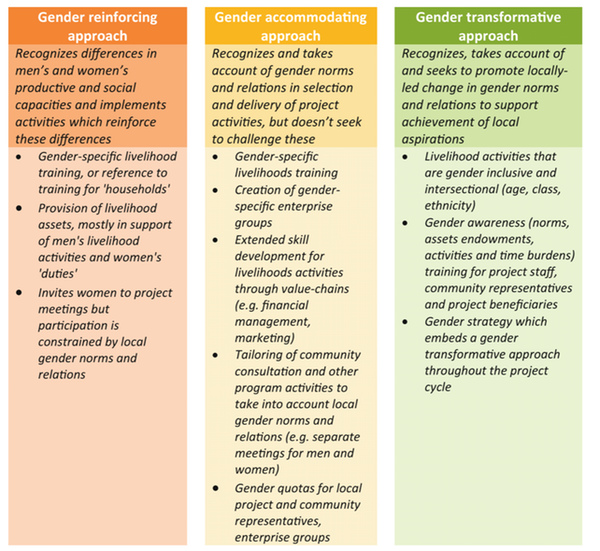
However, we found most projects applied either a “gender reinforcing” approach – reinforcing the existing gender norms and relations that underlie social and economic inequalities between men and women – or a “gender accommodating” approach – recognising these norms and relations but making no attempt to challenge them.

For example, many projects included separate “women’s activities”, such as handicrafts manufacture, or sought to increase household income by engaging women in income-generating enterprise groups. However, there was little consideration of how women would balance these activities with traditional caring and household roles, or of other ways women contributed to the household economy.

What we can do

Based on our findings, we recommend a “gender transformative” approach. Firstly, this approach involves mainstreaming gender issues across entire project cycles. Secondly, it involves working with coastal communities to identify and, where appropriate, challenge existing gender norms and social relations.

A core component of these projects is gender analysis. This is a process that identifies:

  • men’s and women’s activities within the home and community

  • differences in men’s and women’s access to, control over and use of livelihood resources

  • differences in participation in processes that govern management of natural resources

  • the gender norms and relations governing these differences

  • their impact on men’s and women’s livelihood opportunities.

For example, the Coastal Field School program included participatory activities that documented men’s and women’s daily activities. This activity highlighted the time women spent on caring and household duties and unpaid supportive contributions to “men’s activities”.

When undertaken in a participatory manner, this analysis helps communities to identify local, and broader structural, barriers to gender equality. They can then identify options and potential actions for overcoming these barriers. This creates a more equitable social and economic environment.

Summary of the characteristics of approaches to gender in development programs (based on Lawless et al. 2017), with examples of typical project activities drawn from our. study. Stacey et al (2019).

This process must be sensitively facilitated because it may confront traditional power hierarchies within communities. It also takes time, which must be factored into project cycles.

The use of gender-transformative approaches can improve the well-being of coastal communities by identifying and reducing barriers to equitable participation in social and economic life. This increases the ability of men and women to pursue enhanced or alternative livelihood opportunities.

Finally, recognising women’s contributions, building women’s confidence and giving women voice to participate in local community planning processes creates greater opportunities for issues of concern to women to be included in the development agenda.

Natasha Stacey is a Associate Professor, Research Institute for the Environment and Livelihoods, College of Engineering, IT and Environment, Charles Darwin University

Emily Gibson is a PhD Candidate, Research Institute for the Environment and Livelihoods, Charles Darwin University

THIS ARTICLE WAS ORIGINALLY PUBLISHED ON THE CONVERSATION

The Eerie History and Uncertain Future of Japan’s Rabbit Island

Ōkunoshima and its imperiled bunny population remind us that wildlife and tourism don’t always mix.

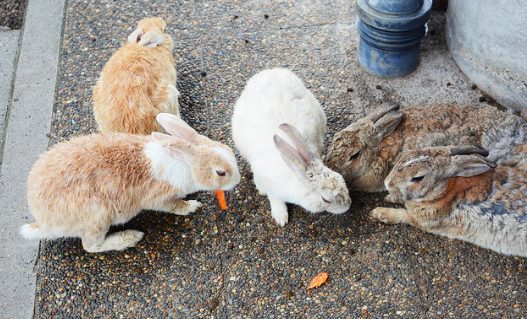
A cluster of bunnies on Rabbit Island. Cindy Pepper. CC BY-NC-ND 2.0

From its many “cat islands,” which boast more feline than human residents, to Jigokudani Monkey Park, where visitors can observe macaques bathing in the naturally occurring hot springs, Japan seems to overflow with fantastical wildlife enclaves. Perhaps the most adorable of all is Ōkunoshima, or “Rabbit Island”—but the cotton-tailed denizens for which this island is known belie its sinister past and ambiguous future.

While Ōkunoshima, located in the Hiroshima Prefecture, is a popular tourist destination for those looking to get their kawaii fix, it was once hidden from maps due to its clandestine status as a World War II military location. Production of chemical weapons in the island’s poison gas factory began in 1929, and apart from factory workers and army higher-ups, few citizens were aware of its existence.

Ōkunoshima was chosen for its location: discreet enough for goings-on there to remain under the radar, and far enough from densely populated cities like Tokyo to prevent mass casualties in case of an accident. The factory there eventually produced more than 6,000 tons of gas—primarily mustard gas and the irritant lewisite—before its closure at the end of the war. Chemicals wereould be shipped to Kitakyushu in the Fukuoka Prefecture to be weaponized, eventually resulting in more than 80,000 casualties (including and more than 6,000 deaths) among Chinese soldiers and civilians.

Despite the fact that Japan was a signatory to the 1929 Geneva Convention banning the use of chemical weapons, none of the country’s citizens were prosecuted for employing poison gas. After Japan’s defeat in the war, most of the Ōkunoshima factory was destroyed, but laboratory buildings, the shell of a power plant, an army barracks, and a few other edifices remain. In 1988, local governmental entities and citizens opened the Poison Gas Museum to pay tribute to this dark and little-known facet of Japanese history. Displays include the ineffective protective gear worn by workers at the factory, which left them vulnerable to exposure and subsequent illness, as well as equipment used to manufacture the gases.

So where did the bunnies enter the equation? We know that a colony of rabbits was brought to the factory during its operational years to test the effects of poisons, but beyond that, theories diverge. Some suggest that the original crop of rabbits was destroyed along with the factory, while others claim that workers set the bunnies free after the war. Another theory asserts that schoolchildren brought eight rabbits to the island in 1971, where they bred until they reached their current population of approximately 1,000.

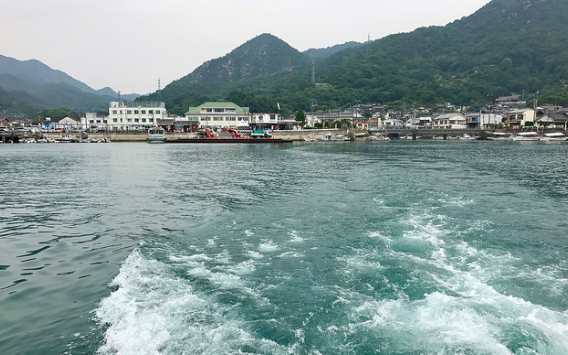
Tadanoumi Port viewed from the ferry to Ōkunoshima. Brian Shamblen. CC 2.0

Today, Ōkunoshima is easily accessible via a 15-minute ferry, and embodies peace, rest, and relaxation for tourists and locals alike. Visitors can easily explore it on foot (the island is less than 2.5 miles in circumference), collect souvenirs, dine, play tennis, swim in the ocean, and bathe in the hot spring—apart from communing with the wildlife, of course. Rabbit Island’s website describes it as a place to seek good fortune for your own family’s fertility, and advertises whipped ice cream and “original rabbit items” for sale, as well as octopus kelp rolls, a local delicacy known to pair well with sake.

Yet even the island’s thriving tourist industry and booming bunny population has a more sinister flip side. The wild rabbits depend on visitors for their food and water, but tourists often come bearing snacks that are harmful to the creatures’ delicate digestive systems—such as cabbage or vegetable peelings, which can cause fatal bloating. And while visitors are keen to share photos of their new fluffy friends online, social media has played a key role in destabilizing the rabbit population: Viral videos and articles have led to a vast influx of tourists in the past decade, and the resultant avalanche of snacks and treats has contributed to a breeding boom that the island’s ecosystem is unable to handle. These factors have combined to lower the bunnies’ life expectancy to only two years, compared to the three-to-five-year lifespan of the average wild rabbit.

The plight of the Ōkunoshima rabbits is just one example of the widespread harm social media has inflicted on wildlife populations across the globe: For instance, viral YouTube videos of slow lorises, wide-eyed nocturnal primates native to Southeast Asia, have led to people taking home lorises from the wild to keep as their own. Unfortunately, captivity is unhealthy for the animals, and they often end up relegated to props in tourist photos—or worse, sold into the illegal pet trade, and possibly slaughtered for use in cuisine or medicinals.

A curious bunny on Ōkunoshima seems to have mistaken the camera for a snack. Brian Shamblen. CC 2.0

Ultimately, bunny lovers need not be deterred from visiting Ōkunoshima, but following the rules is essential in order to treat the creatures kindly and foster their health and wellness. The Rabbit Island website lays out guidelines for responsible rabbit enthusiasts—including “refill water pans” and “check under your car,” as curious bunnies might hide underneath to escape the hot sun—and travelers can use their visit as an opportunity to educate friends and family about the unique perils posed to wildlife in the digital age. Approaching this mystical island mindfully is a small yet important step in helping the myriad diverse populations of the animal kingdom survive and thrive for many years to come.


TALYA PHELPS hails from the wilds of upstate New York, but dreams of exploring the globe. As former editor-in-chief at the student newspaper of her alma mater, Vassar College, and the daughter of a journalist, she hopes to follow her passion for writing and editing for many years to come. Contact her if you're looking for a spirited debate on the merits of the em dash vs. the hyphen.

An Island Disappears off the Coast of Japan

It remained unnoticed until local fishermen investigated.

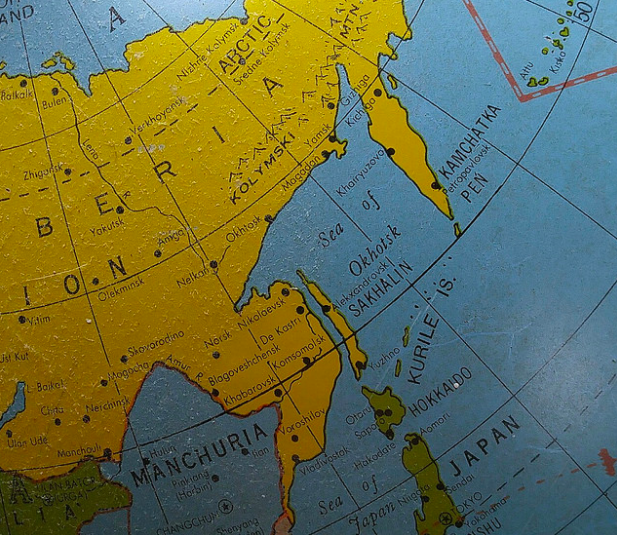
Vintage globe depicting the Sea of Okhotsk. Robin Ottawa. CC BY-SA 2.0

This fall, Esanbe Hamakita Kojima, a tiny island off the northeast coast of Japan dropped out of sight. The island’s disappearance went unnoticed by inhabitants of the nearby village of Sarufutsu, situated on the northern tip of Hokkaido island only 1,640 feet away.

It wasn’t until September, when author Hiroshi Shimizu traveled to Sarufutsu to gather inspiration for his picture book on Japan’s islands, that authorities were notified of the island’s disappearance. Shimizu had been looking for the island but couldn’t locate it. He informed local fisherman who went out to investigate and finally noted that Esanbe was missing.

When Japan’s Coast Guard last surveyed the island in 1987, it was only 4.5 feet above sea level. Authorities could not confirm how large the island had been before the sea rose around it.

Esanbe is west of Japan’s Northern Territories and part of a set of islands that has been long-contested between Japan and Russia. The islands, called the Kurils by Russia, were taken by the Soviets shortly after World War II, but ownership today remains unclear. According to CNN, Esanbe functions as a marker of Japanese ownership in contested waters. But the strategy of claiming islands to maintain the maritime space around them is not exclusive to Esanbe. In fact, according to the Washington Post, Japan owns 158 uninhabited islands that the country named in 2014 so that the sea surrounding them could remain in Japanese control.

Thus, the disappearance of the island may have a slight effect on Japan’s territorial waters, as according to international law, countries can only claim ownership of the sea around an island if that island is visible at high tide. Coast Guard officials in Japan confirmed that Esanbe’s loss, “may affect Japan's territorial waters a tiny bit.” With the island underwater, Japan will have lost approximately 1,640 feet of territorial water.

The island’s disappearance was likely due to erosion by the wind and drift ice common in the Sea of Okhotsk each winter. According to coast guard official Tomoo Fujii, “There is a possibility that the islet has been eroded by wind and snow and, as a result, disappeared,” Asahi Shimbun of the Japanese Daily reported.

According to the Smithsonian, disappearances of land masses in this area of Japan are not unlikely. The good news for Japan’s border, however, is that this phenomenon can occur in reverse. Five years ago, a 1000-foot long island rose out of the sea, prompted by a landslide.


EMMA BRUCE is an undergraduate student studying English and marketing at Emerson College in Boston. While not writing she explores the nearest museums, reads poetry, and takes classes at her local dance studio. She is passionate about sustainable travel and can't wait to see where life will take her. 

Tides of Change : Japan to Resume Commercial Whaling

For more than thirty years, the island nation of Japan has fought to expand its commercial whaling operations. That fight has mostly been a losing one, with its efforts often being blocked by anti-whaling countries around the world and condemned by the International Whaling Commission, an organization whose members include Japan itself. However, Japan’s recently proposed exit from the commission will allow the country to reclaim one of its most time-honored traditions, and the move is drawing international criticism.

Two Minke Whales being loaded onto the Nisshin Maru. The ship has facilities on board which allow it to freeze and process whales while at sea. Australian Customs and Border Protection Service. CC BY-SA 3.0

In 1982 the International Whaling Commission, or IWC, imposed a global moratorium on all commercial whaling, save for subsistence whaling by Aboriginal communities. The moratorium went into effect in 1985 and was met with opposition from Iceland, Norway, and Japan, countries with strong whaling traditions. In Japan, whale meat generally served the same purpose that beef or lamb served in Western societies and this was especially true during hard times. In the 1940s as the country was recovering from World War 2, whale meat was the single most consumed meat among Japanese people, and it remained so through the 1960s. After the announcement of the IWC’s whaling ban, Japan petitioned for the right to continue whaling in the Antarctic for “scientific purposes” though the specific nature of its research remained unclear. Whale activists claimed that this “research whaling” was in fact, commercial whaling in disguise, and vessels like the Nisshin Maru, Japan’s largest whaling vessel and the world's only factory whaling ship, became a frequent target of animals rights groups, with some going so far as to board vessels of their own and try to disrupt the Maru’s whaling expeditions by obstructing its path. Earlier this year, Japan expressed a desire to develop new ships, fast enough to outrun those of the activists, but the plan appears to have been scrapped, as the Japanese government announced in late December that it will formally withdraw from the IWC, discontinue its operations in the Antarctic and resume commercial whaling operations in its own coastal waters. Though the demand for whale meat has diminished somewhat in Japan, the practice of whale fishing is still considered by many to be intrinsic to the country’s cultural identity.


Environmental conservation hinges on the idea that some of the Earth’s resources are non-renewable. Humans can hunt an animal to extinction, and that extinction creates an imbalance in the ecosystem that the animal once belonged to. The effects of that imbalance can, in turn, come back to haunt humans, either directly or indirectly. These are, however, relatively young ideas, and pitting them against hundreds of years of tradition is sure to be a test for all parties involved.


JONATHAN ROBINSON is an intern at CATALYST. He is a travel enthusiast always adding new people, places, experiences to his story. He hopes to use writing as a means to connect with others like himself. 


Mask off: How Beijing is Managing its Smog Problem

Earlier this month, California made national headlines when the worst wildfire in the state’s history covered parts of it in smoke, creating yet another worry for citizens already vexed by the high cost of living and rising homelessness. Some news stations, hoping to illustrate the seriousness of the matter, stressed that the air quality in California was “worse than Beijing’s,” an announcement that prompted many locals to don the air masks that one often sees in images of the Chinese capital. In media, locally, and abroad, Beijing has become synonymous with bad air. The internet is peppered with images of skyscrapers draped in brown or grey fog. But recent efforts by the government have made some headway in the battle with Beijing’s notorious smog and could give us insight into how to battle this problem at home.

A smoggy day in Beijing. By 螺钉 - Own work, CC BY-SA 3.0, https://commons.wikimedia.org/w/index.php?curid=24944427

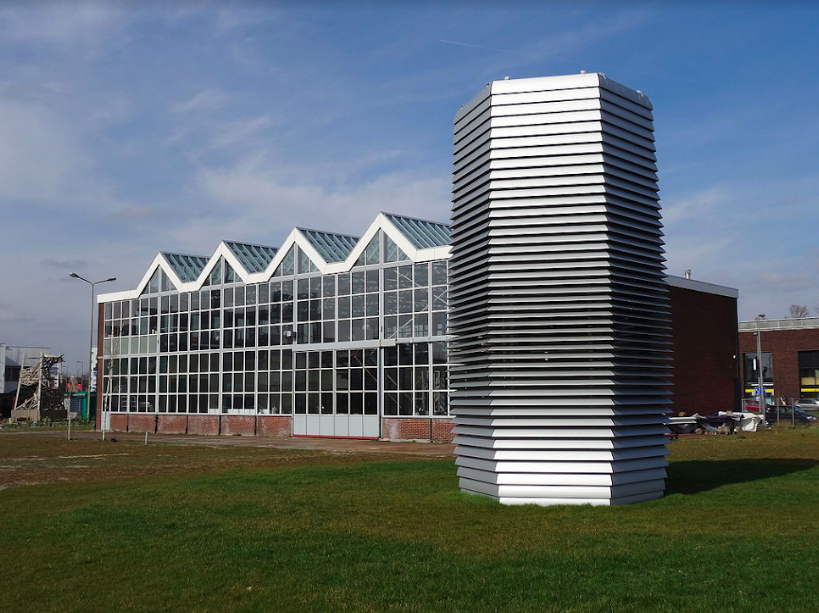
Those who have been to Beijing know that air quality is but one of many dangers; crossing an intersection can be like an action movie at times and drinking water out of the tap is generally a bad idea. Smog, however, is the issue most often associated with Beijing in the media. Fortunately, Beijing is aware of its reputation and has taken steps over the last few years to improve its air quality. The city has pledged to shut down 1000 manufacturing factories by 2020 to help reduce smog. It is also experimenting with new technology. Early last year Beijing employed the use a solar-powered air vacuum to help clean up the city’s air. Developed by Dutch designer Daan Roosegaarde, the Smog Free Tower sucks up 30,000 cubic meters of polluted air per hour. The air is then cleaned at a nano level and released back into the city. In a particularly bold move, Beijing's government is investigating the possibility of switching from coal to natural gas as the primary source of heating for millions of households. This shift will be implemented gradually, as concern for the well-being of Beijingers during the winter months supersedes the need for cleaner air.

Dan Roosegaardes's Smog Free Tower. By Bic - Own work, CC BY-SA 4.0, https://commons.wikimedia.org/w/index.php?curid=47801218

People can change, and ideally, their reputations will change as well. Beijing’s efforts to clean its air shows an environmental consciousness that contradicts its reputation as a dirty industrialized city. As smog becomes a more recurrent issue in cities and courtiers around the world, communities that once judged China for its smog may get to learn a thing or two about how to fight it.


JONATHAN ROBINSON is an intern at CATALYST. He is a travel enthusiast always adding new people, places, experiences to his story. He hopes to use writing as a means to connect with others like himself.