
Ghassan Idriss knows firsthand the harmful effects of child marriage on society. Having married at a young age to a woman even younger than himself, Idriss and his wife faced struggles that so many other couples in his home country of Lebanon grapple with. Now, with three daughters of his own, Idriss is doing everything he can to educate those around him about the dangers of this antiquated institution. By hosting talks, he’s using his voice to spark change within his community.
This Surgeon Has Restored Sight to 130,000 of Nepal’s Blind
Dr. Sanduk Ruit is an ophthalmologist on a mission to restore sight to Nepal’s blind. He is the executive director of the nonprofit Tilganga Institute of Ophthalmology in Kathmandu, Nepal, and has operated on more than 130,000 patients. He has adopted innovative surgical techniques for cataracts and often travels to perform operations, walking up to seven days hauling surgical equipment to reach patients who live in Nepal’s most remote villages. Why does Dr. Ruit do this? He lost family to treatable diseases and knows what it’s like not to have access to healthcare.

Palestinians protest German athletics company Puma for sponsoring the Israeli Football Association (IFA). The IFA’s six national teams have been playing in Israeli settlements on traditional Palestinian land, thus violating International Law. MustangJoe. CC0.
Palestinians Protest Puma
Palestinian activists, organized by the Palestinian Campaign for the Academic and Cultural Boycott of Israel (PACBL), protested and boycotted German athletics company Puma the weekend of June 15. They targeted stores in 15 different countries as a way of spreading information about the boycott. As of last year, Puma began sponsoring the Israeli Football Association (IFA). The IFA hosts games in Israeli settlements held on traditional Palestinian land. This is in violation of both international law and FIFA (football’s governing body) rules. The protesters feel that Puma is profiting off this situation, as well as normalizing it for the rest of the world.
Six teams play in this section of the West Bank. In 2018, Puma began sponsoring the IFA as part of a 4-year deal to provide equipment, including kits, for Israel’s national football teams. Adidas had been the IFA’s sponsor for the last 10 years, until they ended their sponsorship over a similar boycott campaign in July 2018.
In December 2016, the UN Security Council reaffirmed the position that Israeli settlements in Palestinian territories are a violation of international law. In 1961, FIFA suspended apartheid-laden South Africa, but has said little about Israel and Palestine’s current problem. The Palestinian Football Association (PFA) called for a vote on Israel’s FIFA membership in 2014 and 2015, but ultimately backed down both times. In June 2019, FIFA’s Ethics Committee launched an investigation in PFA President Jibril Rajoub regarding statements and actions against Israel.
PACBL appealed to both Puma and Adidas on the basis of social justice. Puma launched a social justice campaign called #REFORM last year, inspired by American sprinter Tommie Smith, who raised his fist at the 1968 Olympic games in protest of racism. However, according to the Palestinian protesters, this hypocrisy in regards to justice shows that money is still the ultimate factor with sports sponsorships. There is always an element of calculation as to how beneficial the social justice commitment will be.
Ultimately, Puma’s decision—regardless of the protests—will come down to reputation. Meanwhile, the protests and boycott against Puma are supported by over 200 Palestinian sports associations and clubs, as well as prominent Palestinian athletes such as Aya Khattab, who is on the women’s national football team.
Mahmoud Sarsk, a Palestinian footballer who used to play on the national team, said, “Endless restrictions on freedom of movement, access to resources and fundamental civil liberties make engaging in sport a constant struggle for Palestinians—these violations of rights are totally incompatible with the principle of sport being accessible to all,” according to Aljazeera. Sarsk was imprisoned for three years by Israeli authorities without charges or a trial. This ended his career as a professional player.
In a statement last year, Adidas said they ended their sponsorship of the IFA for political reasons, as they upheld human rights and agreed with FIFA that a decision needed to be made regarding the state of the settlements. The protest included complaints from over 130 Palestinian football clubs, according to the Palestine Chronicle. Regardless, it was claimed afterwards that Adidas ended the sponsorship for non-political reasons, particularly since the sponsorship term was ending
The Boycott, Divestment, and Sanctions movement (BCD) is a Palestinian-led organization with a larger sports component, which is what the Puma boycott is part of. The sports component has been steadily growing since 2011.
The international response has also been growing. According to Mondoweiss, in February 2017 six NFL players withdrew from a PR trip to Israel, which serves as a prominent win for the BDS movement. Argentina also called off a friendly match with an Israeli team in Jerusalem last June.
FIFA’s response has been lacking, but the international disdain has made it clear that Israel may soon start to run out of sponsors for its sports teams if something is not done about the settlements held on Palestinian land that violate International Law.
NOEMI ARELLANO-SUMMER is a journalist and writer living in Boston, MA. She is a voracious reader and has a fondness for history and art. She is currently at work on her first novel and wants to eventually take a trip across Europe.

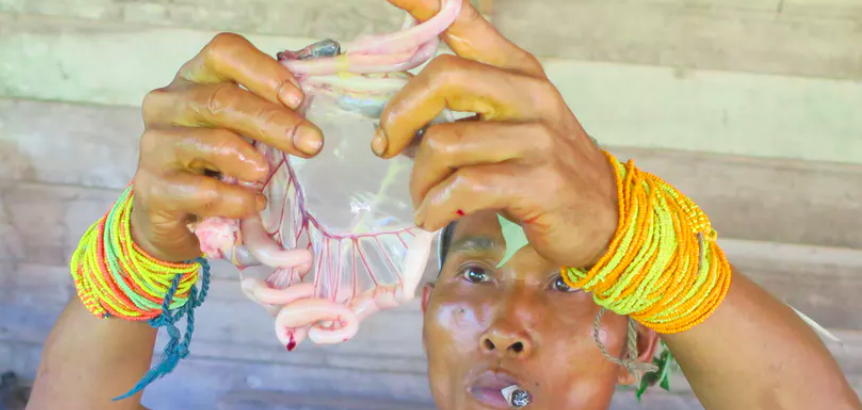
Examining chicken intestines, reading the tea leaves, watching the markets – people turn to experts for insight into the mysteries that surround them. Manvir Singh, CC BY-ND
Modern Shamans: Financial Managers, Political Pundits and Others Who Help Tame Life’s Uncertainty
Aka Manai explains that there are two kinds of people in the world: simata and sikerei.
I am a simata. He is a sikerei. Sikerei have undergone transformative experiences and emerged with new abilities: They alone can see spirits.
I’ve experienced a lot since that night in Indonesia when Aka Manai told me this. I was there when an initiate first saw spirits, when he and the other sikerei wept as they saw their dead fathers swirling around them. I’ve attended seven healing ceremonies, witnessing the slaughter of dozens of pigs to accompany nights of dancing. But that chat with kind-faced Aka Manai, more than any other experience, grounded my understanding of sikerei in particular and shamanism more generally.
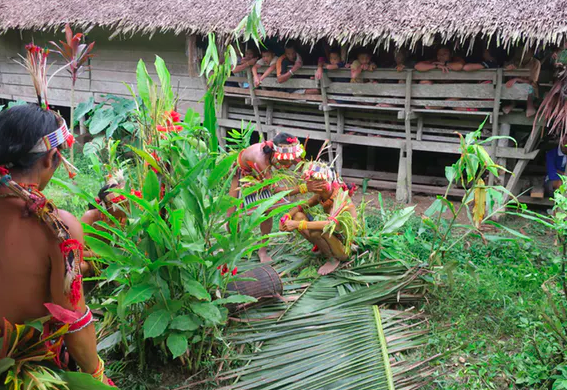
A sikerei treats an initiate’s eyes so he, too, can see spirits. Manvir Singh, CC BY-ND
I’m a cognitive anthropologist who studies why societies everywhere develop complex yet strikingly similar traditions, ranging from dance songs to justice to shamanism. And though trancing witch doctors may sound exotic to a Western reader, I argue that the same social and psychological pressures that give rise to healers like Aka Manai produce shaman-analogues in the contemporary, industrialized West.
What is a shaman?
Shamans, including the sikerei I’ve known in Indonesia, are service providers. They specialize in healing and divination, and their services can range from ending a drought to growing a business. Like all magical specialists, they rely on spells and occult gizmos, but what makes shamans special is that they use trance.
Trance is any foreign psychological state in which a practitioner is said to engage with the supernatural. Some trances involve complete immobilization; others appear as tongue-lolling convulsions. In some South American groups, shamans enter trance by snorting a hallucinogenic powder, transforming themselves into crawling, unintelligible spirit-beings.
Being a shaman often carries benefits, both because they get paid and because their special position grants them prestige and influence.
But these advantages are offset by the ordeals involved. In many societies, a wannabe initiate lacks credibility until he (and it’s usually a he) undergoes a near-death experience or a long bout of asceticism.
One aboriginal Australian shaman told ethnographers that, as a novice, he was killed by an older shaman who then replaced his organs with a new, magical set. When he woke up from the surgery and asked the old shaman if he was lost, the old man replied, “No, you are not lost; I killed you a long time ago.”
A long time ago, a short time ago, here, there – wherever you look, there are shamans. Manifesting as mediums, channelers, witch doctors and the prophets of religious movements, shamans have appeared in most human societies, including nearly all documented hunter-gatherers. They characterized the religious lives of ancestral humans and are often said to be the “first profession.”
Why are there shamans?
Why is it that when we lanky primates get together for long enough, our societies reliably give rise to trance-dancing healers?
According to anthropologist Michael Winkelman, the answer is wisdom. Drugs and drumming, he’s argued, link up brain regions that don’t normally communicate. This connection yields new insights, allowing shamans to do things like heal sickness and locate animals. By specializing in trance, shamans uncover solutions inaccessible to normal brains.
Based on my fieldwork, I’ve argued against Winkelman’s account. Rather than all integrating people’s psychologies, trance states are wildly diverse. Chanting, sipping psychoactive brews such as ayahuasca, dancing to the point of exhaustion, even smoking extreme quantities of tobacco – these methods produce profoundly different states. Some are arousing, others calming; some expand awareness, others induce repetitive thinking. In fact, the only element shared among these states is their exoticness – that once altered, the shaman’s experience stands apart from those of his onlookers.
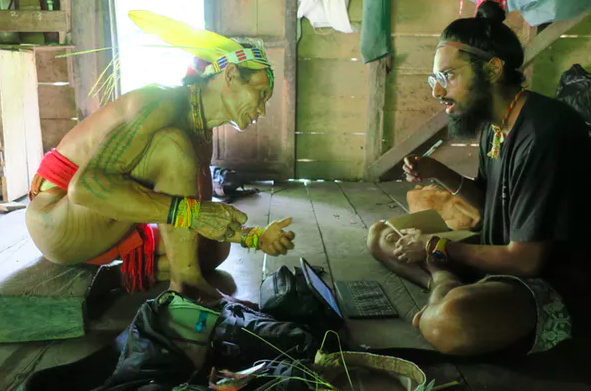
As part of his anthropological fieldwork, author Manvir Singh speaks with an Indonesian shaman. Luke Glowacki, CC BY-ND
Not only are shamans’ experiences exotic, their very beings are, too. As Aka Manai emphasized to me, people understand shamans to be different kinds of entities, made “other” by their ordeals. The Mentawai word for a non-shaman, simata, also describes uncooked food or unripe fruit; it implies immaturity. The word for shaman, in contrast, means a person who has undergone a process: one who has been kerei’d and come out the other side a sikerei.
This otherness is crucial. Convinced that shamans diverge from normal people, communities accept that they have superhuman abilities. Like Superman’s alien origins and the X-Men’s genetic mutations, shamans’ transformations assure people that they deviate from normal humanness, making their claims of supernatural engagement more believable.
And once people trust that a specialist engages with gods and spirits, they go to them when they need to influence uncertainty. A sick child’s parent or a farmer desperate for rain prefers to nudge the forces responsible for their hardship – and a shaman provides a compelling conduit for doing so.
This, I suggest, is why shamans recur around the world and across time. As specialists compete in markets for magic, they fuel the evolution of practices that hack people’s intuitions about magic and special abilities, convincing the rest of us that they can control uncertainty. Shamans are the culmination of this evolution. They use trance and initiations to transcend humanness, assuring their clients that they can commune with the invisible beings who oversee uncertain events.
Who are the shamans of the industrialized West?
Most people assume that shamanism has disappeared in the industrialized West – that it’s an ancient tradition of long-lost tribes, at most resurrected and corrupted by New Age xenophiles and overeager mystics.
To some extent, these people are right. Far fewer Westerners visit trance-practitioners to heal illness or call rain than people have elsewhere in the world or throughout history. But they’re also wrong. Like people everywhere, contemporary Westerners look to experts to achieve the impossible – to heal incurable illnesses, to forecast unknowable futures – and the experts, in turn, compete among themselves, performing to convince people of their special abilities.
So who are these modern shamans?

A specialist you can turn to for help divining the mysterious forces at work in financial markets. Matej Kastelic/Shutterstock.com
According to the cognitive scientist Samuel Johnson, financial money managers are likely candidates. Money managers fail to outperform the market – in fact, they even fail to systematically outperform each other – yet customers continue to pay them to divine future stock prices.
This faith might come from a belief of their fundamental otherness. Johnson points out that money managers emphasize their differences from clients, exhibiting extreme charisma and enduring superhuman work schedules. Managers also adorn themselves with advanced mathematical degrees and use complicated statistical models to predict the market. Although money managers don’t enter trance, their degrees and models assure clients that the specialists can peer into otherwise opaque forces.
Of course, money managers aren’t the only experts to specialize in the impossible. Psychics, sports analysts, political pundits, economic forecasters, esoteric healers and even an octopus similarly sate people’s desires to tame the uncertain. Like shamans and money managers, they decorate themselves with badges of credibility – an association with the White House, for example, or a familiarity with ancient Tibetan medicine – that persuade customers of their special abilities.
As long as hidden forces shape our fates, people will try to control them. And as long as it’s profitable, pseudo-experts will compete for desperate clients, dressing in the most credible and compelling costumes. Shamanism is not some arcane tradition restricted to an ancient past or New Age circles. It’s a near-inevitable consequence of our human intuitions about special abilities and our desire to control the uncertain, and elements of it appear everywhere.
MANVIR SINGH is a PhD Candidate in Human Evolutionary Biology at Harvard University.
THIS ARTICLE WAS ORIGINALLY PUBLISHED ON THE CONVERSATION
The Eerie History and Uncertain Future of Japan’s Rabbit Island
Ōkunoshima and its imperiled bunny population remind us that wildlife and tourism don’t always mix.

A cluster of bunnies on Rabbit Island. Cindy Pepper. CC BY-NC-ND 2.0
From its many “cat islands,” which boast more feline than human residents, to Jigokudani Monkey Park, where visitors can observe macaques bathing in the naturally occurring hot springs, Japan seems to overflow with fantastical wildlife enclaves. Perhaps the most adorable of all is Ōkunoshima, or “Rabbit Island”—but the cotton-tailed denizens for which this island is known belie its sinister past and ambiguous future.
While Ōkunoshima, located in the Hiroshima Prefecture, is a popular tourist destination for those looking to get their kawaii fix, it was once hidden from maps due to its clandestine status as a World War II military location. Production of chemical weapons in the island’s poison gas factory began in 1929, and apart from factory workers and army higher-ups, few citizens were aware of its existence.
Ōkunoshima was chosen for its location: discreet enough for goings-on there to remain under the radar, and far enough from densely populated cities like Tokyo to prevent mass casualties in case of an accident. The factory there eventually produced more than 6,000 tons of gas—primarily mustard gas and the irritant lewisite—before its closure at the end of the war. Chemicals wereould be shipped to Kitakyushu in the Fukuoka Prefecture to be weaponized, eventually resulting in more than 80,000 casualties (including and more than 6,000 deaths) among Chinese soldiers and civilians.
Despite the fact that Japan was a signatory to the 1929 Geneva Convention banning the use of chemical weapons, none of the country’s citizens were prosecuted for employing poison gas. After Japan’s defeat in the war, most of the Ōkunoshima factory was destroyed, but laboratory buildings, the shell of a power plant, an army barracks, and a few other edifices remain. In 1988, local governmental entities and citizens opened the Poison Gas Museum to pay tribute to this dark and little-known facet of Japanese history. Displays include the ineffective protective gear worn by workers at the factory, which left them vulnerable to exposure and subsequent illness, as well as equipment used to manufacture the gases.
So where did the bunnies enter the equation? We know that a colony of rabbits was brought to the factory during its operational years to test the effects of poisons, but beyond that, theories diverge. Some suggest that the original crop of rabbits was destroyed along with the factory, while others claim that workers set the bunnies free after the war. Another theory asserts that schoolchildren brought eight rabbits to the island in 1971, where they bred until they reached their current population of approximately 1,000.
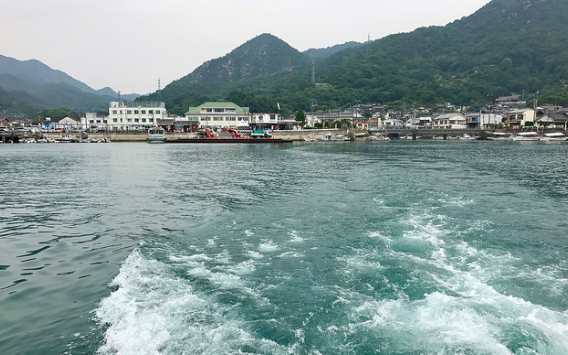
Tadanoumi Port viewed from the ferry to Ōkunoshima. Brian Shamblen. CC 2.0
Today, Ōkunoshima is easily accessible via a 15-minute ferry, and embodies peace, rest, and relaxation for tourists and locals alike. Visitors can easily explore it on foot (the island is less than 2.5 miles in circumference), collect souvenirs, dine, play tennis, swim in the ocean, and bathe in the hot spring—apart from communing with the wildlife, of course. Rabbit Island’s website describes it as a place to seek good fortune for your own family’s fertility, and advertises whipped ice cream and “original rabbit items” for sale, as well as octopus kelp rolls, a local delicacy known to pair well with sake.
Yet even the island’s thriving tourist industry and booming bunny population has a more sinister flip side. The wild rabbits depend on visitors for their food and water, but tourists often come bearing snacks that are harmful to the creatures’ delicate digestive systems—such as cabbage or vegetable peelings, which can cause fatal bloating. And while visitors are keen to share photos of their new fluffy friends online, social media has played a key role in destabilizing the rabbit population: Viral videos and articles have led to a vast influx of tourists in the past decade, and the resultant avalanche of snacks and treats has contributed to a breeding boom that the island’s ecosystem is unable to handle. These factors have combined to lower the bunnies’ life expectancy to only two years, compared to the three-to-five-year lifespan of the average wild rabbit.
The plight of the Ōkunoshima rabbits is just one example of the widespread harm social media has inflicted on wildlife populations across the globe: For instance, viral YouTube videos of slow lorises, wide-eyed nocturnal primates native to Southeast Asia, have led to people taking home lorises from the wild to keep as their own. Unfortunately, captivity is unhealthy for the animals, and they often end up relegated to props in tourist photos—or worse, sold into the illegal pet trade, and possibly slaughtered for use in cuisine or medicinals.

A curious bunny on Ōkunoshima seems to have mistaken the camera for a snack. Brian Shamblen. CC 2.0
Ultimately, bunny lovers need not be deterred from visiting Ōkunoshima, but following the rules is essential in order to treat the creatures kindly and foster their health and wellness. The Rabbit Island website lays out guidelines for responsible rabbit enthusiasts—including “refill water pans” and “check under your car,” as curious bunnies might hide underneath to escape the hot sun—and travelers can use their visit as an opportunity to educate friends and family about the unique perils posed to wildlife in the digital age. Approaching this mystical island mindfully is a small yet important step in helping the myriad diverse populations of the animal kingdom survive and thrive for many years to come.
TALYA PHELPS hails from the wilds of upstate New York, but dreams of exploring the globe. As former editor-in-chief at the student newspaper of her alma mater, Vassar College, and the daughter of a journalist, she hopes to follow her passion for writing and editing for many years to come. Contact her if you're looking for a spirited debate on the merits of the em dash vs. the hyphen.

VIDEO: Nepal Times
James Baker took this video to portray his adventures in the mystical land of Nepal. The video shows a cross-section through jungle, city, and mountains in Nepal.
In Japan, Repairing Buildings Without a Single Nail
In the past, making and developing metal was too costly for carpenters in Japan. So instead of using nails, carpenters called “miyadaiku” developed unique methods for interlocking pieces of wood together, similar to a giant 3D puzzle. Takahiro Matsumoto has been a miyadaiku carpenter for over 40 years. He runs his company in Kamakura, Japan, where he assesses and repairs damage sustained by the many ancient temples in his city. Using ancient techniques, he ensures that these spiritual structures stay standing for generations to come.
Cultivating Japan’s Rare White Strawberry
In Japan, there's a specialty fruit craze sweeping the nation, from square watermelons to grapes the size of Ping-Pong balls. Still, the crown jewel of the luxury fruit basket is the white strawberry, bred to be a whole lot bigger and a whole lot sweeter than its classic red counterpart. We took a tour of Yasuhito Teshima's farm in Karatsu, Japan, to find out why so many people are spending a pretty penny for a taste of these famous white berries.
An Island Disappears off the Coast of Japan
It remained unnoticed until local fishermen investigated.
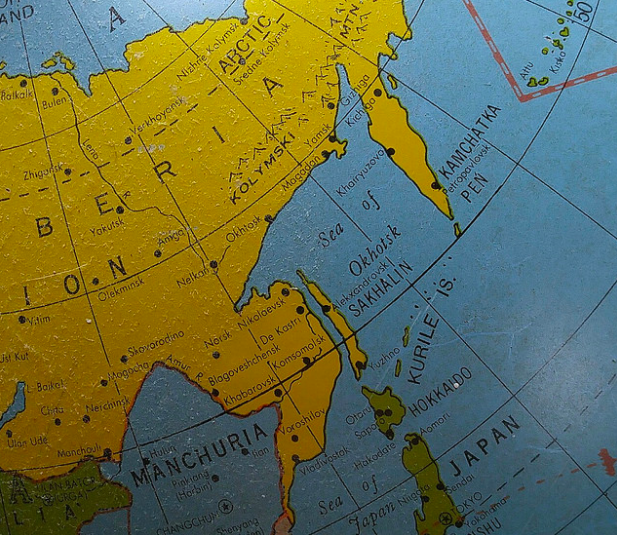
Vintage globe depicting the Sea of Okhotsk. Robin Ottawa. CC BY-SA 2.0
This fall, Esanbe Hamakita Kojima, a tiny island off the northeast coast of Japan dropped out of sight. The island’s disappearance went unnoticed by inhabitants of the nearby village of Sarufutsu, situated on the northern tip of Hokkaido island only 1,640 feet away.
It wasn’t until September, when author Hiroshi Shimizu traveled to Sarufutsu to gather inspiration for his picture book on Japan’s islands, that authorities were notified of the island’s disappearance. Shimizu had been looking for the island but couldn’t locate it. He informed local fisherman who went out to investigate and finally noted that Esanbe was missing.
When Japan’s Coast Guard last surveyed the island in 1987, it was only 4.5 feet above sea level. Authorities could not confirm how large the island had been before the sea rose around it.
Esanbe is west of Japan’s Northern Territories and part of a set of islands that has been long-contested between Japan and Russia. The islands, called the Kurils by Russia, were taken by the Soviets shortly after World War II, but ownership today remains unclear. According to CNN, Esanbe functions as a marker of Japanese ownership in contested waters. But the strategy of claiming islands to maintain the maritime space around them is not exclusive to Esanbe. In fact, according to the Washington Post, Japan owns 158 uninhabited islands that the country named in 2014 so that the sea surrounding them could remain in Japanese control.
Thus, the disappearance of the island may have a slight effect on Japan’s territorial waters, as according to international law, countries can only claim ownership of the sea around an island if that island is visible at high tide. Coast Guard officials in Japan confirmed that Esanbe’s loss, “may affect Japan's territorial waters a tiny bit.” With the island underwater, Japan will have lost approximately 1,640 feet of territorial water.
The island’s disappearance was likely due to erosion by the wind and drift ice common in the Sea of Okhotsk each winter. According to coast guard official Tomoo Fujii, “There is a possibility that the islet has been eroded by wind and snow and, as a result, disappeared,” Asahi Shimbun of the Japanese Daily reported.
According to the Smithsonian, disappearances of land masses in this area of Japan are not unlikely. The good news for Japan’s border, however, is that this phenomenon can occur in reverse. Five years ago, a 1000-foot long island rose out of the sea, prompted by a landslide.

EMMA BRUCE is an undergraduate student studying English and marketing at Emerson College in Boston. While not writing she explores the nearest museums, reads poetry, and takes classes at her local dance studio. She is passionate about sustainable travel and can't wait to see where life will take her.
Fighting to End Child Marriage in Lebanon
Ghassan Idriss knows firsthand the harmful effects of child marriage on society. Having married at a young age to a woman even younger than himself, Idriss and his wife faced struggles that so many other couples in his home country of Lebanon grapple with. Now, with three daughters of his own, Idriss is doing everything he can to educate those around him about the dangers of this antiquated institution. By hosting talks, he’s using his voice to spark change within his community.
In Tokyo, These Trains Jingle All the Way
While most train stations alert passengers with basic dings and dongs, metro riders in Japan are treated to uniquely crafted melodies. Minoru Mukaiya is the mastermind behind these jingles—he’s made around 200 distinct chimes for over 110 stations. For Minoru, there’s no greater joy than bringing a little bit of music to millions across Japan every day.
Heavy Metal Hijabis
The town of Garut in Western Java, Indonesia is a quiet place—that is, until Voice of Baceprot takes the stage. While most people in the town live tranquil, pastoral lives, teenagers Firdda, Widia and Euis thrash out and rock hard. The band has shot to fame for playing heavy metal in the religiously conservative country. After gaining popularity, VoB began to face criticism for performing while wearing hijabs. Still, they continue to shred—an inspiration for everyone with a little bit of music and a little bit of hardcore rebellion in their souls.
Tides of Change : Japan to Resume Commercial Whaling
For more than thirty years, the island nation of Japan has fought to expand its commercial whaling operations. That fight has mostly been a losing one, with its efforts often being blocked by anti-whaling countries around the world and condemned by the International Whaling Commission, an organization whose members include Japan itself. However, Japan’s recently proposed exit from the commission will allow the country to reclaim one of its most time-honored traditions, and the move is drawing international criticism.

Two Minke Whales being loaded onto the Nisshin Maru. The ship has facilities on board which allow it to freeze and process whales while at sea. Australian Customs and Border Protection Service. CC BY-SA 3.0
In 1982 the International Whaling Commission, or IWC, imposed a global moratorium on all commercial whaling, save for subsistence whaling by Aboriginal communities. The moratorium went into effect in 1985 and was met with opposition from Iceland, Norway, and Japan, countries with strong whaling traditions. In Japan, whale meat generally served the same purpose that beef or lamb served in Western societies and this was especially true during hard times. In the 1940s as the country was recovering from World War 2, whale meat was the single most consumed meat among Japanese people, and it remained so through the 1960s. After the announcement of the IWC’s whaling ban, Japan petitioned for the right to continue whaling in the Antarctic for “scientific purposes” though the specific nature of its research remained unclear. Whale activists claimed that this “research whaling” was in fact, commercial whaling in disguise, and vessels like the Nisshin Maru, Japan’s largest whaling vessel and the world's only factory whaling ship, became a frequent target of animals rights groups, with some going so far as to board vessels of their own and try to disrupt the Maru’s whaling expeditions by obstructing its path. Earlier this year, Japan expressed a desire to develop new ships, fast enough to outrun those of the activists, but the plan appears to have been scrapped, as the Japanese government announced in late December that it will formally withdraw from the IWC, discontinue its operations in the Antarctic and resume commercial whaling operations in its own coastal waters. Though the demand for whale meat has diminished somewhat in Japan, the practice of whale fishing is still considered by many to be intrinsic to the country’s cultural identity.
Environmental conservation hinges on the idea that some of the Earth’s resources are non-renewable. Humans can hunt an animal to extinction, and that extinction creates an imbalance in the ecosystem that the animal once belonged to. The effects of that imbalance can, in turn, come back to haunt humans, either directly or indirectly. These are, however, relatively young ideas, and pitting them against hundreds of years of tradition is sure to be a test for all parties involved.
JONATHAN ROBINSON is an intern at CATALYST. He is a travel enthusiast always adding new people, places, experiences to his story. He hopes to use writing as a means to connect with others like himself.


Genking, a male-born Japanese TV personality and ‘genderless’ pioneer. _genking_/Instagram
Japan’s Gender-Bending History
I’m an anthropologist who grew up in Japan and has lived there, off and on, for 22 years. Yet every visit to Tokyo’s Harajuku District still surprises me. In the eye-catching styles modeled by fashion-conscious young adults, there’s a kind of street theater, with crowded alleyways serving as catwalks for teenagers peacocking colorful, inventive outfits.
Boutiques are filled with cosmetics and beauty products intended for both males and females, and it’s often difficult to discern the gender of passersby. Since a gendered appearance (“feminine” or “masculine”) often (but not always) denotes the sex of a person, Japan’s recent “genderless” fashion styles might confuse some visitors – was that person who just walked by a woman or a man?
Although the gender-bending look appeals equally to young Japanese women and men, the media have tended to focus on the young men who wear makeup, color and coif their hair and model androgynous outfits. In interviews, these genderless males insist that they are neither trying to pass as women nor are they (necessarily) gay.
Some who document today’s genderless look in Japan tend to treat it as if it were a contemporary phenomenon. However, they conveniently ignore the long history in Japan of blurred sexualities and gender-bending practices.
Sex without sexuality
In premodern Japan, aristocrats often pursued male and female lovers; their sexual trysts were the stuff of classical literature. To them, the biological sex of their pursuits was often less important than the objective: transcendent beauty. And while many samurai and shoguns had a primary wife for the purposes of procreation and political alliances, they enjoyed numerous liaisons with younger male lovers.
Only after the formation of a modern army in the late-19th century were the sort of same-sex acts central to the samurai ethos discouraged. For a decade, from 1872 to 1882, sodomy among men was even criminalized. However, since then, there have been no laws in Japan banning homosexual relations.
It’s important to note that, until very recently, sexual acts in Japan were not linked to sexual identity. In other words, men who had sex with men and women who had sex with women did not consider themselves gay or lesbian. Sexual orientation was neither political nor politicized in Japan until recently, when a gay identity emerged in the context of HIV/AIDS activism in the 1990s. Today, there are annual gay pride parades in major cities like Tokyo and Osaka.
In Japan, same-sex relations among children and adolescents have long been thought of as a normal phase of development, even today. From a cultural standpoint, it’s frowned upon only when it interferes with marriage and preserving a family’s lineage. For this reason, many people will have same-sex relationships while they’re young, then get married and have kids. And some even later resume having same-sex relationships after fulfilling these social obligations.
Contentious cross-dressing
Like same-sex relationships, cross-dressing has a long history in Japan. The earliest written records date to the eighth century and include stories about women who dressed as warriors. In premodern Japan, there were also cases of women passing as men either to reject the prescribed confines of femininity or to find employment in trades dominated by men.
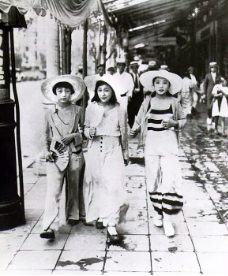
‘Modern girls’ (‘moga’) stroll along the Ginza, Japan’s Fifth Avenue, in 1928. Wikimedia Commons
A century ago, “modern girls” (moga) were young women who sported short hair and trousers. They attracted media attention – mostly negative – although artists depicted them as fashion icons. Some hecklers called them “garçons” (garuson), an insult implying unfeminine and unattractive.
Gender, at that time, was thought of in zero-sum terms: If females were becoming more masculine, it meant that males were becoming feminized.
These concerns made their way into the theater. For example, the all-female Takarazuka Revue was an avant-garde theater founded in 1913 (and is still very popular today). Females play the parts of men, which, in the early 20th century, sparked heated debates (that continue today) about “masculinized” women on stage – and how this might influence women off the stage.
However, today’s genderless males aren’t simply weekend cross-dressers. Instead, they want to shatter the existing norms that say men must dress and present themselves a certain way.
They ask: Why should only girls and women be able to wear skirts and dresses? Why should only women be able to wear lipstick and eye shadow? If women can wear pants, why shouldn’t men be able to wear skirts?
Actually, the adjective “genderless” is misleading, since these young men aren’t genderless at all; rather, they’re claiming both femininity and masculinity as styles they wear in their daily lives.
In this regard, these so-called genderless men have historical counterparts: In the late 19th and early 20th centuries, cosmopolitan “high collar” men (haikara) wore facial powder and carried scented handkerchiefs, paying meticulous attention to their Westernized appearances. One critic – invoking the zero-sum gender attitudes of the era – complained that “some men toil over their makeup more than women.” Conservative pundits derided the haikara as “effeminate” by virtue of their “un-Japanese” style.
On the other end of the masculinity spectrum were the nationalistic “primitive” men (bankara) who wore wooden clogs (geta) to complement their military-style school uniforms. Ironically, like their samurai predecessors – and unlike the foppish haikara – the macho bankara would engage in same-sex acts.
Japan’s ‘beautiful youths’
Probably the biggest contemporary inspiration for today’s genderless males are a spate of popular androgynous boy bands. Cultivated and promoted by Johnny & Associates Entertainment Company, Japan’s largest male talent agency, they include boy bands like SMAP, Johnny’s West and Sexy Zone.
Johnny’s West performs their song ‘Summer Dreamer.’
There’s a term for the type of teenage boy that Johnny & Associates cultivates: “beautiful youths” (bishōnen), which was coined a century ago to describe a young man whose ambiguous gender and sexual orientation appealed to females and males of all ages.
Similarly, Visual Kei is a 1980s glam-rock and punk music genre that features bishōnen performers who don flamboyant, gender-bending costumes and hairdos. In its new, 21st-century incarnation as Neo-Visual Kei, the emphasis on androgyny is even more pronounced, as epitomized by the prolific career of the androgynous Neo-Visual Kei pop star Gackt, who enjoys an international fan following.
Since the word “genderless” is misleading, a better term might be “gender-more,” in the sense that young men – especially in Tokyo – are insisting on the right to present and express themselves in ways that contradict and exceed traditional masculinity. In the long span of Japanese cultural history, there have been many things that were – and are – new under the sun. But genderless males aren’t among them.
JENNIFER ROBERTSON is a Professor of Anthropology and Art History at the University of Michigan.
THIS ARTICLE WAS ORIGINALLY PUBLISHED ON THE CONVERSATION
This Mega Kitchen Serves 40,000 People Each Day
With one of the largest kitchens in Asia, the Shri Saibaba temple in Shirdi, India, prepares, cooks and serves quantities of food that are nearly unimaginable. The kitchen dishes out as many as 40,000 meals per day, every day, all year long. It takes 600 people working in two daily shifts to prepare all this food. Yet despite all the effort, meals are free to the public. Why? The temple believes that those who are hungry deserve to be fed, and those who are thirsty deserve to be given a drink.
Mask off: How Beijing is Managing its Smog Problem
Earlier this month, California made national headlines when the worst wildfire in the state’s history covered parts of it in smoke, creating yet another worry for citizens already vexed by the high cost of living and rising homelessness. Some news stations, hoping to illustrate the seriousness of the matter, stressed that the air quality in California was “worse than Beijing’s,” an announcement that prompted many locals to don the air masks that one often sees in images of the Chinese capital. In media, locally, and abroad, Beijing has become synonymous with bad air. The internet is peppered with images of skyscrapers draped in brown or grey fog. But recent efforts by the government have made some headway in the battle with Beijing’s notorious smog and could give us insight into how to battle this problem at home.
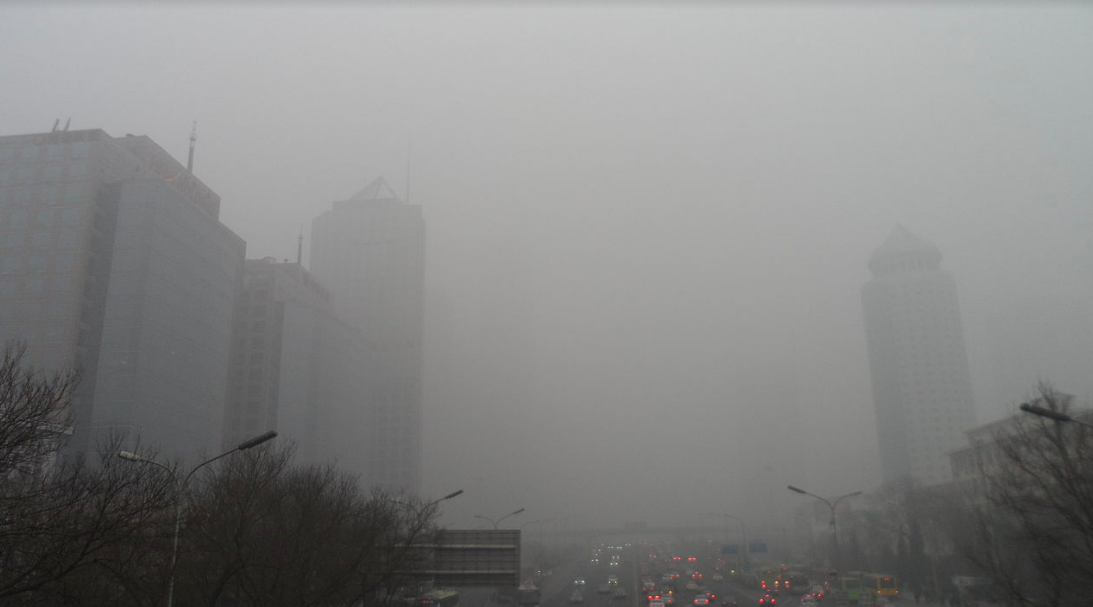
A smoggy day in Beijing. By 螺钉 - Own work, CC BY-SA 3.0, https://commons.wikimedia.org/w/index.php?curid=24944427
Those who have been to Beijing know that air quality is but one of many dangers; crossing an intersection can be like an action movie at times and drinking water out of the tap is generally a bad idea. Smog, however, is the issue most often associated with Beijing in the media. Fortunately, Beijing is aware of its reputation and has taken steps over the last few years to improve its air quality. The city has pledged to shut down 1000 manufacturing factories by 2020 to help reduce smog. It is also experimenting with new technology. Early last year Beijing employed the use a solar-powered air vacuum to help clean up the city’s air. Developed by Dutch designer Daan Roosegaarde, the Smog Free Tower sucks up 30,000 cubic meters of polluted air per hour. The air is then cleaned at a nano level and released back into the city. In a particularly bold move, Beijing's government is investigating the possibility of switching from coal to natural gas as the primary source of heating for millions of households. This shift will be implemented gradually, as concern for the well-being of Beijingers during the winter months supersedes the need for cleaner air.
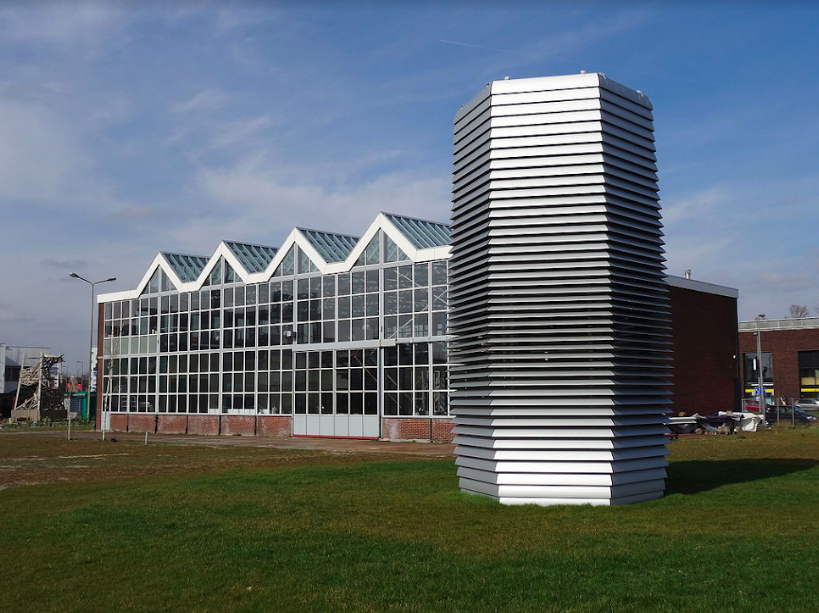
Dan Roosegaardes's Smog Free Tower. By Bic - Own work, CC BY-SA 4.0, https://commons.wikimedia.org/w/index.php?curid=47801218
People can change, and ideally, their reputations will change as well. Beijing’s efforts to clean its air shows an environmental consciousness that contradicts its reputation as a dirty industrialized city. As smog becomes a more recurrent issue in cities and courtiers around the world, communities that once judged China for its smog may get to learn a thing or two about how to fight it.
JONATHAN ROBINSON is an intern at CATALYST. He is a travel enthusiast always adding new people, places, experiences to his story. He hopes to use writing as a means to connect with others like himself.

Grappling with Sexism: Female Wrestlers in Mongolia
There’s an old legend in Mongolia: A woman wrestler once dressed up as a man and entered an all-male wrestling competition, defeating all challengers. She then pulled up her jacket and revealed her breasts, shocking everyone in attendance. From them on, all wrestlers were required to compete bare-chested, a failsafe to ensure that Mongolia’s prized “manly” tradition remained that way. While the legend may or may not be true, the practice of bare-chested wrestling in Mongolia is real, as is the practice of banning women from the sport. Despite achieving international fame in grappling, female Mongolian wrestlers are still unable to compete in their own native games.

Mongolian Wrestling. A. Omer Karamollaoglu. CC BY 2.0.
The Nadaam festival is held every year in July and is the single most anticipated sporting event in the country. Short for “Eriin Gurvan Naadam” (the three games of men), it is a celebration of the three traditional sports of Mongolia: wrestling, archery, and horseback riding. Nadaam dates back to the 13th century when Genghis Khan would throw celebrations for soldiers after successful military campaigns. After Kahn’s death, warlords continued the tradition, encouraging combat sports in order to prepare men for military service. Nadaam endured and developed throughout the centuries, and today, it is the Mongolian equivalent of the Super Bowl or World Cup. The games are typically held in July. Hundreds of small, county level events lead up to the main competition, which is held in the Mongolian capital of Ulaanbaatar. Wrestling is often featured as the centerpiece of the competition, and in Mongolian, is referred to as “Bokh,” which means “durability.”
Mongolia experienced a socialist revolution in 1921 that brought with it an emphasis on male-female equality and gradually these values led to women being allowed to compete in Nadaam, but only in archery and horse racing. To fill the void, female grapplers turned their attention to other grappling sports. Soronzonboldyn Battsetseg won a bronze medal for judo in the 2012 Olympics in London, while Sumiya Dorjsuren won a silver medal in judo in the 2016 Olympics and then went on to win gold in the World Judo Championships in 2017. Both women are national heroes in Mongolia, and yet, Nadaam remains closed to them.
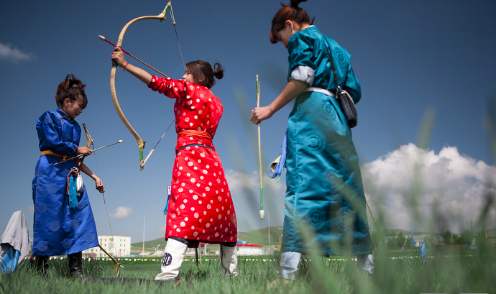
Female archers preparing for Nadaam. Taylor Weidman. CC BY SA-3.0.
The fact that a sport has to be guarded against an entire group people suggests a fear that these people could be competent in the sport. Like the wrestler in the old legend, women grapplers like Soronzonboldyn and Sumiya are barred from competing in Bokh, not because they aren't capable, but because they are. Judo is a widely recognized grappling sport, practiced by professional athletes, law enforcement officials, and ordinary citizens in literally every country on the planet. It would not be a stretch to assume that the grit and skill required to master Judo would translate well to Mongolian Bokh, and that the current barring of women from Bokh in Mongolia seems to be more about maintaining a status quo than anything else. When female grapplers will have a chance to challenge this standard is anyone’s guess.
JONATHAN ROBINSON is an intern at CATALYST. He is a travel enthusiast always adding new people, places, experiences to his story. He hopes to use writing as a means to connect with others like himself.

VIDEO: Hello Tokyo
This video was shot over a 5 day trip to Tokyo in January 2016. It was Christoph Gelep’s (videographer) first time visiting Japan, a place he had always wanted to see. With a population of 35 million, Tokyo is the largest metropolitan area in the world. Due to this, Christophe soon realized how lively and energetic this city really is.
Searching Japan's Ghost Island
Hashima (“battleship” in Japanese) Island is a 16-acre abandoned island about 10 miles off the coast of Nagasaki. With crumbling concrete buildings, abandoned undersea coal mines and a dramatic surrounding sea wall, the island is an eerie testament to Japan’s period of rapid industrialization. It is also a stark reminder of its dark history as a site of forced labor during World War II.
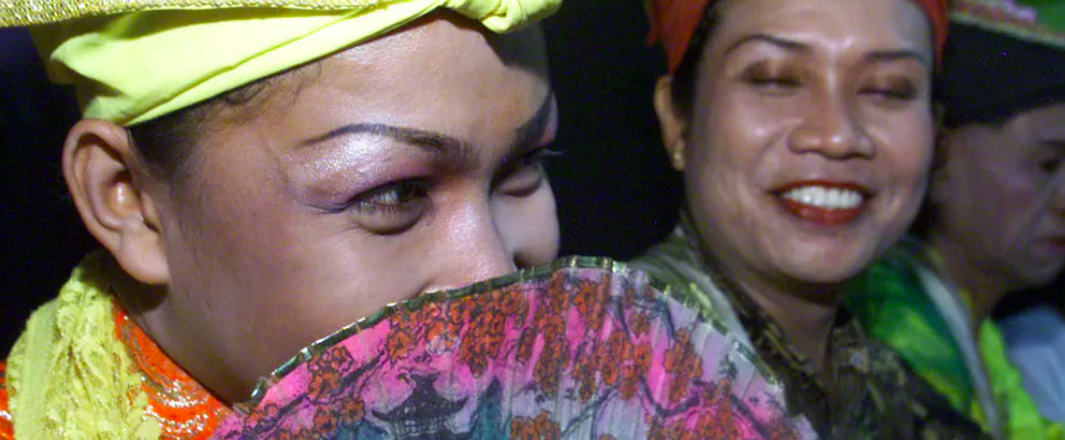

Bissu, or transgender priests, are one of five genders recognized by the Bugis. Reuters
What We Can Learn From an Indonesian Ethnicity that Recognizes Five Genders
On June 13, when a judge in Oregon allowed a person to legally choose neither sex and be classified as “nonbinary,” transgender activists rejoiced. It’s thought to be the first ruling of its kind in a country that, until now, has required that people mark “male” or “female” on official identity documents.
The small victory comes in the wake of a controversial new law in North Carolina that prevents transgender people from using public restrooms that do not match the sex on their birth certificates.
The conflict rooted in these recent policies is nothing new; for years, people have been asking questions about whether the “sex” we are born with should dictate things like which public facilities we can use, what to tick on our passport application and who’s eligible to play on particular sports teams.
But what if gender were viewed the same way sex researcher Alfred Kinsey famously depicted sexuality – as something along a sliding scale?
In fact, there’s an ethnic group in South Sulawesi, Indonesia – the Bugis – that views gender this way. For my Ph.D. research, I lived in South Sulawesi in the late 1990s to learn more about the Bugis’ various ways of understanding sex and gender. I eventually detailed these conceptualizations in my book “Gender Diversity in Indonesia.”
Does society dictate our gender?
For many thinkers, such as gender theorist Judith Butler, requiring everyone to choose between the “female” and “male” toilet is absurd because there is no such thing as sex to begin with.
According to this strain of thinking, sex doesn’t mean anything until we become engendered and start performing “sex” through our dress, our walk, our talk. In other words, having a penis means nothing before society starts telling you that if you have one you shouldn’t wear a skirt (well, unless it’s a kilt).
Nonetheless, most talk about sex as if everyone on the planet was born either female or male. Gender theorists like Butler would argue that humans are far too complex and diverse to enable all seven billion of us to be evenly split into one of two camps.
This comes across most clearly in how doctors treat children born with “indeterminate” sex (such as those born with androgen insensitivity syndrome, hypospadias or Klinefelter syndrome). In cases where a child’s sex is indeterminate, doctors used to simply measure the appendage to see if the clitoris was too long – and therefore, must be labeled a penis – or vice versa. Such moves arbitrarily forced a child under the umbrella of one sex or the other, rather than letting the child grow naturally with their body.
Gender on a spectrum
Perhaps a more useful way to think about sex is to see sex as a spectrum.
While all societies are highly and diversely gendered, with specific roles for women and men, there are also certain societies – or, at least, individuals within societies – who have nuanced understandings of the relationship between sex (our physical bodies), gender (what culture makes of those bodies) and sexuality (which kinds of bodies we desire).
Indonesia may be in the press for terror attacks and executions, but it’s actually a very tolerant country. In fact, Indonesia is the world’s fourth-largest democracy, and furthermore, unlike North Carolina, it currently has no anti-LGBT policy. Moreover, Indonesians can select “transgender” (waria) on their identity card (although given the recent, unprecedented wave of violence against LGBT people, this may change).
The Bugis are the largest ethnic group in South Sulawesi, numbering around three million people. Most Bugis are Muslim, but there are many pre-Islamic rituals that continue to be honored in Bugis culture, which include distinct views of gender and sexuality.
Their language offers five terms referencing various combinations of sex, gender and sexuality: makkunrai (“female women”), oroani (“male men”), calalai (“female men”), calabai (“male women”) and bissu (“transgender priests”). These definitions are not exact, but suffice.
During the early part of my Ph.D. research, I was talking with a man who, despite having no formal education, was a critical social thinker.
As I was puzzling about how Bugis might conceptualize sex, gender and sexuality, he pointed out to me that I was mistaken in thinking that there were just two discrete sexes, female and male. Rather, he told me that we are all on a spectrum:
Imagine someone is here at this end of a line and that they are, what would you call it, XX, and then you travel along this line until you get to the other end, and that’s XY. But along this line are all sorts of people with all sorts of different makeups and characters.
This spectrum of sex is a good way of thinking about the complexity and diversity of humans. When sex is viewed through this lens, North Carolina’s law prohibiting people from choosing which toilet they can use sounds arbitrary, forcing people to fit into spaces that might conflict with their identities.
SHARYN GRAHAM DAVIES is an Associate Professor of Social Sciences at Auckland University of Technology.
THIS ARTICLE WAS ORIGINALLY PUBLISHED ON THE CONVERSATION