
The town of Garut in Western Java, Indonesia is a quiet place—that is, until Voice of Baceprot takes the stage. While most people in the town live tranquil, pastoral lives, teenagers Firdda, Widia and Euis thrash out and rock hard. The band has shot to fame for playing heavy metal in the religiously conservative country. After gaining popularity, VoB began to face criticism for performing while wearing hijabs. Still, they continue to shred—an inspiration for everyone with a little bit of music and a little bit of hardcore rebellion in their souls.
Tides of Change : Japan to Resume Commercial Whaling
For more than thirty years, the island nation of Japan has fought to expand its commercial whaling operations. That fight has mostly been a losing one, with its efforts often being blocked by anti-whaling countries around the world and condemned by the International Whaling Commission, an organization whose members include Japan itself. However, Japan’s recently proposed exit from the commission will allow the country to reclaim one of its most time-honored traditions, and the move is drawing international criticism.

Two Minke Whales being loaded onto the Nisshin Maru. The ship has facilities on board which allow it to freeze and process whales while at sea. Australian Customs and Border Protection Service. CC BY-SA 3.0
In 1982 the International Whaling Commission, or IWC, imposed a global moratorium on all commercial whaling, save for subsistence whaling by Aboriginal communities. The moratorium went into effect in 1985 and was met with opposition from Iceland, Norway, and Japan, countries with strong whaling traditions. In Japan, whale meat generally served the same purpose that beef or lamb served in Western societies and this was especially true during hard times. In the 1940s as the country was recovering from World War 2, whale meat was the single most consumed meat among Japanese people, and it remained so through the 1960s. After the announcement of the IWC’s whaling ban, Japan petitioned for the right to continue whaling in the Antarctic for “scientific purposes” though the specific nature of its research remained unclear. Whale activists claimed that this “research whaling” was in fact, commercial whaling in disguise, and vessels like the Nisshin Maru, Japan’s largest whaling vessel and the world's only factory whaling ship, became a frequent target of animals rights groups, with some going so far as to board vessels of their own and try to disrupt the Maru’s whaling expeditions by obstructing its path. Earlier this year, Japan expressed a desire to develop new ships, fast enough to outrun those of the activists, but the plan appears to have been scrapped, as the Japanese government announced in late December that it will formally withdraw from the IWC, discontinue its operations in the Antarctic and resume commercial whaling operations in its own coastal waters. Though the demand for whale meat has diminished somewhat in Japan, the practice of whale fishing is still considered by many to be intrinsic to the country’s cultural identity.
Environmental conservation hinges on the idea that some of the Earth’s resources are non-renewable. Humans can hunt an animal to extinction, and that extinction creates an imbalance in the ecosystem that the animal once belonged to. The effects of that imbalance can, in turn, come back to haunt humans, either directly or indirectly. These are, however, relatively young ideas, and pitting them against hundreds of years of tradition is sure to be a test for all parties involved.
JONATHAN ROBINSON is an intern at CATALYST. He is a travel enthusiast always adding new people, places, experiences to his story. He hopes to use writing as a means to connect with others like himself.


Genking, a male-born Japanese TV personality and ‘genderless’ pioneer. _genking_/Instagram
Japan’s Gender-Bending History
I’m an anthropologist who grew up in Japan and has lived there, off and on, for 22 years. Yet every visit to Tokyo’s Harajuku District still surprises me. In the eye-catching styles modeled by fashion-conscious young adults, there’s a kind of street theater, with crowded alleyways serving as catwalks for teenagers peacocking colorful, inventive outfits.
Boutiques are filled with cosmetics and beauty products intended for both males and females, and it’s often difficult to discern the gender of passersby. Since a gendered appearance (“feminine” or “masculine”) often (but not always) denotes the sex of a person, Japan’s recent “genderless” fashion styles might confuse some visitors – was that person who just walked by a woman or a man?
Although the gender-bending look appeals equally to young Japanese women and men, the media have tended to focus on the young men who wear makeup, color and coif their hair and model androgynous outfits. In interviews, these genderless males insist that they are neither trying to pass as women nor are they (necessarily) gay.
Some who document today’s genderless look in Japan tend to treat it as if it were a contemporary phenomenon. However, they conveniently ignore the long history in Japan of blurred sexualities and gender-bending practices.
Sex without sexuality
In premodern Japan, aristocrats often pursued male and female lovers; their sexual trysts were the stuff of classical literature. To them, the biological sex of their pursuits was often less important than the objective: transcendent beauty. And while many samurai and shoguns had a primary wife for the purposes of procreation and political alliances, they enjoyed numerous liaisons with younger male lovers.
Only after the formation of a modern army in the late-19th century were the sort of same-sex acts central to the samurai ethos discouraged. For a decade, from 1872 to 1882, sodomy among men was even criminalized. However, since then, there have been no laws in Japan banning homosexual relations.
It’s important to note that, until very recently, sexual acts in Japan were not linked to sexual identity. In other words, men who had sex with men and women who had sex with women did not consider themselves gay or lesbian. Sexual orientation was neither political nor politicized in Japan until recently, when a gay identity emerged in the context of HIV/AIDS activism in the 1990s. Today, there are annual gay pride parades in major cities like Tokyo and Osaka.
In Japan, same-sex relations among children and adolescents have long been thought of as a normal phase of development, even today. From a cultural standpoint, it’s frowned upon only when it interferes with marriage and preserving a family’s lineage. For this reason, many people will have same-sex relationships while they’re young, then get married and have kids. And some even later resume having same-sex relationships after fulfilling these social obligations.
Contentious cross-dressing
Like same-sex relationships, cross-dressing has a long history in Japan. The earliest written records date to the eighth century and include stories about women who dressed as warriors. In premodern Japan, there were also cases of women passing as men either to reject the prescribed confines of femininity or to find employment in trades dominated by men.
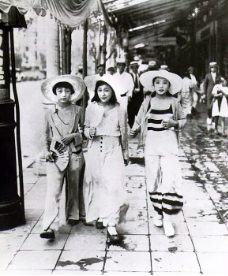
‘Modern girls’ (‘moga’) stroll along the Ginza, Japan’s Fifth Avenue, in 1928. Wikimedia Commons
A century ago, “modern girls” (moga) were young women who sported short hair and trousers. They attracted media attention – mostly negative – although artists depicted them as fashion icons. Some hecklers called them “garçons” (garuson), an insult implying unfeminine and unattractive.
Gender, at that time, was thought of in zero-sum terms: If females were becoming more masculine, it meant that males were becoming feminized.
These concerns made their way into the theater. For example, the all-female Takarazuka Revue was an avant-garde theater founded in 1913 (and is still very popular today). Females play the parts of men, which, in the early 20th century, sparked heated debates (that continue today) about “masculinized” women on stage – and how this might influence women off the stage.
However, today’s genderless males aren’t simply weekend cross-dressers. Instead, they want to shatter the existing norms that say men must dress and present themselves a certain way.
They ask: Why should only girls and women be able to wear skirts and dresses? Why should only women be able to wear lipstick and eye shadow? If women can wear pants, why shouldn’t men be able to wear skirts?
Actually, the adjective “genderless” is misleading, since these young men aren’t genderless at all; rather, they’re claiming both femininity and masculinity as styles they wear in their daily lives.
In this regard, these so-called genderless men have historical counterparts: In the late 19th and early 20th centuries, cosmopolitan “high collar” men (haikara) wore facial powder and carried scented handkerchiefs, paying meticulous attention to their Westernized appearances. One critic – invoking the zero-sum gender attitudes of the era – complained that “some men toil over their makeup more than women.” Conservative pundits derided the haikara as “effeminate” by virtue of their “un-Japanese” style.
On the other end of the masculinity spectrum were the nationalistic “primitive” men (bankara) who wore wooden clogs (geta) to complement their military-style school uniforms. Ironically, like their samurai predecessors – and unlike the foppish haikara – the macho bankara would engage in same-sex acts.
Japan’s ‘beautiful youths’
Probably the biggest contemporary inspiration for today’s genderless males are a spate of popular androgynous boy bands. Cultivated and promoted by Johnny & Associates Entertainment Company, Japan’s largest male talent agency, they include boy bands like SMAP, Johnny’s West and Sexy Zone.
Johnny’s West performs their song ‘Summer Dreamer.’
There’s a term for the type of teenage boy that Johnny & Associates cultivates: “beautiful youths” (bishōnen), which was coined a century ago to describe a young man whose ambiguous gender and sexual orientation appealed to females and males of all ages.
Similarly, Visual Kei is a 1980s glam-rock and punk music genre that features bishōnen performers who don flamboyant, gender-bending costumes and hairdos. In its new, 21st-century incarnation as Neo-Visual Kei, the emphasis on androgyny is even more pronounced, as epitomized by the prolific career of the androgynous Neo-Visual Kei pop star Gackt, who enjoys an international fan following.
Since the word “genderless” is misleading, a better term might be “gender-more,” in the sense that young men – especially in Tokyo – are insisting on the right to present and express themselves in ways that contradict and exceed traditional masculinity. In the long span of Japanese cultural history, there have been many things that were – and are – new under the sun. But genderless males aren’t among them.
JENNIFER ROBERTSON is a Professor of Anthropology and Art History at the University of Michigan.
THIS ARTICLE WAS ORIGINALLY PUBLISHED ON THE CONVERSATION
This Mega Kitchen Serves 40,000 People Each Day
With one of the largest kitchens in Asia, the Shri Saibaba temple in Shirdi, India, prepares, cooks and serves quantities of food that are nearly unimaginable. The kitchen dishes out as many as 40,000 meals per day, every day, all year long. It takes 600 people working in two daily shifts to prepare all this food. Yet despite all the effort, meals are free to the public. Why? The temple believes that those who are hungry deserve to be fed, and those who are thirsty deserve to be given a drink.
Mask off: How Beijing is Managing its Smog Problem
Earlier this month, California made national headlines when the worst wildfire in the state’s history covered parts of it in smoke, creating yet another worry for citizens already vexed by the high cost of living and rising homelessness. Some news stations, hoping to illustrate the seriousness of the matter, stressed that the air quality in California was “worse than Beijing’s,” an announcement that prompted many locals to don the air masks that one often sees in images of the Chinese capital. In media, locally, and abroad, Beijing has become synonymous with bad air. The internet is peppered with images of skyscrapers draped in brown or grey fog. But recent efforts by the government have made some headway in the battle with Beijing’s notorious smog and could give us insight into how to battle this problem at home.
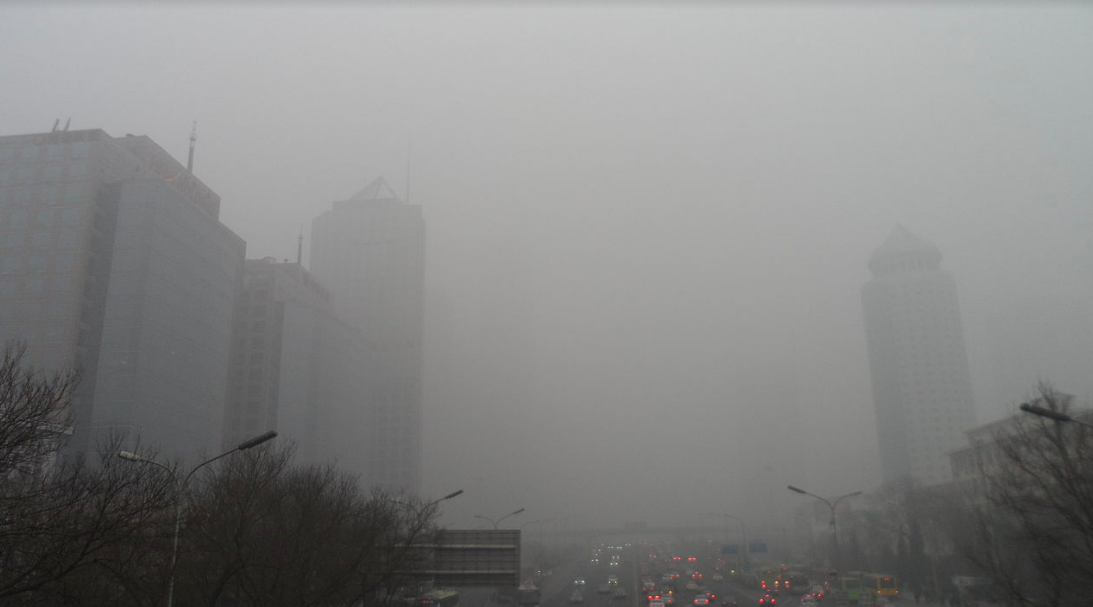
A smoggy day in Beijing. By 螺钉 - Own work, CC BY-SA 3.0, https://commons.wikimedia.org/w/index.php?curid=24944427
Those who have been to Beijing know that air quality is but one of many dangers; crossing an intersection can be like an action movie at times and drinking water out of the tap is generally a bad idea. Smog, however, is the issue most often associated with Beijing in the media. Fortunately, Beijing is aware of its reputation and has taken steps over the last few years to improve its air quality. The city has pledged to shut down 1000 manufacturing factories by 2020 to help reduce smog. It is also experimenting with new technology. Early last year Beijing employed the use a solar-powered air vacuum to help clean up the city’s air. Developed by Dutch designer Daan Roosegaarde, the Smog Free Tower sucks up 30,000 cubic meters of polluted air per hour. The air is then cleaned at a nano level and released back into the city. In a particularly bold move, Beijing's government is investigating the possibility of switching from coal to natural gas as the primary source of heating for millions of households. This shift will be implemented gradually, as concern for the well-being of Beijingers during the winter months supersedes the need for cleaner air.
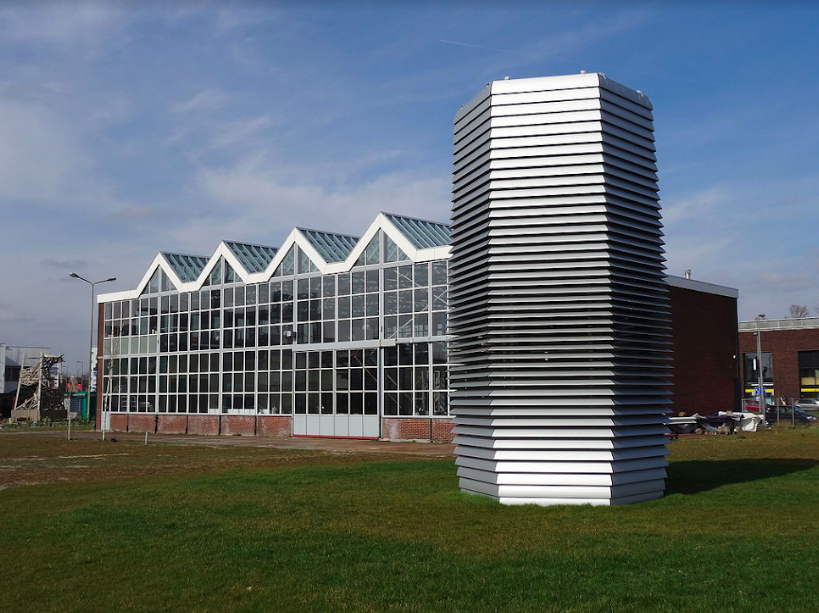
Dan Roosegaardes's Smog Free Tower. By Bic - Own work, CC BY-SA 4.0, https://commons.wikimedia.org/w/index.php?curid=47801218
People can change, and ideally, their reputations will change as well. Beijing’s efforts to clean its air shows an environmental consciousness that contradicts its reputation as a dirty industrialized city. As smog becomes a more recurrent issue in cities and courtiers around the world, communities that once judged China for its smog may get to learn a thing or two about how to fight it.
JONATHAN ROBINSON is an intern at CATALYST. He is a travel enthusiast always adding new people, places, experiences to his story. He hopes to use writing as a means to connect with others like himself.

Grappling with Sexism: Female Wrestlers in Mongolia
There’s an old legend in Mongolia: A woman wrestler once dressed up as a man and entered an all-male wrestling competition, defeating all challengers. She then pulled up her jacket and revealed her breasts, shocking everyone in attendance. From them on, all wrestlers were required to compete bare-chested, a failsafe to ensure that Mongolia’s prized “manly” tradition remained that way. While the legend may or may not be true, the practice of bare-chested wrestling in Mongolia is real, as is the practice of banning women from the sport. Despite achieving international fame in grappling, female Mongolian wrestlers are still unable to compete in their own native games.
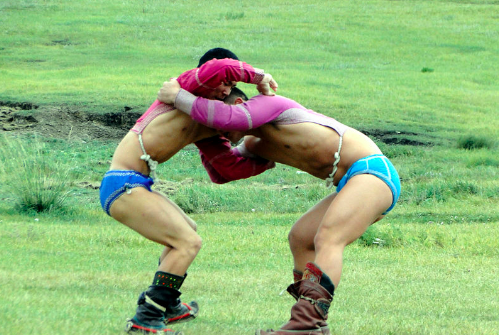
Mongolian Wrestling. A. Omer Karamollaoglu. CC BY 2.0.
The Nadaam festival is held every year in July and is the single most anticipated sporting event in the country. Short for “Eriin Gurvan Naadam” (the three games of men), it is a celebration of the three traditional sports of Mongolia: wrestling, archery, and horseback riding. Nadaam dates back to the 13th century when Genghis Khan would throw celebrations for soldiers after successful military campaigns. After Kahn’s death, warlords continued the tradition, encouraging combat sports in order to prepare men for military service. Nadaam endured and developed throughout the centuries, and today, it is the Mongolian equivalent of the Super Bowl or World Cup. The games are typically held in July. Hundreds of small, county level events lead up to the main competition, which is held in the Mongolian capital of Ulaanbaatar. Wrestling is often featured as the centerpiece of the competition, and in Mongolian, is referred to as “Bokh,” which means “durability.”
Mongolia experienced a socialist revolution in 1921 that brought with it an emphasis on male-female equality and gradually these values led to women being allowed to compete in Nadaam, but only in archery and horse racing. To fill the void, female grapplers turned their attention to other grappling sports. Soronzonboldyn Battsetseg won a bronze medal for judo in the 2012 Olympics in London, while Sumiya Dorjsuren won a silver medal in judo in the 2016 Olympics and then went on to win gold in the World Judo Championships in 2017. Both women are national heroes in Mongolia, and yet, Nadaam remains closed to them.
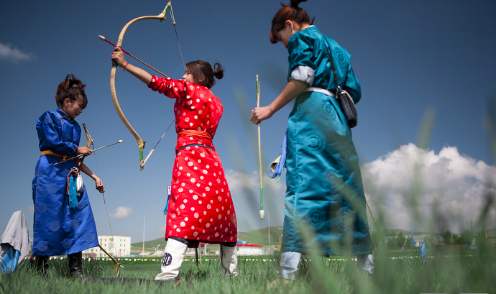
Female archers preparing for Nadaam. Taylor Weidman. CC BY SA-3.0.
The fact that a sport has to be guarded against an entire group people suggests a fear that these people could be competent in the sport. Like the wrestler in the old legend, women grapplers like Soronzonboldyn and Sumiya are barred from competing in Bokh, not because they aren't capable, but because they are. Judo is a widely recognized grappling sport, practiced by professional athletes, law enforcement officials, and ordinary citizens in literally every country on the planet. It would not be a stretch to assume that the grit and skill required to master Judo would translate well to Mongolian Bokh, and that the current barring of women from Bokh in Mongolia seems to be more about maintaining a status quo than anything else. When female grapplers will have a chance to challenge this standard is anyone’s guess.
JONATHAN ROBINSON is an intern at CATALYST. He is a travel enthusiast always adding new people, places, experiences to his story. He hopes to use writing as a means to connect with others like himself.

VIDEO: Hello Tokyo
This video was shot over a 5 day trip to Tokyo in January 2016. It was Christoph Gelep’s (videographer) first time visiting Japan, a place he had always wanted to see. With a population of 35 million, Tokyo is the largest metropolitan area in the world. Due to this, Christophe soon realized how lively and energetic this city really is.
Searching Japan's Ghost Island
Hashima (“battleship” in Japanese) Island is a 16-acre abandoned island about 10 miles off the coast of Nagasaki. With crumbling concrete buildings, abandoned undersea coal mines and a dramatic surrounding sea wall, the island is an eerie testament to Japan’s period of rapid industrialization. It is also a stark reminder of its dark history as a site of forced labor during World War II.
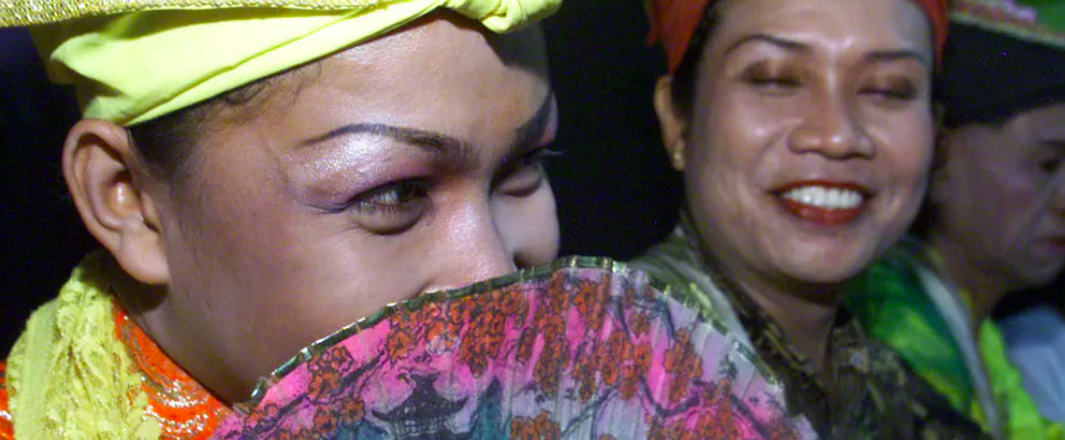
Bissu, or transgender priests, are one of five genders recognized by the Bugis. Reuters
What We Can Learn From an Indonesian Ethnicity that Recognizes Five Genders
On June 13, when a judge in Oregon allowed a person to legally choose neither sex and be classified as “nonbinary,” transgender activists rejoiced. It’s thought to be the first ruling of its kind in a country that, until now, has required that people mark “male” or “female” on official identity documents.
The small victory comes in the wake of a controversial new law in North Carolina that prevents transgender people from using public restrooms that do not match the sex on their birth certificates.
The conflict rooted in these recent policies is nothing new; for years, people have been asking questions about whether the “sex” we are born with should dictate things like which public facilities we can use, what to tick on our passport application and who’s eligible to play on particular sports teams.
But what if gender were viewed the same way sex researcher Alfred Kinsey famously depicted sexuality – as something along a sliding scale?
In fact, there’s an ethnic group in South Sulawesi, Indonesia – the Bugis – that views gender this way. For my Ph.D. research, I lived in South Sulawesi in the late 1990s to learn more about the Bugis’ various ways of understanding sex and gender. I eventually detailed these conceptualizations in my book “Gender Diversity in Indonesia.”
Does society dictate our gender?
For many thinkers, such as gender theorist Judith Butler, requiring everyone to choose between the “female” and “male” toilet is absurd because there is no such thing as sex to begin with.
According to this strain of thinking, sex doesn’t mean anything until we become engendered and start performing “sex” through our dress, our walk, our talk. In other words, having a penis means nothing before society starts telling you that if you have one you shouldn’t wear a skirt (well, unless it’s a kilt).
Nonetheless, most talk about sex as if everyone on the planet was born either female or male. Gender theorists like Butler would argue that humans are far too complex and diverse to enable all seven billion of us to be evenly split into one of two camps.
This comes across most clearly in how doctors treat children born with “indeterminate” sex (such as those born with androgen insensitivity syndrome, hypospadias or Klinefelter syndrome). In cases where a child’s sex is indeterminate, doctors used to simply measure the appendage to see if the clitoris was too long – and therefore, must be labeled a penis – or vice versa. Such moves arbitrarily forced a child under the umbrella of one sex or the other, rather than letting the child grow naturally with their body.
Gender on a spectrum
Perhaps a more useful way to think about sex is to see sex as a spectrum.
While all societies are highly and diversely gendered, with specific roles for women and men, there are also certain societies – or, at least, individuals within societies – who have nuanced understandings of the relationship between sex (our physical bodies), gender (what culture makes of those bodies) and sexuality (which kinds of bodies we desire).
Indonesia may be in the press for terror attacks and executions, but it’s actually a very tolerant country. In fact, Indonesia is the world’s fourth-largest democracy, and furthermore, unlike North Carolina, it currently has no anti-LGBT policy. Moreover, Indonesians can select “transgender” (waria) on their identity card (although given the recent, unprecedented wave of violence against LGBT people, this may change).
The Bugis are the largest ethnic group in South Sulawesi, numbering around three million people. Most Bugis are Muslim, but there are many pre-Islamic rituals that continue to be honored in Bugis culture, which include distinct views of gender and sexuality.
Their language offers five terms referencing various combinations of sex, gender and sexuality: makkunrai (“female women”), oroani (“male men”), calalai (“female men”), calabai (“male women”) and bissu (“transgender priests”). These definitions are not exact, but suffice.
During the early part of my Ph.D. research, I was talking with a man who, despite having no formal education, was a critical social thinker.
As I was puzzling about how Bugis might conceptualize sex, gender and sexuality, he pointed out to me that I was mistaken in thinking that there were just two discrete sexes, female and male. Rather, he told me that we are all on a spectrum:
Imagine someone is here at this end of a line and that they are, what would you call it, XX, and then you travel along this line until you get to the other end, and that’s XY. But along this line are all sorts of people with all sorts of different makeups and characters.
This spectrum of sex is a good way of thinking about the complexity and diversity of humans. When sex is viewed through this lens, North Carolina’s law prohibiting people from choosing which toilet they can use sounds arbitrary, forcing people to fit into spaces that might conflict with their identities.
SHARYN GRAHAM DAVIES is an Associate Professor of Social Sciences at Auckland University of Technology.
THIS ARTICLE WAS ORIGINALLY PUBLISHED ON THE CONVERSATION
Japan’s Town With No Waste
The village of Kamikatsu in Japan has taken their commitment to sustainability to a new level. While the rest of the country has a recycling rate of around 20 percent, Kamikatsu surpasses its neighbors with a staggering 80 percent. After becoming aware of the dangers of carbon monoxide associated with burning garbage, the town instated the Zero Waste Declaration with the goal of being completely waste-free by 2020.
Bringing Indonesian Cuisine to New York, One Table at a Time
Every Tuesday, Indo Java in Queens, New York, turns into the hottest spot in town for traditional Indonesian cuisine. And the best part? You’re always guaranteed the best seat in the house. With only one table, Warung Selasa is one of the smallest restaurants in the city, located inside a tiny, two-aisle grocery store. Owned and operated by Dewi Tjahjadi, Warung Selasa has been spreading the flavors of Indonesia in Queens for the past 10 years.
Tokyo: Random Access Memories
This short film features random shots of Tokyo, offering an artistic perspective of this non-stop city. Shot and edited by Junwoo Lee.
MONGOLIA: In Search of Warriors
LIKE ALL WORTHY QUESTS, MY FASCINATION WITH MONGOLIA BEGINS WITH A STORY. A STORY THAT TURNS ITSELF LIKE POLISHED STONE WITHIN MY FINGERS.
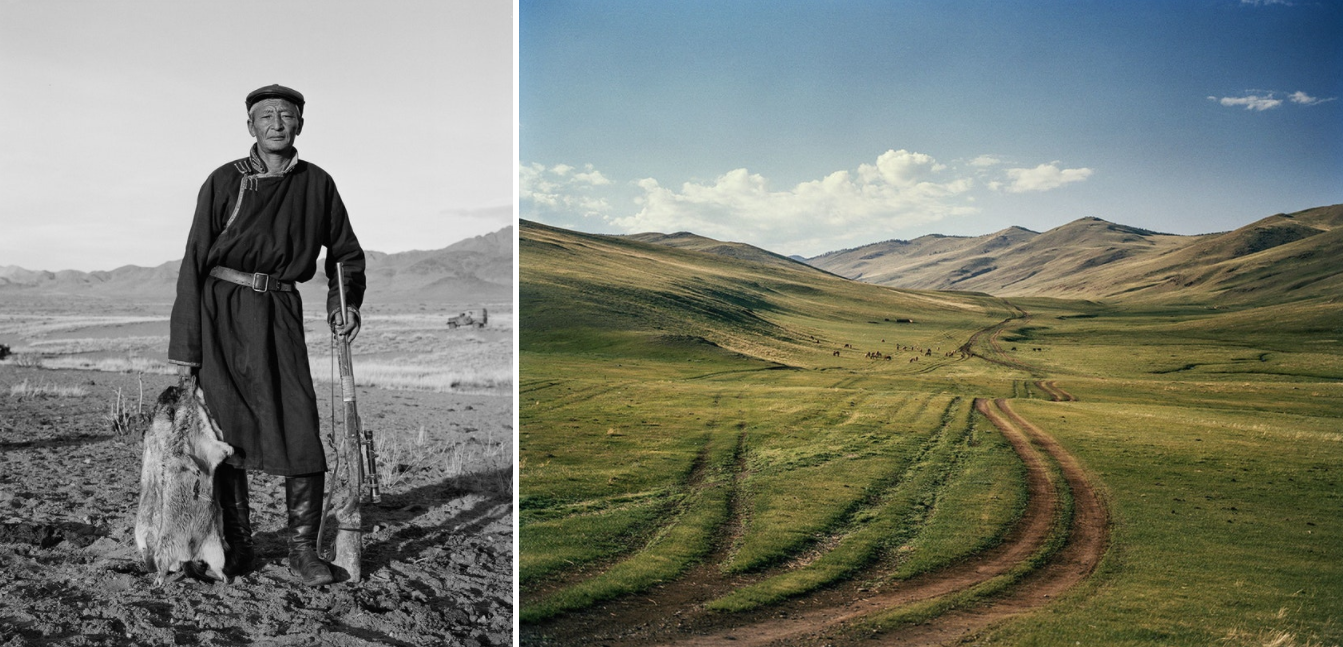
A hunter, old rifle by his side, returns with a few marmots, highly prized delicacies throughout the Mongolian countryside. / A simple road, common in Mongolia, calls to mind this native proverb, “If you endeavour, the fate will favour you.”
This is a tale I have replayed so often since childhood, that when I close my eyes, the characters appear, fully defined, as if I could touch them. At the center is my grandfather, Louis, a young French soldier fighting in World War II. I see him then in black and white, even though when he sat me on his knee, decades later, to tell his story, he was colorful in every way imaginable. It was as if my grandfather had grown up through a period of time when everything existed only in shades of black and grey, as if the entire world with its violence and scarcity had the color sucked right out of it.

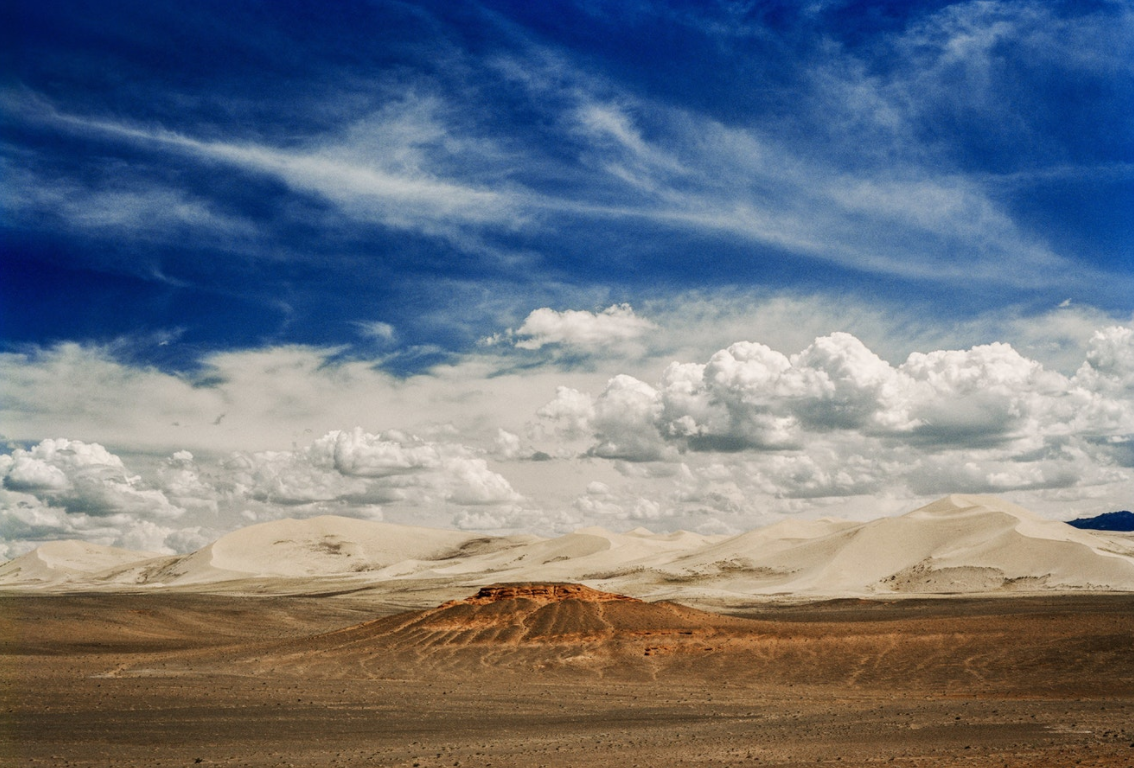
Aerial view of Khvod (Ховд), blanketed by snow, in western Mongolia. / Immense landscapes on a 3,200 km drive through eastern Mongolia.
But then he would tell the part about the Mongol army. About how he was captured and sent to a German prison camp with British, American, and French soldiers. How the camp was eventually liberated, late in 1944, by a small and mighty troop fighting alongside the Allies against the Germans. They were the Mongolian People’s Army, established as a secondary army under Soviet command. As a young child, to hear my grandfather tell it, these liberators loomed large in vibrant, audacious color, a brilliant contrast to the stark landscape that surrounded them all.
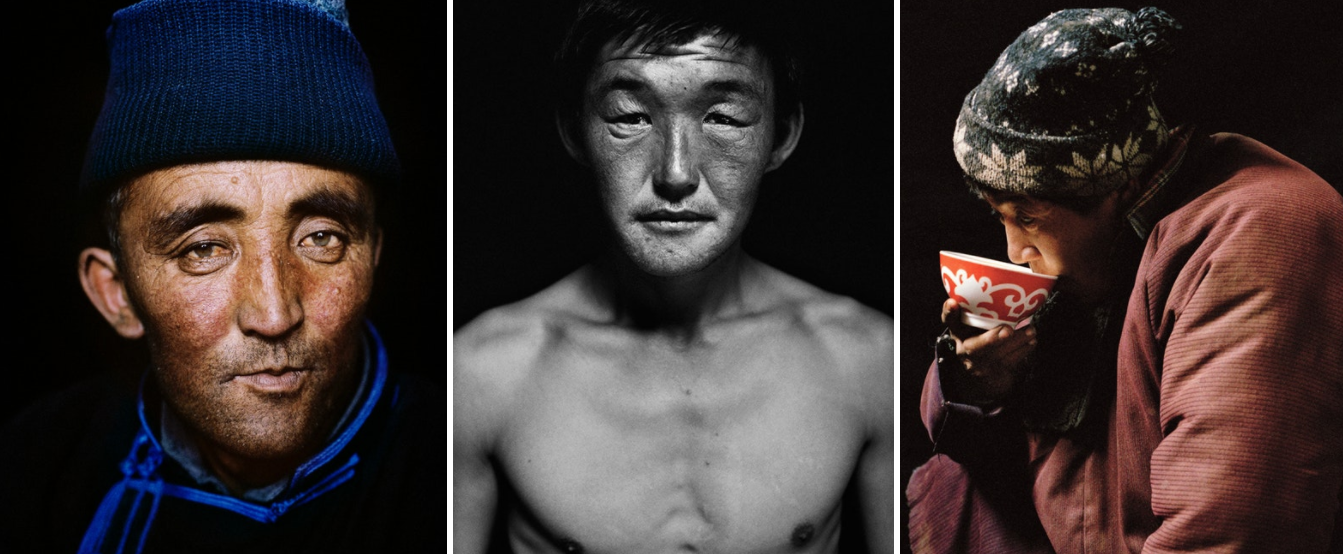
Herders from Ulaangom (Улаангом), the “Red Valley”. / Drinking Mongol tea, made with mare’s milk and salt, at Üüreg Lake (Үүрэг нуур).
I was seven or eight years old when my grandfather would tell me this story, and I remember the grin on his face and the tears in his eyes as he told his tale: “The Mongol army charged the prison and the Germans were scared to death at the sight of them. Never before had anyone seen a people like this. They were fierce and the Germans ran away. They ran for their lives.” He told me that afterwards the freed soldiers and the Mongols kept hugging one other and celebrated long into the night.
This is how my grandfather’s life was saved.
As a young boy this account had a massive impact on me. That mysterious Mongol Army of men who saved my grandfather’s life; they saved my life.

A young rider bathes with his horse at Buir Lake (Буйр Нуур). Mongolians call wild horses “takhi,” which means “spirit,” and horses are profoundly important to them. They believe that one rides to the afterlife on a horse.
Mongolia.
THE NAME HAS ALWAYS LINGERED IN MY MIND AS A COUNTRY WITH A MYTHICAL CONNOTATION.
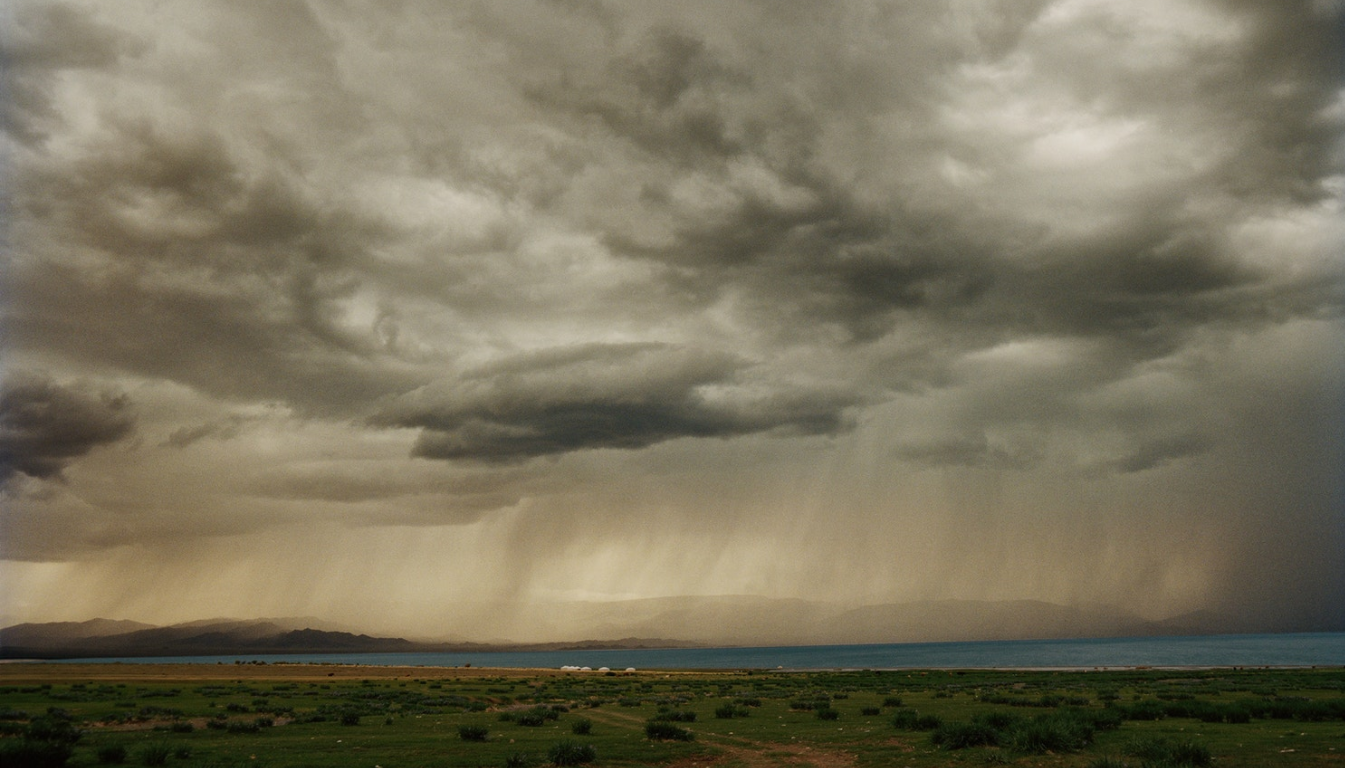
Illuminated bands of rain sweep towards a group of “ger” or yurts, huddled on the shores of Üüreg Lake (Үүрэг нуур) in western Mongolia.
When I got older, I worked as a photo assistant to a high-end fashion photographer in New York, learning the craft and saving a bit of money. For three years I was absorbed in that world of fashion, which was very glamorous and comfortable, but I was most attracted by the travel and began to long for more. At some point, I determined to go to Mongolia and see the place with my own eyes. In the summer of 2001, I took a month and set off.
While I brought my cameras on that first trip, a bit of equipment and film, I was mostly thrilled to put the experience of traveling first. This journey was more a pilgrimage. I have since returned almost annually for fifteen years, driven by a desire to capture the majesty and serene nature of the Mongolian landscape and inhabitants through my photography. At first I sought to discover the country of my imagination, but with every trip, my relationship with the land and its people deepened and became my own.

Timeless reflection. Surrounded by deserted, low mountains, Tolbo Lake (Толбо Нуур) in western Mongolia. / Stopping for tea, our hosts were caring for their grandchildren. Their nomadic home was quite rustic with carpets for side panels, a long-gone style rarely seen today.
“Even when quite a child I felt two conflicting sensations in my heart: the horror of life and the ecstasy of life.” — Baudelaire, Intimate Journals
On that first trip to Mongolia in 2001, I took a photograph of a mother and her infant son at their home on the shores of Üüreg lake, in the western part of the country. I traveled with an easy to pack, black piece of fabric. The light in this country is so beautiful and the fabric was capable of diffusing it to great effect, especially when shooting portraits of people.
Five years later, in 2006, I returned to the region where this family had once resided and sought them out. I often make small prints for the people I photograph and, if lucky enough to see them again, I like to give them as gifts. People in Mongolia, especially in the countryside, live great distances from each other and do not typically have access to this type of technology. I asked my guide to help me find this particular family as most in this area tend to be nomadic and the surroundings are constantly changing. We drove around the area asking people if they knew where we might locate them. Eventually, someone recognized the family and showed us the way.
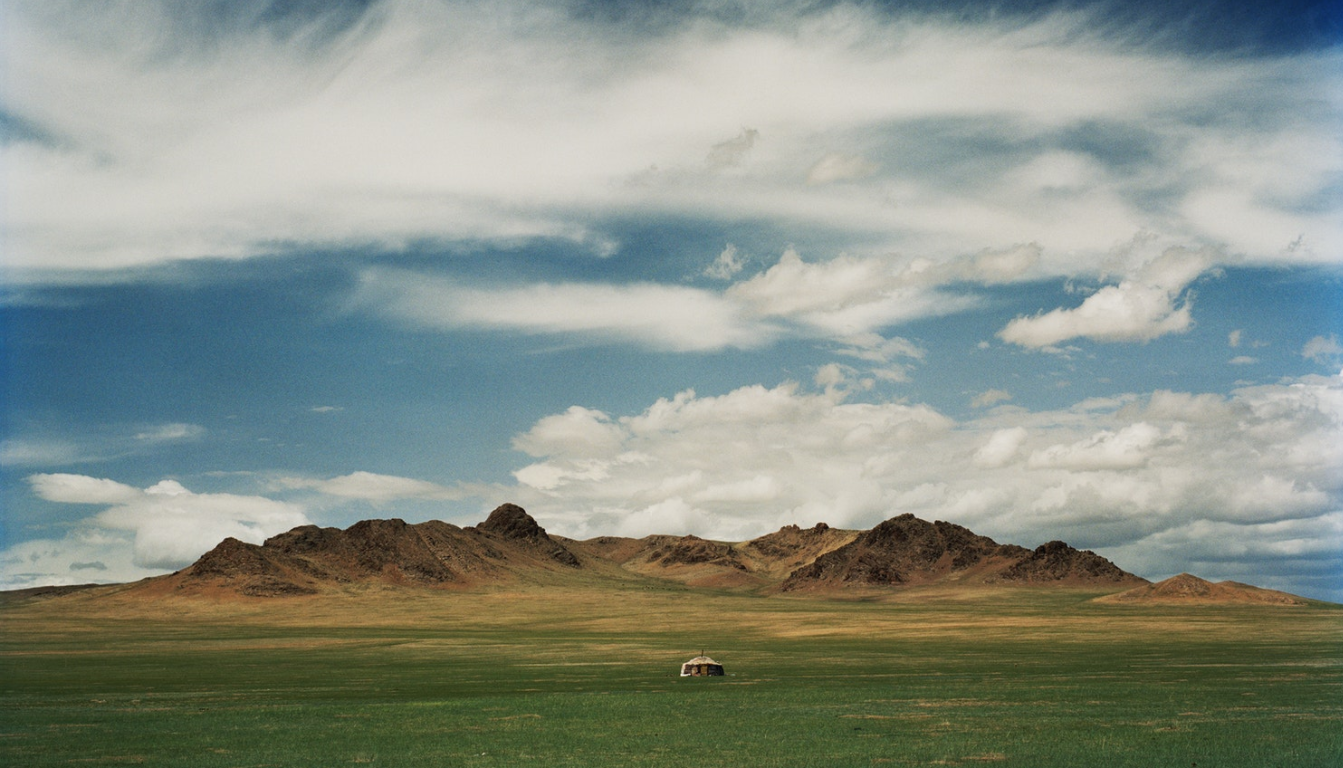
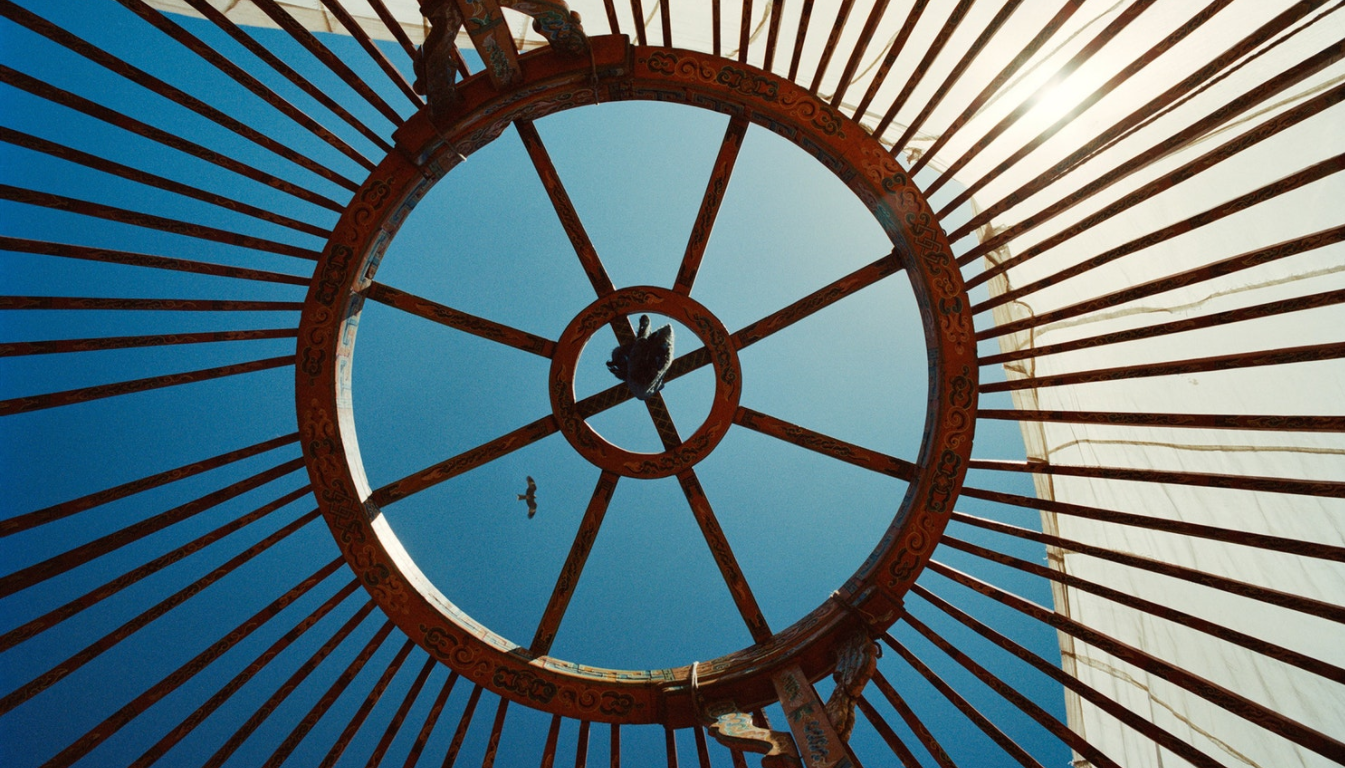
A Mongolian “ger” (гэр) or yurt, covered with skins and felt, the traditional home of nomads living on the expansive steppes of central Asia.
We arrived, as you do in this part of the world, completely unannounced. The family remembered me, gave us a warm greeting and served us a tea. After we had eaten, I pulled out the photograph and handed it to the couple.
The mother picked up the picture, looked at it and there grew a void, her face filled with great sadness as she left the room. Her husband picked up the photograph and stood, his eyes swelling with tears. Their baby, he explained, had died of a virus three weeks after our first visit. They had never seen any picture of him. Here was this image allowing a mother and father to reconnect to their lost son. For a moment, it was like a resurrection—that powerful. My guide and I drove the four hours back in complete silence, as if we were under the spell of what had just happened. It was one of the most profound moments I have ever felt, creating that deepest human connection.
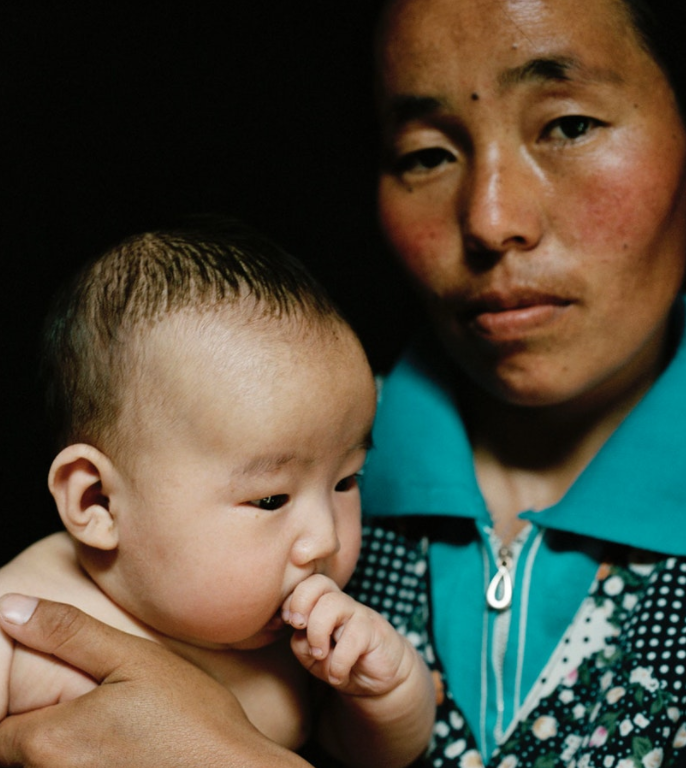
Mother and infant son, in their home on the shores of Üüreg Lake (Үүрэг нуур) in western Mongolia.
“There is not a particle of life, which does not bear poetry within it.” — Gustave Flaubert
While in the countryside, especially, you can feel the influence of Buddhism. In every ger, the Mongolian term for their traditional tents, you will find a small altar with a Buddhist icon. In each village there is a monastery. It is a subtle presence, one felt primarily in how people relate to life. Death is a passage, a journey. It happens, it is anticipated as part of the life cycle. Does death trigger sadness? Yes, but life goes on. The religious culture is something that seems to create an overall sense of morality. In my experience, Mongols are extremely fair people. You ask their point of view and they tell you precisely what they think.
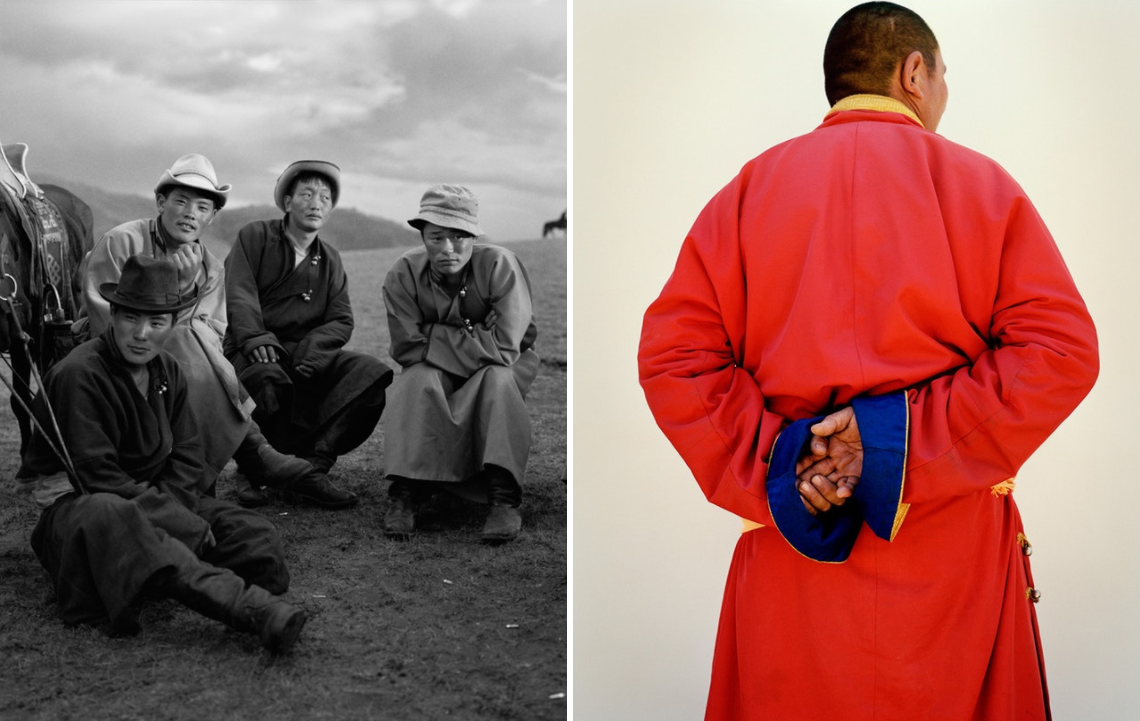
Horse riders at rest in Horkon, central Mongolia. / Baasan Lama, a monk at Bulgan Temple, a Buddhist retreat in the Gobi Desert.
In Mongolia, nothing happens the way you want or expect.
For me, coming from a western culture where everything is linear, this was an awakening. If you are traveling, you only know when you are leaving, never when you will arrive. I found that amazing. In a country as immense as this, the elements are so powerful there is no control. There may be a snow or sand storm. Things that can physically prevent you from moving forward on your journey. You cannot continue… until you can.
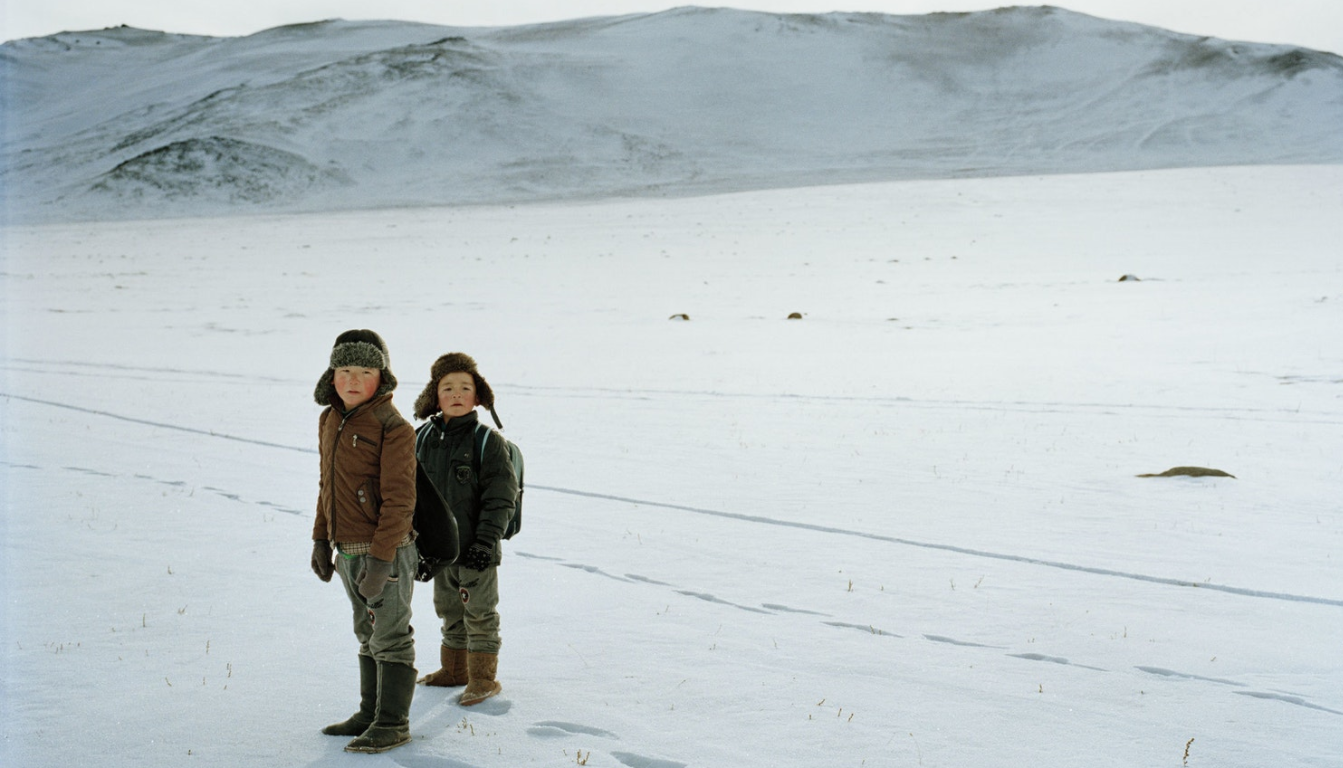
Two schoolboys, wearing fur-lined boots, walk home through the snow near the village of Altai (Алтай) in the far west of Mongolia.
I have learned that most of the time when things are not going as planned, that is often when the situation is the most visually exciting. We have to go a different direction than where we came from and stay one more night all because of a flat tire. But, that is when something special happens. We end up saying afterwards, “Wow. Mind blown.”
Take, for example, the following series of images, which illustrate exactly the type of unexpected scenarios that gift themselves to you while traveling through Mongolia. We had a plan to fly direct from the capital, Ulaanbaatar, to Tsaatan lands, to visit reindeer herders on the Russian border, but for some reason our flight got canceled. This happens a lot. We had to stay one more night in the city, get on a different flight to somewhere further away, then rent a car and drive back across this vast lake, Khövsgöl, one of the biggest lakes in Mongolia. This arduous journey, all to reach the town we were originally attempting to fly to directly. I was fuming. I had just three weeks for this trip and now I was losing two entire days.
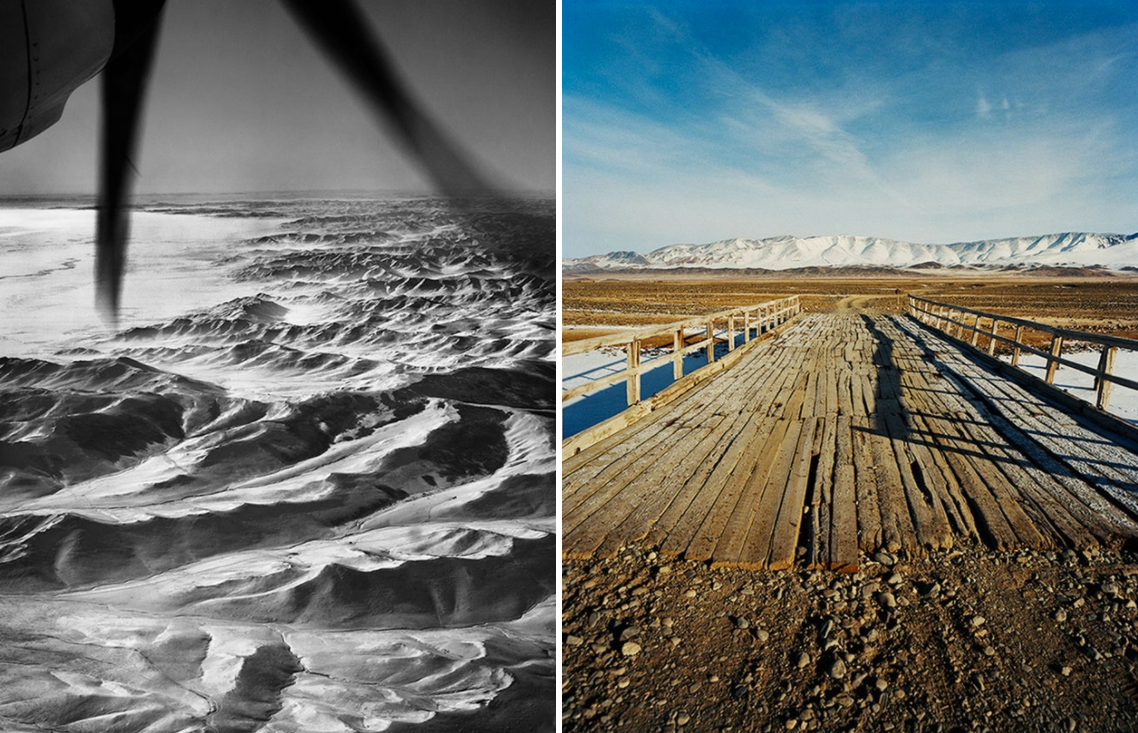
The Altai Mountains, seen on a flight from Ulaanbaatar to Ölgii. / A bridge near the village of Altai (Алтай), a few miles from China’s border.
During the winter months, this lake is completely frozen, often an ice layer of up to six feet, and instead of taking the dirt road, often filled with potholes and hard to navigate, trucks and cars travel directly across the iced over lake. There is a risk, of course. As the drive went on, the truck we were following suddenly began to collapse into the ice, without any warning.
A warmer wind from the south had been blowing in recent days, making the upper layer of ice more fragile. Everyone in our vehicle shouted out in shock “Arrgh!” and we stopped as far away as possible, as the ice in the epicenter was quite fragile. While we contemplated the situation, the owner of the truck, who had at first abandoned it, along with the other passengers, walked back to the vehicle to retrieve his belongings. While he was still in the truck, we heard a massive roar. A roar so deafening we were surrounded by the thunderous sound echoing from the ice.
We knew something was about to happen. Everyone ran from the truck, as it sunk even deeper, seemingly fixed into the ice. Immovable.

What happened next?
Well, the Mongols are impressively strong willed and determined. They called for help and a few hours later a couple of other trucks arrived.
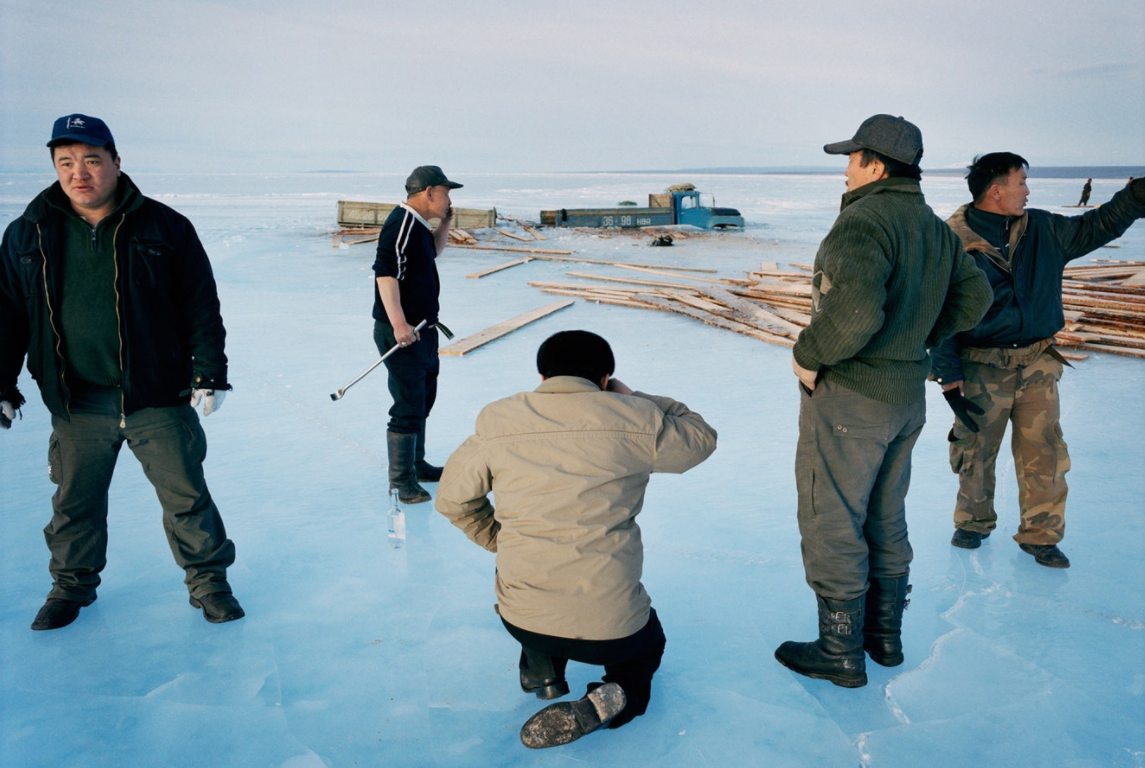
Together, the group waited for night to fall, so that the ice was again solid and reliable ground, and then they literally pulled it out of the ice. So badass.
That truck was filled with wood, likely bound for a construction site. There was too much potentially lost revenue trapped in that one ice circle. Fortunately, no one was hurt that day, but locals have told me stories of jeeps and trucks, loaded with occupants, disappearing entirely in the frozen lake after the ice had cracked, never to be heard of again. Only later did we realize how close we were to possibly meeting the same fate.
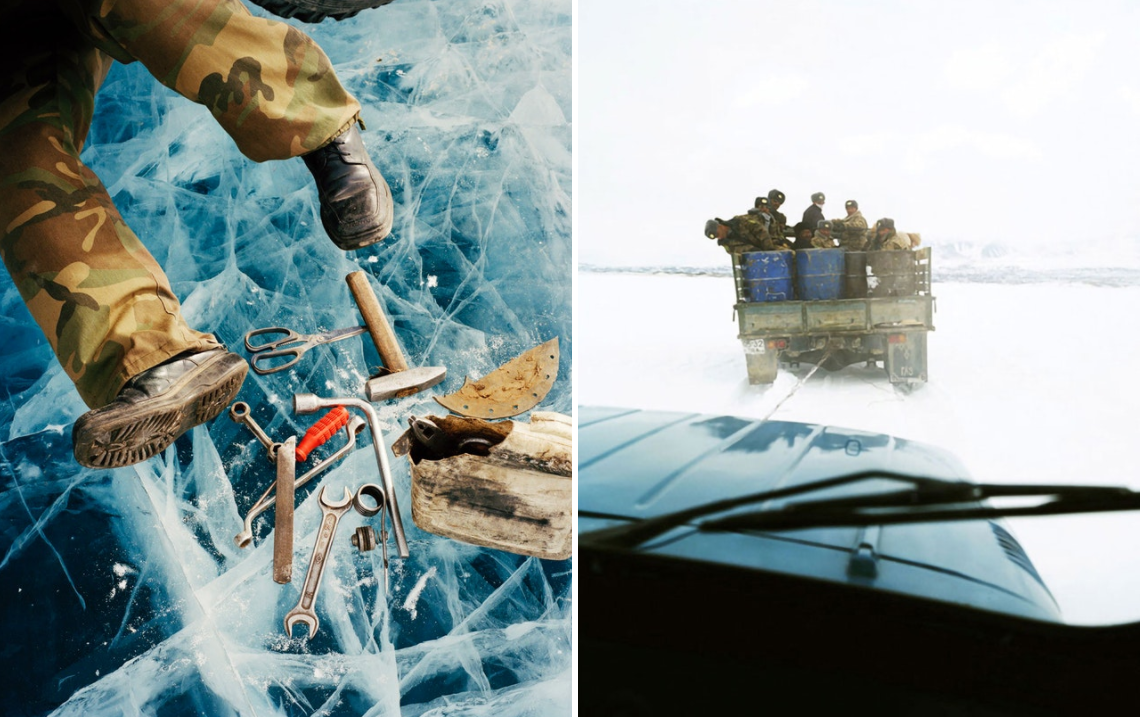
This lake was full of unusual surprises. Earlier the same day, we had come across two young men lying on the ice, in the middle of nowhere. We stopped the car and got out, but they did not move. They just stared. They were completely drunk, wasted. It was still morning! They were just lying there waiting for something.
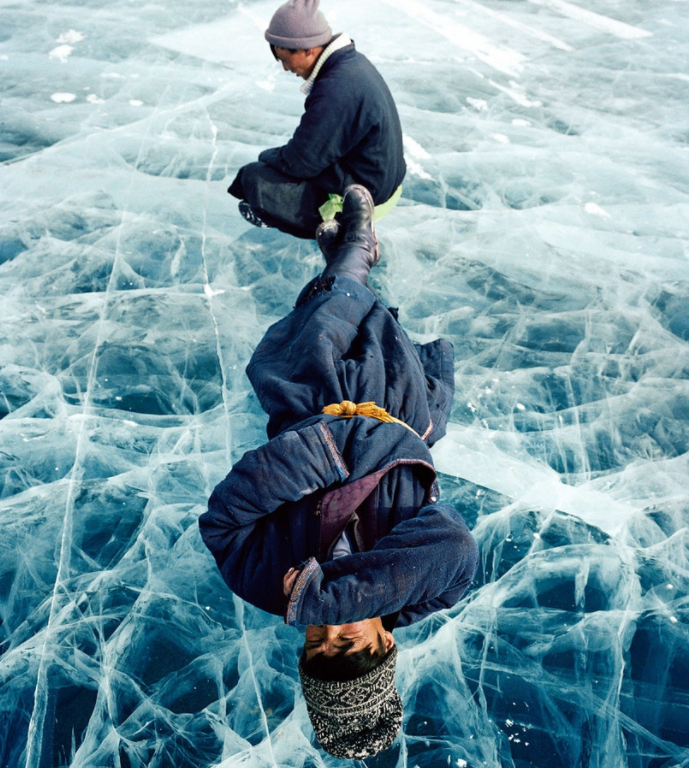
I love the perspective, the color, and texture of the ice in this image. Knowing the strange backstory makes it even better. I had not planned this particular journey, but some of the most powerful images I shot during that trip happened thanks to that canceled flight. In these types of consistently disruptive circumstances, an overall shift in perspective takes place. In retrospect, the entire experience turned out to be perfect.
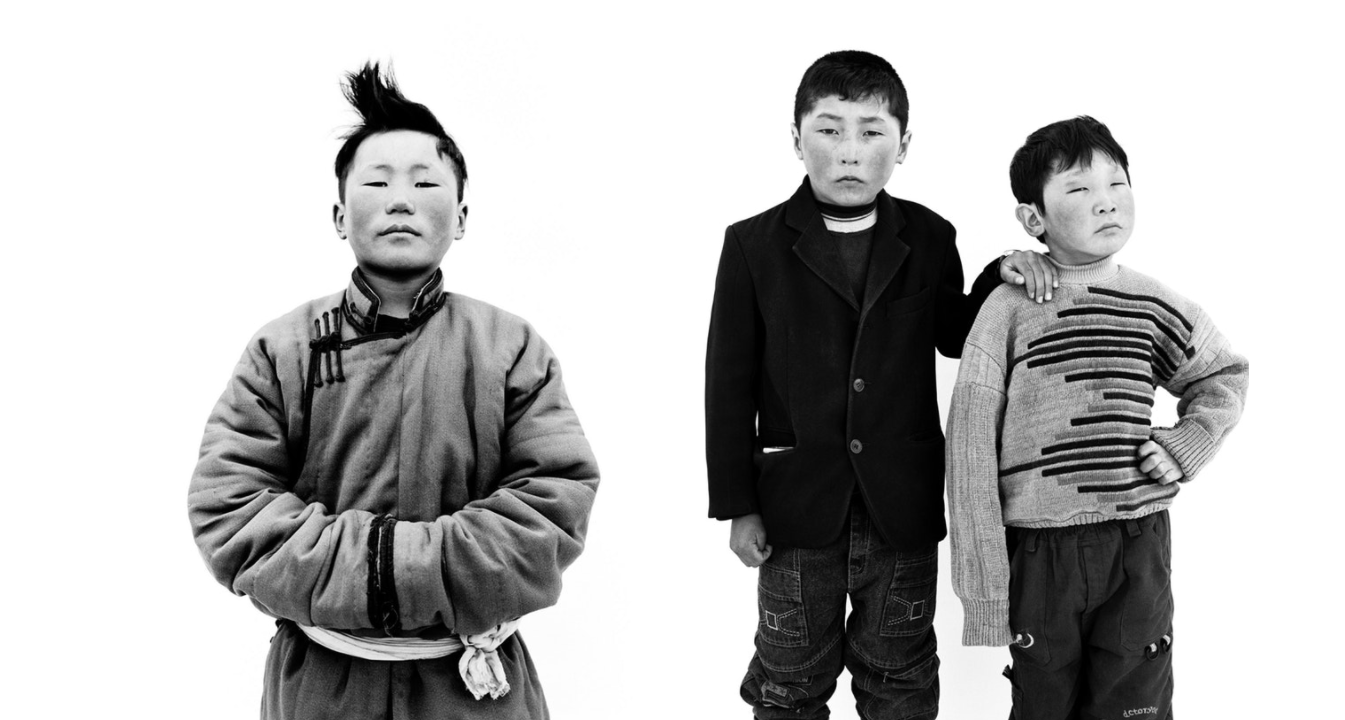
A boy from Kharkhorin (Хархорин) wearing a traditional “deel”or robe, with a silk sash. / Two brothers from Khövsgöl Lake (Хөвсгөл нуур).
Looking back, all my visits to Mongolia have been marked by unexpected moments like these. One place in particular is layered with memories. Many years ago, when I first arrived on the Trans Siberian railway, with no plans and little idea of a destination, I saw a tiny blue dot on the map, in the far west of the country. I could just make out the words, Üüreg Nuur, a lake. Somehow attracted to it, I decided that was where I was going to go. A few days later, I took the picture of the mother and her baby son, and over the years, I have returned many times, making friends and photographing most of the families living there. I have seen toddlers become teenagers, teenagers grow into young adults, and older men pass away. The full cycle of life.
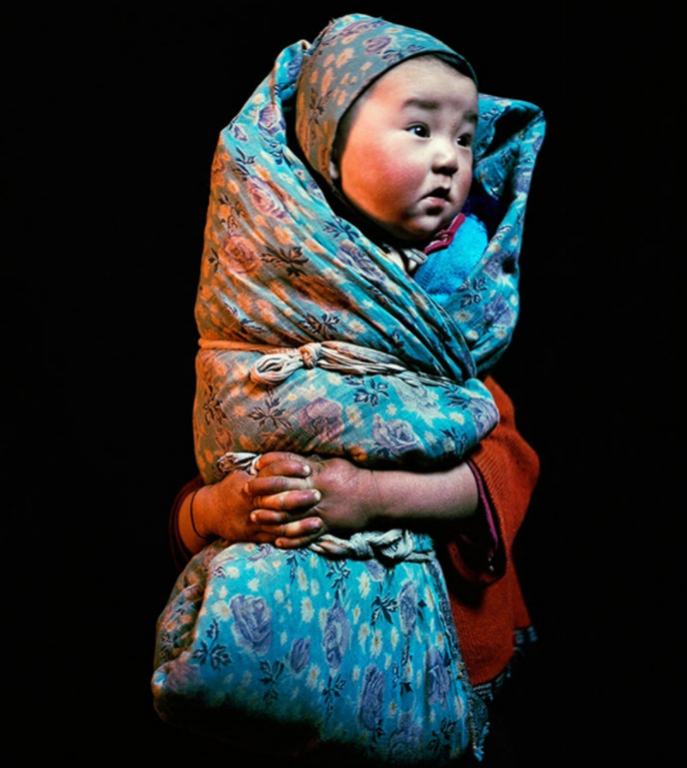
Wrapped baby, held by his sister, at Üüreg Lake in western Mongolia.
Last summer, I returned to Üüreg Lake once again, in June, traveling with two local guides. At some point we stopped because we came across a group of herders who had all of their sheep laid down by the water so they could shear them. When I pointed my camera towards this man, he lifted the sheep high up above his head. It was completely unexpected. Intrigued, I shot a few frames and then asked him, “Why did you do that?” He said, “I don’t know — it is something I have always wanted to do.” Often photography inspires a certain playfulness and spontaneity; there is something fundamentally human about posing for a camera.
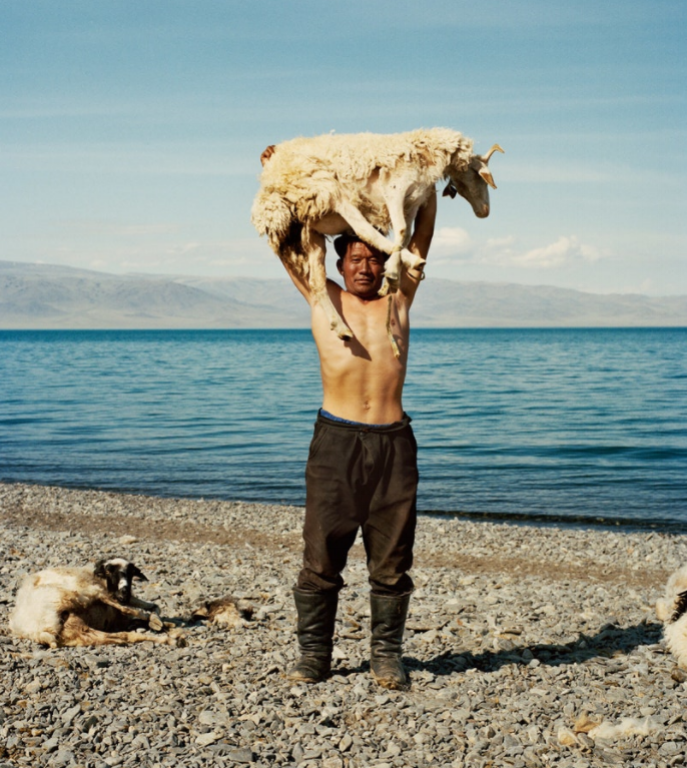
A local herder shearing his sheep on the shores of Üüreg Lake (Үүрэг нуур) in western Mongolia.
Perhaps, above all, in this country, I have learned how to adapt.
Nothing unfolds as you might first imagine, but these unanticipated moments bring rich and beautiful gifts. Traveling here has brought me a new perspective, even some wisdom, particularly as it relates to being attached to expectations and schedules. Over time, I have relaxed my grip on the rigidity of my own culture and let go enough to accept what will be. I have applied this in my everyday life. Even if I am on an intense shoot for a commercial job, I now trust that everything will eventually work out just fine.
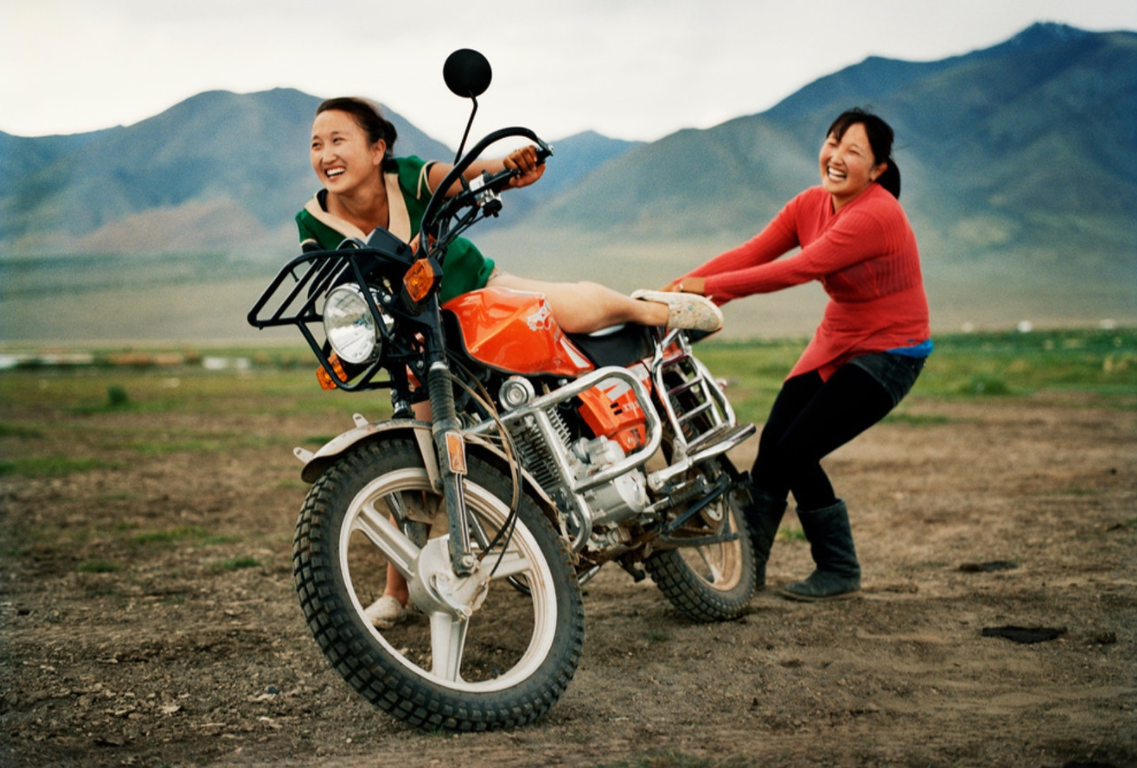
Two friends go out for a ride near their home by Üüreg Lake (Үүрэг нуур) in western Mongolia.
“A strong cold wind gets up from the W.N.W — that is to say, at our back — but we are on a desolate steppe, where we can find neither shrub nor anything else which can help to combat the cold that it is beginning to be unpleasant. On the other hand, we come upon some very pretty flowers, lovely wild pansies and edelweiss that would delight the heart of an Alpinist.”
FRENCH EXPLORER, GABRIEL BONVALOT
Across Thibet, The Mongols, 1891

Buddhist monastery in the summer months. / A frozen river winds through the stark landscape, on a flight from Ulaanbaatar to Ölgii.
You will find two contrasting dimensions in Mongolia, bound both by culture and geography. It is the 19th largest country in the world, yet there are only three million people living there. Close to half that population is located in the capital city of Ulaanbaatar, today the country’s industrial and financial heart, where technology has evolved considerably.
Meanwhile, the rest of Mongolia’s people are dispersed all over the country in small villages and towns, with some thirty percent still choosing a nomadic or semi-nomadic way of life, moving across the land with their horses. People may have a satellite dish or cell phone, but connection is erratic. Here, life is very slow; it hasn’t really changed over time.
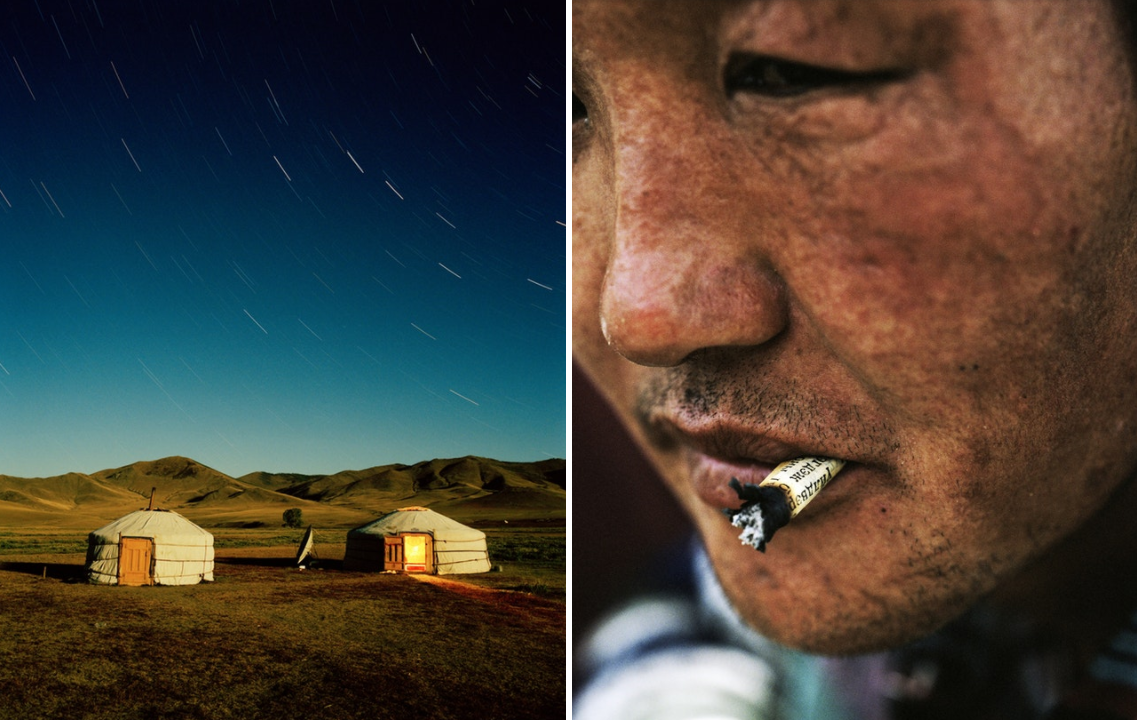
A remote satellite dish provides the evening’s entertainment. / A herder smokes a cigarette rolled from a scrap of newspaper.
Vast plains and beautiful landscapes are the hallmark of these remote lands. The air is pure. The food is very simple. Essentially, a meal is meat that has been taken from a sheep killed that morning and cooked with some flour. The customary tea is called suutei tsai and made with mare’s milk and salt. My initial physical experience in Mongolia is always an exponential energy increase from the combination of fresh air, vast open space, outdoor activity, and unprocessed food intake. It is amazing. It toughens you up — all that vitality and energy.

A herder, his wife, and their five young children make their way to winter pastures, transporting their “ger” or yurt and all their belongings.
There is a spiritual effect as well. Mongolia, overall, is a very flat country, and you can see for many kilometers. Nothing to obstruct you. Somehow, being able to see so far away brings you back to the moment, to where you stand right now. You float through that space. There is a reflection that delivers your own reflection directly back to you. This sense of place and of self, it centers you. In Mongolia, I am able to stay in the moment much more powerfully than other places. The strength and vibrance coupled with the spiritual energy from grounding in the present, is a restorative experience.
“Та өндөр бүтээхийг хүсэж байгаа бол, Хэрэв та гүн ухаж байх ёстой.” — If you want to build high, you must dig deep.
MONGOLIAN PROVERB
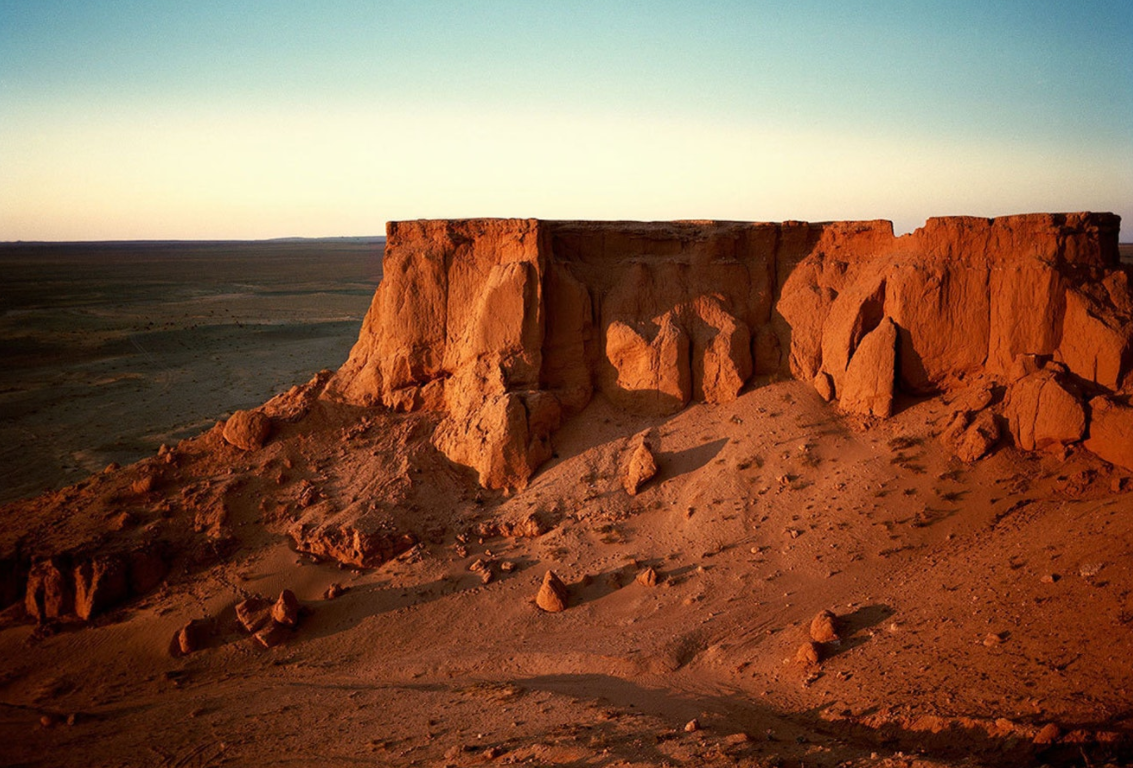
Bayanzag (Улаан Эрэг) or the “Flaming Cliffs” in Mongolia’s Gobi Desert are said to appear to be on fire as the sun sets.
For years, I wanted to photograph the Kazakh, a robust people living in the extreme western part of the country high in the Altai Mountains, who traditionally hunt on horseback with golden eagles. In December 2015, the opportunity finally presented itself. I had two weeks; everything was arranged. The eagle hunters are all ethnic Kazakh their ancestors having fled to neighbouring Mongolia during the mid to late 19th century, in the face of the advance of the Russian Empire troops during the communist era. Some speak Mongol; many don’t. They are Muslim, rather than Buddhist, and for most of the 20th century they remained an isolated, tightly knit community.
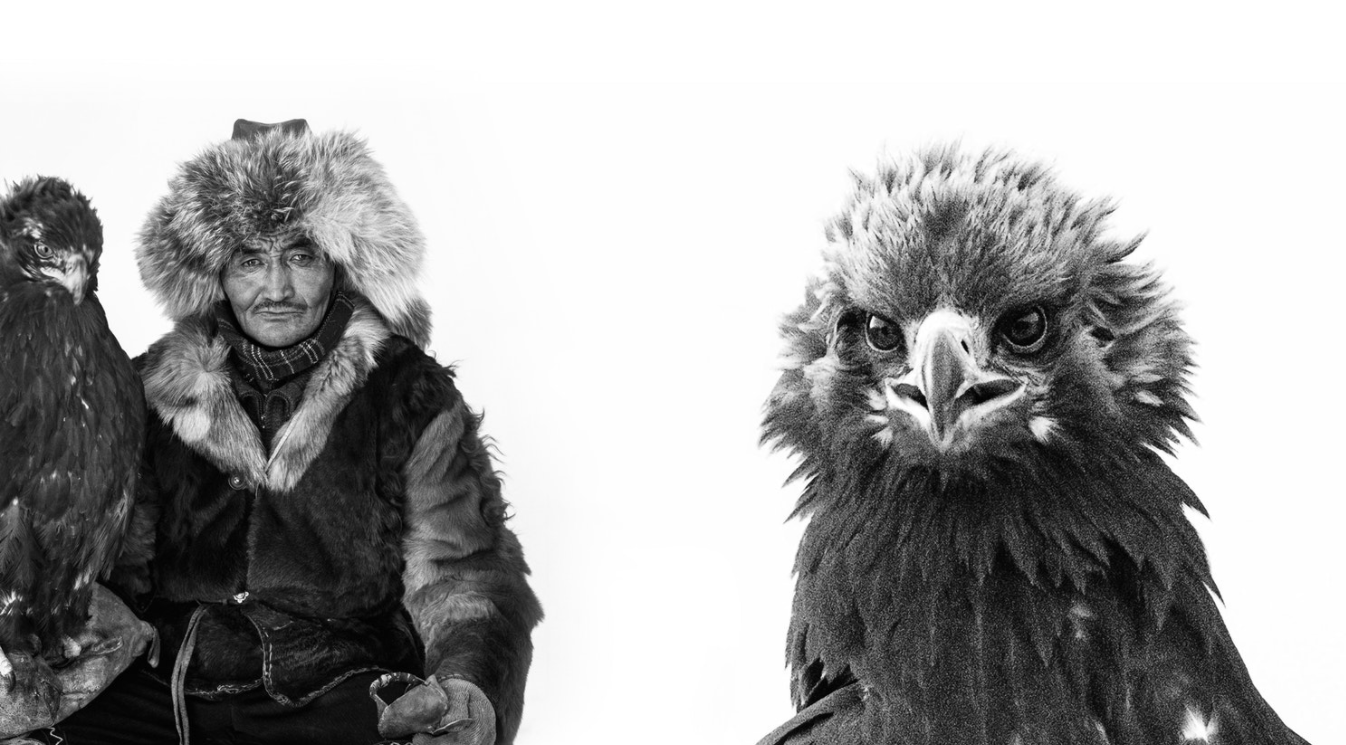
The hunter, Jaidarkhan, an ethnic Kazakh whose ancestors fled to Mongolia, and his eagle.
Living by the ancient art of eagle hunting, I found them to be very generous, kind people. In Kazakh, the word qusbegi, or falconer, comes from the words qus (“bird”) and bek (“lord”), translating as “lord of birds.”
These days, however, only a few Kazakh are still traditional hunters. Some continue primarily for show, as there is a new tourist economy that can support the fading art form, especially each October, when eagle hunting customs are displayed at the Kazakh’s annual Golden Eagle Festival.
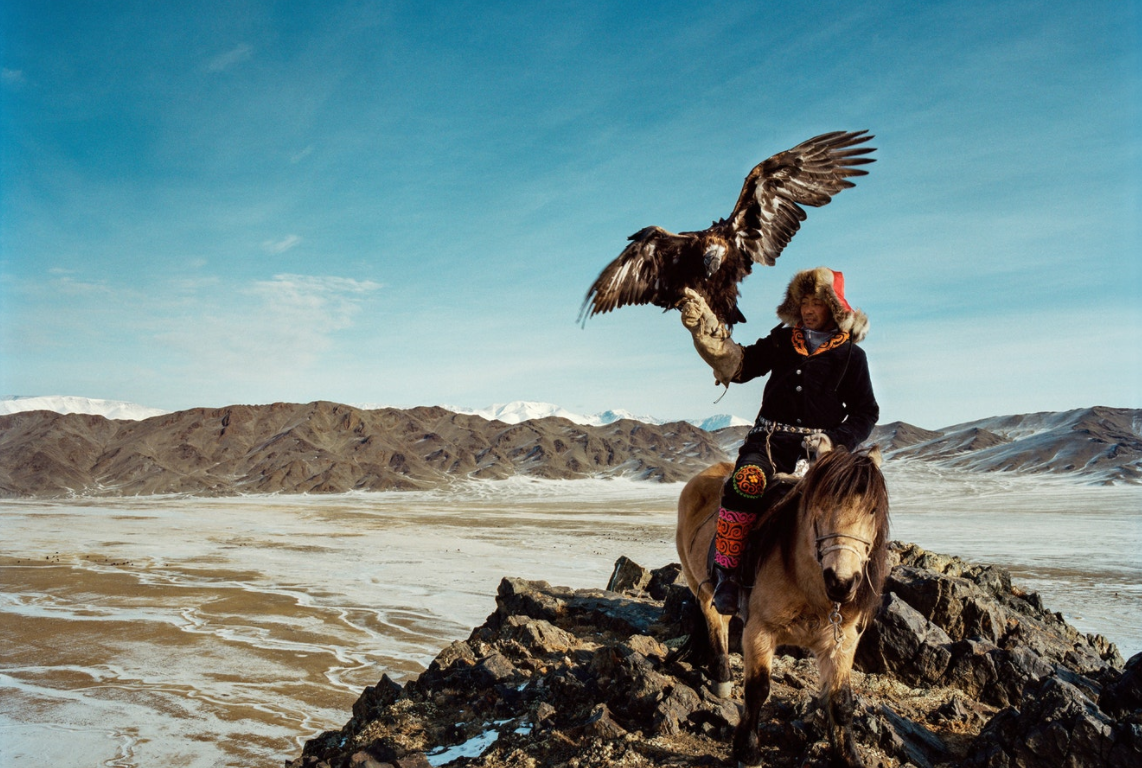
In good years, Kuantkhan Ologban and his eagle catch around 30 animals. Some years, none are caught at all due to extreme weather.
Winter in Mongolia often brings raw, biting winds, and extremely challenging conditions, so our journey to reach Kazakh lands was demanding. When we finally arrived, utterly exhausted, in temperatures of –30°C, I quickly became sick with a fever and was forced to stay in bed for seven days. I was deeply disappointed. My guide, and friend, Enkhdul, with whom I’ve crossed the entire country many times, in all seasons, from the Gobi Desert to Tsaatan lands in the extreme north, and from the eastern plains to the Altaii mountains in the far west, told me, “We are not leaving! You have been talking about coming here, to do this, for years.” So, I waited it out and got better. However, I had only three days to shoot everything.

Hunters value their eagles immensely. In winter, they sleep inside with the family. / Alpam, who is learning the art of hunting from his father.
The Kazakh community is quite incredible and their stories fantastic: how they proceed, scaling remote and cragged mountain peaks to find the eagle they will raise. The relationship that forms between the hunter and eagle has a special connection and symmetry that can only come from time and great care. Sometimes a hunter will work with an eagle for ten or twenty years.
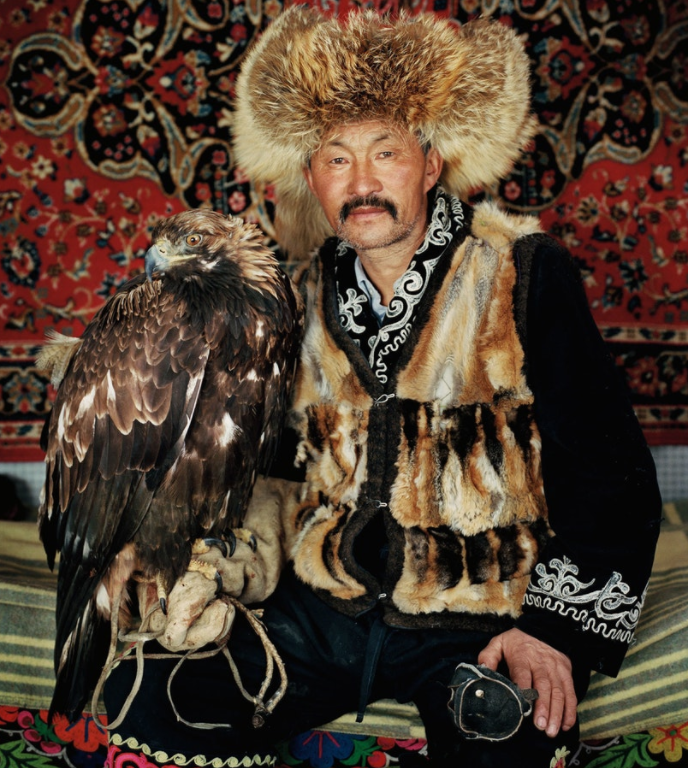
Dalaikhan, a champion hunter, with his 2-year-old eagle. He is wearing fox-skin clothes from previous successful hunts.
As we were so far north, in the middle of December, the hours of daylight were few. The sun was consistently low on the horizon, casting a golden, soft light on everything and everyone it touched. But once the sun disappeared, the temperatures plummeted to a frigid –20°C. My analogue camera would jam and stop working completely, forcing me to end for the day. Once again, gifts and challenges.
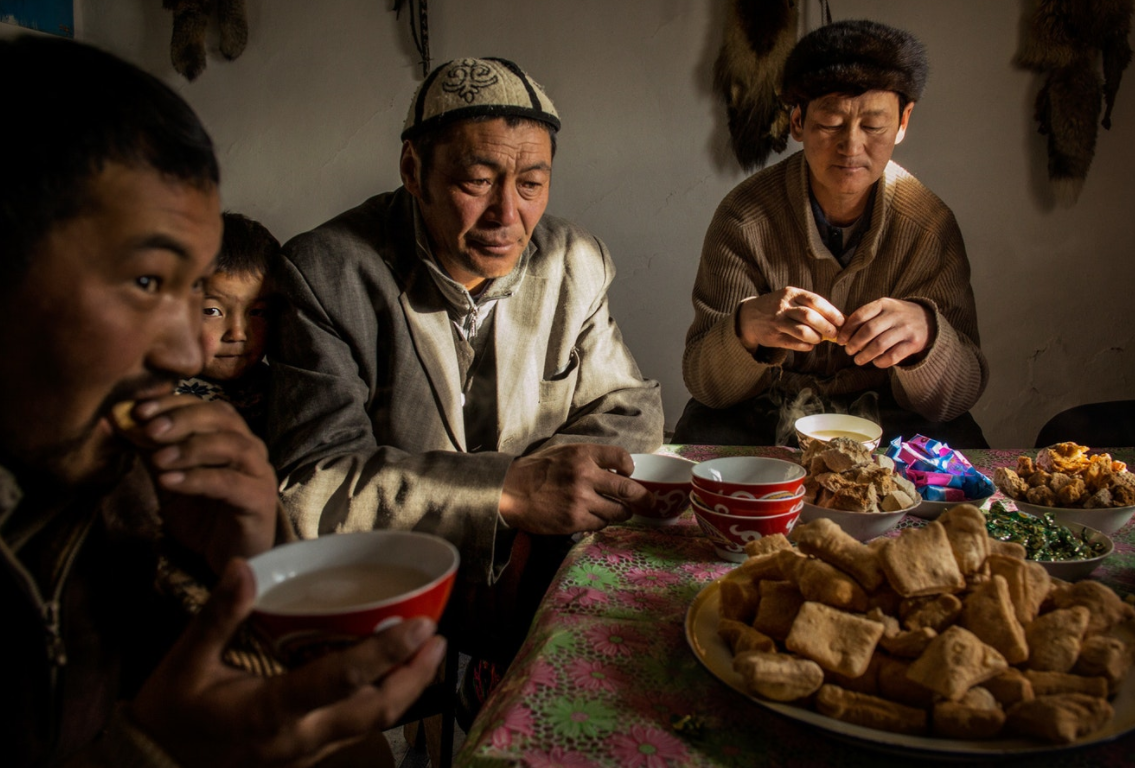
After just one day, my camera and I had become seemingly invisible, to all but the inquisitive eyes of the youngest child.
Like so many other times in this vast and windswept country, my expectations did not match the reality. I had planned for two weeks and received a mere three days. But, those brief days surpassed anything I could have hoped for in quality and depth of relationship. Their grace and exceptional strength was tangible. Here, among the sweeping landscape and rugged way of life that shapes the inhabitants of this part of the world, I could imagine the men who rescued my grandfather.
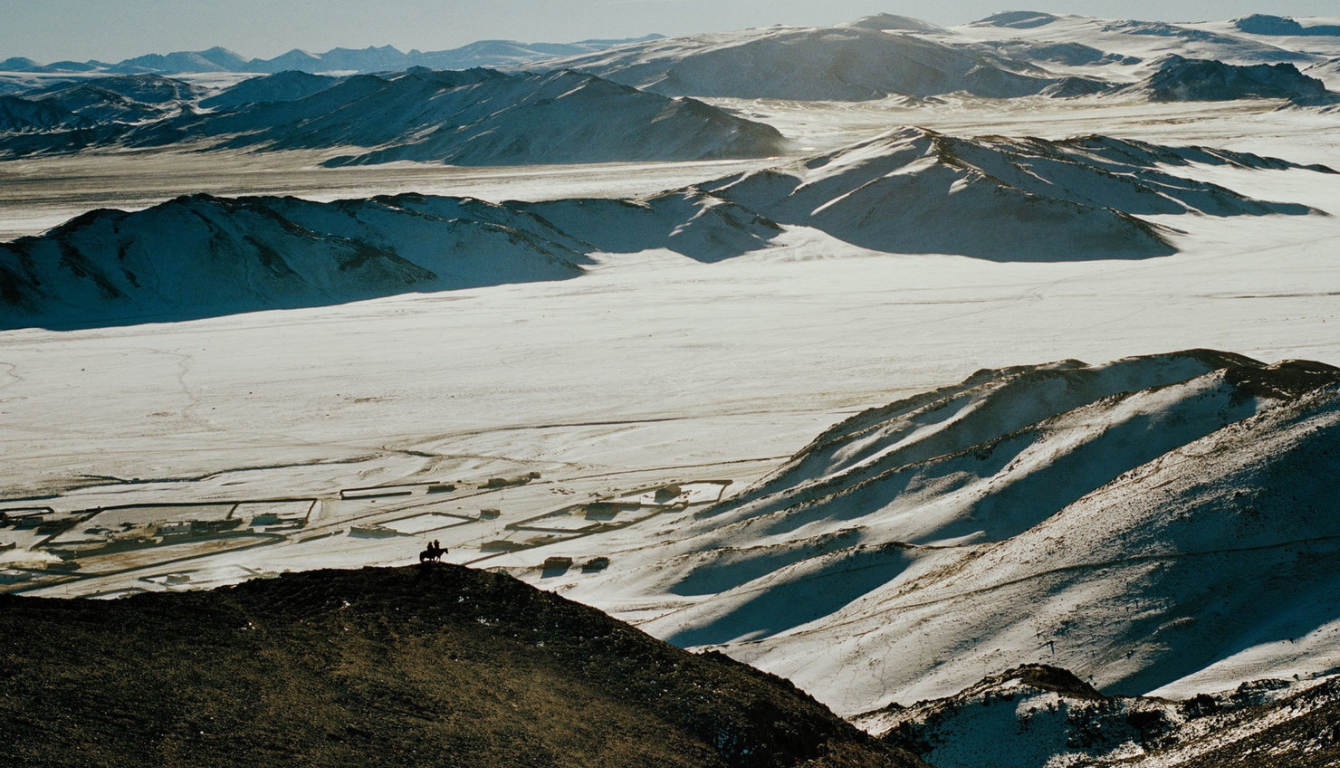
The mountainous landscape dwarfs two Kazakh hunters and their horses in the far west of Mongolia, near the village of Altai (Алтай).
While the heroic ferocity of my grandfather’s Mongol Army certainly inspired my obsession with this country, we are all products of our experience. Regardless of culture, each of us are indelibly shaped by the events and history of the generations that precede us. I may have first come to Mongolia in search of warriors, but I return again and again having discovered raw beauty and elegance in a country equally ethereal as it is grounded.
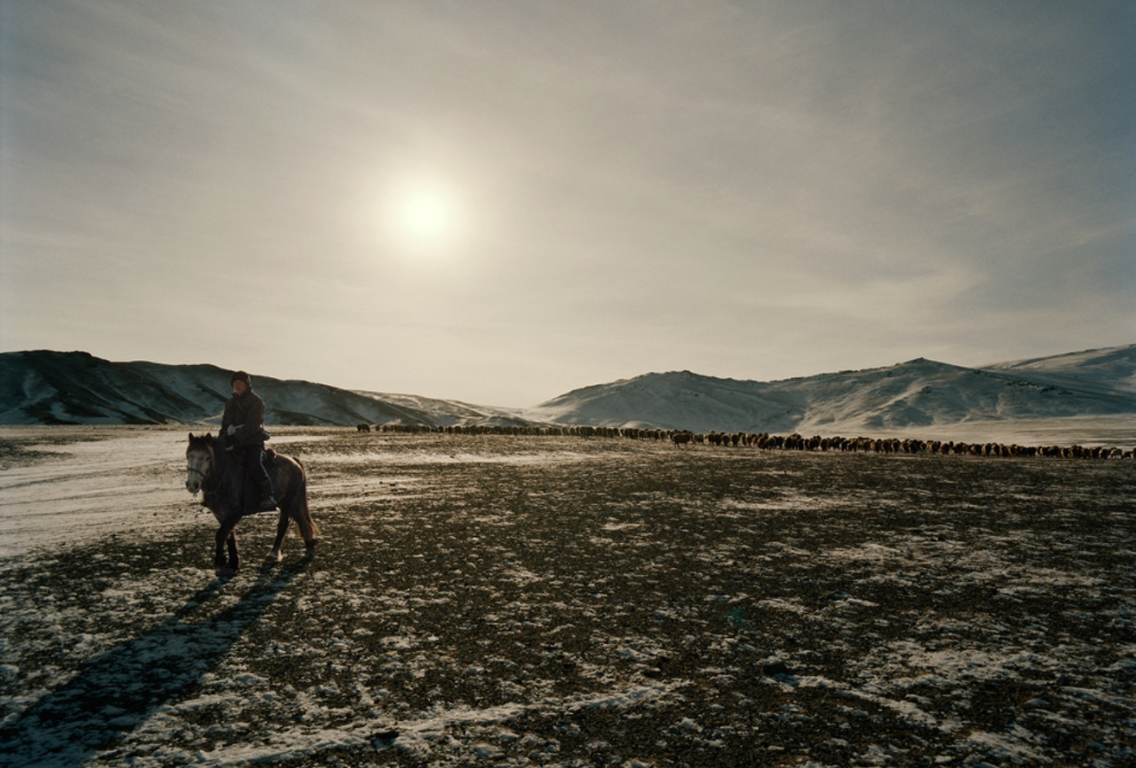
Casting a diffuse, shimmering light, the winter sun was low in the sky, as we watched this young herder and his cattle pass by.
Maybe it is the influence of my professional background, but I have grown attuned to noticing elegance, even in the wildest places in the world. There is always a glimpse of quiet splendor, an angle that calls out something beautiful. Perhaps the knotting of a silk cord along a side pocket or a belt that is latched around a robe, maybe hair done a certain way. I am attracted to these graceful elements and know when I see them that I will make a photo.
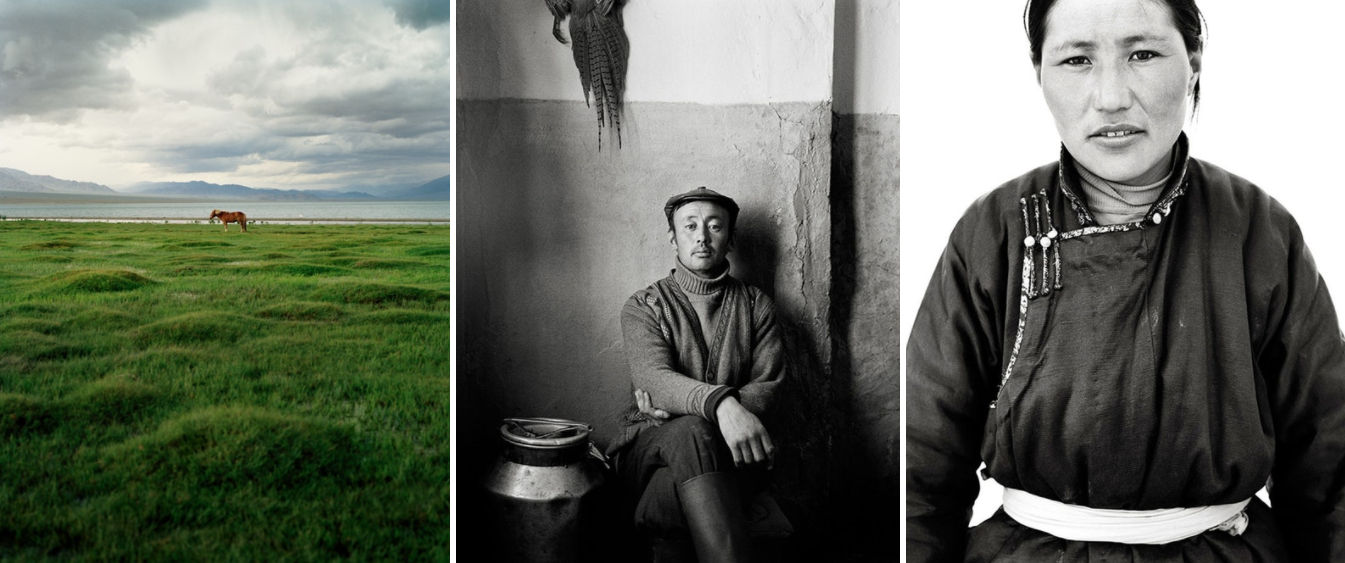
Summer rain clouds gather over the lush grazing pastures on the shores of Üüreg Lake (Үүрэг нуур). / A farmer, pausing for a moment, in his day’s work. / A young woman wearing a traditional “deel” or robe.
All of this is an odyssey. In Mongolia, this journey is most often about shooting in difficult places and seeking the elegant angle. I found photography very late in my life, but am thrilled to discover the range of perspective it offers. It is a learning process that requires great sensitivity. There are constant questions: How am I able to emotionally perceive what I see? What will it take to tell this story in a unique way? All of this fascinates me. This is my passion project. After fifteen years, I have a much better sense of what makes my work distinctive. My sense is that over time, my images have become more artful. Still, this is a work in progress.
I am always exploring.
—
COMING SOON
For years, I have been working to collect material for a retrospective book of my photographic work and experiences in Mongolia. In Fall of 2018, I will be publishing a limited collectible edition of 1,000 books in a large format (17 inches x 14 inches) with more than 250 pages. There will also be a handful of special editions that are offered with a signed print and a special book encasement. Follow along on my Instagram @fredericlagrange to keep up-to-date.
THIS ARTICLE WAS ORIGINALLY PUBLISHED ON MAPTIA.
FRÉDÉRIC LAGRANGE
Photographer & Director based in Brooklyn, NYC shooting for a diverse range of clients worldwide. Capturing nuanced human stories through evocative color & black and white photography.
Tokyo Gen
A short film about Tokyo's unique street culture.

On the Annapurna Circuit Trek | Hiking in the Himalayas, Nepal (Part 1)
"It's 3:30 am and I'm 3500m above sea level... it's been my dream for years to be in Nepal, trekking through the HImalays. Today is the 10th day of my trek on the Annapurna circuit."
Read MoreKayan: Beyond The Rings
Years ago the Kayan people fled Burma and headed to Thailand due to civil war, they lived in refugee camps until the government settled them in Northern Thailand.
Read MorePostcard from Indonesia
An independent short film by Alen Smolic. A relaxing perspective of Indonesia, featuring various shots of the coast, the city, the countryside, and people going about their day.
Read MoreJAPAN: Wabi Sabi
Wabi Sabi is a Japanese lifestyle giving a view of life in many aspects: everything is imperfect and the true beauty comes from simple things, then, one can have subtle feelings in life. Inspired from that spirit, filmmaker duo and couple Le Quynh Anh and Le Nham Quy made this video about Japan in a deeper insight and unbiased feelings. "Japan - Wabisabi" is their best emotional-experience journey in Japan, where they are living and working. They hope that you can feel "Japanese Spirit" from this video.
Freediving With Japan’s Pearl Divers
Aiko Ono was working as a photographer in the bustling megalopolis of Tokyo, but she had long dreamed of the ocean. When an unexpected opportunity arose, she left her life in the city to join Japan’s legendary female “ama” divers. For centuries, ama divers have scoured the ocean floor for pearls and seafood, passing on their expertise to future generations of women. Now, she’s found honor and peace in upholding this 3,000-year-old tradition.
A Cycling Revelation
JULY 2012, TAJIKISTAN
Traveling through Central Asia, a predominately Muslim part of the world, I had noticed that when accompanied by a man I don’t have opportunities to talk and interact with locals, as all conversation is directed to the men. Descending into a valley together with a new and temporary cycling partner by the name of Chris-Alexandre, we would part ways around 10 am in the morning.

The morning Pamiri sunrise from camp, looking over Chris-Alexandre peacefully sleeping.
Chris-Alex, whom I had met in Uzbekistan and planned to meet in Dushanbe, Tajikistan, would wish me luck after three days of cycling together towards the famous Pamir Highway. We promised to stay in contact through our intermittent cell phone signals and meet up ahead. I was now on my own again, something I know so well after two years and close to 25,000 km cycled solo.
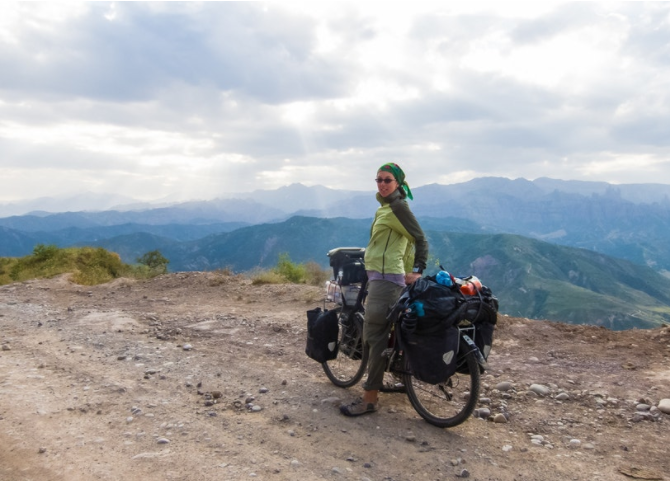
Beginning the ride for the day, little would I know what lied ahead of me. Photograph by Chris-Alexandre of the “All School Project”.
Spending the day riding through a hot and arid valley, but where the small villages are tree lined, I pull over to rest under some trees on the western edge of a village in the late afternoon.
It’s currently Ramadan, which explains the quiet and calm through the days. At sunset, Muslims will quit fasting and have a meal together. It’s considered rude to eat and drink in front of fasting Muslims and I take consideration in hiding myself a bit when eating on the side of the road. At this resting point, I’m not eating but rather just sipping my water and trying to figure out what my plan will be for the night as it’s nearing 6 pm.
There is a fence separating me from a front yard with trees and between the house and trees is a small garden. An older woman wearing a traditional Tajik dress and pants, similar to an Indian styled shalwar kameez, as vivid green as the short trees surrounding me, walks over with a young blonde boy holding her hand.
Exchanging smiles, her mouth of gold glistening in the Pamiri sun as she says “aleikum asalaam” after my greeting of “asalaam alkeium.” She looks at me and my bicycle and directs me to bring my bike and to return to her home down the dirt road that leads behind the garden.
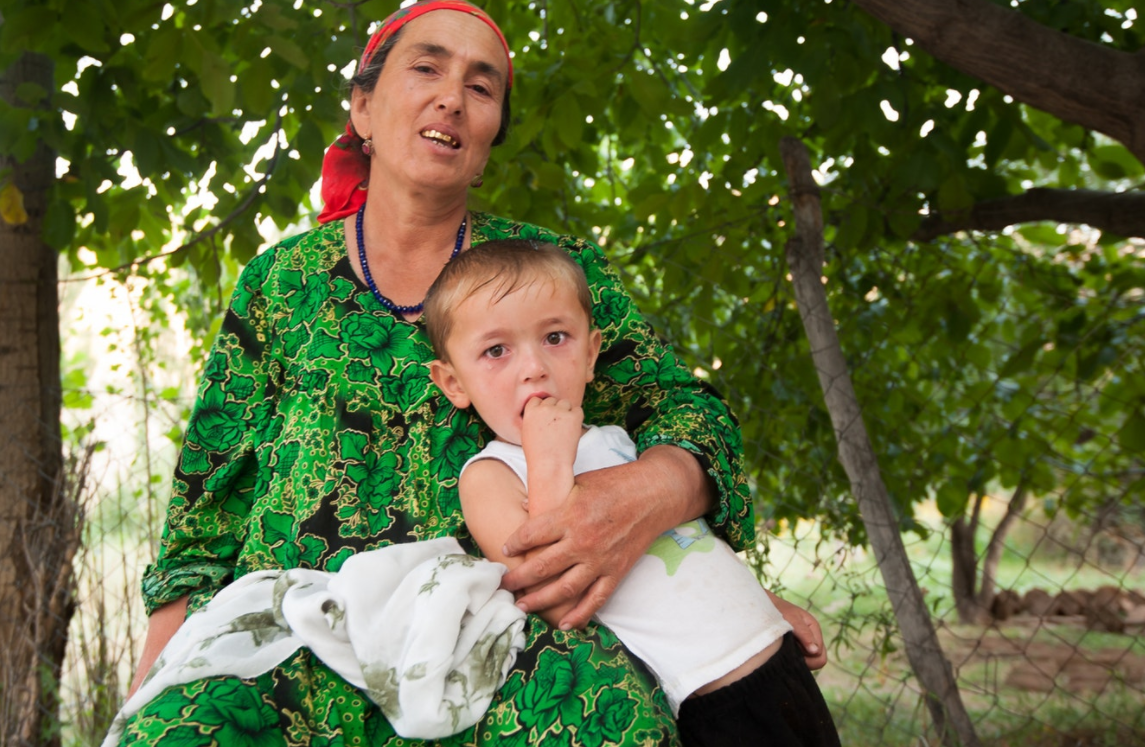
The matriarch of the homestead and her blonde grandson at the home I would spend the evening in.
I would be greeted with children and one of the most beautiful Tajik girls I’d ever seen with her perfectly henna-dyed eyebrow. She is all smiles and I can feel the love among the women while the children are still apprehensive about the lonesome traveling woman.
Many villages through Tajikistan have few men. I have learned that many men work in Russia, and often they will have a second family in Russia, in addition to their family here in Tajikistan. Images of hippie communes flood my imagination here in Tajikistan—happy, beautiful women together with their children living off the land.
Children running around playing in the dirt, a toddler in a crib made of crudely welded steel you would see about construction sites, and the young woman chopping fresh vegetables from their garden. This might just be “the life”…
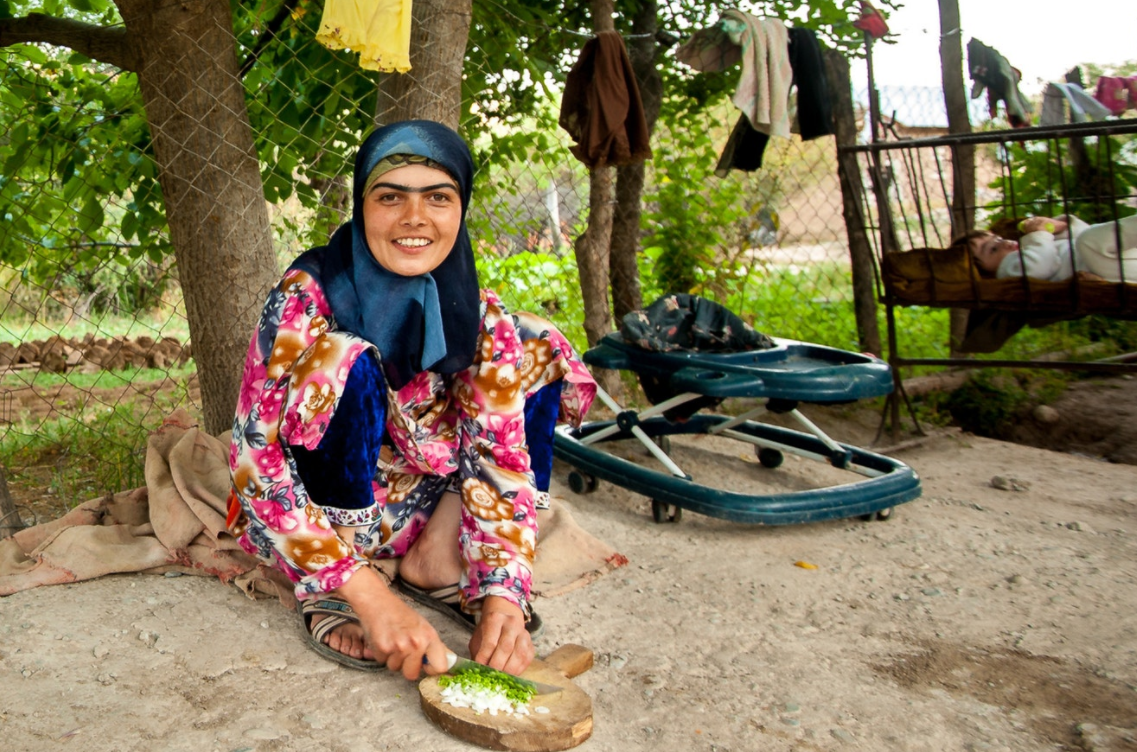
A young Tajik woman chops the fresh vegetables in preparation for the Ramadan feast after nightfall.
The gold-toothed older woman in a traditional Tajik dress and pants, with the most elegant camouflage fabric print I’ve ever seen, begins to pantomime to me about taking a shower and washing my clothes. It has been awhile and I’m wondering if she can smell the odor of travel, woman, and just the scent of a foreigner.
It’s a hot afternoon, where temperatures can get close to 50°C in the sunshine during midday, and I’m not going to deny a cool bath. After a few minutes trying to communicate she lets me know she will heat up some water for the bath. Then I’m led to a corner of a mud packed building, where my bike leans against.
Following her out of the shade and into the cooling Tajikistan air, I’m led into a dark room with light entering from a single window and she directs me to undress and get into the tub. I remove all my clothing except for my knickers and tank top I use for a daily base layer. She looks at me, not even flinching and somewhat serious with no concern, directing me to remove EVERYTHING.
I look into her eyes and I know in my heart she’s a good woman and mother just seeking to help and accommodate the strange traveler that has fallen into her life. Taking a deep breath, I drop all my clothing along with my modesty and step naked into the tub. She pours water over me that is the perfect temperature for this hot July afternoon and she uses the bar of soap that’s splitting to wash my back and hair.
I have gone years without an affectionate, and innocent, human touch and I feel my body slump over in ease and enjoy the gentle and intimate touch of her hands running through my hair and over my shoulders.
Stepping out refreshed, I follow her into the garden where more women are arriving and I’m handed fresh vegetables such as cucumbers from the garden to eat. Cooled down, clean, snacking on vegetables and being served a never ending supply of chai.
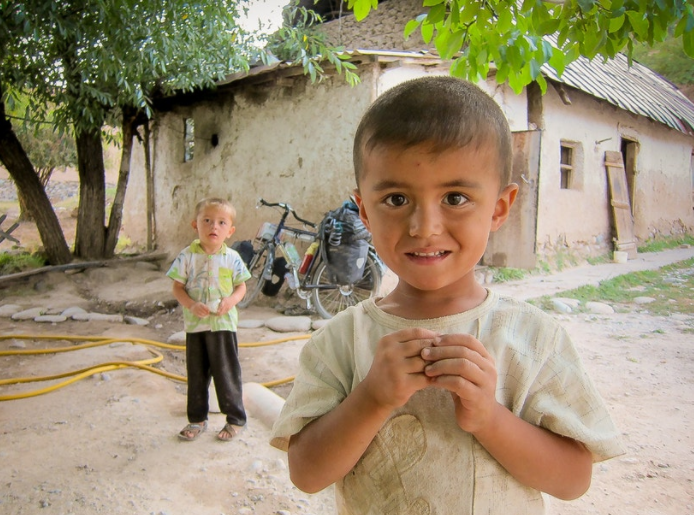
Children greet me at the homestead, my bicycle in the background leaning against the building where my glorious sponge bath would occur.
There is a woman who appears to be around my age, and she is. It turns out that she used to be a teacher and can speak a little English along with some Russian so we can communicate a little bit.
She explains her husband lives in Dushanbe and that she is childless… I can’t imagine what that must be like to live in an area where child-bearing and raising is of the utmost importance to the culture. I take an immediate liking to her, her warm and comforting brown eyes, and I watch her tend to the children as they are her own.
Shortly after her brief explanation to the other women about me, we go inside the main house, passing a teenage boy sitting near the entrance. We enter a room directly off the side where I’m accompanied by a few young male toddlers and about a half a dozen women. The woman with the henna eyebrows is in the room, along with five or six more, and is accompanied by another younger woman carrying the brunette baby from the yard.
It’s explained that they are married to the same man, and along with the gold tooth matriarch, they invite me to become the third. Hysterical laughter breaks out when I smile and nod my head “no.” But after months in Central Asia, and my first time among a commune of women, the thought of sister wives doesn’t seem like such a horrible idea.
After the joking and the conversation, as women slouch against the wall pulling up their pants and dresses to cool down, the matriarch shouts to the teen in the other room to turn up the music. She shuts the door and begins dancing as any beautiful Tajik woman does.
I’m pulled up off the floor and it feels as if I’ve returned to a dance party from my university years. Talking, dancing, laughter… the children are enjoying themselves as well.
There is an advantage being a woman traveling alone.
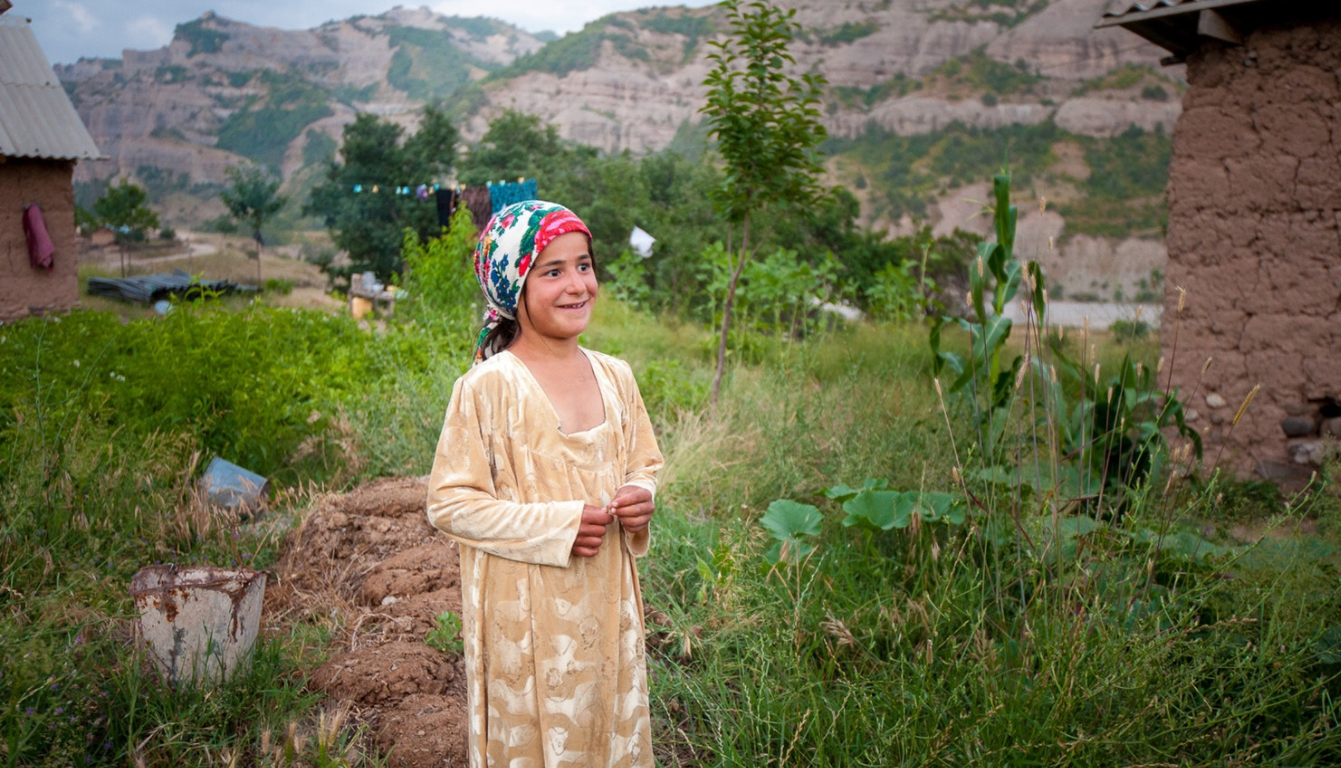
A young Tajik girl watches the boys play before she joins in the fun.
I have been allowed to see and experience moments that are usually behind closed doors or in the kitchen. We have jokes in the West about women being barefoot in the kitchen.
Well, as a feminist, I’ll tell you I wouldn’t want to be anywhere else besides behind those doors or kitchens…it’s where all the fun happens...and gossip…and just behaving like all women around the world.
The matriarch, blonde boy, and I take a nap in the room after the dance party and neighbors leave. Around 7 pm we get up and she takes me for a walk around her land, showing me a new storage building that’s being built out of stones and through the gardens. The children play and we go to a fence dividing the neighbors where I meet a young girl. The adults shout back and forth to one another, along with explanations of who their visitor is.
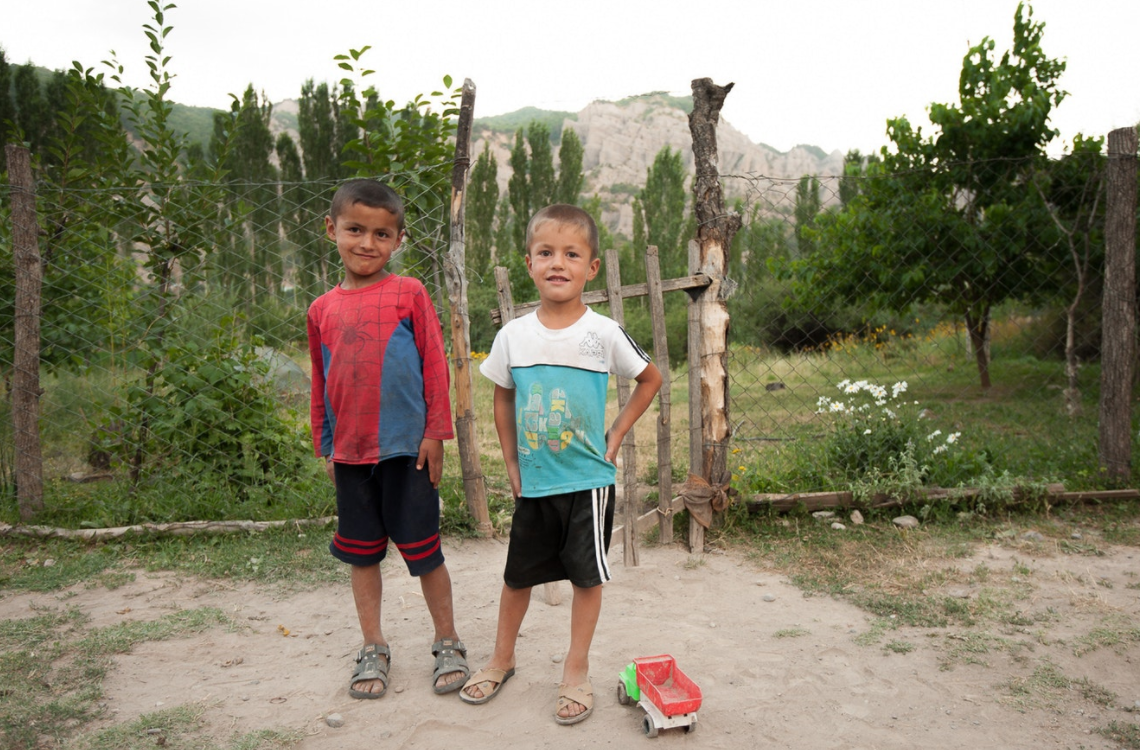
Boys play outside before the fast breaks at sunset for the evening Ramadan feast.
The sun is setting and we return to the woman’s home where the two sister wives are preparing food and the teenage boy is still listening to music acting indifferent to the entire situation. The matriarch serves me food separately from the family unit and then they begin to share a large platter of “polo”/”plov”, a traditional rice and mutton dish of Central Asian, eating with their hands which is the traditional and standard way. The daily fast has ended and they will eat and then pray. The teacher that I warmed up to returns, the television is on and we all lazily lounge around having a very gentle conversation.
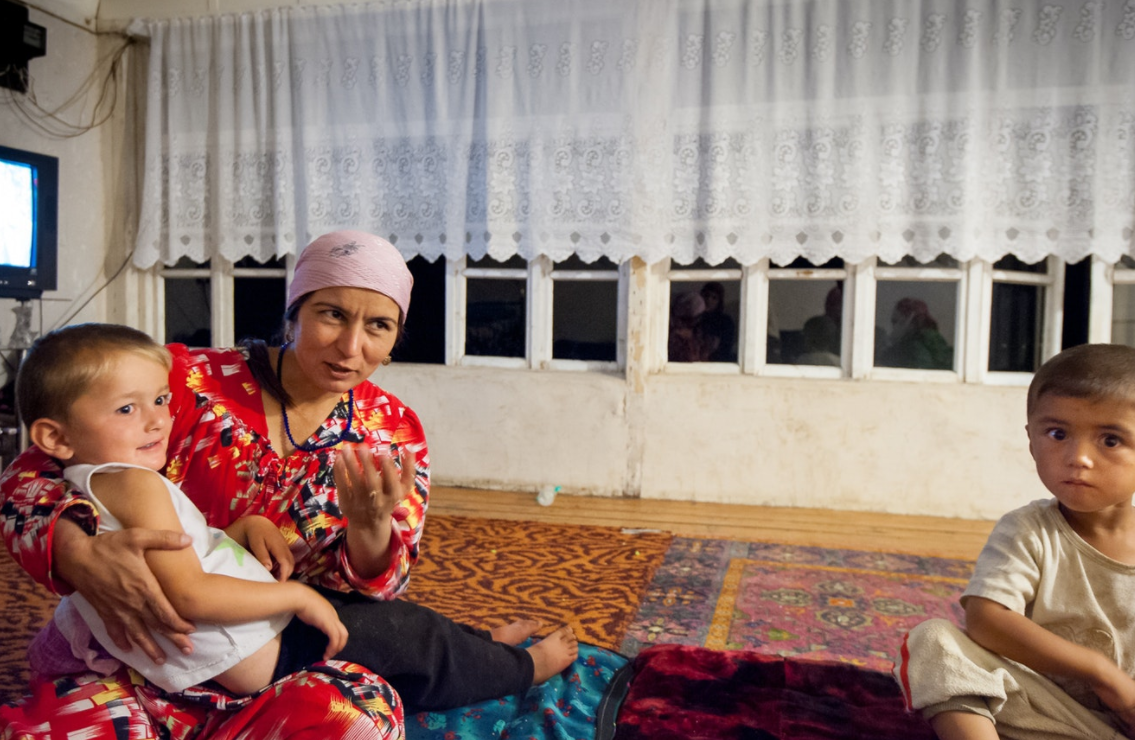
The teacher speaks to the room of women and children after dinner, as the television plays in the background.
They will see my exhaustion and offer me to my sleeping mat as they will stay up later to continue eating and praying. I’m led back to the room where the dancing happened earlier in the day and directed on the mat next to the wall, furthest from the door. I will be sharing it with the matriarch and the small blonde boy that never leaves her side.
Little would I know what the next day would bring…
Awakening the next day with heavy eyes as the cool dawn begins to break into the early morning heat. The aches and pains are extremely acute as I roll off my sleeping mat, as if an invisible force is nudging me to get out into the bright sunshine, onward through the beautiful and majestic valleys of Tajikistan. I’m more groggy than usual, as dogs barking throughout the night kept me awake. Careful not to disturb the old woman and small child sleeping, I move to the window to check on my bicycle and the four bags attached to her sides and top.
The house begins to take on life, as women’s voices break the silence, and I dress and prepare to depart. The old woman asks me to stay for breakfast but I kindly insist I must carry on. Generally breakfast will take a few hours and it’s never been a eat and run type of an affair. Using those early morning hours to cycle will make the difference of 50-70 km a day, and being able to end with a full belly of traditional Muslim food and a long nap under an apricot tree.
Saying my thanks with “rexmet”, speaking in a native tongue based upon Turkish, I exit the mud packed home into the chilled morning light to continue on.
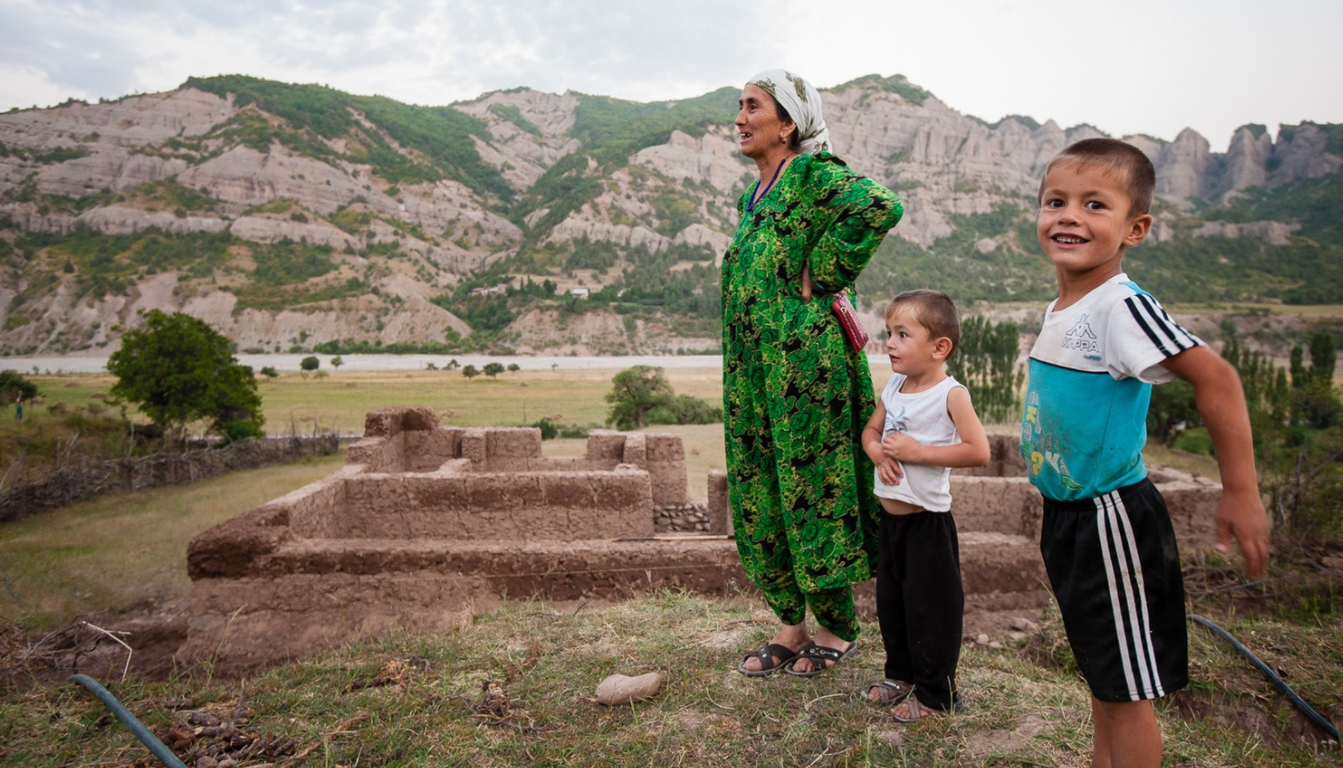
The sun gets intense, and heat unbearable where it sometimes reaches 48 degrees, so I need to make as much progress as possible.
Yesterday had been a short day and I remind myself that I must make up for lost time.
Traversing along a single lane, with deep crevasse jeep tracks, I go slowly up a valley. I lost asphalt nearly two days ago as I had chosen to take a route that most people don’t ride. I had debated about the route as no one could give me an accurate description of the area and there is a missing section of road on the map. Like usual, I was not quite sure what to expect but I knew that I wouldn’t see dozens of cyclists. Having already spent over 20,000 km cycling through China where I can speak the language, I am notorious for pulling myself off well-traveled routes to see what else the world has to offer...but...sometimes there is a reason a particular route is not taken by the masses.
Stopping about fifteen kilometers on from the community I had stayed in the previous night, I stop for breakfast and supplies. Far from a proper town, supplies are limited but I make do with sodas, naan, and sugar-glazed cookies filled with an apricot jelly.
Thankful for the dark storm clouds rolling in and the cool breeze on my skin, I know this will cut down immensely on the heat. I will be able to cycle through the early afternoon without a break. The trees are disappearing and it’s becoming rock mines along a raging brown river. I had been warned of the rivers and glacier melts during the summers, and I would later learn that they were higher than average this summer. The water is angry and completely out of control, I could hear this river beating against the stone banks and walls. Such a contrast to the cool breeze, gentle rolling clouds, and the steady and calm beat of my heart.
There have only been one or two Land Rovers driving in the opposite direction since leaving the last town about four hours earlier. It’s becoming lifeless except for the massive rusted mining machines and mounds of gray stones. The road is more difficult now and the stones cause me to lose my balance at times…tipping sideways a few times, causing my right foot to try and find traction among the broken stones.
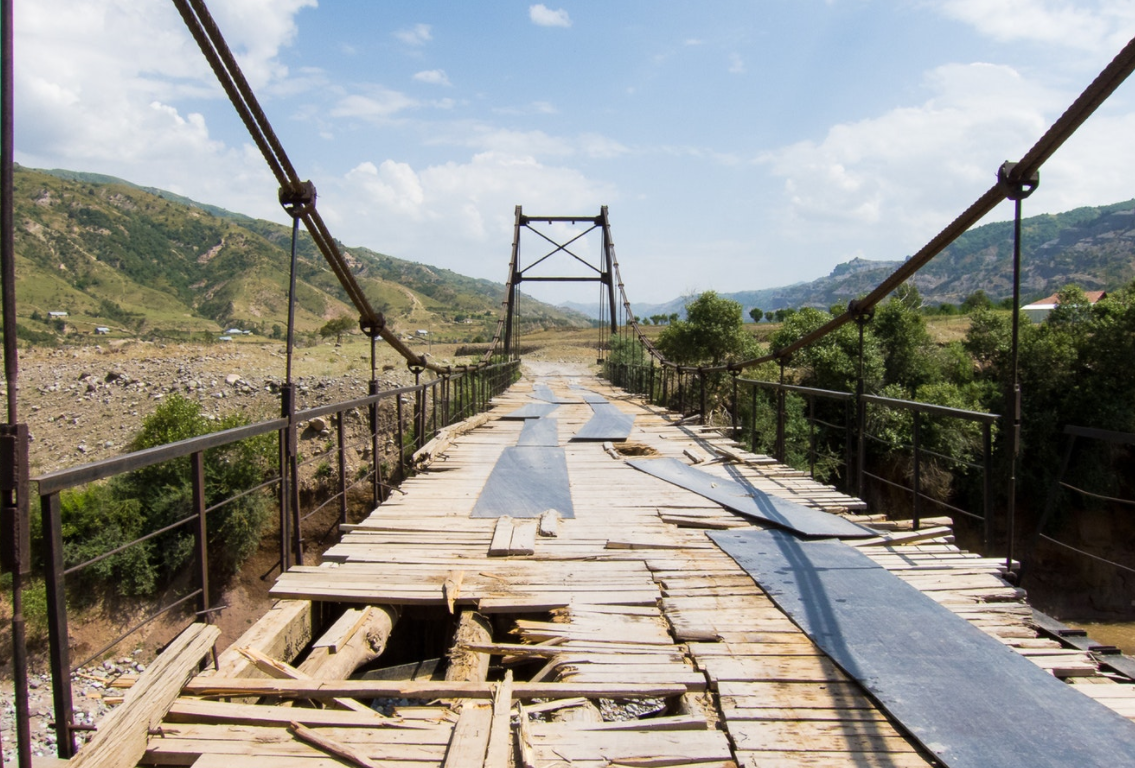
Broken bridges and roadways because of the heavy mining machinery traveling through the area.
Spotting a small pond where the water was flowing clear and shade provided by some short trees, I decide to push over to watch the direction of the storm and to repair a snapped bolt on the front rack. There is no one around and I decide to wash my clothes, feeling guilty that I now have a clean body living in the filthy and salt-marked cycling clothes. Although my hair had been washed yesterday with bar soap, it seemed to make my oily hair even worse, so a proper shampooing was in order.
One man stops to speak with me, only to return to give me some strawberry cookies he had in his Land Rover. He begins to get a little closer and asks me more questions than I bargained for and realize I have to back him off. I’ve had enough men make assumptions about a single American woman in Central Asia and knew I needed to ward off any preconceived ideas.
“Is he your friend?” the man asks me in Russian and points to a blonde Tajik boy with a knapsack and dog. It took me a second to figure out if this kid was another traveler just choosing to walk, but I realized he was a local. Deciding that an innocent lie was in order for this moment I said, “No, my friend is ahead.” This usually confuses them because they assume friends should always be together. The man drove off after putting some water in his radiator and the boy went towards the cliff across the road from my trees.
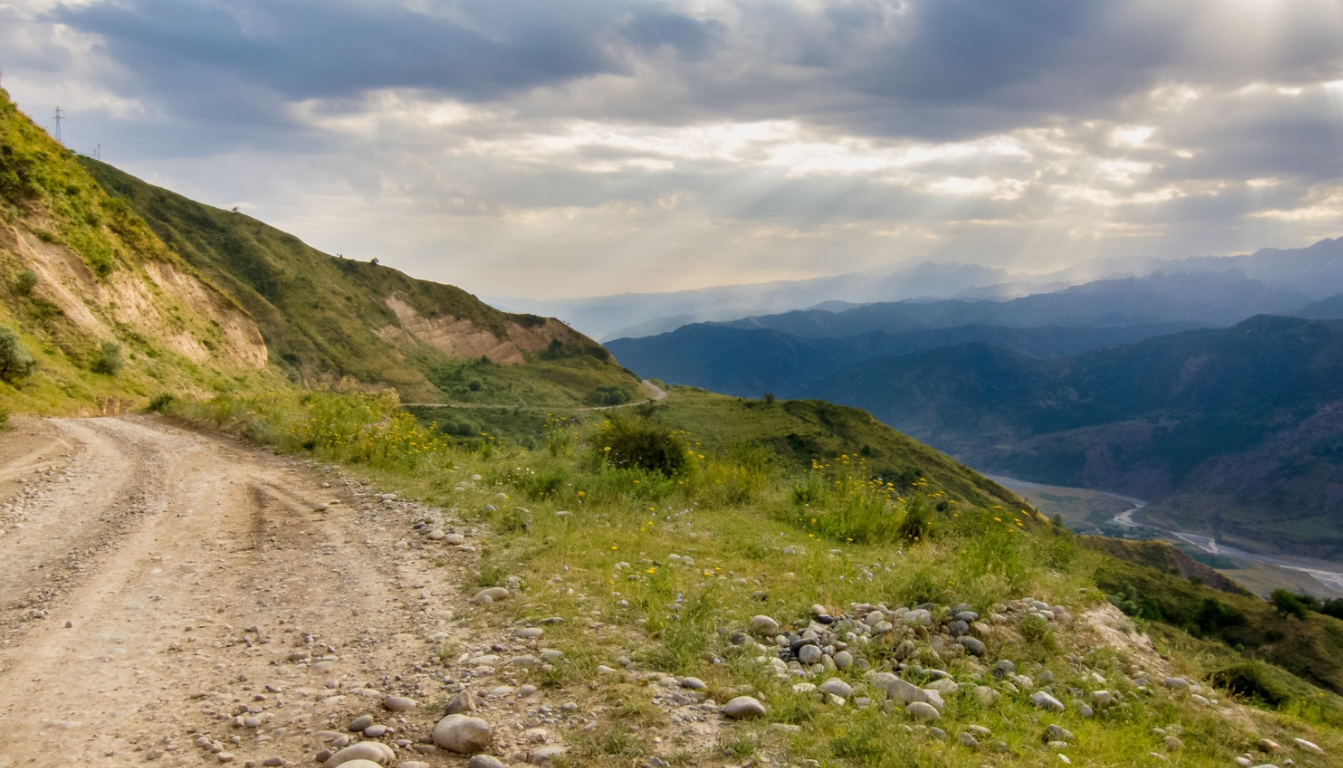
After washing my clothes and hair, I put on some traditional Tajik Atlas printed pants that were made in Dushanbe and hang my wet clothes up in the trees, needing to secure them as the storm is making it’s way closer. My hair tied and wrapped up on my head, I attempt to fix the snapped bolt. The best I can do is to use pliers to tighten the headless screw into the eyelet threads.
The vivid blue sky has now been completely grayed out, and it begins to rain upon me and my damp clothes. I put on rain gear to cut down on my chills and to cover up my wet, yet clean hair. Thinking it’s probably best to stay under this tree for a little bit of coverage, I begin to organize my panniers, as I had dumped everything out digging for soaps and tools.
There is a sound in the bushes behind me…like the sound of something hard falling into dried grass. I stop, there is no one around…what was it, who is it? Another. Then another but it comes through the two meter high trees I’m standing under.
Rocks!? Why are there rocks falling from the sky?
Walking out from under the trees to straighten up, I look around. My left arm is hit with a piece of gravel then “crash” and another “crash”, these are fist-size stones if not bigger.
Across the gravel road and about 15 meters from me there is a cliff, approximately 50 meters high. I see the blonde boy and his dog. The sky is dark and I can barely make him out as he begins to launch another rock, then another.
“Hey! You, I see you!” I shout in English. I had studied Russian for three weeks in Bishkek but when you begin to feel your blood boil it’s not so easy to squeeze out the translated words.
He launches another and begins to pick up another rock. The rocks are getting bigger; the heaved stones have less time between them. His aim is definitely improving too. I again repeat that I see him and he needs to stop while choosing a few four letter words that are understood throughout the world.
The dog is barking and running back and forth along the edge of the cliff. Rocks continue to rain from the sky, overtaking the harmless precipitation that had previously been speckling my body.
During my first few months of tour I learned my “War Cry”, something I didn’t even know existed until it had to be used to remove a man’s body lying atop of me. It came to surface because it’s all I had to fight with. The shrill death cry coming from a woman who feels her existence being shattered from within. This moment wasn’t as frightful as some of my previous battles so I knew it must be conjured up like a masterful magician, or rather a resourceful sorceress.
Now intense feelings, deep buried memories, frustrations are brought to the surface; I allow myself to feel vulnerable and scared. Opening my mouth to inhale has much air as my lungs can take to push the call of anger from my cracked and sunburned lips. As my breathe moves from my guts, I keel over at the waist to make sure that all of these emotions have found their way out of my soul. I let out another and another. Sometimes it feels difficult to stop, releasing emotions that have been shoved deep within my mind for the simple act of survival.
The boy and the dog have now disappeared. I pack up my bike and know it’s time to get out of here as fast as possible. Slightly damp and clean clothes are put back on my shivering body and my clean hair braided, I assumed I would be leaving danger behind.
I had rested my bicycle on her drive-train side, so I could manage repairs. I’m a bit uncomfortable pulling her from the other side so the tire slips down the damp soil. The sharp silver teeth from the triple crank puncture deeply in the front of my right ankle. Water nearby is turning bright red from the blood rushing from my body. There is nothing to do but remain calm.
All I can question at the moment is,
“Did I puncture something important under the skin, deep into my body…I hope this stops…and I don’t bleed out here in the middle of nowhere Tajikistan.”
I’m splashing water on it from the stream, which I know isn’t the best antiseptic to be cleaning an open wound. Especially since I had been watching the cattle bathe and drink from the same water a few meters away, my little pond only separated by a few inches of mud. The bleeding continues…and it’s not letting up.
A Tajik woman is now watching me from the cliff. Too many people are aware of me, I’ve let out the crazy woman “war cry”, and the boy has also returned. I hate, and avoid, confrontation or really any uncomfortable situations in unknown territories. Especially when I can barely speak a few words of the language. In China, I’m more than willing to argue and reprimand as I can speak and understand the culture after living there for more than four years.
I push the bike to the road keeping my eyes on my foot, watching the blood stream down my leg and the dark red beads of blood stream down into my sandals. Another battle scar.
Deciding to walk the bike after the injury, the rocks, the scream, and the storm…just get the hell out of here and to allow myself to find calm physically and mentally. There had been days like this before, when I did not take notice of the omens.
Around the cliff and continuing up stream I am met by an older Uzbek man carrying a stack of newspapers. We communicate through broken sentences and some pantomiming. He has me write my name down on a notebook and invites me to stay at his home for the night, as it’s storming. I politely decline, as his home is about three kilometers downstream. Rarely do I backtrack and I had made little progress over the past 24 hours. We parted with smiles and I continue to walk my bike over the road which had now become loose stones. Experience was telling me I was finding my way off the beaten path.
The next two hours I would be alternating between riding and pushing through loose gravel, slowly going up, then navigating some rocky and steep descents. Once passing a mining community I saw a village inset up in the mountains about ten kilometers away. I would be going over a pass and I was hoping that was not it because of the infinite switch backs for endless miles, or so it seemed. I told the men banging away at new homes where I was headed and they directed me at the fork of the road.
Continuing upstream, I pass a man lounging a top a mound of stones nearly five meters high and he lazily assures me I’m headed in the correct direction. There are many roads branching off this mining road and doubt is beginning to grow within me, with a nagging hint of anxiety. Traversing through mounds of stones, old rusted mining machines and equipment, the road is going up and down and crossing paths with a few massive trucks, so I assume that if I was going in the wrong direction, someone would alert me.
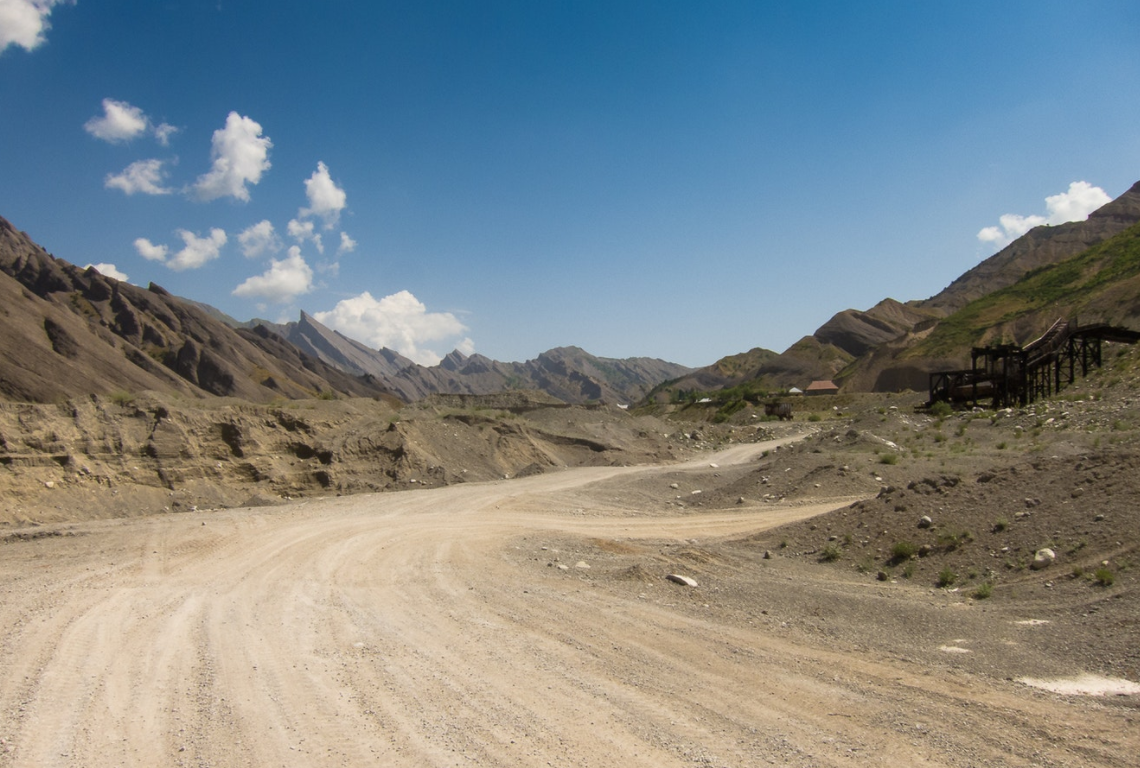
Intense Tajikistan heat and sunshine along the route thorough abandoned, and a few active, mining towns.
Around three o’clock I find myself looking across the raging river that was the source for the water I had been cycling along for the day. The water is coming from the mountains, my right side and snaking to my left and continuing down through the villages I traveled through earlier. There are some trucks to my right, so before deciding to cross the water, I ride the two kilometers up a hill to find someone to speak with or to find an alternative route.
Riding through a few switchbacks and passing a shepherd and his cattle, I arrive in a small work community where mining trucks and Land Rovers are in a parking lot with a few old aluminum-sided buildings. I pass through the checkpoint before two men stop me and tell me it’s the wrong way. With arm movements and finger pointing, they communicate that I must cross the water.
Backtracking to the bank of the water, gulping the hints of fear and anxiety down, I know that if I were to set up camp and wait until sunrise the water would perhaps be lower.
Standing on the edge of the riverbank, created out of massive stones and gravel, my thoughts and apprehension is drowned out by the water beating against the stones and cliffs. The opposite side of the bank is about fifteen meters across and turns into a field of gravel and stones. No sight of a road or tracks. The miners told me this was it; I can’t doubt the directions of locals.
I apprehensively lay the bike on her side, briefly examining the dried blood all over my ankle and foot while noticing the flies enjoy taking a brief rest on the wounds. The water is rough, muddy…it’s bad, nothing I’ve encountered before and I look up into the mountains standing silently, innocently, and curse their summer ice melt.
My recent riding partner, Chris-Alexandre, is about 30 centimeters shorter than I am, so I reassure myself with “if HE can do it, I CAN do it!” Heck, and I’ve been on the road longer and am a well-seasoned veteran. This isn’t a big deal.
“Moseman, you can do this…you’ve been through hell and back, there isn’t anything you can’t defeat.”
Taking a deep breath, standing with my bike to my right and holding the handlebars with a white knuckled grip, I give a good push into the water and the front wheel rolls forward. The front of the bike drops so far down that the water is nearly rushing over my front panniers. The tire doesn’t hit the bottom so I’m pulled further into the water than I anticipated.
My heart skips and stalls when I realize that I’m well over my head in this situation. Water is now brushing along the bottom of the rear panniers and up to my knees. I can feel the front of the bike wanting to be whipped down the river, giving no consideration to the woman between it and the wall of stone further down. The bicycle behaves like a buoy and I think if I can press the front down it will surely help stabilize.
Taking all my might while trying to prevent my body from trembling with fear, this technique doesn’t work. The further the front goes down the greater pressure I feel from my bike, as mother nature’s force is not going to take mercy on me.
Two helicopters are above me, as I had noticed them circling the area all day. I thought maybe they were surveying the high waters. (I would learn the following day that the reason for the helicopters was because a Civil War had erupted in the Pamirs that morning.) I look up, now one is hovering over me. Do they see me, and are they worried for my safety?
The next few minutes would feel like hours, a lifetime, an eternity.
I trudge further into the water so I’m standing next to the left front pannier, pressing my body against the bag with the hope of steading the bike and pushing her back up to the bank. Looking up into the sky, watching the helicopter hover above me, I realize my body isn’t going to be able to stand against this pressure for much longer. What do I need to do to survive this situation to the best of my ability?
It’s very difficult to make a fast, drastic, life-altering decision when fear has taken over your senses. Colors are more vivid, sounds more intense; your heartbeat is pounding in your head while your mind is sitting in the bottom of your guts. Your reality, and world, is spinning out of orbit and you have no idea where you will land or how you will fall. One is left, merciless, to innate instinct; I could only hope that a mere 30 years of existence in this lifetime have taught me a few things for survival.
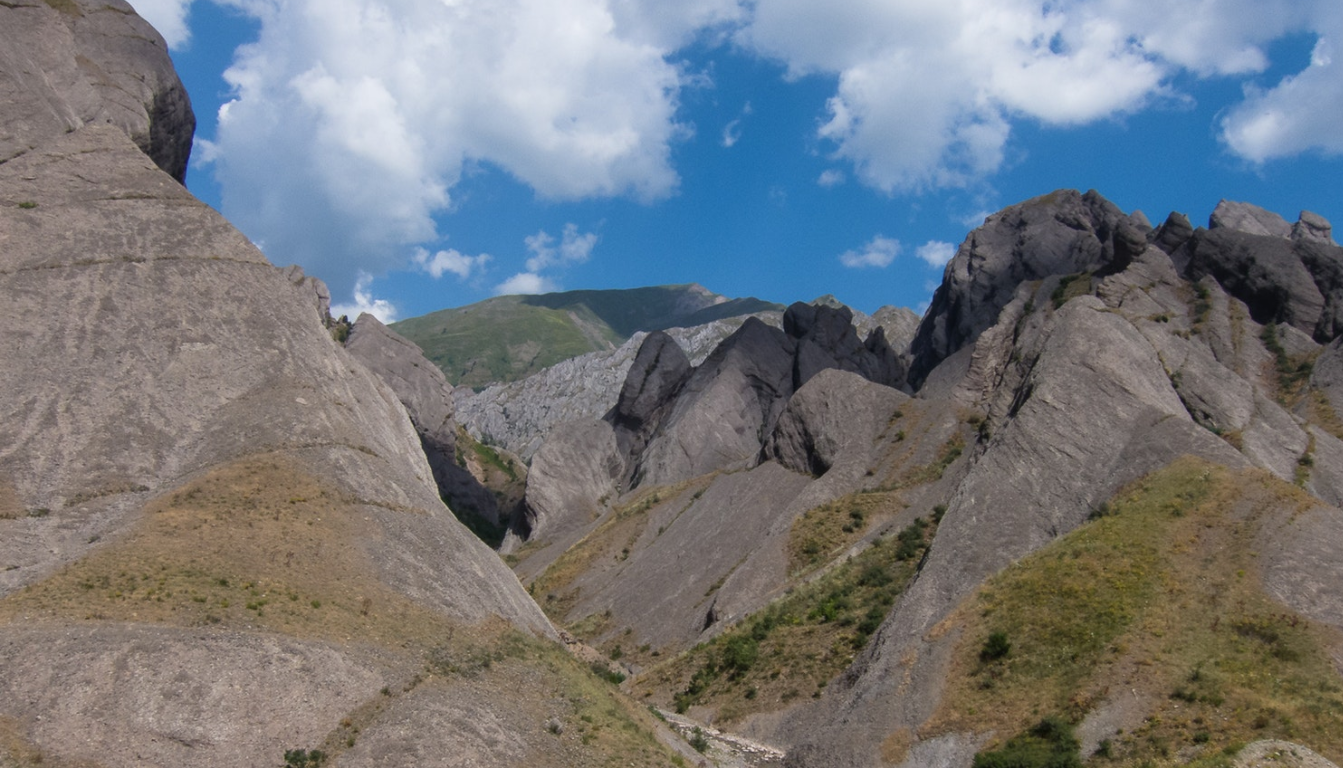
Traveling upstream towards the raging river.
I realise that continually trying to push the bike up the bank, from the side, is not going to work. Gripping for dear life on the handlebars, knuckle bones, tendons, muscles wanting to break through my sun cured, leathered, skin from the desert sun. I move my body very slowly and carefully to the front of the bike.
Attempting to awkwardly straddle the front wheel between my thighs, but still a bit lopsided to the left. The water is well up to my waist, as I stand at 6’ tall. Breathe, relax, concentrate, PUSH.
NO.
Looking up. Am I praying for the helicopter to drop a ladder like I’ve watched on those rescue shows or for the Gods in the heavens to save me? Wanting to raise my arms to wave for help, I know this is impossible as I will lose the bike, my stance, and that I will be swept away before my palms leave the handlebars.
Do I let go of the bike? Do I sacrifice all my gear and let her go? The only possessions in my life for years to be swept away simply because of a completely ignorant and irrational decision?
Did Ego come to play with me by the river that afternoon?
The camera! Just not the camera…my digital files! A year of photos and files are in that back rack bag. The water is not over the rear bags, yet, but if I press my front wheel down the water rushes against my bar bag that has my DSLR, passport, and cell phone.
I look downstream where the river crashes against stone cliffs and then turns left at a nearly 90 degree angle.
Turning my face to the sky and scream “HELP!!” like I’ve never screamed in my entire life. I suddenly realise that I am going to die…my life is going to end, right here, NOW. There is no way my body will survive that abrupt bend in the river. I imagine my body hanging onto the floating bike until it crashes against the stones. How long would I go down the river with my bike…imagining my greatest possessions in life being bashed against stones, thrown around the river, until my lifeless body gives up and nothing would be recognizable?
Long, loud, and wailing screams of help are being released into the canyon, echoing and bouncing around the mountaintops. Finally I see three men watching from the mining area I had been earlier.
“Please, help me, I’m going to die!!!! Help me, PLEASE!!!”
They stand there watching and I know there is no way I can hold this up even if they do come to help.
“PLEEEEEEEEEEEEEEAAAAAAAAAAASE!!! HELP ME!!!!!!” I had tried to bring up my Russian to clarify my meaning but I couldn’t grab the necessary words from the air spilling from my terrified body.
I begin to have images of my mother and father. There is a feeling rushing over me, almost like their presence is near. The images alternate between them; my childhood home and town. It’s more a feeling than imagery. I am going to die, this is the end. With another near death experience in my past because of a car wreck, I know this feeling and it’s growing stronger every moment.
My personal fears are overtaken with the realization my parents will NEVER see me again. They will never be able to say goodbye; not one last hug or kiss. The crashing water will dismantle my undernourished body and they will never see the physical presence of what they had created. I am not fearing my disappearance but the pain I will cause my dear mother and father. Losing my life WILL kill them. I must figure this out, not for my own livelihood but for the sake of those that made the sacrifice of their own lives for mine.
It’s guilt that overwhelms my consciousnesses during those last moments of life. I’ve been selfish. Leaving my friends years ago, ending a long love affair, and not being closer to my parents. Not being a better daughter, sister, friend, girlfriend…a better person.
This would be the ultimate act of selfishness, to let my life be taken away and leave those behind to suffer.
What’s the most important thing on my bike? I’m going to have to try and remove the bags and throw them up on the bank and hopefully lighten the pressure of nature beating against me.
The bar bag: it holds my passport, camera, cell phone, and money. How am I going to manage this balancing act and release the bag to toss onto the river bank? Am I even going to be able to get enough force behind the launch of these essential items? I’m no longer even thinking about the hard drive and year’s worth of files in the back bag. Thousands of photographic images of the persecuted Uyghur minority of Xinjiang, would now be lost and destroyed forever.
A split second after I release my hand to reach for the bar bag release, the bike is thrown on top of me and I’m pinned under the freezing water with the top tube against my collarbones.
All my gear is completely submerged and I visualize my photo gear and files being flooded by the brown silt-filled water. The current turns me counterclockwise and I’m facing my death, heading straight towards the bend in the river and the unforgiving stone wall.
My parents are now standing before me in a grayish and hazy cloud, arm in arm as I remember them from my childhood. This is the end, you will never see me again. It’s over. This is going to kill you both, so much more pain for you two and I will realize none of it.
I can’t…it just can’t happen this way.
Two meters down the river and somehow I’m pulling myself out on my back, with my eyes finally opening, I crawl onto the bank with my face to the sky and the bike still on top of me.
The plastic bin that holds my food, cooking supplies, and a book had been pushed out from a tight bungee cord and are now moving swiftly down the river.
Within a few more seconds the bike is clearly out of the water and I’m examining myself for serious wounds and seeing the water line on my shirt nearly hitting my shoulders.
There is no time to cry, no time to panic, not even a chance for recovery and to smack myself to see if I’m actually still ALIVE because the bags have been flooded and I have to get my gear out to dry.
Unloading the bags trembling, shaking, teeth chattering, absolutely exhausted. This shouldn’t be happening, but it has and it’s my fault. I should have known better, I’m an idiot. Beginning to cry, the first in years…not heavy and heaving because I’m too exhausted...but silently with big crocodile tears rolling down my sunburned cheeks.

Drying all the gear after being soaked in the muddy river.
A coal mining truck eventually comes to my rescue and takes me across the water explaining to me that they saw my friend earlier. They would leave me at the base of the pass that was a meter wide stone path. Pointing up, telling me that’s the direction I must go.
We unload and they leave, after plenty of “rexmet” and my right hand over my heart. The first friends, a meeting of souls, I would have for this second chance at living. Or, were they simply angels that had descended that mountain in a steel chariot on massive wheels to only escort me safely over Sytx to the “other side”? These days, dreams and reality intermingle too much for me to ever make sense of the dividing lines.
Dumping all my bags next to a pile of rusted mining equipment for the hot Tajikistan sun to dry, I let it out. The tears are running down my face, all over my shirt, losing my breath because of exhaustion of nearly drowning and now the emotional melt down.
There is no longer a fear of death, was there ever? Perhaps my fear has been more directed at living? What do I fear? Fear prevents movement, progress, growth...this is not me. Maybe I don’t define and experience fear as many do.
I’ve pushed the limits, and beyond, more than most will ever in an entire lifetime. My fear is of the torment I would cause others; I nearly lost my life only to cause others a life-long mental and emotional death. Near-death stories often tell how the hero sees fleeting images of his lover, his children, and his close friends and feels grief stricken that he will never see them again. This was not the case. I saw the only two people who gave me life out of love, lose one of the greatest things that they’ve created and nurtured in their lifetimes.
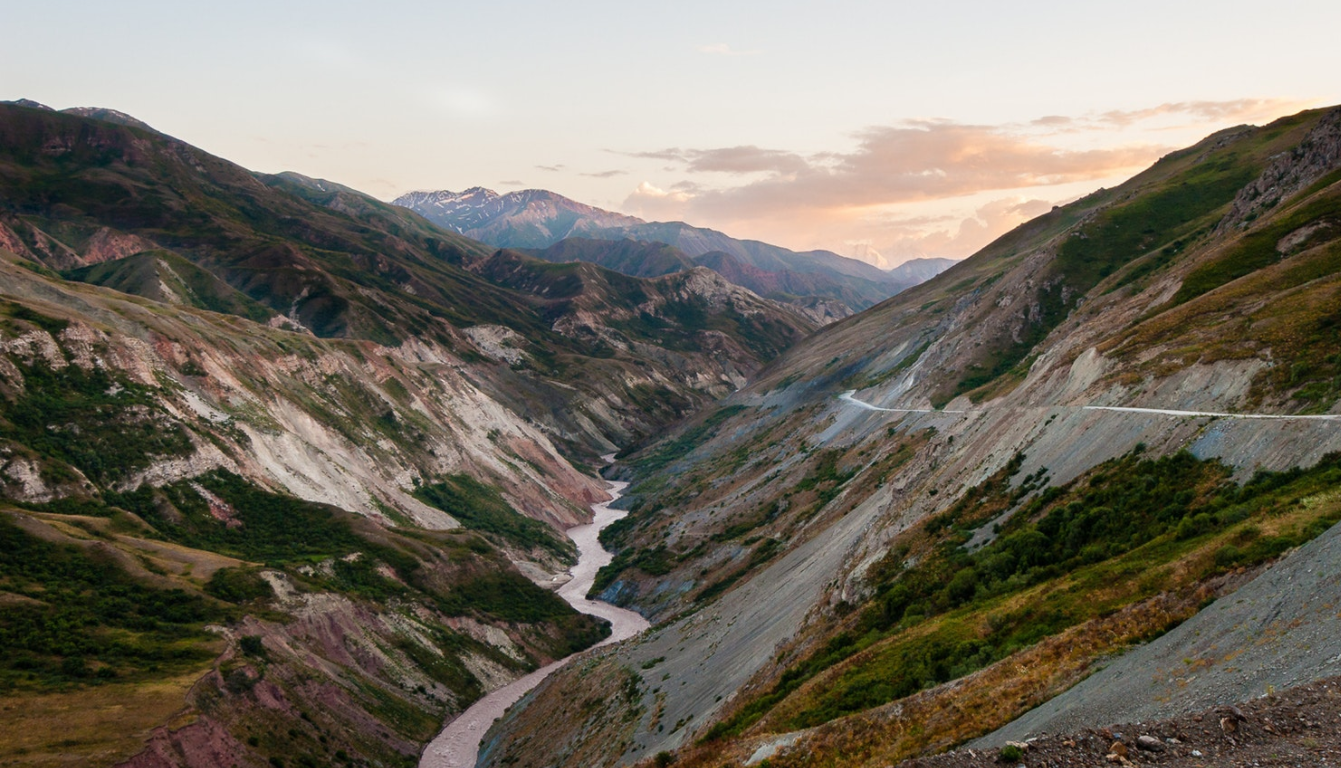

Sunset looking back into the Pamirs from the Kyrgyzstan and Tajikistan border, “no man’s land”.
Momma and Pops raised me to believe that I must live life for myself, but I have learned that one of my responsibilities is to hold onto this life for those who love and need me.
This simple existence and lifetime isn’t for my benefit, but for those who my soul has intermingled with. I vow then to continue to travel within this life, full of passion and conviction, using my personal power and inner strength to overcome whatever obstacle may stand in my way.
Whether man, beast, machine, or my own inner demons...I must go on for there are those who are counting on me, and my many safe returns.
THIS ARTICLE WAS ORIGINALLY PUBLISHED ON MAPTIA.
ELEANOR MOSEMAN
Photographer. Storyteller. Exploring spectacular lands and sharing the stories of the beautiful, and mystical, inhabitants of Asia. www.eleanormoseman.com