For generations, the Kombai hunter-gatherers have lived hidden deep in the forests of West Papua. First coming into contact with the outside world less than forty years ago, today their unique and self-sustaining way of life — from their reliance on the sago palm, to the tree houses they construct — is under threat.
Flying towards the tiny village of Wanggemalo, the valley is filled with a canopy of dense forest, wildlife, and no visible human presence for hundreds of miles. In this hot, swampy region — one of the wettest on Earth — the elusive Kombai hunter-gathers, along with many other indigenous groups, have remained hidden for generations.
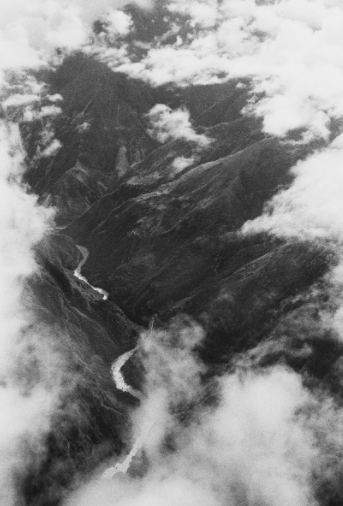
Seven metres of rain fall per year in West Papua’s lowland forests, which are rarely more than a few metres above sea level.
Living in small isolated family groups, it was less than forty years ago when a Dutch missionary made a controversial ‘first contact’ with the Kombai. He was reportedly fed human meat by his hosts, and fled.
Today, their numbers have dropped to around 4,000 individuals. The relentless tide of logging and mining activities is steadily encroaching on the territory of the Kombai and their neighbours, and the ongoing violent conflict in the region — between the Indonesian military and those who believe in independence for West Papua — continue to threaten these peoples and their way of life. Human rights groups claim that since the contested Indonesian occupation of West Papua began in 1963, an estimated 100,000 natives of the island have been slaughtered by Indonesian soldiers or have ‘disappeared’ in the last half-century.
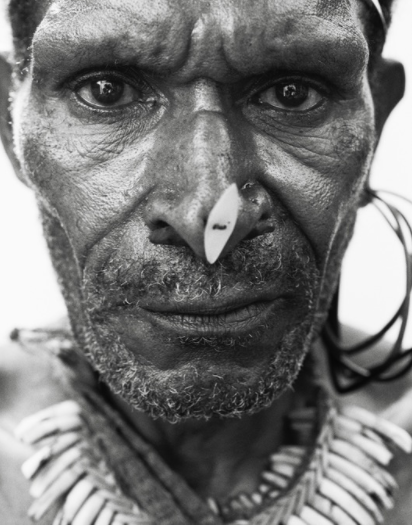
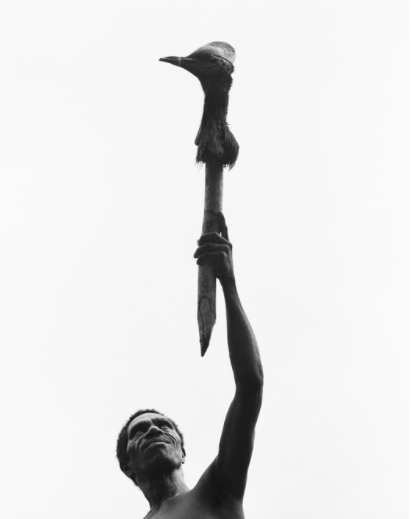
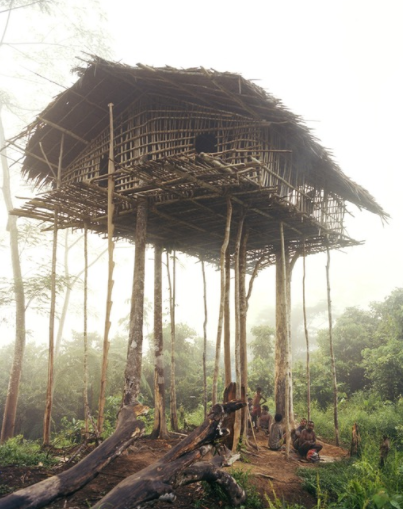
Kombai hunter wearing a necklace made of dog’s teeth / Head of a cassowary bird mounted on a staff / Traditional Kombai treehouse
The expedition on which the photographs in this story were taken, was in 2008, and in many ways, would come to have a profound impact on me.
Leaving the miniature makeshift airstrip at Wanggemalo behind, we headed into a remote part of the Papuan forest. Around twenty local porters formed a quarter-of-a-mile-long procession, carrying our supplies and tents for the intense two-week-long trek. Some of the porters had been hired to help carry my photo equipment, stands and backgrounds.
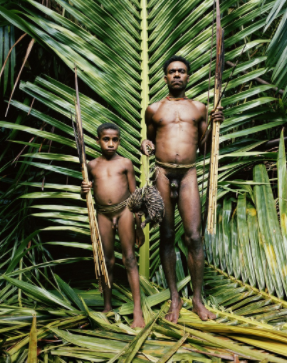
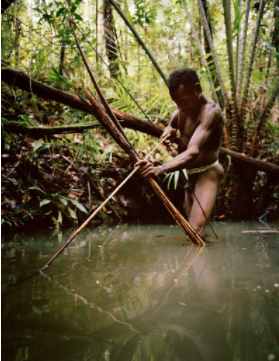
Kombai father and son, with their traditional weapons and catch of a small marsupial / Kombai hunter fishing in a forest stream
Our trek took us a few days deep into the hot and humid forest, before we reached Kombai territory. Constantly covered in insect repellent, as the risk of malaria was very high, my guide had warned me that when it rained the conditions could become a quagmire of mud and very challenging. Fortunately we did not experience that kind of weather.
According to Kombai tradition, when strangers are approaching a treehouse, including invited guests, they are stopped by men armed with bows and arrows, and forced to prove that they mean no harm.

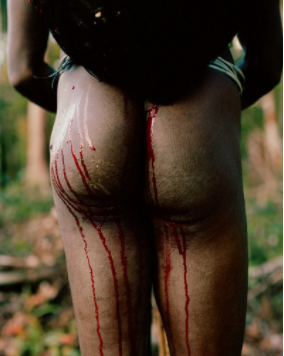
Young Kombai carrying a freshly killed piglet after a successful hunt in the forest, with blood pouring down his lower back.
Day-to-day, the men use their bows and arrows — crafted from cassowary bones and dry sugar cane stick — to hunt a wide range of prey in the surrounding forests, including cassowary birds, marsupials, and wild boar and pigs, often using small dogs to help track down and kill animals. The Kombai also fish in the many streams, by building small dams, and then beating the poison from a particular toxic root into the pooled water. This forces the fish to the surface, where they are easily captured.
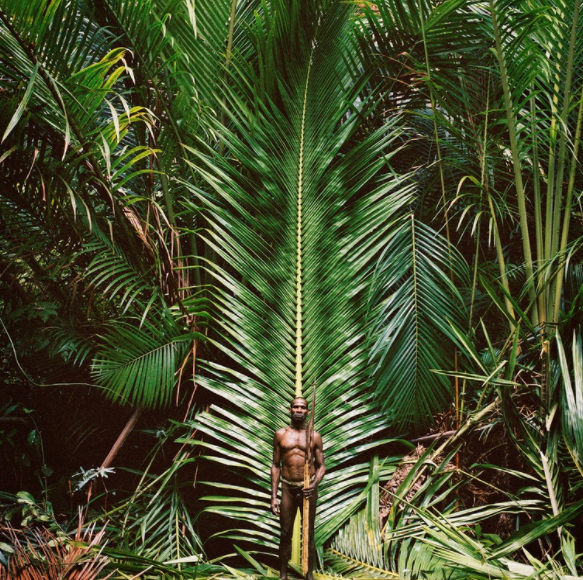
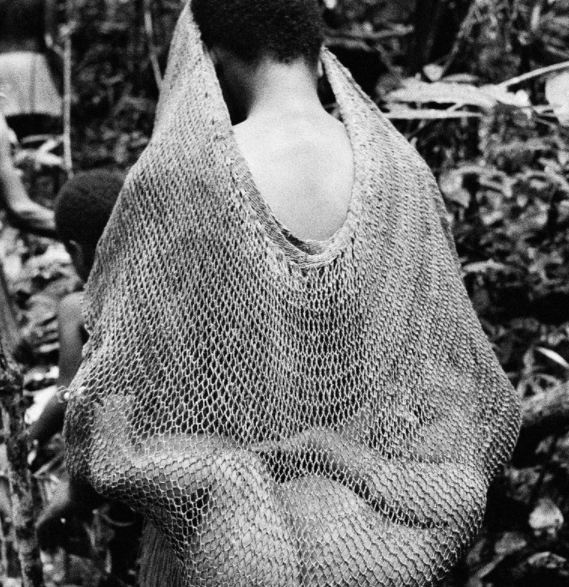
Kombai mother carrying her child through the forest in a root bag / Kombai hunter standing in front of a giant sago palm leaf
As food is abundant in the forest, none is stored, and it is the sago palm tree that provides the Kombai’s staple food — acting as their main source of carbohydrate. In addition to their role as hunters, the men are responsible for cutting down the sago palms, which grow in clumps of a few dozen, wild in the forest. Once felled, the women and girls will then drain and dry bundles of starchy pulp extracted from the inside of the palm, before pulverising it into flour and baking a kind of bread. A large sago tree can provide enough pulp to sustain a family for at least a week.
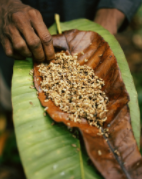

Aman is eating sago out of a leaf / A Kombai drinks water from a stream out of a leaf
The sago tree also provides a particular delicacy and treat for the Kombai: the sago grub, which is actually the larvae of the capricorn beetle. In order to harvest these grubs, they will cut down a sago palm, leave it for a month, and then wrap the trunk in leaves while it continues to rot. Three months later, they will return once again to collect the grubs. Both the Kombai, and their neighbouring tribe, the Korowai, have traditionally held special festivals, usually every five or ten years, to feast on these grubs and renew social ties. The grub is a luxury, and it is customary for the hosts to feed each one of their many guests before eating themselves.
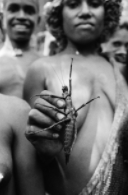
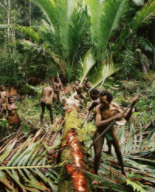
Giant cricket / Kombai men cutting down a sago tree and the size of the many insects in the forest was mesmerising. The natural environment, the trees, the birds — they all had an extraordinary quality.
The size of the many insects in the forest was mesmerising. The natural environment, the trees, the birds — they all had an extraordinary quality.
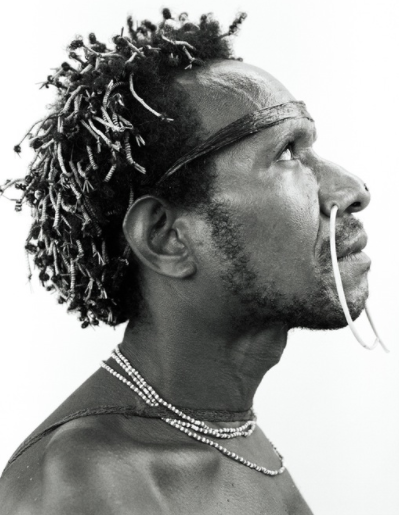
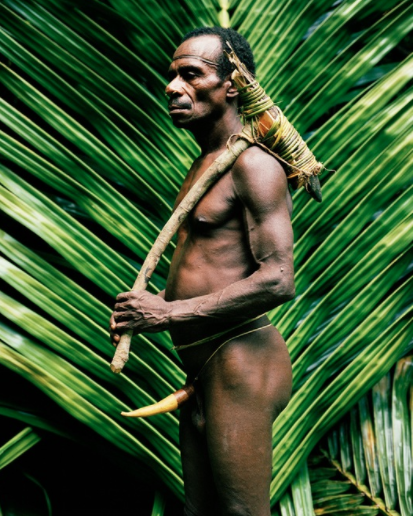
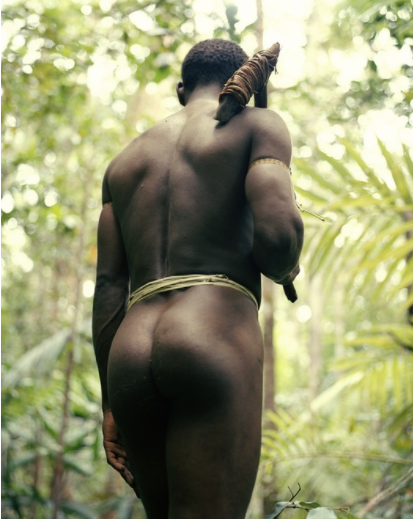
Many Kombai pierce their noses with a sago thorn / Kombai men start wearing penis gourds during puberty / Kombai hunter with his stone axe
The forest also provides the Kombai with materials for their traditional garments. The men wear little apart from a koketa, or a penis gourd, which seemed to be made from a bird’s beak. Some of the men we met also wore necklaces made from dog’s teeth. A few times during our stay, I was asked why I was wearing clothes, and was told that it would make my hosts less afraid and more at ease if we were all naked. Meanwhile, the women fashion grass skirts, and as a sign of beauty also wear crowns made of dry moss or feathers, including those of chickens and cockatoos. Mothers will often carry their babies through the forest in root beerags, woven out of fibrous strands, with the load resting on their foreheads.
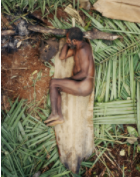
Colourful forest beetle / Kombai hunter at rest
Although machetes and metal knives are becoming more common, most Kombai men still carried and used a homemade axe composed of a piece of rock wrapped around a tree branch. Often the stone had been traded for hundreds of miles away, and kept in the family for generations.
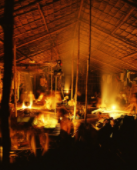
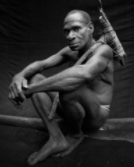
Inside a Kombai treehouse ‘kitchen’ / Kombai hunter seated on a palm tree branch, carrying a handcrafted traditional stone axe
High above the ground, the Kombai’s tree houses are reached by scaling a tree trunk that has steps carved into it, to form a ladder. It is thought that their tree houses evolved as a method of protection from raiding enemy tribes, and the roofs are created using the giant leaves of the sago palms.
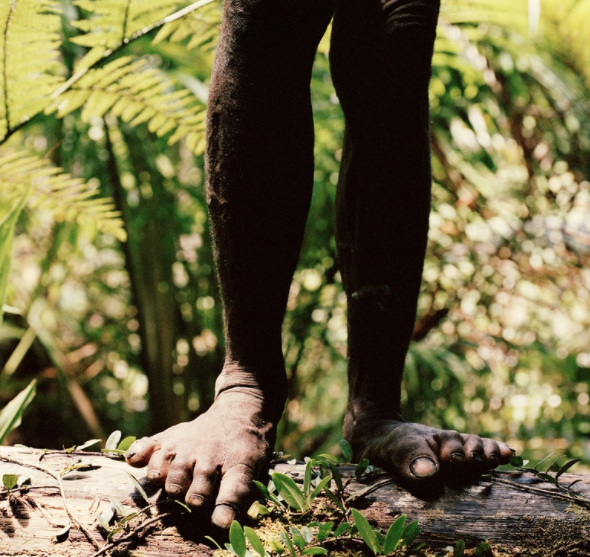
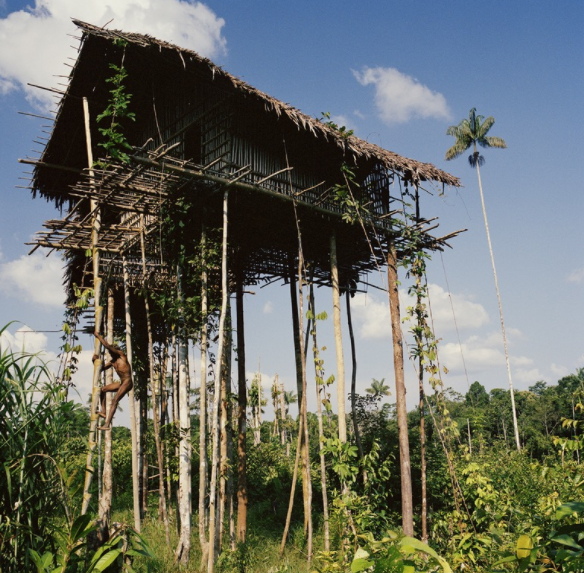
Descending a stepped trunk from a Kombai tree house / The Kombai are intimately connected with the forest around them
While living with the Kombai, I learned that only the men will sleep in the tree houses, while the women will sleep in small houses on the ground. I wondered about this apparent division between the men and women, who for the most part, spent their days apart and did not eat or sleep together. When they shared moments of intimacy remained a mystery.
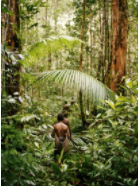

Hunters advancing in the forest, looking for pigs and cassowary birds / Kombai couple
Kombai life is suffused with belief and rituals linked to both benevolent and evil spirits. The forest is divided into clan or family territories, but there are also areas where no clan will live, as these are thought to be inhabited by spirits. Historically, it was seen a grave threat for a stranger to enter a clan’s territory, and it is interesting that the word for a spirit in their language, kwai, is also the word used to describe an outsider.
In traditional Kombai culture, men who have been identified as evil, called Khakhua-Kumu, are believed to consume the souls of their victims, and must be killed or eaten in return. Reports vary as to whether or not cannibalism is still practised as a punishment among the Kombai today.
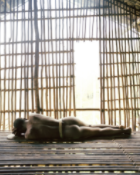
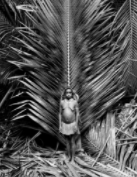
Hunter at rest in a tree house / Kombai woman standing in front of a giant sago palm leaf
It was hard for the Kombai to fathom or understand what I was trying to achieve with the strange and utterly unfamiliar device that I was pointing at them. Asking whether they would mind standing still for a few minutes for a particular pose was often very challenging, as my unusual requests had to be first translated from English into Bahasa Indonesian, and then from Bahasa into the local Kombai language.
Although I could not communicate with the Kombai except through a translator, I was able to observe a few of the characters with whom we were spending time. Most of them were hunters. I remember them laughing a lot, and it seemed as if they were in the habit of constantly cracking jokes at each other. They certainly had a good sense of humor.
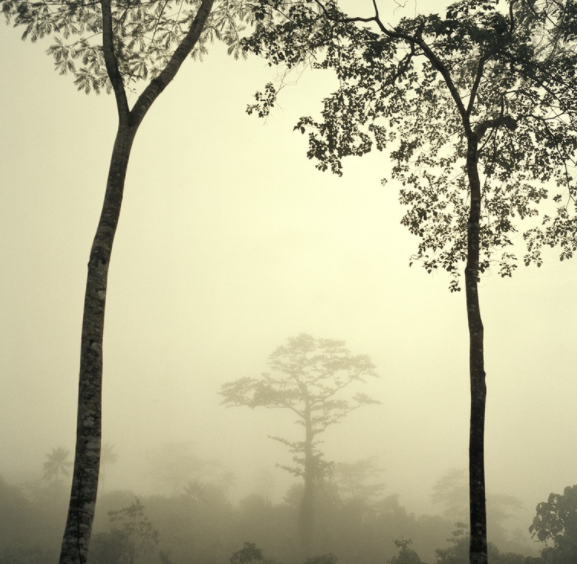
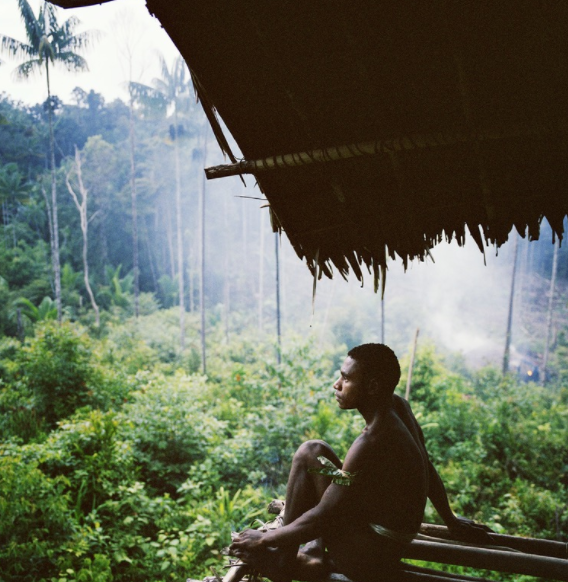
Mist in the early morning / Kombai hunter scrutinising the forest from a tree house
The time I spent with the Kombai was a very introspective one. So often during my stay in their pristine natural environment it seemed quite unbelievable and incredible to think of the life and the material world that I had left behind in New York, and to which I would be returning in just a few weeks — there was a chasm of thirty or forty thousand years between my life and theirs. Those moments felt like an out-of-body experience, thinking that this was the way of life we all once came from.
I was millions miles away from New York and all the hassles that living in a big modern city bring. This trip, I would realise weeks and months later, was to have a deep lasting effect on me and to be a life-changing event in many ways. Most importantly, it put a great many things into perspective. Once back home, I thought very often about my startling and unusual time with the Kombai, and I found that the everyday stress and worry had a very different impact on me. It was truly a remarkable effect.
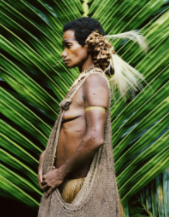
Kombai women wearing a moss crown and feathers as a sign of beauty, also carrying a traditional root bag.
Today, Kombai lands and their traditional way of life in the forest are under great threat, particularly from deforestation. For decades, the island has ben plagued by political unrest, mining, logging, unscrupulous traders, inter-tribal conflict, controversial missionary influences, and human rights atrocities committed by the Indonesian military.
Though the remote, inaccessible areas of virgin forest where the Kombai live are some of the last to be reached by outsiders, they are now being subject to powerful forces beyond their control. Many other groups are still actively fighting for independence for West Papua, and it is important that peoples like the Kombai somehow have a voice in the future of the lands that their ancestors have inhabited for many thousands of years.
THIS ARTICLE WAS ORIGINALLY PUBLISHED ON MAPTIA.
FREDERIC LAGRANGE
Frédéric Lagrange is a photographer & director based in Brooklyn, NYC shooting for a diverse range of editorial and commercial clients world-wide. Follow the journey on Instagram @fredericlagrange.