
This short film is the story of a road trip in India. The filmmaker, Georgy Tarasov, traveled 14,000 miles across 15 states for a 3 month long adventure.
You must not lose faith in humanity. Humanity is an ocean; if a few drops of the ocean are dirty, the ocean does not become dirty.

I live my life in widening circles that reach across the world.
We should consider every day lost in which we do not dance at least once.

When should one boycott a country?
WHEN I WAS A SOPHOMORE in college, I went on Semester at Sea. It was a 4-month study abroad program that sailed around the world. Shortly after I was accepted into the program, I was sent an email with two pretty big surprises in it: first, Nobel Peace Laureate Desmond Tutu would be sailing with us for the entire voyage. Second, as a precondition of Tutu joining us, we would now be skipping our planned stop in Burma and would be going to Malaysia instead.
Tutu had insisted on this change because his friend, Burmese leader (and fellow Nobel Peace Laureate) Aung San Suu Kyi had called for a tourism boycott to Burma. Tutu had cut his teeth in the South African anti-apartheid movement, which conducted a similar international boycott over the course of several decades. The international solidarity, Tutu claimed, was essential for bringing apartheid to an end.
This led to a huge debate on the ship: a lot of people really wanted to go to Burma, and argued that the cultural exchange was valuable and worthwhile. They also argued that we could visit Burma in a way that wouldn’t be supportive of the oppressive military regime that Aung San Suu Kyi and her National League for Democracy were fighting against. We could, they argued, make sure our money would go to the right places.
In the end, we didn’t go to Burma. Several years later, Suu Kyi and her NLD lifted their call for a tourism boycott as the country started to transition towards democracy. But since then, I’ve heard a lot of calls for tourism boycotts to certain countries. It’s a question worth examining: when is it right to boycott a country? When is it wrong? When is it just pointless?
When are boycotts pointless?
During the Bush years, I heard conservative friends and family members say more than once, “I’ll never visit France after how they bailed on us in Iraq.” It was usually uttered by people who were using patriotic fervor as an excuse to skip a country they were never planning on going to in the first place, but sometimes, conservatives who might otherwise have enjoyed a trip to Paris decided that they needed to make a moral stand. No France for them. That’d teach France to bail on America, “and after we did so much for them in World War II.”
The correct response to this type of crap is “ugh,” but lefties and liberals shouldn’t get too smug: I’ve heard plenty of my activist friends suggest they were boycotting a country as well, whether it was of Japan (because of their treatment of dolphins and whales), of Thailand (because of their Tiger Temple), or of Russia (because of the Russian government’s oppression of journalists).
Boycotts can be well-meaning and still be useless. The one case in which they are always useless is in the case of the personal boycott. If you are boycotting a country for moral reasons, that’s just fine, but don’t delude yourself into thinking you’re making any sort of difference. Boycotts are an expression of political (and sometimes economic) power. By saying, “I refuse to engage with you,” you are basically saying you don’t think that country is legitimate, and that it does not deserve your support.
The truth is that, unless you are a very high-profile person, a single person boycott of a country is meaningless. It’s just not a large enough expression of power to make a noticeable difference and to affect any change. Had Rosa Parks been the only person to boycott the Montgomery, Alabama bus system, the gesture would have been noble but totally futile. It was when hundreds of people (including high-profile leaders like Martin Luther King, Jr.) joined that the boycott really did what it was meant to do. A boycott, to be done effectively, must be done collectively.
When is a travel boycott effective?
I’ve developed three tentative rules to when you should consider a travel boycott.
1. You must have power over whomever you’re boycotting.
You can’t boycott something you don’t have any power over. This is why, for instance, it would be impossible for Americans to arrange a travel boycott of North Korea (1): we simply don’t go there enough for the withdrawal of our tourist dollars to make any difference. It’s only countries that we have a healthy relationship that we can effectively boycott.
A boycott is effectively saying is, “You’re not playing by rules that we accept, so we refuse to play with you.” You can’t threaten to walk off when you weren’t playing in the first place.
2. Money isn’t enough: You must have the ear of the media.
The economic results of boycotts are tough to gauge. The Boycott, Divest, and Sanction (BDS) (2) movement against Israel has been going for over 10 years, but hasn’t necessarily resulted any tangible economic loss for Israel (3). The boycott of South Africa, on the other hand, is widely considered to have been a success in economic terms.
But ultimately, whether the BDS movement or the cultural boycott of South Africa had any real economic effect isn’t the point. The point is in getting enough media coverage to draw attention to the injustice and, presumably, to shame the perpetrators. As I write, this is happening in North Carolina, where a recent anti-LGBTQ law has resulted in New York Governor Andrew Cuomo boycotting travel to the state on official business, in Paypal pulling jobs from the state economy, and in rocker Bruce Springsteen canceling a NC concert (which, for me personally, is literally the worst punishment I could imagine).
Yes, these moves may cost North Carolina money here and there, but more importantly, they build a political and social momentum behind the movements they support. It was not, in the end, economics that ended apartheid. It was external pressure worldwide (pressure which had to come from the grassroots, as leaders like Ronald Reagan supported apartheid), and volatile internal politics which brought about the end of that regime. Boycotts can be a powerful symbol that raise awareness of an issue and turn public opinion. If they succeed in this regard, whether or not they’re effective economically is beside the point.
3. Boycotts have to have an internal element.
Boycotts have more moral clout when they’re done in solidarity with people from within the place you’re boycotting. In other words, if local people say, “don’t boycott us,” then don’t (4). So when the ANC and leaders like Desmond Tutu called for the rest of the world to boycott South Africa, it gave the boycott legitimacy. When Aung San Suu Kyi called for tourists to not visit Burma, it gave the boycott legitimacy. When Palestinians or liberal Israelis support the BDS movement, it gives the movement legitimacy.
Boycotts that are done entirely externally — as in you and your friends unilaterally deciding to boycott France because reasons — aren’t effective, and can be perceived as bullying, because you’re attempting to impose your morality on another country. If you don’t agree with someone’s morals, it’s usually better to talk to them and try and find common ground than it is to simply shut them out. But if you and your allies within that country are within agreement, and your allies think a boycott’s a good idea, then it may be worth giving a try.
So should I participate in travel boycotts?
The answer to this, I’m sorry to say, is annoyingly ambivalent: Sure. If you want. In some rare cases. Boycotts just too rarely achieve that rare combination of effectiveness and legitimacy to be worthwhile (5). Philosopher Peter Singer told Traveller.com.au of travel boycotts:
“A boycott may be one way of getting some leverage on [political issues] when nothing else seems to work. But I don’t think that there is a general obligation to boycott all countries that are doing something unethical.”
The reason, he said, is because boycotts are only really effective when they’re accompanied by a public campaign. And it’s worth noting that there’s no such thing as a totally ethical country. You should definitely not boycott a country that there’s not already an organized boycott against unless you want to undertake the gigantic effort of organizing the boycott yourself. And in all honesty, there may well be much better ways of pushing your agenda politically than through a boycott: frequently, you may be able to push your government to act instead.
Boycotts really only make sense when they’re an attempt to undermine your government’s action: in South Africa and Israel, the US Government has acted in response to perceived geopolitical interests rather than in response to human rights standards, so those places make sense to organize boycotts around. In North Carolina, Indiana, and other states that have enacted anti-LGBT laws, the boycotts are in response to actions by the government itself. In these cases, participating in boycotts may be the just and right thing to do.
That said, there are totally legitimate arguments for not participating in boycotts, from supporting locals who may be unfairly harmed by a boycott, to simply pursuing other forms of protest and resistance that you believe would be more effective. Paul Simon’s breach of the UN-approved cultural boycott of South Africa during the making of his album Graceland was extremely controversial, but in the end, he used the breach to give an international platform to black South African musicians like Ladysmith Black Mambazo and Miriam Makeba. While it may not personally have been my choice — and indeed was not the choice of many activist musicians, from Springsteen to Bono to Queen — it is conceivably justifiable.
It’s worth noting, though, that Paul Simon’s breach was at least thought-out and intentional. He didn’t simply ignore the cultural boycott for personal profit: he attempted to make things better for South African musicians. So if there’s a movement that you find yourself aligned with, and they are calling for a travel boycott to a country you want to visit, you certainly may decide to go anyway, but going will only really be justified if you engage in some other political act.
In the end, the only real sin, if you believe something wrong is being done, is silence. If you feel your voice is best heard through a boycott, go for it. If you feel you can speak out in a better way, feel free to do that instead. Just don’t do nothing.
Footnotes
1. Americans shouldn’t travel to North Korea anyway: they frequently charge American visitors with barely-supported crimes and then hold them as bargaining chips.
2. Something quick I should mention: the BDS movement hasn’t really singled out travel as a priority in their boycott movement. They’ve focused more broadly on academic boycotts, culture boycotts, divestment, and the boycotting of certain Israeli businesses. I mention them here because it’s the highest-profile active boycott movement.
3. This is totally debatable, but the lack of consensus on whether or not the boycott has worked kinda proves my point.
4. This gets tricky, of course, when you have multiple groups saying different things. At that point, you have to listen to arguments and side with the group you agree with the most.
5. Excellent ethical travel sites like Responsible Travel don’t advocate travel boycotts except in rare exceptions like Burma.
THIS ARTICLE WAS ORIGINALLY PUBLISHED ON DON'T BE A DICK TRAVEL.
MATT HERSHBERGER
Matt Hershberger is a writer and blogger who focuses on travel, culture, politics, and global citizenship. His hobbies include scotch consumption, profanity, and human rights activism. He lives in New Jersey with his wife and his Kindle. You can check out his work at the Matador Network, or over at his website.
The first condition of understanding a foreign country is to smell it.
No matter how you travel, it's still you going.
The test of our progress is not whether we add more to the abundance of those who have much, it is whether we provide enough for those who have too little.
Life on the Margins
During the northern summer of 2001 thousands of Chinese security personnel, backed by an army of labourers armed with sledgehammers, massed at the entry of the Larung Gar Tibetan Buddhist Institute. In this almost impossibly remote place, sitting high on the Tibetan Plateau, 9,000 monks and nuns had found a home, defying decades of China’s aggressive atheist policies to learn from its charismatic and avowedly apolitical founder, Khenpo Jigme Phuntsok.
PRC authorities had long been skittish about the institute’s remarkable growth, and particularly alarmed by its growing appeal to ordinary Han Chinese. By 2001 over 1,000 Han also called Larung Gar home.

The Larung Gar Five Sciences Buddhist Institute.
Both Larung Gar and Yarchen Gar (gar translates as camp) have remained largely hidden from the outside world, as much because of their inaccessible geography as the tight controls on freedom of movement put in place by the Chinese government. Both sit at elevations of over 4,000 metres, sunk deep into hidden valleys of the Hengduan mountain range, which cuts across China’s south-western Sichuan province.
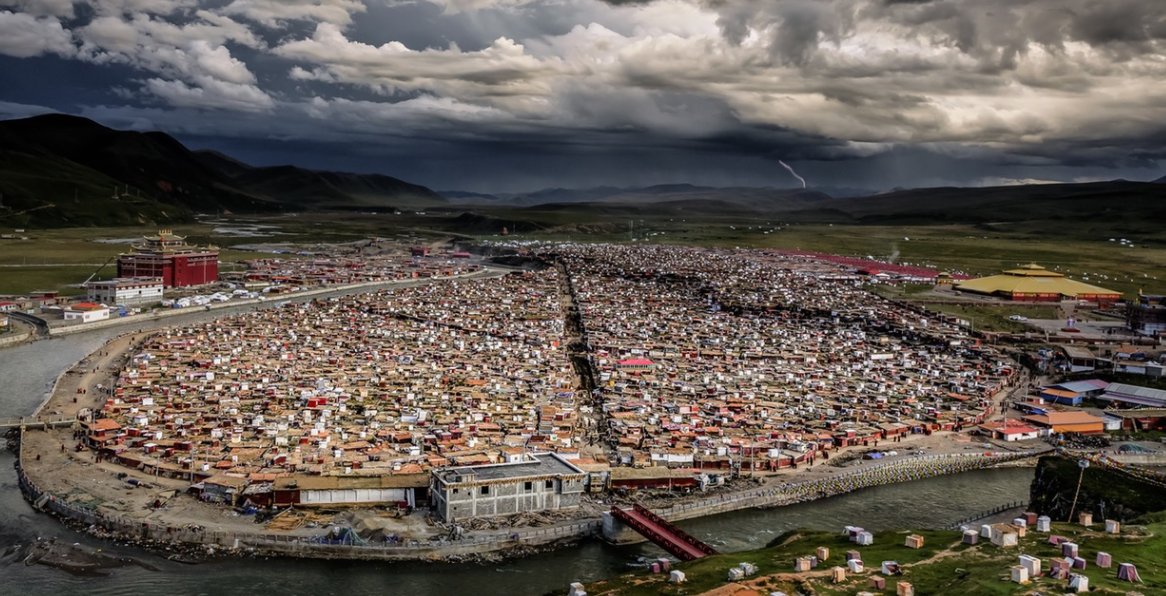
Yarchen Gar sits hard against the border of the TAR and is home to roughly 9,000 nuns.
Both Yarchen and Larung Gar are part of what is known as the Garzê Semi Autonomous Prefecture, where 77 percent of the inhabitants — some 800,000 people — claim ethnic Tibetan heritage. As is the case in the similarly named Tibetan Autonomous Region (TAR), the people’s future has long been out of their own hands.
In theory, to move around Garzê as a foreigner, one only needs a Chinese tourist visa and bucket loads of time, patience and fortitude. This is in stark contrast to the neighbouring TAR, at the border of the lands known to the wider world as ‘Tibet’. Visitors to the TAR are required to first negotiate a complex and shifting permit process, before joining an organised and highly controlled tour of the region.
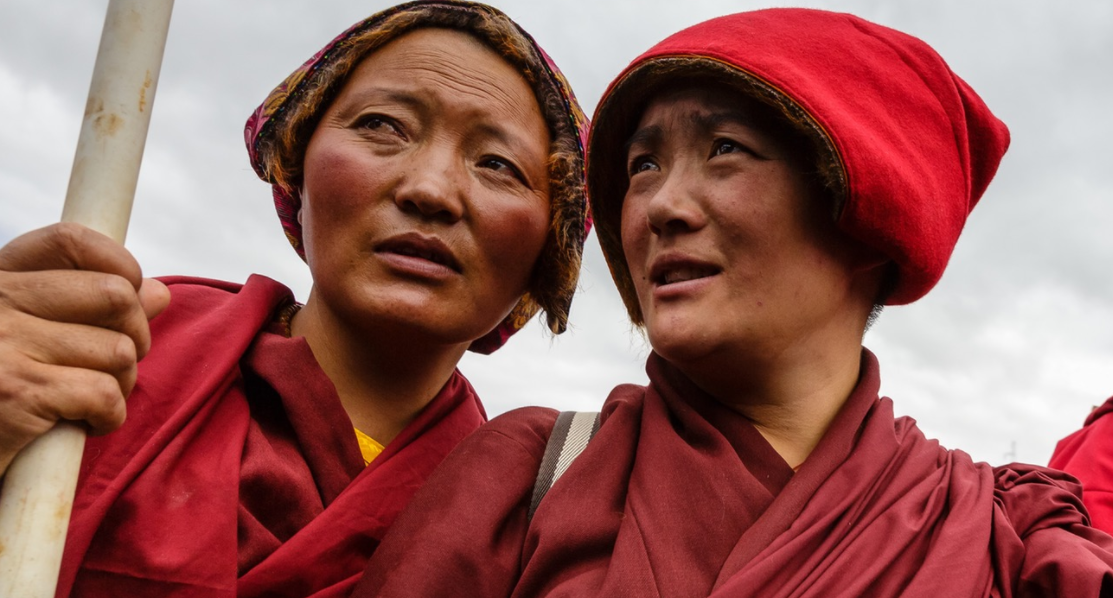
Nuns at a ceremony at Yarchen Gar in which almost the entire population of the camp leaves for a month of meditation in the surrounding hills.
Yet Garzê and nearby Qinghai are also restive. Tibetans here have openly protested against Chinese control, most notably as part of a violent uprising in 2008. Referred to by the Chinese as the 3-14 riots, unrest had spread from the TAR into Sichuan. This unrest effectively slammed the door shut to the region’s hidden treasures until 2013. Today, despite relative calm, nuns and monks continue to take the extreme measure of self-immolation in towns and villages. Reports of random arrests and the disappearance of accused activists are common. Recently Garzê has been open, yet regulations can change overnight and information is scarce.
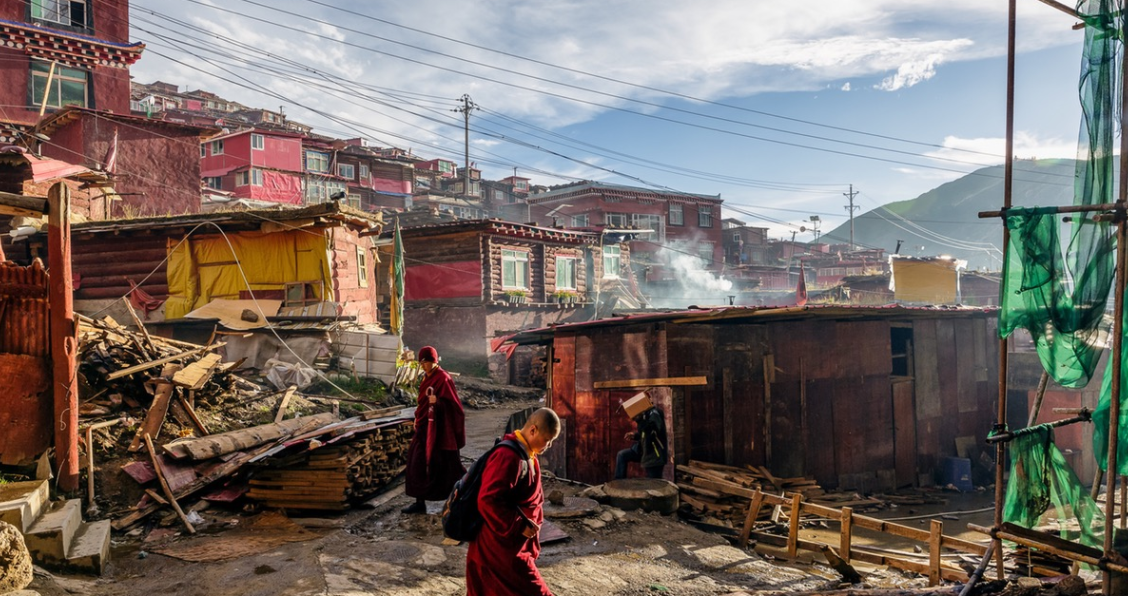
The narrow, winding alleyways of Larung Gar.
During China’s breakneck boom the mountainous Garzê region represents ground zero in the great ‘go west’ campaign — viewed by the People’s Republic as integral to the rapid growth of the Chinese economy.
The wealth of natural resources found here, as well as the nation-building railway into Tibet (completed in 2006) have been the catalyst for extraordinary development. In the regional town of Sertar, which sits astride the Larung Gar complex, the reality of the security situation quickly hits home. I was challenged in the main square and taken to police headquarters to sign in and face a barrage of questions.
Mercifully, one officer spoke English and took my story of being a history teacher at face value. This would be just one of my almost daily encounters with the local police force over the coming weeks.
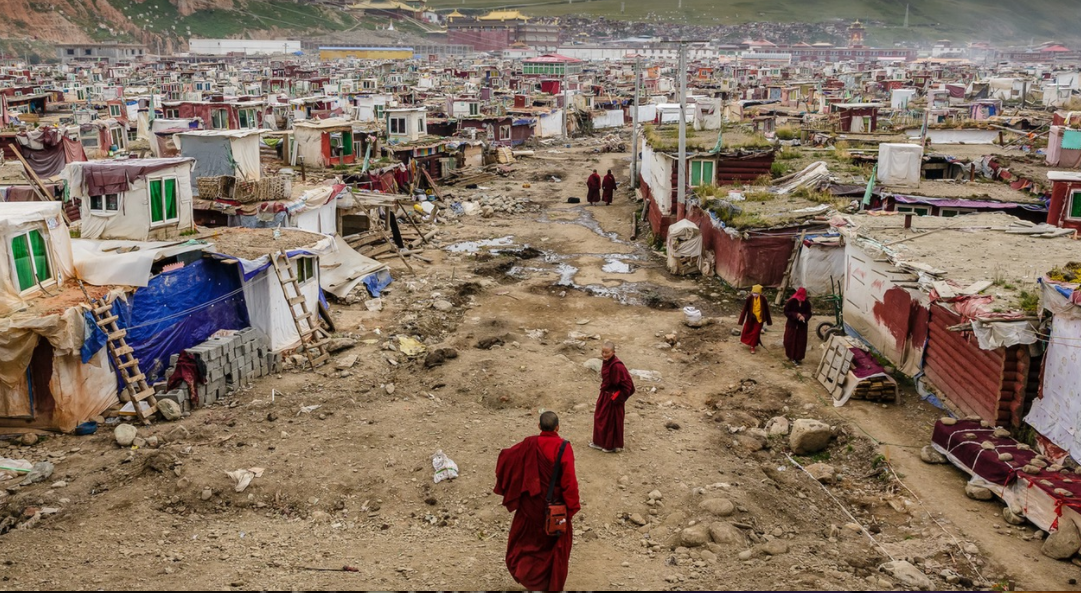
The main street through Yarchen Gar

Monks debating at Larung Gar.
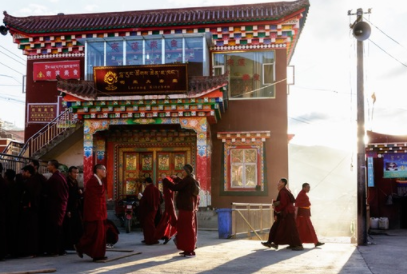
During the following days I was left free to explore the vast warren of huts, temples and study houses that surround the complex. One morning I witnessed a loud monks’ debate; where the men and boys almost come to blows over competing theological arguments.
The monks and nuns live their lives separated by the main road which slices Larung Gar camp down the middle. I found both groups to be generally welcoming and curious, and the tinderbox atmosphere and police presence of Sertar is replaced by the constant hum of worship, with the sound of prayer and Tibetan horns a constant.
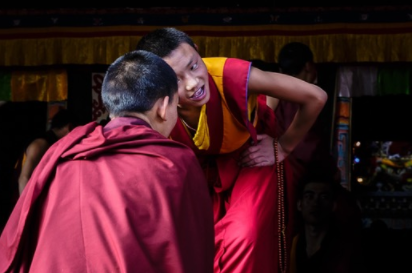
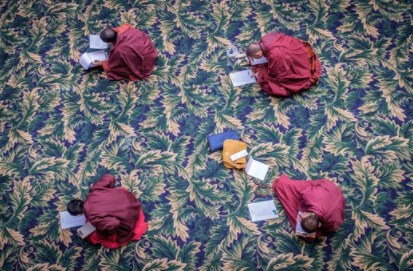
Monks in study and debate at Larung Gar.
Many Chinese tourists visit Larung too. The biggest draw for them turns out to be the opportunity to witness a traditional Tibetan ‘Sky Burial’. At 1pm every day, the Rogyapa (“body breaker”) arrives to dismember recent human remains, which are then fed to aggressive flocks of resident vultures on a hillside set back from the complex.
Macabre to some, this ancient ritual is both a practical way of disposing of human remains whilst also adhering to jhator, the principle of kindness to all living things, which includes feeding these huge carrion creatures. Few of traditional these sky burial locations remain operational, mainly due to religious marginalisation, urbanisation and the decimation of vulture populations.
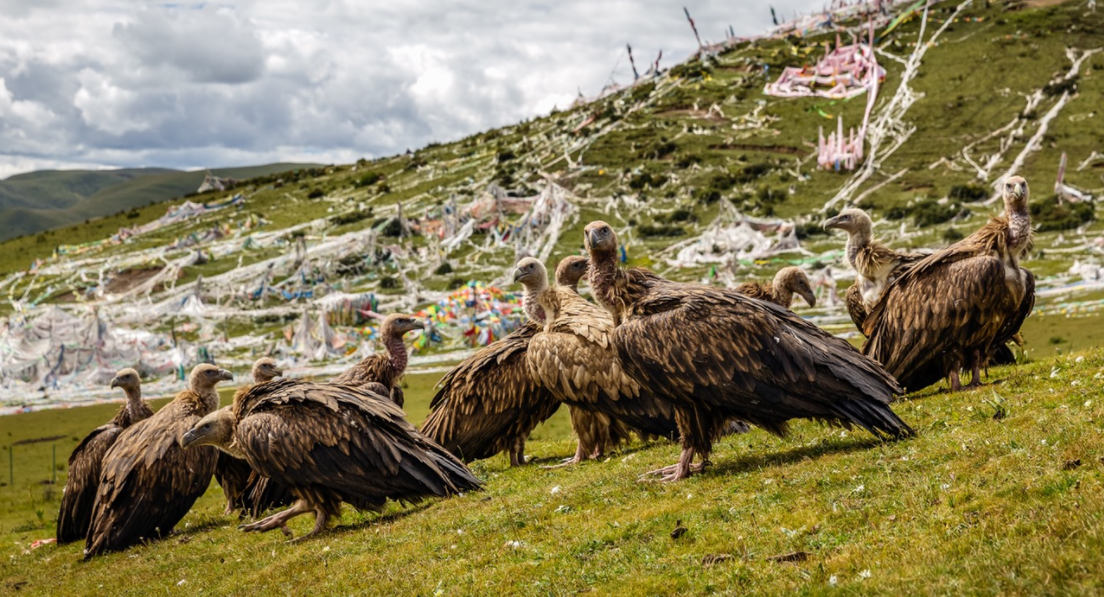
The vultures who are fed during the traditional ‘Sky Burial’ on the hillside above Larung Gar.
The institute at Larung Gar currently attracts followers of Tibetan Buddhism from all over China. Its regrowth after the 2001 evictions was swift; students began to illegally return and rebuild almost immediately. After Jigme’s death in 2004, countless followers made a pilgrimage to Larung Gar to pay homage to their spiritual master. Many stayed and contributed to the already rapid regrowth of the population. Today, Larung Gar is home to an estimated population of 50,000 people.
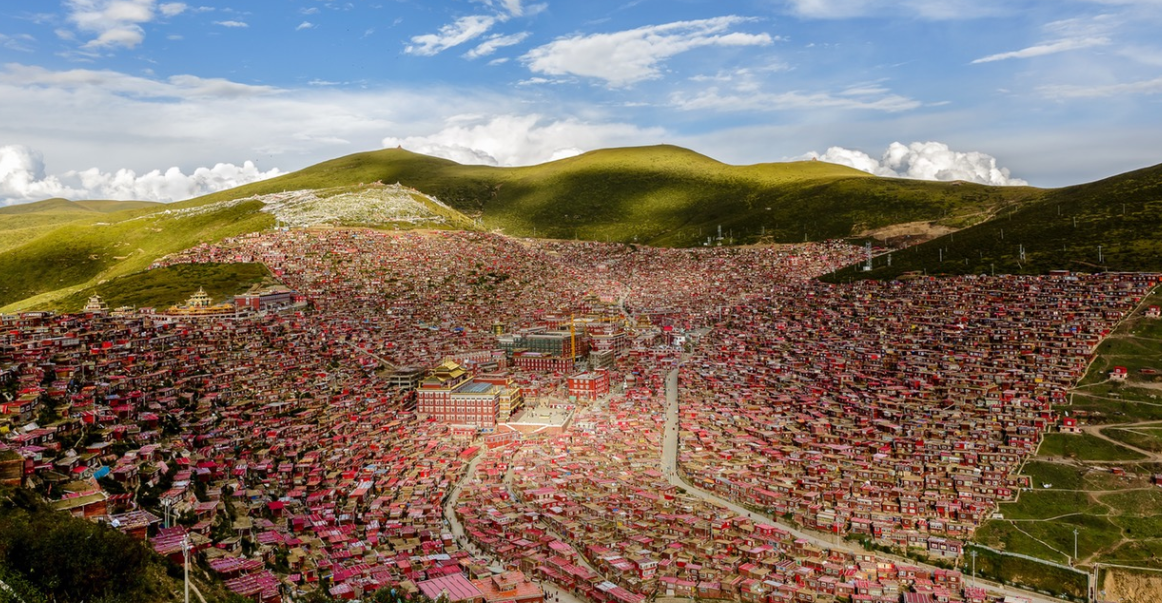
Gar camp from above, on rare clear day.
Yarchen Gar, founded in 1985 hard against the border of the TAR, has deplorable living conditions. Without even basic sanitation, every corner of the complex is permeated by a breathtakingly toxic smell. Around 9,000 nuns live in ramshackle huts on an island, while the more solidly built monks’ quarters sit more favourably on the surrounding hills. Monsoon rains bring regular flooding; on my visit ankle-deep raw sewage flowed into the streets on more than one occasion.
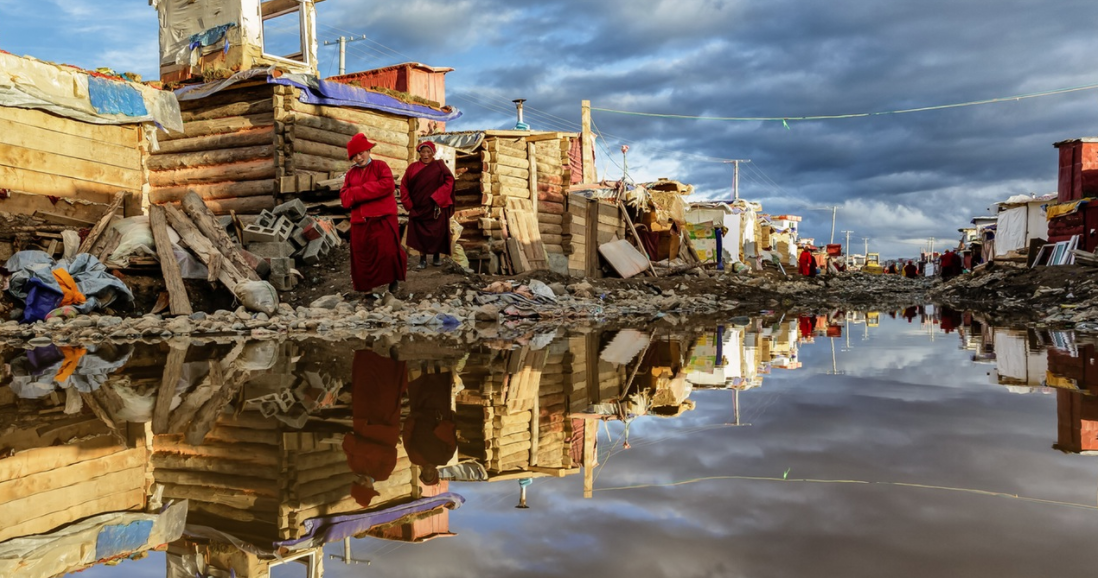
Rains in Yarchen Gar flood the streets with raw sewage.
No electricity runs to the island where the nuns live. Cholera and typhoid outbreaks are a daily threat. In winter, the temperatures plunge to a life-threatening minus 25 degrees. Yet this does not deter the nuns. Winter meditation sessions, referred to as the “direct crossing”, can last for days, with nothing more than a blanket to shield worshippers from the cold.
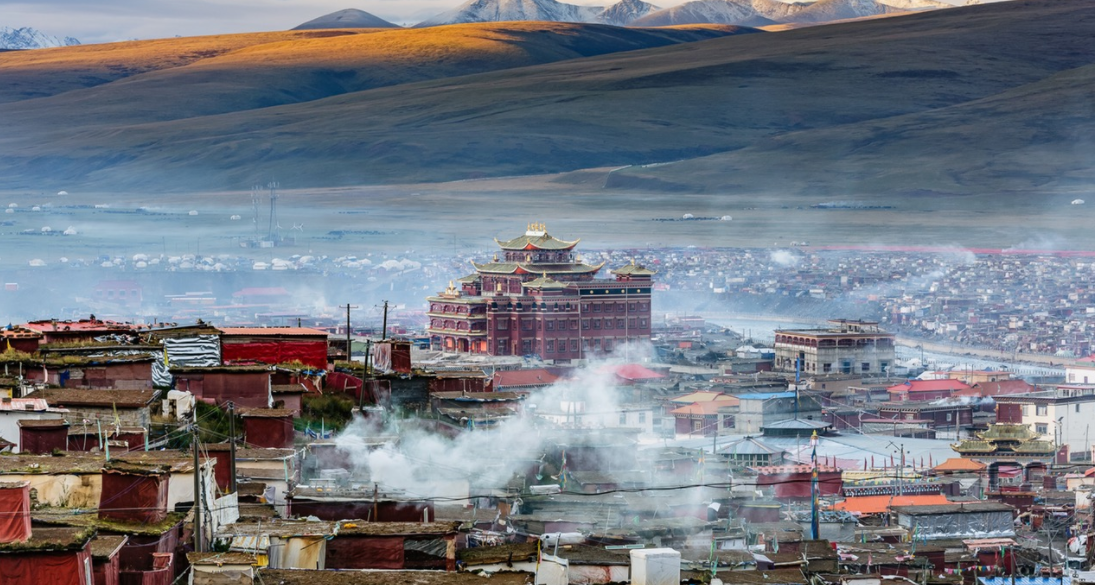
Sunrise at Yarchen
The reward for this remarkable display of self-deprivation is the chance to learn first-hand from some of the most revered figures in Tibetan Buddhism. The current leader in residence is Asong Tulku. ‘Tulku’ is a title given to a person who has reached the highest level of spiritual enlightenment, and Asong is considered a living Buddha by his followers. To assist in his teaching at Yarchen, Asong is aided by senior nuns, called khenmos. Many nuns begin their life here at the age of just six.
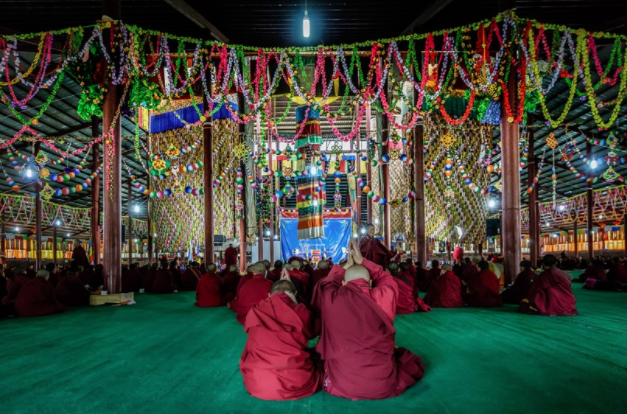
Worshippers inside one of the temples at Yarchen Gar.
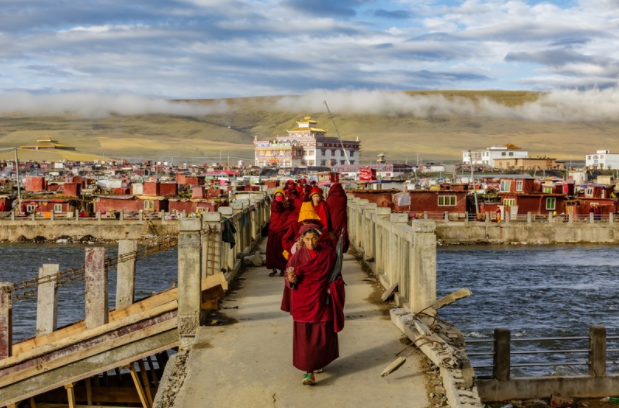
The bridge over to the island where the nun’s live.
Not only do the nuns dedicate themselves fully to their studies, they are also responsible for almost all physical labour at Yarchen, constructing houses, unloading trucks or building roads. The monks, who rarely participate in physical labour here, seem to have it easy in comparison.
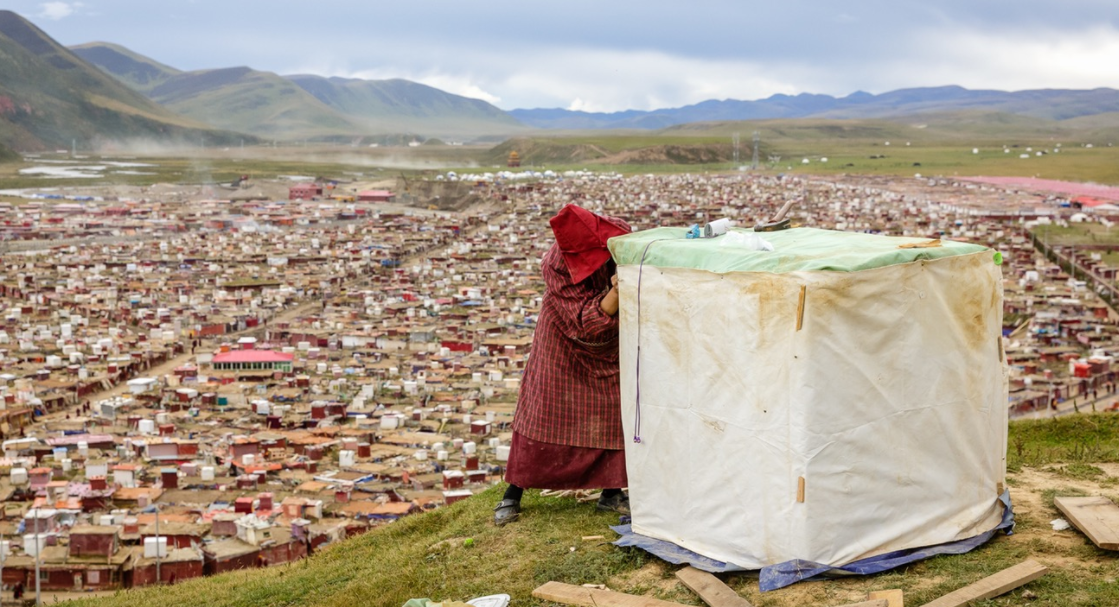
Building a basic meditation hut on the hills overlooking the nun’s encampment.
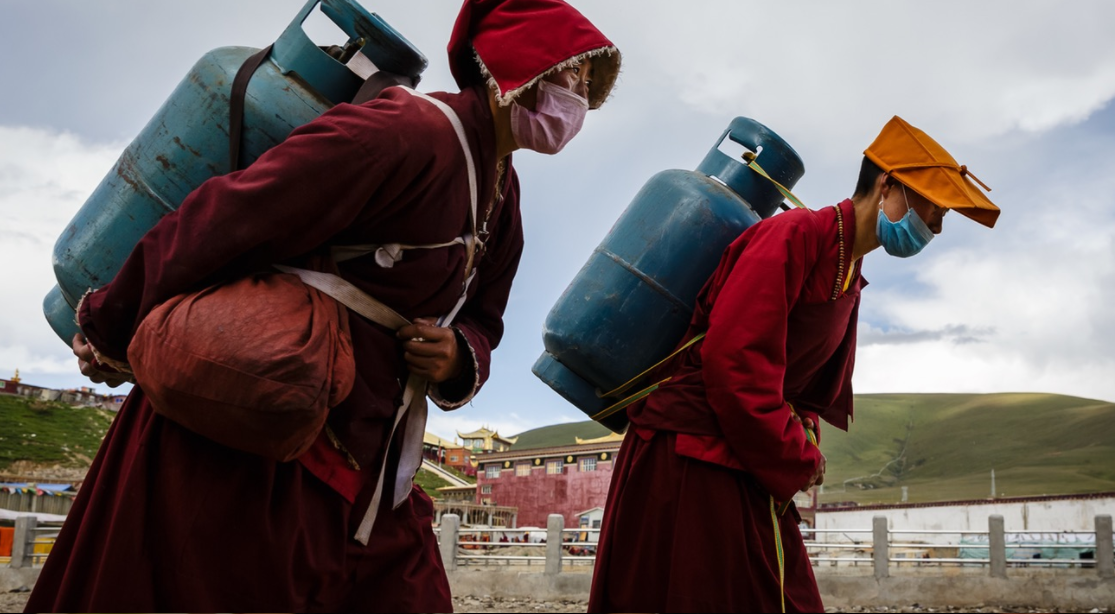
The nuns carry out most of the hard physical labour at Yarchen.
Despite the challenging living conditions, vast amounts of money are being funnelled into gigantic, ornate temples and monuments in the heart of the camp, while the surrounding slums continue to crumble.
Han Chinese money has poured into this region, with relatively wealthy converts to Tibetan Buddhism bringing much needed funds to the camps. These wealthy benefactors, hoping to improve their karma for the next business deal, or through a “cover all bases” spiritual mentality, have sparked a huge construction boom on the far western Chinese frontier.
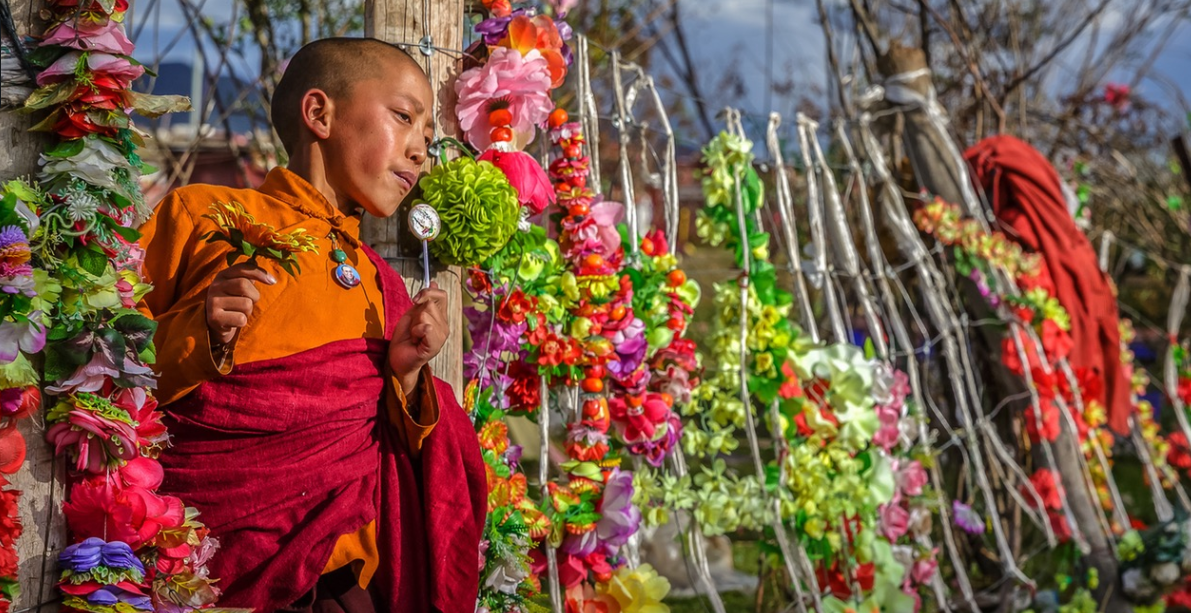
A young nun exits an area reserved for eating and socialising in the centre of Yarchen.
During my time in Yarchen I had several memorable brushes with the revered leader, Asong Tulku. As he piloted his gleaming white Lexus around the slum, our paths would meet on my early morning photo shoots. Watching people fall into the putrid mud at his feet wherever he walked, all rushing to pay tribute with cash and gifts, I found myself wondering if the money for the Lexus couldn’t be better spent elsewhere.
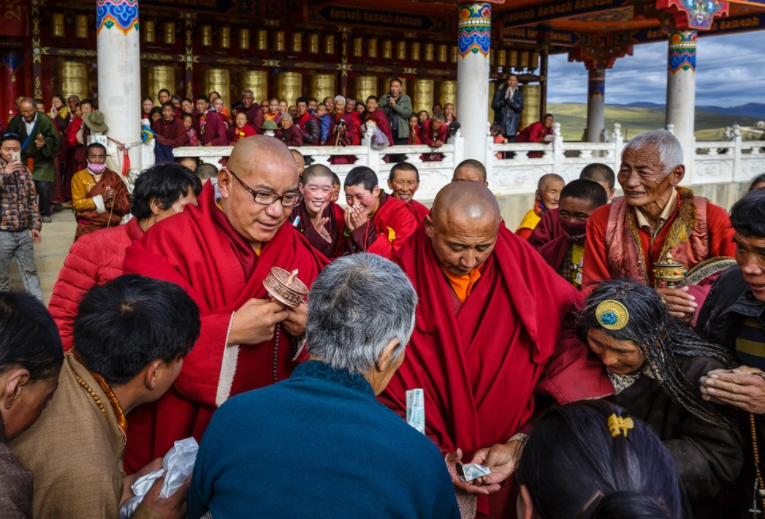
Asong Tulku is considered a living Buddha by his followers
The abrupt change from the monsoon season to the biting cold of winter was a fortuitous time to be visiting Yarchen. A ceremony in which almost the entire population of nuns empty from the confines of their island home for a month of meditation in the hills was due to take place. For days, preparations for this ritual, translating roughly to the “circle of life”, had provided a preview of what was to come.
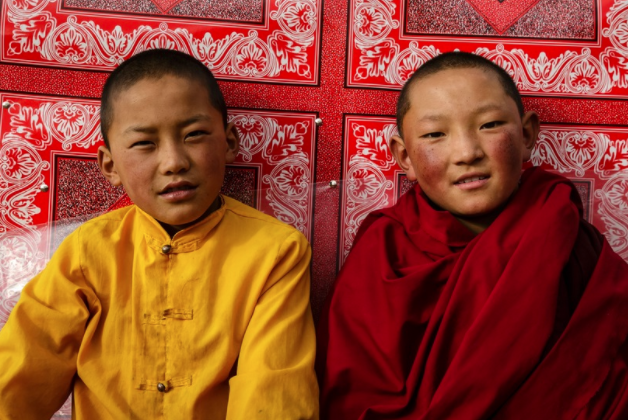
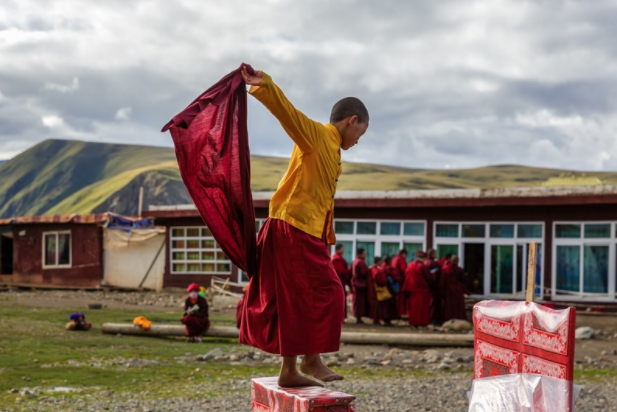
Young monks taking a break from daily classes at Yarchen.
Basic supplies were taken by foot to a hidden nook outside the complex, the location of which was strictly off limits to outsiders. When the fortuitous day finally arrived, the sight of 9,000 nuns in their bright red robes streaming into the hills was a privilege to see.
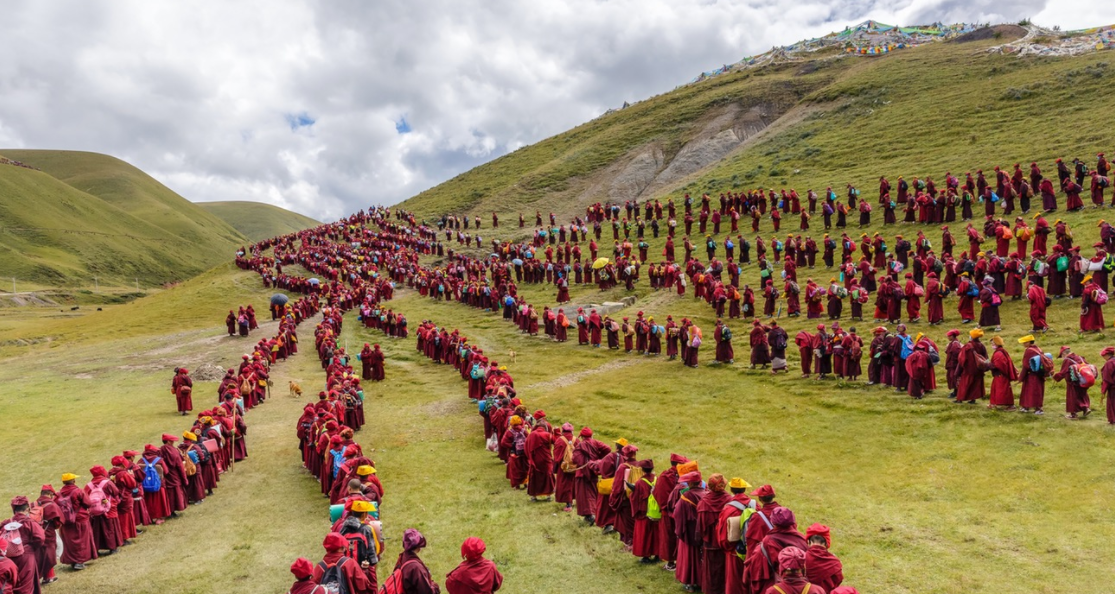
The nuns of Yarchen Gar prepare to walk into the hills for a month of meditation.
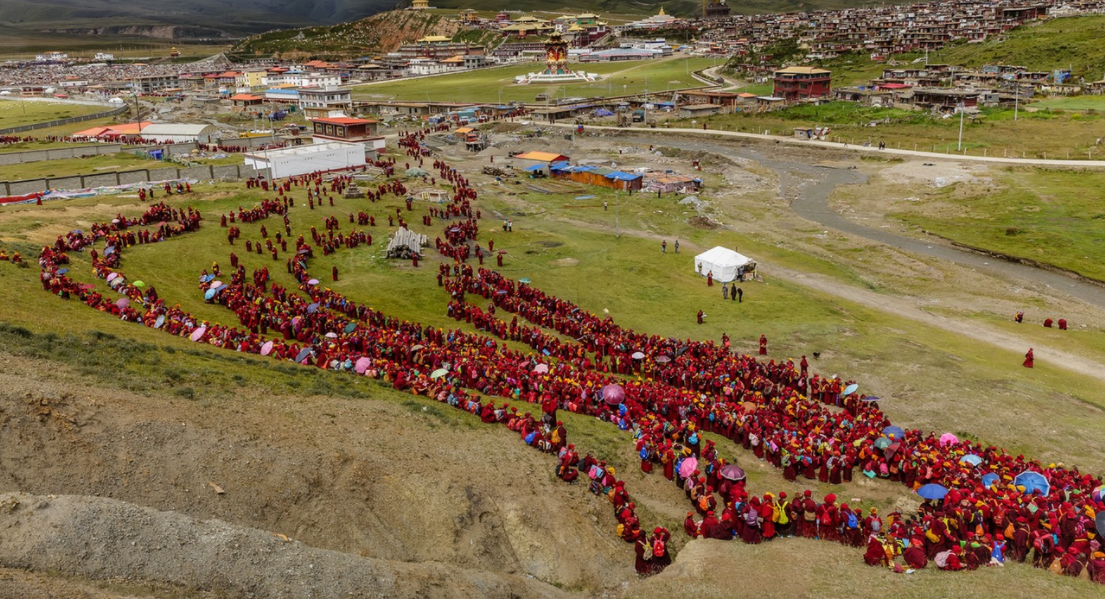
At the entrance to the valley I reached a sign hammered into the ground, with a message written in bold letters, announcing that any man who followed the nuns on their trek would return blind. With this, I knew that my luck had held out for long enough; it was time to go.
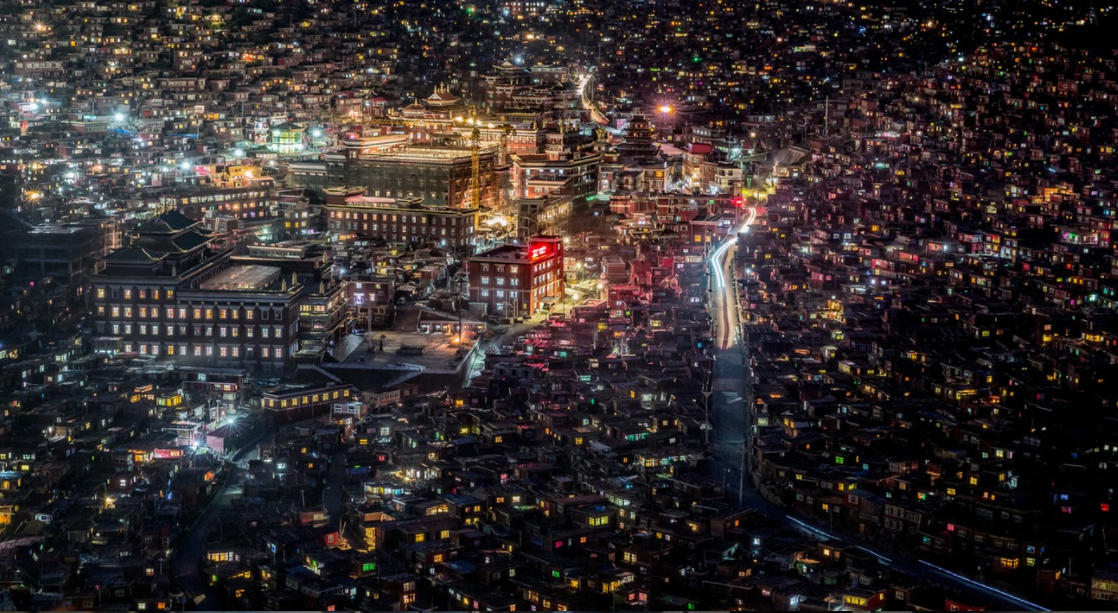
Larung Gar camp by night.
By rights Larung Gar and Yarchen Gar shouldn’t exist, and at different times the authorities have tried to sweep them away. Draconian restrictions on the freedom of movement and religious practices in the TAR itself means that nothing exists there to rival these two sites.
Quite possibly, the future leadership of Tibetan Buddhism rests not within the more recognisable white-washed walls of Lhasa’s hillside fortresses, or within the Dalai Lama’s inner circle, but within China itself.
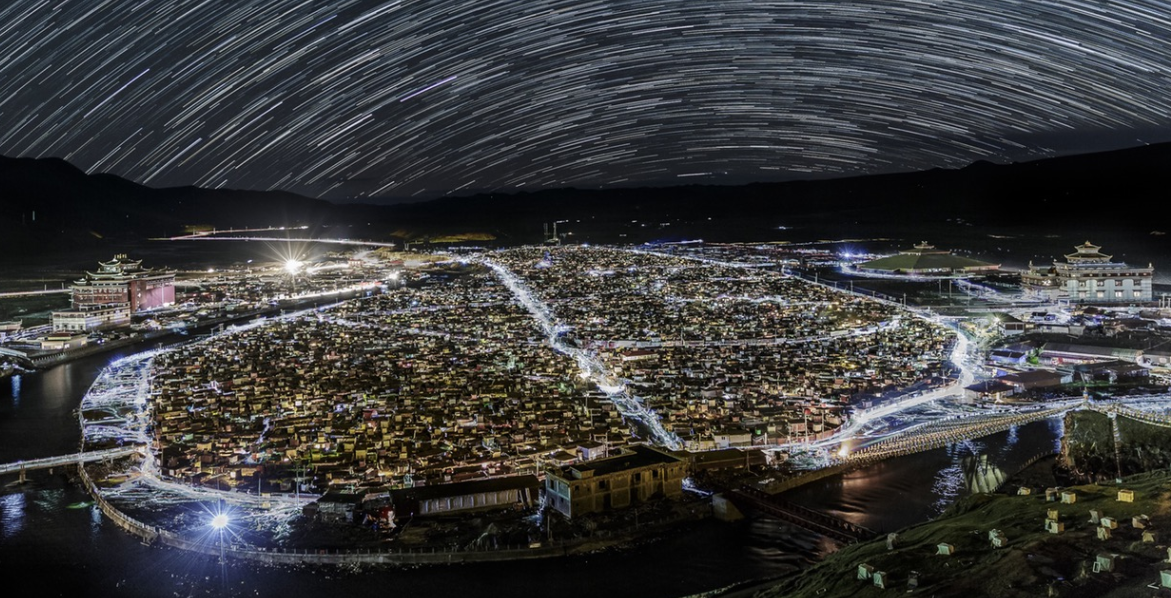
Star trails arching over Yarchen Gar.
THIS ARTICLE WAS ORIGINALLY PUBLISHED ON MAPTIA.
BROOK MITCHELL
Brook Mitchell is a photographer + writer with Getty & The Sydney Morning Herald.
Visions of Kenya
A long time went by before I was able to understand this trip. Sometimes, the present is not understood until it becomes the past. Kenya belongs to a continent of origins, remote and distant, and for now, for better or worse, many of its vast and beautiful rural areas remain far from the globalised world.
In a matter of two weeks I had organised everything. Bought the tickets from Buenos Aires to Mombasa, got the necessary vaccines, packed my things and let my friends know I was leaving. “I’m going to Kenya for a month, alone, just my backpack and camera, nothing else.” It was a long flight to Mombasa. I was very tired and somewhat nervous about it all. At the airport in Mombasa the image of a rhino gave me goosebumps. I had arrived.
— Mombasa —
The first morning I was woken by the heat and the unrelenting racket made by the many crows that inhabit Mombasa. I looked outside the window to see Africa for the first time: bonfire smoke on the sides of the street, women selling fresh fruit right outside our building, next to them, I saw other women with beautiful braids in their hair, and a little further away, a man selling plants. Here, life takes place on the streets.
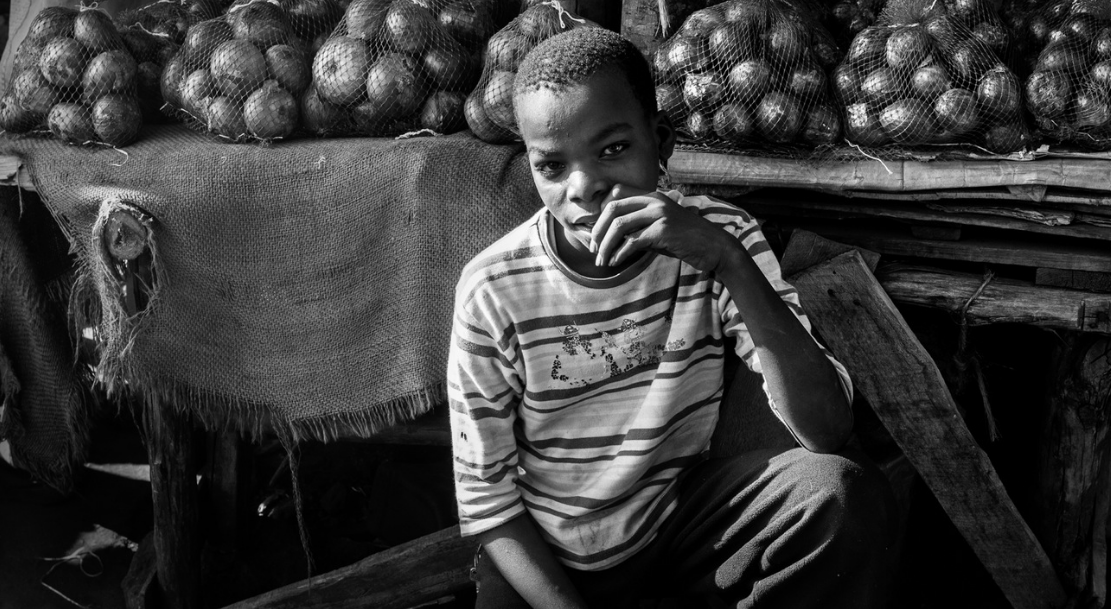
He was selling onions on the side of the road to Nairobi
I enjoy travelling alone and getting to know different cultures, in the most simple and genuine way possible, simply by being there, and merely observing. Trying not to alter what I see, to be inconspicuous. But in Mombasa, I was noticed right away. I am a white Argentinian, in a city where almost everyone is black. It was impossible to remain unseen.
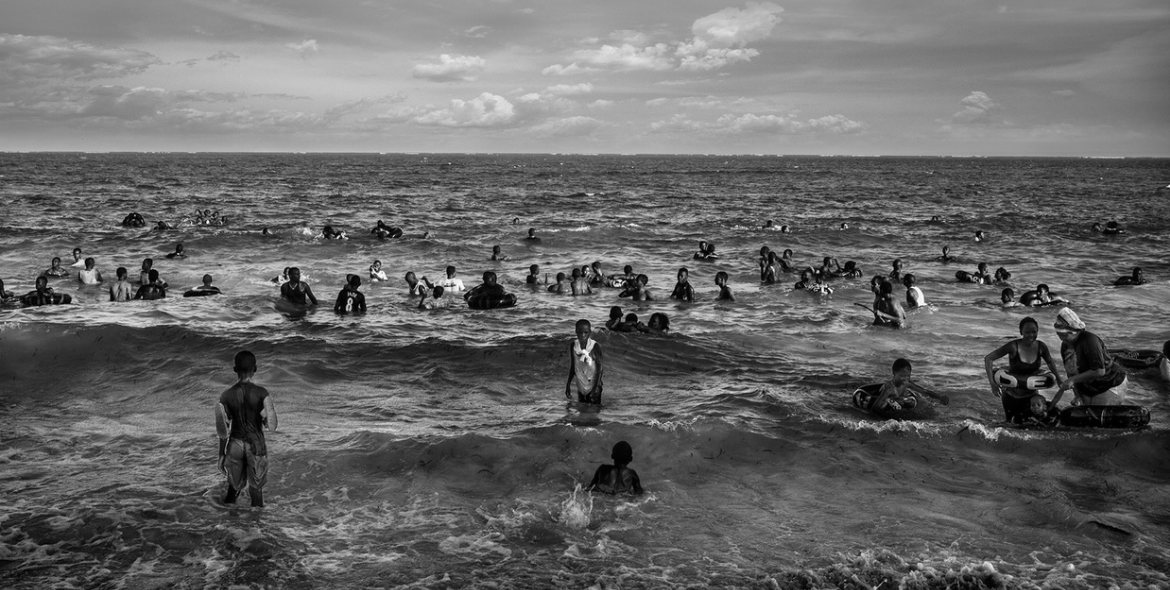
Sunday morning is a social time for families at the public beach
The first few days were filled with nervousness and anxiety. I was alone in a place completely different to my own, full of tension and expectations about what the trip might become. Was I going to be able to adapt to Africa? I just wanted to let go, come to know the locals, let down my resistance, and give myself up to whatever had to happen.
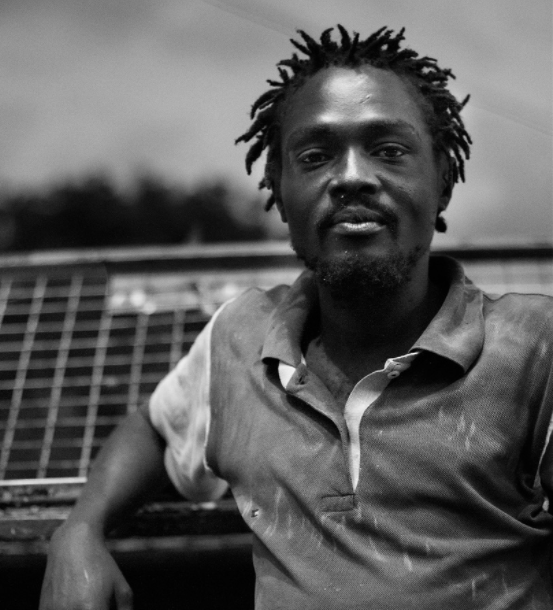
Eddie lives inside a garbage container in Mombasa. The day I left Kenya, I gave Eddie all of my clothes.
Two days went by and I decided it was time to get out of the city. Venturing into the more rural areas of Kenya would be better than staying in Mombasa. Leaving my big backpack behind, I grabbed my camera, my flip flops, swimming trunks, and my kikoy — a traditional man’s wraparound worn on the Swahili coast of East Africa, especially in Kenya. It protected me from the sun and from the stares too. I took a tuk-tuk to the south of town, then a ferry, and then a three-hour matatu — one of Kenya’s colourful buses. My destination was Wasini Island, a small island in the south, where people usually snorkel for a few hours and then leave. I wanted to stay, at least for a few days.
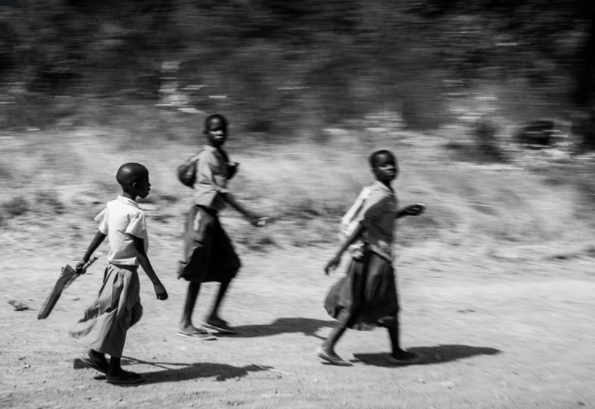
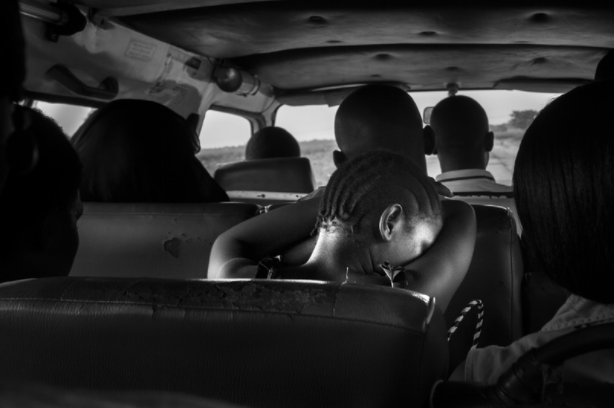
School children on the road from Mombasa to Kilifi / She was sleeping in the matatu along the way.
I was greeted by Abdullah, who was surprised to meet a foreigner who wanted to stay longer than a few hours. I got on a small boat and crossed the island with two guys who were carrying huge machine guns, which they used to absentmindedly scratch their feet and faces — I had never seen such big weapons.
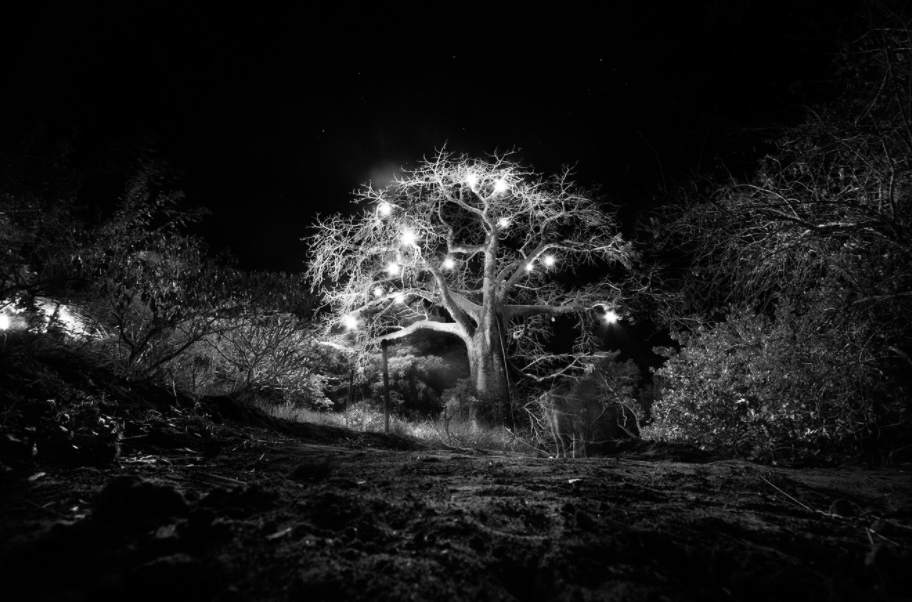
Baobab tree lit up at night
— Wasini —
Wasini is a coral rock island that during its hey-day was a popular summer destination for retired and wealthy Europeans who wanted to enjoy the heat and beaches of Kenya. The day I arrived, there was just one dutchman and me, and the rest of the island was a small fisherman’s village. Abdullah cooked a fish for me with great care, and later made me visit the “tourist attractions,” which meant very little to me.
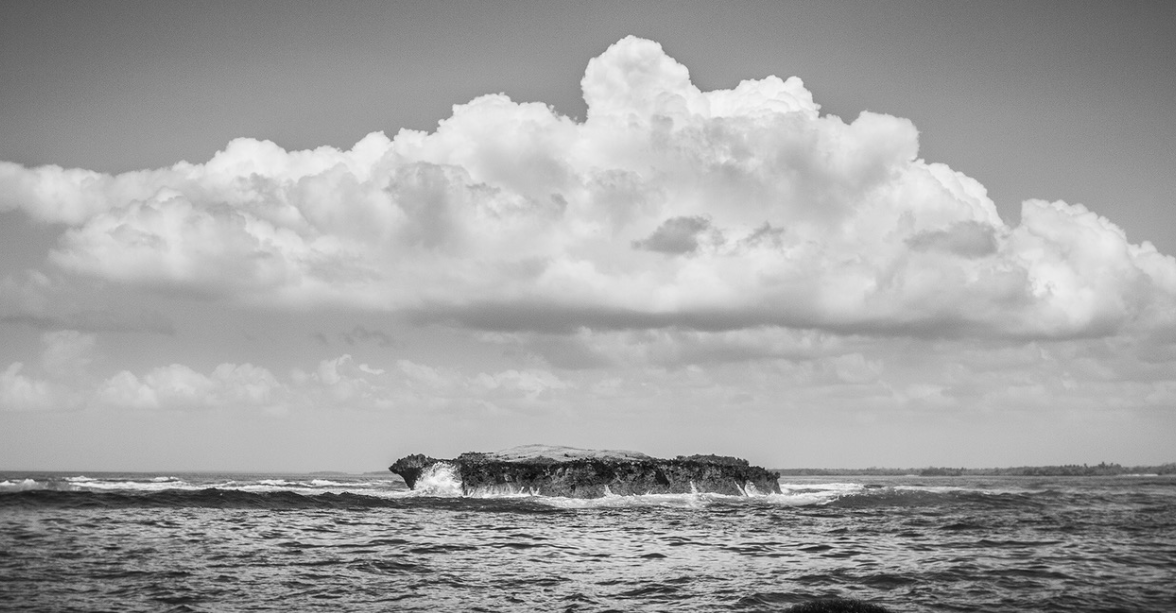
Coral stones in the Indian Ocean
I met someone who said he would take me over to the other side of the island along a path that would pass through the mangroves. I told him I had very little to tip him with, as I had left all my money in Mombasa. He gently insisted on taking me and I followed him. We walked through the island for a long time and I started to worry, thinking about where this stranger was actually taking me. The sun had started to set and as is common in many places in Kenya, there was no electric light.
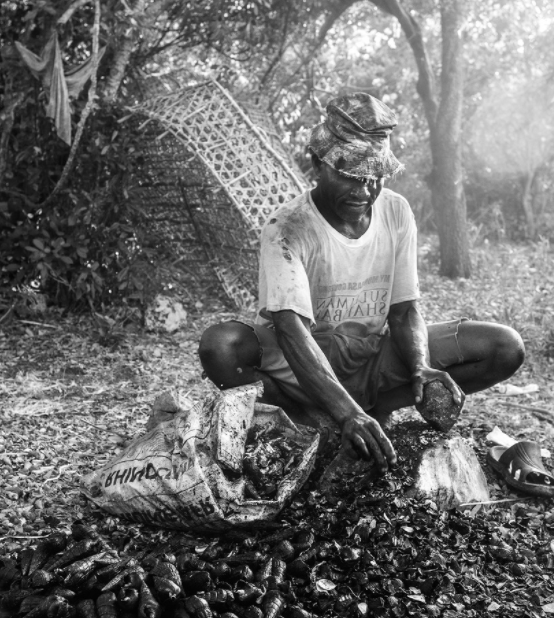
We were crossing the path with this guy, while a fisherman was preparing his bait. I asked to take a picture of him, and he accepted.
We kept on walking until we finally reached the other side of the island. The mangrove trees continued all the way into the sea, and it was a very beautiful sight. I calmly took a breath, my guide had not deceived me. At that moment I felt that if I had managed to get to such a remote place with a complete stranger, then it meant that the rest of my trip would turn out alright. It was a feeling I had. Complete trust.
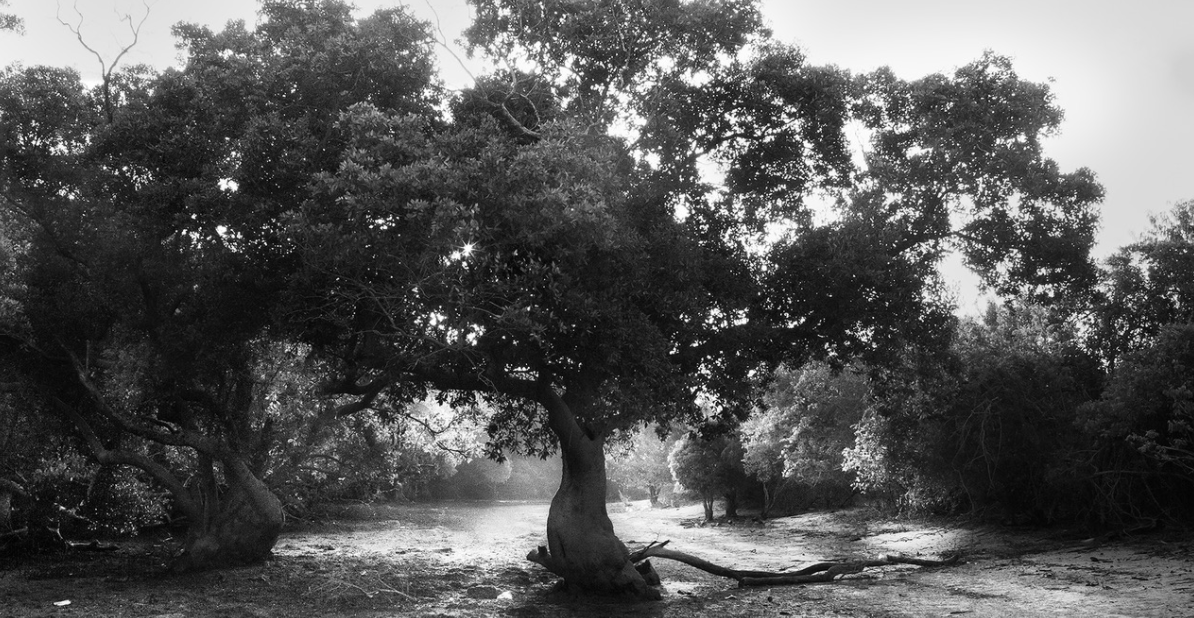
Among the mangroves
— Kilifi —
I spent a few days in Wasini and then returned to Mombasa to continue northwards along the coast, towards Kilifi. In Kilifi there was a very impressive hostel, but when I entered I had the feeling of being out from what I have been seeing. Luckily, I decided to walk towards the beach, where I found a beautiful sunset.
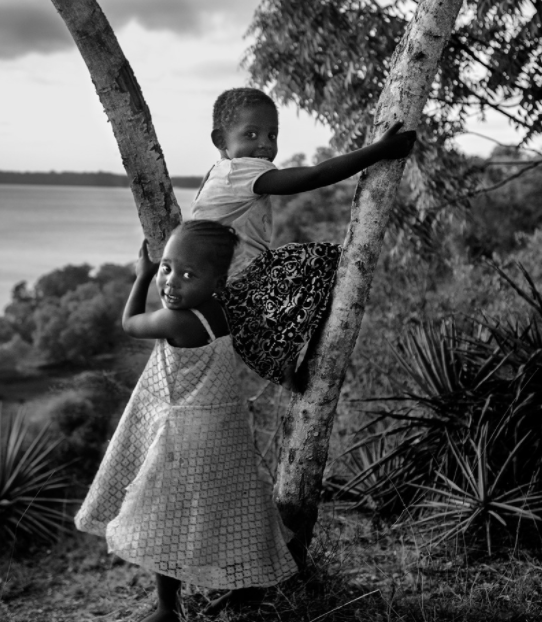
Little sisters playing together in a tree near their home.
The beach was deserted. It was actually an estuary, very serene. I loved rural Kenya, so far away from the cities. As I sat with my camera I saw a kid walking in the distance. As he approached me I waved, then he waved back and continued to walk. A few hours later, the kid returned and I went over to have a chat. He responded by asking me if I knew how to hunt crabs. His name was Buda.
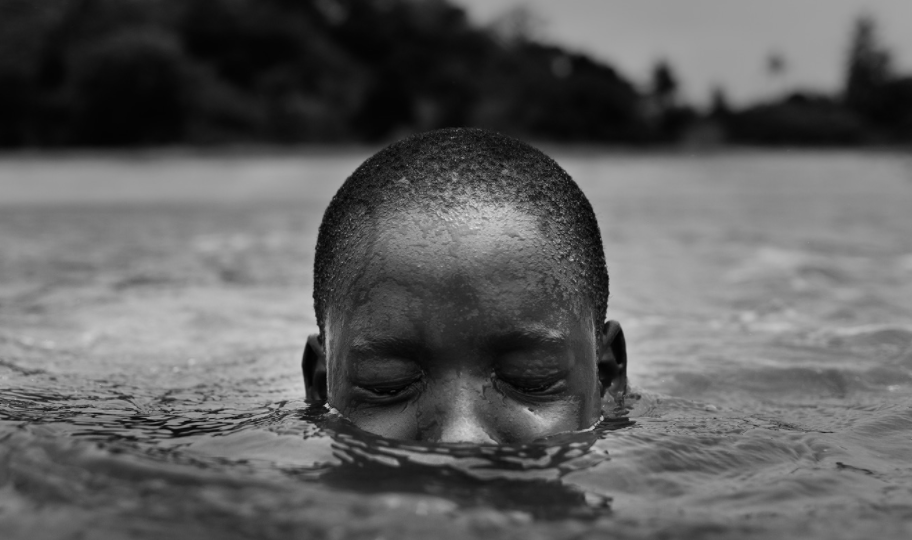
Portrait of Buda
We became friends and I met all of his brothers and sisters as well. They were many, and lived on the coast with their aunts and cousins. Most families in Kenya live with their extended family, and the women are in charge of the houses. Men are absent most of the time, often spending time with friends, away from their homes.
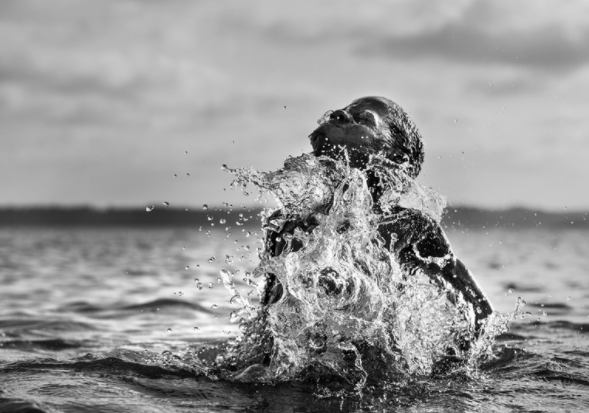
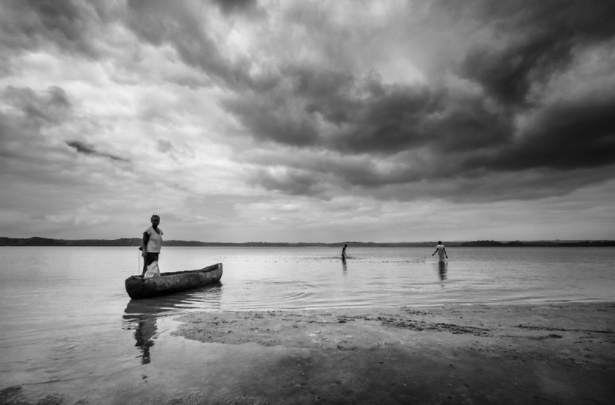
Full of joy in the ocean / Fishermen and family in the early morning
I quickly became very fond of Buda and his siblings, and they became fond of me. Every time I came down to the beach, they would arrive to greet me. I spent whole days on the beach, sometimes helping them gather wood for making fires, or finding things their mother had asked for — I learnt a lot about their culture and way of life, which was not always easy. Buda and Nuzrah were the eldest siblings and spoke better English. They taught me a lot of words in Swahili, their native tongue.
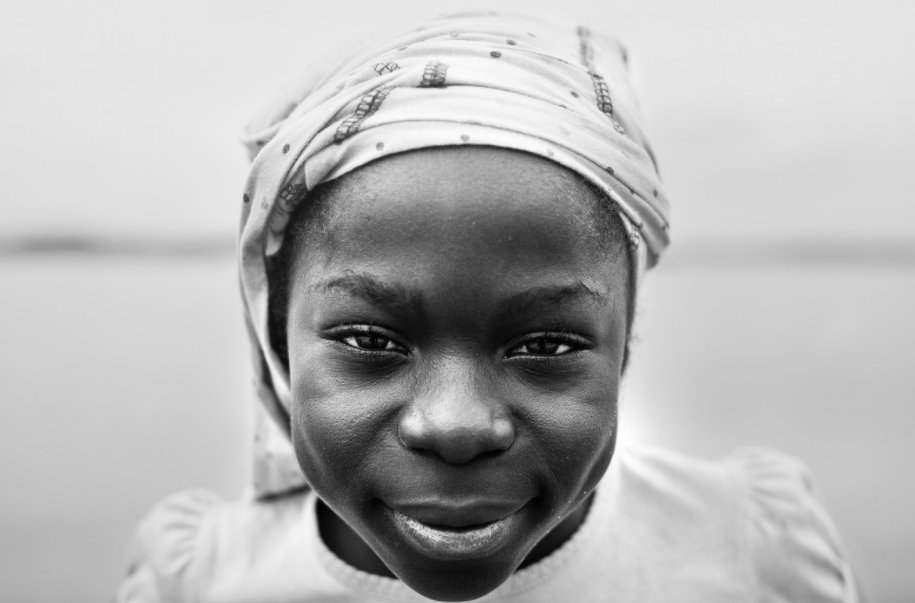
Portrait of Nuzrah
One of the days we spent together I brought them a football, a water gun and a jumping rope. We played with them, they taught me beach games, and every now and then we would all go for a swim. It was with great grief that I said goodbye to these children, as I had to continue travelling towards the west of the country. They stayed with me until I left, and their mother also came to say goodbye.

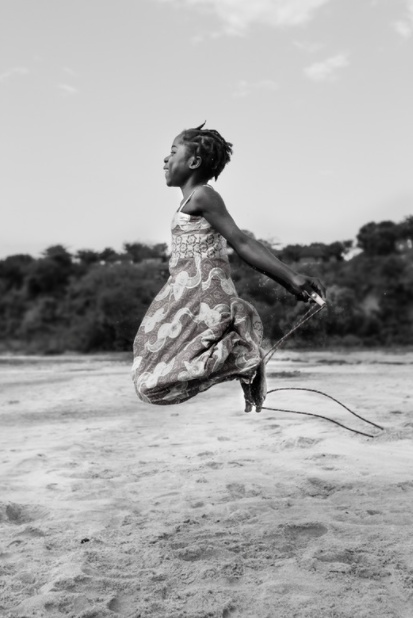
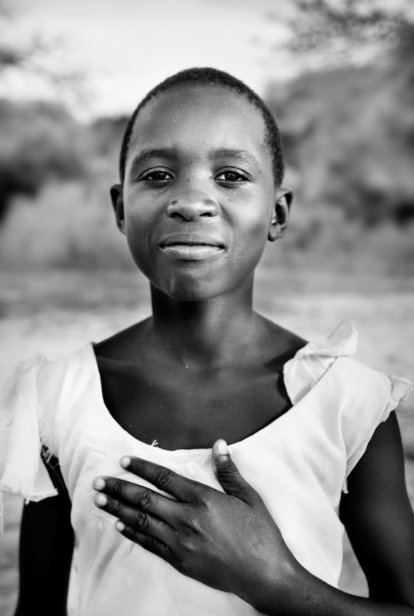
Portrait of Buda / Jumping rope / Portrait of Mwanaisha
— Amboselli —
I took a tuk-tuk back to Mombasa, thinking about everything I was experiencing. It felt so powerful and different, making me reflect on my own life, and how grateful I was for the opportunity to travel. The following dayay I left for Amboselli National Park. Enormous and open, there were no fences around it. Animals are not easy to see. You might spend a whole day walking around and only encounter a few zebras.
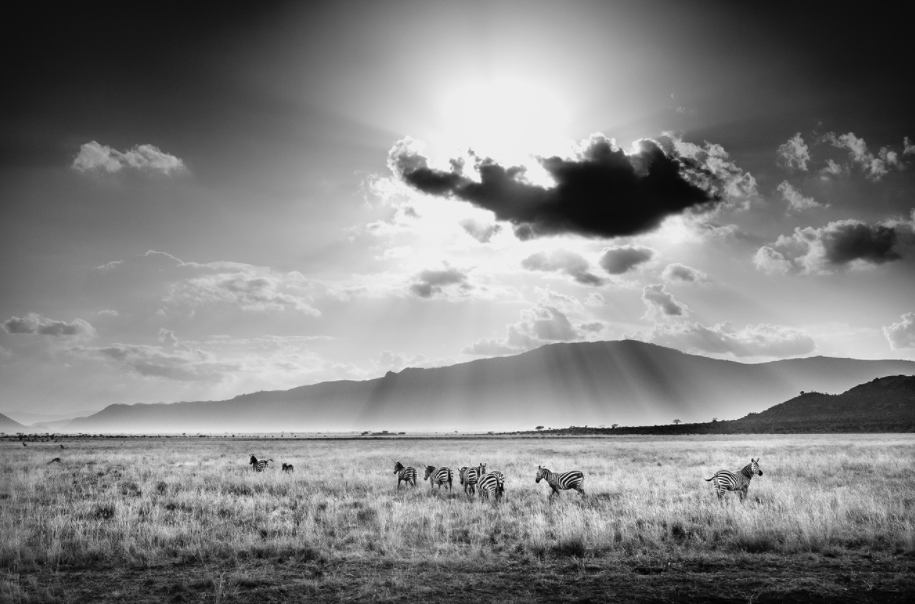
Morning of the Zebras
But the immensity and beauty of the landscape was truly dazzling to me, sometimes reminding me of my native Patagonia, similarly wild and empty in its own way. I also thought about the devastation humans have caused to the natural environment, and the complex challenges local and international communities face as they attempt to tackle and reverse this.
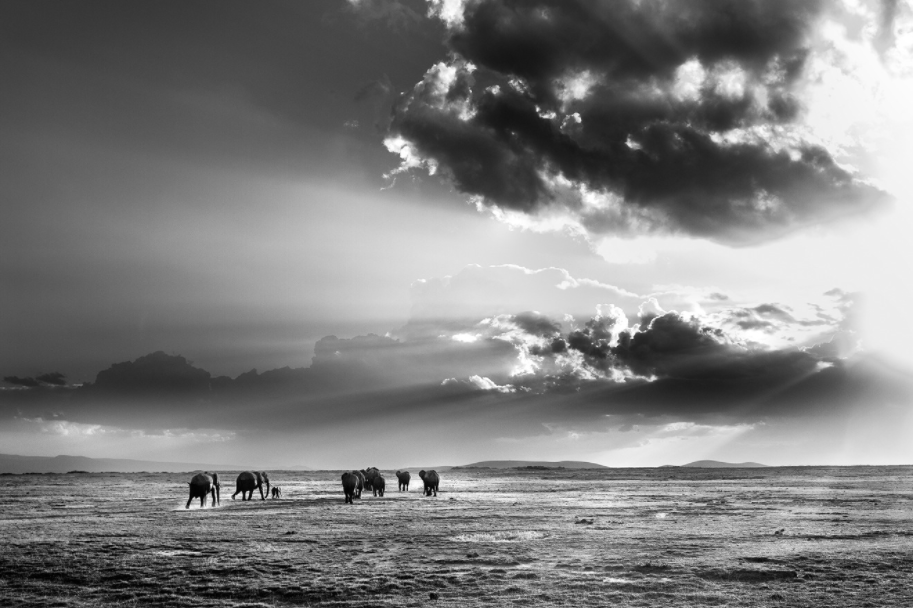
Afternoon of the elephants
I spent my whole childhood fascinated by documentaries on Animal Planet, or Discovery Channel. I could not quite believe I was there, in these vast landscapes. The animals were so big, so strong. They had very little to do with the image I had of elephants in zoos or television. And the trees, they were so magical, I really have no words to describe them.
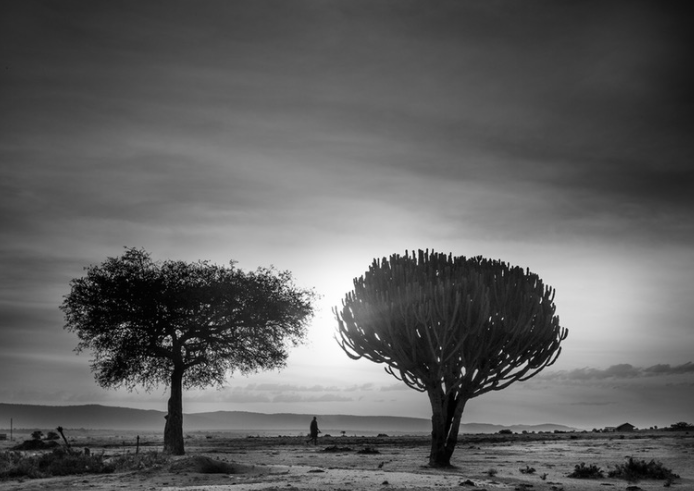
Masai walking in the early morning / Just a beautiful tree, in my first moments in the park
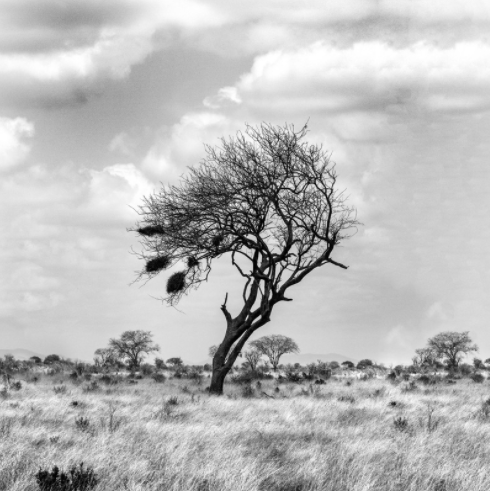
A long time went by before I was able to understand this trip. Sometimes, the present is not understood until it becomes the past.
When I travel, I seek to explore places that will surprise and challenge me, and from that surprise create beautiful experiences and photographic visions of what I have witnessed. Kenya belongs to a continent of origins, remote and distant, and for now, for better or worse, many of its vast rural areas remain far from the globalised world.
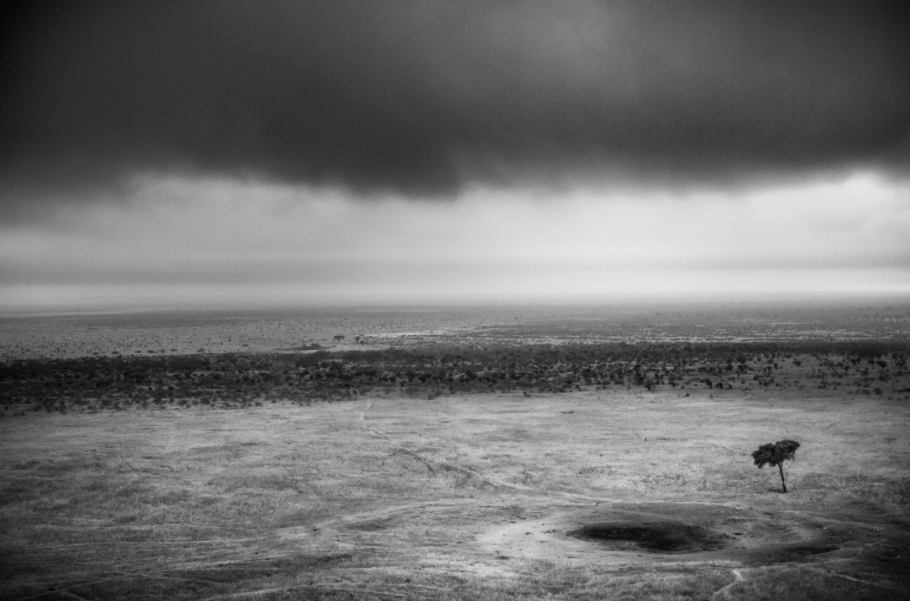
Early morning at Tsavo. There is always magic in the first hours of the day.
THIS ARTICLE WAS ORIGINALLY PUBLISHED ON MAPTIA.
FRAN PROVEDO
Fran Provedo is a photographer and Architect from Argentina. Passionate about nature, and what is invisible in it.

People don't take trips. Trips take people.

What are ALL voluntourists good at?
In recent years Voluntourism it has gotten a bad name. There are a lot of valid reasons that people have been turned off by voluntourism, including:
- voluntourism’s potential to foster colonialist attitudes and cause harmful side effects (as in Illich’s thoughts on Peace Corps)
- projects which place unskilled foreign travelers in jobs requiring skilled laborers or taking away local jobs
- short term interactions with children without proper child protection policies (Some argue that English teaching is a great way to engage English-speaking travelers in volunteer work, and perhaps sometimes it is, but I feel that even this is not always a good fit. Often times native speakers know the language, but are not trained teachers and repeated short-term interactions can have harmful side effects for children.)
- volunteer placement agencies charging exorbitant fees from their overseas offices with little to no money reaching the development projects themselves (no need to link to a lot of them for examples, just google “volunteer abroad”!)
These reasons are some of the reasons that I too am skeptical of voluntourism initiatives. I have seen some damaging results of travelers philanthropy which did not embody effective voluntourism or development practices and ended up causing more harm than good. At PEPY, we have made many mistakes ourselves, especially in our first few years of operations where we designed trips for tourists to “teach and give” rather than “learn and support” and where we designed trips around the needs and demands of travelers rather than those of the communities we were working with. Many of our initial mistakes are highlighted in the documentary “Changing the World on Vacation” by Deeda Productions. Although watching some of your mistakes on TV and seeing yourself say some ridiculous things you no longer believe in is not a fun pass time, I appreciative that filmmaker Daniela Kon’s work will serve as a learning tool for many others and reminder to me about the lessons we have learned.
As we have examined at the hands-on service portions of our trips looking to find the most useful way to engage tourists in something they are skilled at, we asked ourselves: What ARE all tourists experts at?
The answer we came up with is this: All tourists are experts at being tourists! Of course!
They know what THEY want when they travel, and that knowledge is often the missing key to successful community based tourism initiatives. Now of course, you and I don’t share the same wants/needs as every tourist and living in Cambodia with a huge child sex tourism industry, I surely wouldn’t want to take the opinions of all tourists to heart when developing new programs. I do though believe that if we find similar minded people looking for an eco-friendly and responsible adventure, one very useful skill they all can bring is the ability to give their feedback and ideas about how to design such a trip.
Tourists can use these skills to help local communities who have a tourism product to offer but are perhaps lacking the experience to market or tailor the trip to tourists. They can also help promote positive environmental practices by highlighting their desire to see natural environments and physical and cultural preservation in the countries they visit.
By matching travelers up with community based tourism initiatives, we hope to improve the whole adventure tourism supply chain by:
- giving thorough feedback and ideas for improvement to community based tourism initiatives and groups looking to offer such products
- offering marketing advice
- promoting positive environmental practices and preservation initiatives
- creating informational and promotional material for the organizations we believe in from signs helping travelers find their way to the site to English language placards or hand-outs describing the locations highlights in areas where English speaking guides might not be available
- Physically helping to improve offerings in the area (constructing signage, cleaning surroundings, beautifying local infrastructure, building safety or protective tools such as fencing or walkways, etc)
We believe that, by designing trips which improve the local adventure tourism supply chain, we can place travelers in a position where both their time and funding are valuable while also helping to ensure that tourism dollars support local initiatives.
We have done some of this in the past, but had not embraced the concept of “using voluntourists as tourists” as much as we currently are in our upcoming tours. Our updated website (coming soon!) will highlight these offerings. In the meantime… what do you think? No, it’s not building a house for a family nor petting kids in an orphanage, so it might not have the same appeal as other offerings, but we believe that if we highlight the added value travelers can bring to responsible (aka. well-vetted) community tourism programs, people will be excited to support these programs.
What do YOU think?
THIS ARTICLE WAS ORIGINALLY PUBLISHED ON LESSONS I LEARNED.

DANIELA PAPI
Daniela is the Deputy Director of the Skoll Centre for Social Entrepreneurship. She has spearheaded student programming initiatives at Saïd Business School including the Leading for Impact programme and had taught on MBA courses including the Entrepreneurship Project and a course on high-impact entrepreneurship. Daniela is a graduate of Saïd Business School's MBA programme and was a Skoll Scholarship recipient.
Prior to coming to Oxford, Daniela spent six years in Cambodia where she grew a youth leadership organization, PEPY, an educational travel company, PEPY Tours, and an advocacy organisation, Learning Service. Daniela is co-authoring a book advocating for a 'Learning Service' approach to philanthropic and volunteer travel and has worked as a consultant to other social impact organizations, typically supporting their strategy redesign by incorporating her experience in social marketing and user-centered programme design. She recently wrote a report called 'Tackling Heropreneurship' focused on fuelling collective impact through an 'apprenticing with a problem' approach.
Check out Learning Service for more.
Voluntourism: What Could Go Wrong When Trying to Do Right?
Here are some of the common problems I have seen in the voluntourism market and some tips for travelers on how to choose the right program.
Read More
The Quest for Afghan Singletrack
“His name means ‘soldier’,” says Yaar Mahahammad, our translator. Yaar is talking about Askarkhan, a thirteen year old boy who has been hefting rocks to form the foundations for a new stone hut with the kind of ease that puts my own strength to shame.
Askarkhan looks at us with piercing, curious eyes from beneath his over-sized, hand-me-down clothes. Despite his military-sounding name, his clothes have no resemblance to a uniform, and he doesn’t need one. Here, at 4,305 metres amidst the swirls of a snowstorm in the remote Wakhan Corridor, Askarkhan is far from the war and troubles that have tragically become synonymous with his home country, Afghanistan.

Thirteen-year-old Askarkhan, whose family are semi-nomadic shepherds in the remote Wakhan Corridor.
In these regions the best weapon for survival is resilience, not a rifle. Guns are useful against marauding wolves, but it is resilience that will see Askarkhan brave the short, eight-week summer of herding yaks and sheep high on the mountainsides. Resilience that will arm him against the cold of night, the relentless snowstorms possible on 350 days of the year, and the thin air. I have a lot to learn. All in all, this is probably the harshest place I have ever been, so why the hell are we trying to ride bikes here?
Today, the snow buries our six bikes and tents alike. Above us, enveloped in dense fog, sits the way ahead. At 4,860 metres, the Karabel Pass is the second of three high passes that we have to brave during our twelve day pioneering mountain bike traverse through the Wakhan Corridor. Navigating each pass means an early 4am start, as we must give the pack animals carrying our supplies a good chance of crossing while the snowpack is still frozen hard. Each climb requires dragging ourselves from warm sleeping bags to force on frozen bike shoes hours before any sign of breakfast. But each pass, we hope, will deliver another brake-searing singletrack descent.
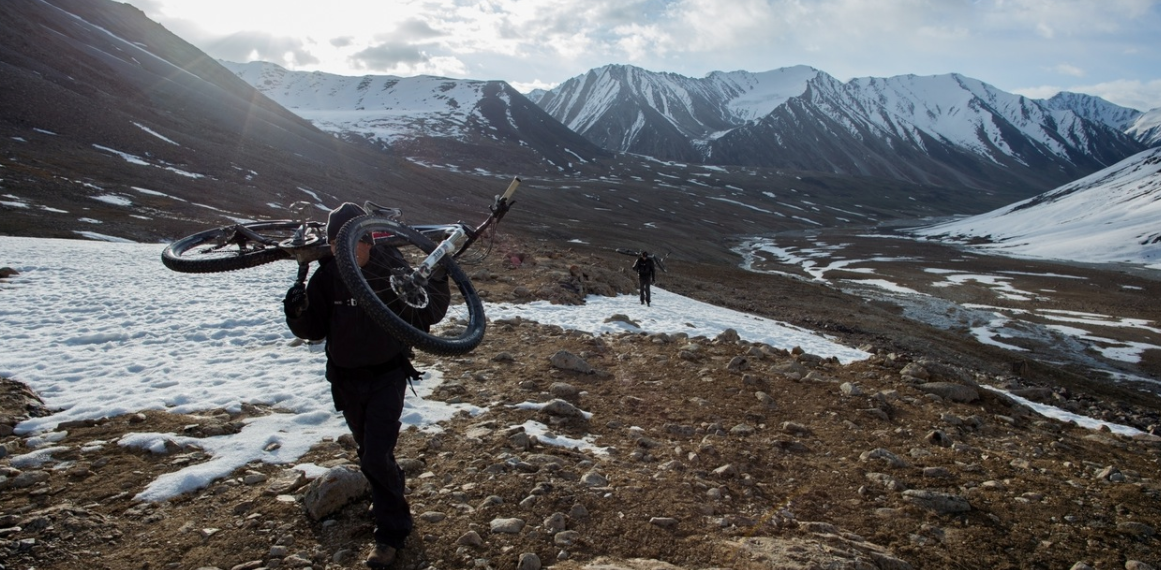
Colin Jones, half way up the 4,867 metre Shawal Pass. Early, first light starts, usually at 4am, mean that our pack animals can safely cross the snowpack while it’s still frozen.
As far as adventure-bike trips go, it doesn’t get more adventurous than this. The term ‘adventure’ seems to put such trips outside the normal remit for whinging. After all, if the going gets tough, then that is just part of ‘adventure’. Yet after thirty years of remote mountain biking trips, this one is stretching my resolve. If “hard-earned” is the price you pay for riding where no one has ever ridden before, then we are certainly paying the price in Afghanistan. There has been nothing easy about our ride so far, from hefting our bikes across perilous, icy river crossings in churning waters, to the massive temperature swings that deliver 30°C heat one day and snowstorms the next. It is day five when we meet Askarkhan. We have seven more to go. I am tired, my feet are wet and my hands numb.
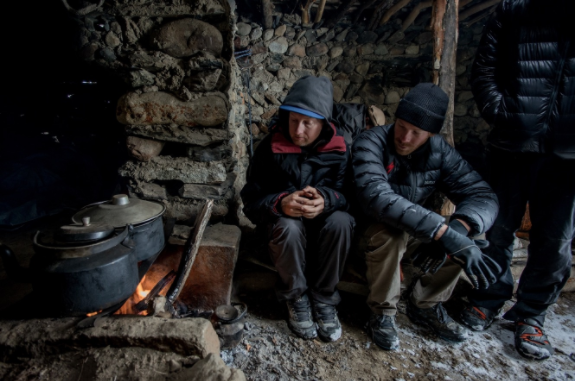
Pro rider Matt Hunter and cameraman Colin Jones huddle near the fire, inside a draughty shepherd’s hut during a day of blizzards at Karabel camp, 4,300 metres.
Every year the remote and wild Wakhan Corridor welcomes a small handful of intrepid trekkers, but nobody has tried to mountain bike across it until now. A week earlier, after the drive in, I start to understand why. With the road from Kabul deemed too dangerous for travel, the only way to enter the Wakhan is from the neighbouring capital of Dushanbe, in Tajikistan. It takes us four days of navigating dry, desolate boulder-strewn roads, fording rivers swollen with summer snow melt, in jeeps with bald tyres, cracked windscreens, and leaky radiators. We took turns to ride shotgun alongside our driver, while the cassette player tried but failed to drown out the car’s rattles, its interior constantly filled with clouds of dust.
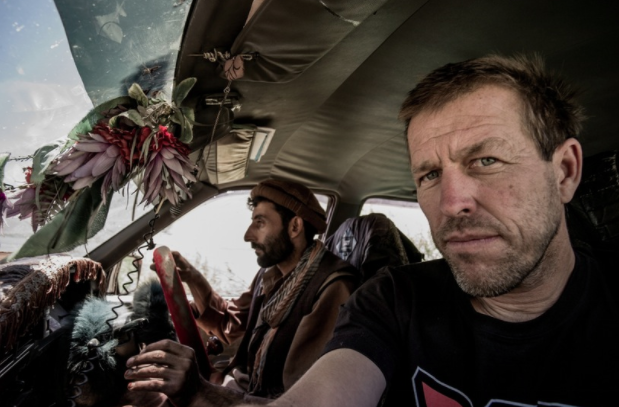
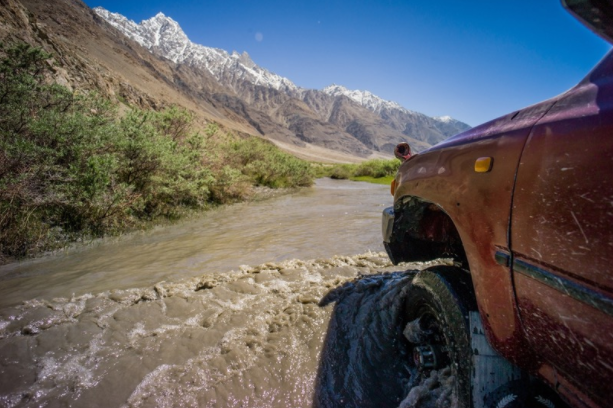
Riding shotgun in our Afghan jeep, a battered Toyota Hilux. There are few bridges in these remote regions and rivers are swollen with snowmelt.
Eventually we reach Sarhad, the village at the end of the dirt road and the starting point for our twelve day traverse of the Wakhan. Within the region’s arid landscape, such villages are an oasis of fertility. We spend two nights here, making arrangements to hire pack animals to haul the camping gear and the food we will need for the duration. For all of the assembled mountain bikers, including Canadian pro-rider Matt Hunter, the lure of this pioneering expedition is not about kudos or dubious bar-talk bravery.
It is the enticement of the unknown, of what lies beyond our usual boundaries. It is the magnetic appeal of hard-earned singletrack rewards that brings us to this unforgiving landscape.
Some might criticise venturing through such impoverished areas while flaunting our own relative wealth, but my experience suggests that such trips help break down barriers and educate both hosts and tourists alike. It is only through better understanding of different cultures that we can really do away with war.
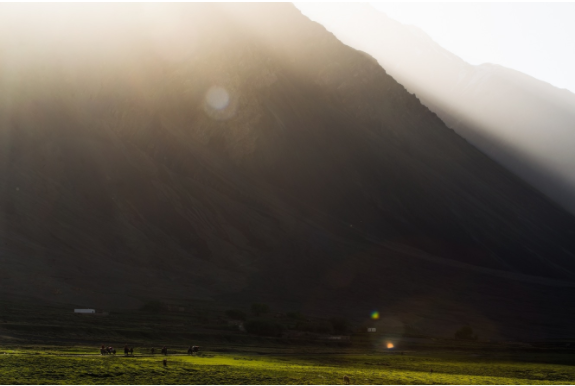
An oasis of green grazing lands surrounds the small Afghan village of Sarhad. At 3,400 metres it is the starting point for our ambitious traverse of the Wakhan.
Tom Bodkin, who runs adventure travel company Secret Compass and is the brains behind the outlandish expedition we have signed up for, lays out a patchwork of old 1980s Soviet maps on the grass. Without hacking into the US military’s drone programme, these old Soviet era maps are the only source of detail we have. The maps are a maze of tightly packed contour lines. As if adding items to a shopping list, Tom methodically points out a number of rivers swollen with snowmelt and high, snowy passes, any of which might prove un-crossable and cause our retreat.
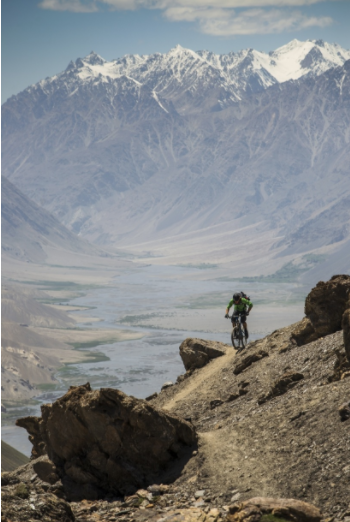
Canadian pro-rider Matt Hunter summits the 4,250 metre Dalriz pass, our first high pass of the twelve day traverse.
We strike out on day one, heading straight into a climb up the 4,250 metre Dalriz Pass, our first high pass of the ride, and a stunning view across the Little Pamir valley. Acclimatisation comes slowly to us, making the first two days a serious slog as we haul our bikes over these passes. Any semblance of vehicle, toilet, or cell-phone coverage is left behind us. Our tyres roll only on ancient trails chiselled into the dusty hillsides by centuries of determined pack animal traffic. For the first two days we follow part of the ancient silk route, beating its way East towards China, shadowed by the impossibly vertical peaks of Pakistan’s Hindu Kush.
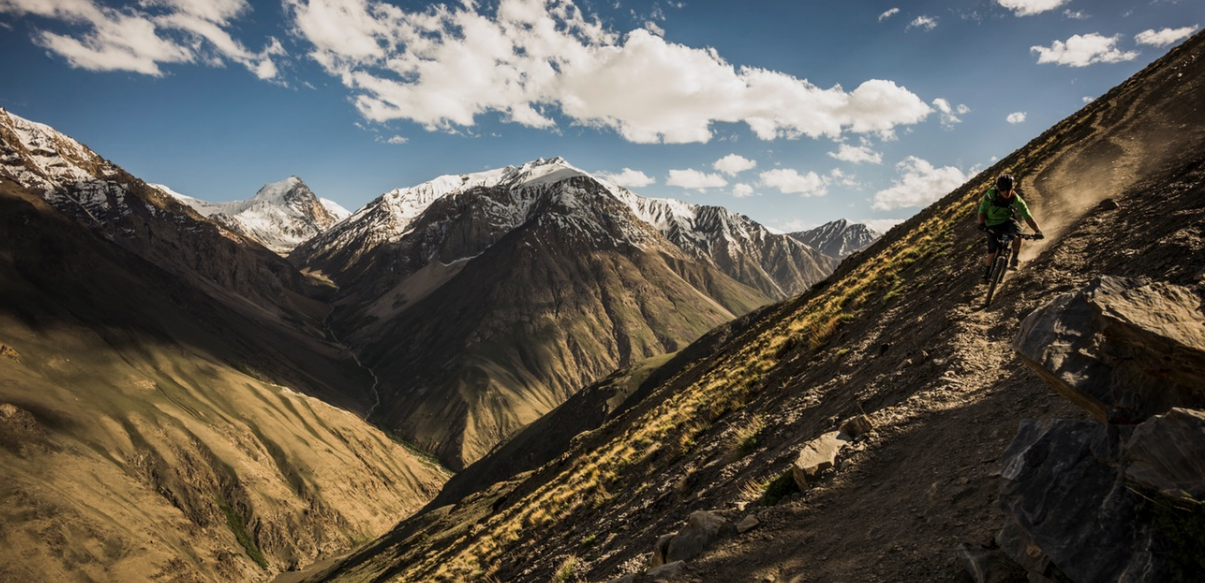
Wild, remote and high, the Wakhan Corridor’s landscape became the backdrop to the toughest expedition I have ever shot.
The locals here are among the hardiest and most resourceful people I have ever encountered. They have little choice to be otherwise. Surviving in this wild and unforgiving landscape is a constant challenge. There are few trees in the Wakhan, so yak dung is the default fuel for warmth and for cooking. Smoking fiercely when burnt, it fills the occasional stone huts our support team sometimes use for cooking duties with thick, eye-watering smoke.
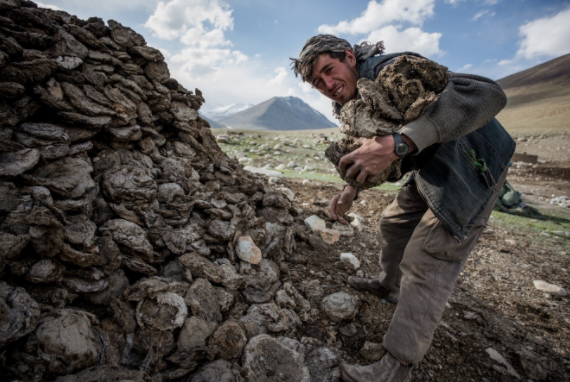
Collecting dried yak dung for the cooking fire. Respiratory complaints from the thick, acrid smoke the dung generates are common here.
We follow precarious trails perched high above the thundering Wakhan river, brown with meltwater silt. There is no shortage of off-camber, loose, narrow singletrack, making for challenging and nerve-racking riding, where a fall could spell calamity. For the first few days, getting the trail surface dialled proves to be a steep learning curve. Each of us deals with the exposure factor differently, but in the end it is the turbulent river crossings that become the single great leveller.
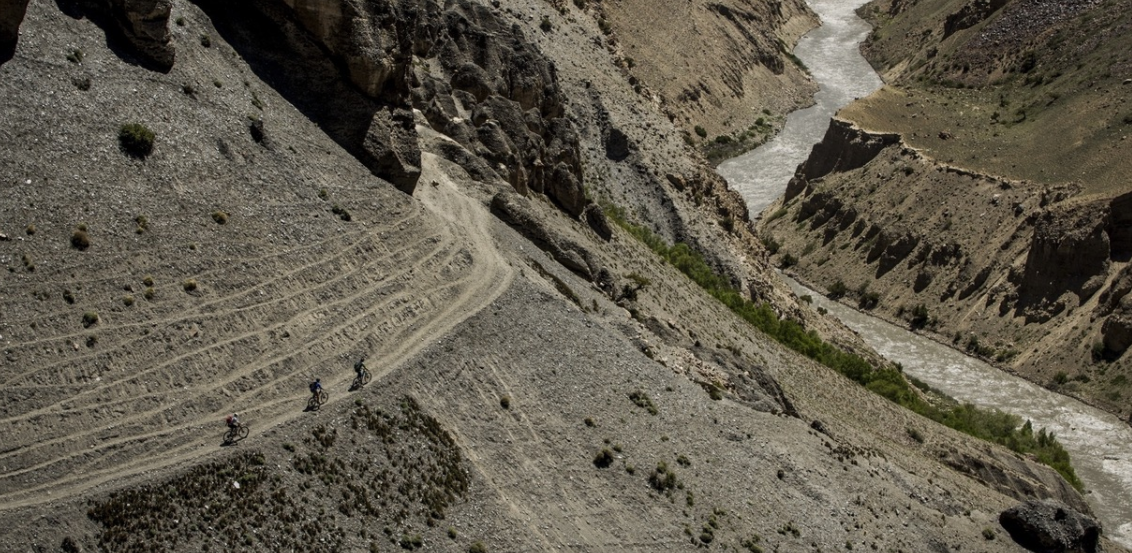
Navigating narrow, loose trails high above the churning Wakhan river, on day two. Rivers are swollen with meltwater in June.
In twelve days of riding, we only cross four bridges. For the remainder, we have no choice but to wade, often thigh deep, in icy cold, churning waters. At each river we stop, regroup and collectively plan a way across. A slip or fall here would mean a battering at best, and at worst losing a bike or even a life into the heaving mass of the Wakhan River below.
Every tributary we encounter is a raging torrent of ice-cold meltwater, formidably dark with silt. Carrying bikes becomes a game of nerves and balance. Numb feet become the targets for bowling-ball rocks, rolled along the riverbed by an angry current.
Meanwhile our enthusiastically grabbing, wildly shouting Afghan support team beckons from the far bank, adding to the drama. And then we have to get the donkeys across. It is a process we must repeat many times.
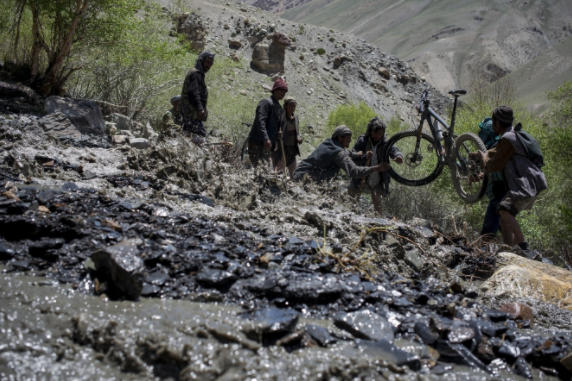
Rivers created anxiety equally within our group. Some were simple, while others were steep, muddy, raging torrents that could easily knock you from your feet. All were icy cold.
In truth, though, we would be going nowhere without the local support and hardy pack animals. In this forgotten land, where winter lasts eight months of the year, we are a valuable source of income for six locals, including our cook Amin Beg, his helper Amin Ali, and our translator Yaar Mahammad. Yaar’s English is basic, and he struggles to understand much of what Tom tries to convey to our horsemen. But without him we would be felled. Finding an English speaker in this remote corner of the world is nigh on impossible. When Tom put the word out, only three candidates showed up at the Tajik-Afghan border crossing at the town of Ishkashim. One of them had travelled for two days to pitch his service.
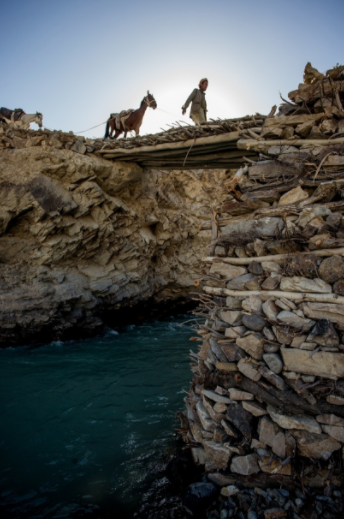
One of the only bridges we crossed during our traverse. Horses and yaks are the only possible forms of transport here.
For the first three days we work our way up the side of the thundering Wakhan river, crossing its tributaries and making the most of every dusty section of trail we can ride. We reach the magnificent rolling hills of Little Pamir, and follow a solitary horse trail up valleys and over passes. Spirits are high and group camaraderie is building, but the physical and mental challenges will take their toll before long. As the days pass, each of us suffers a low point, when energy and morale is lacking.
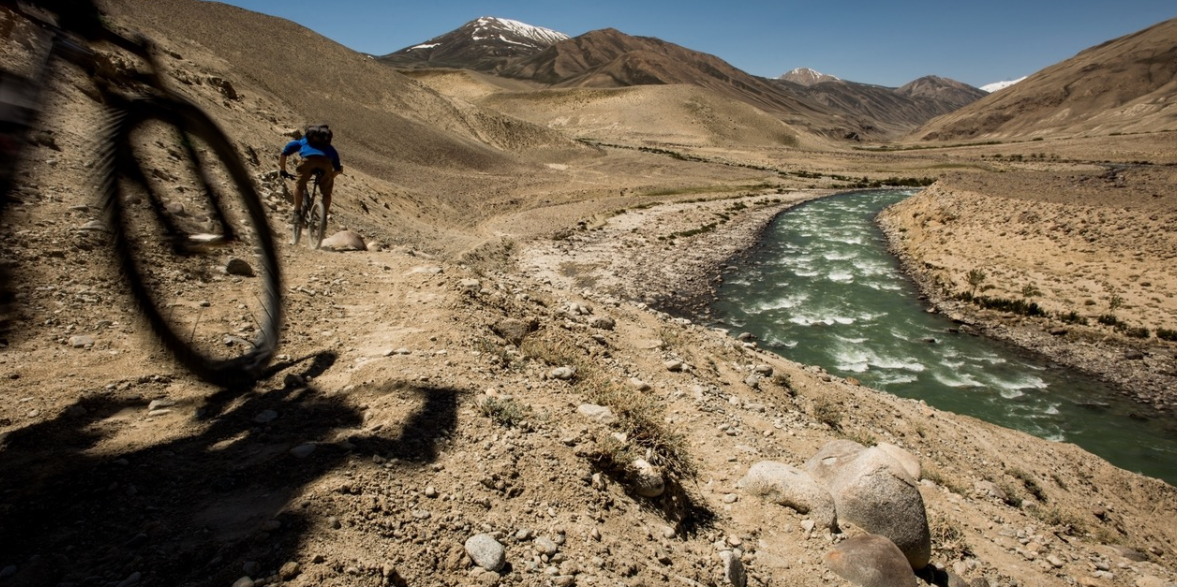
Dropping down to the Wakhan river, and towards one of the most unrideable two kilometres of trail we encountered. No-one can ride a bike through deep sand.
Where we stop to camp each night is dictated by water and the grazing needs of the pack animals, rather than by our own abilities. The distances we cover each day are not big by any standards, but I am thankful for that. We rapidly climb to over 4,200 metres, and then remain above 4,000 metres for much of the trip. Only time will allow us to acclimatise.
The vast emptiness of the Wakhan means that we are assured a permanent feeling of solitude. It is probably the most remote-feeling and wild place that I have ever journeyed through.
Sometimes we pitch our tents in open, exposed meadows surrounded by boulders etched with petroglyphs, sometimes we are squeezed into steep-sided river gorges. The people of the Wakhan are semi-nomadic, and there are are no permanent villages, so we camp wherever a shepherd’s outpost or hut can be found as shelter for our support team. On other nights, they hastily erect ad-hoc stone walls behind which they will sleep in freezing temperatures. None of us have met such a hardy, tough people, and resourceful too. The night before our first high mountain pass crossing, the Afghans sit melting the rubber soles of their shoes on the campfire to stick on patches of fabric. They tell us that these makeshift crampons will help them during the snowy hike ahead.
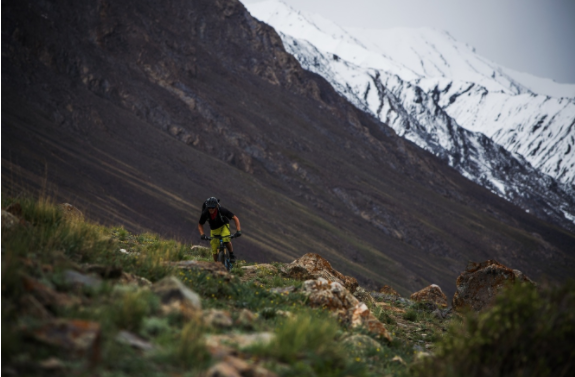
Matt Hunter dwarfed by the snowy Pamir mountains. We make the most of the times we can ride, rather than carry, our bikes.
The high passes become our biggest obstacle. Higher than any peak in Europe they are a challenge for fitness and lung capacity alike. With a 4am, sub-zero start each pass is a race against time, as we attempt to cross before the snow softens. After waiting out the blizzard on day five, with young Askarkhan and his fellow shepherds, it is the 4,860 metre Karabel Pass that finally defeats us. Without the previous night’s clear sky and sub-zero temperatures to freeze the snowpack, our horses flounder in the deep, soft snow. Although we have crested the pass, further progress is impossible without risking injuring an animal. We reluctantly beat a retreat knowing that tomorrow we will have to take a 45 kilometre detour to reach our staging post for the next pass.
This is the nature of pioneering expeditions: facing whatever challenge arises.
Back at Karabel camp, we laugh with our Afghan support team and the shepherds as they try riding our bikes, their first bike experience ever, and we try riding their horses in return. Inevitably, it is humour that most easily slices through the cultural and language barriers between us.
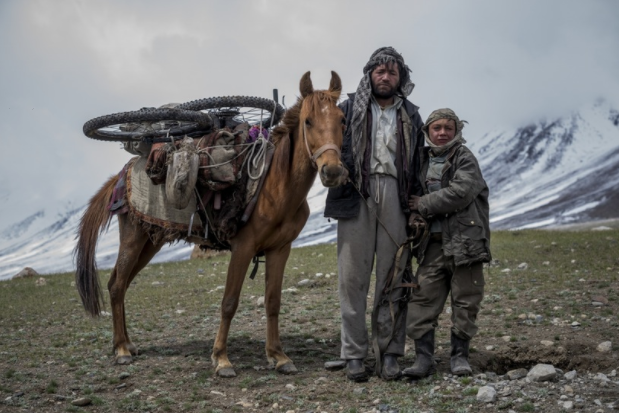
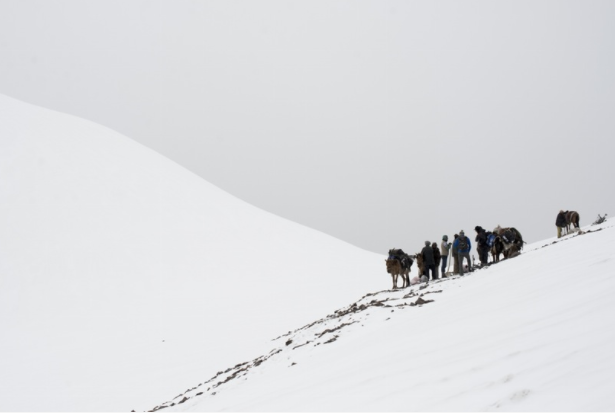
Preparing to cross the 4,860 metre Karabel pass, this was one of the few times we strapped a bike onto a horse to try and make the climb easier for us.
Riding bikes into uncharted territory like this is fraught with challenges that demand dogged resilience and a willingness to simply take what comes. At some point on this ride, we all hit ‘the wall’.
Now day seven, this detour up valley, in bleak weather of frequent snow storms, is the longest and most brutal we have endured. It is on this afternoon, in a swirl of freezing sleet, while pushing my bike across a half-frozen peat bog, I experience my moment of personal defeat. It is understandable. My feet are numb again, the weather is stacked against us, and we are eight hours into a gruelling day of physical duress. When we stop for a rest, I question our sanity. The group is silent. I get the feeling that others share my doubts, but no one wants to spoil the party. We press on, and of course later I will be glad that we did, but by the time we collapse at our camp at dusk, we will have been on the trail for fourteen gruelling hours.
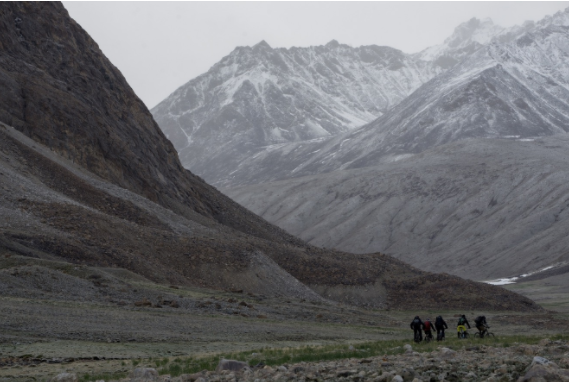
Partway through our gruelling fourteen hour detour, through peat bog and sleet storms, to avoid the Karabel Pass.
That night, we sleep at 4,400 metres beneath an enormous hanging glacier. It is possibly the most spectacular camp spot I have ever seen, but I am too exhausted to truly appreciate it. Six hours after crawling into a cold sleeping bag, we are up and hiking icy scree again, attempting to crest our third high pass, the 4,850 metre Showr Pass. When we finally cross it, the achievement is as much mental as physical. Representing a significant milestone, this pass divides the Wakhi-populated Little Pamir from the culturally distinct Kyrgyz-controlled Great Pamir. The descent is an eclectic mix of snow, mud and rocky singletrack, weaving between boulders and around bogs. The riding is as wild as our surroundings.
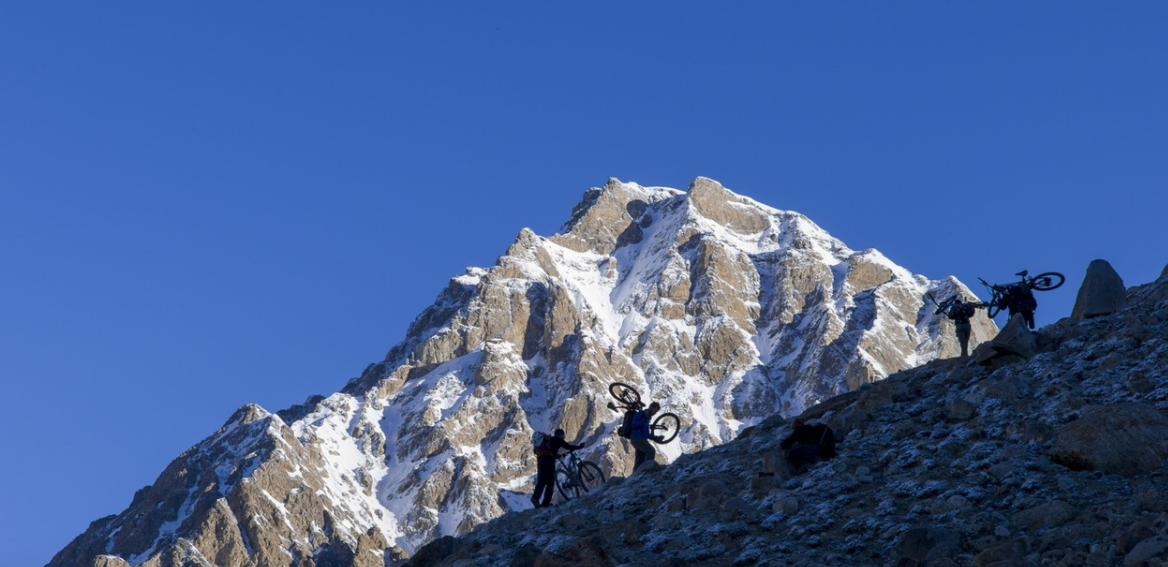
An early start to crest the 4,850 metre Showr Pass leaves our group silhouetted against the mighty peaks that welcome us.
While the Wakhan is isolated from the dangers associated with the rest of war-torn Afghanistan, its unruly, changeable weather and formidable terrain devoid of natural shelter make it a place to not come unstuck, and the locals know this. As we descend from the Showr Pass, we pause too long to photograph the late-afternoon scene, bathed in glowing light. Realising our support team are no longer in sight, we are faced with multiple junctions in the trail. The very real possibility of being lost hits us. Fortunately, the Afghans we are with have our backs. Before long, in the distance, we spot Amin Beg, our cook, running back on foot. When he finds us, his look of relief mirrors our own.
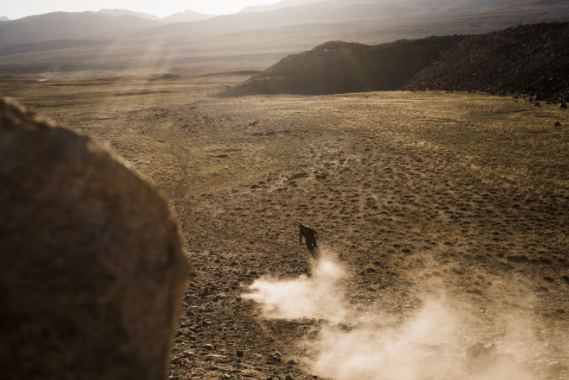
Heading into Wakhi-populated Big Pamir, we stop to photograph and re-photograph a spectacular section of trail glowing beneath the setting sun.
Eventually escorted safely to our camp for the night, we reach the Kyrgyz village of Rabot, the first permanent settlement we have encountered on our ride. Later that evening, through the limited English of our translator Yaar and our own efforts at sign language, we realise that our safety is of genuine concern to our support team. They may be surprised to find us trying to ride bikes through this unforgiving and wild land, but they will do everything in their power to help us succeed.
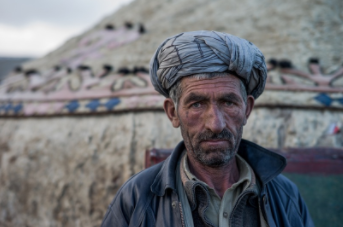
One of our Afghan support crew. There are few people as resourceful and tough as the Wakhan inhabitants.
The landscape opens up into a wide glaciated valley, and we roll through it, dwarfed by the scale our surroundings. The Kyrgyz are masters of horsemanship, and here, horses and yaks are the only practical modes of transport. Bikes have never made an appearance. As we descend further into the valleys, our bikes become the objects of intense interest. We realise none of kids here have ever handled anything like this before, let alone tried to ride a bike. The marvel that is the wheel is something that lights up dozens of faces as Matt hands one around to an eager cluster of children. They hold them up and spin, and spin, laughing.
To me, bikes will always be a great way to break down social awkwardness in remote places and regularly create smiles all round.
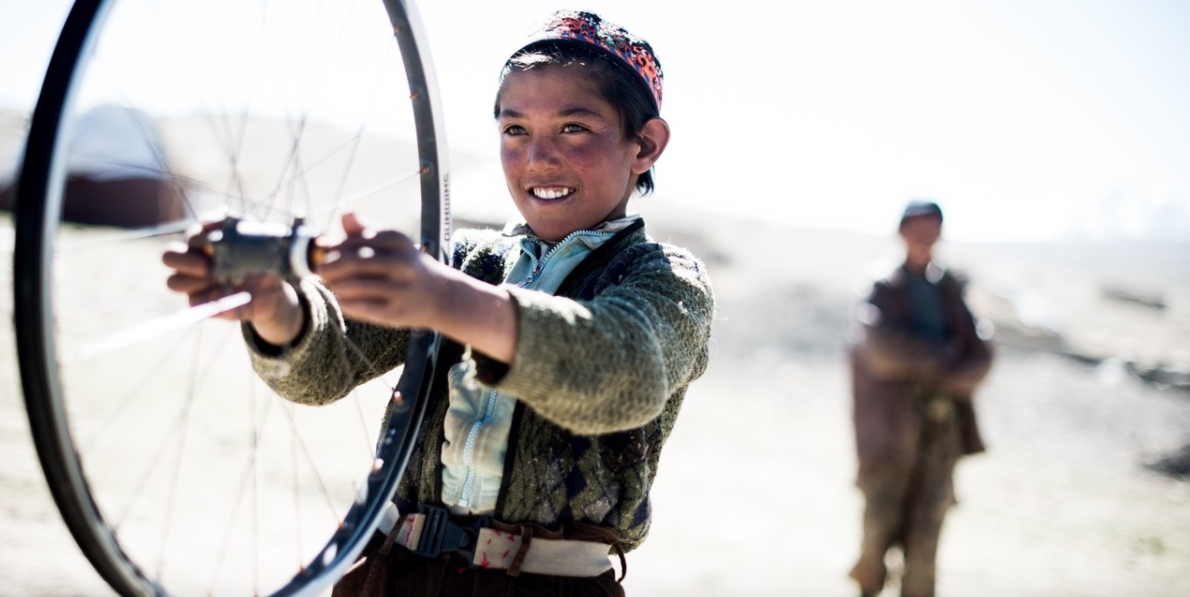
Fascinated, a young boy from the small village of Rabot in the Kyrgyz-populated Great Pamir, spins the wheel from one of our bikes.
We experience a dramatic change in culture in these valleys. Leaning our bikes up outside, we are welcomed into yurts to drink sour chai and consume fermented yak yoghurt, a staple of afternoon tea. The chief of the settlement welcomes us warmly, and a dusty rug is unrolled on which to share our meal. We are all as captivated by yurt life as the Kyrgyz are by our bikes. They laugh when we struggle to down the rancid yoghurt.
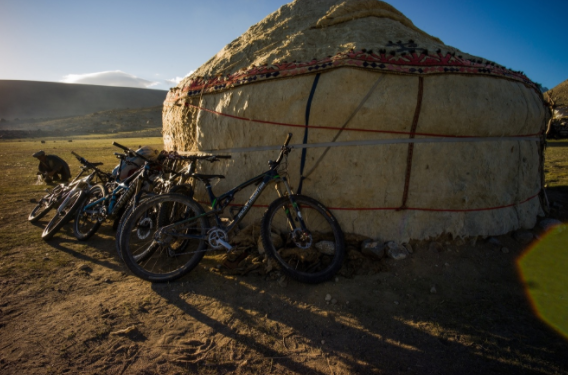
The first time that bikes have been leant against this, or any other yurt here.
Tonight, we are invited to sleep alongside our six-strong Afghan team in the shelter of the settlement’s guest yurt. It is our first chance to escape the frenzied flapping of tent flysheets pitched at the mercy of the Pamir’s relentless wind. We learn that Kyrgyz villages often have a guest yurt, something that seems unlikely in such a remote place, but given the harsh environment and changeable weather, it is customary to offer such hospitality to passing travellers. We accept gratefully, united in our appreciation of this incredibly beautiful, untamed landscape, and in our wonder and disbelief at the arduous lives of the inhabitants here.
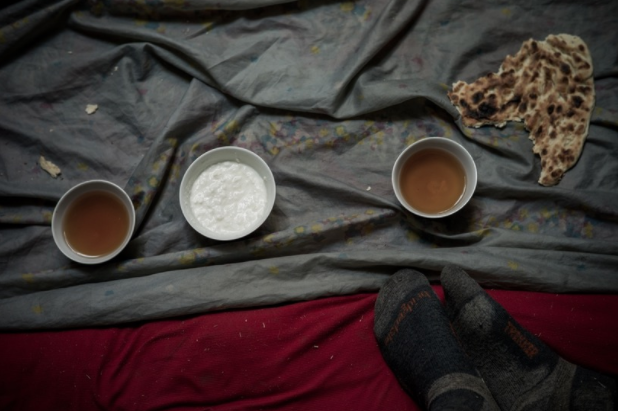

We are served tea and rancid yak-milk yoghurt, along with traditional flat breads. That evening, we are six westerners, and six Afghans, in one yurt.
Eleven days into our ride, and it is nearly time for us to leave these mountains to face the four-day drive back to the lives that we know. For now, the routine of ride, wade, eat, sleep has become normal. We are weather-beaten and at our physical and mental limits, but every day has brought incredibly rewarding experiences. Yes, hygiene has gone by the wayside, and the rivers are too cold for anything more than a token dip, but despite the daily challenge of covering distance, of climbing snowy passes or riding rocky, technical singletrack, life has become simple.
At times, the sight of bikes in this area has raised eyebrows and concerns from locals, and from us too. Faced with testing conditions this trip has become a learning experience for all involved, but also one full of rewards and rich experiences. It has to be one of the most beautiful and peaceful areas I have ever had the honour of visiting and photographing, and the people here some of the most welcoming I have ever met.
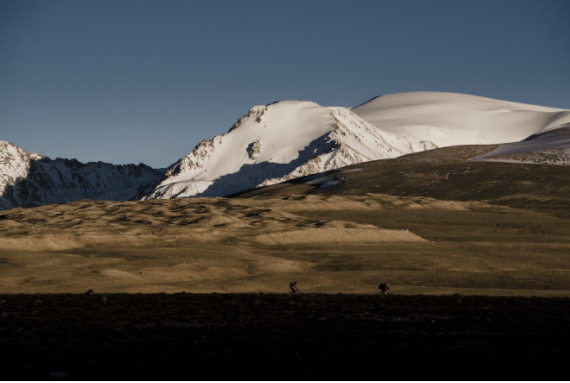
Silhouetted against the humbling grandeur of the Great Pamir, our group makes its way to camp at the end of day ten.
As I push my bike across another traverse too cluttered with fist-sized rocks to ride, I remind myself of this. The frustration of pushing a bike is something to which I am now accustomed. Before I know it, I will be boarding a plane bound for the comfort and luxuries of Europe. It is hard to pretend that I am not excited about the prospect of a real bed, or being able to turn on a tap to have drinkable water run freely from it. But at the same time I know I will never repeat what we are doing now. I will never have these same exact experiences again. And so for now I smile, revelling in the experiences that are clogging my senses in this moment.
It is the hardest thing I have ever done, but I love it. In this wild, harsh corner of the world I realise that I am between a rock and a hard place. Literally.
THIS ARTICLE WAS ORIGINALLY PUBLISHED ON MAPTIA.
DAN MILNER
Dan Milner is a British adventure travel photographer bent on shooting masochistic bike, snow or just-for-the-hell-of-it expeditions.
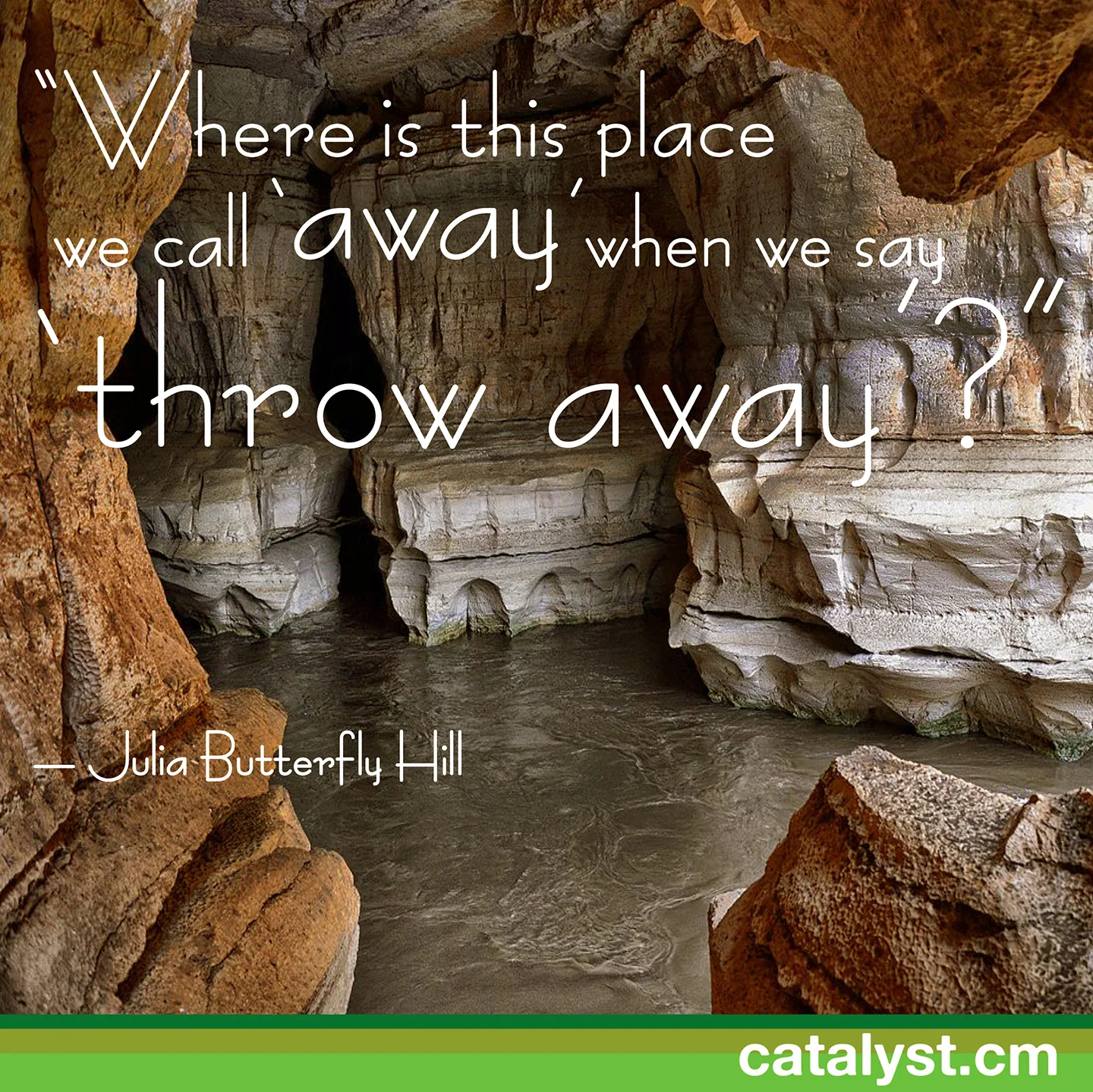
Where is this place we call 'away' when we say 'throw away'?

If you want to make peace with your enemy, you have to work with your enemy. Then he becomes your partner.

A good traveller has no fixed plans and is not intent on arriving.

Change will not come if we wait for some other person or some other time. We are the ones we've been waiting for. We are the change we seek.

Travel is to live.
VIDEO: Deep in Panama's Rainforest
Enrique Pacheco’s cinematography takes us on a journey through Panama’s lush landscape.
“Deep in the Rainforest” captures the density and beauty of this undisrupted natural space. Through Pacheco’s lens, we explore nature’s gentle power—torrential storms, vibrant light, and the intricate ecosystems that make up Panama’s environment.