Life on the Margins

During the northern summer of 2001 thousands of Chinese security personnel, backed by an army of labourers armed with sledgehammers, massed at the entry of the Larung Gar Tibetan Buddhist Institute. In this almost impossibly remote place, sitting high on the Tibetan Plateau, 9,000 monks and nuns had found a home, defying decades of China’s aggressive atheist policies to learn from its charismatic and avowedly apolitical founder, Khenpo Jigme Phuntsok.  
PRC authorities had long been skittish about the institute’s remarkable growth, and particularly alarmed by its growing appeal to ordinary Han Chinese. By 2001 over 1,000 Han also called Larung Gar home.
 

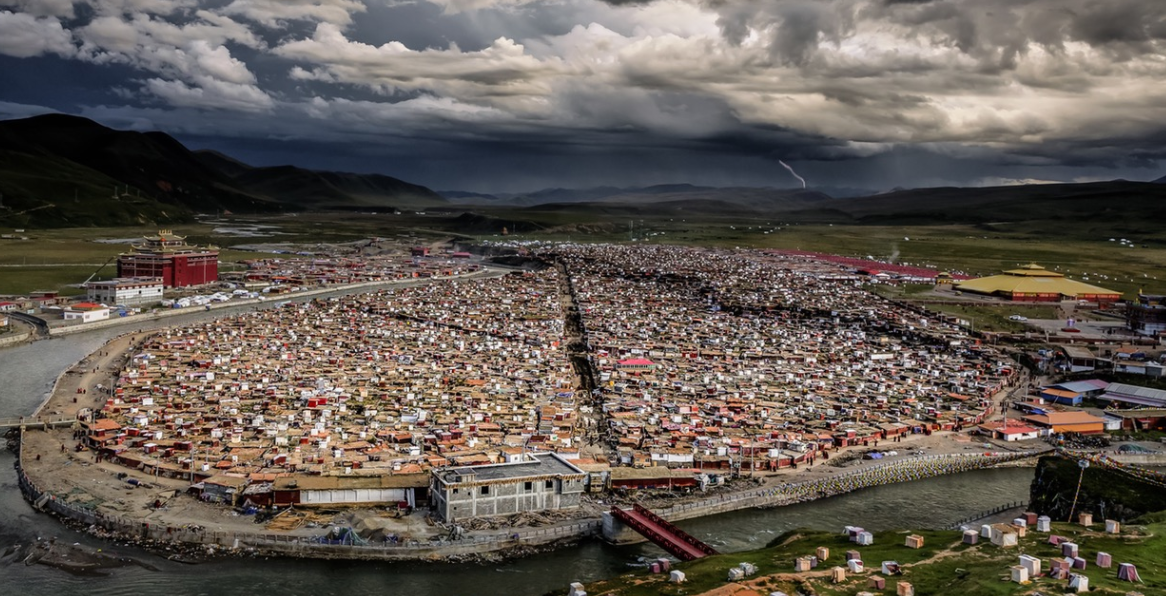
The Larung Gar Five Sciences Buddhist Institute.

Both Larung Gar and Yarchen Gar (gar translates as camp) have remained largely hidden from the outside world, as much because of their inaccessible geography as the tight controls on freedom of movement put in place by the Chinese government. Both sit at elevations of over 4,000 metres, sunk deep into hidden valleys of the Hengduan mountain range, which cuts across China’s south-western Sichuan province.
 

Yarchen Gar sits hard against the border of the TAR and is home to roughly 9,000 nuns. 
 

Both Yarchen and Larung Gar are part of what is known as the Garzê Semi Autonomous Prefecture, where 77 percent of the inhabitants — some 800,000 people — claim ethnic Tibetan heritage. As is the case in the similarly named Tibetan Autonomous Region (TAR), the people’s future has long been out of their own hands.

In theory, to move around Garzê as a foreigner, one only needs a Chinese tourist visa and bucket loads of time, patience and fortitude. This is in stark contrast to the neighbouring TAR, at the border of the lands known to the wider world as ‘Tibet’. Visitors to the TAR are required to first negotiate a complex and shifting permit process, before joining an organised and highly controlled tour of the region.
 

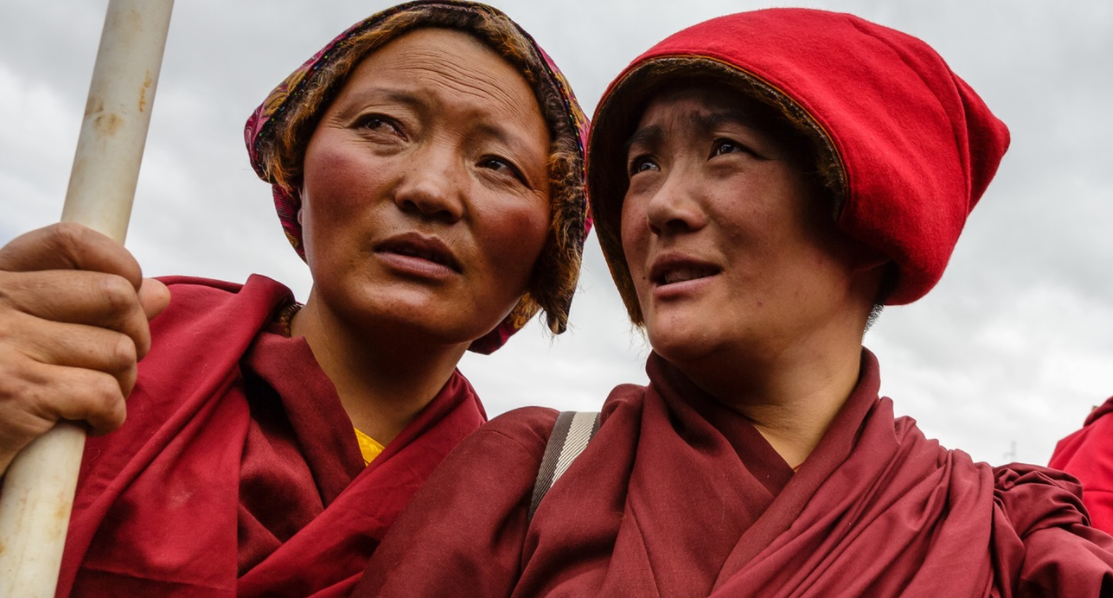
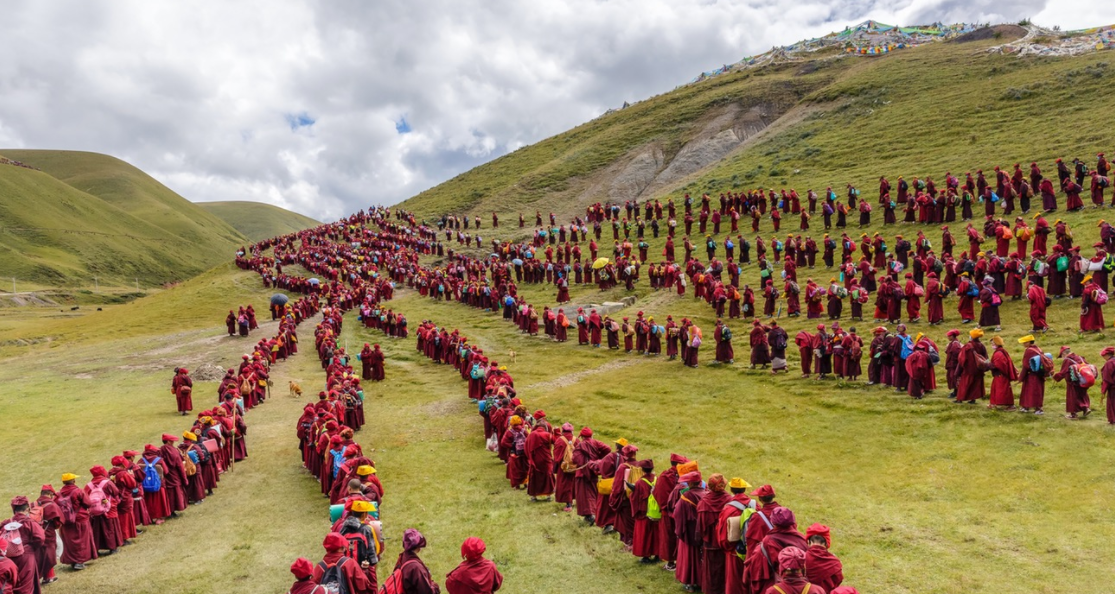
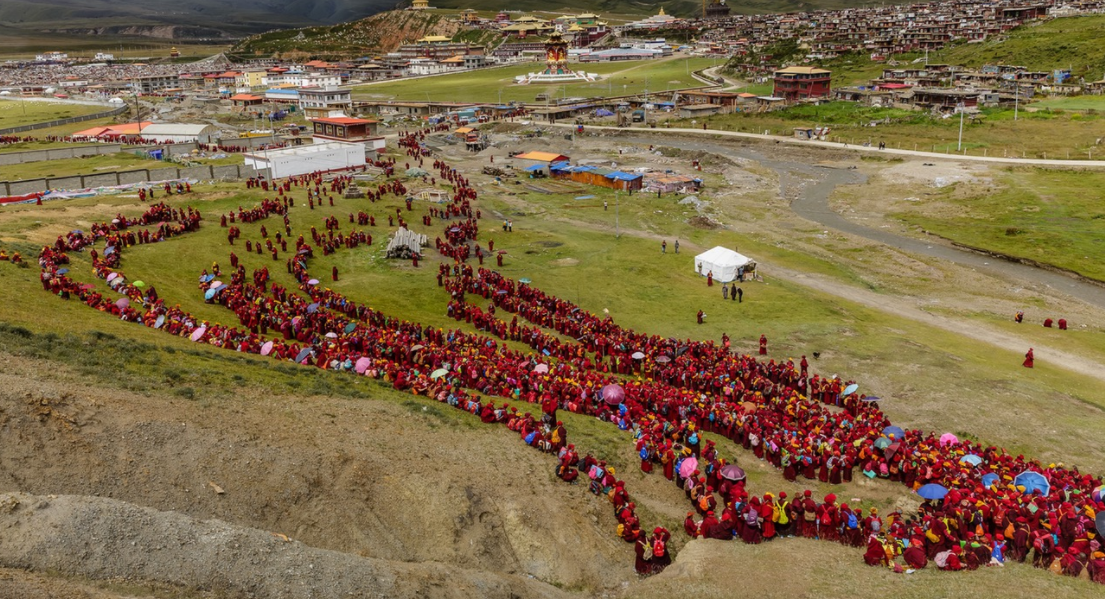
Nuns at a ceremony at Yarchen Gar in which almost the entire population of the camp leaves for a month of meditation in the surrounding hills. 

Yet Garzê and nearby Qinghai are also restive. Tibetans here have openly protested against Chinese control, most notably as part of a violent uprising in 2008. Referred to by the Chinese as the 3-14 riots, unrest had spread from the TAR into Sichuan. This unrest effectively slammed the door shut to the region’s hidden treasures until 2013. Today, despite relative calm, nuns and monks continue to take the extreme measure of self-immolation in towns and villages. Reports of random arrests and the disappearance of accused activists are common. Recently Garzê has been open, yet regulations can change overnight and information is scarce. 
 

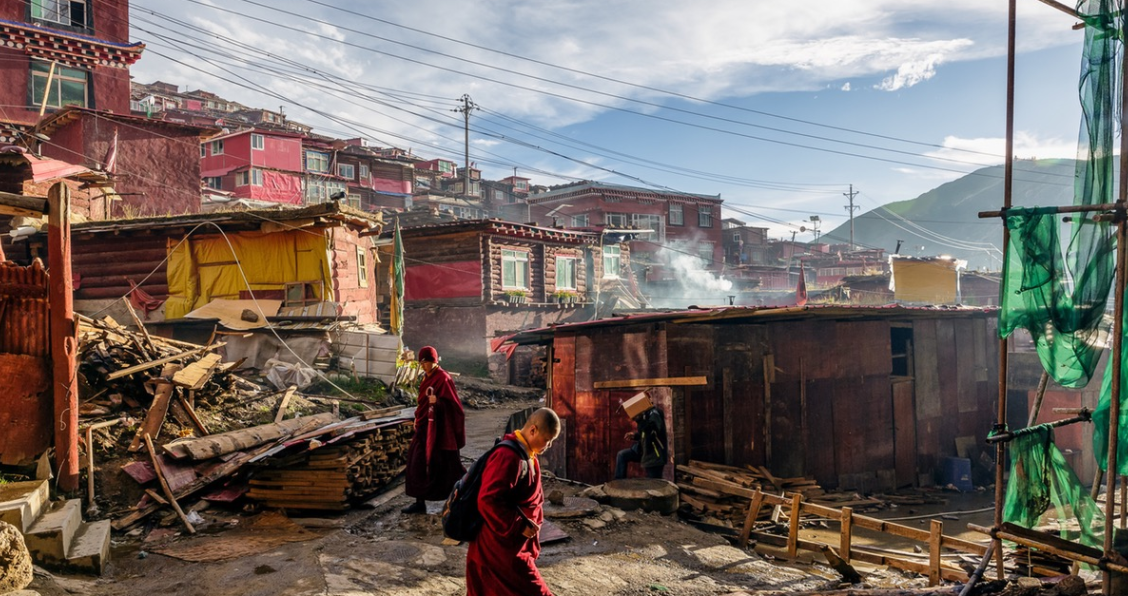
The narrow, winding alleyways of Larung Gar.

During China’s breakneck boom the mountainous Garzê region represents ground zero in the great ‘go west’ campaign — viewed by the People’s Republic as integral to the rapid growth of the Chinese economy. 

The wealth of natural resources found here, as well as the nation-building railway into Tibet (completed in 2006) have been the catalyst for extraordinary development. In the regional town of Sertar, which sits astride the Larung Gar complex, the reality of the security situation quickly hits home. I was challenged in the main square and taken to police headquarters to sign in and face a barrage of questions.

Mercifully, one officer spoke English and took my story of being a history teacher at face value. This would be just one of my almost daily encounters with the local police force over the coming weeks.

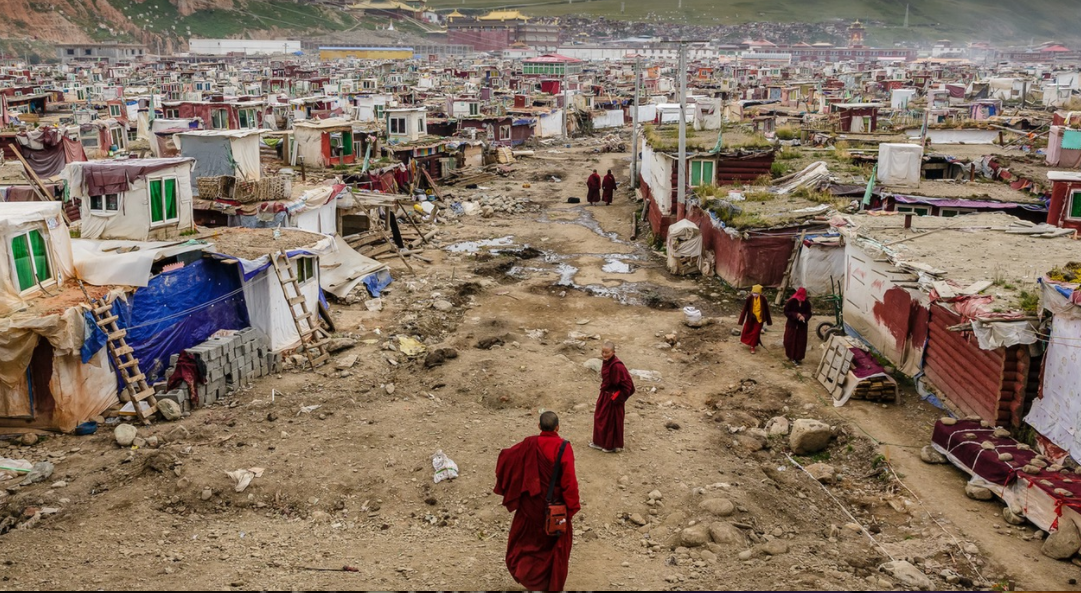
The main street through Yarchen Gar

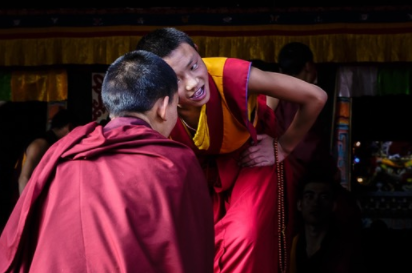
Monks debating at Larung Gar.

During the following days I was left free to explore the vast warren of huts, temples and study houses that surround the complex. One morning I witnessed a loud monks’ debate; where the men and boys almost come to blows over competing theological arguments.

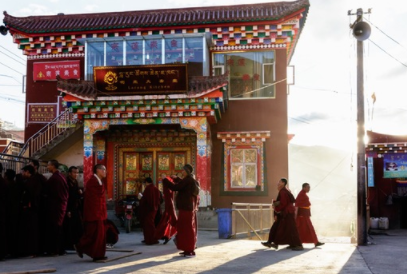
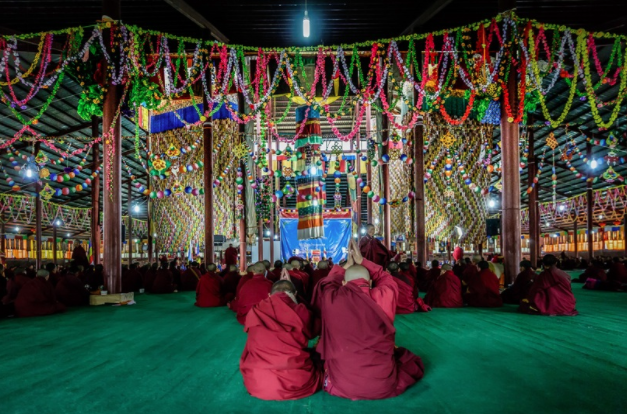
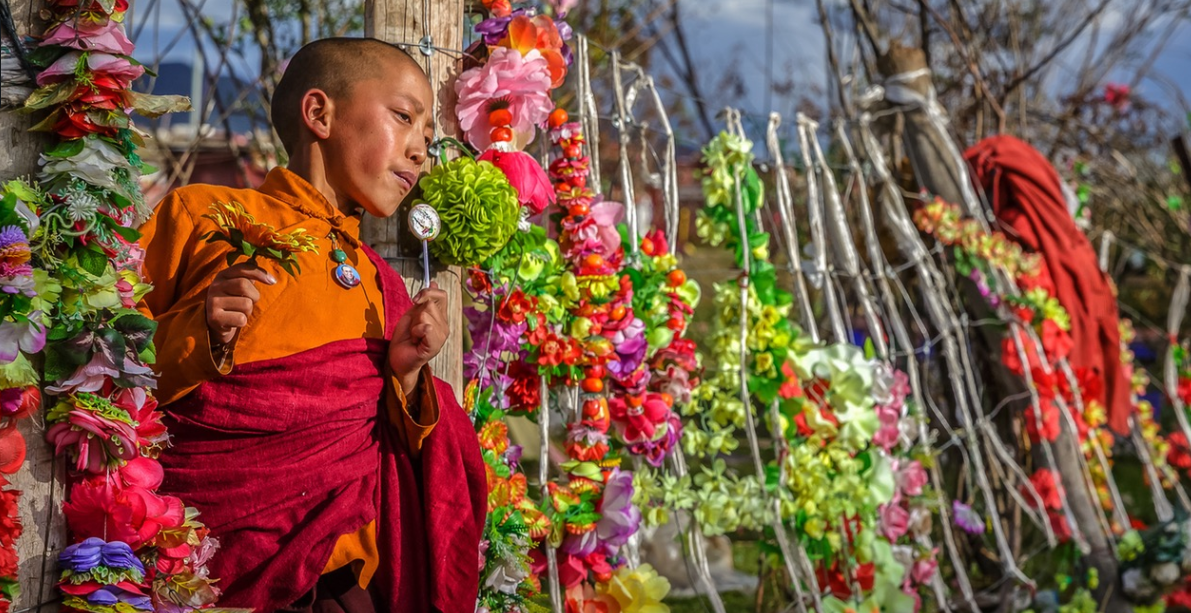
The monks and nuns live their lives separated by the main road which slices Larung Gar camp down the middle. I found both groups to be generally welcoming and curious, and the tinderbox atmosphere and police presence of Sertar is replaced by the constant hum of worship, with the sound of prayer and Tibetan horns a constant.
 

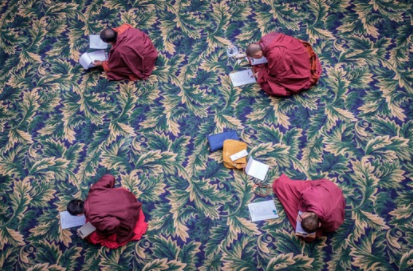
Monks in study and debate at Larung Gar. 

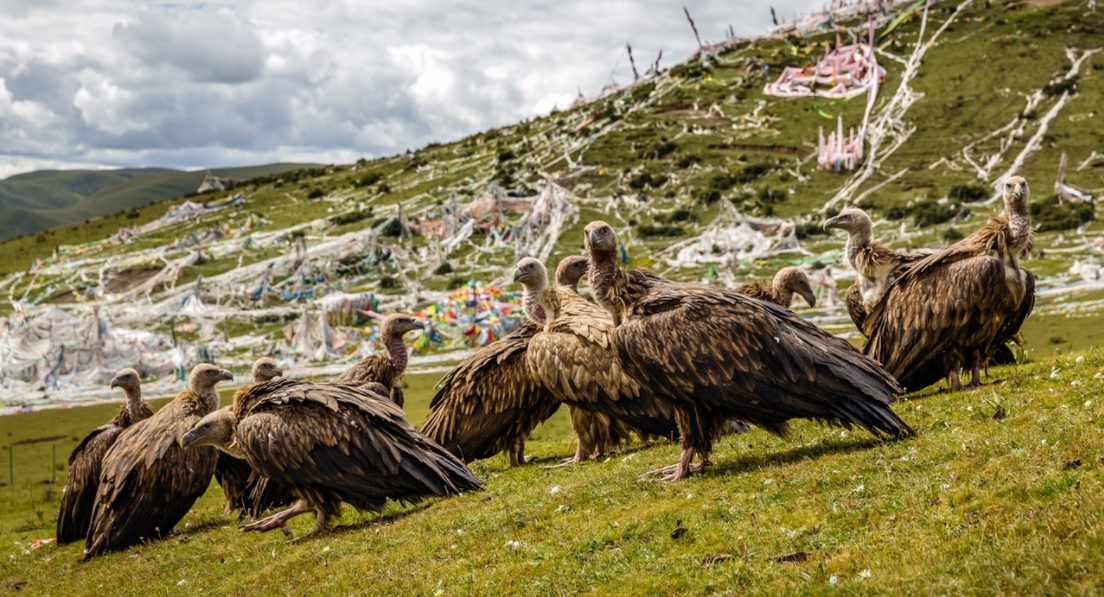
Many Chinese tourists visit Larung too. The biggest draw for them turns out to be the opportunity to witness a traditional Tibetan ‘Sky Burial’. At 1pm every day, the Rogyapa (“body breaker”) arrives to dismember recent human remains, which are then fed to aggressive flocks of resident vultures on a hillside set back from the complex.

Macabre to some, this ancient ritual is both a practical way of disposing of human remains whilst also adhering to jhator, the principle of kindness to all living things, which includes feeding these huge carrion creatures. Few of traditional these sky burial locations remain operational, mainly due to religious marginalisation, urbanisation and the decimation of vulture populations.
 

The vultures who are fed during the traditional ‘Sky Burial’ on the hillside above Larung Gar. 

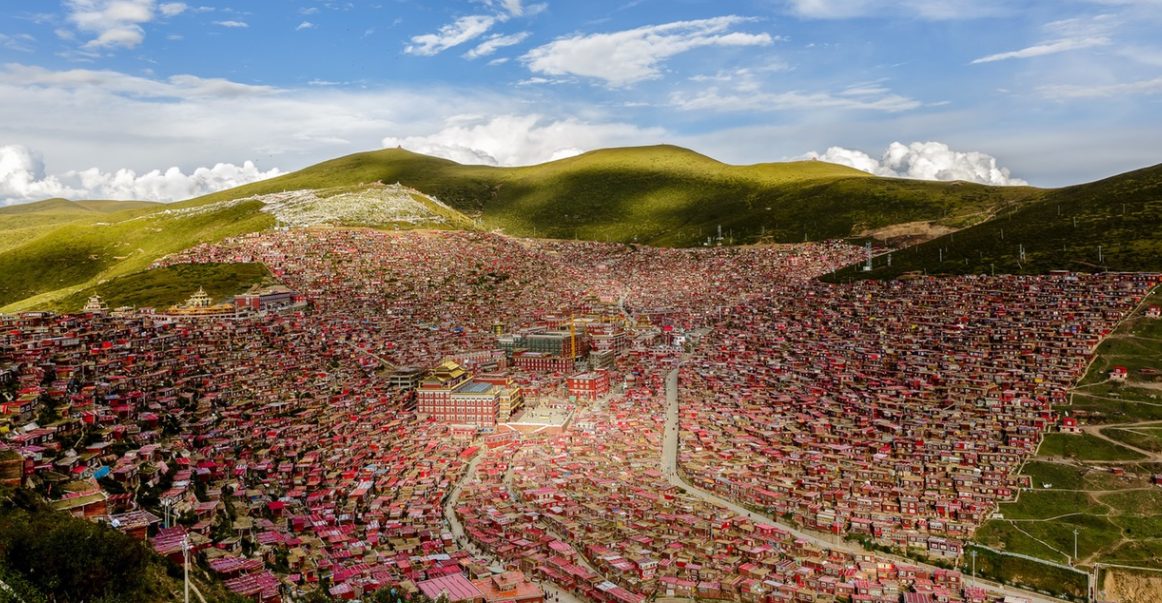
The institute at Larung Gar currently attracts followers of Tibetan Buddhism from all over China. Its regrowth after the 2001 evictions was swift; students began to illegally return and rebuild almost immediately. After Jigme’s death in 2004, countless followers made a pilgrimage to Larung Gar to pay homage to their spiritual master. Many stayed and contributed to the already rapid regrowth of the population. Today, Larung Gar is home to an estimated population of 50,000 people.
 

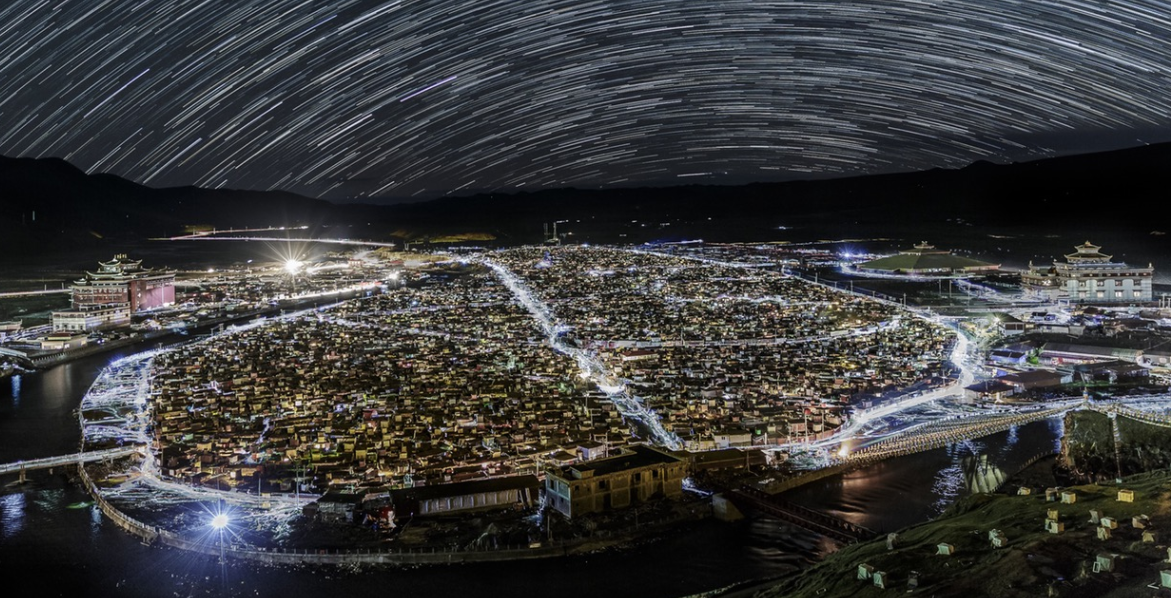
Gar camp from above, on rare clear day.

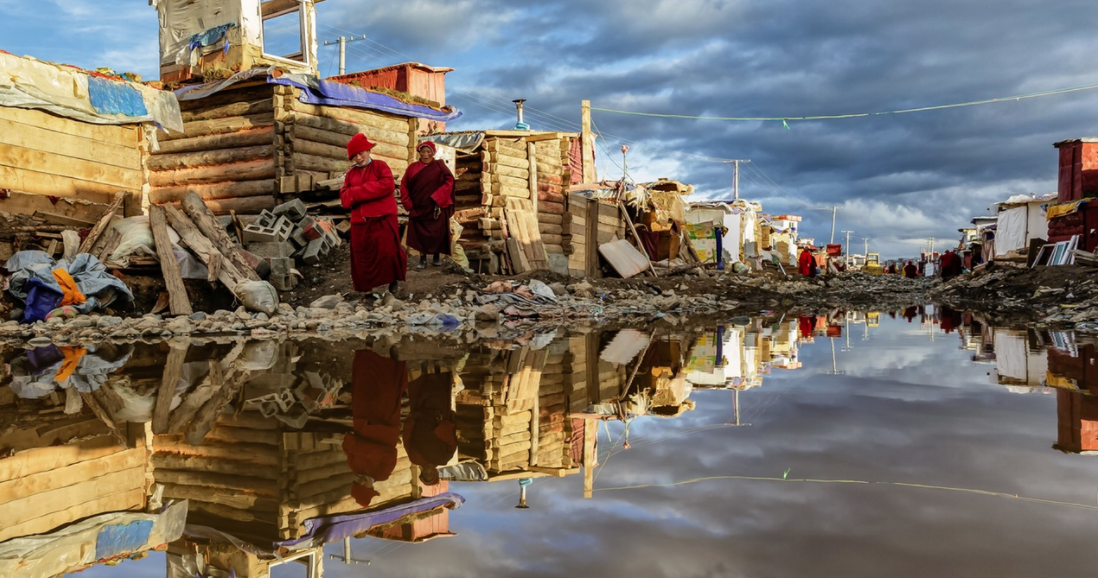
Yarchen Gar, founded in 1985 hard against the border of the TAR, has deplorable living conditions. Without even basic sanitation, every corner of the complex is permeated by a breathtakingly toxic smell.  Around 9,000 nuns live in ramshackle huts on an island, while the more solidly built monks’ quarters sit more favourably on the surrounding hills. Monsoon rains bring regular flooding; on my visit ankle-deep raw sewage flowed into the streets on more than one occasion. 

Rains in Yarchen Gar flood the streets with raw sewage.

No electricity runs to the island where the nuns live. Cholera and typhoid outbreaks are a daily threat. In winter, the temperatures plunge to a life-threatening minus 25 degrees. Yet this does not deter the nuns. Winter meditation sessions, referred to as the “direct crossing”, can last for days, with nothing more than a blanket to shield worshippers from the cold.
 

Sunrise at Yarchen

 The reward for this remarkable display of self-deprivation is the chance to learn first-hand from some of the most revered figures in Tibetan Buddhism. The current leader in residence is Asong Tulku. ‘Tulku’ is a title given to a person who has reached the highest level of spiritual enlightenment, and Asong is considered a living Buddha by his followers. To assist in his teaching at Yarchen, Asong is aided by senior nuns, called khenmos. Many nuns begin their life here at the age of just six.
 

Worshippers inside one of the temples at Yarchen Gar.

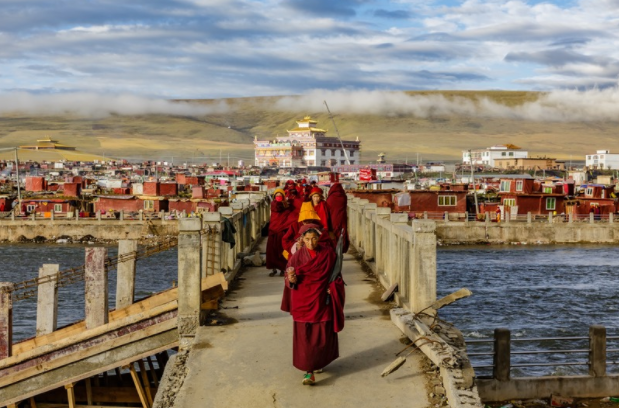
The bridge over to the island where the nun’s live.

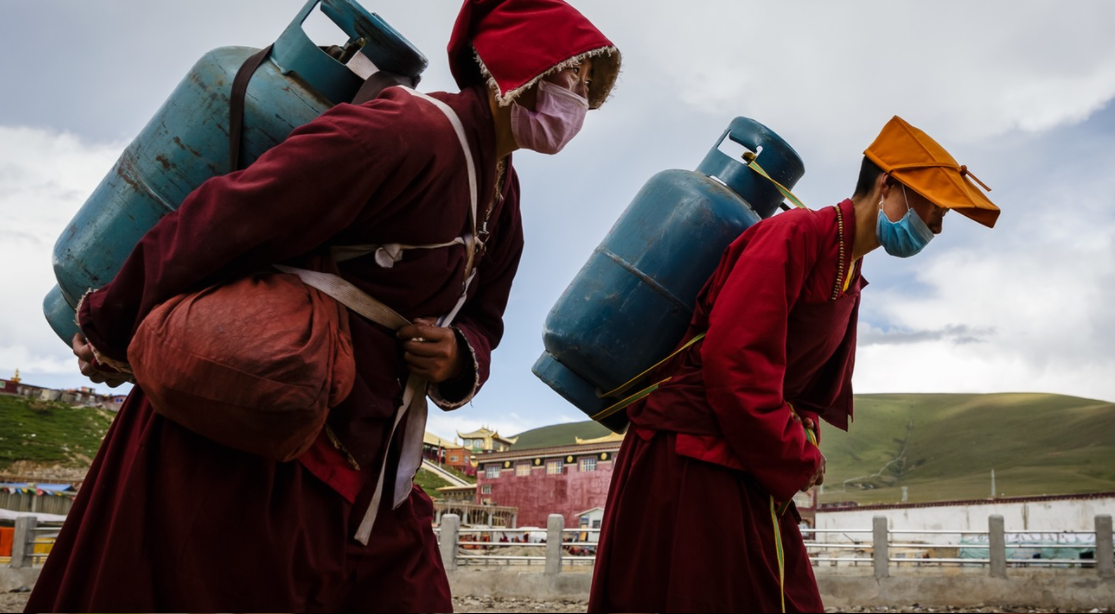
Not only do the nuns dedicate themselves fully to their studies, they are also responsible for almost all physical labour at Yarchen, constructing houses, unloading trucks or building roads. The monks, who rarely participate in physical labour here, seem to have it easy in comparison.
 

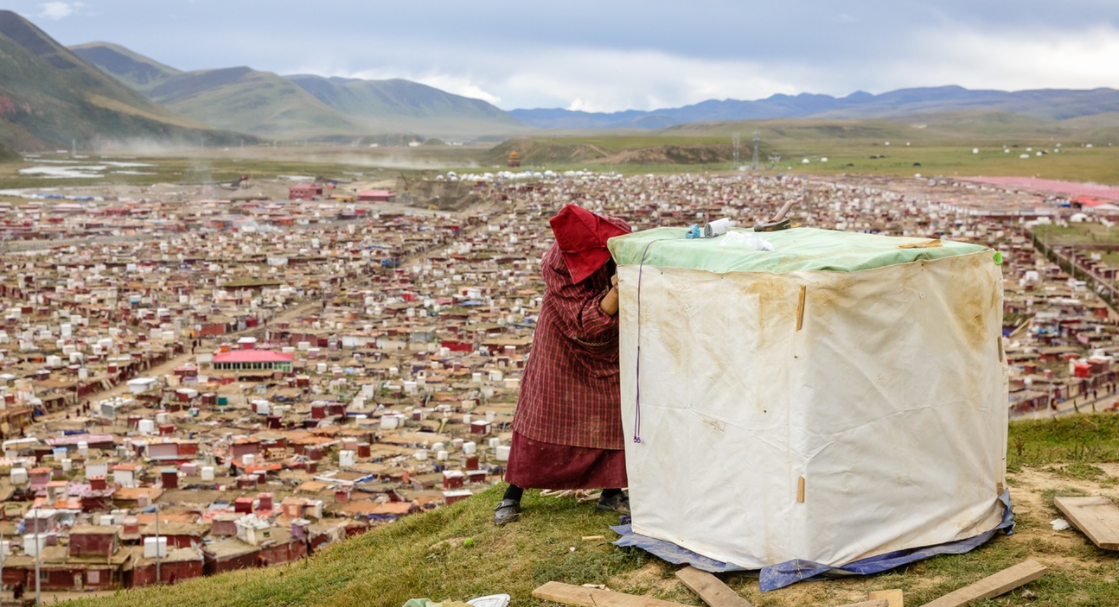
Building a basic meditation hut on the hills overlooking the nun’s encampment.

The nuns carry out most of the hard physical labour at Yarchen. 
 

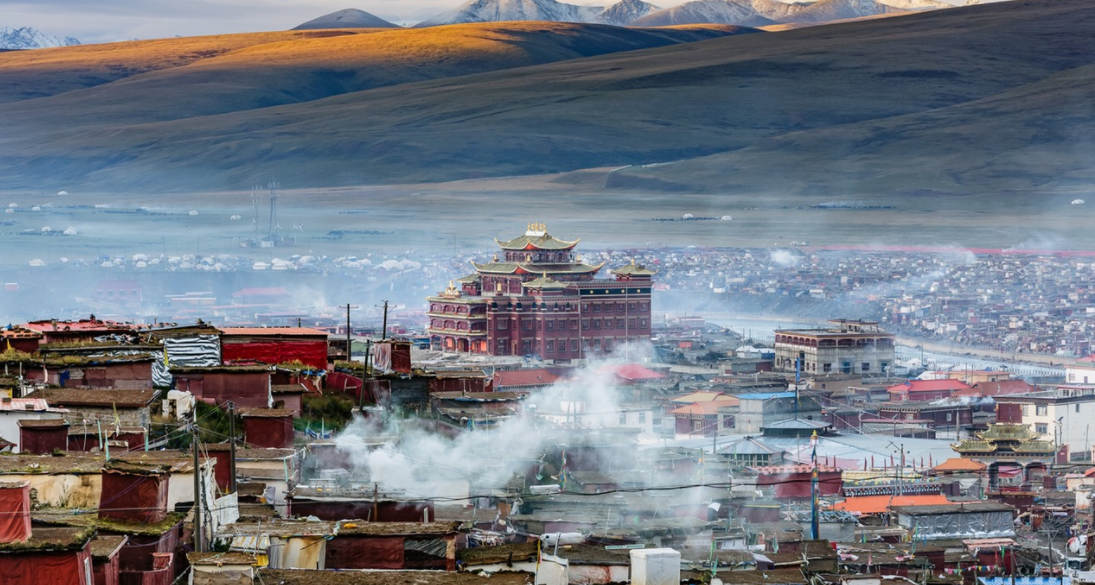
Despite the challenging living conditions, vast amounts of money are being funnelled into gigantic, ornate temples and monuments in the heart of the camp, while the surrounding slums continue to crumble.

Han Chinese money has poured into this region, with relatively wealthy converts to Tibetan Buddhism bringing much needed funds to the camps. These wealthy benefactors, hoping to improve their karma for the next business deal, or through a “cover all bases” spiritual mentality, have sparked a huge construction boom on the far western Chinese frontier.

A young nun exits an area reserved for eating and socialising in the centre of Yarchen. 

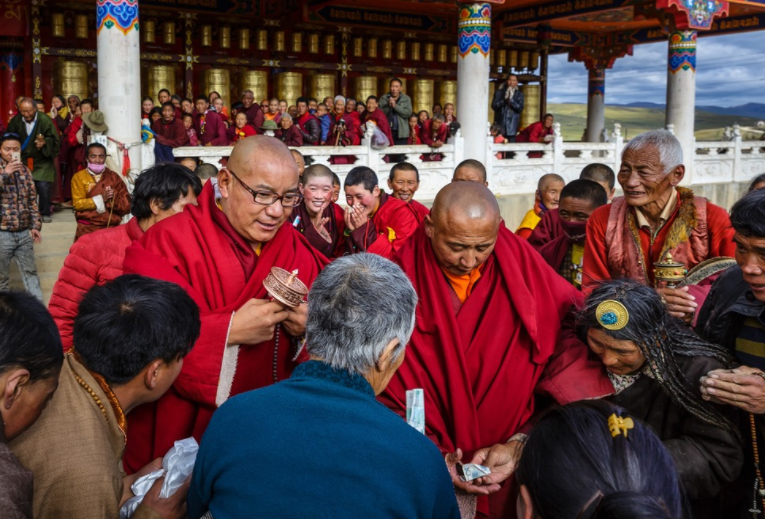
During my time in Yarchen I had several memorable brushes with the revered leader, Asong Tulku. As he piloted his gleaming white Lexus around the slum, our paths would meet on my early morning photo shoots. Watching people fall into the putrid mud at his feet wherever he walked, all rushing to pay tribute with cash and gifts, I found myself wondering if the money for the Lexus couldn’t be better spent elsewhere.
 

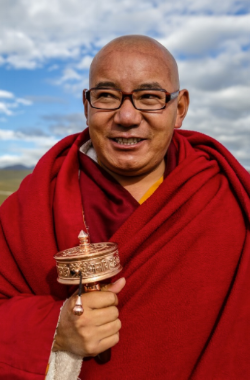
Asong Tulku is considered a living Buddha by his followers

The abrupt change from the monsoon season to the biting cold of winter was a fortuitous time to be visiting Yarchen. A ceremony in which almost the entire population of nuns empty from the confines of their island home for a month of meditation in the hills was due to take place. For days, preparations for this ritual, translating roughly to the “circle of life”, had provided a preview of what was to come.
 

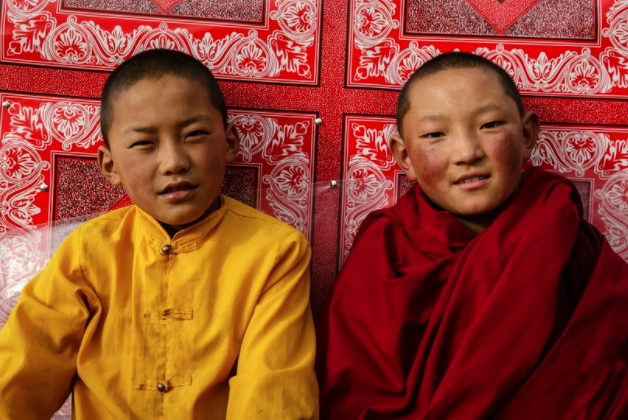
Young monks taking a break from daily classes at Yarchen.

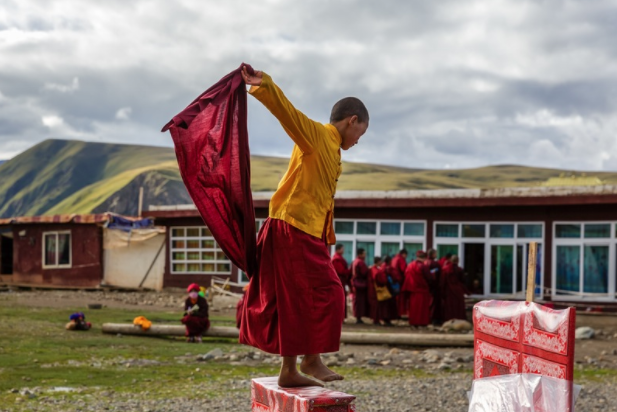
Basic supplies were taken by foot to a hidden nook outside the complex, the location of which was strictly off limits to outsiders. When the fortuitous day finally arrived, the sight of 9,000 nuns in their bright red robes streaming into the hills was a privilege to see.
 

The nuns of Yarchen Gar prepare to walk into the hills for a month of meditation.

At the entrance to the valley I reached a sign hammered into the ground, with a message written in bold letters, announcing that any man who followed the nuns on their trek would return blind. With this, I knew that my luck had held out for long enough; it was time to go.
 

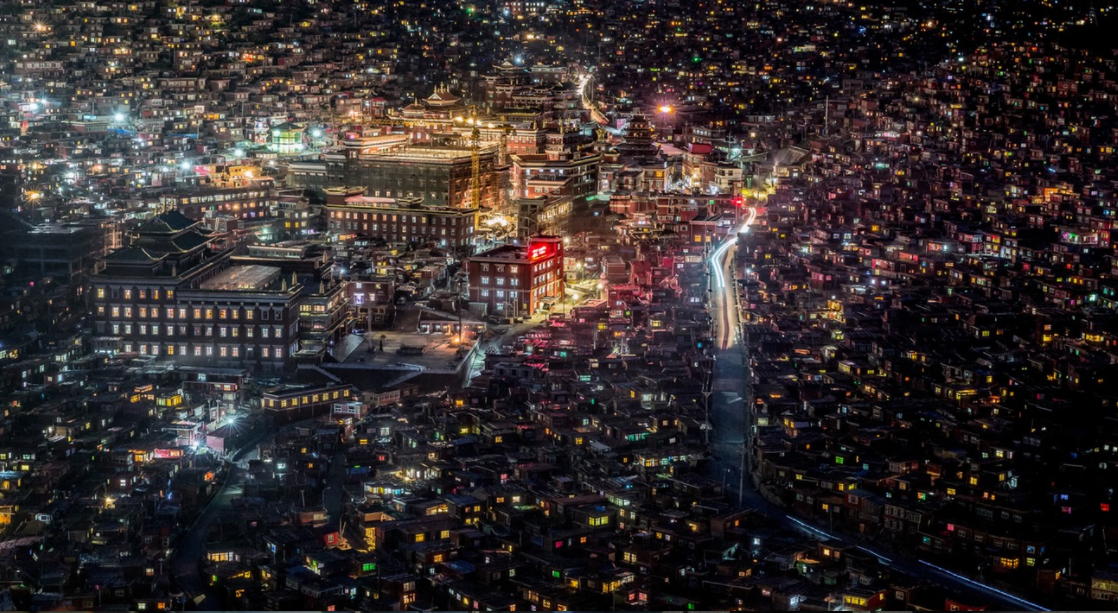
Larung Gar camp by night. 

By rights Larung Gar and Yarchen Gar shouldn’t exist, and at different times the authorities have tried to sweep them away. Draconian restrictions on the freedom of movement and religious practices in the TAR itself means that nothing exists there to rival these two sites.

Quite possibly, the future leadership of Tibetan Buddhism rests not within the more recognisable white-washed walls of Lhasa’s hillside fortresses, or within the Dalai Lama’s inner circle, but within China itself.
 

Star trails arching over Yarchen Gar.


THIS ARTICLE WAS ORIGINALLY PUBLISHED ON MAPTIA.


BROOK MITCHELL

Brook Mitchell is a photographer + writer with Getty & The Sydney Morning Herald.

Visions of Kenya

A long time went by before I was able to understand this trip. Sometimes, the present is not understood until it becomes the past. Kenya belongs to a continent of origins, remote and distant, and for now, for better or worse, many of its vast and beautiful rural areas remain far from the globalised world.

In a matter of two weeks I had organised everything. Bought the tickets from Buenos Aires to Mombasa, got the necessary vaccines, packed my things and let my friends know I was leaving. “I’m going to Kenya for a month, alone, just my backpack and camera, nothing else.” It was a long flight to Mombasa. I was very tired and somewhat nervous about it all. At the airport in Mombasa the image of a rhino gave me goosebumps. I had arrived.

— Mombasa —

The first morning I was woken by the heat and the unrelenting racket made by the many crows that inhabit Mombasa. I looked outside the window to see Africa for the first time: bonfire smoke on the sides of the street, women selling fresh fruit right outside our building, next to them, I saw other women with beautiful braids in their hair, and a little further away, a man selling plants. Here, life takes place on the streets.

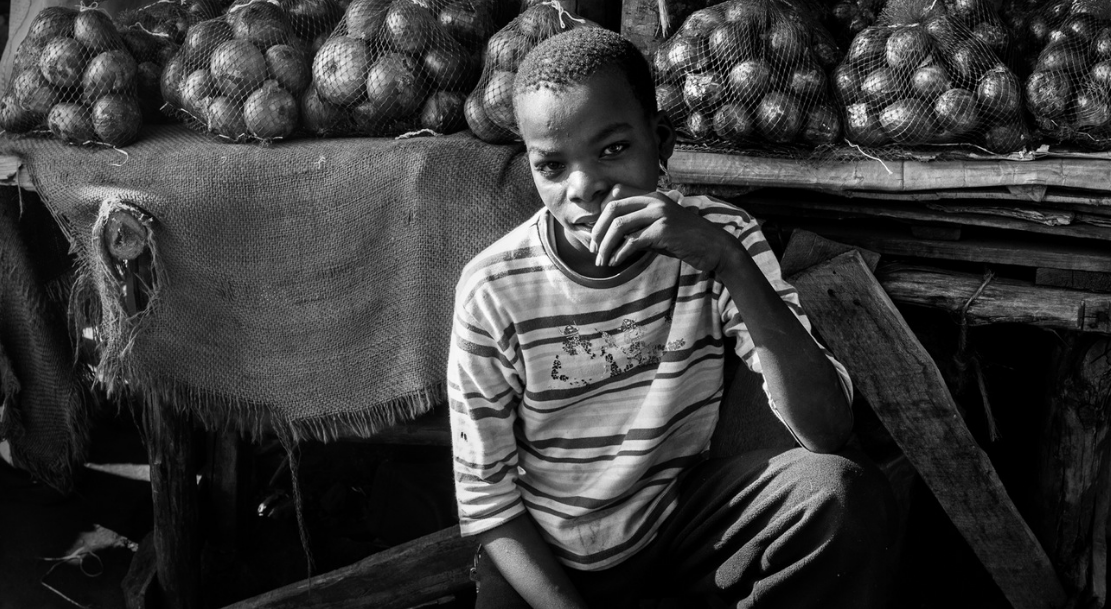
He was selling onions on the side of the road to Nairobi

I enjoy travelling alone and getting to know different cultures, in the most simple and genuine way possible, simply by being there, and merely observing. Trying not to alter what I see, to be inconspicuous. But in Mombasa, I was noticed right away. I am a white Argentinian, in a city where almost everyone is black. It was impossible to remain unseen.

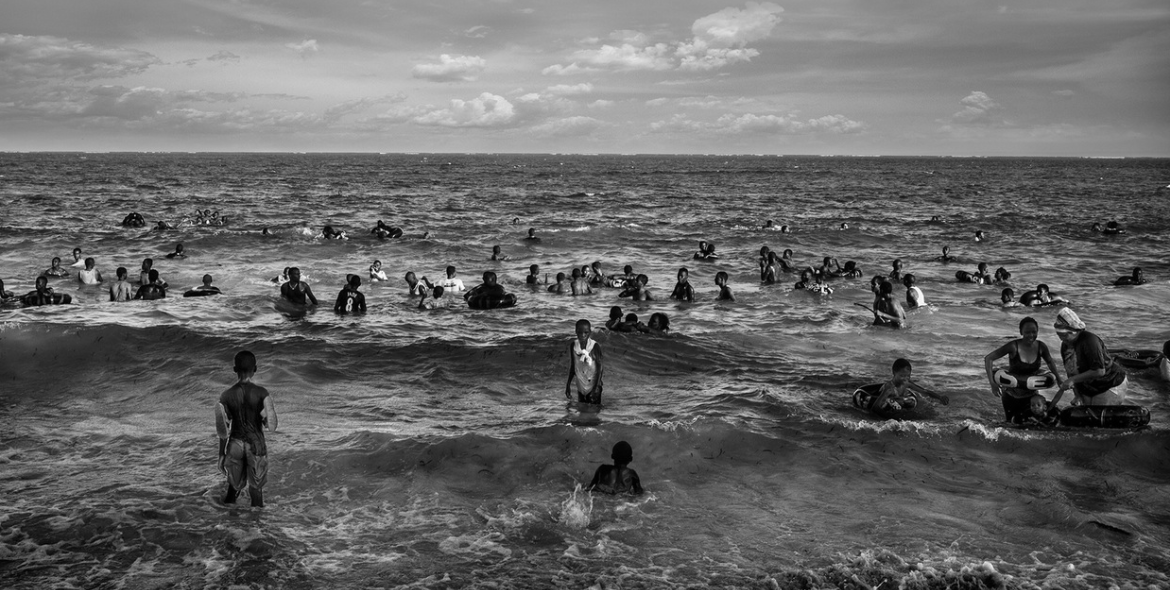
Sunday morning is a social time for families at the public beach

The first few days were filled with nervousness and anxiety. I was alone in a place completely different to my own, full of tension and expectations about what the trip might become. Was I going to be able to adapt to Africa? I just wanted to let go, come to know the locals, let down my resistance, and give myself up to whatever had to happen.
 

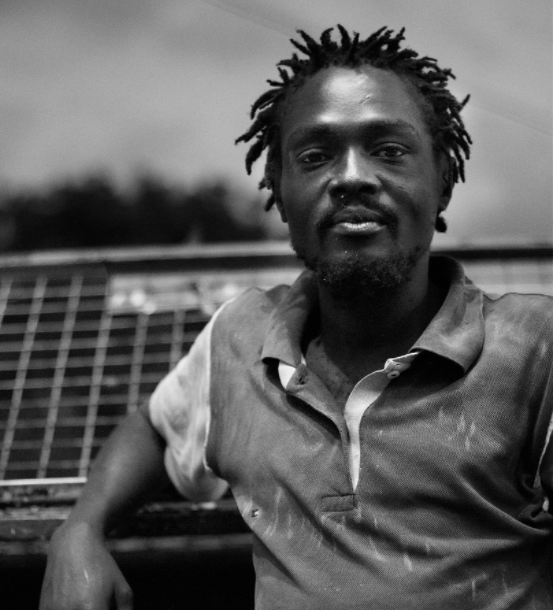
Eddie lives inside a garbage container in Mombasa. The day I left Kenya, I gave Eddie all of my clothes.

Two days went by and I decided it was time to get out of the city. Venturing into the more rural areas of Kenya would be better than staying in Mombasa. Leaving my big backpack behind, I grabbed my camera, my flip flops, swimming trunks, and my kikoy — a traditional man’s wraparound worn on the Swahili coast of East Africa, especially in Kenya. It protected me from the sun and from the stares too. I took a tuk-tuk to the south of town, then a ferry, and then a three-hour matatu — one of Kenya’s colourful buses. My destination was Wasini Island, a small island in the south, where people usually snorkel for a few hours and then leave. I wanted to stay, at least for a few days.

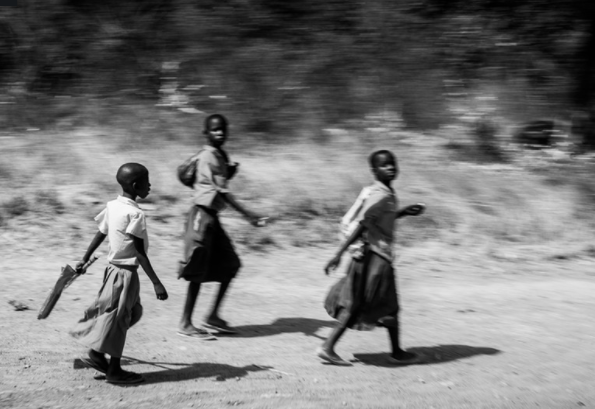
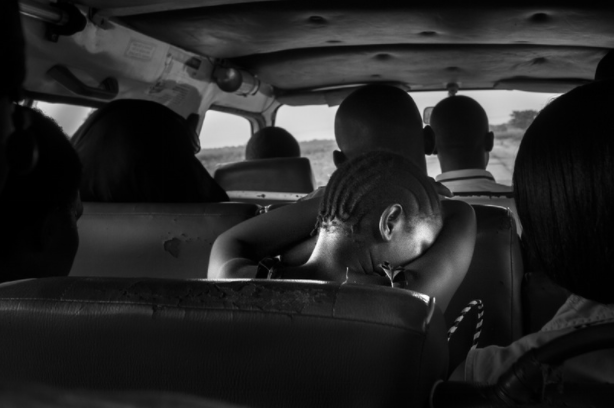
School children on the road from Mombasa to Kilifi / She was sleeping in the matatu along the way.

I was greeted by Abdullah, who was surprised to meet a foreigner who wanted to stay longer than a few hours. I got on a small boat and crossed the island with two guys who were carrying huge machine guns, which they used to absentmindedly scratch their feet and faces — I had never seen such big weapons. 
 

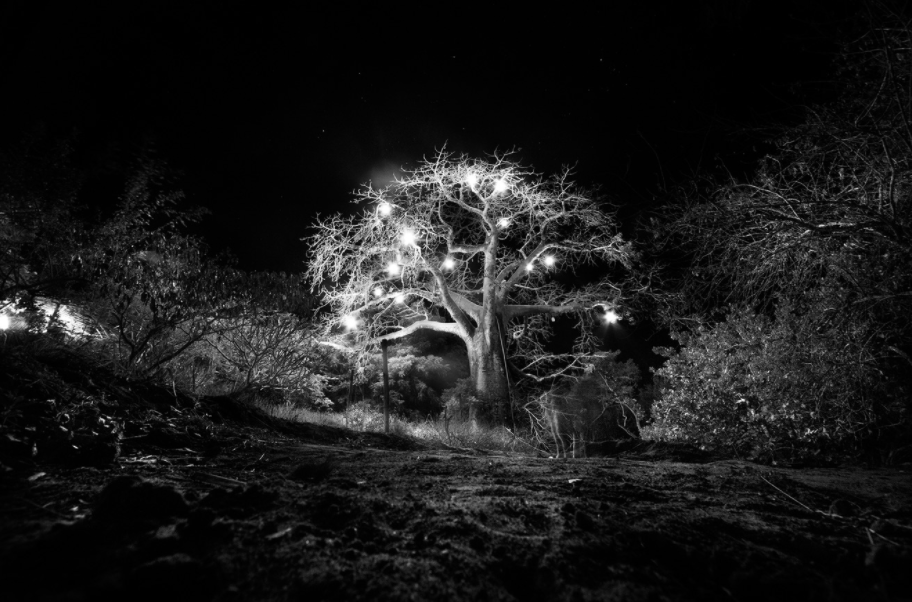
Baobab tree lit up at night

— Wasini —

Wasini is a coral rock island that during its hey-day was a popular summer destination for retired and wealthy Europeans who wanted to enjoy the heat and beaches of Kenya. The day I arrived, there was just one dutchman and me, and the rest of the island was a small fisherman’s village. Abdullah cooked a fish for me with great care, and later made me visit the “tourist attractions,” which meant very little to me.


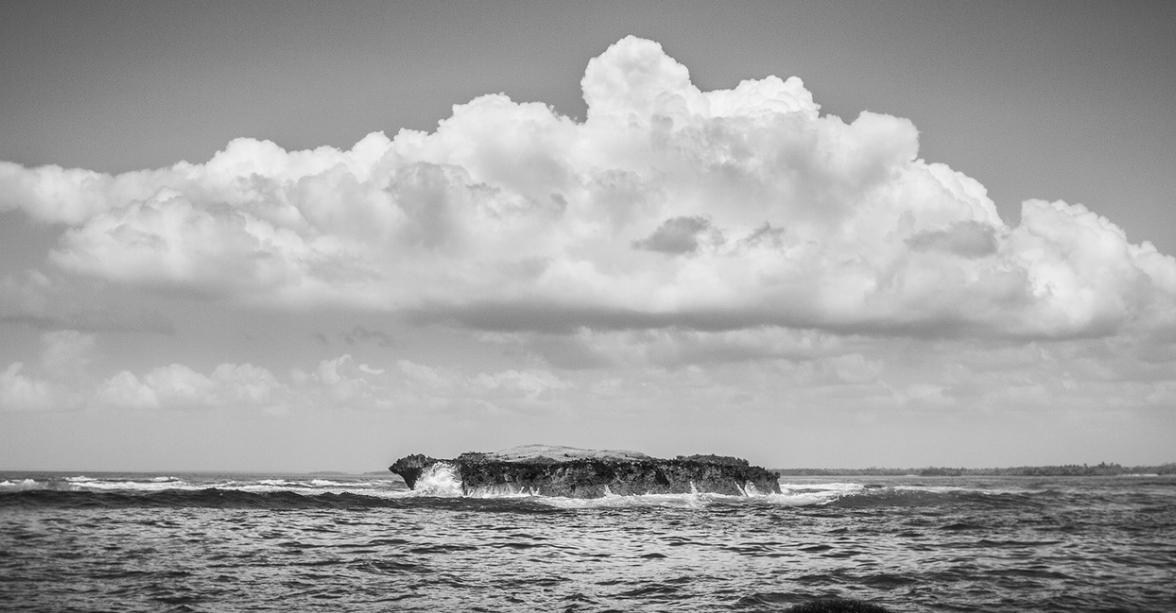
Coral stones in the Indian Ocean

I met someone who said he would take me over to the other side of the island along a path that would pass through the mangroves. I told him I had very little to tip him with, as I had left all my money in Mombasa. He gently insisted on taking me and I followed him. We walked through the island for a long time and I started to worry, thinking about where this stranger was actually taking me. The sun had started to set and as is common in many places in Kenya, there was no electric light.
 

We were crossing the path with this guy, while a fisherman was preparing his bait. I asked to take a picture of him, and he accepted.

We kept on walking until we finally reached the other side of the island. The mangrove trees continued all the way into the sea, and it was a very beautiful sight. I calmly took a breath, my guide had not deceived me. At that moment I felt that if I had managed to get to such a remote place with a complete stranger, then it meant that the rest of my trip would turn out alright. It was a feeling I had. Complete trust.
 

Among the mangroves

— Kilifi —

I spent a few days in Wasini and then returned to Mombasa to continue northwards along the coast, towards Kilifi. In Kilifi there was a very impressive hostel, but when I entered I had the feeling of being out from what I have been seeing. Luckily, I decided to walk towards the beach, where I found a beautiful sunset.
 

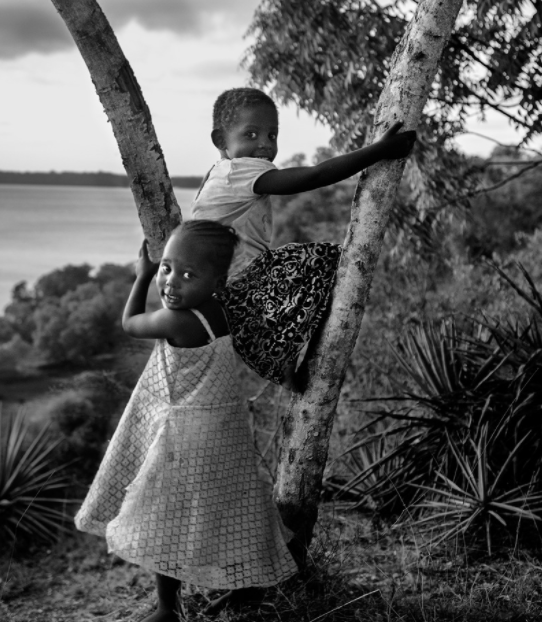
Little sisters playing together in a tree near their home.

The beach was deserted. It was actually an estuary, very serene. I loved rural Kenya, so far away from the cities. As I sat with my camera I saw a kid walking in the distance. As he approached me I waved, then he waved back and continued to walk. A few hours later, the kid returned and I went over to have a chat. He responded by asking me if I knew how to hunt crabs. His name was Buda.
 

Portrait of Buda

We became friends and I met all of his brothers and sisters as well. They were many, and lived on the coast with their aunts and cousins. Most families in Kenya live with their extended family, and the women are in charge of the houses. Men are absent most of the time, often spending time with friends, away from their homes.
 

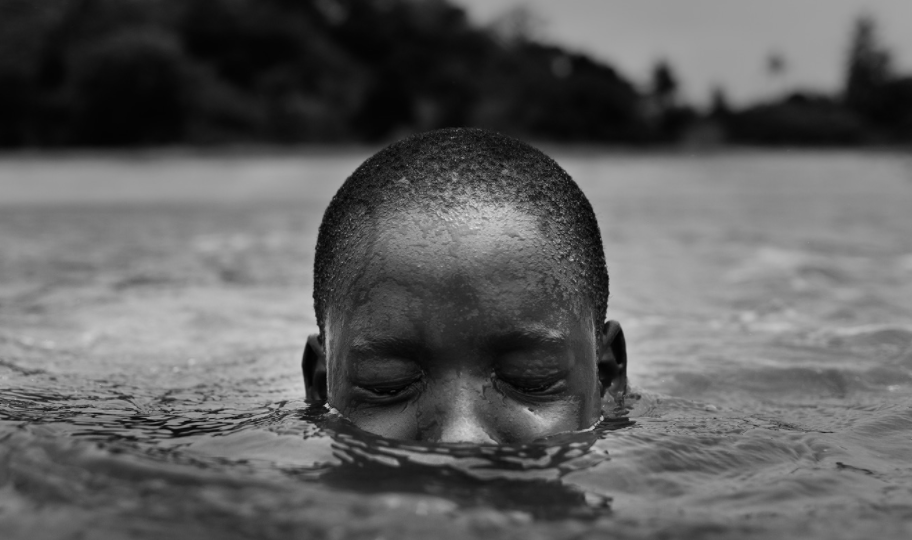
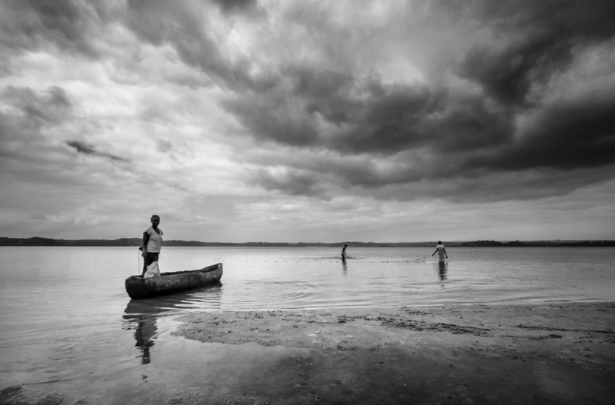
Full of joy in the ocean / Fishermen and family in the early morning

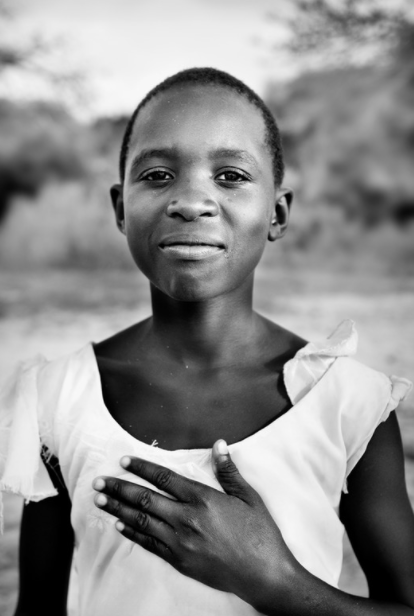
I quickly became very fond of Buda and his siblings, and they became fond of me. Every time I came down to the beach, they would arrive to greet me. I spent whole days on the beach, sometimes helping them gather wood for making fires, or finding things their mother had asked for — I learnt a lot about their culture and way of life, which was not always easy. Buda and Nuzrah were the eldest siblings and spoke better English. They taught me a lot of words in Swahili, their native tongue.
 

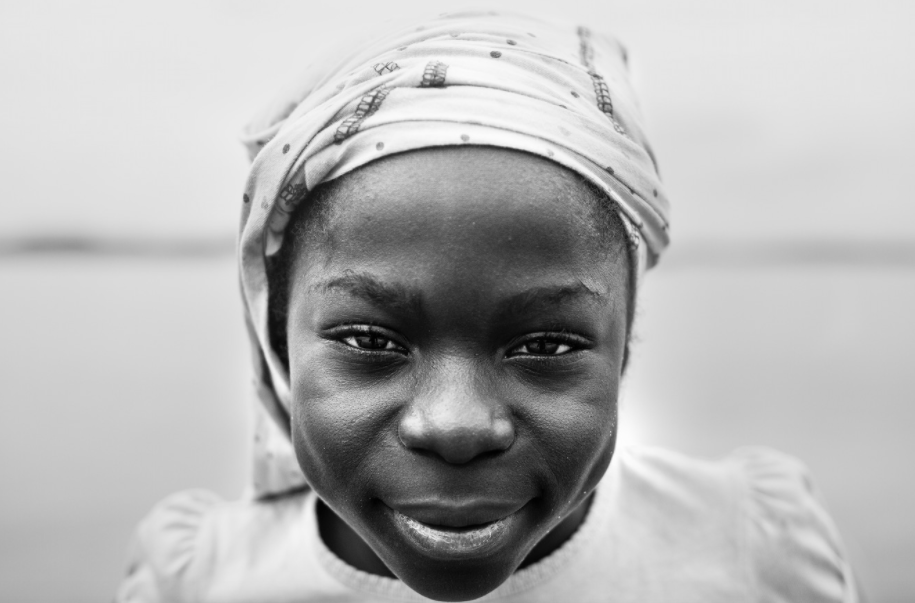
Portrait of Nuzrah

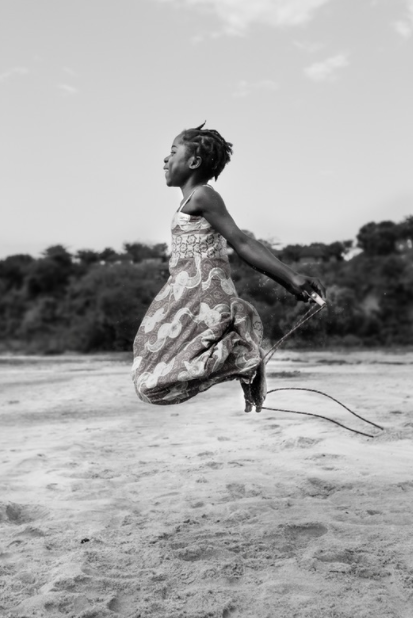
One of the days we spent together I brought them a football, a water gun and a jumping rope. We played with them, they taught me beach games, and every now and then we would all go for a swim. It was with great grief that I said goodbye to these children, as I had to continue travelling towards the west of the country. They stayed with me until I left, and their mother also came to say goodbye.
 

Portrait of Buda / Jumping rope / Portrait of Mwanaisha

— Amboselli —

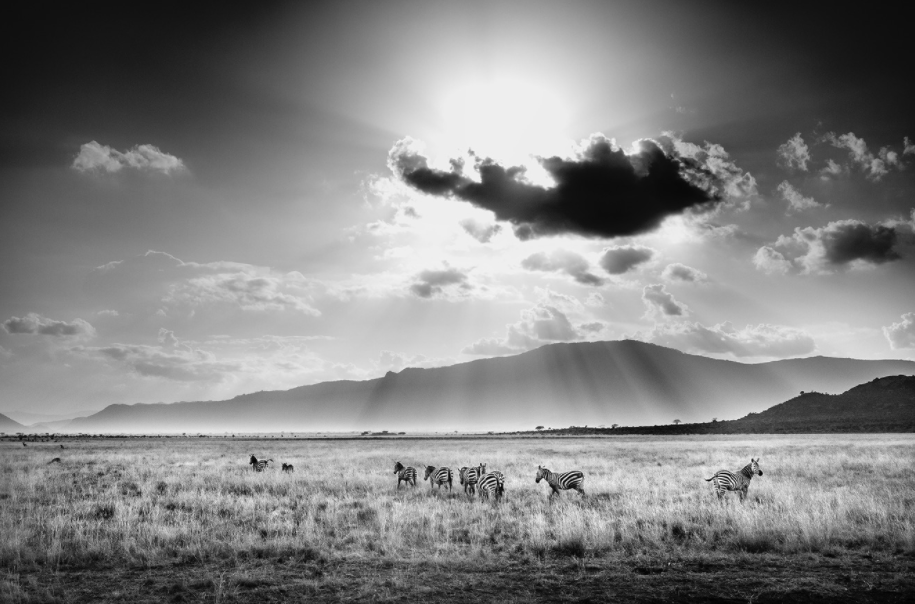
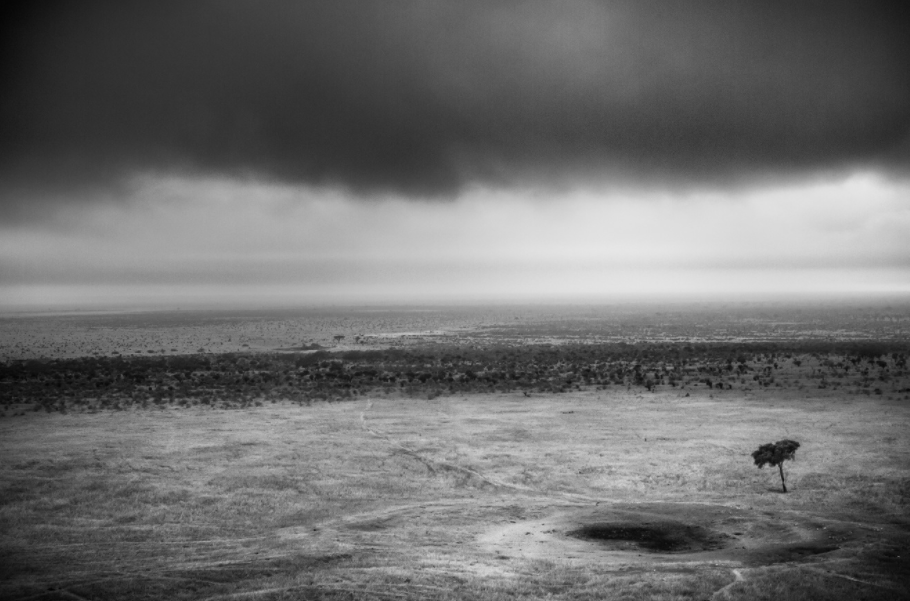
I took a tuk-tuk back to Mombasa, thinking about everything I was experiencing. It felt so powerful and different, making me reflect on my own life, and how grateful I was for the opportunity to travel. The following dayay I left for Amboselli National Park. Enormous and open, there were no fences around it. Animals are not easy to see. You might spend a whole day walking around and only encounter a few zebras.

Morning of the Zebras

But the immensity and beauty of the landscape was truly dazzling to me, sometimes reminding me of my native Patagonia, similarly wild and empty in its own way. I also thought about the devastation humans have caused to the natural environment, and the complex challenges local and international communities face as they attempt to tackle and reverse this.
 

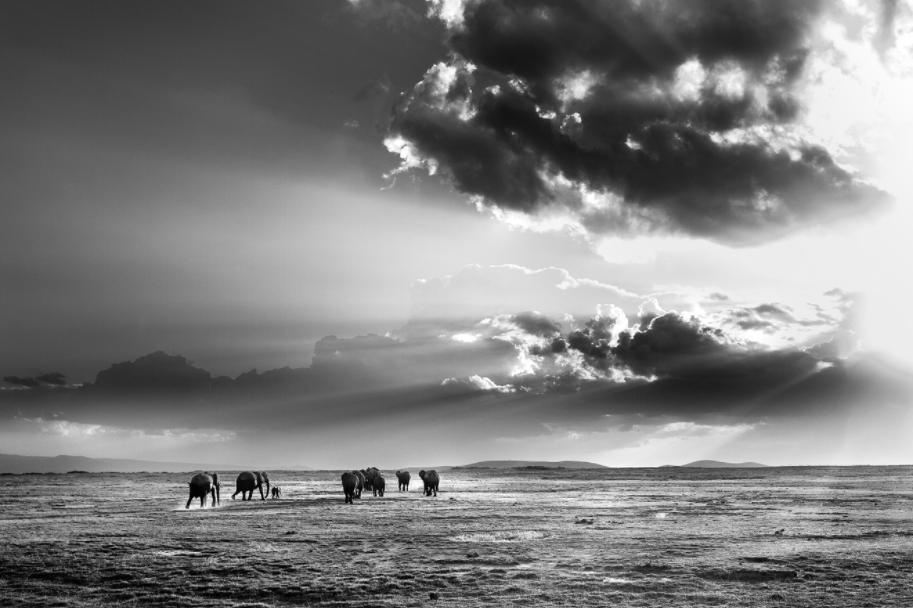
Afternoon of the elephants

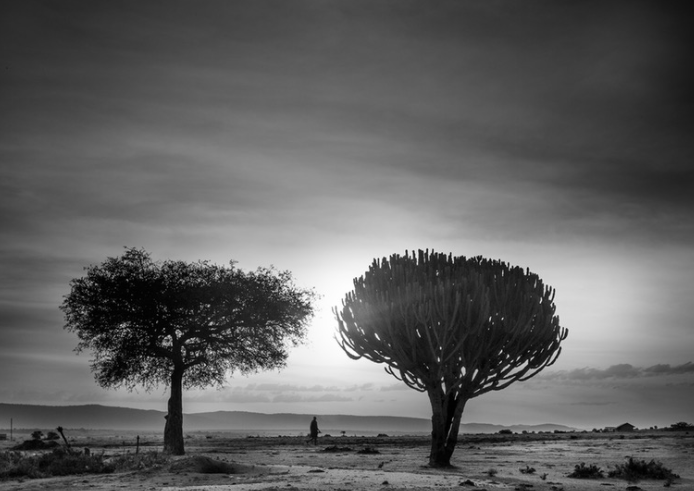
I spent my whole childhood fascinated by documentaries on Animal Planet, or Discovery Channel. I could not quite believe I was there, in these vast landscapes. The animals were so big, so strong. They had very little to do with the image I had of elephants in zoos or television. And the trees, they were so magical, I really have no words to describe them.
 

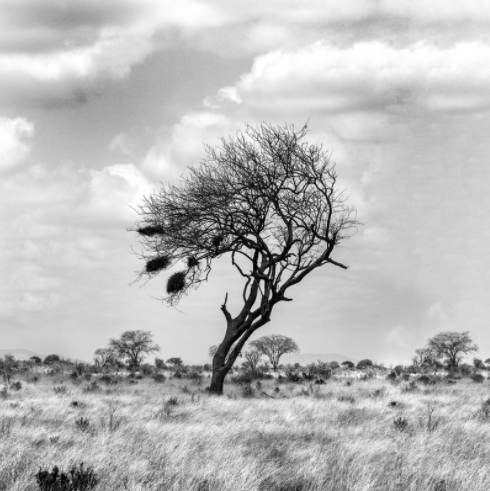
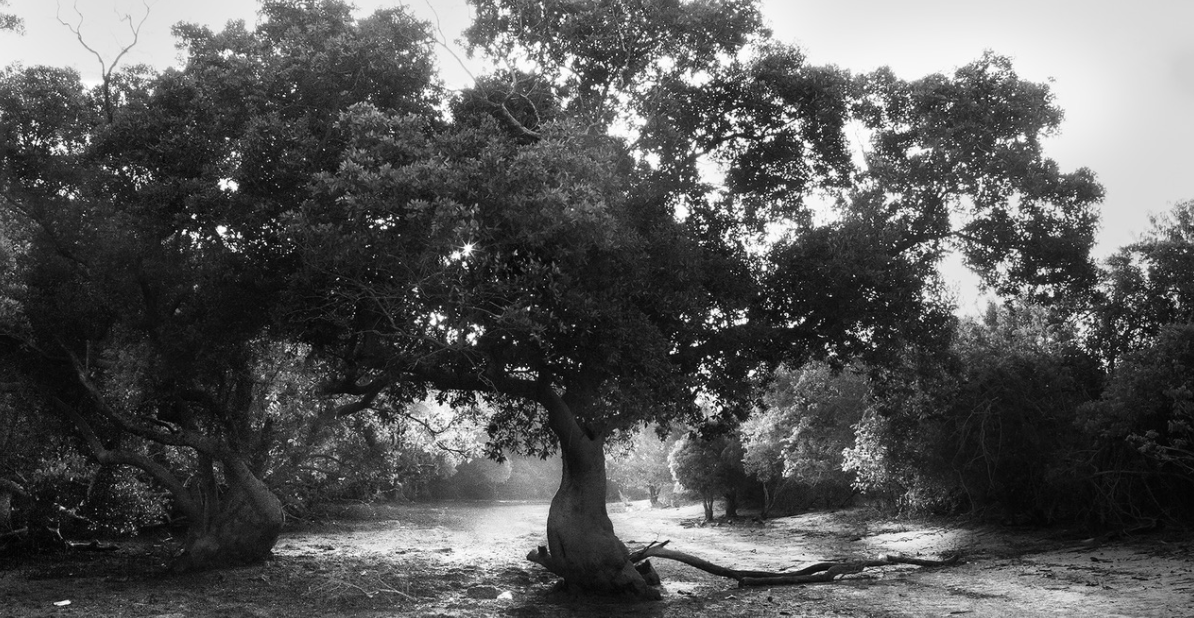
Masai walking in the early morning / Just a beautiful tree, in my first moments in the park

A long time went by before I was able to understand this trip. Sometimes, the present is not understood until it becomes the past. 

When I travel, I seek to explore places that will surprise and challenge me, and from that surprise create beautiful experiences and photographic visions of what I have witnessed. Kenya belongs to a continent of origins, remote and distant, and for now, for better or worse, many of its vast rural areas remain far from the globalised world.
 

Early morning at Tsavo. There is always magic in the first hours of the day.


THIS ARTICLE WAS ORIGINALLY PUBLISHED ON MAPTIA.


FRAN PROVEDO

Fran Provedo is a photographer and Architect from Argentina. Passionate about nature, and what is invisible in it.

Unexpected Friends in Amsterdam

August 29, 2015: I was cruising on my bike on a rare sunny day in Amsterdam, weaving in and out of pockets of confused tourists, when I rode past an orange and white sign that read “A’DAM INT’L ART FAIR.” Just two weeks into my four-month long journey of self-discovery in Amsterdam, my one-item agenda on this particular day consisted solely of exploring my new city. In that moment, my explorations led me to Berus van Berlage, a medieval looking building in the city center where the art fair was slated to take place. I secured my bike to a nearby pole and headed inside having neither the intentions of purchasing art, nor the expectations of what fascinating people I might meet inside. 

I took my time strolling up and down each aisle, attempting to take in all of the photographs, sculptures, and paintings hanging on the walls of Berus van Berlage amidst the mixed crowd of intrigued passersbys and veteran art collectors. Eventually I found myself in the far right corner of the hall, where I came across a row of ceramic necklaces next to a sculpture of what appeared to be a naked woman with a severed torso. Nervously, I approached the woman standing next to the display and inquired if she was the artist who created the necklaces. She told me she was not, but the artist who did make the necklaces would be back from lunch in just a few minutes. I wandered aimlessly for a couple of minutes before returning to the far right corner to solicit information from the artist herself about the necklaces. 

Upon my return to the far right corner, I was greeted by a beautiful blonde woman who introduced herself to me as Mirjam (Miriam). Originally born in Turkey, Mirjam had immigrated to The Netherlands at the age of 5, living in different places throughout the country until settling in The Hague, a small city southwest of Amsterdam. From inside her apartment on the beach in Scheveningen, Mirjam creates all different types of art—pottery, paintings, and nearly everything in between—which she then sells at regional art fairs. The only piece she does not sell, but brings to every art show, is her most prized creation: a sculpture she calls “A Tribute to Every Woman in the World,” the woman with the severed torso. 

I then introduced myself as Allie, an American college student studying in Amsterdam for the semester, and asked if I could purchase one of the ceramic necklaces on display. In an exchange that lasted no more than 5 minutes, Mirjam wrapped up the necklace, handed me her card, and invited me to have coffee with her in The Hague should I ever found myself there. I then left the fair, not thinking too much about the encounter I just had with Mirjam. 

The following Wednesday I boarded a train from Amsterdam to The Hague. Mirjam was going to meet me and my friends at the train station, share a bite to eat with us, and then we would be on our separate ways; or at least, that is how I envisioned the day going. When I arrived in The Hague, Mirjam greeted me with a hug so tight you may have thought we had known each other for years having no prior knowledge of our relationship. She treated me and my friends to lunch, showed us the ins and outs of town, and then brought us back to her beachside apartment for snacks and drinks. Before heading back home to Amsterdam, we strolled along the ocean just as the sun was setting and I thanked her for an unforgettable day. On the ride home I replayed moments from the day over and over again in my mind, finding it difficult to process the bond I had just formed with a woman I met at an art fair that I hadn’t even planned on going to.  Though we had just gotten acquainted with one another, Miriam believed that our souls had met one another prior to our first physical encounter, and I could not help but think that she was right. 

Miriam and I kept in touch throughout the remainder of my stay in Amsterdam. Each month we met in a different city in Holland: Rotterdam in October, Amsterdam in November (where she met my family while they were visiting me), and Delft in December. Seeing all of these new places from her perspective made me appreciate them that much more. Every time I met up with her became adventures that I will never forget. When I return to Amsterdam next month, we will surely add another adventure to our list. 

Traveling or spending any significant period of time abroad presents one with unique opportunities to meet people they more than likely would not have met otherwise. While I could have never anticipated meeting Miriam where I did or forming the relationship I have since formed with her, being open to new experiences and meeting new people definitely lends itself to the possibility of forming relationships like the one I have with Miriam. So next time you find yourself at an art fair in Amsterdam, strike up a conversation with an artist you meet; perhaps she’ll become your Dutch mother just like Miriam became for me. 
 

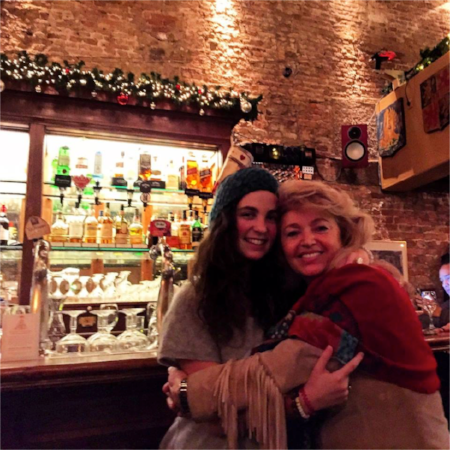
Miriam and I in Delft at Café De Waag, December 2015

ALLIE BLUM

Born and raised just outside of Philadelphia, PA, Allie's love for travel has led her to find that you can call many places "home." While she is primarily based in New Orleans, LA, where she will be completing her undergraduate studies this coming May, Allie has spent significant periods of time traversing the continental US (mostly by car) and Europe, and parts of the Middle East. Allie hopes that her curiosity to understand other cultures will bring her to every continent over the course of her lifetime. When she's not studying or planning her next trip, Allie loves to read, write, and make playlists on Spotify.

Kicking the Habit: Air Travel in the Time of Climate Change

Air travel is neither just nor sustainable. So how can environmental justice activists make a global difference?

We live in a time of far-flung relationships, our families, colleagues, and friends often spread out across continents. These relationships mirror the global nature of many of our most pressing problems, such as global climate change—and they also contribute to those problems.

In Eaarth: Making a Life on a Tough Planet, Bill McKibben likens the biosphere to “a guy who smoked for forty years and then he had a stroke. He doesn’t smoke anymore, but the left side of his body doesn’t work either.” This new world, he says, requires new habits.
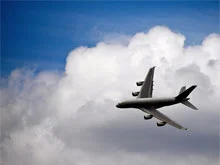
And, no doubt, many of us have adopted new habits—trying to use public transportation, buying local foods, rejecting bottled water. But the “savings” from such practices are wiped out by a habit that many of us not only refuse to kick, but also increasingly embrace: flying, the single most ecologically costly act of individual consumption.

Flights of Privilege

A round-trip flight between New York and Los Angeles on a typical commercial jet yields an estimated 715 kilos of CO2 per economy class passenger, according to the International Civil Aviation Organization.
 

Only 2-3 percent of the world’s population flies internationally each year, but the climate impacts are felt by a much larger—and poorer—population.


But due to the height at which planes fly, combined with the mixture of gases and particles they emit, conventional air travel has an impact on the global climate that’s approximately 2.7 times worse than its carbon emissions alone, says the Intergovernmental Panel on Climate Change. As a result, that roundtrip flight’s “climatic forcing” is really 1,917 kilos, or almost two tons, of emissions—more than nine times the annual emissions of an average denizen of Haiti (as per U.S. Department of Energy figures).
Only 2-3 percent of the world’s population flies internationally on an annual basis, but the climate impacts of air travel are felt by a much larger—and poorer—population. It is difficult to illustrate the meaning of such numbers in terms of who among the planet’s citizens pays the costs.

But this is exactly what the 2009 German short film The Bill does in powerfully demonstrating the ecological privilege and disadvantage embodied by flying. In doing so, it shows aviation to be a classic example of how the comparatively well-off privatize benefits of environmental resource consumption (the ability to travel quickly and afar) while socializing the detriments. By making a disproportionate contribution to climate destabilization and associated forms of environmental degradation—biodiversity loss, rising sea levels, and desertification, for instance—air travelers exacerbate the precarious existence of the most vulnerable. In doing so, they contribute to unjust hierarchies (e.g. racism and imperialism) that reflect a world of profound inequality.

Global Organizing—Without Planes

Clearly this presents a huge challenge to social and environmental justice advocates, activists, and organizers from the planet’s relatively wealthy areas who often connect to distant peoples and places by flying. Because the institutions and individuals most responsible for our global predicaments typically exercise mobility and exert their power across great distances, those of us who want to challenge their practices often must also do so. So what to do?

One option is to use transportation that stays on the Earth’s surface, to accept traveling more slowly, and to make flying a very rare exception instead of the rule. Throughout North America, buses—and, in many places, trains—are viable options. And for transoceanic voyages, ships (including freight ones) are a possibility—albeit not typically inexpensive or as common as they need be.
 

Finding Rootedness

In an increasingly vulnerable world, we’re searching for rooted communities—and what we can learn from them.

Another option—indeed an obligation in a time of growing ecological destruction and a degraded resource base—is to stay home more often. Given that “jet travel can’t be our salvation in an age of climate shock and dwindling oil,” McKibben writes, “the kind of trip you can take with a click of a mouse will have to substitute.” In other words, we have to become much better at exploiting the “trips” that the Internet and related technologies afford—by videoconferencing, for example.

While such options present numerous challenges, not least logistical ones, perhaps the biggest obstacle is the particular way of seeing and being common to the small slice of the world’s population that flies regularly. Traveling long distances by bus, train, or ship, for example, necessitates time—and a willingness to expend it in manners that those from the world’s privileged parts and sectors are not used to doing. It doesn’t necessarily entail doing less, but it does mean doing things in different ways.

A New Normal

It also calls for new mechanisms and institutions—and some organizing to bring them about. Take long-distance travel by ship. Less than a century ago, many regular folks traversed the seas—think of immigrants to Angel and Ellis islands. And many well-known organizers and activists—Gandhi, Helen Keller, and W.E.B. Dubois, to name just three—journeyed extensively by ship.

To do so today, of course, is far more difficult as jet travel has greatly weakened the passenger ship option. But what if, for instance, U.S. and Canadian activists and advocates going to Denmark for the Dec. 2009 climate summit had, instead of booking individual flights, organized to travel together by ship—with all promising to get to and from their ports of call by surface-level transportation? And what if they had publicized this effort as a way of setting an example for, and challenging, others?

That such a suggestion will seem unrealistic, if not foolhardy, to many illustrates the way that what we’re used to thinking of as normal can stifle our imaginations, and let us off the political, ecological, and ethical hook. The option is as “realistic” as we make it. In this regard, we need to push and support one another in the effort to make far-reaching alternatives viable.
 

What we’re used to thinking of as normal can stifle our imaginations, and let us off the political, ecological, and ethical hook. The option is as "realistic" as we make it.

Climate science tells us that we need a 90 percent cut in greenhouse gas emissions over the next few decades to keep within a safe upper limit of atmospheric carbon. In light of the great changes such a reduction demands, what is unrealistic and foolhardy is the notion that we can continue flying with abandon.
 

Interested?
    •    We thought we had 20, 30, 50 years to take on the climate crisis. We were wrong. The scary science, smart policies, and critical actions that could still avert disaster.
    •    Bill McKibben imagines himself in the year 2100, looking back at a century of climate chaos and asking: What did it take to save the world?

THIS ARTICLE WAS ORIGINALLY PUBLISHED ON YES MAGAZINE.

JOSEPH NEVINS

Joseph Nevins wrote this article for YES! Magazine, a national, nonprofit media organization that fuses powerful ideas with practical actions. Joseph is a geography professor at Vassar College. Among his books is Dying to Live: A Story of U.S. Immigration in an Age of Global Apartheid (City Lights Books/Open Media).