
In Tehuantepec, a town in the Mexican state of Oaxaca, Lukas Avendaño and fellow muxes live beyond the gender binary. A muxe is an individual assigned male at birth who behaves outside roles traditionally associated with masculinity. Sometimes referred to as a third gender, muxe identity pre-dates Spanish imperialism in the Zapotec region. For Lukas, dressing in feminine Zapotec clothing is a political act, giving everybody the power and the liberty to decide who they want to be.
Read MoreThe Spirit of Morocco: Music, Architecture, and Living Heritage
There is more to Morocco than the gorgeous sand dunes of Merzouga in the Sahara or the majestic Atlas Mountains of the Maghreb region. Morocco’s music can take you on a journey through Spain, with flavors of Berber, hints of Arabic, and the Saharan style. Its architecture is a show stopping feature of pisé buildings, the finesse of Moorish exiles, and a glimpse into the Islamic influence of the Idrisid dynasty. The people bring craftsmanship and skill to their communities, combining history and culture in a way only Morocco can do.
Read MoreMexico
The videographer is Face du Monde and these are his comments on the video:
Read More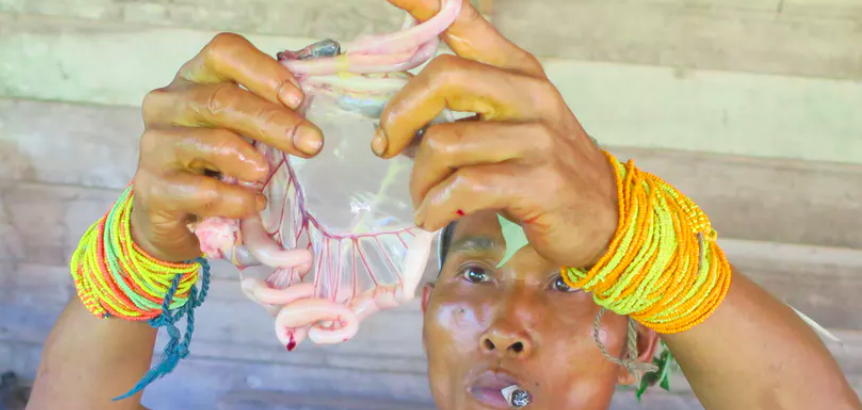
Examining chicken intestines, reading the tea leaves, watching the markets – people turn to experts for insight into the mysteries that surround them. Manvir Singh, CC BY-ND
Modern Shamans: Financial Managers, Political Pundits and Others Who Help Tame Life’s Uncertainty
Aka Manai explains that there are two kinds of people in the world: simata and sikerei.
I am a simata. He is a sikerei. Sikerei have undergone transformative experiences and emerged with new abilities: They alone can see spirits.
I’ve experienced a lot since that night in Indonesia when Aka Manai told me this. I was there when an initiate first saw spirits, when he and the other sikerei wept as they saw their dead fathers swirling around them. I’ve attended seven healing ceremonies, witnessing the slaughter of dozens of pigs to accompany nights of dancing. But that chat with kind-faced Aka Manai, more than any other experience, grounded my understanding of sikerei in particular and shamanism more generally.
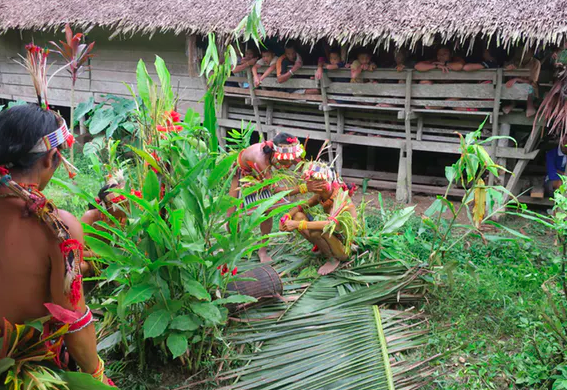
A sikerei treats an initiate’s eyes so he, too, can see spirits. Manvir Singh, CC BY-ND
I’m a cognitive anthropologist who studies why societies everywhere develop complex yet strikingly similar traditions, ranging from dance songs to justice to shamanism. And though trancing witch doctors may sound exotic to a Western reader, I argue that the same social and psychological pressures that give rise to healers like Aka Manai produce shaman-analogues in the contemporary, industrialized West.
What is a shaman?
Shamans, including the sikerei I’ve known in Indonesia, are service providers. They specialize in healing and divination, and their services can range from ending a drought to growing a business. Like all magical specialists, they rely on spells and occult gizmos, but what makes shamans special is that they use trance.
Trance is any foreign psychological state in which a practitioner is said to engage with the supernatural. Some trances involve complete immobilization; others appear as tongue-lolling convulsions. In some South American groups, shamans enter trance by snorting a hallucinogenic powder, transforming themselves into crawling, unintelligible spirit-beings.
Being a shaman often carries benefits, both because they get paid and because their special position grants them prestige and influence.
But these advantages are offset by the ordeals involved. In many societies, a wannabe initiate lacks credibility until he (and it’s usually a he) undergoes a near-death experience or a long bout of asceticism.
One aboriginal Australian shaman told ethnographers that, as a novice, he was killed by an older shaman who then replaced his organs with a new, magical set. When he woke up from the surgery and asked the old shaman if he was lost, the old man replied, “No, you are not lost; I killed you a long time ago.”
A long time ago, a short time ago, here, there – wherever you look, there are shamans. Manifesting as mediums, channelers, witch doctors and the prophets of religious movements, shamans have appeared in most human societies, including nearly all documented hunter-gatherers. They characterized the religious lives of ancestral humans and are often said to be the “first profession.”
Why are there shamans?
Why is it that when we lanky primates get together for long enough, our societies reliably give rise to trance-dancing healers?
According to anthropologist Michael Winkelman, the answer is wisdom. Drugs and drumming, he’s argued, link up brain regions that don’t normally communicate. This connection yields new insights, allowing shamans to do things like heal sickness and locate animals. By specializing in trance, shamans uncover solutions inaccessible to normal brains.
Based on my fieldwork, I’ve argued against Winkelman’s account. Rather than all integrating people’s psychologies, trance states are wildly diverse. Chanting, sipping psychoactive brews such as ayahuasca, dancing to the point of exhaustion, even smoking extreme quantities of tobacco – these methods produce profoundly different states. Some are arousing, others calming; some expand awareness, others induce repetitive thinking. In fact, the only element shared among these states is their exoticness – that once altered, the shaman’s experience stands apart from those of his onlookers.
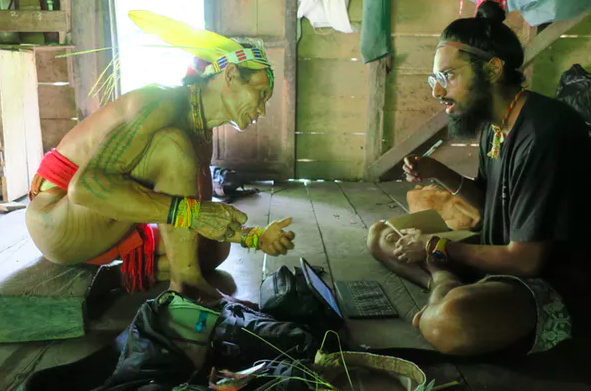
As part of his anthropological fieldwork, author Manvir Singh speaks with an Indonesian shaman. Luke Glowacki, CC BY-ND
Not only are shamans’ experiences exotic, their very beings are, too. As Aka Manai emphasized to me, people understand shamans to be different kinds of entities, made “other” by their ordeals. The Mentawai word for a non-shaman, simata, also describes uncooked food or unripe fruit; it implies immaturity. The word for shaman, in contrast, means a person who has undergone a process: one who has been kerei’d and come out the other side a sikerei.
This otherness is crucial. Convinced that shamans diverge from normal people, communities accept that they have superhuman abilities. Like Superman’s alien origins and the X-Men’s genetic mutations, shamans’ transformations assure people that they deviate from normal humanness, making their claims of supernatural engagement more believable.
And once people trust that a specialist engages with gods and spirits, they go to them when they need to influence uncertainty. A sick child’s parent or a farmer desperate for rain prefers to nudge the forces responsible for their hardship – and a shaman provides a compelling conduit for doing so.
This, I suggest, is why shamans recur around the world and across time. As specialists compete in markets for magic, they fuel the evolution of practices that hack people’s intuitions about magic and special abilities, convincing the rest of us that they can control uncertainty. Shamans are the culmination of this evolution. They use trance and initiations to transcend humanness, assuring their clients that they can commune with the invisible beings who oversee uncertain events.
Who are the shamans of the industrialized West?
Most people assume that shamanism has disappeared in the industrialized West – that it’s an ancient tradition of long-lost tribes, at most resurrected and corrupted by New Age xenophiles and overeager mystics.
To some extent, these people are right. Far fewer Westerners visit trance-practitioners to heal illness or call rain than people have elsewhere in the world or throughout history. But they’re also wrong. Like people everywhere, contemporary Westerners look to experts to achieve the impossible – to heal incurable illnesses, to forecast unknowable futures – and the experts, in turn, compete among themselves, performing to convince people of their special abilities.
So who are these modern shamans?

A specialist you can turn to for help divining the mysterious forces at work in financial markets. Matej Kastelic/Shutterstock.com
According to the cognitive scientist Samuel Johnson, financial money managers are likely candidates. Money managers fail to outperform the market – in fact, they even fail to systematically outperform each other – yet customers continue to pay them to divine future stock prices.
This faith might come from a belief of their fundamental otherness. Johnson points out that money managers emphasize their differences from clients, exhibiting extreme charisma and enduring superhuman work schedules. Managers also adorn themselves with advanced mathematical degrees and use complicated statistical models to predict the market. Although money managers don’t enter trance, their degrees and models assure clients that the specialists can peer into otherwise opaque forces.
Of course, money managers aren’t the only experts to specialize in the impossible. Psychics, sports analysts, political pundits, economic forecasters, esoteric healers and even an octopus similarly sate people’s desires to tame the uncertain. Like shamans and money managers, they decorate themselves with badges of credibility – an association with the White House, for example, or a familiarity with ancient Tibetan medicine – that persuade customers of their special abilities.
As long as hidden forces shape our fates, people will try to control them. And as long as it’s profitable, pseudo-experts will compete for desperate clients, dressing in the most credible and compelling costumes. Shamanism is not some arcane tradition restricted to an ancient past or New Age circles. It’s a near-inevitable consequence of our human intuitions about special abilities and our desire to control the uncertain, and elements of it appear everywhere.
MANVIR SINGH is a PhD Candidate in Human Evolutionary Biology at Harvard University.
THIS ARTICLE WAS ORIGINALLY PUBLISHED ON THE CONVERSATION
In Japan, Repairing Buildings Without a Single Nail
In the past, making and developing metal was too costly for carpenters in Japan. So instead of using nails, carpenters called “miyadaiku” developed unique methods for interlocking pieces of wood together, similar to a giant 3D puzzle. Takahiro Matsumoto has been a miyadaiku carpenter for over 40 years. He runs his company in Kamakura, Japan, where he assesses and repairs damage sustained by the many ancient temples in his city. Using ancient techniques, he ensures that these spiritual structures stay standing for generations to come.
Cultivating Japan’s Rare White Strawberry
In Japan, there's a specialty fruit craze sweeping the nation, from square watermelons to grapes the size of Ping-Pong balls. Still, the crown jewel of the luxury fruit basket is the white strawberry, bred to be a whole lot bigger and a whole lot sweeter than its classic red counterpart. We took a tour of Yasuhito Teshima's farm in Karatsu, Japan, to find out why so many people are spending a pretty penny for a taste of these famous white berries.
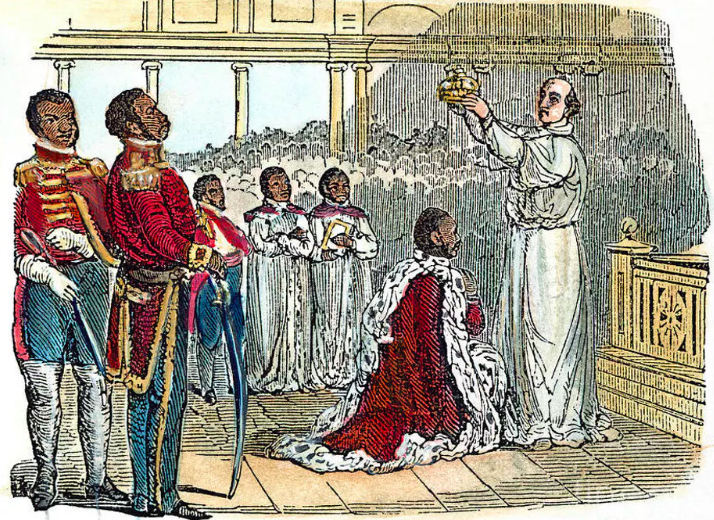
An 1811 wood engraving depicts the coronation of King Henry. Fine Art America
Inside the Kingdom of Hayti, ‘the Wakanda of the Western Hemisphere’
Marvel’s blockbuster “Black Panther,” which recently became the first superhero drama to be nominated for a Best Picture Academy Award, takes place in the secret African Kingdom of Wakanda. The Black Panther, also known as T’Challa, rules over this imaginary empire – a refuge from the colonialists and capitalists who have historically impoverished the real continent of Africa.
Read MoreIn Tokyo, These Trains Jingle All the Way
While most train stations alert passengers with basic dings and dongs, metro riders in Japan are treated to uniquely crafted melodies. Minoru Mukaiya is the mastermind behind these jingles—he’s made around 200 distinct chimes for over 110 stations. For Minoru, there’s no greater joy than bringing a little bit of music to millions across Japan every day.
Heavy Metal Hijabis
The town of Garut in Western Java, Indonesia is a quiet place—that is, until Voice of Baceprot takes the stage. While most people in the town live tranquil, pastoral lives, teenagers Firdda, Widia and Euis thrash out and rock hard. The band has shot to fame for playing heavy metal in the religiously conservative country. After gaining popularity, VoB began to face criticism for performing while wearing hijabs. Still, they continue to shred—an inspiration for everyone with a little bit of music and a little bit of hardcore rebellion in their souls.
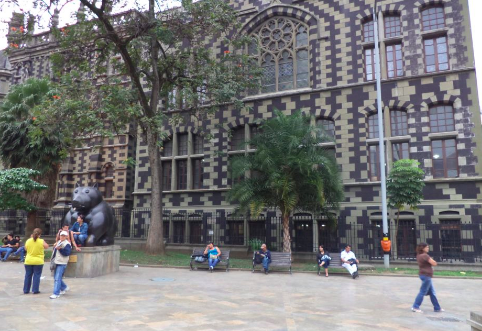
The Museum of Antioquia, in Medellin. Jonathan Robinson.
Turmoil, Pain, and Beauty: Colombia’s Blossoming Art Scene
With its rich, diverse culture, picturesque landscapes and lush natural resources, Colombia should be one of the most popular tourist destinations in South America. However, the country’s image took a hit in the 1980s, with the rise of cocaine and the drug cartels that controlled it, most notably, Pablo Escobar and his Medellin cartel. In recent years the Colombian government has addressed this problem head-on, dismantling drug rings and adopting a national slogan designed to put visitors at ease: “The only risk is never wanting to leave”. A recent spike in Colombia’s art scene may also help lift the stigma that shrouds the country, adding a new dimension to a people and culture the world thought it knew, and helping Colombia develop a new identity, or perhaps, reclaim an old one.
To be fair, Colombia is still the world's top producer of cocaine, and the legal status of cocaine within the country, combined with the high demand for it outside of the country makes the drug trade a recurrent enemy of the government. To make matters worse, drugs are not the only vice thriving in Colombia. Prostitution is also legal and readily available, making Colombia a popular destination for sex tourism, like Thailand or the Netherlands. In 2012, American secret service agents made international headlines when they got into a spat with a prostitute over an unpaid bill for “services rendered” while then President Barack Obama was visiting Cartagena. While the incident was a PR nightmare for the US, it also added to Colombia’s already prevalent image as a haven for illicit activity.
There is, however, much more to Colombia than sex and dope—and there always has been. In the heart of Medellin, the very city Escobar called home, lies the Museo de Antioquia, one of Colombia’s oldest museums. The museum features the work of famed Medellin artist Fernando Botero, known for his voluminous depictions of people and animals. This “Boterismo” style won Botero international fame, with many of his paintings and sculptures being featured in museums around the world. There was even a restaurant named after him in Las Vegas. Medellin is not the only city to get swept up in the art craze. The capital city of Bogota is home to over 100 commercial art galleries, a byproduct of an economic boom that Colombia experienced as the drug wars began to subside and the country began to stabilize.
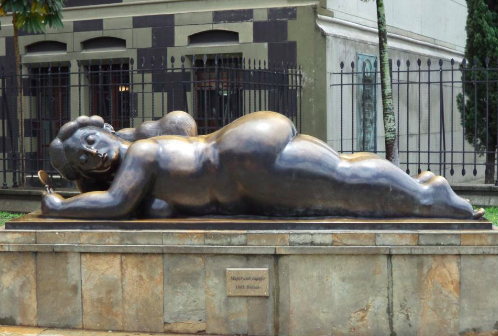
The works of Fernando Botero are prominently featured at the museum. Jonathan Robinson.
Sometimes, in the scramble to create a compelling story, media outlets may narrow or oversimplify the identities of people. Colombians are joining a long list of ethnic, gender, and religious groups who take issue with the way they are portrayed in the media and are taking it upon themselves to help the world understand that their culture may be a bit more nuanced than it has been led to believe. While the rise of Colombia's art scene may not refute the bloody images the media has shown in the past, it does add to them, creating a separate narrative for the country that exists alongside the current one. In the end, understanding Colombia may not require the world to empty its cup, but rather, to invest in a larger one.
JONATHAN ROBINSON is an intern at CATALYST. He is a travel enthusiast always adding new people, places, experiences to his story. He hopes to use writing as a means to connect with others like himself.

VIDEO: Germany's Oasis for Humanity
In the heart of Magdeburg, Germany is a mosaic superstructure known as the Green Citadel. Equipped with residential apartments, shops, cafes, hotels and a preschool, the complex was built to be an oasis for all mankind. Taking only two years to complete construction, the Citadel is considered one of the first pre-fabricated buildings in Germany. With its incredible pink exterior and bright green gardens, the building stands as the last work of architect Friedensreich Hundertwasser, built to be "an oasis for humanity and nature in a sea of rational houses."
Savor Japan’s Deep-Fried Maple Leaves
Maple leaf tempura, also known as “momiji,” is a snack native to the Japanese town of Minoh. Battered and deep-fried to a golden crisp, making momiji is a delicate process that takes about a year to prepare. Just ask Setsuko Hisakuni—she’s been making them for over 50 years, carrying on a tradition that began in the 1300s.
VIDEO: Hello Tokyo
This video was shot over a 5 day trip to Tokyo in January 2016. It was Christoph Gelep’s (videographer) first time visiting Japan, a place he had always wanted to see. With a population of 35 million, Tokyo is the largest metropolitan area in the world. Due to this, Christophe soon realized how lively and energetic this city really is.
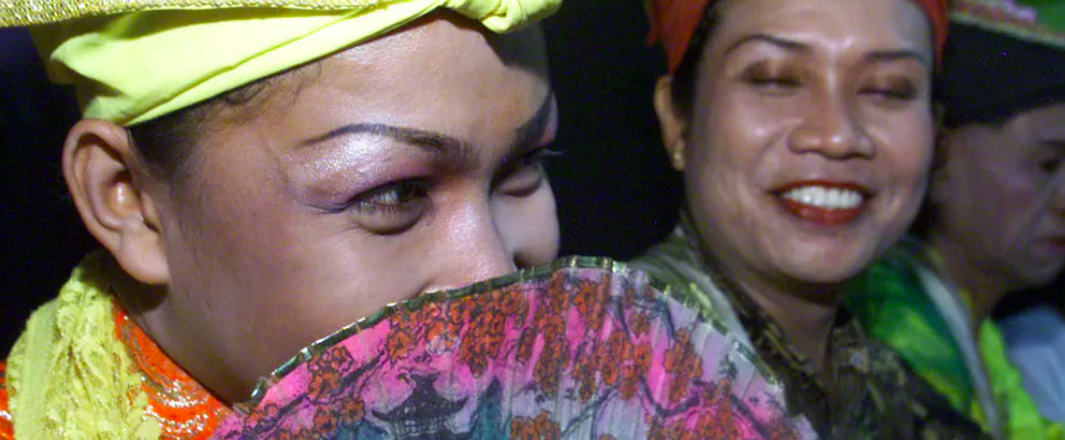
Bissu, or transgender priests, are one of five genders recognized by the Bugis. Reuters
What We Can Learn From an Indonesian Ethnicity that Recognizes Five Genders
On June 13, when a judge in Oregon allowed a person to legally choose neither sex and be classified as “nonbinary,” transgender activists rejoiced. It’s thought to be the first ruling of its kind in a country that, until now, has required that people mark “male” or “female” on official identity documents.
The small victory comes in the wake of a controversial new law in North Carolina that prevents transgender people from using public restrooms that do not match the sex on their birth certificates.
The conflict rooted in these recent policies is nothing new; for years, people have been asking questions about whether the “sex” we are born with should dictate things like which public facilities we can use, what to tick on our passport application and who’s eligible to play on particular sports teams.
But what if gender were viewed the same way sex researcher Alfred Kinsey famously depicted sexuality – as something along a sliding scale?
In fact, there’s an ethnic group in South Sulawesi, Indonesia – the Bugis – that views gender this way. For my Ph.D. research, I lived in South Sulawesi in the late 1990s to learn more about the Bugis’ various ways of understanding sex and gender. I eventually detailed these conceptualizations in my book “Gender Diversity in Indonesia.”
Does society dictate our gender?
For many thinkers, such as gender theorist Judith Butler, requiring everyone to choose between the “female” and “male” toilet is absurd because there is no such thing as sex to begin with.
According to this strain of thinking, sex doesn’t mean anything until we become engendered and start performing “sex” through our dress, our walk, our talk. In other words, having a penis means nothing before society starts telling you that if you have one you shouldn’t wear a skirt (well, unless it’s a kilt).
Nonetheless, most talk about sex as if everyone on the planet was born either female or male. Gender theorists like Butler would argue that humans are far too complex and diverse to enable all seven billion of us to be evenly split into one of two camps.
This comes across most clearly in how doctors treat children born with “indeterminate” sex (such as those born with androgen insensitivity syndrome, hypospadias or Klinefelter syndrome). In cases where a child’s sex is indeterminate, doctors used to simply measure the appendage to see if the clitoris was too long – and therefore, must be labeled a penis – or vice versa. Such moves arbitrarily forced a child under the umbrella of one sex or the other, rather than letting the child grow naturally with their body.
Gender on a spectrum
Perhaps a more useful way to think about sex is to see sex as a spectrum.
While all societies are highly and diversely gendered, with specific roles for women and men, there are also certain societies – or, at least, individuals within societies – who have nuanced understandings of the relationship between sex (our physical bodies), gender (what culture makes of those bodies) and sexuality (which kinds of bodies we desire).
Indonesia may be in the press for terror attacks and executions, but it’s actually a very tolerant country. In fact, Indonesia is the world’s fourth-largest democracy, and furthermore, unlike North Carolina, it currently has no anti-LGBT policy. Moreover, Indonesians can select “transgender” (waria) on their identity card (although given the recent, unprecedented wave of violence against LGBT people, this may change).
The Bugis are the largest ethnic group in South Sulawesi, numbering around three million people. Most Bugis are Muslim, but there are many pre-Islamic rituals that continue to be honored in Bugis culture, which include distinct views of gender and sexuality.
Their language offers five terms referencing various combinations of sex, gender and sexuality: makkunrai (“female women”), oroani (“male men”), calalai (“female men”), calabai (“male women”) and bissu (“transgender priests”). These definitions are not exact, but suffice.
During the early part of my Ph.D. research, I was talking with a man who, despite having no formal education, was a critical social thinker.
As I was puzzling about how Bugis might conceptualize sex, gender and sexuality, he pointed out to me that I was mistaken in thinking that there were just two discrete sexes, female and male. Rather, he told me that we are all on a spectrum:
Imagine someone is here at this end of a line and that they are, what would you call it, XX, and then you travel along this line until you get to the other end, and that’s XY. But along this line are all sorts of people with all sorts of different makeups and characters.
This spectrum of sex is a good way of thinking about the complexity and diversity of humans. When sex is viewed through this lens, North Carolina’s law prohibiting people from choosing which toilet they can use sounds arbitrary, forcing people to fit into spaces that might conflict with their identities.
SHARYN GRAHAM DAVIES is an Associate Professor of Social Sciences at Auckland University of Technology.
THIS ARTICLE WAS ORIGINALLY PUBLISHED ON THE CONVERSATION
Lights of the Medina
This video depicts the famous medinas in Marrakesh, Morocco. The medinas are huge hubs of commerce for locals and tourists. Every sort of product can be found in the medinas, such as food, clothes, souvenirs, performances, etc.
Read More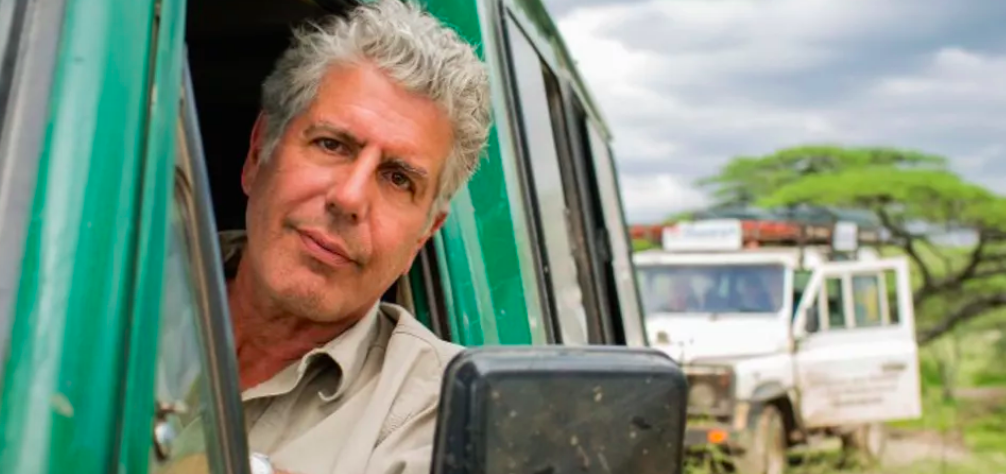

In Season 3 of ‘Parts Unknown,’ Anthony Bourdain took viewers to Tanzania. CNN
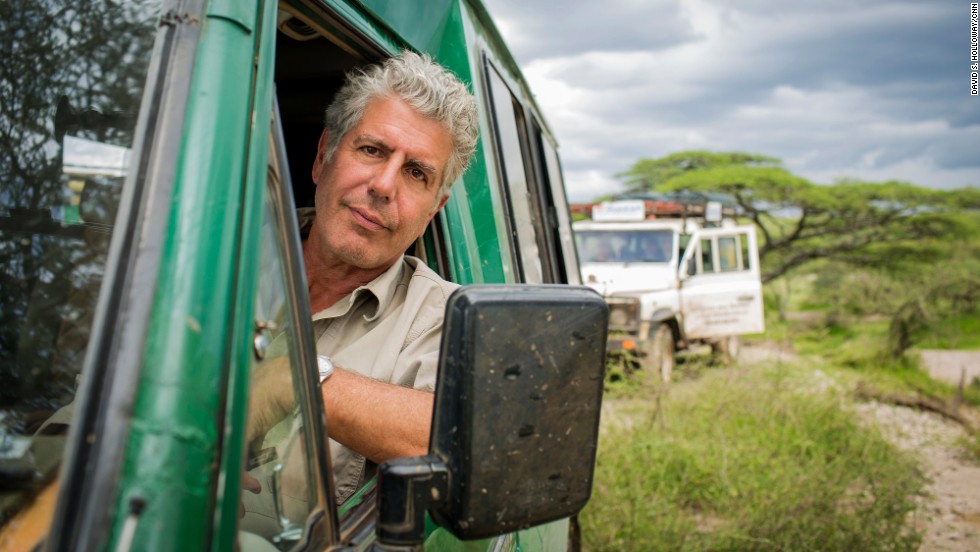
Anthony Bourdain’s Window into Africa
Anthony Bourdain might have been a celebrity chef, but viewers of his Emmy Award-winning travel show, “Parts Unknown,” didn’t tune in for curry and noodle recipes.
Cooking was simply the conceit Bourdain used to have a conversation about the culture, politics, struggles and triumphs of people around the world.
As a human geographer, I was drawn to how Bourdain upended the travel show genre, telling compelling and complicated stories about people and places most Western viewers tend to view through a lens of simplistic stereotypes or caricatures.
Even more remarkable, his work wasn’t relegated to obscurity. The show aired on CNN – a mainstream cable outlet with millions of viewers.
I was especially interested in the way the show depicted Africa, a continent Western media tends to portray using what novelist Chimamanda Ngozi Adichie famously called a “single story” – a monolithic narrative of poverty, backwardness and hopelessness.
So in a paper published last fall, I analyzed Bourdain’s Africa episodes, which took viewers to Congo-Kinshasa, South Africa, Tanzania, Madagascar and Ethiopia.
In them, he largely rejects the “single story” approach taken by much travel writing, and later travel television, since at least the 16th century. While the stories told about Africa in the West have changed over time, they’ve often lacked nuance and multiple voices – something Bourdain was eager to provide.
A ‘single story’ of horror and hopelessness
In the imaginations of many Westerners, Africa exists as a silent, docile, set piece – a contrasting “other.”
Sociologist Jan Nederveen Pieterse notes that for centuries – through deliberate lies and well-meaning mistakes – travel writers, missionaries and popular media outlets have wrongly depicted Africa as a place devoid of civilization, a frontier of wilderness and savagery.
The dominant narrative goes something like this: If the West is stable, Africa must be chaotic; if the West is mature, Africa must be infantile; and if the West is technologically advanced, Africa must be primitive.
Reality television and travel shows often deploy these tropes. Cultural anthropologist Kathryn Mathers has written widely on media depictions of Africa, suggesting that programs like “Survior: Africa” and Nicholas Kristof’s popular newspaper columns tell predictable stories of poverty and chaos with little effort to contextualize them within a larger history.
The dynamic voices of Africans – hardly a monolithic category – are often absent in these narratives. In the rare event they do appear, they’re often presented as people without politics who exist only to welcome tourists and protect rhinos. Intrepid conservation officers and overburdened health workers are favorite characters, along with the traditional leader, the street vendor and the small child in school uniform.
Cable news coverage of Africa also tells a “single story.” As Mathers wryly notes, when the continent does get coverage, the stories can be distilled down to the same topic: “the horrors of the hopeless continent, as seen on CNN.”
Bourdain’s critical lens
But Anthony Bourdain was also “seen on CNN.”
Beginning with his memoir, “Kitchen Confidential,” Bourdain built his persona as a speaker of unspoken truths. Likewise, he steered his travel show to “parts unknown” – or, more accurately, parts only known through incomplete tropes.
In each episode, Bourdain gives a brief historical overview to remind the audience that places are made by their histories. He doesn’t gloss over the difficult ones. For example, when explaining contemporary Congo, he implicates his American viewers:
“When the new country managed to inaugurate their first democratically elected leader, Patrice Lumumba, the CIA and the British, working through the Belgians, had him killed. We helped to install this miserable bastard in his place: Joseph Mobutu.”
When Bourdain is in Madagascar, he reflects on his own conflicted relationship to tourism and colonialism.
In Season 6, Ethiopian-born, Swedish-raised chef Marcus Samuelssonjoins him in Ethiopia. Together, they explore the theme of home in the context of the African diaspora.
While one might criticize Bourdain’s perspectives, he could never be accused of taking a sanitized, apolitical approach.
In the episode on Tanzania, he visits a Maasai village – a common pit stop for travel shows about East Africa. But “Parts Unknown” rejects the stereotype that the Maasai are an isolated, backwards tribe that exists apart from the modern world.
When a villager learns that Bourdain was born in New Jersey, he tells the host that his son attends university there. The conversation picks up again later in the episode, when Bourdain and the Maasai man thoughtfully ponder globalization and the anxiety and opportunity of social change. Bourdain understands that his African hosts aren’t anchored to a static past. Instead, they are dynamic actors in a global economy.
Bourdain writes his own reflections into each script. In Madagascar, Bourdain reminds viewers that
“the camera is a liar. It shows everything. It shows nothing. It reveals only what we want. Often, what we see is seen only from a window, moving past and then gone. One window. My window. If you had been here, chances are you would have seen things differently.”
The episode then cuts to previously rolled footage but reedited in the style of Mathers’ “horrors of the hopeless.” It’s all done to show the ease with which dominant narratives are packaged and to emphasize that “Parts Unknown” seeks to convey something entirely different.
The greatest strength of “Parts Unknown” was its comfort with unknowns remaining unknown – its resistance to arriving at singular truths about complex places. Bourdain never claimed that the “artifice of making television” – as he called it – allowed more than “one window, his window.”
Yet it was an open window, a critical lens that helped his large audience disentangle the tropes so often served up by popular media. Bourdain was critical of the single story, critical of widely held stereotypes and perhaps most critical of his own position as a masterful storyteller.
THIS ARTICLE WAS ORIGINALLY POSTED ON THE CONVERSATION
Bringing Indonesian Cuisine to New York, One Table at a Time
Every Tuesday, Indo Java in Queens, New York, turns into the hottest spot in town for traditional Indonesian cuisine. And the best part? You’re always guaranteed the best seat in the house. With only one table, Warung Selasa is one of the smallest restaurants in the city, located inside a tiny, two-aisle grocery store. Owned and operated by Dewi Tjahjadi, Warung Selasa has been spreading the flavors of Indonesia in Queens for the past 10 years.
Inside an Apache Rite of Passage Into Womanhood
For the Mescalero Apache Tribe, girls are not recognized as women until they have undergone the Sunrise Ceremony- an ancient, coming-of-age ceremony that lasts for four days. Last May, VICE got rare access to the ceremony for Julene Geronimo - the great, great grand-daughter of the renowned Apache leader, Geronimo. We followed Julene through each day of her arduous rite-of-passage to better understand what womanhood means for the Apache tribe, and how these ceremonies play a significant role in preserving a way of life that almost became extinct.
Winds from Morocco
This video captures scenes in Morocco ranging from the deserts to the cities.
Read MoreTANZANIA: The Last Hunter Gatherers
Hunting only with bows, arrows, and their ingenuity, what marked my time with the Hadza was how remarkably happy they seemed. In their language, there is no word for “worry” and by following their ancestral ways, the Hadza truly live in the moment.
Read More