Fighting Human Extinction in London and Beyond

Over the past week, governmental officials and police say, protesters have wreaked havoc in London—but it’s all part of an effort to address the sociopolitical factors wreaking havoc on our planet.

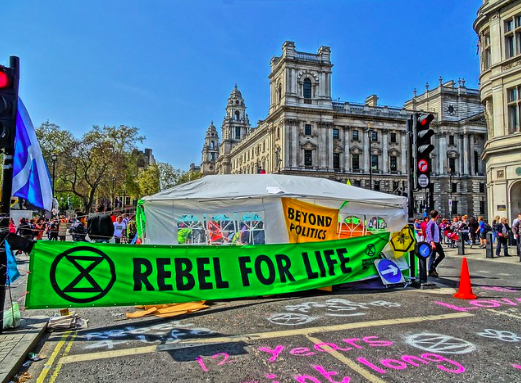
Parliament Square on April 19. DAVID HOLT. CC BY 2.0

In the early afternoon of Monday, April 22, about 100 people entered London’s Natural History Museum and made their way to Hintze Hall. As sunlight streamed in from the skylights and illuminated the Romanesque arches that punctuate the stone walls, the protestors positioned themselves underneath Hope—the enormous blue whale skeleton suspended from the ceiling—and lay down on the ground. After about half an hour, most concluded their “die-in,” but a few remained; wearing face paint and crimson robes, they gave a classical music performance on the steps beneath the skeleton.

This unusual demonstration was part of a massive mobilization by Extinction Rebellion (abbreviated as XR), a non-partisan movement aiming to revise environmental policy with the goals of slowing climate change and minimizing the possibility of imminent human extinction. The group launched in the United Kingdom in October of 2018—in response to the Intergovernmental Panel on Climate Change report announcing that we have just 12 years to halt catastrophic change—and quickly proliferated worldwide.


Today, the movement boasts about 130 groups across the UK, and is active in countries from the U.S. to South Africa to Australia. Its core demands are threefold: Honesty and transparency from governments regarding the ecological crisis; reduction of carbon emissions to zero by 2025; and the implementation of a participatory democracy to monitor progress towards these goals.

The current actions in London, advertised on XR’s website as “UK Rebellion—Shut Down London!,” are the focal point of a constellation of protests planned in 80 cities across 33 countries. Beginning on April 15, thousands of protestors poured into the heart of London, blocking five major landmarks: Waterloo Bridge, Marble Arch, Parliament Square, Oxford Circus, and Piccadilly Circus. From the beginning, group members made it clear that they weren’t going anywhere, filling the bridge with trees and flowers and even setting up a skate park and stage. Live music emanated from Oxford Circus, and a life-sized model of a boat with “Tell the Truth” painted on the side blocked the center of the bustling junction.

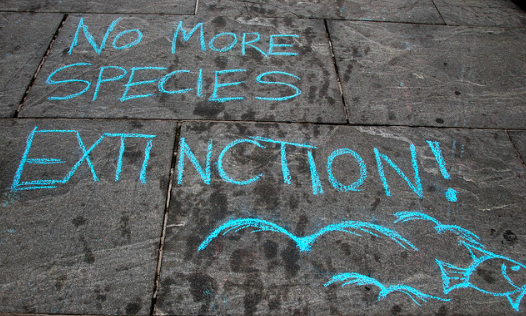
Nearby at Piccadilly Circus, younger protestors chalked messages on the pavement, while inside an open-sided truck at Marble Arch, bands entertained hundreds of onlookers. In Parliament Square on April 15, Jamie Kelsey Fry—contributing editor for the Oxford-based New Internationalist magazine—encouraged demonstrators from an octagonal stage.

Chalk message on April 17. Felton Davis. CC BY 2.0

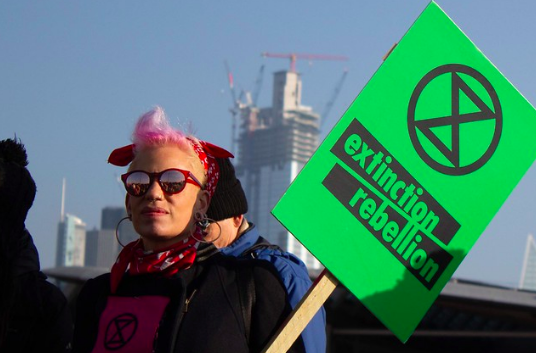
The audience waved flags and banners emblazoned with the symbol of the movement, dubbed by Steve Rose of The Guardian as the ubiquitous logo of 2019. According to Rose, the “X” signifies extinction, and the horizontal lines suggest an hourglass—reminding us once again that time is running out.

A high point for protestors was a visit from 16-year-old climate activist Greta Thunberg on Sunday, April 21. The Swedish teenager, who staged a “School Strike for Climate” at Sweden’s Parliament last year and initiated the weekly #FridaysforFuture school walkouts, received chants of “We love you” as she took the stage at Marble Arch.

Demonstrating on London’s Blackfriars Bridge last November. Julia Hawkins. CC BY 2.0

While the protests have in some ways resembled a modern-day Woodstock, full of music and goodwill, London authorities—who have deployed some 9,000 police officers in response—see a different side of the story. As of April 22, more than 1,000 people had been arrested since the demonstrations began; the youngest to be charged was 19, and the oldest 74.

London mayor Sadiq Khan said that the protest was taking a toll on London’s police forces and businesses, commenting, “I'm extremely concerned about the impact the protests are having on our ability to tackle issues like violent crime.” Protestors, for their part, view the stress on police as unavoidable: “We wish we didn’t have to distract police resources,” their website states. “80 year old grandfathers would rather not be putting themselves in the physically uncomfortable position of being in a police cell and children don’t want to be skipping school  – but 30 years of government inaction have left us with no choice.”

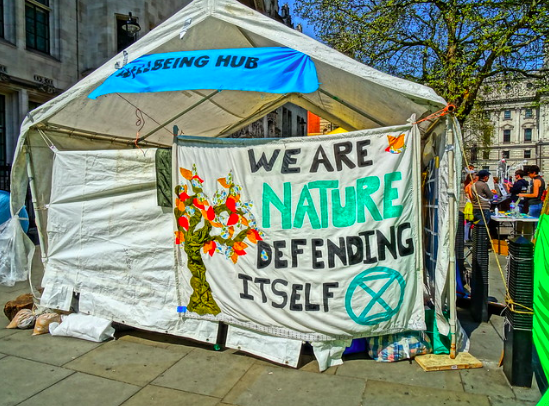
Tent set up in Parliament Square. DAVID HOLT. CC BY 2.0

As protesters continue to be removed from the scene one by one by the police, with more rushing in to take their place, the question is whether or not the government will be responsive to XR’s message. On the first day of the mobilization, XR wrote to Prime Minister Theresa May outlining its demands, requesting talks, and issuing a stern warning: Failing government action, the group’s disruptive demonstrations would only escalate over the coming weeks. On April 22—the day of the Natural History Museum die-in, and also Earth Day—the group said that they would soon hold a “people’s assembly” to determine next steps. The next day, protesters marched on Parliament in a renewed push to open dialogue with government officials.


London’s Energy & Climate Intelligence Unit has said that XR’s demand for carbon neutrality by 2025 “technically, economically and politically has absolutely no chance of being fulfilled,” but nevertheless supports the message behind the movement and the actions it has engendered. For XR, surmounting the impossible is the only way forward to ensure that human beings can continue to inhabit the earth: Their website reads, “Only a peaceful planet-wide mobilisation of the scale of World War II will give us a chance to avoid the worst case scenarios and restore a safe climate.” Only time will tell whether those in power agree.


TALYA PHELPS hails from the wilds of upstate New York, but dreams of exploring the globe. As former editor-in-chief at the student newspaper of her alma mater, Vassar College, and the daughter of a journalist, she hopes to follow her passion for writing and editing for many years to come. Contact her if you're looking for a spirited debate on the merits of the em dash vs. the hyphen.


Indigenous Communities in Brazil Protest Encroachment on Land Rights

The annual Free Land protest takes on a new sense of urgency under Bolsonaro’s far-right government.

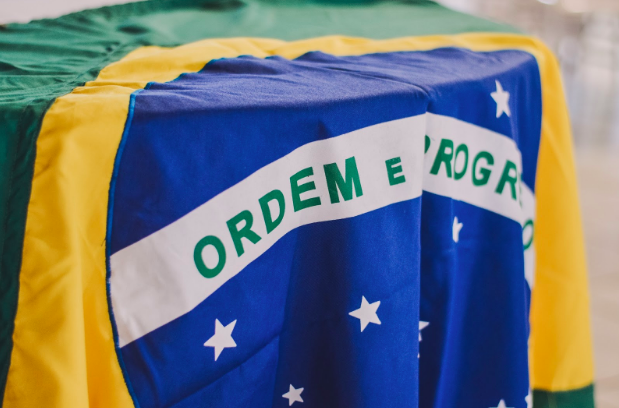
Photo of the Brazilian flag by by Rafaela Biazi on Unsplash.

Last week, more than 4,000 indigenous people from over 300 tribes across Brazil gathered in Brasilia to set up camp in front of government buildings for three days of cultural celebrations and protest.

While the Free Land protest is an annual event, it has taken on a new significance this year under president Jair Bolsonaro and his far-right government’s encroachment on the rights of native people and their territories. Al Jazeera writes that according to The Articulation of the Indigenous People of Brazil (APIB), the central organizer of the gathering, this year the event occurs in a "very grave context".

Recently, Bolsonaro promised to stop the development of new indigenous reserves, and to revoke the protected status of established land reserves. Bolsonaro has even gone so far as to publicly question the need for indigenous reserves at all.

The Guardian writes that among the new far-right government’s projects is a movement to enable commercial farming and mining on indigenous reserves. One of the reserves targeted is the Yanomami territory, Brazil’s largest reserve which already experiences threats from illegal gold miners.

“We are defenders of the land, we are defenders of the Amazon, of the forest,” Alessandra Munduruku, one of the representatives of the Munduruku tribe told the Guardian. “The white man is [...] finishing off our planet and we want to defend it.”

Instead of directly handling the demarcation of Brazil’s indigenous reserves, the government has given the project to the agriculture ministry, a branch controlled by the farming lobby, a powerful organization which has been known to oppose indigenous land rights (Guardian). Joenia Wapichana, the first indigenous congresswoman in Brazil, told Al Jazeera that during her time in office she had become aware of just how deeply the government was to indigenous rights. “The government is completely anti-indigenous,” she said, “[Jair Bolsonaro] is only open to those who defend mining and land grabbing, which is his intention.”

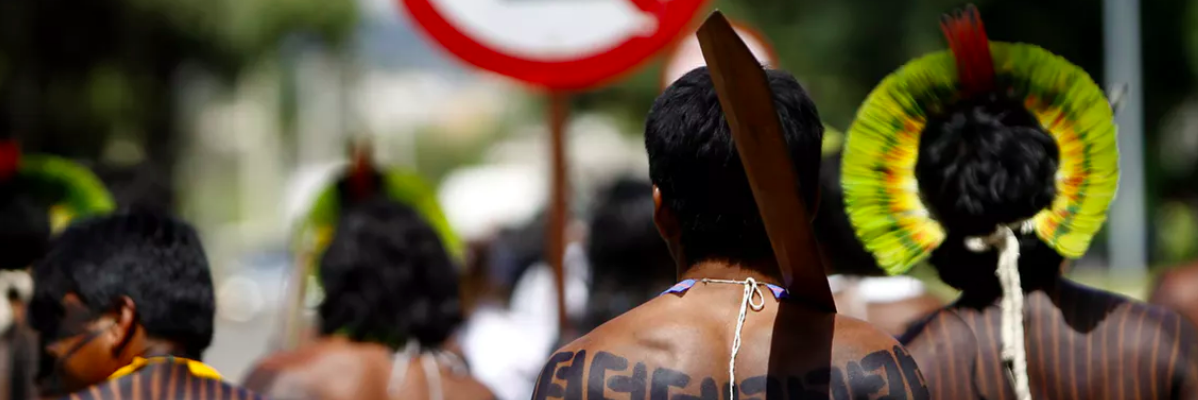
After days of encampment outside government buildings, indigenous groups began their annual march last friday. Protestors wore body paint and feathered headdresses, while beating beating drums and holding bows and arrows (Reuters).

The Guardian writes that last week Bolsonaro’s justice minister Sérgio Moro, requested the presence of Brazil’s national guard at the event, foreshadowing possible clashes with protestors. While Moro said that the guard would be working to “secure the public order and the safety of people and patrimony,” the guard said in a statement to Al Jazeera that it would use force “if necessary” to protect the “safety of the patrimony of the Union and its servers.”

In response to growing concern, the APIB released a statement saying that “our camp has been happening peacefully for the past 15 years to give visibility to our daily struggles. [...] We are not violent, violence is attacking our sacred right to free protesting with armed forces.”

In a statement to Reuters, David Karai Popygua, a native person from the state of Sao Paulo, summed up what is at stake for protestors. “Our families are in danger, our children are under threat, our people are being attacked,” he said. “In the name of what they call economic progress they want to kill our people.”


EMMA BRUCE is an undergraduate student studying English and marketing at Emerson College in Boston. While not writing she explores the nearest museums, reads poetry, and takes classes at her local dance studio. She is passionate about sustainable travel and can't wait to see where life will take her.


Living With Albinism in Sub-Saharan Africa

In Malawi, Mozambique, Tanzania, and beyond, children and adults with this rare condition face widespread violence based on superstition—and fight for the right to live their lives free of persecution.

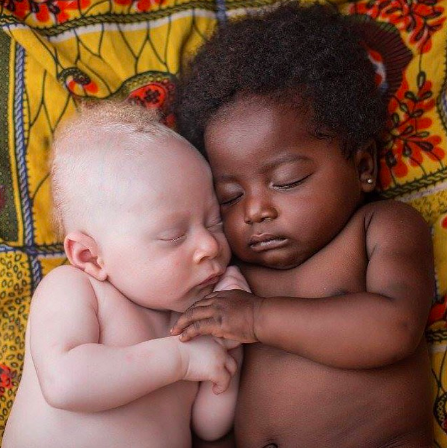
On the left, a baby with albinism. Kaysha. CC BY-NC-ND 2.0

On January 1 of this year, unknown assailants climbed through the window of Kwenda Phiri’s home in Nhkata Bay, Malawi, and hacked him to death, chopping off his hands and fleeing with them. Their motive? Phiri had albinism, meaning that—due to a rare genetic condition—he was born without pigment in his skin, hair, or eyes. Unfortunately, Phiri’s killing was far from an isolated incident. Across sub-Saharan Africa, people with albinism face physical violence and persecution based on superstition, often leaving them unemployed, isolated, and fearful of even leaving their homes.

Kidnapping and dismemberment, such as in the case of Phiri, is common, as body parts from people with albinism can bring in up to $75,000 on the black market. Witchdoctors perpetuate myths about the magical qualities of people with albinism, and make outlandish claims that their body parts can be used in charms and potions to summon wealth, power, and good luck. Babies born with albinism may be considered a curse and slaughtered at birth, especially in certain regions: in Tanzania, where the condition affects up to 1 in 1400 citizens, people with albinism are called zeru zeru, meaning “ghosts,” and assumed to bleed a different color or be immortal. Such superstitions have fueled more than 520 recorded attacks in 28 countries since 2006; Tanzania had the highest number, at more than 170 incidents. Attackers and witchdoctors rarely face legal action, and not a single buyer in this gruesome segment of the black market has ever been prosecuted.

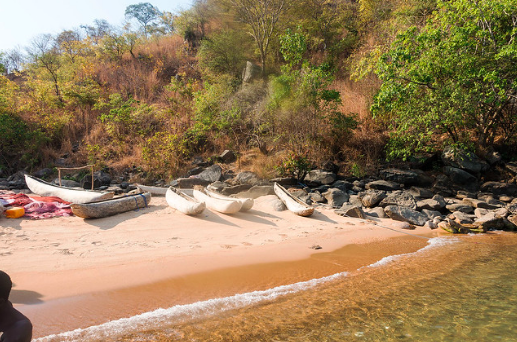
The Nkhata Bay, Malawi, area, near where Kwenda Phiri was killed. Matthew and Heather. CC BY-NC-ND 2.0

For people with albinism who manage to escape fatal attacks, prospects for education and gainful employment are often dim. In Tanzania, only half of children with albinism complete primary school, and even fewer attend secondary. The condition typically affects vision, leaving children without access to glasses to struggle and underperform academically. Adults with albinism are met with few job opportunities, and often fall into poverty. Women with albinism suffer specific and especially dangerous injustices. Unfounded myths run rampant that sex with a women who has the condition can cure HIV/AIDS, leading to many women with albinism contracting AIDS through this heinous variety of ritual rape. Even after death, persecution persists: Many families whose relative with albinism has passed away do not hold the funeral in public, for fear that the grave might be dug up and the corpse stolen. This practice of quiet, unnoticed burial may also perpetuate superstitions regarding immortality.

Attacks are especially prevalent in certain countries—namely Tanzania, Malawi, and Mozambique, according to Turkish news outlet TRT World. Indeed, Nyasa Times, the online breaking news source that reported Phiri’s murder, stated that “Malawi faces ‘systematic extinction’ of people living with albinism if they continue to be murdered for their body parts.”

The general culture of neglect and harmful behavior toward people with albinism also exacerbates concerns about skin cancer, to which people with albinism are particularly susceptible given their lack of pigmentation. Parents often do not know about the importance of covering up in the sun and copiously applying sunscreen; in fact, some actually take their children with albinism into the sun to intentionally darken their skin, leading to dark-colored pre-cancerous lesions that only encourage the parents to continue. Only 2 percent of people with albinism in sub-Saharan Africa live beyond age 40—largely due to the scourge of cancer—and most children with albinism as young as 10 already have some early form of the disease.

In response to the unchecked spread of skin cancer, a company called Kilimanjaro Suncare, or Kilisun, has designed a sunscreen especially for people with albinism. When the product was released in 2012, it was used to help 25 children; as of 2017, it was being given free of charge to 2,800 people at clinics taking place every four months. Over half of those receiving Kilisun were children.

While skin cancer can be mitigated with appropriately distributed medical care, resolving the culture of violence against people with albinism will be a longer and more arduous process. In its 2017–2018 report, Amnesty International acknowledged the situation of people with albinism in Mozambique for the first time ever, estimating that 30,000 people experienced discrimination for their condition and pointing to a spike in incidents of persecution. In Tanzania, a charity called Under One Sun runs an education program for students with albinism and a summer camp for students who have been abandoned by their families due to their condition, as well as performing public advocacy and outreach through seminars and film screenings. The Albino Foundation offers similar advocacy services in Nigeria, aiming to empower people with albinism and educate the Nigerian and global societies about the realities of the condition.

For some individuals with albinism, art has served as a powerful means to address the injustices hindering their lives on a daily basis. Singer-songwriter Salif Keita—who endured bullying and rejection as a child in Mali due to his albinism, and who founded a global foundation in 2006 to aid those who are afflicted—dedicated a benefit concert in November 2018 to a five-year-old girl with albinism who was kidnapped, tortured, and killed in Mali in May of that year. More than 100 politicians, diplomats, and people with albinism attended the event.

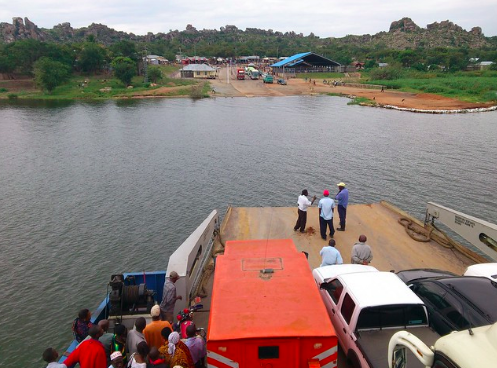
Arriving to Sengerema region in Tanzania, where a life-sized statue dedicated to people attacked due to their albinism can be found. TANZICT Project. CC BY-NC-SA 2.0

In Sengerema, Tanzania, a monument has been erected to honor those who have been assaulted and murdered due to their albinism. The statue portrays a dark-skinned father and mother; the father holds his light-skinned child with albinism on his shoulders, and the mother places a hat on the child’s head to keep them safe from the rays of the sun. Around the monument are etched the names of people with albinism who have been attacked, representing an homage to those lost to the anachronistic attitudes of the past. Standing tall above the ground, the life-sized statue—which was made by Tanzanian artists with disabilities—imagines a possible future in which people with albinism can live safely and normally regardless of their pigmentation.


TALYA PHELPS hails from the wilds of upstate New York, but dreams of exploring the globe. As former editor-in-chief at the student newspaper of her alma mater, Vassar College, and the daughter of a journalist, she hopes to follow her passion for writing and editing for many years to come. Contact her if you're looking for a spirited debate on the merits of the em dash vs. the hyphen.