Food Insecurity Affects More than 41 Million Americans

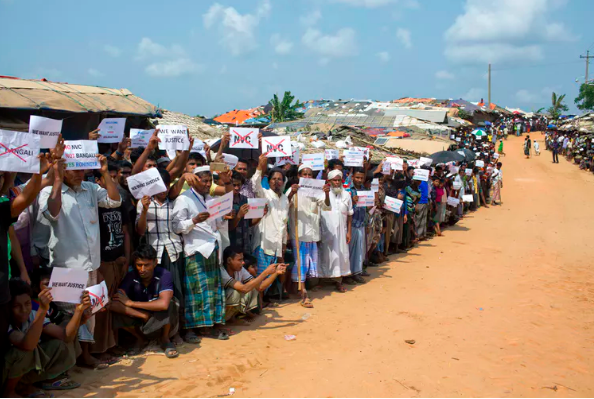
In a nation of plenty, why do 1 out of 8 Americans have uncertain or limited access to food?

In America 1 out of 10 don’t have enough to eat, much more than the 1 in 20 in Europe (Source: Bread Institute for America).

Going hungry in America is not what most would expect. Hunger might mean sacrificing nutritious food for inexpensive, unhealthy options. It might mean periodic disruption to normal eating patterns. And increasingly such hunger occurs among white families, in the suburbs, and among obese people. In other words, any community can be affected; and in 2017, the USDA reported 12.3% of American households are food insecure. Hunger today is a result of tradeoffs between food and other costs—such as health care, bills, and education.

However, hunger does not accurately depict food insecurity in America. Hunger is a prolonged, involuntary lack of food that can lead to personal or physical discomfort. Conversely, food insecure, coined in 2006 by the USDA, defines a household with limited or uncertain access to food. Food insecurity results from limited financial resources and makes it difficult to lead an active, healthy lifestyle. Further, food insecurity can be categorized either as low food insecurity (reduced quality of food, but not intake) or high food insecurity (both reduced quality and intake).

No matter the category given, food insecurity has serious effects. This is most evident in the need for 66% of Feeding America customer households to choose between medical care and food, according to a 2014 study. Considering many food insecure individuals have diabetes or high blood pressure, medical care can be critical. A study by the Bread for the World Institute in 2014 estimated hunger creates $160 billion in healthcare costs. This includes mental health problems, nutrition related issues, and hospitalizations among other potential costs.

Further, 13 million of food insecure individuals are children and 4.9 million are seniors: two critical groups whose bodies rely on proper nutrition. For example, the effects of hunger in children have been known to delay development, cause behavioral problems, and even increase the chances a child will repeat a grade.

One solution for food insecurity is federal food assistance programs. Indeed, 59% of food insecure households are part of at least one major federal food assistance program— but 25% of households do not qualify. The most well-known of these federal programs is SNAP, or Supplemental Nutrition Assistance Program. SNAP requires your gross income be at or below the poverty line by 130%, allowing for adjustments with family size. Still, the average amount per person is around $133.07 a month—or less than $1.50 per meal.

The desired solution though is the end of food insecurity in America. A major force behind this future is the domestic nonprofit, and hunger relief organization, Feeding America. Feeding America supports food banks, funds research, provides meal programs, mobilizes anti-hunger advocacy, and educates the public among other initiatives.

Overall, Feeding America and its partners served 1 out of 7 Americans in 2017. It was able to do so as it works together with 200 food banks and 60,000 pantries. Each affiliated food bank, a non-profit that stores food for smaller organizations, is evaluated according to industry practices and food safety laws. Additionally, all staff receive food safety training. These practices ensure all food is safe when distributed at the food pantries, which directly serve their communities.

Much of the food was higher quality too: around 1.3 billion pounds of nutritional food was delivered to food banks in 2017. Some food is food waste, in 2017 3.3 billion pounds were rescued from landfills and redistributed for consumption from partner companies, such as Starbucks. And all these small initiatives are directly helping communities, making food security an increasing possibility for the future.


TERESA NOWALK is a student at the University of Virginia studying anthropology and history. In her free time she loves traveling, volunteering in the Charlottesville community, and listening to other people’s stories. She does not know where her studies will take her, but is certain writing will be a part of whatever the future has in store.


Nigeria Replaces India as Home to Most in Extreme Poverty

Extreme poverty is increasingly common in Africa according to a Brookings Institution report.

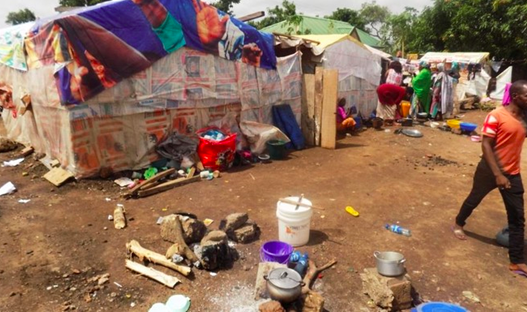
A snapshot of what poverty means in Nigeria (Source: Daily Trust).

Imagine living on $1.90 or less a day, struggling even to access basic necessities. 767 million people in the world fit that description, according to a 2013 survey (the last comprehensive survey on global poverty): 1 in 10 people. The World Bank describes such people as “predominantly rural, young, [and] poorly educated.” For a long time India has been home to the most people living in extreme poverty. But Nigeria is now number one for most people in extreme poverty, according to Brookings Institution, a DC public policy nonprofit.

This change reflects a geographical shift in extreme poverty. Once extremely common in Asia, economic progress has helped to eliminate a significant proportion of extreme poor. The trend in Asia reflects worldwide trends since the 1990s that have seen rates of extreme poverty decrease by more than 60% according to the World Bank. Progress in India also reflects progress with the international Sustainable Development Goals, set in 2016, that seeks to eliminate extreme poverty by 2030. Since the goals were set in 2016, 83 million have escaped extreme poverty.

However, the progress in India has not been praised by everyone. Some wonder if the reported progress illustrates continued rural distress and worries about job creation in India. Another potential criticism is about what poverty means. For India, a middle-income country based on its per capita income, its poverty line is $3.20 or less per day according to the World Bank. This means poverty is less defined by living on the edge of hunger and more on having an income that can access opportunities of a growing economy, according to a financial editorial in Mint.

Meanwhile, extreme poverty has become the unwelcome status quo in Africa. This is most notable in statistics, calculated through the IMF’s World Economic Outlook and household surveys, provided by the World Poverty Clock. It states as six people enter extreme poverty per minute in Nigeria, 44 leave it in India. More generally, 87 million Nigerians (44% of the population) live in extreme poverty while 70.6 million (around 5% of the population) live in extreme poverty in India.

Further, Nigeria is only a part of the extreme poverty in Africa. Two-thirds of Africans live in a state of extreme poverty and 14 of the 18 countries that have rising numbers of extreme poor are located in Africa. Indeed, on track to be number two for extreme poor is the Democratic Republic of Congo.

The theme of poverty in Africa also depicts difficulties in achieving the Sustainable Development Goals. When it was implemented in 2016, the pace required to eliminate poverty by 2030 was 1.5 people every second. However as countries have slowed down in eliminating poverty, the actual pace is remarkably less—by 2020 it could be 0.9 people per second. The difference in pace will make it difficult to eliminate poverty by 2030 if not impossible, especially as the required pace to get back on track for the goal is 1.6 people per second.

In spite of the difficulties, eliminating global poverty is a priority for many charitable organizations. One is The Borgen Project, a Seattle nonprofit who hopes to be “an influential ally” for the world’s poor by building “awareness of global issues and innovations in poverty reduction.”  The Borgen Project builds awareness by advocating for poverty-reducing legislation by meeting directly with members of Congress or staff. They also hold members of Congress accountable for blocking poverty-reducing legislation.

The Borgen Project’s success is especially evident in the passing of the 2017 Reinforcing Education Accountability in Development (READ) Act. The Act holds the US accountable for ensuring access to basic education in war-torn and developing countries. Basic education encourages economic growth by equipping people with skills needed to participate in the global marketplace— an important step to reducing poverty.

Another successful organization is international organization Oxfam, which hopes to create “lasting solutions to poverty, hunger, and social justice.” Oxfam strives to create such systemic change through social justice advocacy of legislation that reduces poverty; disaster response improvements; and public education about the causes of poverty. Oxfam also focuses on programs that educate individuals about their rights or address inequalities in resource accessibility— such as clean water initiatives.

These programs cultivate local partnerships and networks with a focus on “locally informed and locally driven solutions.” For example, after over ten years of working with local communities and government authorities to minimize the impact of disasters on poor people, El Salvador was able to swiftly respond to the October 2011 flood. More importantly, when a village (La Pelota) received unclean drinking water, they asserted their right to clean water by sending it back to the authorities.

Both organizations show work that has been directly done to eliminate poverty. Like other organizations that focus on global poverty, they strive to enforce systemic change by targeting root issues. These include a lack of education— of individuals about their rights as well as the general public, a lack of adequate resources, and a lack of legislation that addresses the poor. Whether it is by 2030 or later, it is possible to imagine a future where extreme poverty does not exist. Many individuals already do.


TERESA NOWALK is a student at the University of Virginia studying anthropology and history. In her free time she loves traveling, volunteering in the Charlottesville community, and listening to other people’s stories. She does not know where her studies will take her, but is certain writing will be a part of whatever the future has in store.

Health Care Inequalities Impact Indigenous Communities

What are the Effects of Racism In Health Care Delivery in Canada and the US?

Research released the week of July 1 suggested health care inequalities among indigenous communities extended beyond the Northwest Territories’—where around half the population is indigenous—to all of Canada. The research says racism, in particular implicit racism, has contributed to unnecessary deaths among indigenous communities. Dr. Smylie, a Métis doctor and researcher, commented that “the most important and dangerous kinds of racism that people encounter is actually racism that's hidden.”

Yet implicit racism is not new: it has been the focal point of past studies, most notably the 2015 Wellesley Institute study “First Peoples, Second Class Treatment” also led by Dr. Smylie. The study suggested indigenous people either strategized their visits or avoided care completely due to the frequency of experienced racism. Such racism was commonly felt in a “pro-white basis,” according to Dr. Smylie, and negative stereotypes that originated in colonial government policies like segregation.

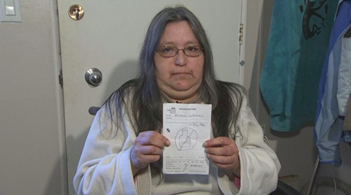
Michelle Labrecque’s prescription for severe stomach pain was merely a message to not drink (source: CBC news).

The findings of the 2015 Wellesley study underlined the unnecessary death of elder Hugh Papik in 2016. Even though Papik did not have a history of drinking, Papik’s stroke was mistaken for drunkenness. His death prompted an external investigation that made 16 recommendations for the Government of the Northwestern Territories. Four of the recommendations focused specifically on fostering relations between indigenous communities and health care professionals. All but two were adopted.

The recommendations included training staff—“policies for implementation of mandatory and ongoing culture safety training… in partnership with the Indigenous community”—in hopes of breaking down the root issue of systemic racism by confronting stereotypes. According to health minister Glen Abernethy, training will do so by incorporating information about the different cultures of the territory as well as a history of colonization for non-indigenous staff. In addition to the training, Abernethy hopes to increase the number of indigenous staff in the future by encouraging young locals to pursue medical careers so that they might return and serve their communities.

However, the messy entanglement of racism and health care is not unique to Canada. A 2017 survey by NPR, the Robert Wood Johnson Foundation, and the Harvard T.H. Chan School of Public Health found 23% of Native Americans faced discrimination when “going to [the] doctor or health clinic” in the US.  

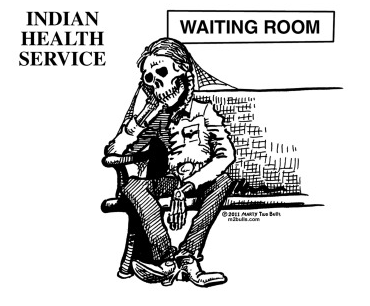
Even though the US federal government is obligated, through treaty agreements, to provide for the health of Native Americans, the IHS itself is too underfunded to provide adequate care. A 2014 study stated that “Long-term underfunding of the IHS is a contributing factor to AI/AN health disparities.”  Indeed, for people like Anna Whiting Sorrell who have struggled to get treatment in the past, it is no surprise that “a lot of American Indians simply put up with …“‘tolerated illness.’” Other care alternatives are also difficult to access as the American health care system makes it hard for many Native Americans to obtain care in the private sector.

Cartoon depicting the waiting room of an IHS facility-- and the struggles of the system (Source: Marty Two Bulls).

And while some communities have successfully started looking inwards at traditional forms of healing and eating to improve health, it is evident that many are doing so because outside systems of support are inadequate or nonexistent. Although Canada is actively trying to address inequalities in its health care, the US has yet to do so.


TERESA NOWALK is a student at the University of Virginia studying anthropology and history. In her free time she loves traveling, volunteering in the Charlottesville community, and listening to other people’s stories. She does not know where her studies will take her, but is certain writing will be a part of whatever the future has in store.

How Tampons are Hurting the Environment

...and what you can do to help.

Image Credit: HelloFlo

Disposable tampons and pads are something that almost every woman uses on a monthly basis without realizing the negative effect these products have on the environment. This is partly due to the cultural taboos surrounding menstruation that allow manufacturers to proffit and prevent the topic from becoming a global conversation. It seems counterintuitive that despite sustainable options in other everyday products, this necessary part of a woman’s life has gone unchanged for the past fifty years.

How are tampons hurting the environment?

The average woman will use between 11,000 and 16,000 tampons in her lifetime. Those tampons add up to about 250 to 300 pounds of waste, not including the resources used to produce and ship the tampons. And that is only the beginning: once the tampon is disposed of it will take six months to decompose (this doesn’t include the applicator or wrapper).

Also, tampons are partly made out of plastic and usually include a plastic applicator which contributes to plastic pollution worldwide. Plastic is unable to biodegrade, meaning that it continues to break down into smaller pieces which contaminate groundwater, hurt wildlife, and attract and carry toxins. Because only 8% of plastic is ever recycled, the rest piles up in landfills, becomes litter, and often ends up in the ocean. In the past ten years volunteers have collected over 20,000 tampons and applicators from British beaches alone.

Tampons and pads are also made from cotton that is heavily treated by pesticides, meaning that those toxins will seep into groundwater when the tampon is discarded. Also, because tampons are registered with the FDA as medical devices, manufacturers are not required to list ingredients meaning that there are likely many undisclosed toxins in tampons and pads.

What Can I Use Instead?

Fortunately there are many options for a more sustainable period. A popular alternative to the tampon is the menstrual cup, a medical grade silicone cup that catches menstrual fluid. Unlike a tampon, the menstrual cup can be worn for up to 12 hours and is completely re-usable, saving you the money spent monthly on tampons. Menstrual cups are also chemical free, allowing you to know exactly what you are putting in your body. http://divacup.com/

Another sustainable option is period panties. These are basically regular underwear with extremely absorbent padding that can take the place of a pad or tampon. Most retailers list the amount of menstrual fluid the underwear is able to absorb, allowing you to supplement with a menstrual cup as needed. https://www.shethinx.com/

Cloth menstrual pads are also available. These pads will last you up to ten years and are made from natural material so that they will biodegrade once you need to throw them away.

It’s time to move past tampons to a more sustainable alternative that is better for you and your world.


EMMA BRUCE is an undergraduate student studying English and marketing at Emerson College in Boston. She has worked as a volunteer in Guatemala City and is passionate about travel and social justice. She plans to continue traveling wherever life may take her.