• Travel Features
  • Global Action
  • Take A Trip
  • Travel Guides
    • Podcast
    • Courses
    • Bookshop
  • About
  • Sign Up
Menu

CATALYST PLANET

  • Travel Features
  • Global Action
  • Take A Trip
  • Travel Guides
  • Discover
    • Podcast
    • Courses
    • Bookshop
  • About
  • Sign Up

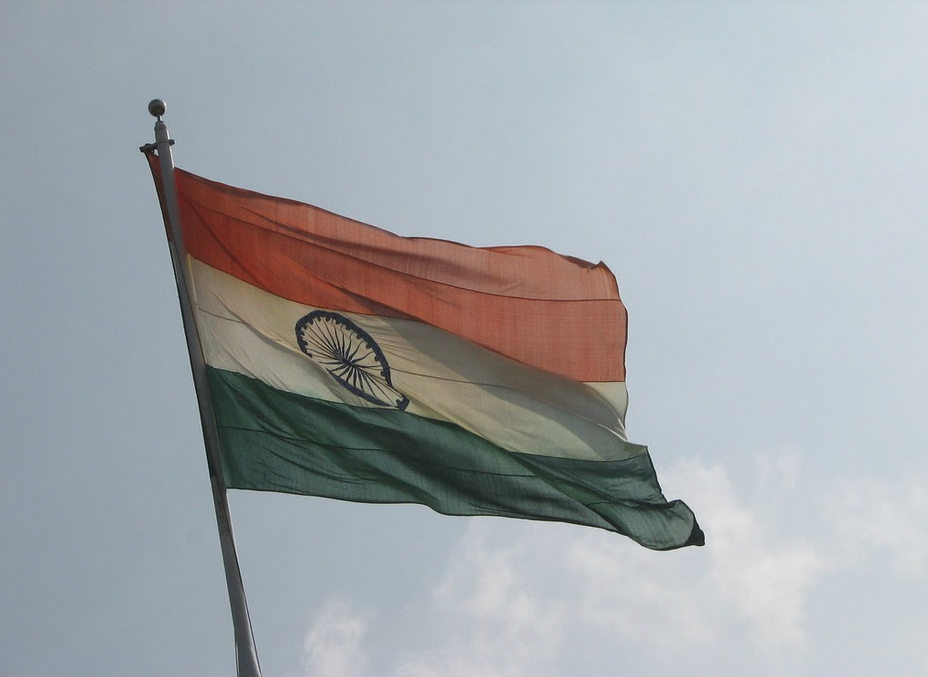
"Indian Flag at Sriperumbdur" by rednivaram is licensed under CC BY-NC-SA 2.0

Delhi Muslims Still Rebuilding Their Lives After Days of Deadly Riots

March 22, 2020

Almost three weeks after religious violence erupted in Delhi, India, thousands of Muslims are still displaced, most living in relief camps that are overwhelmed by the number of people who have lost everything.

Hindu mobs attacked neighborhoods in the northeast area of New Delhi on Sunday, February 23, 2020. At least 53 people have been killed and more than 200 injured in what is being called the worst violence New Delhi has seen in decades. The three days of violent attacks included the torching and looting of schools, homes, mosques, and businesses. “Mobs of people armed with iron rods, sticks, Molotov cocktails and homemade guns ransacked several neighborhoods, killing people, setting houses, shops and cars on fire”, according to CBS News. The New York Times reported, “Gangs of Hindus and Muslims fought each other with swords and bats, shops burst into flames, chunks of bricks sailed through the air, and mobs rained blows on cornered men.” These attacks came after months of mainly peaceful protests by people of all faiths over changes to citizenship laws that allowed discrimination against Muslims.

The new law, called the Citizenship Amendment Bill, uses a religious test to determine whether immigrants from Afghanistan, Bangladesh, and Pakistan can be considered for expedited Indian naturalization. All of South Asia’s major religions were included—except Islam. According to CBS News, those who oppose the law say, “it makes it easier for persecuted minorities from the three neighboring nations of Pakistan, Afghanistan and Bangladesh to get Indian citizenship - unless they are Muslim.” Kapil Mishra, a local Hindu politician of the Hindu nationalist party, the Bharatiya Janata Party, told India’s police that they needed to break up the protests against the law, or he and others would take it into their own hands.

Doctors at the Mustafabad Idgah camp (one of the largest camps) are reporting that many of the survivors are showing early signs of Post-Traumatic Stress Disorder (PTSD) and depression. The makeshift relief camps are overcrowded and undersupplied, and are lacking in some sanitation amenities. Due to the lack of hygiene amenities, many are suffering from urinary tract infections and skin rashes. The lack of basic hygiene amenities is even more dangerous and deadly amid the global coronavirus pandemic.

Muslims found help from another religious minority in India: Sikhs. A Sikh man, Mohinder Singh, and his son, Inderjit, helped sixty people get to safety by tying turbans around their heads so they would not be recognized as being Muslim. Sikhs themselves experienced large-scale religious violence in October 1984 when 3,000 Sikhs were killed in Delhi after the assassination of then-Prime Minister Indira Gandhi. Khalsa Aid, a non-profit organization founded upon Sikh principles, was one of the first groups to provide aid to the victims. Members of the organization helped by assisting in repairing looted and damaged shops. They also opened a “langar”, a Sikh term for a community kitchen that serves free meals to all visitors—regardless of religion, caste, gender, or ethnicity.
Asiya Haouchine

is an Algerian-American writer who graduated from the University of Connecticut in May 2016, earning a BA in journalism and English. She was an editorial intern and contributing writer for Warscapes magazine and the online/blog editor for Long River Review. She is currently studying for her Master's in Library and Information Science.

@AsiyaHaou
In India Tags India, Hindu, PTSD, Muslim, Racism, Sikh, Delhi, New Delhi, Islam, ethnic violence, religion, discrimination, Citizen Amendment Bill, Delhi Muslims, International Affairs
Comment

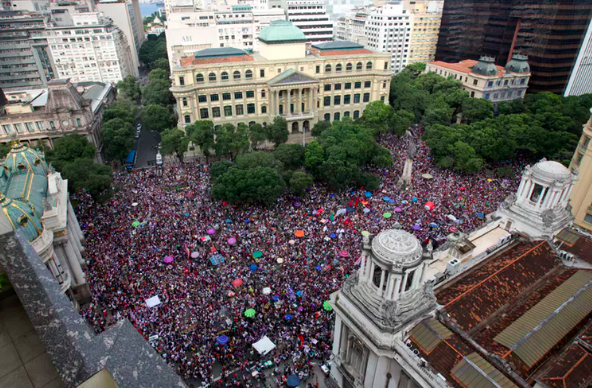
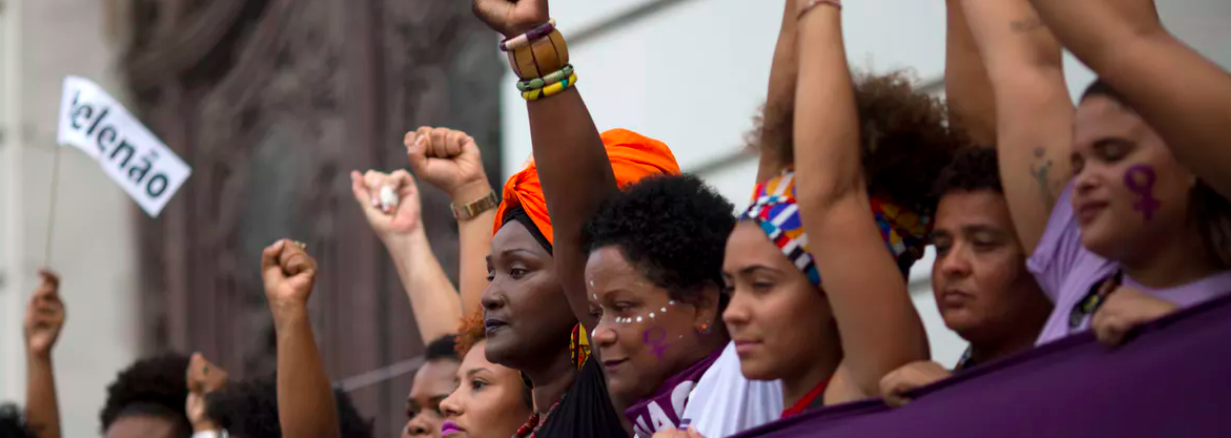
Black women in Brazil protest presidential frontrunner Jair Bolsonaro, who is known for his disparaging remarks about women, on Sept. 29, 2018. AP Photo/Silvia Izquierdo

Sexism, Racism Drive More Black Women to Run for Office in Both Brazil and US

October 9, 2018

Motivated in part by President Donald Trump’s disparaging remarks about women and the numerous claims that he committed sexual assault, American women are running for state and national office in historic numbers. At least 255 women are on the ballot as major party congressional candidates in the November general election.

The surge includes a record number of women of color, many of whom say their candidacies reflect a personal concern about America’s increasingly hostile, even violent, racial dynamics. In addition to the 59 black female congressional candidates, Georgia’s Stacey Abrams hopes to become her state’s first black governor.

The U.S. is not the only place where the advance of racism and misogyny in politics has has spurred black women to run for office at unprecedented levels.

In Brazil, a record 1,237 black women will be on the ballot this Sunday in the country’s Oct. 7 general election.

Brazilian women rise up

I’m a scholar of black feminism in the Americas, so I have been closely watching Brazil’s 2018 campaign season – which has been marked by controversy around race and gender – for parallels with the United States.

Last weekend, hundreds of thousands of Brazilian women marched nationwide against the far-right presidential frontrunner Jair Bolsonaro, under the banner of #EleNao – #NotHim.

Bolsonaro, a pro-gun, anti-abortion congressman with strong evangelical backing, once told a fellow congressional representative that she “didn’t deserve to be raped” because she was “terrible and ugly.”

Bolsonaro has seen a boost in the polls since he was stabbed at a campaign rally on Sept. 8 in a politically motivated attack.

Protests in Rio de Janeiro against Jair Bolsonaro on Sept. 29, organized under the hashtag #EleNao (#NotHim). AP Photo/Silvia Izquierdo

Brazil has shifted rightward since 2016, when the left-leaning female president Dilma Rousseff was ousted in a partisan impeachment process that many progressives regard as a political coup.

Her successor, then-Vice President Michel Temer, quickly passed an austerity budget that reversed many progressive policies enacted under Rousseff and her predecessor, Workers Party founder Luís Inácio “Lula” da Silva.

The move decimated funding for agencies and laws that protect women, people of color and the very poor.

Racism in Brazil

In Brazil, these three categories – women, people of color and the very poor – tend to overlap.

Brazil, which has more people of African descent than most African nations, was the largest slaveholding society in the Americas. Over 4 million enslaved Africans were forcibly taken to the country between 1530 and 1888.

Brazil’s political, social and economic dynamics still reflect this history.

Though Brazil has long considered itself colorblind, black and indigenous Brazilians are poorer than their white compatriots. Black women also experience sexual violence at much higher rates than white women – a centuries-old abuse of power that dates back to slavery.

Afro-Brazilians – who make up just over half of Brazil’s 200 million people, according to the 2010 census – are also underrepresented in Brazilian politics, though sources disagree on exactly how few black Brazilians hold public office.

Three Afro-Brazilians serve in the Senate, including one woman. In the 513-member lower Chamber of Deputies, about 20 percent identify as black or brown. Women of color hold around 1 percent of seats in the Chamber of Deputies.

Black women step into the fray

That could change on Sunday.

This year, 9,204 of the 27,208 people running for office across Brazil are women, which reflects a law requiring political parties to nominate at least 30 percent women. About 13 percent of female candidates in 2018 are Afro-Brazilian.

A campaign ad for Rio city council member Talíria Petrone, who is running for Congress.Facebook

In most Brazilian states, that’s a marked increase over Brazil’s last general election, in 2014, according to the online publication Congresso em Foco.

In São Paulo, Brazil’s most populous state, 105 black women ran for office in 2014. This year, 166 are. In Bahia state, there are 106 black female candidates for political office, versus 59 in 2014. The number has likewise doubled in Minas Gerais, from 51 in 2014 to 105 this year.

As in the United States, Brazil’s black wave may be a direct response to alarming social trends, including sharp rises in gang violence and police brutality, both of which disproportionately affect black communities.

But many female candidates in Rio de Janeiro, Brazil’s second largest city, say one specific event inspired them to run.

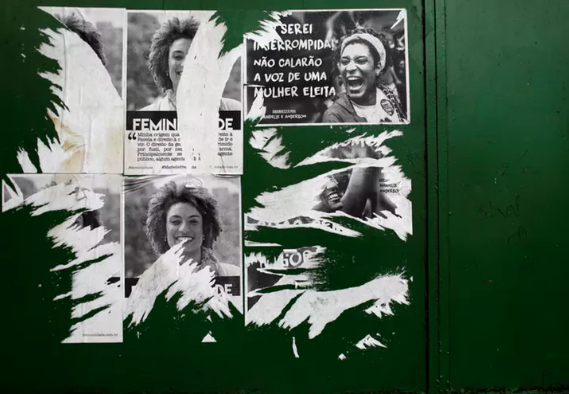
In March, Marielle Franco, an Afro-Brazilian human rights activist and Rio de Janeiro city councilwoman, was assassinated – the 11th Brazilian activist to be murdered since November 2017.

Franco’s murder remains unsolved, but she was an outspoken critic of the military occupation of Rio’s poor, mostly black favela neighborhoods. The ongoing police investigation has implicated government agents in the shooting, which also killed her driver.

Her death unleashed an avalanche of activism among black women in Rio de Janeiro, with new groups offering fundraising and political training for female candidates of color.

On Sunday, 231 black women from Rio de Janeiro state will stand for election in local, state and federal races – more than any other state in Brazil and more than double the number who ran in 2014.

Black representation from Rio to Atlanta

Black women may have been historically excluded from Brazil’s formal political arena, but they have been a driving force for social and political change since the country’s transition from dictatorship to democracy in 1985.

Decades before #MeToo, Brazilian women of color were on the front lines of activism around issues like gender-based violence, sexual harassment and abortion.

The March 2018 assassination of Rio de Janeiro city councilwoman, Marielle Franco, spurred a wave of black women running for local and federal office in Brazil. Reuters/Ricardo Moraes

Brazil has hundreds of black women’s groups. Some, including Geledes, a center for public policy, are mainstays of the Brazilian human rights movement. The founder of the Rio de Janeiro anti-racism group Criola, Jurema Werneck, is now the director of Amnesty International in Brazil.

The fact that thousands of black women, both veteran activists and political newcomers, will appear on the ballot on Sunday is testament to their efforts.

As in the United States, black Brazilian women’s demand for political representation is deeply personal. They have watched as their mostly male and conservative-dominated congresses chipped away at hard-won protections for women and people of color in recent years, exposing the fragility of previous decades’ progress on race and gender.

Black women in Brazil and the U.S. know that full democracy hinges on full participation. By entering into politics, they hope to foster more inclusive and equitable societies for all.

KIA LILLY CALDWELL is a Professor of African, African American, and Diaspora Studies at the University of North Carolina at Chapel Hill.

THIS ARTICLE WAS ORIGINALLY PUBLISHED ON THE CONVERSATION

Tags Brazil, feminism, Latin America, Racism, Sexism, government, Arts and Culture, Women and Girls, USA, International Affairs
Comment

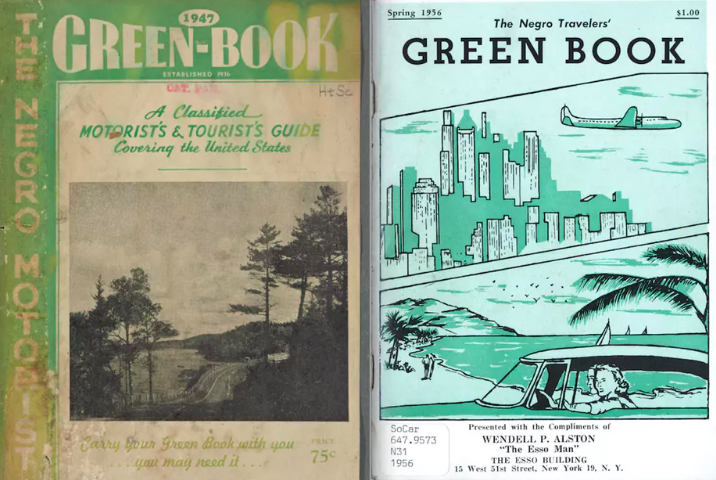
The 1947 and 1956 editions of the ‘Green Book,’ which was published to advise black motorists where they should – and shouldn’t – frequent during their travels. Image on the left: Schomburg Center for Research in Black Culture, Manuscripts, Archives and Rare Books Division, The New York Public Library. Image on right: Courtesy of the South Caroliniana Library, University of South Carolina, Columbia, S.C

‘Traveling While Black’ Guidebooks May be Out of Print, but Still Resonate Today

July 25, 2018

In the summer of 2017, the NAACP issued a travel advisory for the state of Missouri.

Modeled after the international advisories issued by the U.S. State Department, the NAACP statement cautioned travelers of color about the “looming danger” of discrimination, harassment and violence at the hands of Missouri law enforcement, businesses and citizens.

The civil rights organization’s action had been partly prompted by the state legislature’s passage of what the NAACP called a “Jim Crow bill,” which increased the burden of proof on those bringing lawsuits alleging racial or other forms of discrimination.

But they were also startled by a 2017 report from the Missouri attorney general’s office showing that black drivers were stopped by police at a rate 85 percent higher than their white counterparts. The report also found that they were more likely to be searched and arrested.

When I first read about this news, I thought of the motoring guidebooks published for African-American travelers from the 1930s to the 1960s – a story I explore in my book “Republic of Drivers: A Cultural History of Automobility in America.”

Although they ceased publication some 50 years ago, the guidebooks are worth reflecting on in light of the fact that for drivers of color, the road remains anything but open.

The half-open road

In American popular culture, movies (1983’s “National Lampoon’s "Vacation”), literature (“On the Road”), music (the 1946 hit “Route 66”) and advertising have long celebrated the open road. It’s a symbol of freedom, a rite of passage, an economic conduit – all made possible by the car and the Interstate Highway System.

‘Get your kicks on Route 66,’ Bobby Troup crooned in his hit song.

Yet this freedom – like other freedoms – has never been equally distributed.

While white drivers spoke, wrote and sang about the sense of excitement and escape they felt on automobile journeys through unfamiliar territories, African-Americans were far more likely to dread such a journey.

Especially in the South, whites’ responses to black drivers could range from contemptuous to deadly. For example, one African-American writer recalled in 1983 how, decades earlier, a South Carolina policemen had fined and threatened to jail her cousin for no reason other than the fact that she had been driving an expensive car. In 1948, a mob in Lyons, Georgia, attacked an African-American motorist named Robert Mallard and murdered him in front of his wife and child. That same year, a North Carolina gas station owner shot Otis Newsom after he had asked for service on his car.

Such incidents weren’t confined to the South. Most of the thousands of “sundown towns” – municipalities that barred people of color after dark – were north of the Mason-Dixon Line.

Of course, not all white people, police and business owners behaved cruelly toward travelers of color. But a black individual or family traveling the country by car would have had no way of knowing which towns and businesses were amenable to black patrons and visitors, and which posed a grave threat. The only certainties for African-Americans on the road were anxiety and vulnerability.

‘A book badly needed’

“Would a Negro like to pursue a little happiness at a theatre, a beach, pool, hotel, restaurant, on a train, plane, or ship, a golf course, summer or winter resort?” the NAACP magazine The Crisis asked in 1947. “Would he like to stop overnight in a tourist camp while he motors about his native land ‘Seeing America First’? Well, just let him try!”

Despite the dangers, try they did. And they had help in the form of guidebooks that told them how to evade and thwart Jim Crow.

“The Negro Motorist’s Green Book,” first published in 1936 by a New York letter carrier and travel agent named Victor Green, and “Travelguide: Vacation and Recreation Without Humiliation,” first published in 1947 by jazz bandleader Billy Butler, advised black travelers where they could eat, sleep, fill the gas tank, fix a flat tire and secure a myriad of other roadside services without fear of discrimination. The guidebooks, which covered every state in the union, drew upon knowledge hard-won by pioneering black salesmen, athletes, clergy and entertainers, for whom long-distance travel by car was a professional necessity.

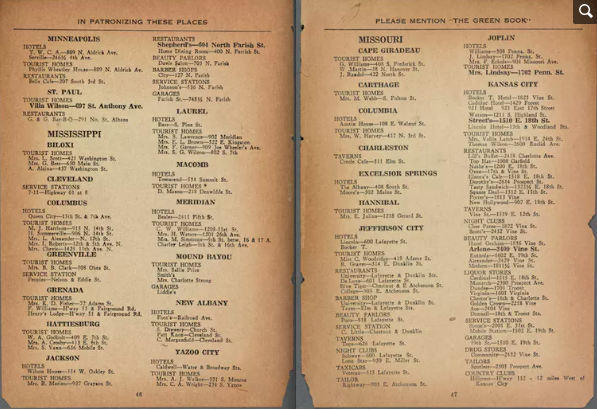
Pages from an original 1947 edition of the ‘Green Book’ highlight businesses in Mississippi and Missouri. Schomburg Center for Research in Black Culture, Manuscripts, Archives and Rare Books Division, The New York Public Library. 'The Negro Motorist Green Book: 1947' The New York Public Library Digital Collections. 1947

“It is,” a “Green Book” subscriber wrote to Victor Green in 1938, “a book badly needed among our Race since the advance of the motor age.”

Acknowledging the era’s racial tensions and dangers of travel, the 1956 edition reminded drivers to “behave in a way to show we’ve been nicely bred and [were] taught good manners.”


The 1950 edition of ‘Travelguide.’ Cotten Seiler, Author provided

It pointed to certain states that would be more amenable to black travelers: “Visitors to New Mexico will find little if any racial friction there. The majority of the scores of motels across the State accepts guests on the basis of ‘cash rather than color.’”

Yet even as they sought to ease the black traveler’s passage through an America in which racial discrimination was the norm, the guidebooks, whose covers often featured well-heeled travelers of color with upscale automobiles and accessories, also asserted African-Americans’ claims to full citizenship.

The guidebooks’ images and text conveyed an attitude of indignation and resistance to the racist conditions that made them necessary.

“Travel Is Fatal to Prejudice,” the cover of the 1949 edition of the “Green Book” announced, putting a spin on a famous Mark Twain quote.

In 1955, “Travelguide” declared, “The time is rapidly approaching when TRAVELGUIDE will cease to be a ‘specialized’ publication, but as long as racial prejudice exists, we will continue to cope with the news of a changing situation, working toward the day when all established directories will serve EVERYONE.”

Is racial terror really over?

Travelguide and the Green Book did indeed shut down in the 1960s, when the civil rights movement sparked a profound transformation in racial law and custom across the country.

Today, copies can be found in research archives at Howard University, the New York Public Library and the Library of Congress. The guidebooks have been the focus of a growing body of print and digital scholarship. The University of South Carolina, for example, has built an interactive map that allows visitors to search for all of the businesses listed in the 1956 edition of the “Green Book.”

In popular culture, a play, a children’s book and a forthcoming Hollywood film starring Mahershala Ali all center on these travel guides.

While the story of these books recall an era of prejudice many regard as bygone, there remains much work to be done.

The NAACP’s decision to issue a travel advisory calls attention to the dangers that continue to be associated with “driving while black.” The highly publicized recent deaths of Sandra Bland, Philando Castile and Tory Sanford are the starkest examples of what can happen to black drivers at the hands of police. Studies have shown that across the nation, police are still much more likely to stop and search drivers of color.

If guidebooks for drivers of color are unlikely to make a return, it is because the internet now fulfills their role, not because the “great day” of racial equality the “Green Book” heralded 70 years ago has arrived.


THIS ARTICLE WAS ORIGINALLY PUBLISHED ON THE CONVERSATION

Tags Race, Racism, US History, Arts and Culture, Travel
Comment

Also check out...

Featured
Vietnam’s Floating Markets Are Disappearing
The Supernatural Role of Masks in Nigeria’s Yoruba Tribal Culture
Opening the World to Deaf Travelers with Lily Yu

Featured trips

Featured
Offer NGO Support While Visiting Quito
Experience Life as a Mongolian Nomad
Help Grow Organic Costa Rican Coffee

Sign up for the CATALYST newsletter

Sign up for our newsletter to get the scoop on international travel, global social impact insights, our latest podcast releases, and more from around the world, all delivered right to your inbox!

We respect your privacy.

Thank you!
Newsletter Sign Up | Advertise | Careers + Internships | Privacy Policy | Submissions | Contact Us

Copyright © 2025, MISSION MEDIA LLC. All rights reserved.