5 Stunning Temples in Cambodia

From Hindu to Buddhist, Cambodia is home to some of the most architecturally rustic and traditional temples in the world. 
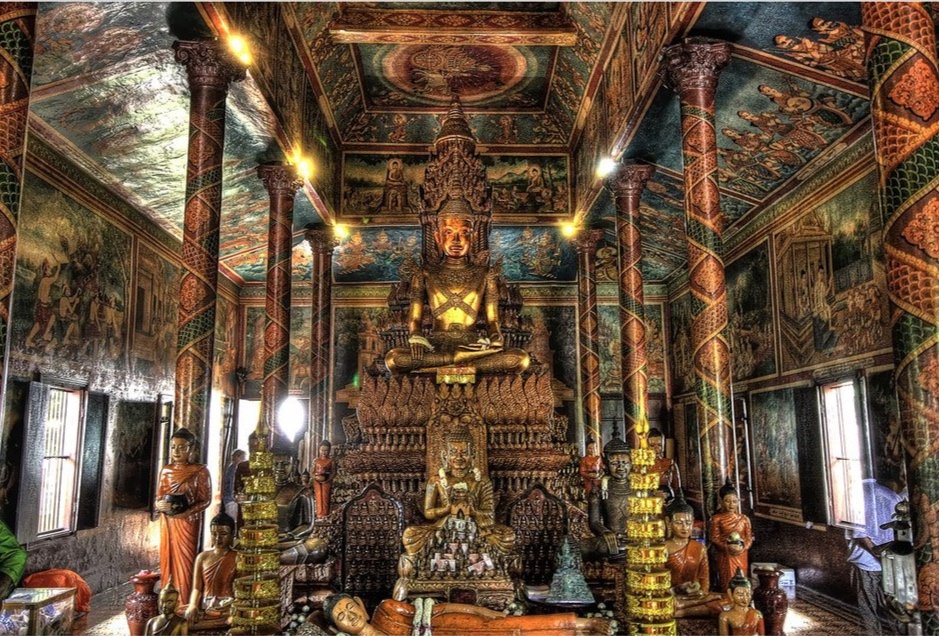
Inside of Wat Phnom temple and a central shrine. The colors are a mix of browns, gold, orange, and teal. There are ornate paintings on the walls and central 6 pillars surrounding many religious sculptures, with one central large gold sculpture

Inside of Wat Phnom. Daniel Mennerich. CC BY-NC-ND 2.0. 

While Angkor Wat is on most traveler’s lists when they visit Cambodia, the country also has many other extraordinary and one-of-a-kind temples which each hold immense historical, cultural, religious and artistic significance. 

1. Banteay Srei 

A stone walkway between temples in Banteay Srei. The rust-colored stone buildings have sets of stairs leading up to them and ornate etchings the walls. Sculptures lining the stairs to the entrance and pillars along the doorway.

Banteay Srei. Uwe Schwarzbach. CC BY-NC-SA 2.0.

The temple Banteay Srei, located in Angkor, Cambodia, is believed to have been built in the tenth century by and for some sort of spiritual guru to a royal, though not much is known about the person themselves. In addition to its fascinating origin, Banteay Srei’s architecture is unique for the area, built almost entirely out of a shining pink sandstone and surrounded by a moat. In terms of the architeccture’s cultural significance, the temple features a large and ornate statue of the Hindu God Shiva. Nowadays, Banteay Srei is primarily known for its meaning to women. Banteay Srei directly translates to “the women’s temple”, and the statue of Shiva is surrounded by other statues of women including Hindu gods and saints. 

2. Ta Prohm
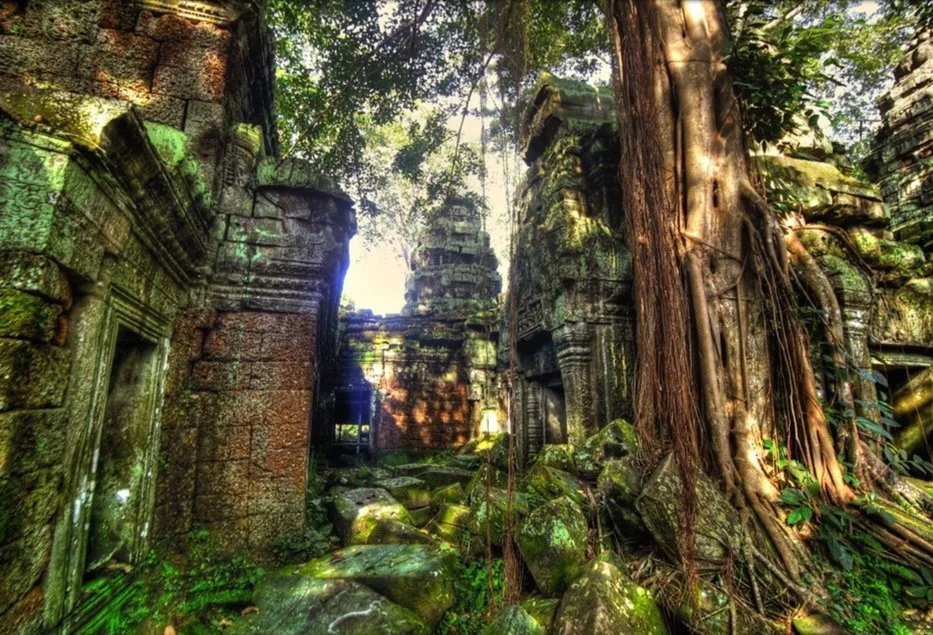
Tree rooted and growing along the side of a building in Ta Prohm. The perspective is in a dark overgrown path between buildings, with rocks and moss. The buildings are gray stone and the architecture is ornate

Tree growing in Ta Prohm. Daniel Mennerich. CC BY-NC-ND 2.0. 

The temple Ta Prohm, located in Krong Siem Reap, Cambodia, is one of few historical sites to have been left untouched by archaeologists and society in general. It was built around the 12th to 13th century, and it was a temple of enormous scale surrounded by a village of an estimated 79,000 people who worked to maintain it.  Unlike Banteay Srei, Ta Prohm was built by a Khmer king. Today, only the ruins of Ta Prohm remain, and its beauty and intrigue have only increased with growing trees surrounding the temple. Visitors can see a tree whose roots have grown over the roof of a corridor, and another stands tall in the middle of a courtyard. While visitors can walk through Ta Prohm, they are no longer permitted to climb on the stone walls, as the temple’s foundation is so old and precarious that damage can easily be done. 

3. Wat Phnom
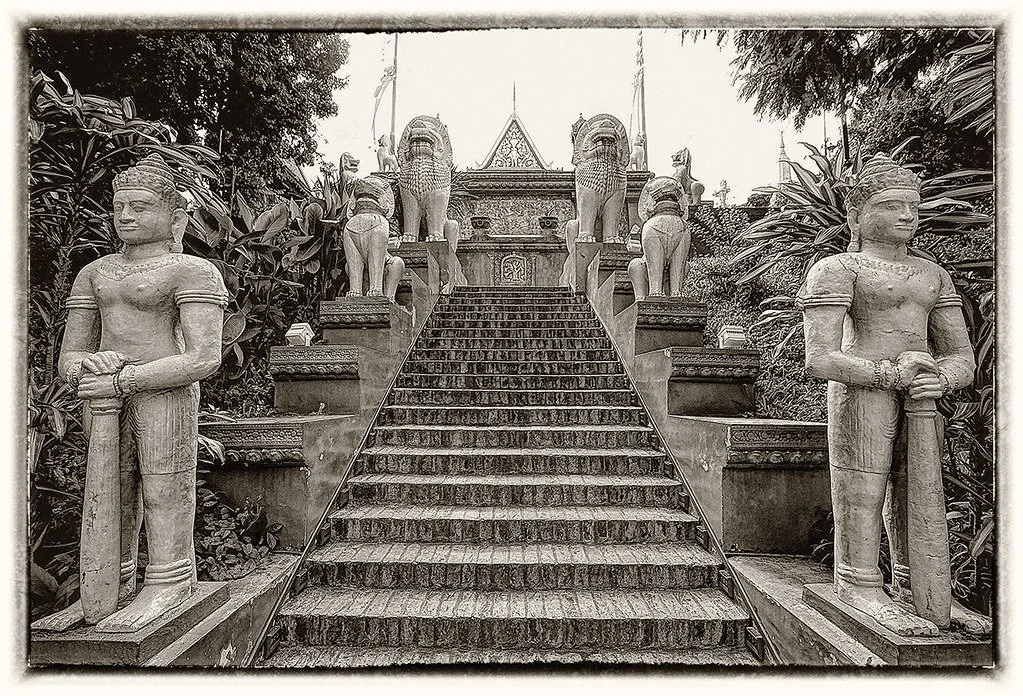
Staircase leading into Wat Phnom temple. The image is in grayscale. There are large sculptures lining the staircase and gardens on either side. The temple at the top of the stairs has a triangular pointed top and covered in designs.

Staircase to Wat Phnom. Daniel Mennerich. CC BY-NC-SA 2.0. 

In contrast to Ta Prohm, which has maintained a rustic look, temple Wat Phnom is located in the major city Phnom Penh, at the top of the only hill in the city. Unlike many other ancient temples, historians know Wat Phnom was built in 1372. A large and ornate staircase lined with animal sculptures such as lions and five-headed snakes leads the way to the temple. The temple is a place of worship, as people go to make wishes, requests and prayers for themselves and their loved ones. Wat Phnom is known to be a bustling and busy center, with vendors selling cold drinks and birds flying through the temple

4. Sambor Prei Kuk

Sambor Prei Kuk temple stands on a hill among a wooded grassy area. The temple is a rust color and appears to be eroded by the elements on the top.

Sambor Prei Kuk temple. Plb06. CC BY-NC-ND 2.0.

The Sambor Prei Kuk temples are unique from the other temples on this list primarily because of their age and striking architecture. Sambor Prei Kuk is a collection of temples built in the 6th to 7th century CE, in the Pre-Angkorean architectural style which favored more natural looking octagonal temple structures that were less outwardly ornate than later temples. Sambor Prei Kuk was named an UNESCO World Heritage Site in 2017 due largely to its architecture, which represents a significant period in the history of Cambodia. The religious symbols inside the temple also reflect the significance of the relatively new cross-continental trade that was emerging at the time in Asia. The inscriptions and statues feature a mix of Buddhist and Hindu figures and messages, as well as displaying the “God-kings” who ruled the region at the time by claiming divine connections

5. Angkor Wat

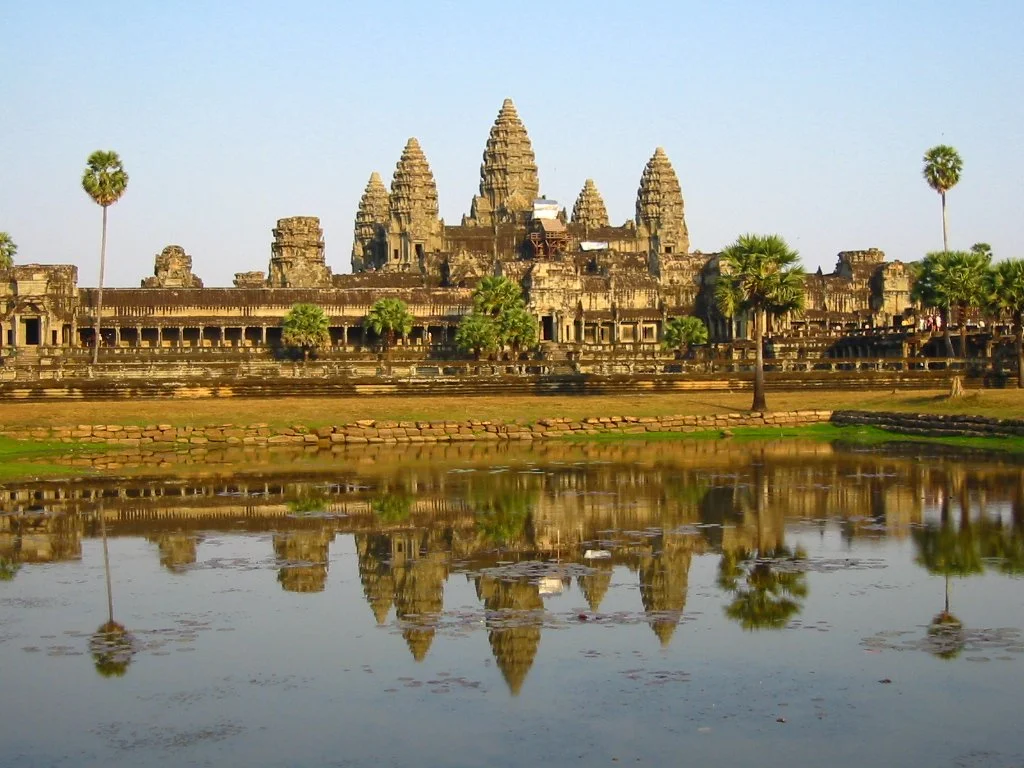
Angkor Wat temple stands in the background, reflected by a pond in the foreground. Grassy meadow between the temple and pond and scattered palm trees. The temple is a mix of gray and brown, with many windows and several towers.

Angkor Wat. Pigalle. CC BY-NC-SA 2.0.

A Cambodian temples list wouldn’t be complete without Angkor Wat. The temple, located in Angkor, was built in the 12th century and is one of the most famous temples in the world, as well as one of Cambodia’s most famous sites. The compound contains hundreds of buildings, and is the largest religious structure globally. Originally, Angkor Wat was a Hindu temple, but in 1177 after losing a battle and thus losing faith in Hinduism, the king at the time (King Jayavarman VII) converted Angkor Wat into a Buddhist temple. In 1992, Angkor Wat became a UNESCO World Heritage Site, and an estimated 500,000 people per year travel to see the historic temple


Calliana Leff

Calliana is currently an undergraduate student at Boston University majoring in English and minoring in psychology. She is passionate about sustainability and traveling in an ethical and respectful way. She hopes to continue her writing career and see more of the world after she graduates. 
Unknown Specialties: 10 Little-Known Global Dishes

Uncovering some of the best lesser-known cultural foods from around the world.

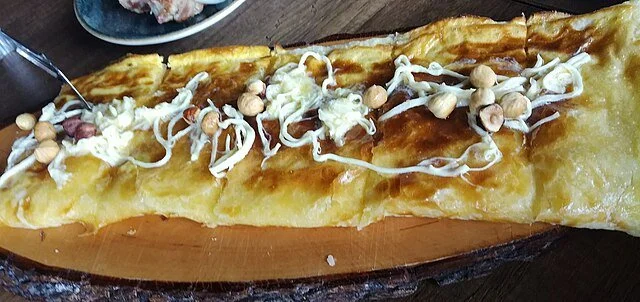
Khachapuri on the end of a wooden table. It is a long piece of cheesy bread, topped with nuts.

Khachapuri served with nuts. Ekkatterrinna. CC BY-SA 4.0

From sushi to falafel to chicken tikka masala, most cultures are represented on the global food stage. But for every well-known cultural classic, hundreds of local delights have never quite made it out of their homeland. This list compiles ten of the best, most unique specialties that most of the world has yet to experience. Each dish will include links to recipes and can be made at home with relative ease.

1. Lahmacun

Turkey

Two lahmacun wraps in branded paper. Out of the wrap sticks some vegetables and a glimpse of sauce. The pita is slightly charred.

A traditionally wrapped lahmacun. Garret Ziegler. CC BY-SA 4.0

Lahmacun is a traditional flatbread variety that incorporates minced meat (usually lamb or beef), tomatoes and red peppers, and a healthy amount of garlic and chili pepper. Despite being commonly referred to as “Turkish pizza”, lahmacun is never prepared with cheese.  Instead, the dish is often served rolled up around other vegetables like pickles or roast eggplant.

2. Kare-kare

The Philippines

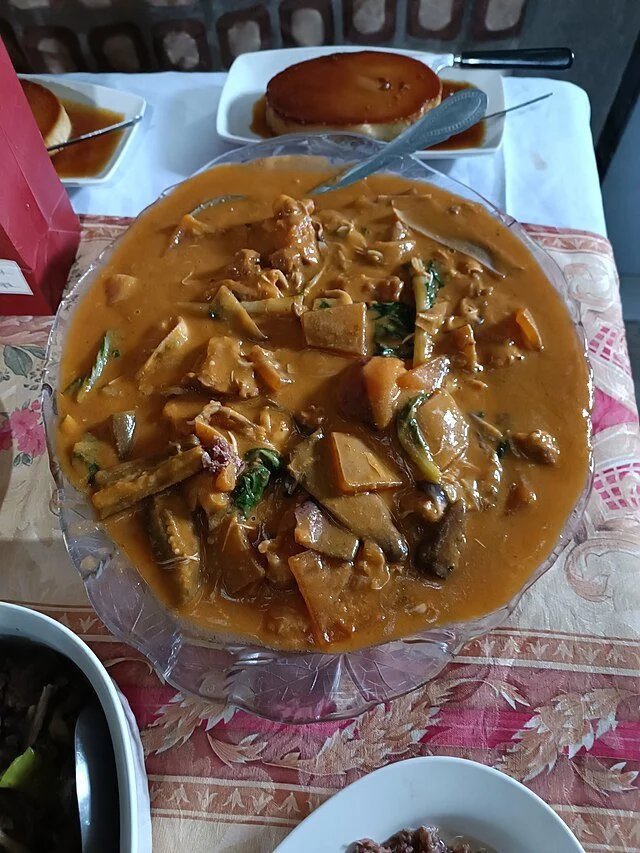
A bowl of kare-kare on the dinner table. It is a thick brown stew, with a mix of meat, greens, and vegetables. A serving spoon lays on the bowl. There are glimpses of other foods on the table in background.

A bowl of kare-kare. Maffeth.opiana. CC BY-SA 4.0

Kare-kare is a stew of thick peanut sauce. Typically made with oxtail and occasionally pigs’ or calves’ feet, kare-kare also features vegetables like eggplant and daikon.  Some varieties include seafood (like prawns and squid), while others are entirely vegetarian. This dish has been a part of Filipino culture for hundreds of years and is considered one of the island nation’s staple dishes.

3. Zeljanica

The Balkans

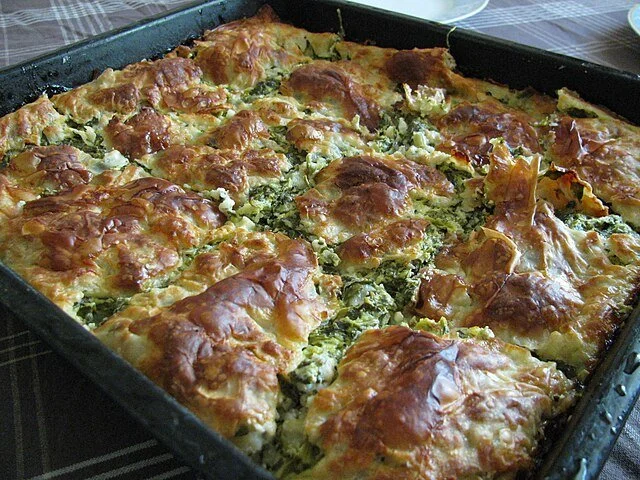
A baking tray of zeljanica. The dish appears to be a flaky golden brown pastry with a mix of feta cheese and spinach or greens inside.

A tray of zeljanica. BiHVolim. CC BY-SA 4.0

Often referred to as “savory spinach pie,” zeljanica is a flaky pastry filled with chopped spinach, egg and white or feta cheese. This particular meal has several options for substitution; just about any white cheese (preferably salted) can be used for the filling, and a variety of pastries can be used to make the outer shell, including phyllo or horiatiko (both of which are specialties in their own right).

4. Pastitsio

Greece

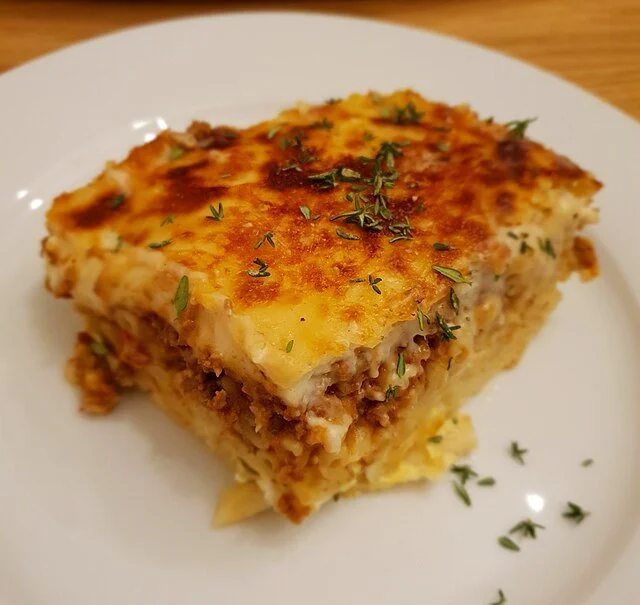
A close up of pastitsio on a white plate with a green herb sprinkled on top. The food appears similar to a lasagna, with a layered pasta, meat and cheese.

A plate of pastitsio. Sam Bailey. CC BY-SA 4.0

While this dish is often referred to as “Greek lasagna,” it takes a few steps outside of the box that sets it apart from its Italian cousin. Pastitsio has evolved over the years, transforming from a phyllo-wrapped meat pasta to a layered dish. The bottom layer is composed of bucatini or similarly-shaped pasta, bound together with cheese or eggs. The second layer features ground beef or pork heavily seasoned with cinnamon and cloves, and the top is a mixture of bechamel and mornay sauce.

5. Cou Cou

Barbados

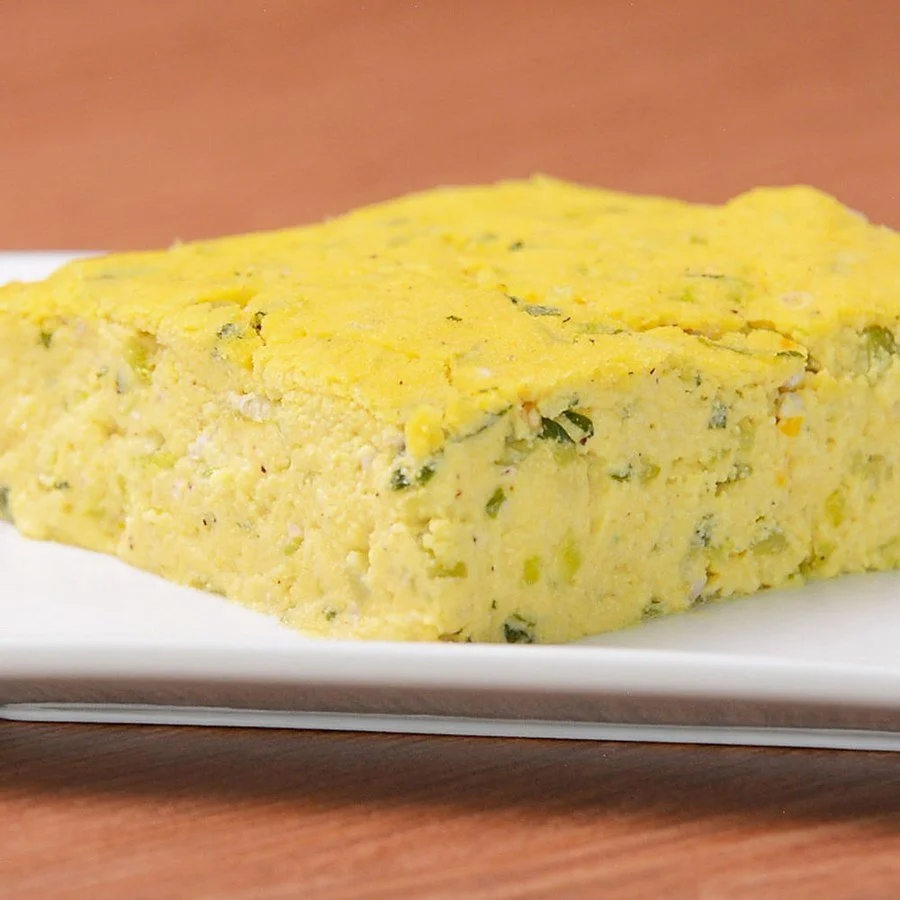
A close up image of cou-cou on a white plate. A yellow cake of okra and cornmeal.

An example of Cou Cou. KINGBROBLOXZZZ. CC BY-SA 4.0

Cou-cou is widely regarded as the best example of Barbados’ national food: the flying fish. While cou-cou is actually a mixture of cornmeal and okra, it is typically served alongside steamed or fried flying fish. Today, this meal is traditionally served on Friday in Barbados and has spread to Antigua and the Virgin Islands.

6. Khachapuri

Georgia

A brown paper placemat on table. Red plate with large bread bowl with pinched sides and cooked egg in the middle. Brown paper wrapped package beside.

A variety of khachapuri including egg yolk. Rorschach11. CC 2.0

There are many varieties of Georgia’s khachapuri, but the most common (and most popular) is Imeretian khachapuri. This variation is made with yeast dough and filled with salted white cheese. Other varieties incorporate egg yolks, potatoes and a variety of seasonings.

7. Nacatamales

Nicaragua

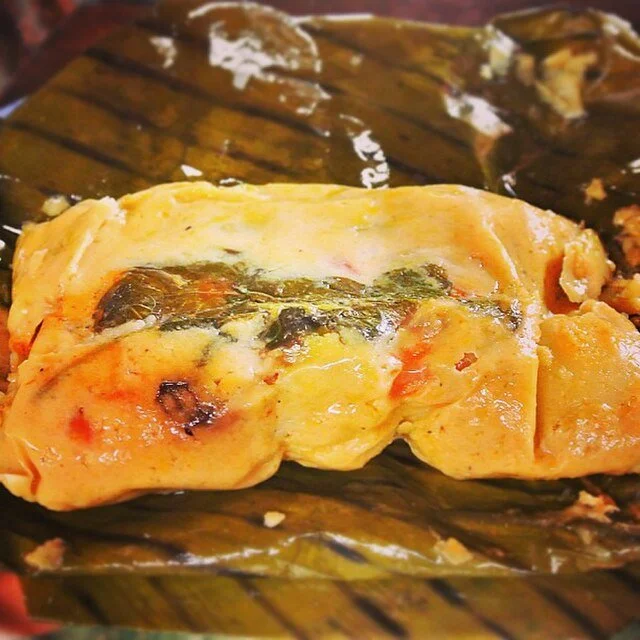
Close up image of an unwrapped nacatamale. It appears to be steamed with a green vegetable inside.

A finished nacatamal. MiguelRamirez77. CC BY-SA 4.0

Nacatamales were historically made by Nicarao hunters who would wrap and steam herbs, deer and turkey meat in corn husks. Rapidly evolving into a cultural staple after the Spanish conquest of Nicaragua, nacatamales have continued to change throughout the centuries. Today, the dish is commonly wrapped in banana leaf and tinfoil and steamed for up to five hours.

8. Nam Khao

Laos

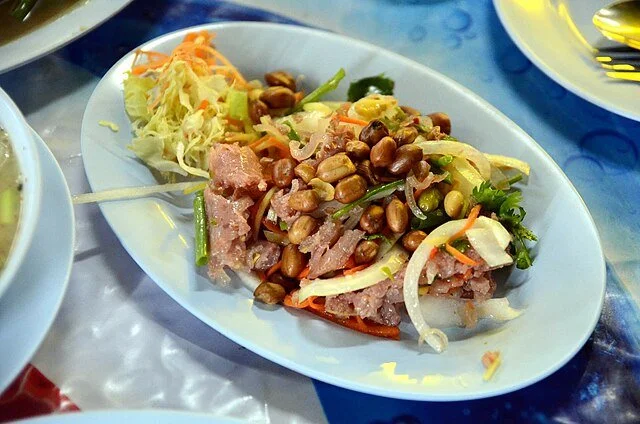
A white oval plate of Nam Khao on a table. The dish is a mix of a side of chopped lettuce and carrots, and the main mixture of meat, nuts, herbs, and onions.

A pre-wrapped nam khao. Takeaway. CC BY-SA 3.0

Nam khao is a common dish throughout Laos, appearing everywhere from street stalls and potlucks to high-brow restaurants. The meal’s main ingredients include fried rice balls, classic Vietnamese pork sausage, chopped peanuts and other seasonings. Nam khao is unique from traditional salads as ingredients are used to fill a singular lettuce leaf before being topped with chili peppers and herbs.

9. Lo Mai Gai

Southern China

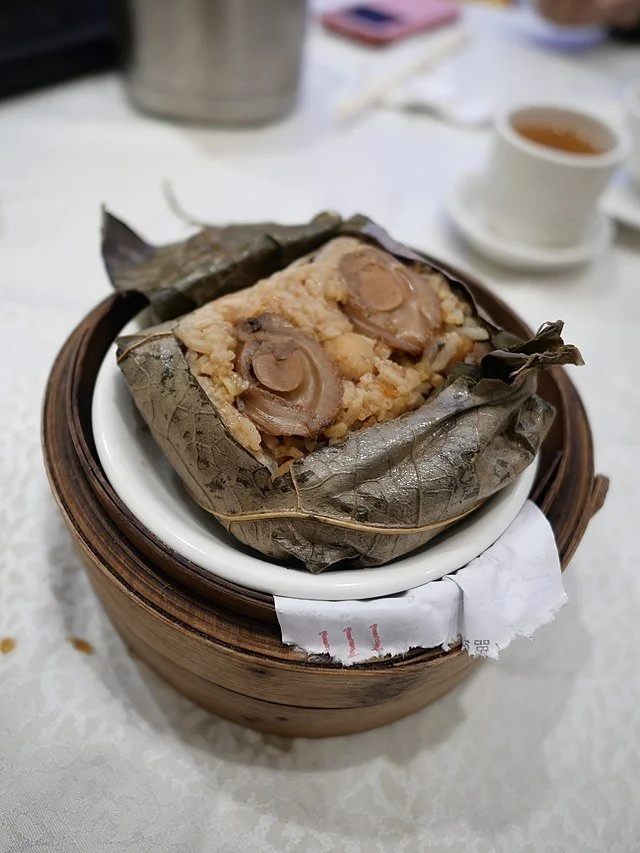
Sitting in a bowl atop a steaming basket. Wrapped in a dark leaf and filled with rice and vegetables.

A variety of lo mai gai made with abalone. Peachyeung316. CC BY-SA 4.0

A gluten-rich rice stuffed with chicken, sausage, mushrooms and scallions, the most unique aspect of this variation on the classic dim sum is the method of cooking. Before being steamed, lo mai gai is wrapped in dried lotus leaves — in areas where lotus is not available, banana and grape leaves are frequently substituted.

10. Jollof Rice

West Africa

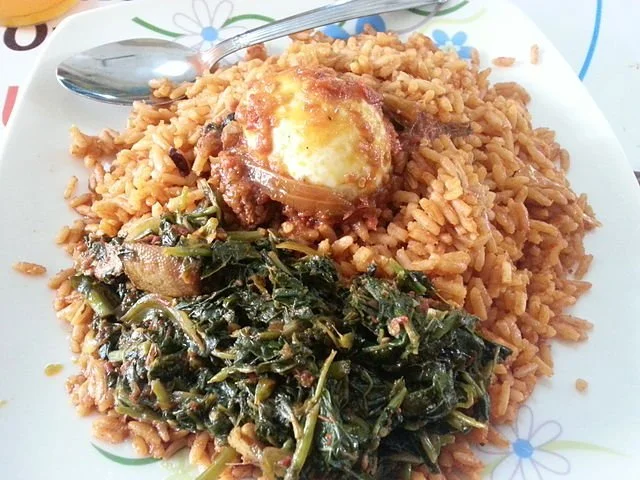
A plate of jollof. A pile of red-yellow rice, side of sauteed greens, and topped with a hard-boiled egg in a red sauce.

A variety of jollof including vegetables. Segun Famisa. CC BY-SA 4.0

Last but certainly not least is the ever-changing meal known as jollof rice, or jollof for short. This dish has a general ingredient list, but just about every nation in West Africa has its own regional variety, which has led to friendly rivalries between different regions. Typically, jollof is made with long rice grains, incorporating tomatoes, chili peppers, and a variety of spices together into one pot. Variations of the dish can range from different spices to the inclusion of additional vegetables or cuts of meat.

Few of the dishes on this list are available outside of their home country. However, the ingredients for each dish are relatively easy to obtain, so international foodies can find all the materials they need to cook some of these specialties at home.


Ryan Livingston

Ryan is a senior at The College of New Jersey, majoring in English and minoring in marketing. Since a young age, Ryan has been passionate about human rights and environmental action and uses his writing to educate wherever he can. He hopes to pursue a career in professional writing and spread his message even further.

Connecting with Culture: Embracing Food, Tradition and Language in Sri Lanka

With ancient Buddhist temples, stories of independence and deep-rooted traditions, Sri Lanka offers a South Asian experience unlike any other.

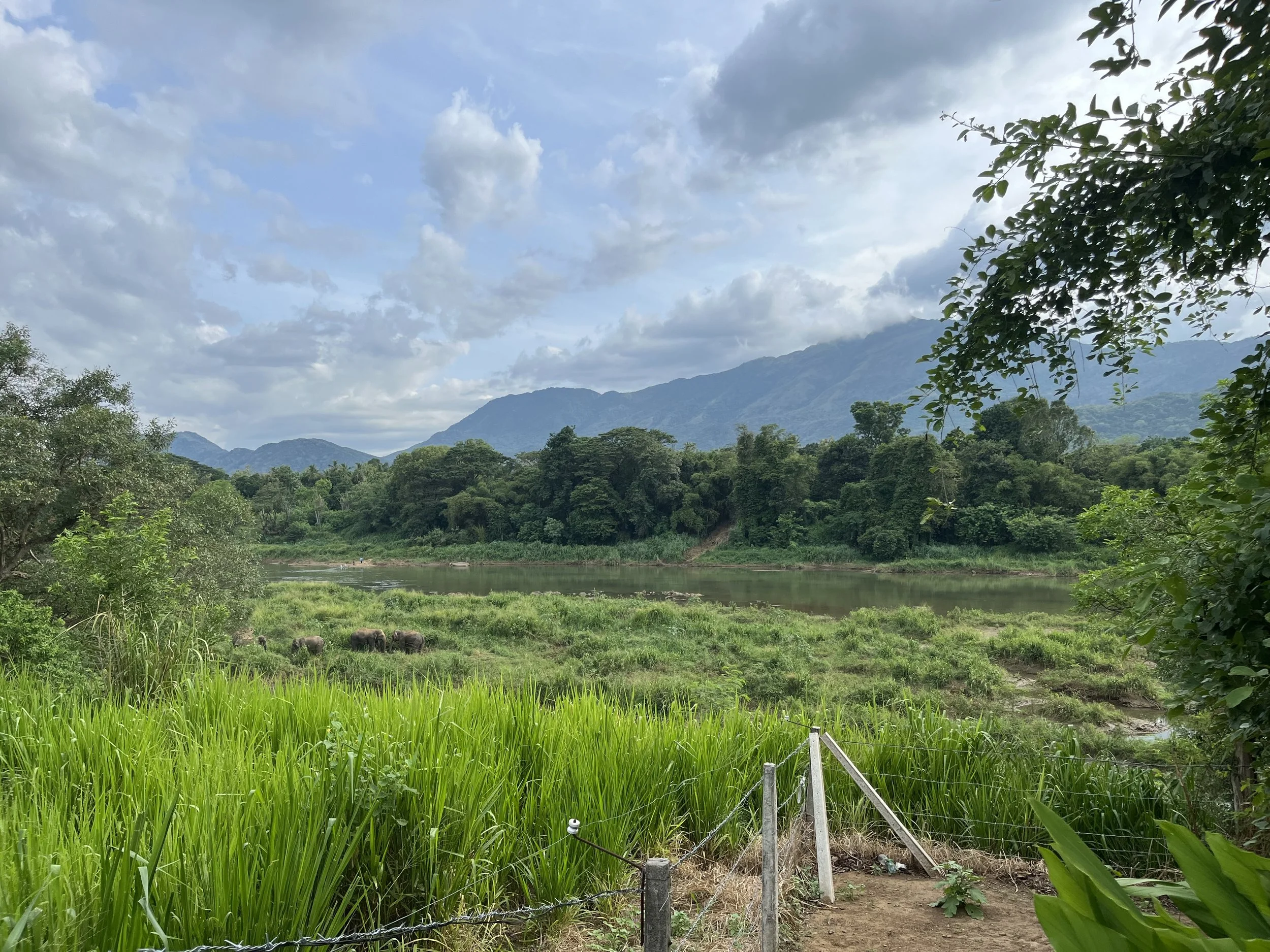
Lush green grown field and mountainous landscape in the background. Fencing around the field.

View from Elephant Sanctuary. Mira White.

The jewel of the Indian Ocean, Sri Lanka is recognized for its abundance of biodiversity and rich culture. Featuring vast rainforests, idyllic beaches and towering mountain ranges, the island is a hotspot for elephants, pink sand beaches and adventurous travelers. Its extensive history bridges the divide between the past and the present. 

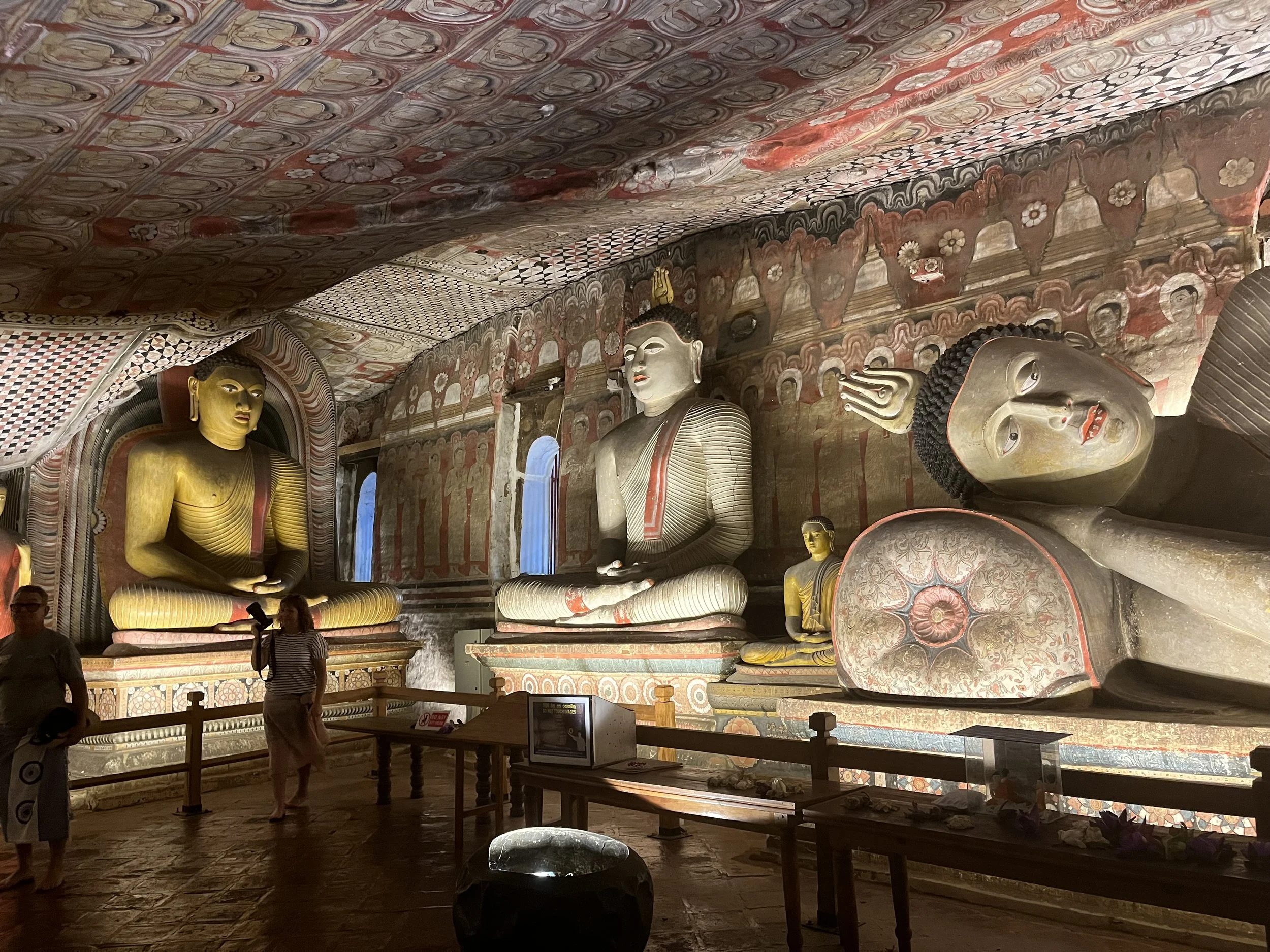
Inside of a temple with ornately inscribes ceilings and walls, as well as three massive religious sculptures.

Dambulla Cave Temple. Mira White.

Living with a host family in Colombo and working for the Sri Lankan grassroots organization, Gammadda, I was able to experience the authenticity of Sri Lankan local life. Sponsored by Brown University, I interned for Gammadda, a group that prides itself on being an initiative “for the people by the people” while traveling across the country to complete rural development projects. Regardless of whether I was with my host family, at the office or in a remote part of the island, I was continuously exposed to an outstanding variety of new cultures, customs and habits. 

My ten weeks living in Sri Lanka presented me with the opportunity to immerse myself in various facets of a culture older than any other I’ve experienced. Surrounded by Sinhala, spiced curry and tuk-tuks, I adapted to a lifestyle consumed by the language barrier, a diet of rice and, often, unpredictable transportation. Despite my unfamiliarity with Sri Lankan customs and traditions, I was always welcomed with kindness and understanding.

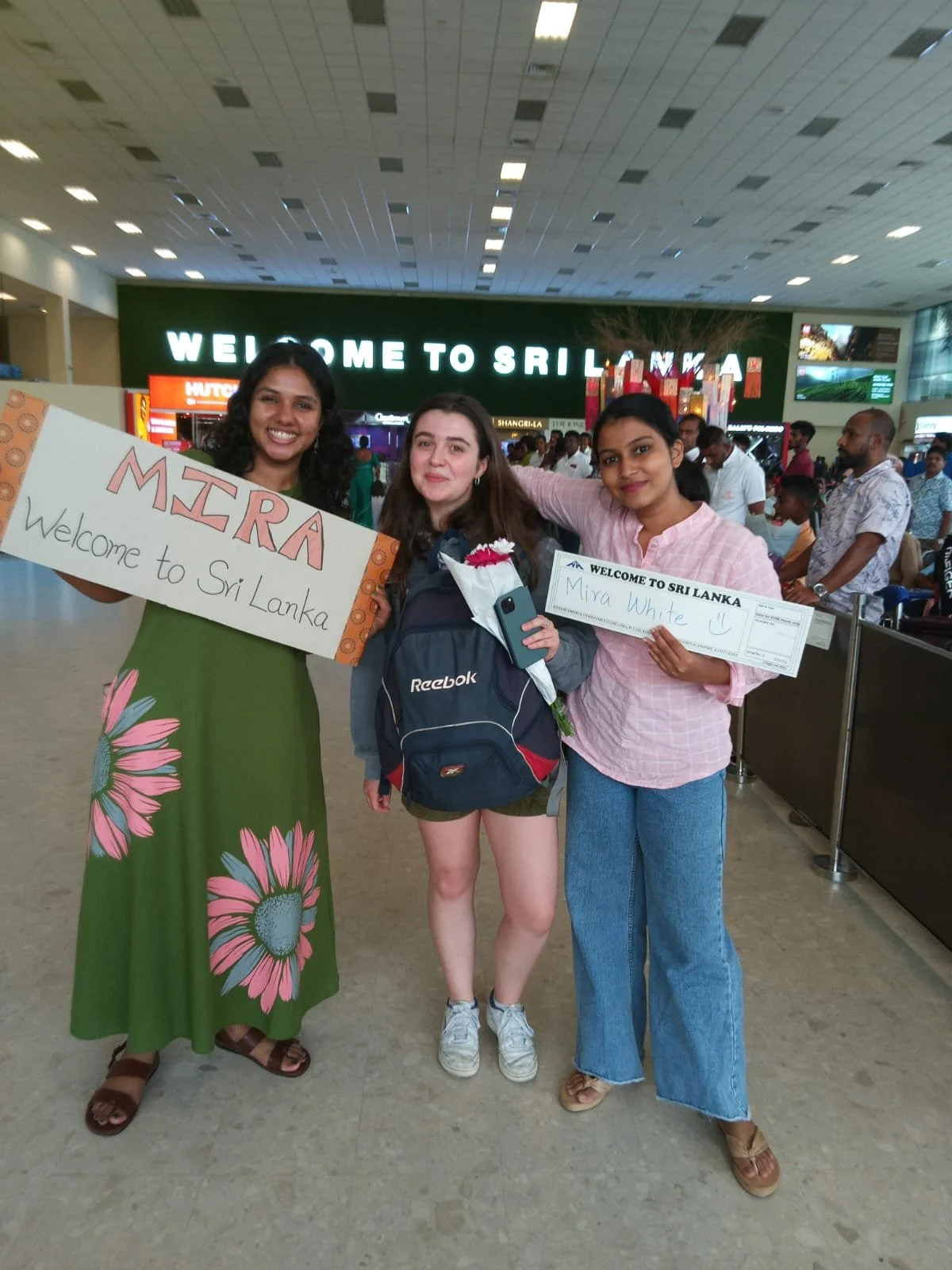
I arrived at the end of May, near the end of Sri Lanka’s Vesak Festival which celebrates the birth, enlightenment and death of Lord Buddha. The Colombo Bandaranaike International Airport was decorated with traditional flags and lights hanging from the ceiling. Upon my entrance into the country, I was greeted with warm welcomes and joyful smiles from coworkers and my host family, a testament to the real pride that Sri Lankans feel in welcoming internationals to their country.

Young woman at the airport arrival sections, under the arms on either side of two smiling women holding "Welcome" signs.

Arriving at Colombo Bandaranaike International Airport. Mira White.

Living with a host family provided me with an intimate view of Sri Lankan life. Most mornings for the family began with the traditional Sri Lankan breakfast of rice and curry. At dinner, I was introduced to an array of rich spices and flavors and encouraged to try string hoppers, kottu and roti—so long as I could stomach food with intense spice— I could not. 

My host family took great joy in seeing me taste their country’s diverse cuisine and were often eager to share with me the components and history of each dish. Aside from the food we shared, they took pride in speaking Sinhala and Tamil around me, hoping I would catch on to some words. They were eager to teach me small bits of the local languages in order to make me feel more integrated into their world. By the end of my trip, I could confidently say that I was familiar with simple phrases and greetings. I was elated to hear someone say “kohomada”—how are you?— when they answered the phone. 

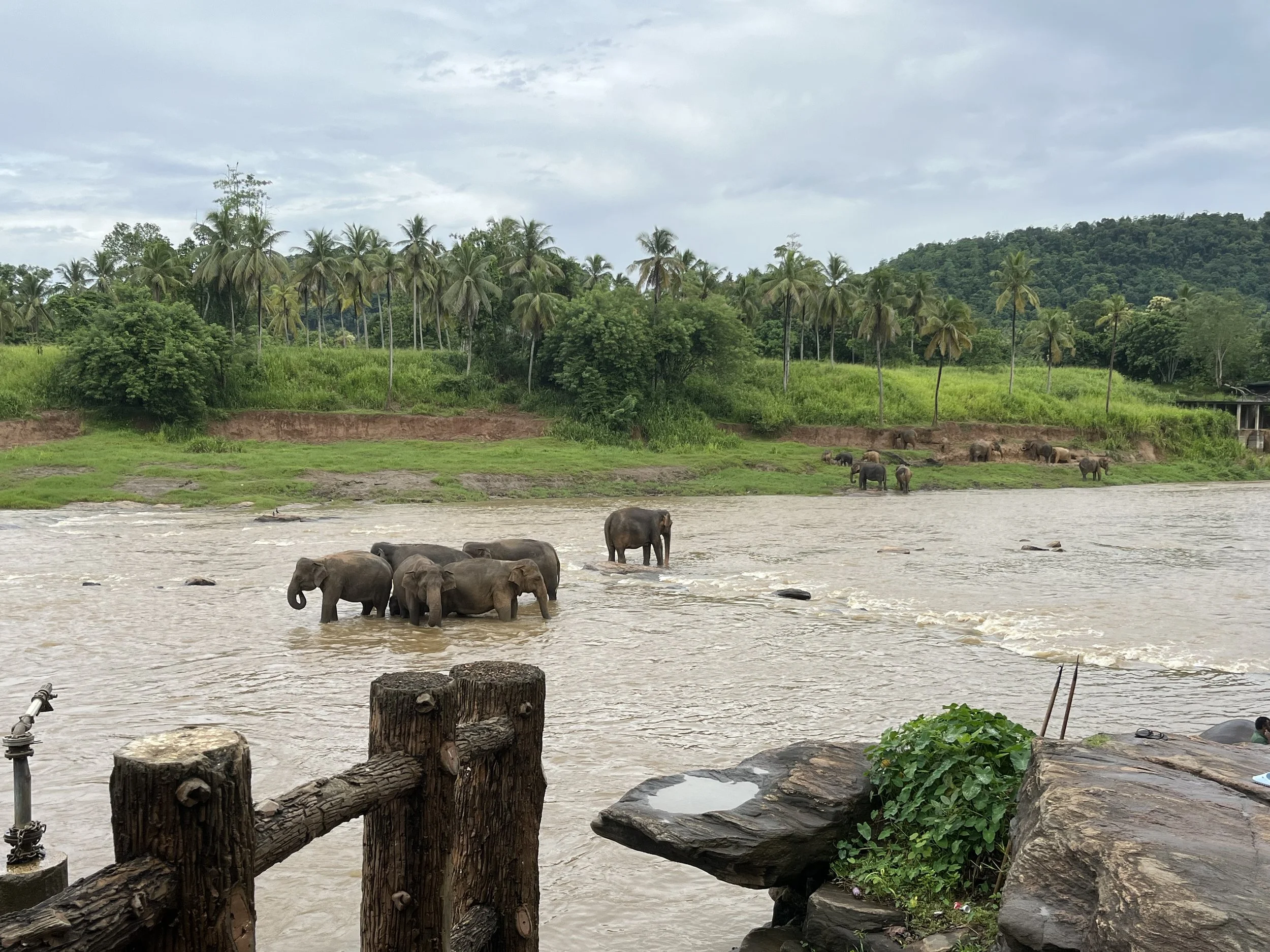
The hospitality of my host family extended beyond the dining table. They offered to take me on multiple excursions, highlighting places that showcased the island’s natural beauty. One memorable trip was to the Pinnawala Elephant Orphanage where I had the chance to see and touch elephants up close.

Several elephants crossing through a river, with a lively green hill and palm trees behind them

Pinnawala Elephant Orphanage. Mira White.

In the office, camaraderie among my co-workers was one of my most rewarding experiences. Colleagues helped me navigate office culture and even brought me to their homes to help dress me in a traditional Kandyan saree for formal work events, a gesture that made me feel deeply connected to those that I’d met in Sri Lanka and its local traditions.

A group of five colleagues dressed formally and smiling at the camera at an event.

Gammadda Colleagues. Mira White.

Beyond the office, co-workers were enthusiastic about sharing their local knowledge. They recommended must-see places and offered to accompany me on several outings to explore the island. They eagerly encouraged me to delve into local traditions and festivals. While on field site trips together, they encouraged me to try different foods and went out of their way to bring me to nearby sites to experience the natural richness of the island. Through their guidance, I gained a deeper understanding of the Sri Lankan business, cultural, and personal life that makes up the nation’s diverse tapestry.

Fieldwork took me to various parts of Sri Lanka, including areas severely impacted by poverty and climate change. The challenges faced by locals were stark—drought, erratic weather and economic hardship painted a sobering picture of life outside of Colombo. Despite the difficult circumstances under which I met those in rural villages, the warmth and gratitude of each individual was remarkable. My co-workers and I were welcomed into homes with genuine hospitality and kindness, often through the form of shared meals.

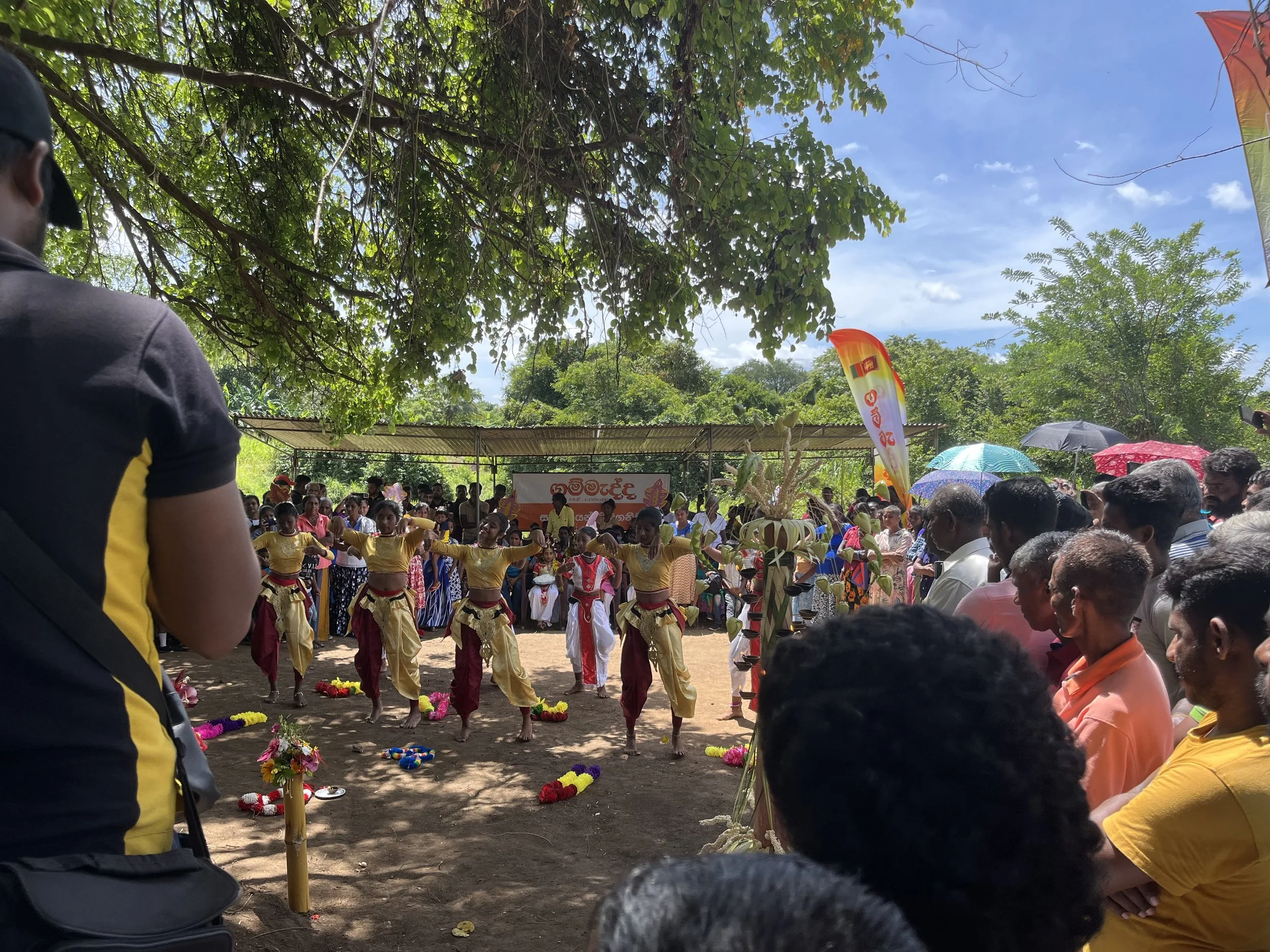
During projects for the grassroots organization I worked for, locals performed traditional dances and musical performances. These ceremonies provided a glimpse into their cultural heritage, underscoring their determination to preserve the connection to their roots against all odds. The people I encountered lived a life deeply intertwined with their faith and traditions. Their resilient authenticity stood in contrast to the struggles that they faced, demonstrating their profound strength and pride. 

A crowd surrounds a traditional dance ceremony in the town. The dancers are in yellow and there are flowers on the ground.

Traditional Dance Ceremony. Mira White.

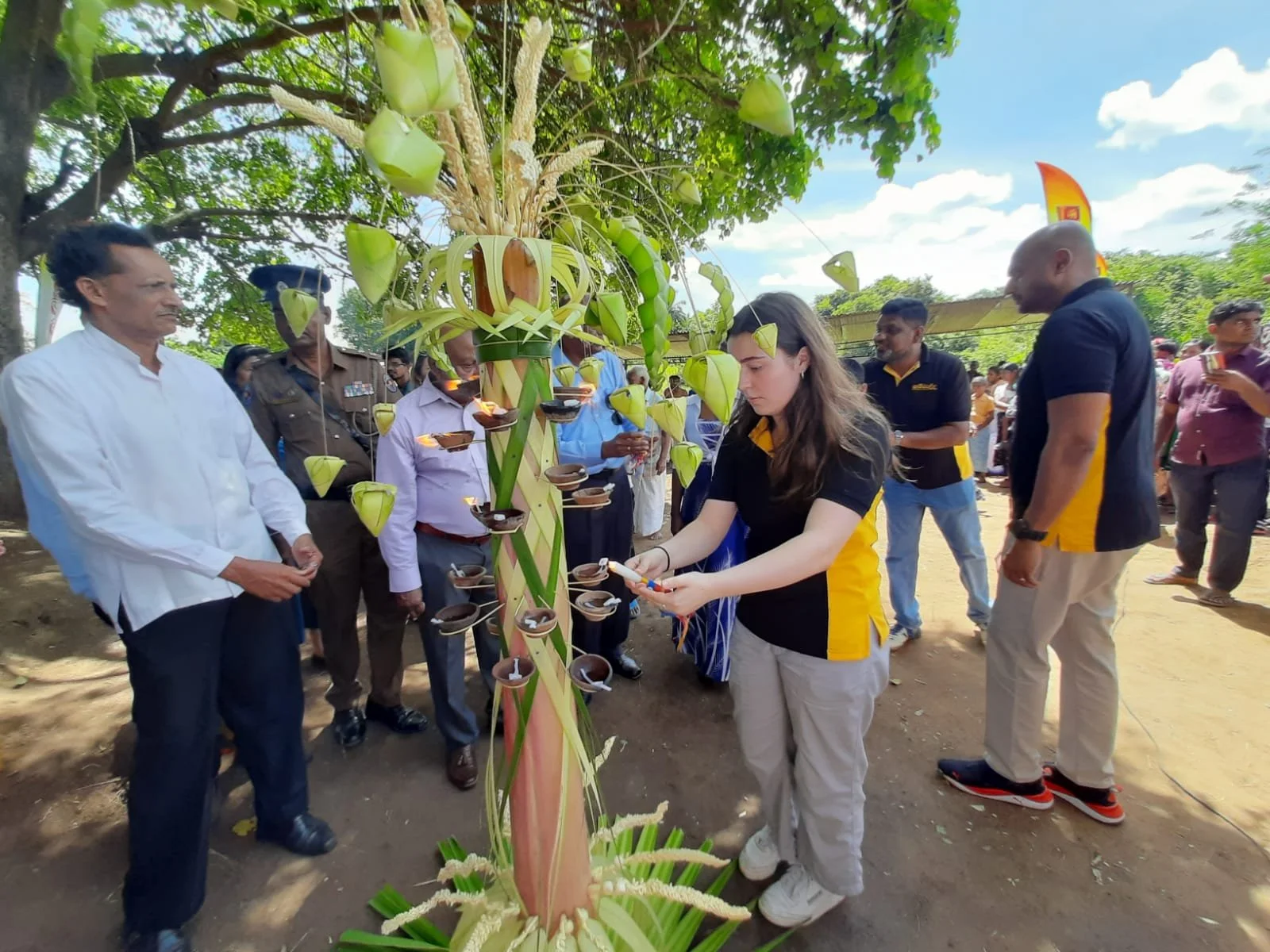
During one particular ceremony, I was asked to join project organizers and funders in lighting a ceremonial candle in tribute to the work done. This act had been a gesture of symbolic participation in local customs, connecting me deeply with this specific community and the challenges of its people. 

Lighting hanging candles off of a handmade tree in the busy town

Candle Lighting Ceremony. Mira White.

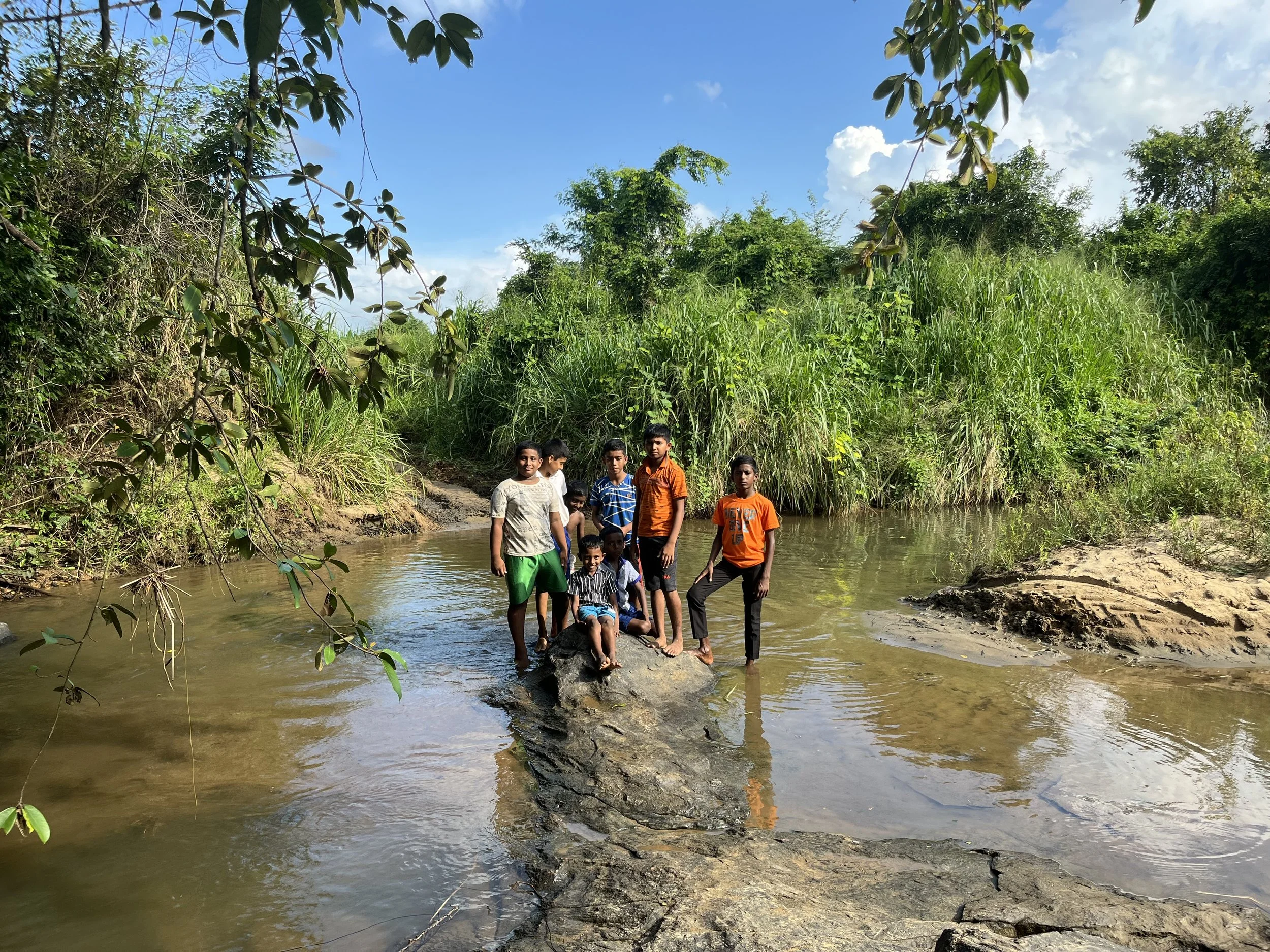
A group of children huddled and standing on a rock in the river. The vegetation surrounding is lush.

Children in the Koleyaya community. Mira White.

This sense of community was evident in all of my interactions, whether with colleagues, rural children or just observing those on the side of the road. Sri Lanka’s allure as a tourist destination extends far beyond its picturesque landscapes alongside cities such as Kandy or Sigiriya Rock. The island’s cultural richness is reflected in its food, language and music, each of which tells a story of history and pride. Through sampling local cuisine, attending cultural festivals and engaging with the community, visitors are provided with deep insight into how Sri Lankans navigate the complexities of their environment while maintaining an exuberant spirit. 

In the face of its challenges, Sri Lankans have cultivated a culture of warmth and hospitality. For those who choose to visit the island, the experience is as much about understanding the cultural landscape as it is about witnessing breathtaking beauty. Sri Lankans’ deep-rooted cultural pride is matched only by their kindness, making every visitor feel like a cherished guest. Beyond its landscape, Sri Lanka offers an opportunity to immerse oneself fully in a culture that thrives on connection and community. The enthusiasm with which locals invite you to explore their traditions, participate in ceremonies, learn the language and experience their daily lives creates a unique journey that I have yet to experience anywhere else. Once you’ve visited Sri Lanka, you become part of a larger family that eagerly awaits your return. Truly, Sri Lanka is more than just the jewel of the Indian Ocean, for visitors, it becomes a home away from home—a transformative experience that will call you back to its shores. 

A large family stands outside with Mira and they all smile

Families in Koleyaya village in Badulla District. Mira White.


Mira White

Mira is a student at Brown University studying international and public affairs. Passionate about travel and language learning, she is eager to visit each continent to better understand the world and the people across it. In her free time she perfects her French, hoping to someday live in France working as a freelance journalist or in international affairs.

Matcha's Roots: The Legacy of Japan's First Tea Tree

Explore Shofuku-ji, Japan’s oldest Zen temple, where the legacy of the first tea tree still thrives.

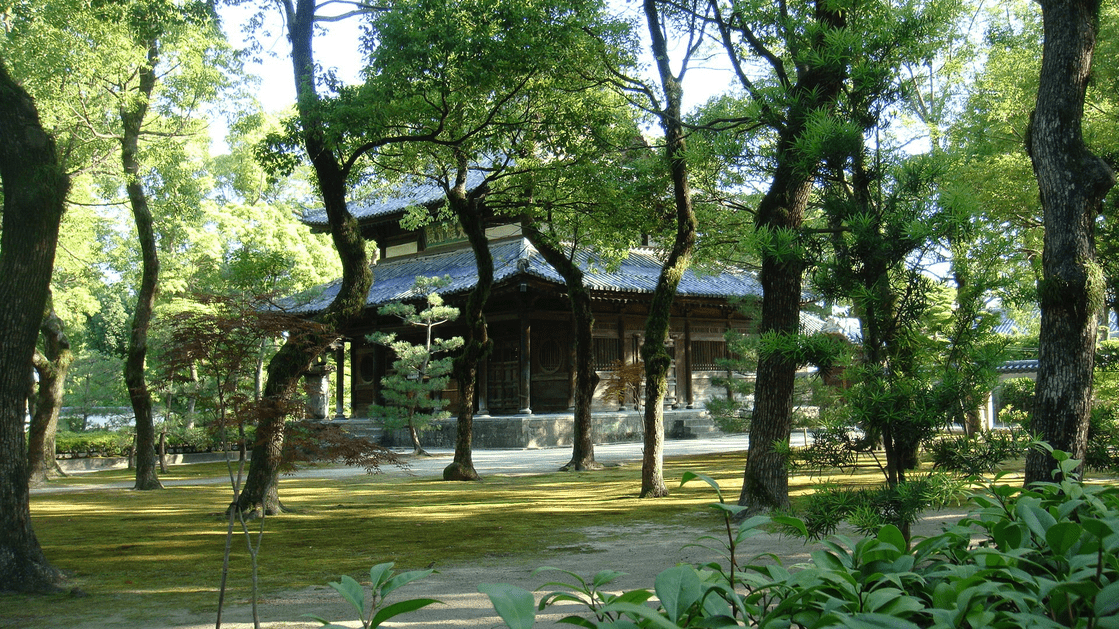
A temple among a mossy meadow dotted with trees

Shofuku-ji Temple. N yotarou. CC BY-SA 4.0

At the end of an unassuming street in Fukuoka, Japan stands the Shofuku-ji Temple. Its ancient grounds are a testament to centuries of cultural and spiritual history, particularly to the evolution of matcha, Japan’s iconic powdered green tea. Matcha is made from specially grown and processed tea leaves. The process begins with shading the tea plants several weeks before harvest to boost chlorophyll levels, resulting in its vibrant green color. The leaves are then carefully picked, steamed to stop oxidation, dried, and ground into a fine powder using traditional stone mills. Matcha's popularity outside Japan, especially in the U.S., experienced a surge in the early 21st century due to a growing interest in health and wellness globally. Its high antioxidant content, culinary versatility, and cultural appeal contributed to its widespread adoption in cafés and homes worldwide. 

Shofuku-ji Temple was founded in 1195 CE by the Buddhist priest Myōan Eisai, who is often credited with introducing Zen Buddhism to Japan. However, Eisai’s cultural influence extends beyond religion. Chinese legend dates the invention of tea to around 2737 BCE in ancient China. From China, the beverage was brought to Japan by a mission of monks, including Eisai, returning from a pilgrimage in 1191 CE. Upon arriving in Japan, Eisai cultivated the tea seeds in the Iwakamibo gardens of Ryozen-ji Temple, Saga. 

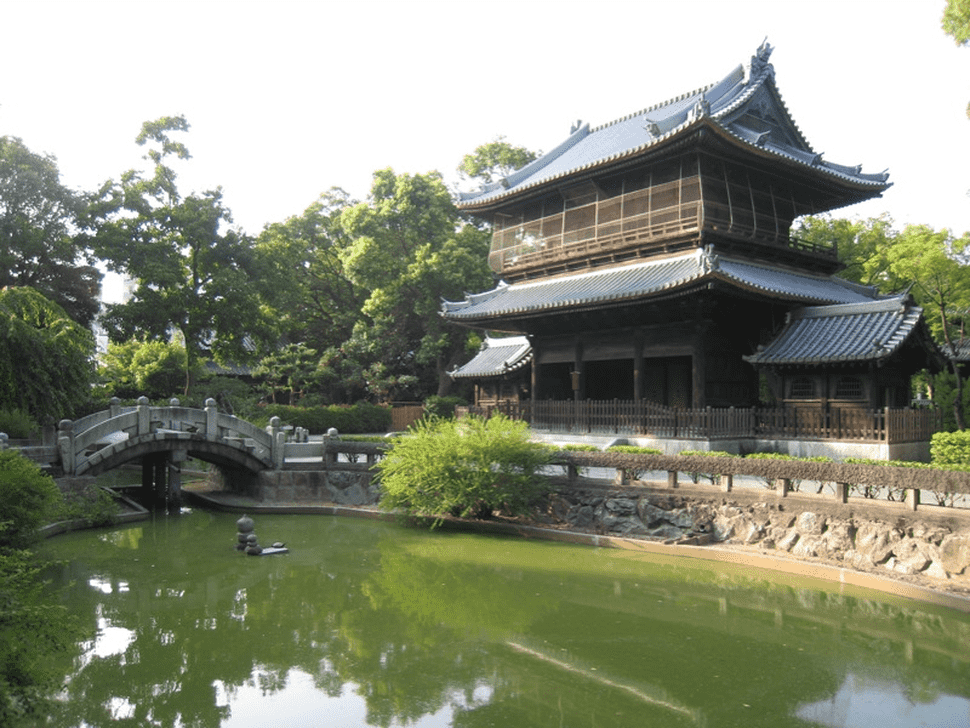
A temple standing next to a green pond, walking bridge, woods, and stone walls

Shofuku-ji Temple Pond. Mark Pegrum. CC BY 2.0

These seeds, which produced the first tea plants in Japan, became the foundation of what is now known as matcha. The plant that stands at Shōouku-ji today, often referred to as "Japan’s First Tea Tree," is a direct descendant of those original plants, a living monument to the history of Japanese tea culture.

When Eisai brought the tea seeds to Japan, he was not merely bringing a new beverage, he was introducing a practice that would become integral to the Zen way of life. The preparation and consumption of matcha evolved into a ritualized practice that aligned perfectly with the principles of mindfulness and presence central to Zen. 

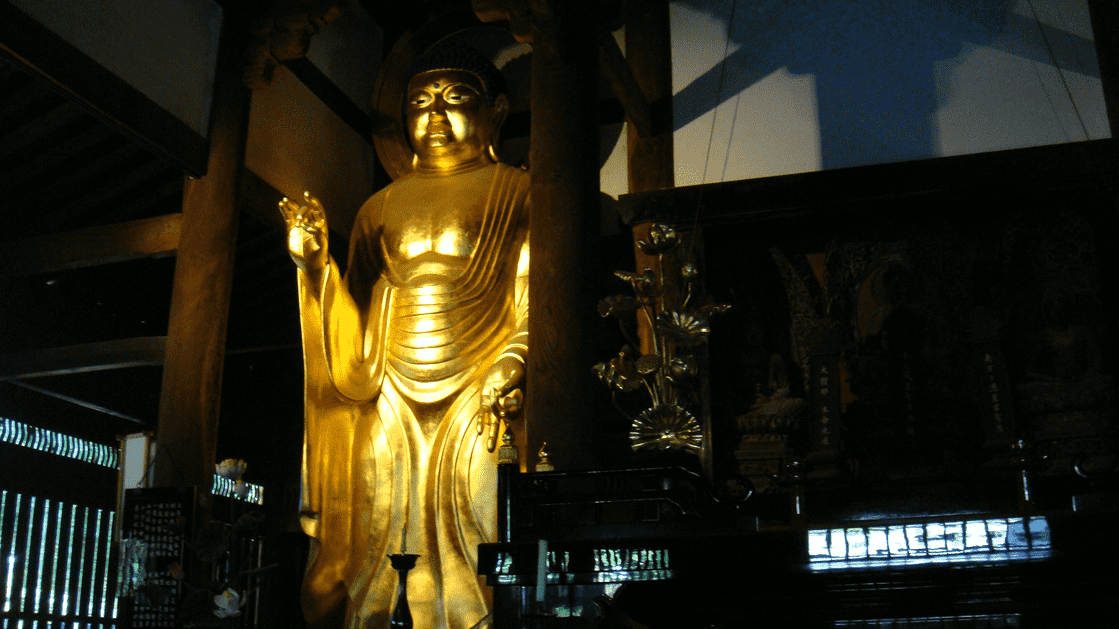
Large gold buddha statue standing between beams inside a temple. Glimmers of sunlight shine in through slats in the windows.

Buddha Statue. David McKelvey. CC BY-NC-ND 2.0

Referred to as “the way of tea,” the preparation of tea developed into an exercise of Zen devotion that honored the beauty which can be discovered in an otherwise flawed world. Author and tea expert Solala Towler has said: “It is a ceremony that takes the simple art of drinking tea to a sacred level, where the host and the guests share a moment of worship of the simple art of preparing and drinking of tea together, elevating them to a level of purity and refinement.”

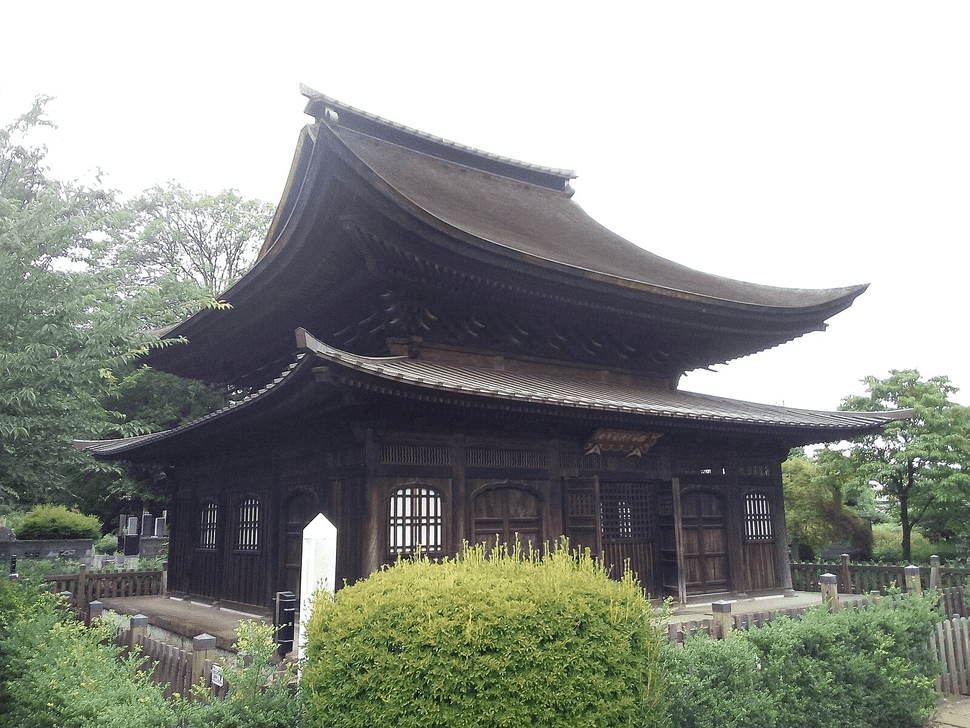
A brown Japanese-style temple stands centrally in the image, surrounded by manicured hedges and woods in the background

The Jizōdō at Shōfuku-ji. MomoyamaResearch. CC BY-SA 4.0

The word matcha comes from the Japanese verb “matsu”, (to rub or to daub) and “cha” , (tea). In its early form, matcha was consumed as a medicinal drink. Eisai himself wrote about the health properties of tea in his book “Kissa Yojoki” (“Drinking Tea for Health”), where he extolled the virtues of tea for both body and mind. 

Eisai believed that tea could cure physical ailments and enhance mental clarity and spiritual well-being, making it an ideal companion for Zen meditation. He realized that drinking matcha improved his meditation sessions by producing a state of calm alertness, likely a product of the cognition-boosting interaction between matcha’s caffeine and L-theanine. Caffeine, a natural stimulant, provides an energy boost. However, caffeine alone can sometimes lead to jitters, increased heart rate, or anxiety. L-theanine, an amino acid found in tea leaves, counters this with its calming effect on the brain. It promotes the production of alpha waves, which are associated with a relaxed yet alert mental state.When consumed together in matcha, caffeine and L-theanine synergize to create a balanced effect. 

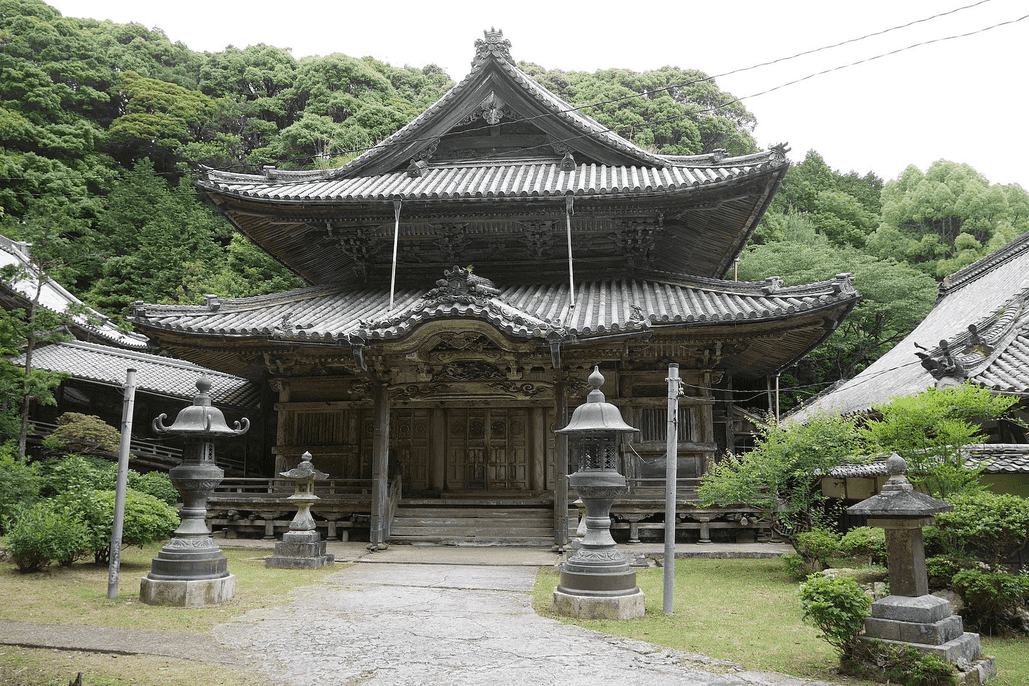
The front side of a stone temple and its courtyard. There are various lantern sculptures in the grass lining the walkway, and woods in the background.

Shofuku-ji Temple. David McKelvey. CC BY-NC-ND 2.0

For centuries, the practice continued to spread throughout Japan, dispersing throughout all levels of society. Today, the matcha tea ceremony provides an opportunity for intellectual exchange, the sharing of knowledge and the continuity of tradition.

As was written in a collection of essays entitled “The Book of Tea” by Okakura Kakuzo, one of the first Japanese to advocate for the art of tea drinking, “Those who cannot feel the littleness of great things in themselves are apt to overlook the greatness of little things in others,” a sentiment that ties humility in oneself to the appreciation of others and their work, tea among them. 

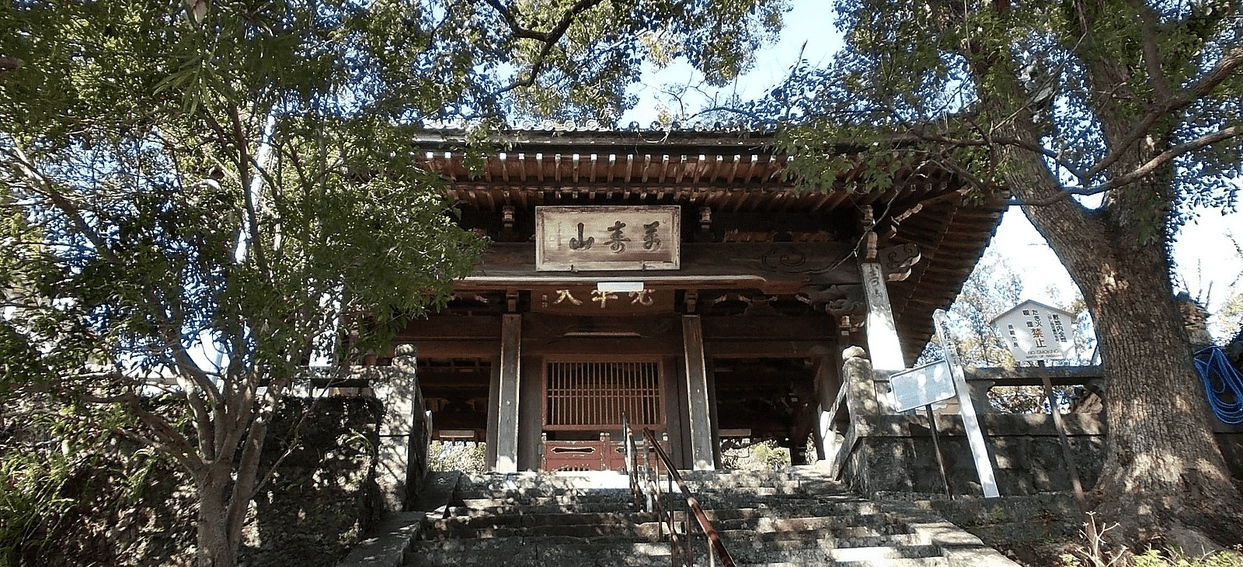
Looking up at a stairway leading into the open doors of a temple. Signs inscribes with characters hang from the roof and large trees line either side of the stairway.

A Sanmon at Shofuku-ji Temple. STA3816. CC BY-SA 3.0

Today, Shofuku-ji Temple remains a serene sanctuary where visitors can connect with the historical and spiritual origins of matcha. The temple grounds, with their carefully maintained gardens and ancient structures (including a Buddhist temple, a kitchen, a Zen hall, a bell tower, a sun and moon garden, a records hall, and more) provide a peaceful setting for reflection upon the past. Visitors can appreciate the tea plant, a living link to Japan’s first tea plants, and the enduring legacy of Eisai’s contributions to Japanese culture. 

Generally, Shofukuji Temple is not open to the public. If you are visiting as a group, you must apply one month in advance and receive permission from the temple, even if you just wish to tour the grounds. The application and a guide to the grounds can be found on the temple’s website. The temple is a nationally designated historic site that protects cultural assets and the continuation of the Zen tradition, so visitors are asked to proceed quietly and with care. Visitors may also be asked for a contribution to help protect and restore cultural properties. Applications received less than one month in advance will not be accepted.

GETTING THERE

Shofukuji Temple can be reached in a short walk from Gion Station and a 15-20 minute walk from Hakata Station in Fukuoka. Fukuoka is the sixth largest city in Japan and offers a variety of hotels and transportation methods for visitors.


Rebecca Pictairn

Rebecca studies Italian Language and Literature, Classical Civilizations, and English Writing at the University of Pittsburgh. She hopes to one day attain a PhD in Classical Archeology. She is passionate about feminism and climate justice. She enjoys reading, playing the lyre, and longboarding in her free time. 

Tunisia: Discover Ancient Rome in North Africa

Thousands of years later, Tunisia’s rich history as part of the Roman empire is still on display.

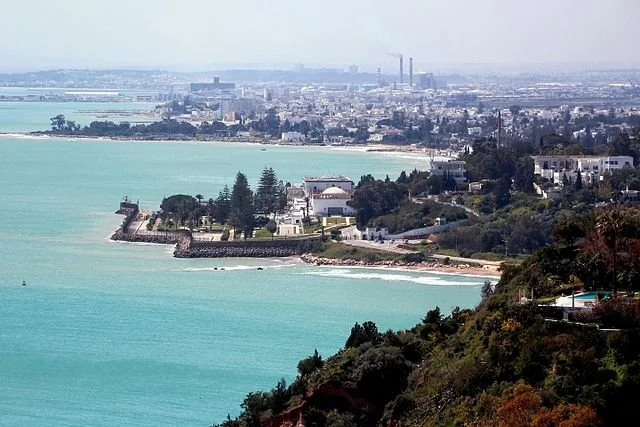
An aerial view of the coastline. A large palace stands on a piece of land jutting out onto bright teal ocean, with the city in sight further in the distance.

A view of Carthage Palace in Tunisia. Farah Jack Mustaklem. CC BY-SA 4.0

For many, the word “Rome” evokes images of the city in Italy. Its days as the center of one of the largest empires in history ended millennia ago, and today, popular culture has largely moved on, TikTok memes aside. But the Roman Empire was far bigger than many now imagine, stretching well into the modern-day Middle East and across North Africa. Today, the empire’s ruins remain visible in the furthest reaches of its territories.

Tunisia, for instance, is home to a wealth of ancient Roman history. Sitting on the edge of the Sahara Desert, the African nation has found fame with tourists who admire its gorgeous beaches. However, beyond the nation’s natural beauty and high-quality resort towns, Tunisia's territory was once at the very heart of the Roman empire in Africa. Ranging from the remains of villages to the shell of the great city of Carthage, ancient ruins dot the country’s landscape. Almost every major city features ancient Roman artwork, architecture and history. While Tunisia is gorgeous in its own right, the country possesses a richer history than almost anywhere else in the world.

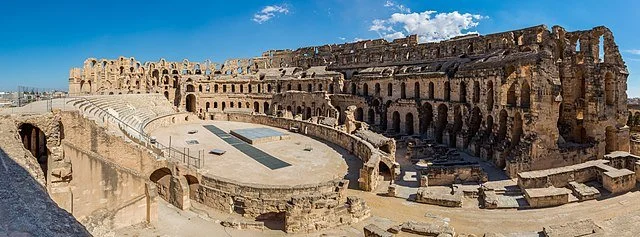
The best-preserved example of Imperial Rome’s presence in Tunisia is El Jem. Estimated to have held up to 35,000 people at once, El Jem is not only the largest amphitheater in Africa but one of the largest in the world. Incredibly, the entire building is supported by stone arches, the edifice resting on a flat plain with no hills or rises for balance. The structure’s underground passages also remain largely intact, and tours are led daily through the entire grounds of the colosseum.

An aerial panorama of a massive Roman ampitheater. The walls are still standing in good shape, with some erosion of the tops.

A panoramic view of El Jem. Diego Delso. CC BY-SA 4.0

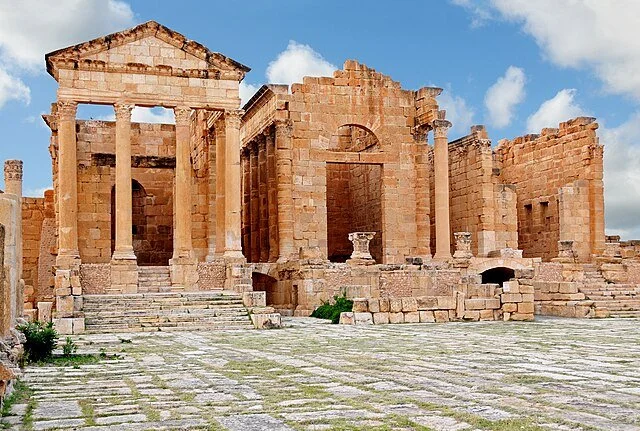
Another incredible part of history hidden away just outside the Sahara is the ancient city of Sbeitla, home to some of the  best-preserved temples from the Byzantine Empire. Outside Sbeitla, visitors can also tour the ruins of Byzantine public baths, a Roman Forum that houses ancient temples to Minerva, Jupiter and Juno, and a series of Catholic basilicas.

Looking at the front of Roman forum ruins. The area is well-preserved and empty

The Roman Forum in Sbeitla. Dennis Jarvis. CC BY 2.0

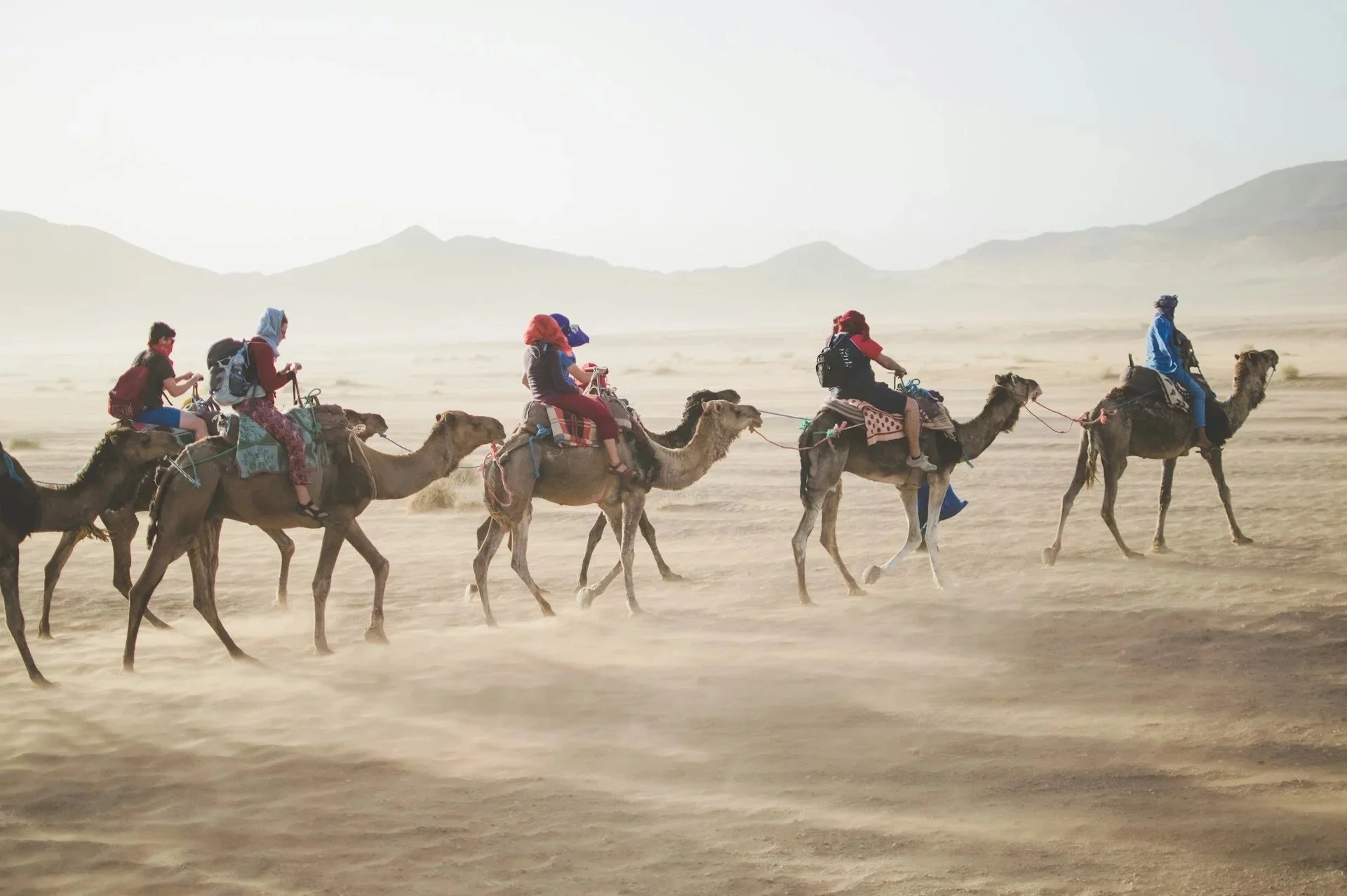
In addition to its ancient history, Tunisia provides visitors with the unique opportunity to visit the Sahara Desert. Numerous tour companies offer frequent excursions into the desert on camelback. These tours range from day trips to two or more days of camping and bivouacking in traditional Bedouin style. These tours are a once-in-a-lifetime opportunity to experience the lifestyle of the nomadic tribes local to Tunisia.

A line of tourists ride camelback through the desert, with dust obscuring the silhouette of mountains in the distance

A camelback tour of the Sahara Desert. Vaida Tamošauskaitė. CC0

Despite all of the wonderful experiences that Tunisia presents, there are notable risks to visiting the country as a tourist. As of May 2024, the US Department of State issued a Level 2 travel advisory. This marker warns tourists to avoid certain areas due to increased terrorist activity in countries around Tunisia and the newly declared military zone south of the city of Remada. However, the majority of the country is still considered mostly safe to visit, with only select  locations listed at Level 4 or “do not travel.” Tourists should mind the precautions listed in the advisory.

Visitors to Tunisia may be advised to stay in the country’s capital Tunis, a central location which allows easy access to the majority of the destinations listed above. The city offers a variety of hotel options, with prices ranging from $100-300 a night. More affordable options include the Dar Ya hostel in Tunis (priced at around $40 per night) and rentable apartments (from around $35 a night) located just outside the main city.


Ryan Livingston

Ryan is a senior at The College of New Jersey, majoring in English and minoring in marketing. Since a young age, Ryan has been passionate about human rights and environmental action and uses his writing to educate wherever he can. He hopes to pursue a career in professional writing and spread his message even further.

4 of UNESCO’s Newly Named World Heritage Sites

Take a closer look at four of UNESCO's most important new World Heritage Sites.
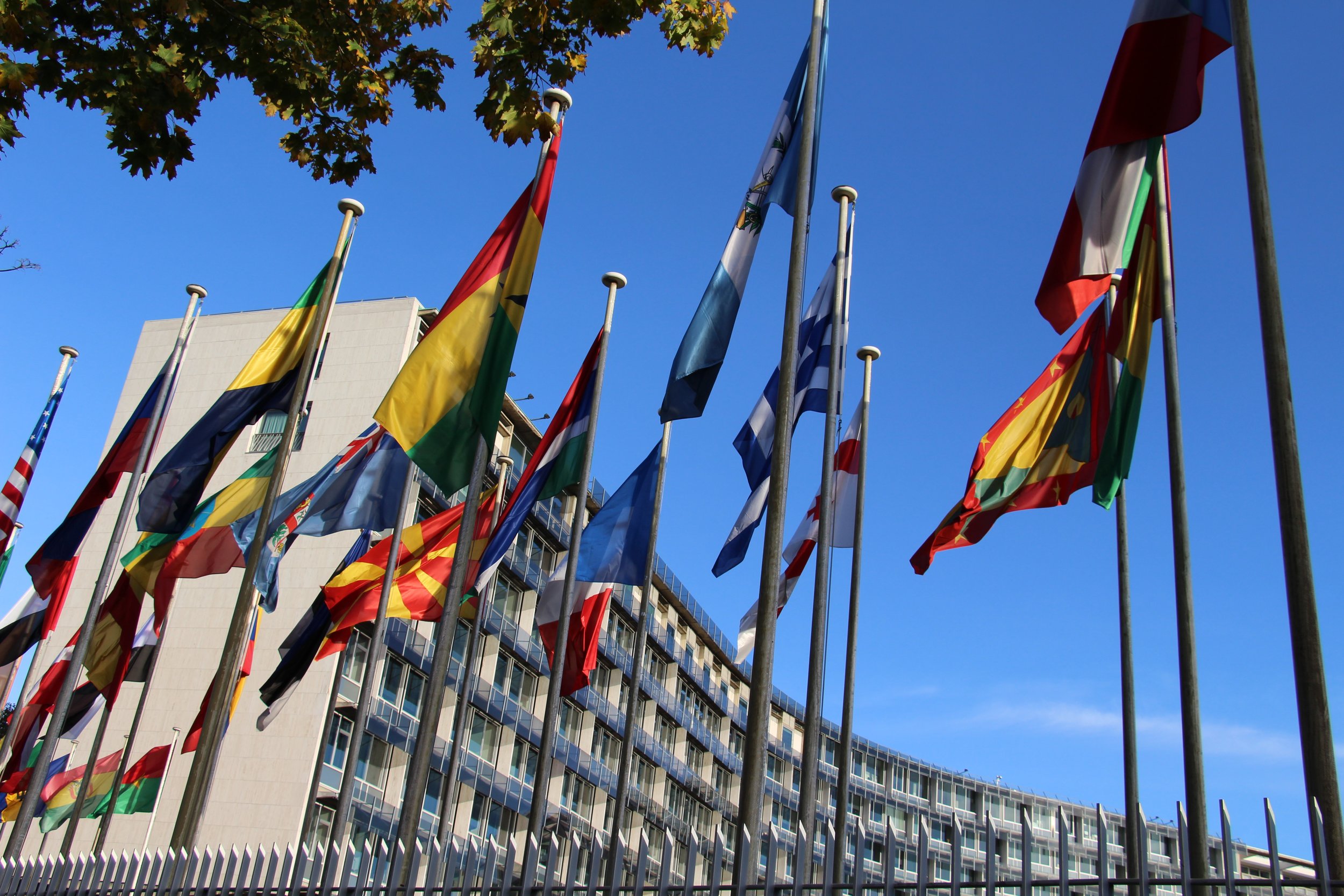
Large curved office building rises behind a fence with dozens of multiple nation's flags.

UNESCO building in Paris, France. Fred Romero. CC BY 2.0

The role of the United Nations Educational, Scientific, and Cultural Organization (UNESCO) is to contribute to peace and development around the world, a goal it has embraced through the establishment of numerous World Heritage sites. Located across the globe, these prestigious locations are hand-picked by the agency to retain their immense natural and/or cultural significance. Popular World Heritage sites include the Taj Mahal, the Great Barrier Reef, the Great Pyramid of Giza and the Serengeti National Park. Spanning across 168 countries, there are currently 1223 properties marked as UNESCO World Heritage sites. In alignment with the 1972 World Heritage Convention, UNESCO continues to hold annual meetings to decide what new locations they will adopt to their list. According to UNESCO, the Convention unites the importance of, “nature conservation and the preservation of cultural properties.” The World Heritage Committee’s selection process is centered around a set of policies referred to as the “Five C’s”: credibility, conservation, capacity-building, communication and communities. It is through the analysis of these characteristics that UNESCO establishes a yearly list of exceptional locations worthy of preservation for the continual appreciation of humanity. This year, the 46th session of the World Heritage Committee took place in New Delhi, India during the week of July 21. The session was live-streamed and recorded, providing full transparency to the public on the Committee’s decision to name 24 new World Heritage sites. Below is a closer look at a few of this year’s additions.
Nelson Mandela Legacy Sites, South Africa

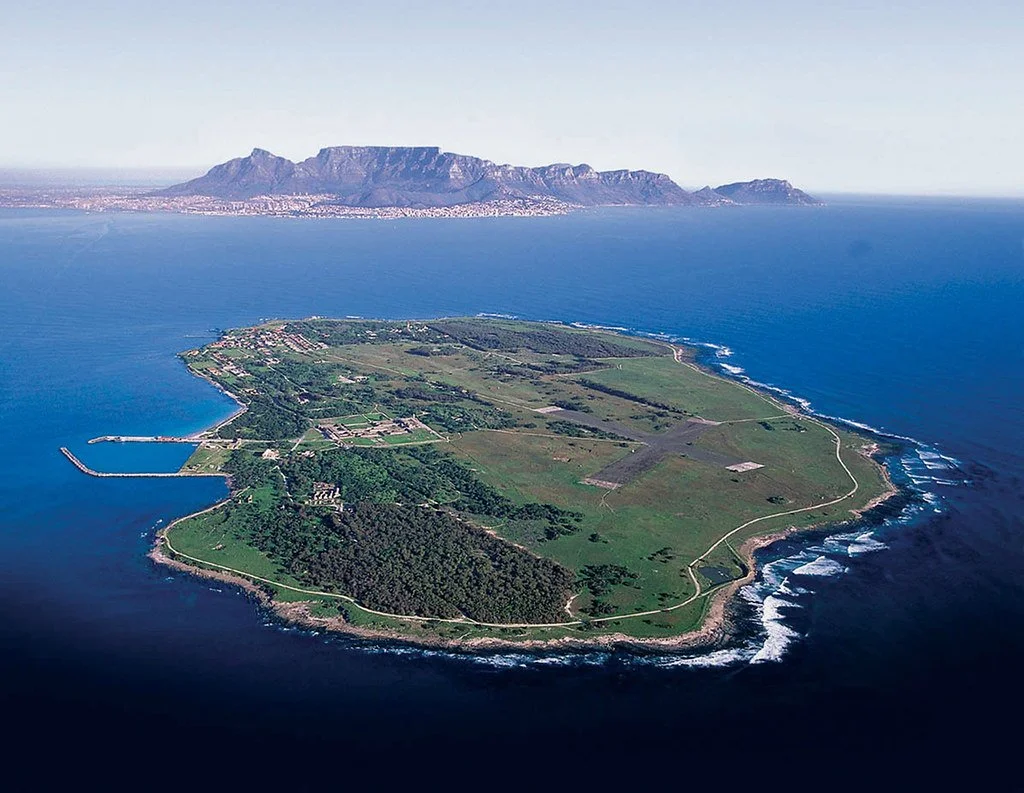
An aerial view of a circular, flat and green island. There is an air strip and small town on the island, with wooded areas scattered. View of Cape Town in the background.

Robben Island. South African Tourism. CC BY 2.0

Representing the “legacy of the South African struggle for human rights, liberation, and reconciliation”, the Nelson Mandela Legacy Sites were recently inducted into UNESCO’s list.  The Legacy Sites are broken into 14 parts, each place with a special significance. For example, the Sharpeville sites commemorate the massacre of 69 protestors of the Pass Laws which restricted the free movement of Black South Africans in 1952. Other spots include the Mqhekezweni Great Place and the Union Buildings in Pretoria, now the official location of South Africa’s government. 

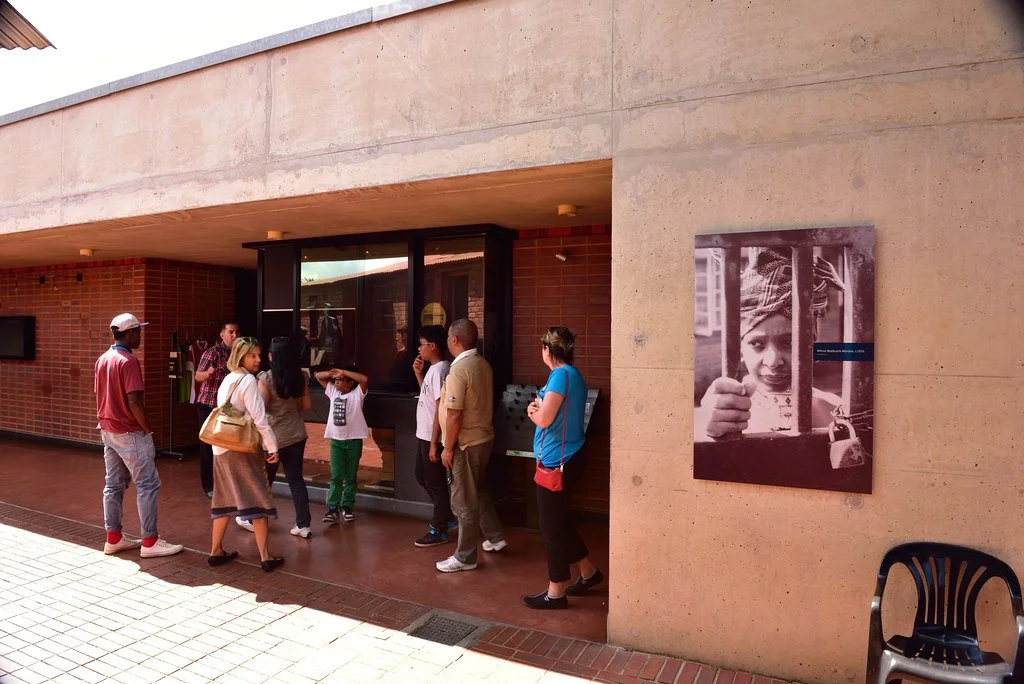
People waiting outside the doors to a museum. On the wall outside is a large portrait of a young girl looking through a window behind locked bars, holding on

Nelson Mandela Museum in Soweto, South African Tourism, CC By 2.0

Spanning across South Africa, visitors can visit anywhere from one to all fourteen sites. With an entry fee of about $9 per adult, the Apartheid Museum features interactive exhibits and personal stories detailing South Africa’s history. Robben Island, where Mandela was imprisoned for 18 years, offers guided water tours at $22 per person.

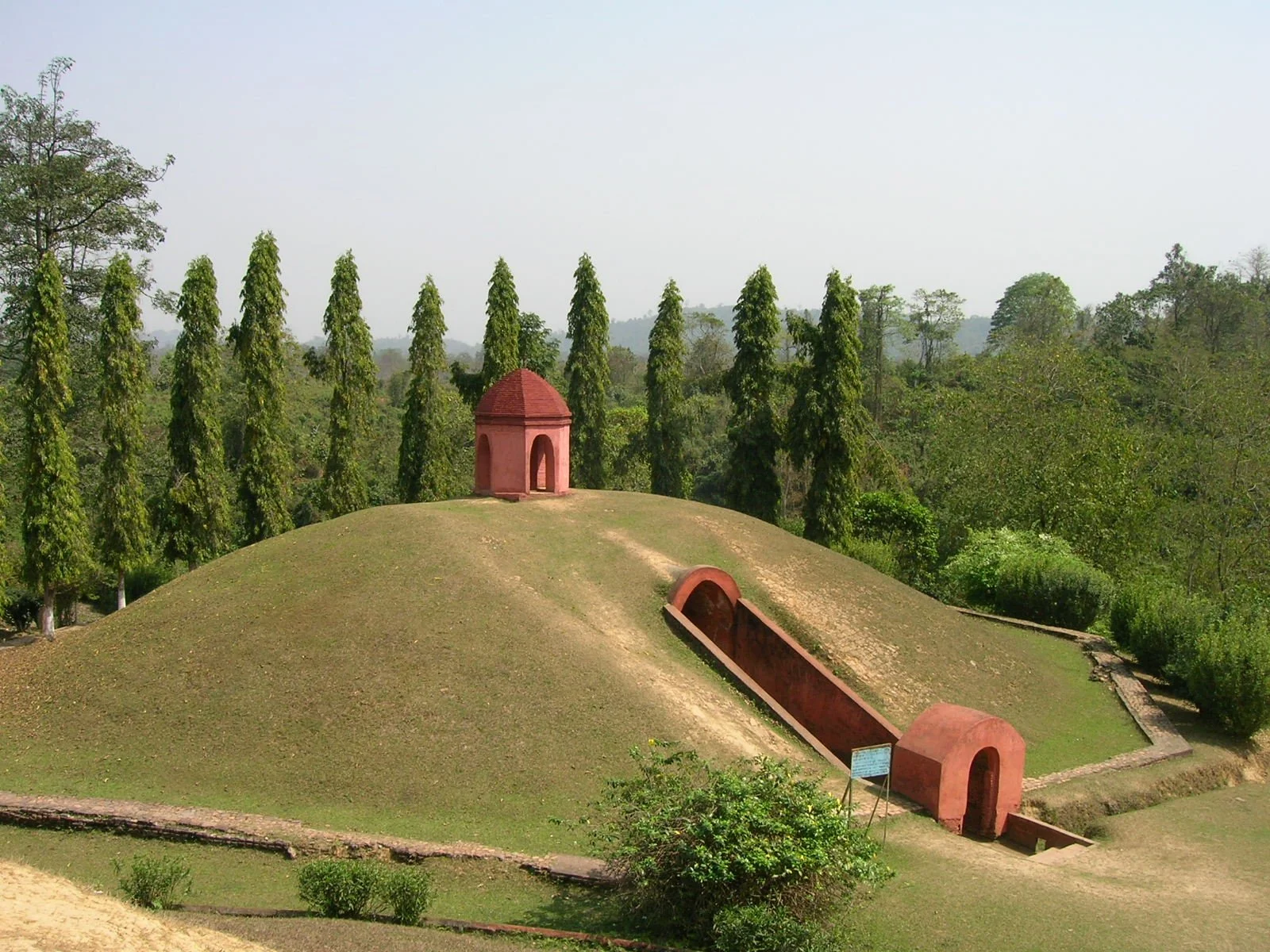
Charaideo Maidams, India

A grassy mound, with a red small building atop. Tunnel through the center, with its entrance under a red arch. Surrounding the mound is a moat and retaining wall, beyond that lies dense jungle.

Charaideo Maidam. Mozzworld. CC BY-SA 4.0

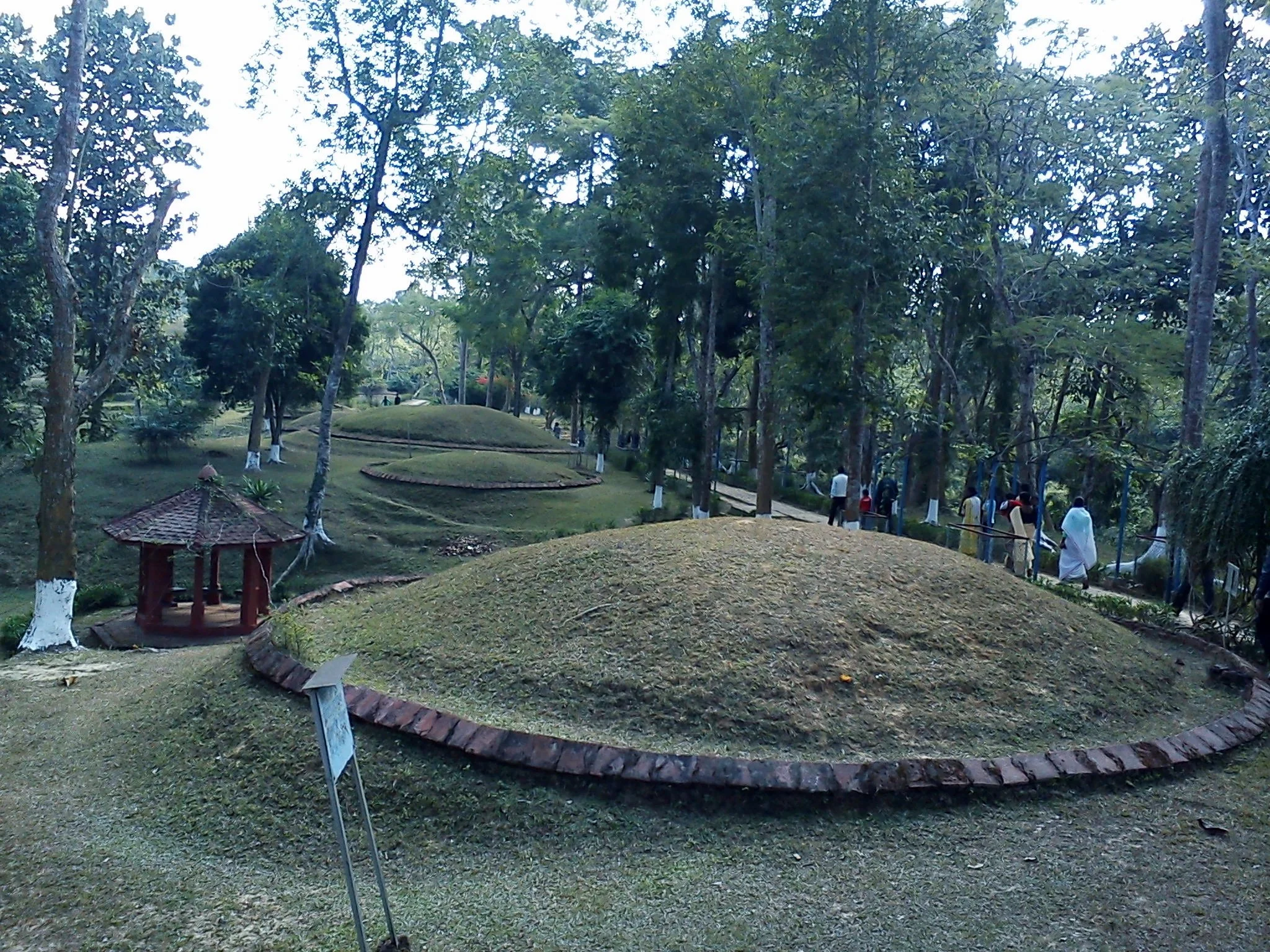
Created by the Ahoms, an ethnic group in Northern India that once possessed its own indigenous kingdom, “maidams” are large mounds built atop graves. Constructed over a “hollow vault” of earth, these “mounded burial grounds” served as burial grounds for Ahom royalty. This year, Assam’s Charaideo Maidam, a royal burial complex of approximately 90 maidams established over a period of 600 years, was recognized by UNESCO as a World Heritage Site. Spokespeople from the World Heritage Committee’s advisory board ICOMOS proclaimed that, “The [maidams] are an exceptional example of an Ahom necropolis that represents funeral traditions and associated beliefs in a tangible way.” In addition to royals and significant members of Ahom society, maidams may also contain food, horses, elephants, and sometimes the bodies of queens and servants.

Four smaller grassy mounds lined together, each encircled by a brick border. People walk past on a walkway to the side

Group of four smaller maidams, Dhruba Jyoti Deka, CC BY-SA 3.0

The Charaideo Maidams’ visiting hours are between 9:30 AM to 5:00 PM. According to the Directorate of Archaeology in the Government of Assam, a full tour of the site takes approximately two and half hours. Visitors can purchase entry tickets online ahead of time or on-site for about $3. With public transportation, the Charaideo Maidams is  approximately an hour away from Sivasagar, the closest major city.

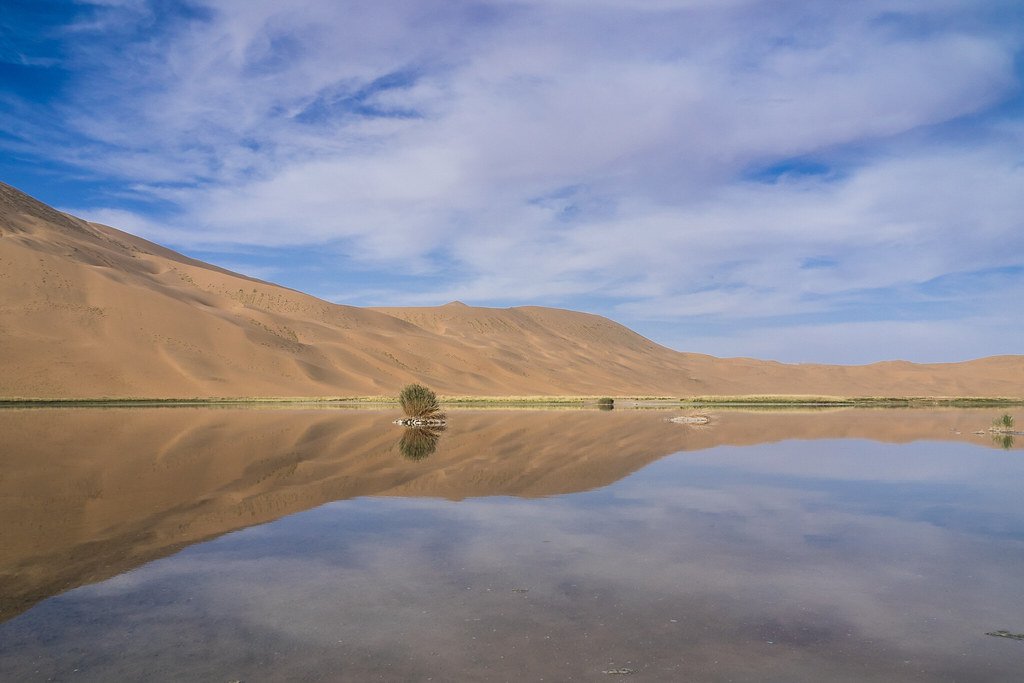
Badain Jaran Desert, China

Desert dunes are reflected into a crystal clear large pond.

Badain Jaran Desert. Rita Willaert. CC BY-NC-SA 2.0

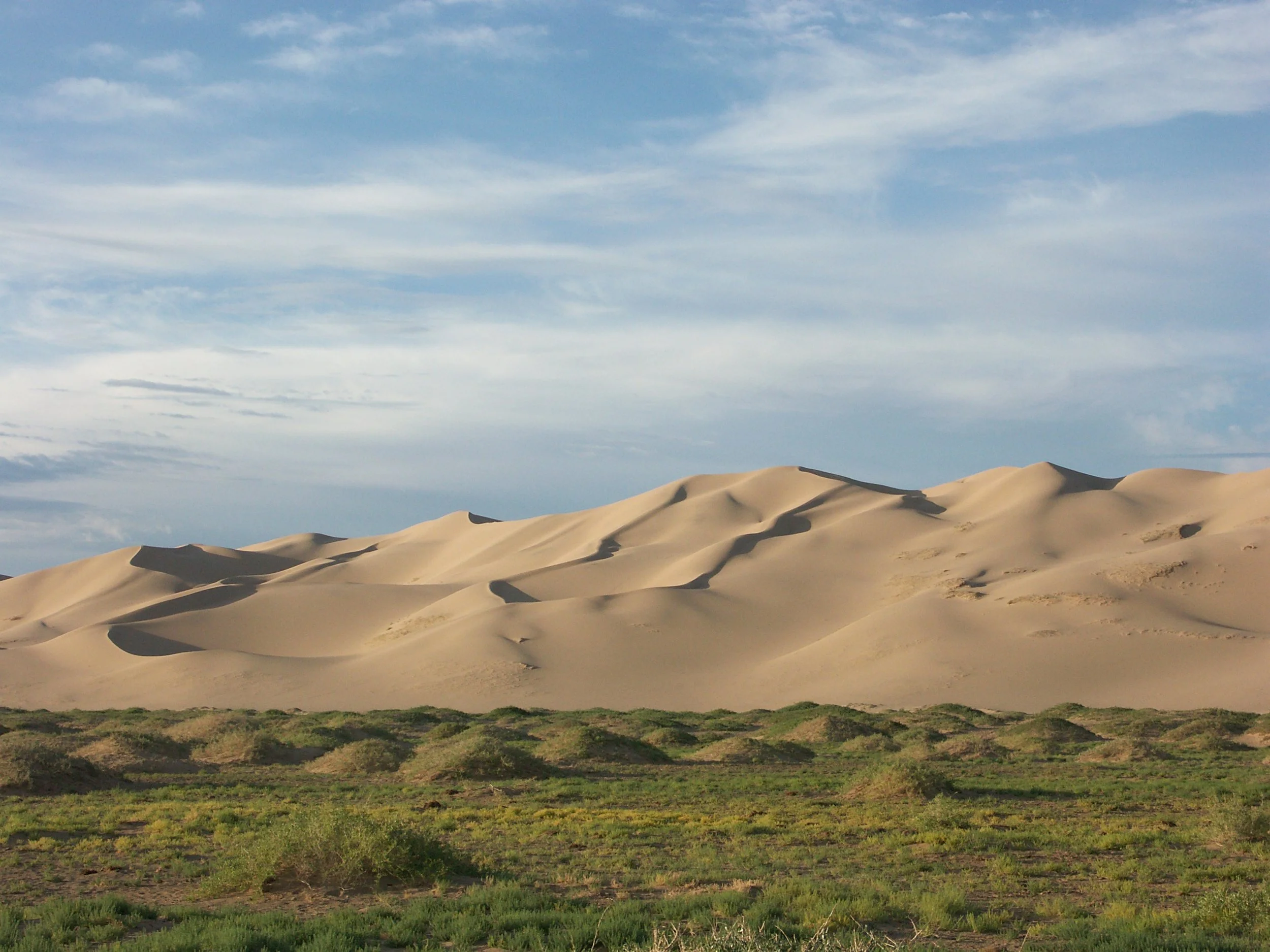
The Badain Jaran Desert can be found in the Alashan Plateau of northwestern China’s desert region. According to UNESCO, “the property stands out with its high density of mega-dunes, intersected with interdunal lakes.” The site’s unique geologic features, “include the world’s tallest, stabilized sand mega-dune (relative relief of 460 meters)’ and the largest expanse of “singing sands” (so-called due to resonance caused by wind moving dry and loose sand). China Discovery classifies the unique terrain of the desert into “five wonders”: the sandy peaks, singing dunes, colorful lakes, clear springs and an ancient temple. At just over 30,000 square miles, the site is the third largest desert in China. 

Dunes meet a grassy and shrubby meadow.

Dunes in Badain Jaran Desert.. Zhoarby. CC BY-SA 3.0

The desert can only be accessed by jeep, with the Zhangye Travel Guide warning travelers of the local agency's monopoly on desert travel The desert features specific tourist attractions, including the Pearl Lake of the Badain Jaran Desert, the Yinderitu (A Magic Spring) and Bilutu Dune, the world’s highest sand dune. The starting fee for entrance into the Badain Jaran Desert is about $30 and $11 for the Badain Lake, not accounting for additional fees for accommodation and guided desert tours.

Flow Country, United Kingdom

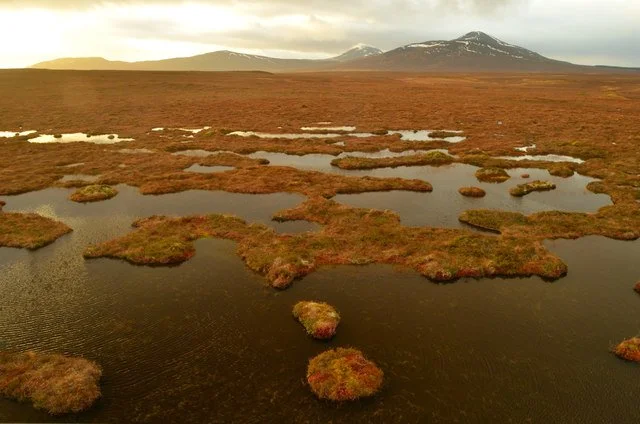
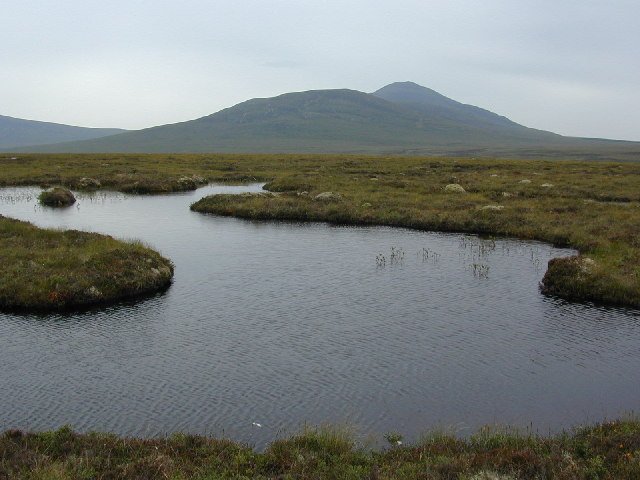
Looking down at a bog, with vegetation a mix of green and browns, and some lightly snowy hills looming in the background.

View of peatlands in the Flow Country. Andrew Tryon. CC BY-SA 2.0

The first peatlands to be recognized as a World Heritage Site, the Flow Country in Scotland is a massive bog storing about 400 million tons of carbon. A “globally rare” habitat, the Flow Country is immensely environmentally significant. In the Flow Country, carbon is trapped and stored in dead vegetation, preventing it from being released into the atmosphere and causing further environmental harm. Professor Mike Robinsons on the Culture at United Kingdom National Commission for UNESCO highlighted the importance of the site’s environmental impact in its official naming: “World Heritage status recognises the global importance of the Flow Country and its peat bogs, not only as important ecosystem for wildlife, but also through their carbon storage, as a critical defense against the impact of climate change.” 

A pond among a marsh, with a rolling green hill behind on a foggy day.

Closer view of a peat pool. Steve Neal. CC BY-SA 2.0

In the Flow Country, there are numerous experiences for interested visitors. The Forsinard Flows Visitor Center features exhibitions and educational films about the area. Nearby the center is the Lochan Dub Trail, a one-mile loop weaving through peat pools and sections of the blanket bog. A longer trail option would be the Forsinain Trail four miles north of the Forsinard train station. For those hoping for a less outdoorsy visit, the Far North Railway Line travels through the Flow Country as well.


Aanya Panyadahundi

Aanya Panyadahundi Aanya is a student at the University of Michigan studying sociology and journalism on a pre-law path. She loves to travel the world whenever she can, always eager to learn more about the different cultures and societies around her. In her free time, she likes to play the violin, ski, and listen to podcasts.

5 Must-Visit Speakeasies Across the Globe

Inspired by the American Prohibition era, speakeasies exist in the most unconventional places today.

Black and white image of four men sitting on bags of confiscated liquor bottles in a house pose

Liquor raid by sheriff’s department circa 1925. Gleason W. Romer. CC0

Prohibition was a result of the 18th amendment of the U.S. Constitution in 1919, which stated that, “The manufacture, sale, or transportation of intoxicating liquors within, the importation thereof into, or the exportation thereof from the United States and all territory subject to the jurisdiction thereof for beverage purposes is hereby prohibited,” within a years time. The amendment marked a political move that brought dismay to many citizens. Daniel Okrent, author of "Last Call: The Rise and Fall of Prohibition," argues that, “Prohibition became the same sort of political football that people on either side would use trying to struggle to get it towards their goal, which was control of the country," with politicians using the ban and the controversies around it to push other agendas.

Although Prohibition was mainly an American phenomenon, many countries around the world have made, or are currently making, attempts to limit alcohol consumption. Currently, Nordic countries concerned with their citizens’ alcohol intake are resorting to alcohol monopolies, marketing bans and higher taxation to combat it. Japan also struggles with alcoholism, with 60% of alcoholics being businessmen that drink socially to help their careers. With alcohol consumption quadrupling in Japan since 1960, private treatment centers and halfway houses have been popping up to combat the issue.

One of the most recognizable institutions of the Prohibition era was the speakeasies. A speakeasy was a place where alcohol was illegally sold, usually underground or at least out of view due to the danger posed to workers, owners and patrons. Although the 18th amendment was repealed in 1933, speakeasies still exist throughout the United States and the world today. Listed below are five notable and currently operating speakeasies from various major cities.

Evans and Peel Detective Agency 

London, England

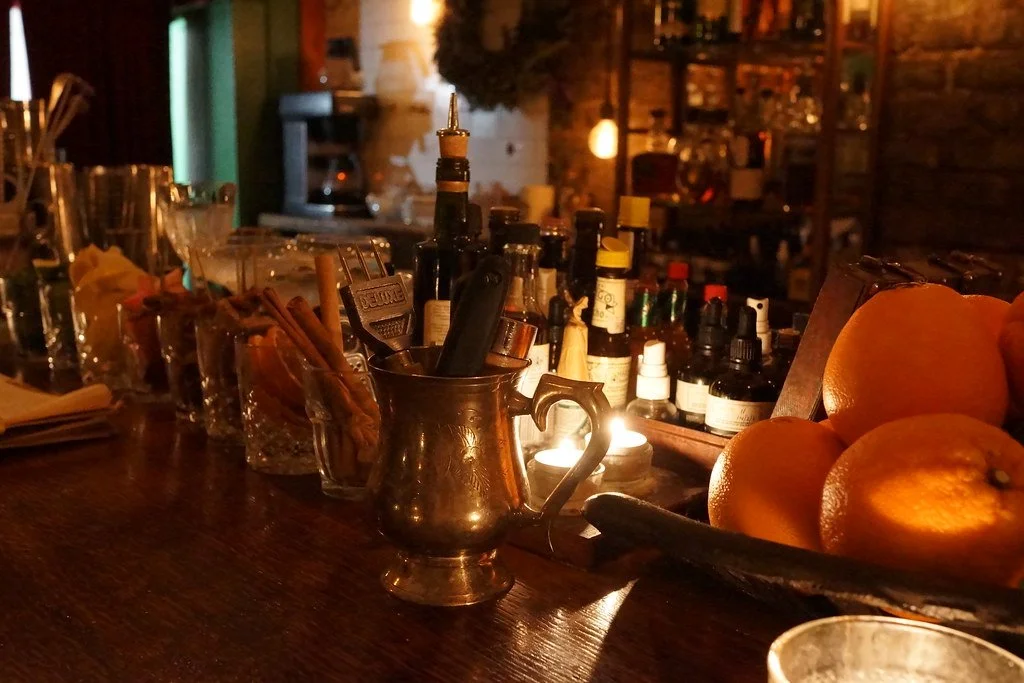
Bartop and Evans and Peel. Jan Mark Holzer. CC By 2.0.

Located in Chelsea, Evans and Peel is a detective-themed speakeasy. Appointments are booked through the company's website, which tells prospective visitors, “We’re Evans & Peel, a highly renowned Detective duo who operate from our hidden Agency in Chelsea, London. Go beyond our facade and discover our famous secret.” People are given the option to customize their experience, sending the detective agency information about the “case” they wish to consult on. To enter the bar, customers have to ring a buzzer to enter a fake detective’s office and stay in character, explaining that they have, “an appointment with the detective.” They are then guided down a staircase to consult with the detective. Emily Gray from "The Handbook"  recalls that, “The Agatha Christie fan that I am, I went into a long story about losing a very expensive earring that had been stolen from a jeweler in the 1920’s (apparently most people say they’ve just lost their cat).” Evans and Peel's drink menu is also outlaw themed, with most of its special cocktails based on some of the biggest real and fictional superstar criminals like Thomas “Tommy” Shelby, Bill McCoy and Al Capone. The "agency" claims to make the “World’s Best Old Fashioned.”

‘Al Capone’ themed drink on the menu. Evans and Peel.

Located at: 310c Earls Court Road, London, SW5 9BA, England

Bank Bar 

Manila, Philippines

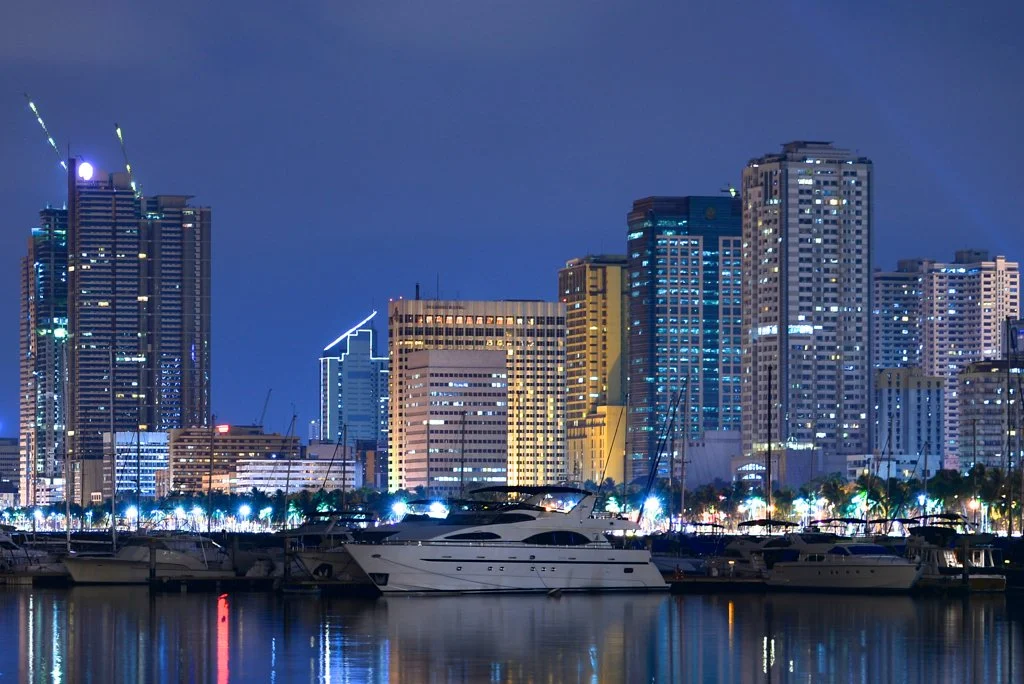
City skyline at night, with skyscrapers lit up in the background and small boats in the port.

Manila skyline at night. Thomas Yie. CC BY 2.0

In keeping with its name, the Bank Bar in Metro Manila's Bonifacio Global City has set up shop in the RBCB Savings Bank Corporate Center. A bouncer is waiting inside, next to a small door which opens into a fake stockroom that patrons walk through to enter the bar. Once in, there is a calming and luxurious ambiance. Erica Jahn notes in her review that, “The velvet sofa and candles on the marble table make the place attractive and intimate.” The bar advertises its own drinks drinks as including, “ Inventive cocktails and the widest selection of any bar in Manila” Although located in the Philippines, much of the bar's menu has an American theme. Bank Bar offers pasta, pizza, burgers, steaks, fried chicken and more American classics. The establishment is far from a simple American outpost, however, offering among other indigenous options Chicharon Bulaklak, a traditional Filipino appetizer and street food. Visitors are asked to call ahead and reserve their spots because space is limited and can fill up quickly.

Located at: 26th and 25th Street G/F RCBC Savings Bank Corporate Center, Taguig City, Luzon 1934, Philippines

Janai Coffee 

Tokyo, Japan

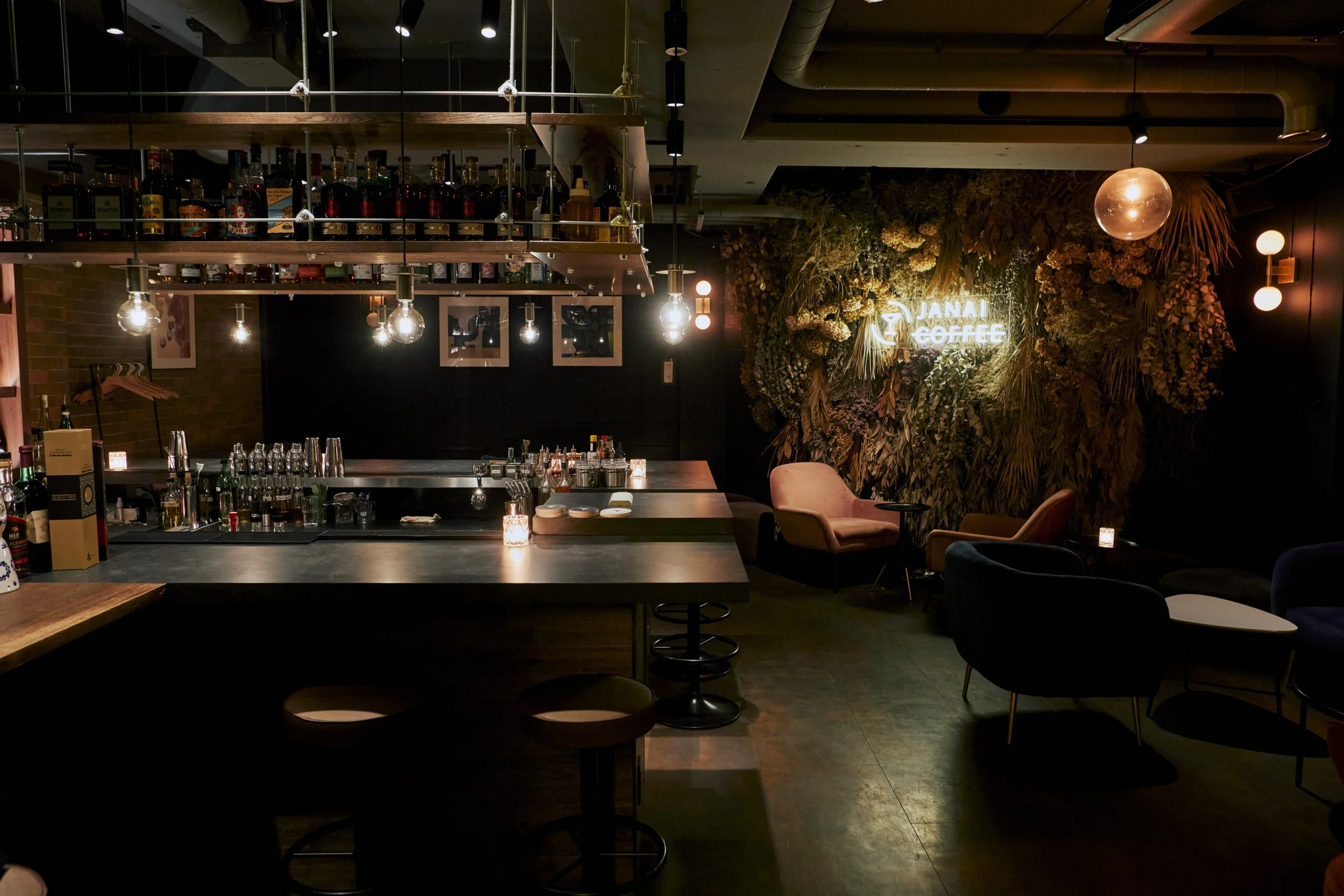
Low-lit interior of trendy coffee shop. Low stone bar counter, comfortable modern chairs, and a flower wall with neon light sign

Interior of Janai Coffee. Junki Yoshida.

This Tokyo speakeasy takes on the guise of a traditional coffee bar, hidden behind a secret doorway only the barista knows how to access. At first glance, Janai's website sticks with the coffee theme, offering to-go cups, explaining seasonal coffee bean selection, all while subtly hinting that it might offer more: “We don’t just want to serve coffee. Forget about time. Stop measuring. Don’t compare yourself to others. Take time to relax and forget about your daily routine. A place where you can forget about your daily routine and enjoy coffee to your heart’s content without thinking about anything else.” There is a secret puzzle that has to be solved on their website before being able to make a reservation (a hint—look at the logo). The flipside states their mission as a speakeasy and adds that, “This bar has a wide selection of alcohol that the staff all tasted and selected together. Even if you are not an expert, even if the taste is difficult, you can enjoy Janai Coffee for some ‘just because’ reason such as the cute label or the interesting name.”

Espresso martini from Janai Coffee’s bar, Junki Yoshida.

Located at: 2-3-13 Ebisu, Shibuya, Tokyo, 150-0022

Moonshiner 

Paris, France

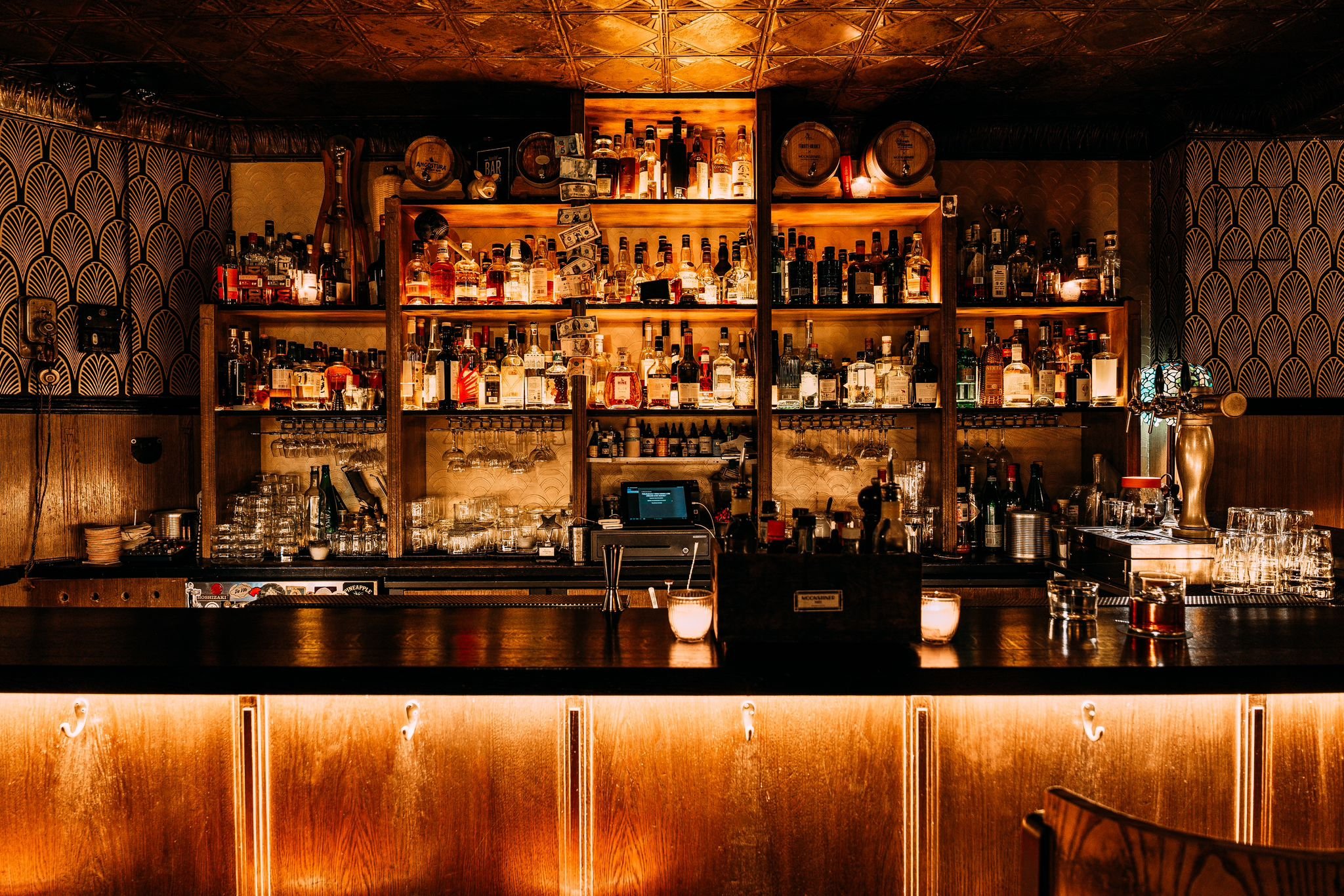
Swanky wood bar design, lit from underneath, with intricate shelving on the wall behind to hold dozens of bottles and garnishes

Bartop at Moonshiner, Fiamma Brighi. 

Continuing the theme of being hidden behind a conventional storefront, the Moonshiner’s entrance is through Da Vito, a small pizza parlor in Paris. The joint's website tells potential visitors, “Shhhh, listen up, music is filtering behind this wall … lower your voice, lighten your steps, and push the door to the cold room … we’ll see you on the other side!” To enter, guests walk into the pizza parlor and head directly to the steel door of a fake meat locker at the back. This speakeasy in particular tends to attract a younger crowd of twenty-to-thirty-year-olds, and a combination of travelers and locals. Their drinks range from classic cocktails like Old Fashioneds to more novel and creative options like “Money Time” or “Back to Basil.” As it is a small space, the bar tends to get very busy. Sara Lieberman from Conde Nast Traveler notes that, “Despite it looking like the type of place you want to sit and sip luxuriously, unless you get there early be prepared to stand and hover over those with seats until other bar-goers finally get up (IF they get up!).” Many bar goers are just stopping by for a drink while waiting for the pizza they ordered on the way in, with Liberman also explaining that, “Moonshiner and the pizza parlor out front—Da Vito—--are more or less one in the same, so if you’re hungry, put your name on the list when you arrive and head to the back for a drink while you wait.”

Old Fashioned at the Back Room. Fiamma Brighi.

Located at: 5 rue Sedaine, 75011, Paris, France.

The Back Room 

New York City, United States

A street in the city with a small metal barrier gate around a staircase leading down to a building basement. There is a stickered sign on the gate pointing to the stairs, describing it as the "Lower East Side Toy Co."

The entrance to the Back Room, Troy Hahn.

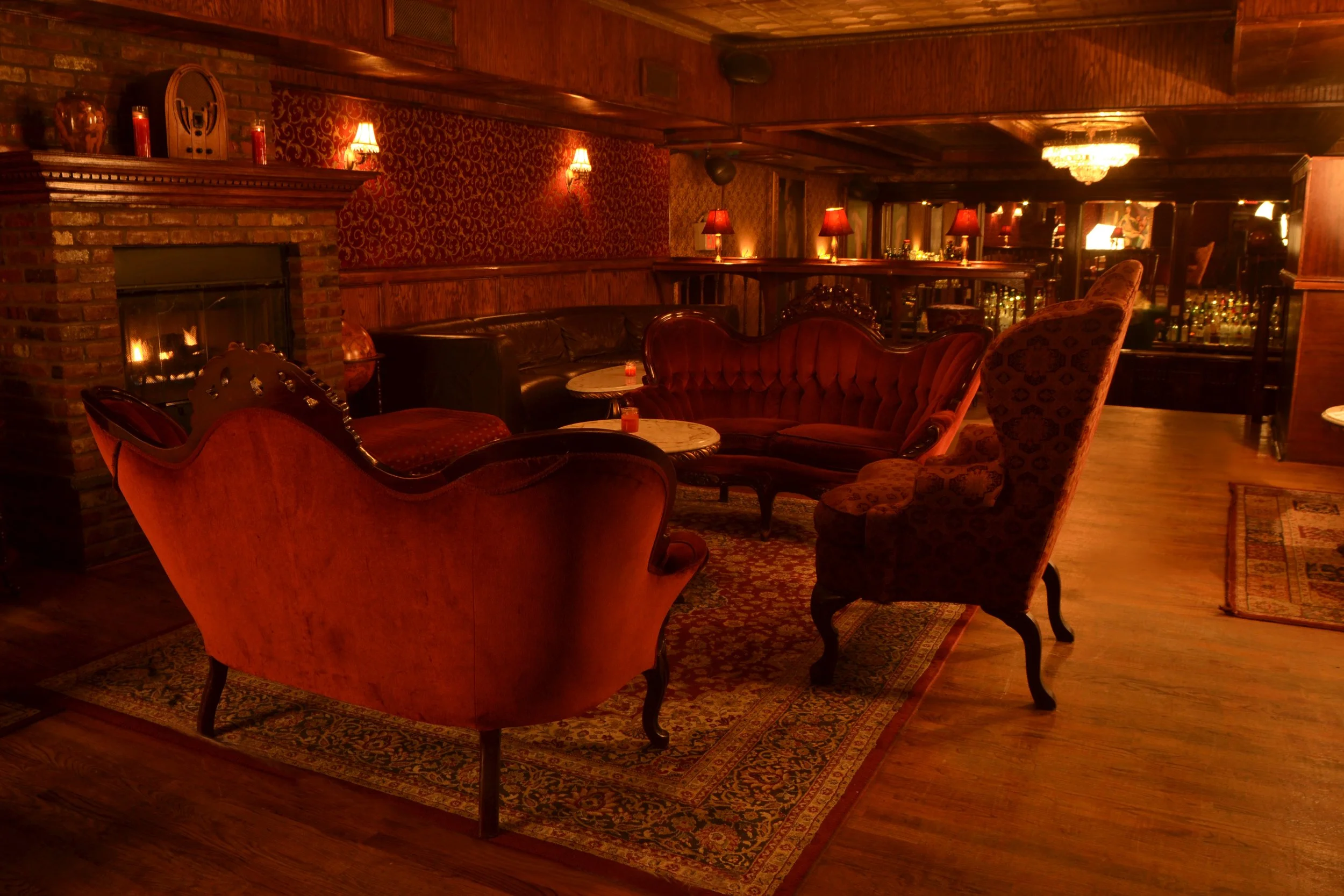
Finally, located in the heart of the Big Apple, the Back Room is a speakeasy in New York that has been operating since the Prohibition era. Disguised as  the "Lower East Side Toy Company,"  the Back Room is hidden down a secret staircase in a narrow corridor. There are no clear indications to the entrance and a variety of staircases are involved before visitors find themselves at the door of the bar. In order to enter, a weekly password from the official Bank Room website is required. Once entered, the bartenders serve drinks in a traditional Prohibition-era style—cocktails are served in teacups and beers in brown paper bags, disguising their true contents. The Back Room was predated by Ratner’s Backroom, which was opened in 1908 in the same location. Owner Johnny Barounis has said that it used to be a popular meeting spot for many Jewish gangsters due to its convenient location, saying, “If somebody came in and was being double crossed or there was a hit going on, there were so many different ways out if you knew the space. You could [even] hop the roofs all the way to Rivington.” The general appearance of the Back Room is luxurious, straying away from the traditional rough appearance speakeasies had due to fear that cops would overturn the establishment at any given point. Barouis calls it, “My bastardized version of these old 1920s ballrooms fused with a speakeasy.” The decor incorporates 1920s cigarette dispensers, mutoscopes, chandeliers, hardwood floors and other period-accurate details. 

A look back in time, with a luxurious interior decoration with massive brick fireplace, red velvet antique chairs and couches, hardwood floors, and warm lighting

The Back Room’s luxurious decor, Troy Hahn.

Located at: 102 Norfolk Street, New York City, NY, 10002-3310


Aanya Panyadahundi

Aanya Panyadahundi Aanya is a student at the University of Michigan studying sociology and journalism on a pre-law path. She loves to travel the world whenever she can, always eager to learn more about the different cultures and societies around her. In her free time, she likes to play the violin, ski, and listen to podcasts.

6 of August's Hottest Music Festivals

From the U.S. to Hungary, music festivals have blossomed over recent decades and now attract millions of people from around the world every year.

A lit up stage at night with festivalgoers cheering in the crowd as confetti falls from the sky.

Music festival performance. Veld Music Festival. CC BY-SA 2.0

Since the origins of music festivals sprung up in ancient Greece in 582 BC, these lively events have evolved from local music and sports competitions to globally renowned happenings. During August, many people flock to these festivals to experience remarkable performances accompanied by the summer weather.

Boomtown Festival, England

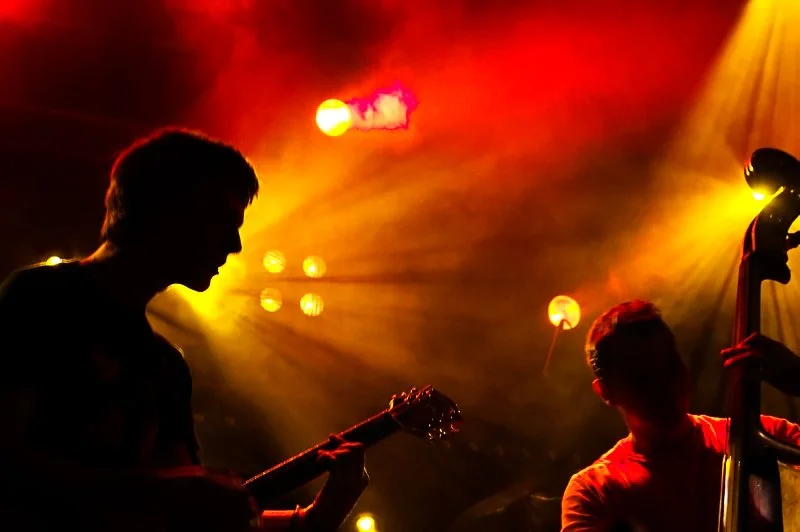
Two artists on stage silhouetted by warm orang and red lights, playing the guitar and bass.

Performers at the 2006 Boomtown Festival, UK. Dimi15. CC BY-NC-SA 2.0

With over 50 venues, a dozen main stages and thousands of performers, the Boomtown Festival located near Winchester in the United Kingdom brings eight city districts to life from August 7 to 11, 2024. The lineup is often kept a mystery until right before the festival, but the Boomtown Festival generally incorporates all kinds of genres into the lineup, from folk music to EDM.

Festival-goers are encouraged to camp overnight. Every ticket provides access to the Campsite Villages located throughout the festival. For eco-conscious attendees, the Boomtown Festival offers upgraded Green Transport Citizen Entry Tickets at a discounted rate for those who arrive via public transport.

Burning Man, U.S.

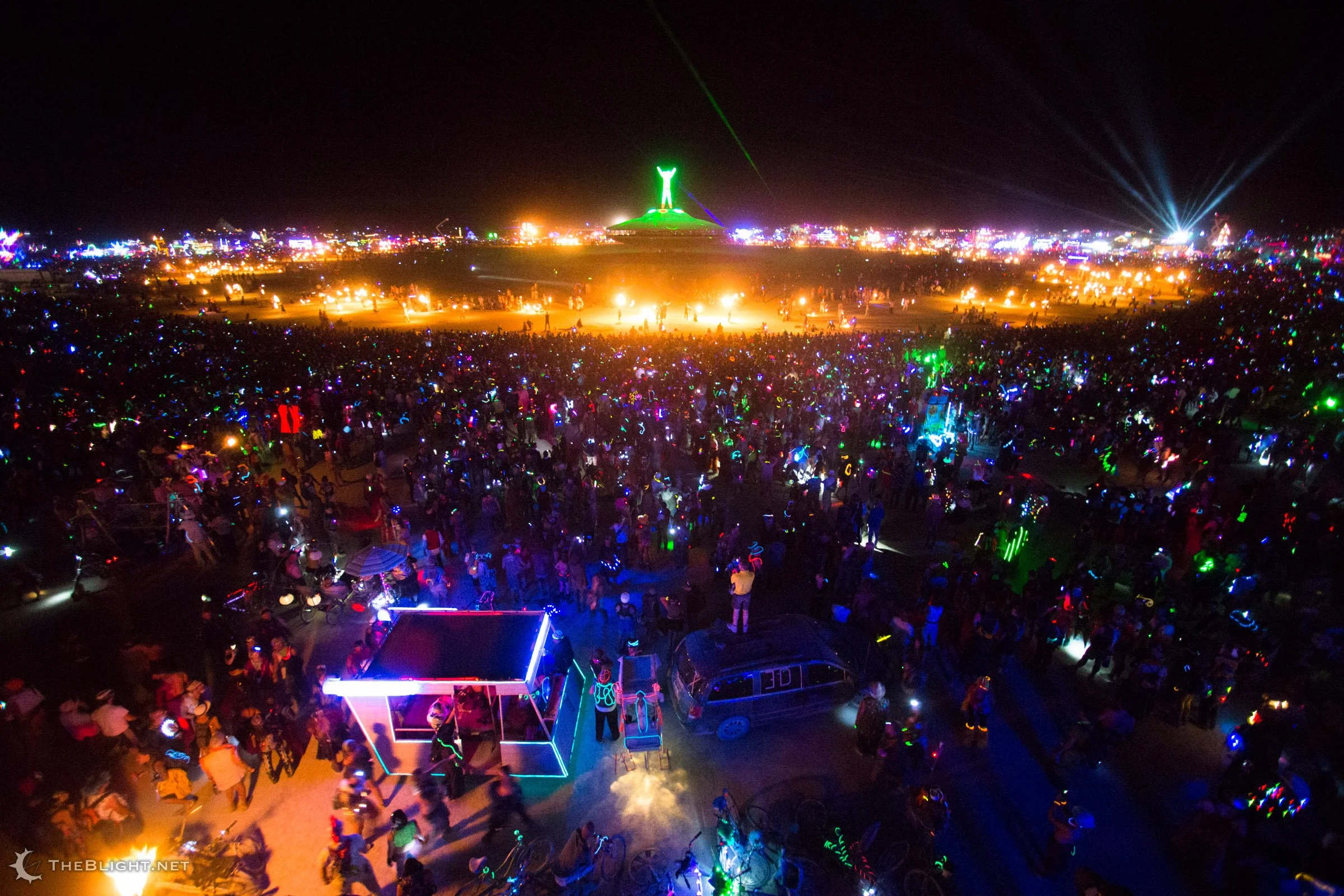
An aerial view of Burning Man music festival, the crowd littered with multi-colored neon lights, food trucks, and art structures

Burning Man, 2013. Chayna Girling. CC BY-NC-ND 2.0

From August 25 to September 2, 2024, tens of thousands of people will come together in Nevada’s Black Rock Desert for the notorious Burning Man music festival. The theme for Burning Man 2024 is "Curiouser & Curiouser," inviting participants to explore their curiosities and wonders. The lineup has not yet been released, but Burning Man is known to host artists from many different genres.

Burning Man evolved from a spontaneous event on a San Francisco beach in 1986, when Larry Harvey and Jerry James drew a crowd to burn a wooden man in celebration of the Summer Solstice. Since then, Burning Man has become an official event that has attracted as many as 75,000 people. Ticket prices range greatly, from $225 tickets for low-income participants who qualify for the Ticket Aid Program, to $2,500 for early-bird FOMO Tickets. The Main Sale tickets cost $575 in addition to a $150 vehicle pass.

Creamfields, England

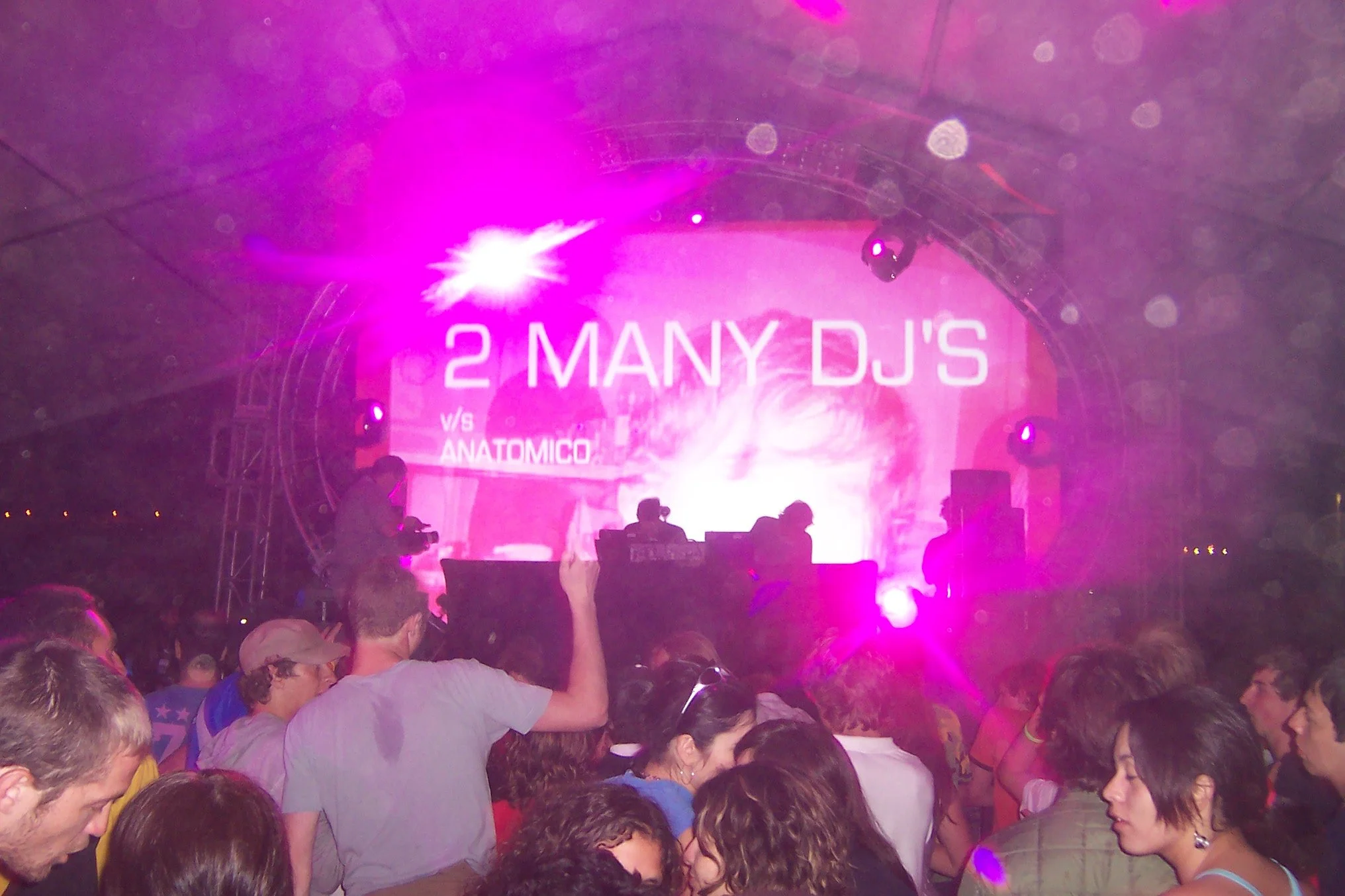
Festivalgoers at a neon pink lit DJ stage dancing along.

2005 Creamfields music festival, UK. Edith Adasme. CC BY-NC-SA 2.0

From August 22 to 25, 2024, Creamfields will return to Daresbury, UK, for another electrifying multi-day music festival. Since its origins as a weekly house music night called Cream, the event has transformed from a cozy club night into an iconic music festival that attracts thousands of attendees each day. 

With each stage dedicated to a different genre, Creamfields attracts lovers of all kinds of music. Dozens of artists will perform throughout the festival, from blk. to Calvin Harris. For an elevated festival experience, Creamfields offers a range of ticket options to suit different preferences and budgets. The ticket costs range from Standard Day Tickets, which cost about $100, to four-day Gold Tickets that cost about $550. 

Edinburgh Fringe Festival, Scotland

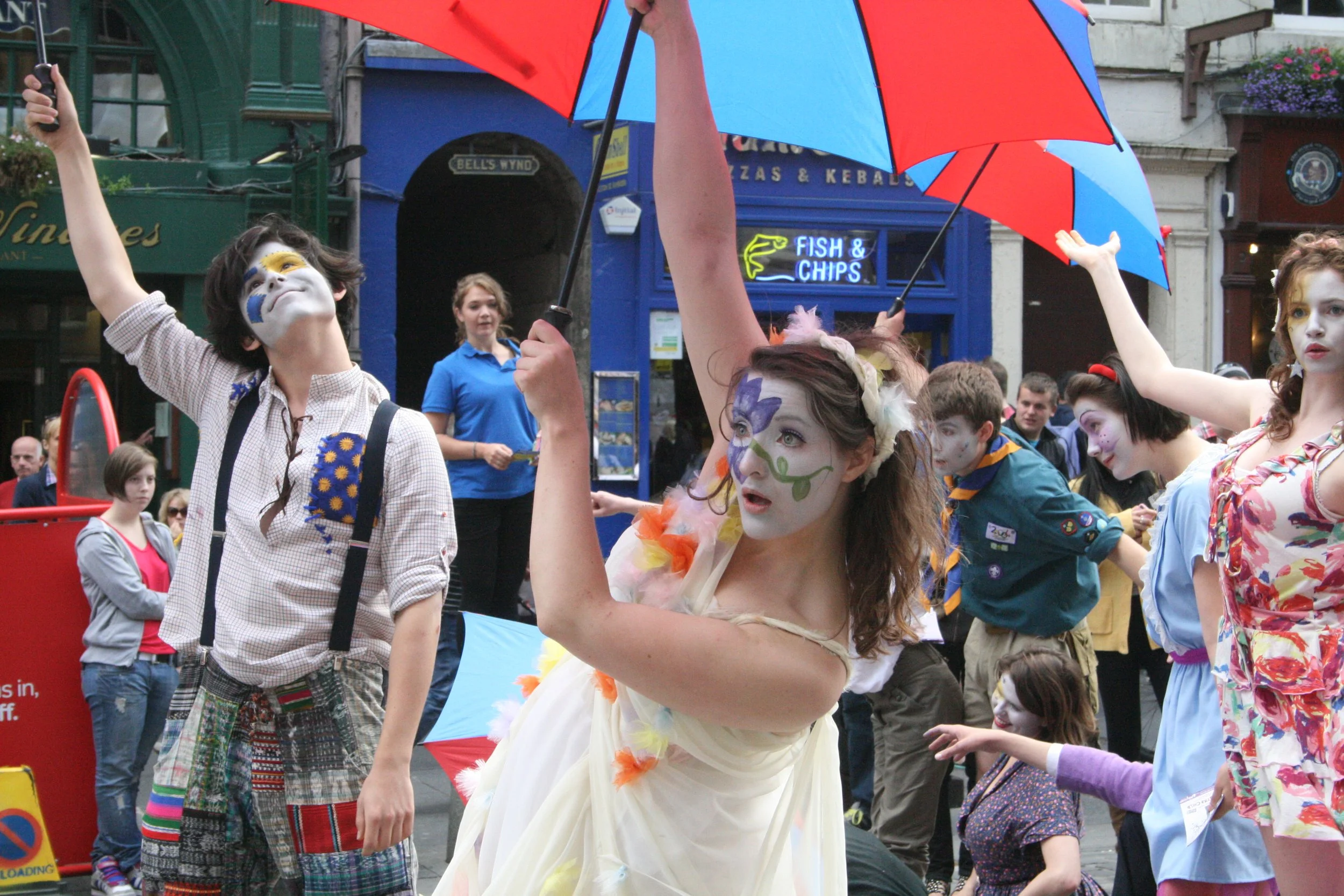
Three street performers in facepaint holding multi-colored umbrellas in downtown Edinburgh

Edinburgh Fringe 2011, Scotland. Anriro96. CC BY-NC 2.0

The 2024 Edinburgh Fringe Festival will bring 14 venues to life throughout Edinburgh from August 2 to 26. The origins of the Edinburgh Fringe Festival date back to 1947, when eight theater groups performed on the fringes of the Edinburgh International Festival. Since then, the Edinburgh Fringe has drawn millions of people.

Edinburgh Fringe features thousands of shows, from comedy to music. With many free shows, festival-goers can attend the Edinburgh Fringe Festival regardless of financial status. For those on a budget or with limited travel ability, there are some virtual events that festival-goers can attend as well. 

Lollapalooza, U.S.

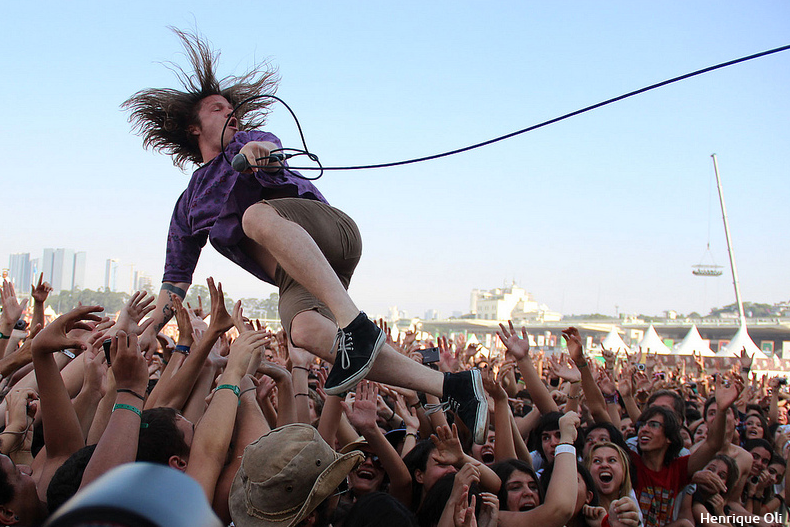
A singer crowdsurfing over cheering fans while still holding onto the corded microphone.

Cage the Elephant crowdsurfing at Lollapalooza. Henrique Oli. Wikimedia. CC 3.0

Lollapalooza returns to Chicago’s Grant Park from August 1 to 4, 2024, featuring a star-studded lineup with headliners like SZA, Megan Thee Stallion, The Killers, Blink-182 and Skrillex. Lollapalooza began as a traveling festival in 1991 when founder Perry Farrell envisioned it as a grand farewell for Jane’s Addiction. 

Since then, the festival has found its home in Chicago’s Grant Park, growing from a two-day event into a four-day extravaganza that attracts 100,000 attendees daily. With international outposts in cities like Santiago, São Paulo, Berlin and Mumbai, Lollapalooza’s impact has transcended borders. Ticket prices range from $155 for general admission to $4,500 for platinum two-day tickets. 

Sziget Festival, Hungary

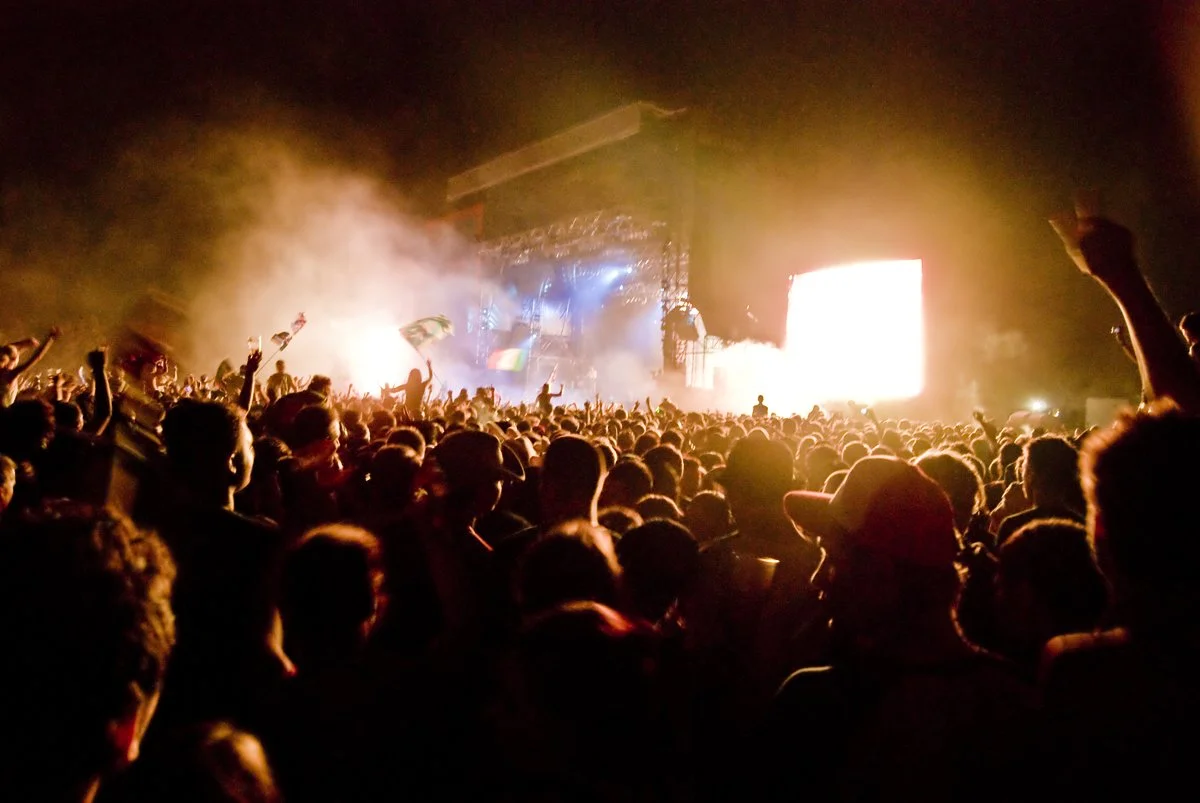
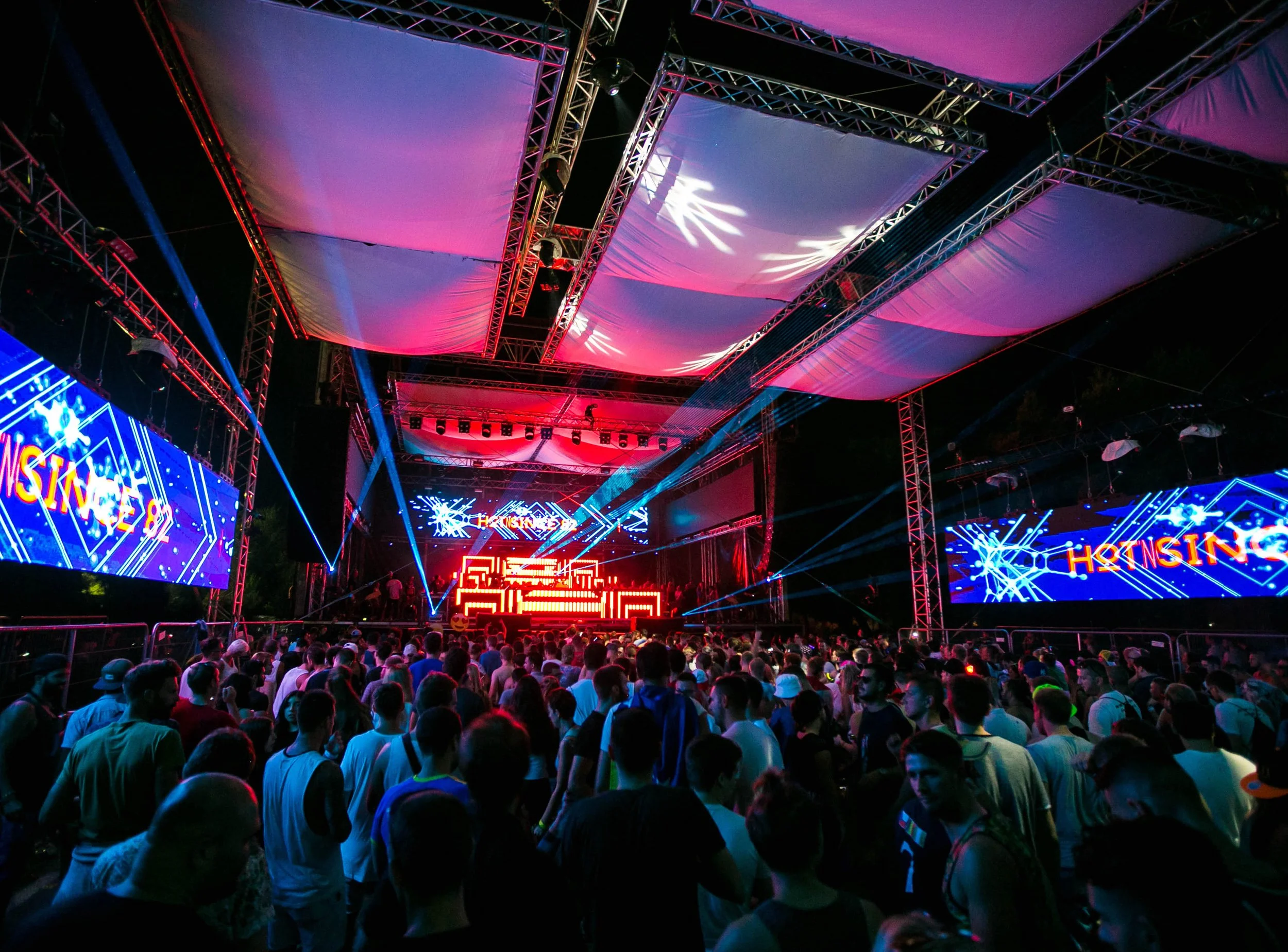
A full crowd at night dancing along against the lit stage.

A performance at the Sziget Festival, Hungary. Opethpainter. CC BY 2.0

From August 7 to 12, 2024, the Sziget Festival will transform Budapest into a musical paradise. At the Sziget Festival, festival-goers can witness world-renowned performances by artists like Halsey, Janelle Monáe, Sam Smith, Fred Again, Liam Gallagher, Martin Garrix, Skrillex, Stormzy, Louis Tomlinson and RAYE.

Tickets are available for purchase directly from the website. The ticket prices range from less than a dollar to about $2.50. Families are welcome, and children under 11 can enter free with a child wristband. Basic camping is included with the tickets, allowing festival-goers to set up a tent in any free camping area.


Madison Paulus

Madison is a student at George Washington University studying international affairs, journalism, mass communication, and Arabic. Born and raised in Seattle, Washington, Madison grew up in a creative, open-minded environment. With passions for human rights and social justice, Madison uses her writing skills to educate and advocate. In the future, Madison hopes to pursue a career in science communication or travel journalism.

A Trip Through the Past: Japan’s Living Heritage on Sado Island

The historical music, performing arts and cuisine are kept alive on a tiny resort island off the Japanese coast.

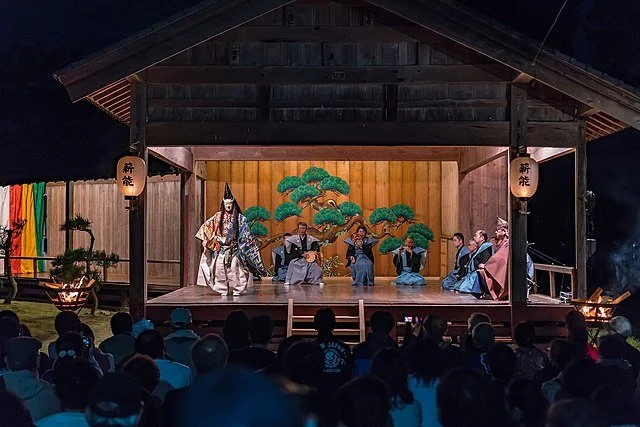
Traditional performers with instruments and in dress on stage as an audience sits and watches.

A Noh performance onstage on Sado Island. Yoshiyuki Ito, CC BY-SA 3.0

Feudal Japanese history gave rise to one of the most fascinating cultures in the world. Decades of relative isolation on the islands of Japan allowed for a completely unique society to blossom, and the resulting art, music and performance is incredible to behold. Although the world has largely moved on from the 18th century, there are still small pockets of society that try to keep those cultures alive. And there is no better place to see Japan as it once was than on Sado Island.

Sado Island was not always beautiful. In the beginning, it was used as a prison colony for political exiles from nearby Japan. Around 1601, however, the territory's rulers discovered a massive vein of gold running through the island. This naturally led to a gold rush, which jump started the population of Sado. The mine lasted for over 400 years, closing at last in 1989. After this, the population began to decline, and now the island has gone from a mining hub to a lush resort.

Today, Sado is a massive cultural hotspot. Throughout history, Sado Island was a crucial trading base on the way to Osaka—this resulted in a huge number of cultures leaving their mark on the land over centuries. Ancient Buddhist shrines and feudal Japanese temples share space across the island, as architecture from all eras fills in the gaps.

The city of Shukunegi, for instance, has been around for over 400 years—it was constructed during the beginning of the Edo era in the 1600s. Many of the buildings were actually built from wood and stone brought by or recycled from the trading ships themselves. Many of these structures are still standing today, packed tightly together to form blocks of houses.

However, the heart of Sado’s cultural preservation comes in the form of its performing arts and music. Noh, a traditional style of Japanese theater, is typically performed in shrines, with the audience sitting outside around bonfires. The stages are open on three sides, with the back featuring a painted image of pine trees. The lead performer typically wears a mask, fashioned after the leading characters of the play (although they are also used to denote spirits and demons). There is nothing in the world quite like Noh, and Sado Island is one of the best places to watch these magnificent performances in person.

Another example of classic Japanese culture on Sado Island is onidaiko, which literally translates as “demon drumming”. These performances include masked dancers and the famous music of Japanese taiko drumming, which was traditionally used to ward off negative energy and spirits during rice harvests. Taiko is most prominent during the Earth Celebration, which takes place in the middle of August every year and lasts for three days of music, performances, and culture. The Sado Island Taiko Centre, where visitors can see taiko drumming year-round, is home to two of the biggest taiko drums in the world.

In addition to its vibrant culture and rich history, Sado Island is a simply gorgeous natural vista. It boasts over 170 miles of coastline, with everything from nearly 100-foot cliffs and volcanic rock walls to lovely beaches. The island is also home to a wide variety of rare plants and animals, including the toki, also called the crested ibis, an extremely rare bird that has become the unofficial mascot of Sado. Even if you’re more in the market for nature than culture, there’s an incredible amount of both to be found on Sado.

Sado has a large number of hotels all over the island, ranging in price from $99 to $500. The island is a wonderful travel destination year-round, but the best time to go is mid-August in order to catch the Earth Celebration.


Ryan Livingston

Ryan is a senior at The College of New Jersey, majoring in English and minoring in marketing. Since a young age, Ryan has been passionate about human rights and environmental action and uses his writing to educate wherever he can. He hopes to pursue a career in professional writing and spread his message even further.

July 2024's Top European Music Festivals

Here's a compilation of music festivals to rock your summer.

A crowd under the neon lights and lit stage at a music festival.

Live outdoor concert. Ultrafan123, CC BY-SA 4.0

Exploring Europe offers a rich tapestry of experiences, from museums and historic cathedrals to renowned cuisines and coastlines. In between the typical, however, consider enlivening your trip with a summer music festival.

Rock Werchter (Werchter, Belgium) 

July 4-7, 2024

Packed crowd attends the outdoor venue and waits under the Black Keys stage.

The Black Keys at Rock Werchter 2023. Haggis MacHaggis, CC BY-SA 4.0

Head over to the tiny town of Werchter, Belgium, which has hosted the multi-award-winning Rock Werchter festival for over 40 years. It is one of the largest and most renowned festivals in Europe, with this year’s event boasting a strong 4-day lineup with headliners including Lenny Kravitz, Måneskin, Dua Lipa, and the Foo Fighters. According to their website, the carefully curated lineup “spans across all genres, making it a truly unique experience.” The curators also make it a point to showcase established artists alongside new talents. Rock Werchter is known for its Belgian beer, waffles, campgrounds, and multiple stages.

EXIT Festival (Novi Sad, Serbia)

July 10-14, 2024

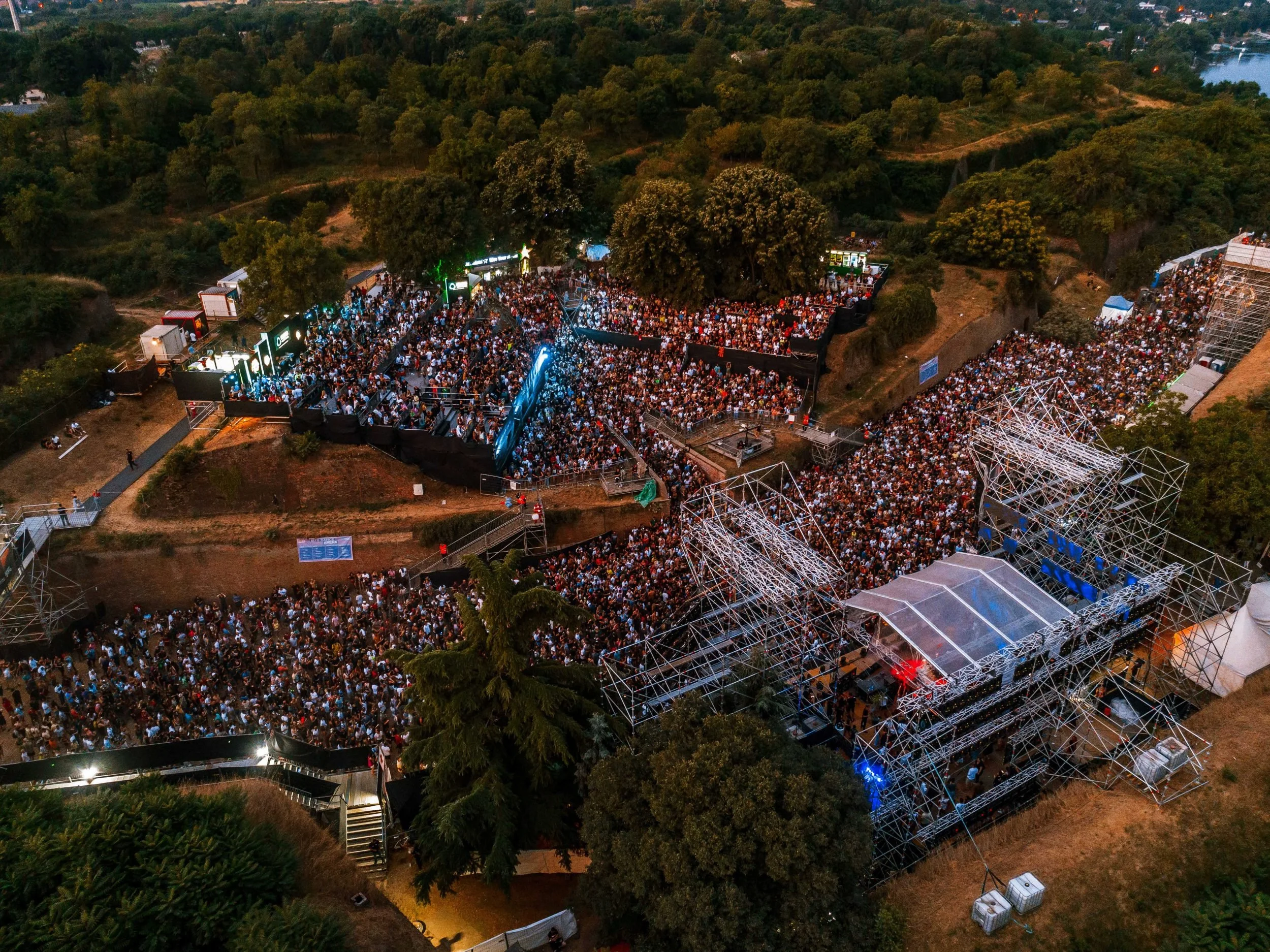
A birds-eye-view of the crowds and multiple stages at a festival

Drone shot of Exit Festival 2021. Exitfest, CC BY 3.0

The EXIT Festival of Serbia is known for its astounding location: the Petrovaradin Fortress, a historic fortress located on the banks of the Danube River, has unique acoustics and acts as a picturesque backdrop for the festival’s performances. This festival was first held in 2000 as part of a student movement fighting for democracy and freedom in Serbia. Since then, it has grown into one of the largest festivals in Southeast Europe, attracting tens of thousands of attendees each year. Today the festival continues to emphasize social activism and positive change through its various social responsibility projects. This year’s four-day lineup includes Gucci Mane, the Black Eyed Peas, John Newman, and Tom Morello.

NOS Alive Lisbon (Lisbon, Portugal)

July 11-13, 2024

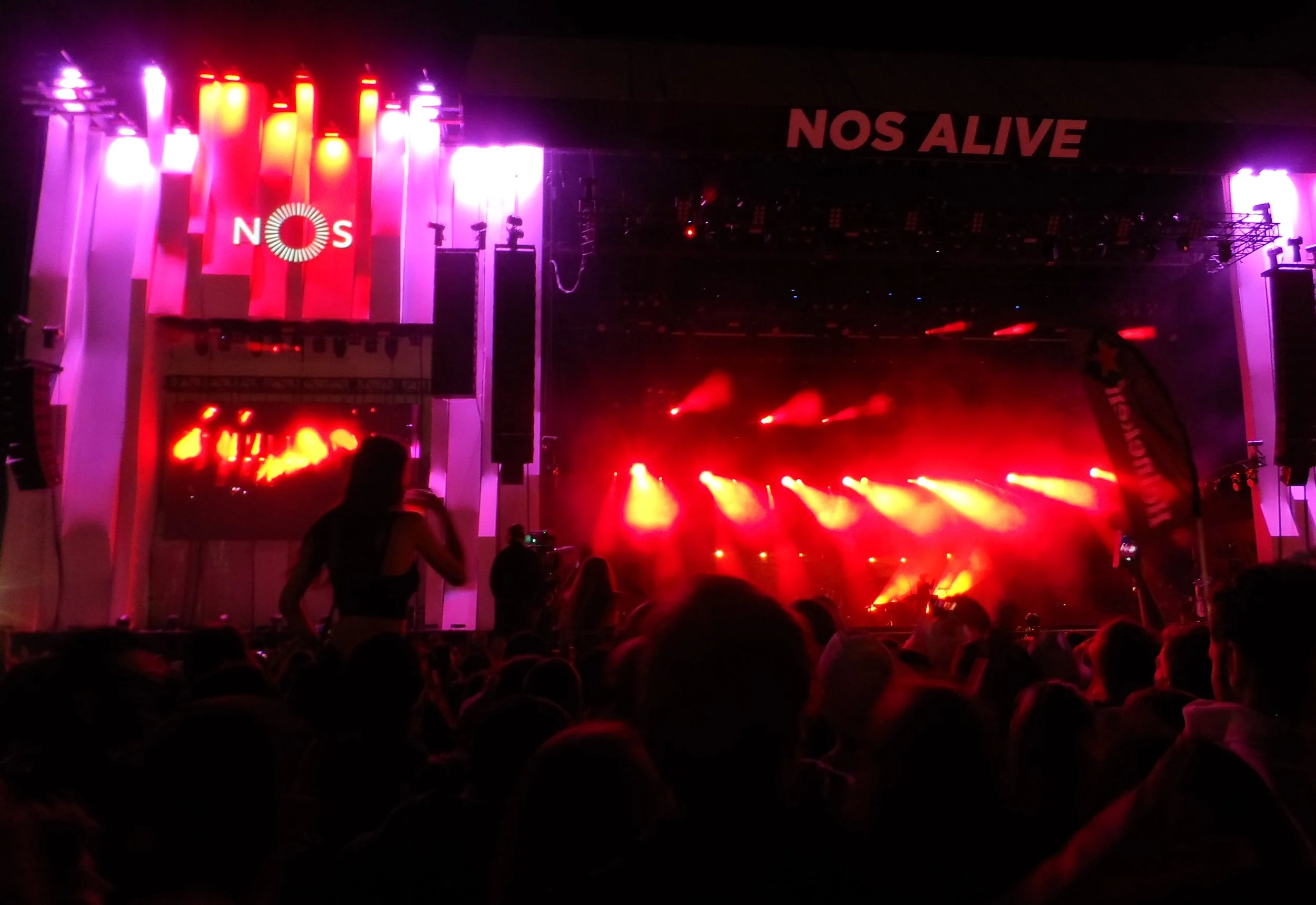
Under red lights, the crowd at a main stage cheers and dances along, looking up at stage.

The view of the mainstage from the crowd at NOS Alive. Chris, CC BY-SA 2.0.

NOS Alive Lisbon takes place at the waterfront Passeio Marítimo de Alges. Formerly known as Optimus Alive, this festival is known for local and international attendees attracted by its diverse lineup, including rock, indie, pop, electronic, and more. It typically showcases a mix of established artists and emerging talents across multiple stages. Festival goers can either camp on the grounds or stay in nearby hotels as the location is just eight minutes from downtown Lisbon. The three-day lineup this year includes artists like Arcade Fire, The Smashing Pumpkins, Dua Lipa, Tyla, Aurora, Pearl Jam, and Sum 41. Its reputation for hosting top-notch artists and vibrant festival atmosphere has contributed to its global appeal. 

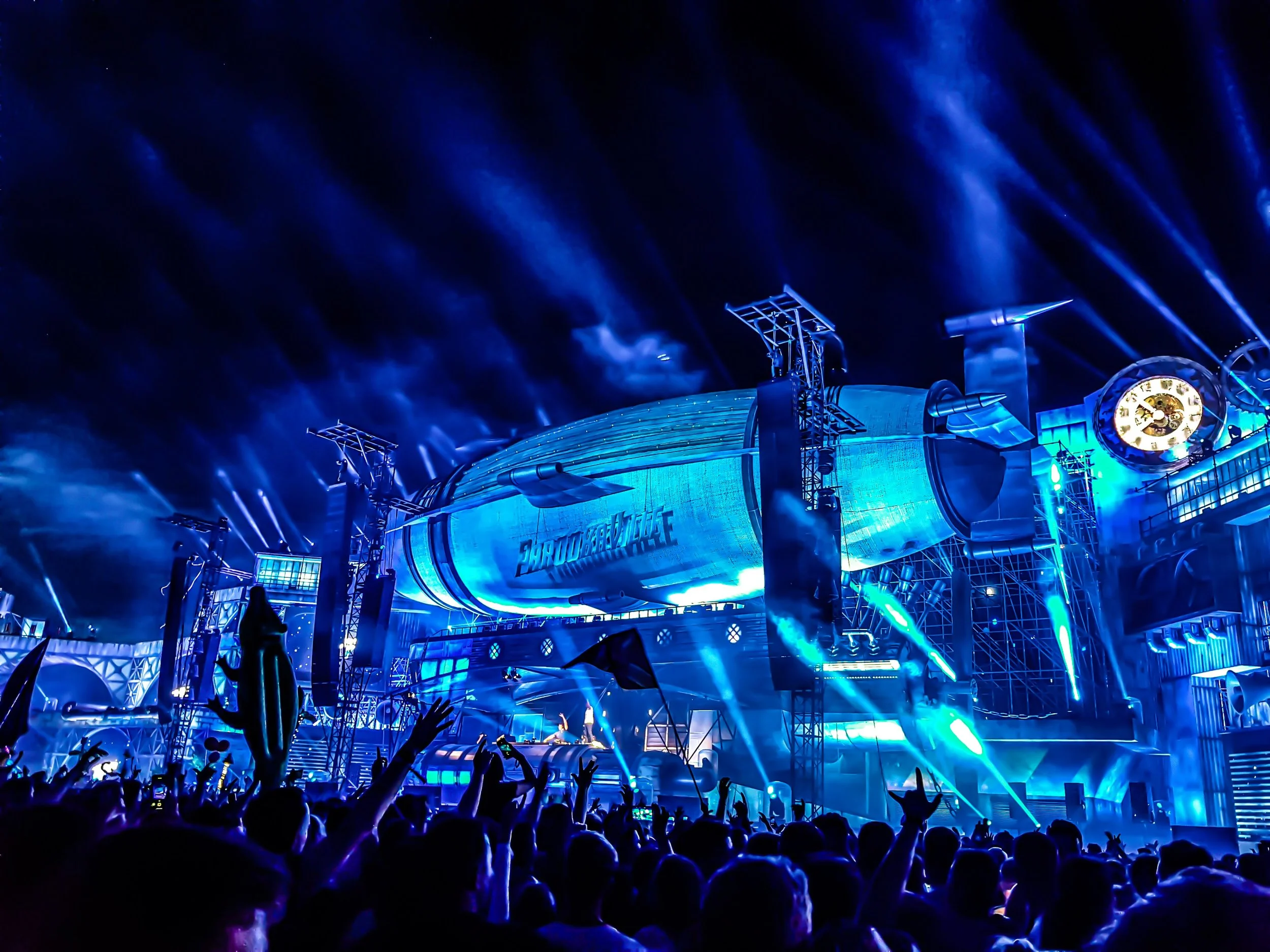
Parookaville (Weeze, Germany)

July 19-21, 2024

Under blue lighting and large blimp, a packed crowd cheers along under the stage at a festival.

The concert at the mainstage at Parookaville. Ss279, CC BY-SA 4.0

This German festival is truly unique as the event takes place in a faux city, known as Parookaville. Since 2015, the urban creation has come to life once a year in remembrance of the fictional founding father and mayor, Bill Parooka, whose goal was to make people remember to celebrate the joy of life. According to the festival’s website, Parooka is allegedly responsible for instituting the “Madness, Love and Pure Happiness” laws. Festival fans are invited to experience a “mad” musical place where they can connect with their purest selves, experience true connections, and feel sensations of bliss and love. This lineup for this year’s eccentric festival includes headliners such as Don Diablo, Steve Aoki, KSHMR, Oliver Heldens, and Timmy Trumpet. Parookaville is ideal for those open to new experiences and electronic dance. 

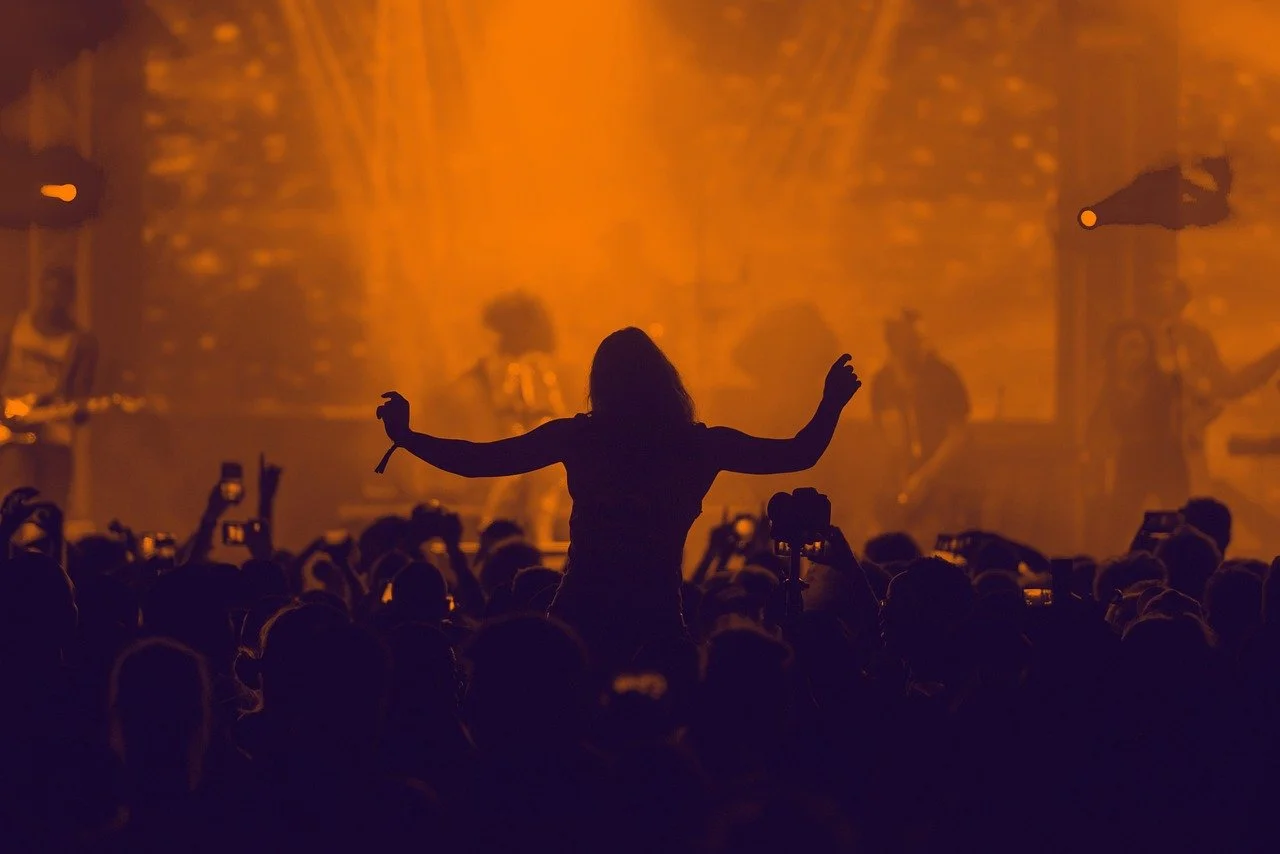
Hill Vibes Reggae Festival (Telfs, Austria)

July 24-27, 2024

Silhouette of a crowd in orange light and haze, as a girl dances atop someone's shoulders.

Concert, Crowd, Silhouette image. Mike Wall, CC0.

For the more relaxed and tranquil festival-goer, consider the Hill Vibes Reggae Festival in the mountains of Telfs, Austria. Hill Vibes celebrates reggae music and its various sub-genres. Attendees can expect performances from both local and international reggae artists. The festival boasts a lineup of talented musicians, featuring Gentleman, Alborosie, Romain Virgo, Mellow Mood, Teacha Dee, Samora, and Treesha. From roots reggae to dancehall and dub, the lineup offers something for every reggae enthusiast.

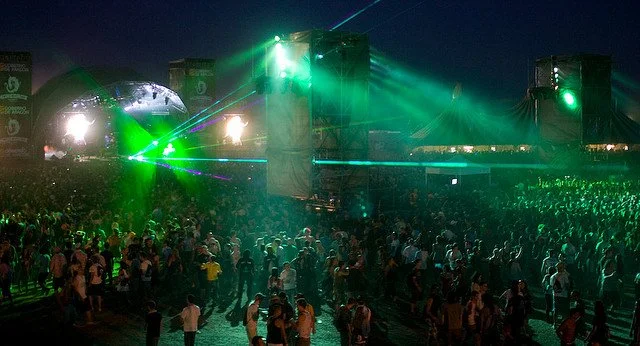
Monegros Desert Festival 2024 (Fraga, Spain)

July 27, 2024 

Festival attendees walk between crowded stages at night under flashing lights and colorful beams.

Monegros Desert Festival attendees at night. Gaudencio Garcinuño, CC BY-SA 2.0

The festival takes place in the Monegros Desert, located near Fraga in the province of Huesca, Aragon, Spain. Monegros Desert Festival is renowned for its lineup of electronic music artists, spanning various sub-genres such as techno, house, trance, drum, bass, and more. The festival has a rich history, from its inception in 1994 growing in popularity and stature to become one of the most anticipated electronic music events in Spain and beyond. In addition to the music, the festival is known for its impressive visual displays, stage designs, and production value. Immersive lighting, pyrotechnics, and other visual effects enhance the overall experience for festival-goers. This year’s one-day lineup includes Chase and Status, Vitalic, Sophia Gabanna, Culture Shock, and ASTRIX. According to Music Festival Wizard, Monegros is the biggest electronic music festival in Spain, and although many attempt to describe the festival, “It is literally impossible to put in plain words if you have not had the chance to attend it.”


Julz Vargas

Julz is a student at Wellesley College studying Anthropology and Spanish. She grew up in Los Angeles, CA, and has studied all around the world in places such as Costa Rica, Greece, Iceland, and Spain. She is passionate about employing writing as a tool to explore human connection and diversity. Julz aspires to foster cross-cultural connections through community-based research, amplifying inclusive and diverse media about global cultures, foods, and people, to encourage individuals to engage more wholly with the world.

In Mongolia, a Summer Festival for the Ages

For a few days in early July, the people of Mongolia eat, dance and play “the three games of men” during a storied festival called Naadam.

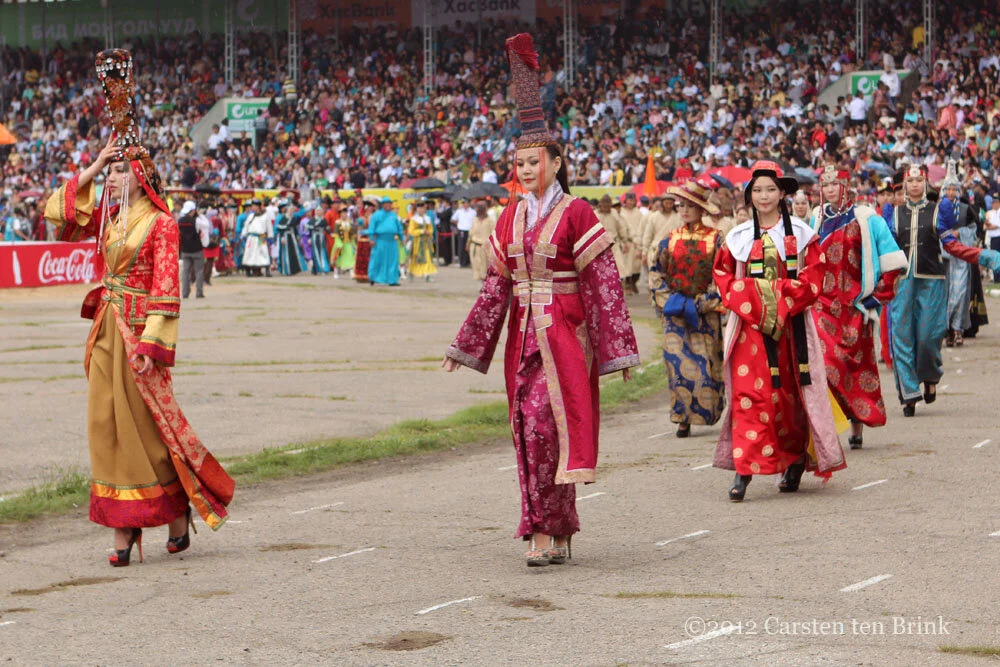
Women in traditional dress walk in a line during the opening ceremony of a festival in a filled stadium

The 2012 Naadam opening ceremony in Ulaanbaatar. Carsten ten Brink. CC BY-NC-SA 2.0.

Mongolia is a country primarily known for its nomadic inhabitants and isolated location. Positioned between Russia and China, it is easily overlooked in the midst of these global giants. Its relative emptiness does not help matters; only 3.3 million people inhabit Mongolia’s 603,909 square miles , making it the least densely populated country in the world. But every summer, those 3.3 million come together in a celebration of sports, culture and Mongolia’s past. This celebration is called Naadam, and as far as festivals go, it is one of the last of its kind.

In ancient times, when Ghengis Khan and his horde of Mongols were inhabiting what would eventually become Mongolia, soldiers were selected for battle based on their skills in various sports. Wrestling, horse racing and archery in particular were activities that Khan believed a good soldier should, and would, excel at. Before and after battles, his battalions would organize and participate in sports competitions. These local competitions evolved into what Naadam is now. 

As a consequence of the 1921 Mongolian People’s Revolution, which brought the nation independence from China, Naadam’s essence was altered. It was officially sanctioned as a national holiday, with a date set in the second week of July. Mongolia’s capital of Ulaanbaatar became the home of “National Naadam,” the biggest and most important celebration of the holiday. Most importantly, the festival became less of a violent competition and more of a national celebration; an emotional change which remains today. 

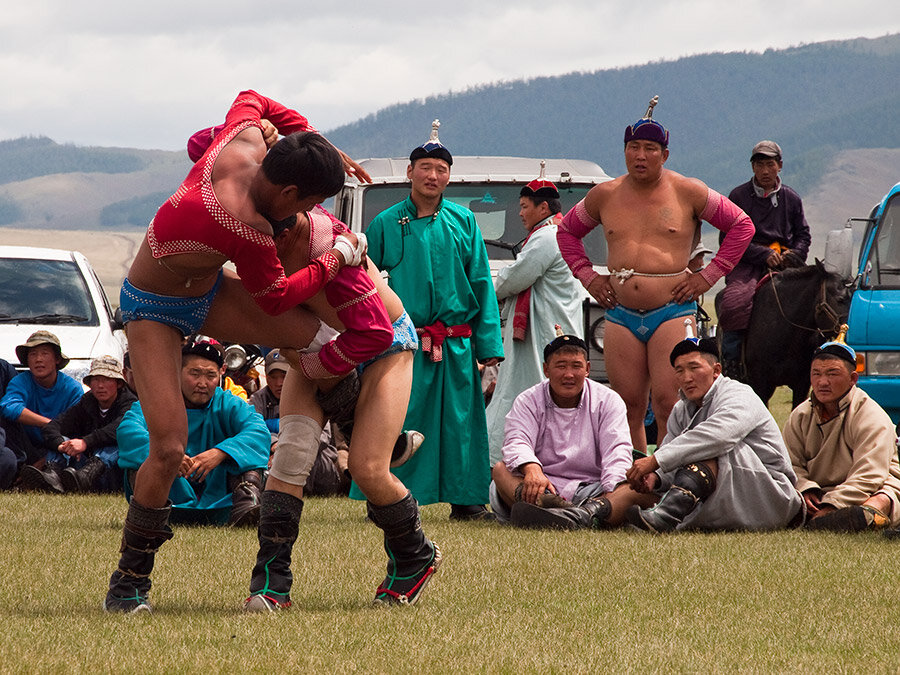
Every celebration of Naadam features the three main sports of Mongolia; wrestling, horse racing and archery. All three sports have histories in Mongolia that are older than the country itself. For example: if a rock carving found in central Mongolia is anything to go by, wrestling competitions have been around in the county since the Bronze Age. Naadam features the grandest of all Mongolian wrestling competitions; up to a thousand or more take part in the Ulaanbaatar tournament. Before their matches, wrestlers often mimic local birds such as eagles, hawks and vultures. By doing well in the competition, wrestlers can receive titles based on these animals—“hawk of Ulaanbaatar,” for example, would be given to a wrestler who makes it to the final few rounds.

The final thing to note about Mongolian wrestling is the dress code, which is very particular. Wrestlers must don a four-sided hat, shorts, boots, and a shoulder vest that exposes the chest. The legend is that the open vest was put into practice after a woman snuck into the male-only wrestling competition in ancient times by pretending to be her father, and eventually won the competition. Such deceptions have been made impossible by exposing the chest of the wrestlers; to this day, Mongolian wrestling continues to be an exclusively male sport.

Two wrestlers in traditional dress on a grassy field, while a crowd sitting forms around them to watch.

Naadam wrestling in the village of Tariat. Evgeni Zotov. CC BY-NC-ND 2.0

Horses are a large part of Mongolian life—nomadic tribes continue to depend exclusively on them for transportation. It follows that horse racing is extremely popular in the nation. According to Naadam’s official website, around 180,000 horses race during the holiday. All of Naadam’s races are very long in distance—at least in comparison to western competitions. The Kentucky Derby is about 1¼ miles long; a Naadam race can be up to ten times that.

Mongolian jockeys are incredibly wily and experienced; most Mongolians learn to ride a horse when they are just five years old. The jockeys treat their horses with incredible care. Before, after and even during the races, they are said to sing complimentary songs to their steeds.

The final sport of Naadam is archery, which is said to be even older than wrestling in Mongolia. Naadam’s official website hypothesizes that archery has been around in Mongolia since the Neolithic period, which ended in 4,500 BC. It was first used for hunting—later on, Ghengis Khan would employ it in his battles and sports competitions.

Male, female and child archers all compete at Naadam, wearing traditional costumes made of colorful cloth. There are three categories of the sport—Khalka, Buriat and Uriankhai—each of which come from different tribes and have different sets of rules. Only men are allowed to practice Uriankhai archery, for example.

While these three sports are the core of Naadam, the festival does not begin and end with them. There are smaller carnival games, singing and dancing. National cuisine is enjoyed; Khuushuur, a fried pancake with meat, is the most popular dish. Airag, a fermented, alcoholic drink made from horse milk, is also popular.

However, Naadam’s most important attribute is not the food, the history or the sports competitions. It is the fact that for a few summer days, the sparse vastness of Mongolia is filled. Whether in Ulaanbaatar or in a tiny village, Naadam brings Mongolians together to celebrate a culture that few in the world know anything about. This quiet happiness is the magic of Naadam; it is a magic that will continue long into the future.


Finn Hartnett

Finn grew up in New York City and is now a first-year at the University of Chicago. In addition to writing for Catalyst, he serves as a reporter for the Chicago Maroon. He spends his free time watching soccer and petting his cat

The Oldest Russian Theatre is in Latvia

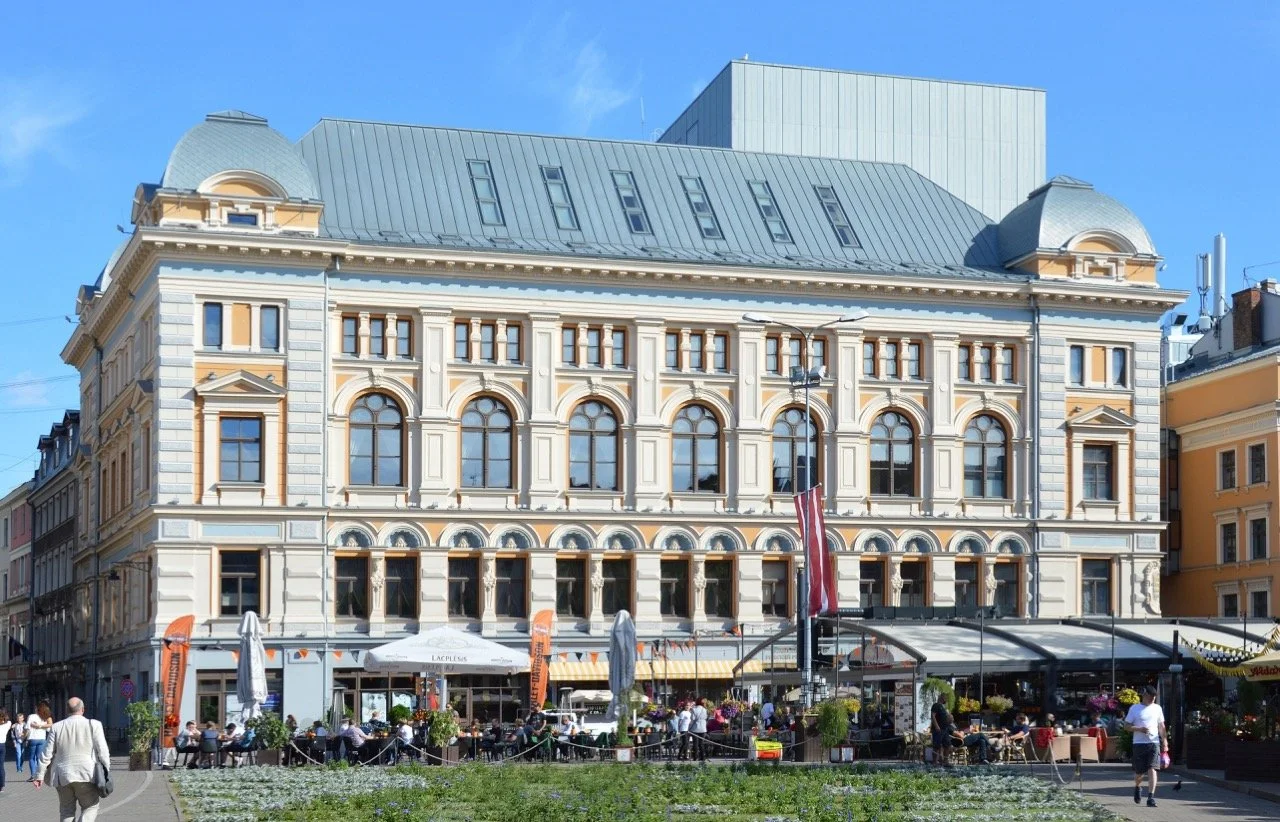
The Mikhail Chekhov Riga Russian Theater in Riga, Latvia, faced political censorship under the Soviets but managed to keep its doors open.

Large yellow building with ornate trim and window arches, standing tall among a lovely street.

Riga Russian Theater, 2018. Olaf Meister. CC BY-SA 4.0

Established in 1883, the Mikhail Chekhov Riga Russian Theater was the first of two kinds: the first professional theater in Latvia and the first Russian-language theater outside Russia. Before it was founded, there were no permanent Russian theaters in the capital city, only the occasional amateur performance, and it is thus deeply rooted in the history and development of professional theater in Latvia. Today the theater offers a mix of classical plays and modern, experimental works.

In 2006, the theater, known previously as the Riga Russian Drama Theater, was rechristened the Mikhail Chekhov Riga Russian Theater as a tribute to the actor, director and teacher, who spent two years working in Riga in the 1930s. A friend of Chekhov’s, Janis Karklinsh, quoted one of Chekhov's interviews with the Latvian press from this time: "Great nations crumble under the outcome of materialism and lust for power. The revival of art comes through the small nations.'' It was Chekhov’s opinion that the cultural context of Latvia in the early 1930s was the best ground for "real art.” Germany and France treated art as a "pretty cheap kind of entertainment.” “New art" could only be born in a developing country that was in the midst of cultural renewal. While in Riga, Chekhov directed and acted in five performances. 

The theater continuously confronted the issue of a lack of funding. In the early 1900s, a committee known as the ​​Society of the Guarantors of the Russian Theater in Riga was formed with the task of ensuring “the permanent existence of the Russian theater in Riga.” The First World War disrupted these efforts, and for a period of time between 1915 and 1921, the theater ceased operations. In 1921, the Latvian government made the decision to allocate close to $1,700 a year in order to “support the theaters of national minorities—German, Jewish, Russian” and the theater was able to resume its activities.

On August 5th, 1940, Latvia was occupied by the Soviet Union. Around 35,000 Latvians were killed or deported during the occupation between 1940 and 1941. As a result, the Riga Theater became a public theater and was cut off from its financial support from private entities, facing the political censorship that was common under Soviet occupation. It was not until 1998, less than a decade after Latvia had regained its independence from the USSR, that the Society of Guarantors was revived and the theater could once again receive financial donations.

The theater employs directors and designers from all parts of Europe, including Belarus, Estonia, Lithuania, Germany, Sweden, Italy, and more. Following the tradition of Russian theater, the company often performs pieces that include music and dance, though its repertoire is by no means limited to musicals. Directors employed by the theater strive to choose works that are profound and psychologically provocative in nature and push the boundaries of  drama itself. 

The theater retains a permanent troupe of actors as well as a repertoire of Russian, Latvian and international works, as well as works by young, emerging playwrights. In 2018, the theater inaugurated a studio for children and youth, ages seven to twelve, to train in the performing arts and develop skills in confidence and communication. Although the studio had to pause its workshops during COVID-19, as of 2024 they have resumed.

According to its website, the theater “harmoniously lives in the cross-cultural space, participates in the cultural dialogue—both nationally and internationally,” making it a significant cultural institution for Latvia.


Rebecca Pitcairn

Rebecca studies Italian Language and Literature, Classical Civilizations, and English Writing at the University of Pittsburgh. She hopes to one day attain a PhD in Classical Archeology. She is passionate about feminism and climate justice. She enjoys reading, playing the lyre, and longboarding in her free time.

Italian Night Life Thrives in Abandoned Buildings

Thanks to self-managed social centers, Italians have found a space to enjoy concerts, dinners, movie nights and more

A concert at night with one performer singing to the crowd.

Concert at XM24. Zeroincondotta. CC BY-NC-SA 2.0 

Since the 1970s, self-managed social centers have offered a place for Italians to gather as a community. Usually located on the outskirts of cities, these centers are established and operated entirely by locals. They are often formed as a direct response to social issues such as lack of affordable housing, drug addiction and marginalization. Members of the community occupy buildings that have fallen into disuse, such as schools, apartment complexes, forts and even farms. 

Pasted concert and political posters on a grafittied wall.

CSOA Forte Prenestino. boklm. CC0 1.0

The legal status of these centers varies, and some face eviction by authorities despite their value to the community. Many of the centers take a strong political stance, defining themselves as anti-fascist, anti-sexist, anti-racist and anti-capitalist. These spaces serve as important refuges for members of the community and a place for diverse groups of people to meet and collaborate.

Singer on stage holding his fist in the air.

Concert at XM24. Zeroincondotta. CC BY-NC-SA 2.0 

One of the most famous of these self-managed social centers was XM24, or ExMarket, of Bologna. It emerged during a period of repression as the mayor of the city engaged in a campaign against social housing and squatter movements. The center established itself in several abandoned spaces, including a former fruit and vegetable market from which it took its name. It offered a number of services to the community, including a cafe, a bike shop, a vegetable garden, live concerts, a gym, and a dormitory for migrants, refugees and the houseless. It was run by a general assembly of local volunteers.

Written grafitti on a wall that promotes collective action.

XM24 Graffiti, Against those who close our spaces, let’s ignite our rage. Zeroincondotta. CC BY-NC-SA 2.0

In 2013, XM24 was able to reach an agreement with the local government, allowing the center to operate independently and utilize the abandoned spaces. However, the agreement expired in 2017. Members of the community attempted to protest the eviction in a struggle with the city that lasted two years, but in 2019 the space was evicted and bulldozers arrived to clear it out. As of 2024, the center no longer exists. 

Leoncavallo Spazio Pubblico Autogestito. Robertino Radovix. CC BY-NC-SA 2.0 

XM24 was not the only self-managed center to be evicted by the government, but many centers have still found a way to thrive. The Leoncavallo Spazio Pubblico Autogestito of Milan still offers jazz concerts, stand-up comedy, dinners, English lessons and more to locals. It is currently open Thursdays through Sundays in the afternoon and evening, although they face eviction on June 18th, 2024 by the bailiff and the property’s lawyers. 

Daniele Sepe & Aldolà Chivalà. L’Asilo. CC BY-NC-SA 2.0 

Je So’ Pazzo is a self-managed center in the Marterdei district on the outskirts of the city of Naples in a former asylum for the criminally insane. When it was occupied in 2015, it was managed by the Penitentiary Police. Volunteers collaborate with local associations to house, collect clothing for and distribute meals to the houseless. Their services include medical clinics, psychiatric support and migrant aid. They also offer a number of recreational activities, such as Naples’ only indoor rock climbing wall, a football pitch, a gym, a theater, a bar, social dinners, concerts, and so much more. It is still active and open 24 hours a day, six days a week. Like most places in Italy, it is closed on Sundays.

Two male performers on stage at concert, one with a guitar and the other singing through microphone

Concert at CPA, Firenze. GothEric. CC BY-SA 2.0

The Centro Popolare Autogestito Firenze Sud and LaPolveriera SpazioComune are both self-managed centers located in Florence. Like other social centers, they offer a variety of recreational activities during the days and the evenings, such as ceramics classes and concerts, as well as important social services for the community.

Whether you are looking to participate in a ukulele workshop, enjoy a dinner and movie, discuss politics with local Italians, or let loose at a heavy metal concert, self-managed social centers are the perfect place.


Rebecca Pitcairn

Rebecca studies Italian Language and Literature, Classical Civilizations, and English Writing at the University of Pittsburgh. She hopes to one day attain a PhD in Classical Archeology. She is passionate about feminism and climate justice. She enjoys reading, playing the lyre, and longboarding in her free time. 

Journey to Malaysia: The Gawai Dayak Festival

On June 1st travelers can relish in Sarawakian culture at the colorful Gawai Dayak Festival.

A parade float decorated with a small house built on the roof of a truck, grass hangs off the side, children march behind smiling.

A Gawai Dayak float. Baka_neko_baka. CC BY 2.0

In the Iban language, Gawai Dayak means something like "Festival of the Native Ethnic Groups of Sarawak," a state in Malaysia. This festival brings communities together to celebrate the end of the rice harvesting season. Gawai Dayak is a time of gratitude and companionship where people give thanks for that year's harvests and pray for a fortunate future.

Rice agriculture is integral for many Sarawakians. By June the majority of the hard work in the rice fields is done, and Sarawakians have a period of celebration and rest until the next planting season begins in September.

Gawai Dayak festivities begin during Gawai Eve on May 31st. On Gawai Eve, locals conduct a ceremony called Muai Antu Rua to cast away negative spirits and roast rice over bamboo. During the Muai Antu Rua ceremony, unwanted items are collected from Iban longhouses and used in a miring, or offering ceremony, filled with music. 

After the Muai Antu Rua ceremony, attendees await midnight when the sound of a gong kicks off Gawai Dayak. Many activities and traditions are open to locals and visitors during Gawai Dayak. During the celebrations, participants can engage in traditional dances, dance competitions, and enjoy Sarawakian delicacies such as a rice wine called Tuak, which is thought to bring long life, and rice cakes called Penganan

Gawai Dayak is a time filled with events and activities. A popular Gawai Dayak tradition is the Kumang and Keling Gawai contests where celebrants elect the festival’s queen and king. Other common Gawai Dayak traditions include blow-pipe demonstrations and rooster fighting.

Gawai Dayak celebrations can continue for several days. During the festivities, travelers have the unique opportunity to visit the Dayak homes, which are often open to visitors during Gawai Dayak.

Many visit the Sarawakian capital Kuching to celebrate Gawai Dayak. While the official date for Gawai Dayak is June 1st, in Kuching Gawai Dayak is celebrated the week before the World Harvest Festival. These dates vary every year, but the celebration usually falls at the end of May or the beginning of June.

During the Gawai Dayak in Kuching, there is an array of theatrical and musical performances from both local and international troupes. Explorers can also discover traditional cuisine in local longhouses and experience appetizing aromas, engaging workshops and upbeat music at the Food & Craft Fiesta.


Madison Paulus

Madison is a student at George Washington University studying international affairs, journalism, mass communication, and Arabic. Born and raised in Seattle, Washington, Madison grew up in a creative, open-minded environment. With passions for human rights and social justice, Madison uses her writing skills to educate and advocate. In the future, Madison hopes to pursue a career in science communication or travel journalism.

May Day Magic: How Different Countries Celebrate

Sixty-six countries around the world recognize May Day, and a variety of different celebrations and traditions can be found throughout Europe.

Close-up of bouquets of colorful flowers wrapped in ribbon and paper lying side by side

May Day bouquets. Alyss. CC BY-NC-SA 2.0

The roots of May Day are in the Gaelic Beltane Festival and Roman Floralia. In 1891, the first of May also became recognized as International Workers Day. Over the years, May Day festivities have maintained ancient traditions while evolving to include modern activities from picnics to music festivals.

England

Children dressed in white holding onto colorful strings attached to a central pole, they form circles as they dance around the maypole.

Children performing the Maypole Dance. Pete Ashton. CC BY-NC 2.0

England boasts a long history of May Day celebrations. Traditional Maypole dances can still be seen throughout the country. These dances are often performed by children adorned with flowers who hold ribbons connected to the Maypole. 

The ribbons create a colorful design as the children dance around the maypole. Said to represent the increase of daylight between the winter and summer months, this tradition is around 600 years old.

Beyond witnessing this traditional dance, history enthusiasts can witness re-enactments of conflict between the Vikings and Saxons at Corfe Castle in Dorset. 

Finland

Crowds gather in a park, all wearing special graduation caps and with picnics to celebrate.

May Day picnic in Helsinki, Finland. Ninara. CC BY 2.0

Finnish May Day celebrations are called Vappu, and are celebrated on April 30th and May 1st. During the festivities, travelers can see streets and parks dotted with white hats; these hats are secondary-school graduation caps, which have become a staple of the Vappu celebration. 

During Vappu, Finland is incredibly lively, full of parties, picnics, parades and political speeches. These events are accompanied by several traditional delicacies, including Finnish May Day funnel cakes called Tippaleipa, Finnish donuts called Munkki, and a unique kind of mead called Sima.

France

Close up of a white Lily of the Valley flower in garden.

Lily of the Valley. liz west. CC BY 2.0

In France, May Day is known to be a day of rest when nearly every business is closed in honor of Labour Day, although flower shops and stands are allowed an exception. This is because Lily of the Valley flowers, called Muguet in French, are a staple May Day tradition.

During the holidays, Lilies of the Valley are exchanged between family and friends as a symbol of good luck. During May Day, French streets are strewn with these flowers as this day marks the only time of the year when people are allowed to sell these flowers on the street without requiring a license or taxation.

Germany

People stand in front of the massive bonfire at night.

Walpurgisnacht celebration, Germany. Michael Panse. CC BY-ND 2.0

On the eve of May Day, Germans celebrate Walpurgisnacht, a spring festival with a history rooted in witchcraft. This tradition has its origin in the belief that witches celebrate the coming of spring on the summit of Blocksberg Mountain. During Walpurgisnacht, festivalgoers can dance around bonfires and indulge in Maibowle, a punch made up of white and sparkling wines and wild woodruff. 

On May Day, parades featuring brass bands make their way through the streets, followed by maypole dances and public gatherings filled with bratwursts and beer. A festival for dark rock and arts has also been celebrated in Leipzig since 1992, drawing goths from around the world.

Greece

Looking over a wooden fence, a view of a grassy wildflower meadow in the mountains.

Wildflowers in Greece. Kevin Casper. CC0

May Day has been celebrated in Greece long before its association with Labour Day. Protomagia, the traditional Greek May Day celebration, has been a time for Greeks to celebrate rebirth and honor the dead for centuries. 

While traditions vary across regions, many feature lively singing, dancing and rituals. A few of these customs include women singing traditional May Day songs while dancing around bonfires. Children also leap over the bonfires to symbolize the end of winter and banish disease. 

Greenery and flowers have long symbolized vivacity and fertility. In preparation, people collect wildflowers from the countryside and create wreaths. These wreaths can be found on balconies and doors across the country, intended to ward off evil. These wreaths are then preserved and tossed into bonfires during the Feast Day of Aghios Ioannis Klidonas on June 24th.

Ireland

A close up of a field of red flowers, the top of a historical church or building peeks out at the top.

May Day flowers in Northern Ireland. Etrusia UK. CC BY-NC-SA 2.0

Traditionally, Ireland celebrated the Beltane Festival, including Maypoles and May Bushes, which were usually Hawthorn bushes decorated with ribbons and occasionally colored eggshells left over from Easter. 

Children in Dublin would wander the streets in search of money, candles or sweets by approaching people and saying “Long Life, a pretty wife, and a candle for the May Bush”.

While these traditions have largely died out, travelers can still find bonfires in counties like Clare and Limerick. Partygoers celebrate throughout the country, enjoying the holiday with family and friends.

Italy

A sole performer on stage with their microphone in the air under purple lights, surrounded on all sides by massive crowds.

May Day Concert, 2008. Gniliep. CC BY 2.0

For May Day, Italy hosts the largest free music event in Europe. The May Day Concert in Rome's Piazza San Giovanni in Laterano began in 1990 and has drawn thousands of people every year since. At this event, travelers can experience live music and street events.

Beyond the May Day Concert, Italians and visitors alike use the holiday as an opportunity to soak up the sun and indulge in Italy’s rich culture. Italy has many beaches, such as Salento, where people can celebrate the coming of spring along the water. People also flock to San Gimignano, home to incredible wine, architecture, and a UNESCO World Heritage Site at the city center.

Scotland

Performers dressed in white, flowers, and green tulle are among a crowd and torches for the May Day Celebration at night.

Performers at the Beltane Fire Festival, 2009. Martin Robertson. CC BY-NC-ND 2.0

Scotland is another destination where the Beltane Festival is celebrated. Since the 1980s, traditional Beltane celebrations have been revived with modern additions. 

One of the most prominent celebrations occurs on April 30th in Edinburgh. Every year, around 10,000 people from around the world are drawn to the Beltane Fire Festival. During the festival, a procession filled with drums travels through the streets, led by traditional May Day characters like the Green Man and the May Queen. 

Following the procession, there is a three-hour stage performance which is concluded by the lighting of a bonfire. At the festival, visitors have the opportunity to immerse themselves in the traditional performances and support local businesses


Madison Paulus

Madison is a student at George Washington University studying international affairs, journalism, mass communication, and Arabic. Born and raised in Seattle, Washington, Madison grew up in a creative, open-minded environment. With passions for human rights and social justice, Madison uses her writing skills to educate and advocate. In the future, Madison hopes to pursue a career in science communication or travel journalism.