
Despite its small size and remote location in the southwest Pacific Ocean, New Zealand boasts diversity of all kinds and is exploding with culture, innovation, and beauty. Although today most of its inhabitants are of European descent, its Maori culture shines through, as well as the influences of recent immigrant groups. Additionally, while New Zealand is incredibly developed, with populous cities, it still has incredible geographic diversity. A traveler can find mountains, marshes, valleys, and coastal cliffs all without leaving a single island. The preservation of New Zealand’s nature is a testament to its people’s dedication to maintaining a balance between technological innovation and preserving the climate. Any traveler there will enjoy the best of both worlds and get a taste of a life unlike any other.
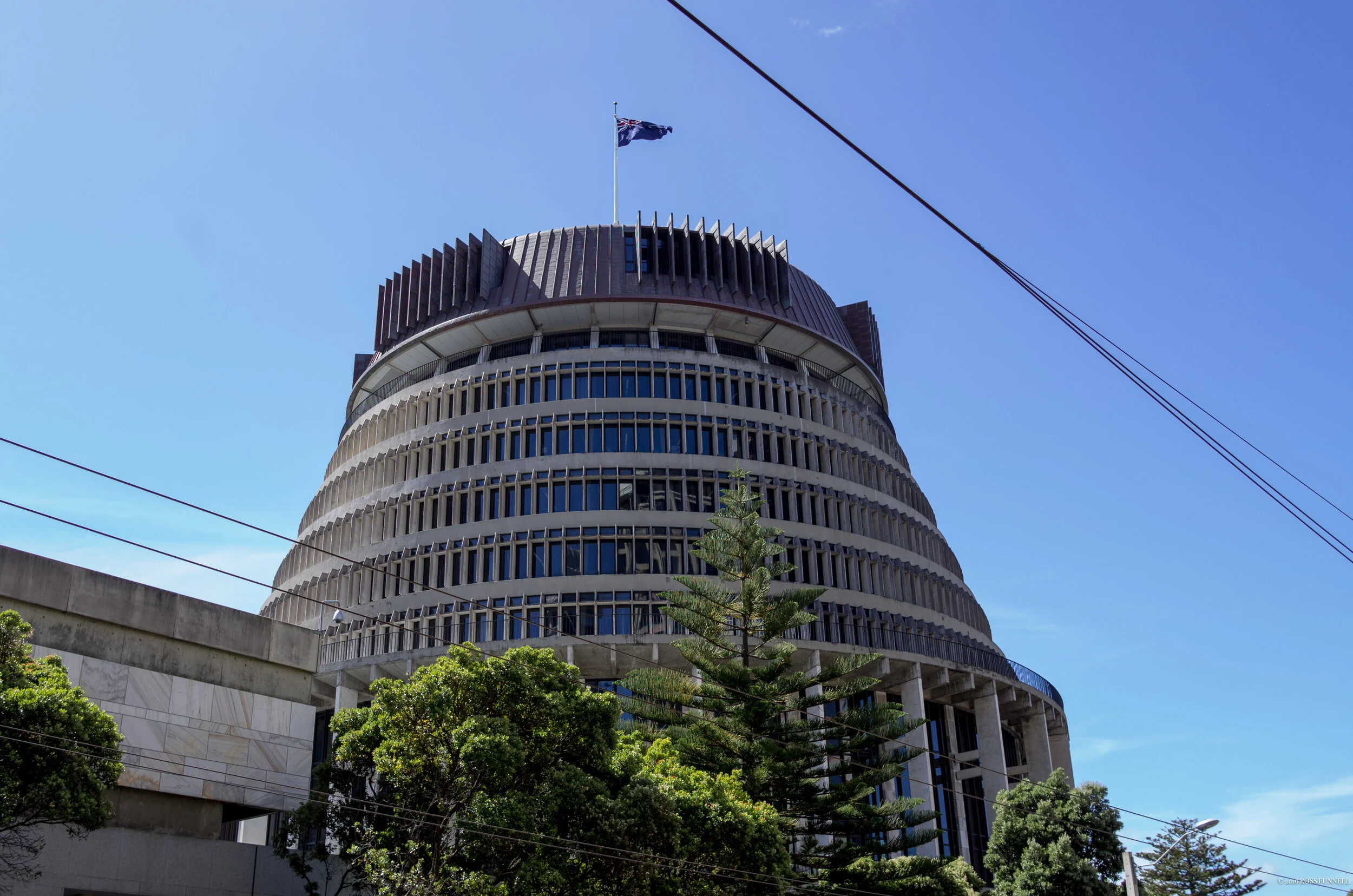
The New Zealand Parliament building. Ref54. CC BY-NC-ND 2.0.
New Zealand Legalizes Euthanasia as World Begins to Accept the Practice
In a late October referendum, New Zealanders voted in favor of legalizing euthanasia, the practice of allowing patients with an incurable and painful illness to terminate their life early. This binding act, which will go into effect on Nov. 6, 2021, will make New Zealand one of seven countries to permit the controversial practice. Assisted suicide, a similar practice which involves a physician aiding in ending a terminal patient’s life, is legal in a handful of jurisdictions, including Switzerland, Germany and several U.S. states.
The practice of euthanasia, while gaining support around the globe, is still considered controversial, especially among religious communities. The Roman Catholic Church, for instance, has condemned the practice, stating in the Catechism of the Catholic Church that: “Whatever its motives and means, direct euthanasia consists in putting an end to the lives of handicapped, sick or dying persons. It is morally unacceptable.” This opposition has resulted in a patchwork system of legal euthansia, assisted suicide or other means of voluntarily terminating one’s life.
New Zealand’s “End of Life Choice Act”
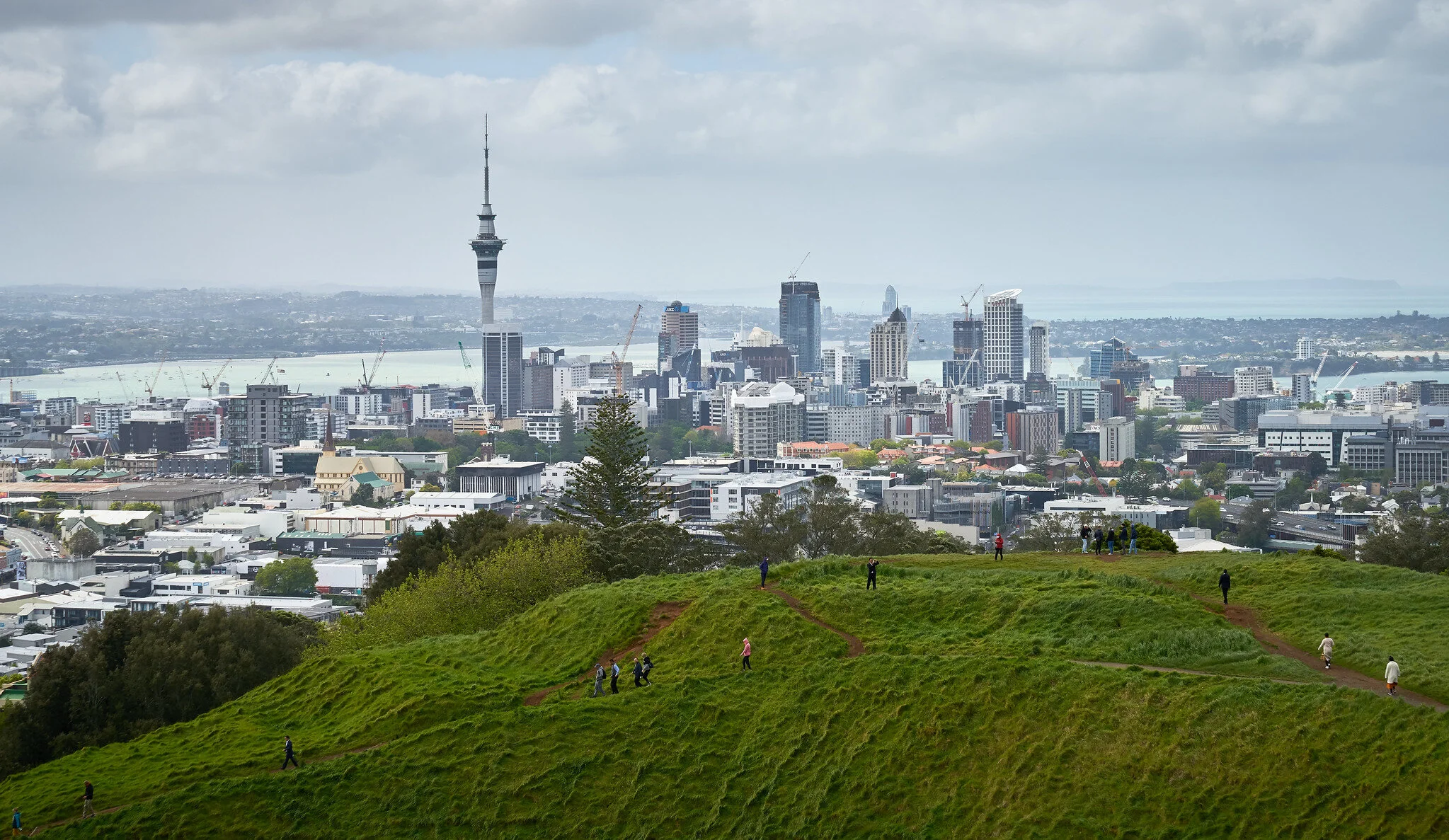
A view of Auckland, New Zealand’s most populous city. Pedro Szekely. CC BY-SA 2.0.
New Zealand’s referendum centered around whether or not the country should adopt the 2019 End of Life Choice Act. The law, which was originally introduced in October 2015 by member of Parliament David Seymour, permits voluntary euthanasia for patients confirmed by two doctors to have a terminal illness and be in the final six months of their lives.
“The motivation for this bill is compassion,” Seymour said in a press release from political party ACT New Zealand. “It allows people who so choose and are eligible under this bill to end their life in peace and dignity, surrounded by loved ones.”
While public opinion in New Zealand over the last two decades has averaged around 68% annually in support of legalized euthanasia, opponents to the practice have succeeded in shooting down similar legislation. Two iterations of the Death with Dignity Bill and a previous iteration of the End of Life Choice Bill, which outlined similar euthansia legalization statuses to the one voted on last month, failed to make it through Parliament in 1995, 2003 and 2012, respectively.
The main opposition force to euthanasia in New Zealand has been The Care Alliance, an organization which was created shortly after the introduction of the 2012 End of Life Choice Bill. It advocates for “better end-of-life care and assisted living services for people at the end of life or who require assistance to live” with the belief that “a compassionate and ethical response to suffering does not include euthanasia or assisted suicide.”
The current End of Life Choice Act is set to go into effect on Nov. 6, 2021, which allows for a one-year implementation period to take place immediately after the results of the referendum were finalized on Nov. 6, 2020.
Bans on Euthanasia Around the Globe

A crowd listens as Pope Francis delivers Sunday Angelus. Greg Sass. CC BY-NC-SA 2.0.
As of November 2020, euthanasia in any form is explicitly banned in countries on every continent. While each country has its own reasons for banning the practice, one standard which has inhibited further global legalization has been the United Nations’ International Covenant on Civil and Political Rights, which states that “Every human being has the inherent right to life. This right shall be protected by law. No one shall be arbitrarily deprived of his life." This has been interpreted by many in opposition to euthanasia as a standard to abide by.
Many within the religious community have opposed euthanasia for years. Many denominations of Christianity, including Episcopalianism, Lutheranism, the Eastern Orthodox Church and the aforementioned Catholicism, have all condemned the practice as a form of murder.
While Islam does not explicitly prohibit euthanasia, the practice is considered to be in direct opposition to Islamic law. Several passages from the Quran have been interpreted in such a manner, including “And do not take any human being’s life—which Allah has made sacred save with right” and “Do not kill yourselves: for verily Allah is to you most merciful.” This has resulted in euthanasia being a crime in nearly all majority-Muslim countries.
Other world religions, such as Judaism, Buddhism and Hinduism, are still debating the ethics of euthanasia. Generally, these debates center around a conflict between a divine right to life and the increasing trend toward global secularism.
Euthanasia’s Patchwork Legality
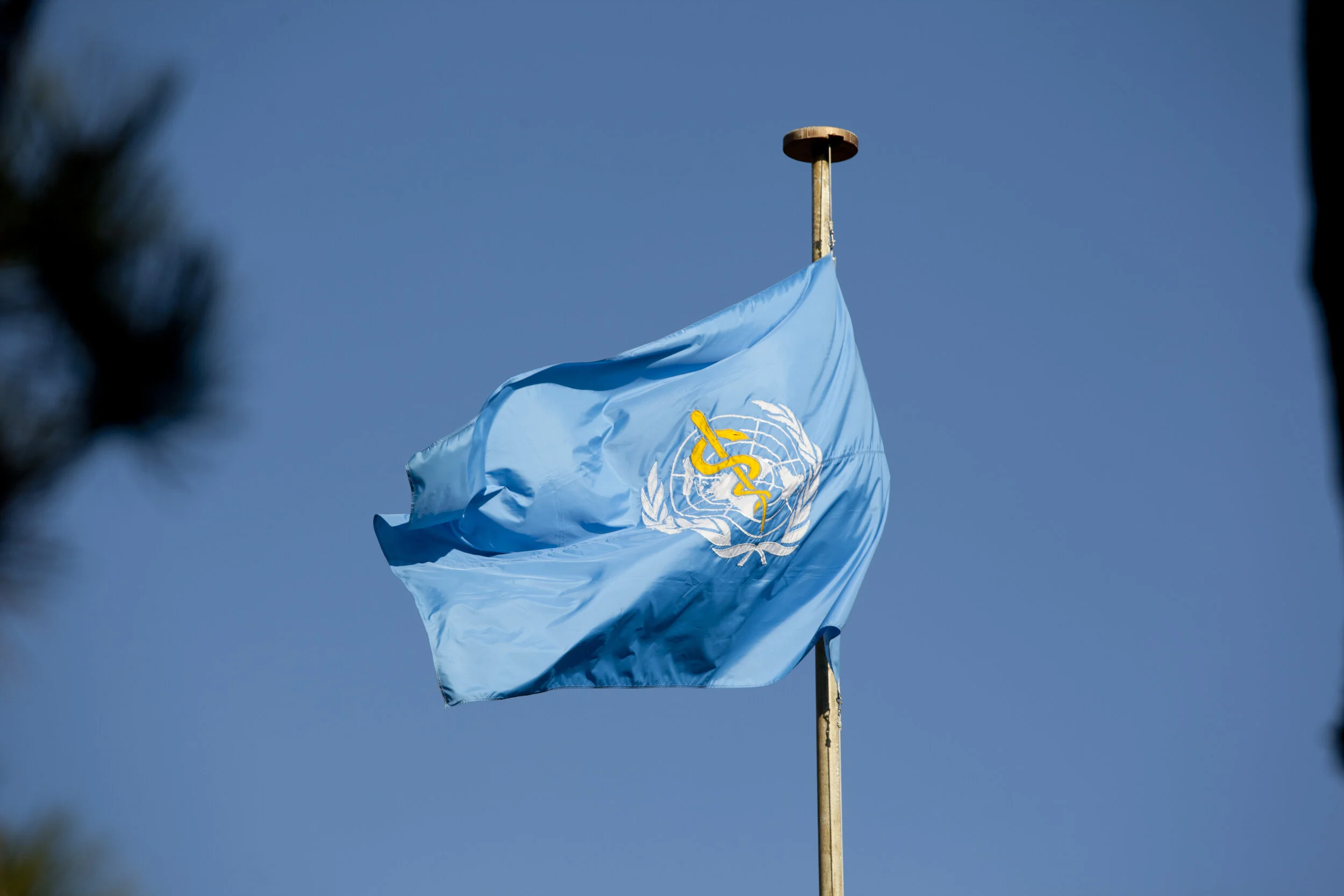
The flag of the World Health Organization. United States Mission Geneva. CC BY-ND 2.0.
Euthanasia in any form and assisted suicide are legal in at least one country on every continent except Africa. Belgium, Canada, Colombia, Luxembourg, the Netherlands, and the Australian state of Western Australia are the most permissive places for euthanasia, allowing for the active form of the practice, which involves an incurably ill patient receiving terminal care.
Passive euthanasia, the practice of refusing medical treatment and receiving appropriate pain management, is more broadly legal, primarily in the Western world but also in India, South Korea, Argentina and Chile.
The Australian state of Victoria and the countries of Germany and Switzerland permit assisted suicide. This practice differs from both active and passive euthanasia in that a physician is not the one terminating a patient’s life, but rather aids a patient as they terminate their own life. In the United States, assisted suicide is legal in the District of Columbia, California, Colorado, Hawaii, Maine, New Jersey, Oregon, Vermont and Washington state. Additionally, the legal status of assisted suicide in Montana is disputed due to an unclear court ruling in 2009.
With the ongoing pandemic and renewed discussions on the ethics of ending one’s life, euthanasia remains a hotly debated issue which likely will not go away any time soon.

Jacob Sutherland
is a recent graduate from the University of California San Diego where he majored in Political Science and minored in Spanish Language Studies. He previously served as the News Editor for The UCSD Guardian, and hopes to shed light on social justice issues in his work.
Aotearoa: Reclaiming Maori Language and Identity in New Zealand
Compared to Indigenous groups around the world, the Maori in New Zealand enjoy more agency because of the Treaty of Waitangi, a founding document that recognizes Maori ownership of land and their subsequent autonomy in the country’s government. However, some feel that more can be done to create a bicultural and celebratory society—one that puts the Maori language at the forefront.
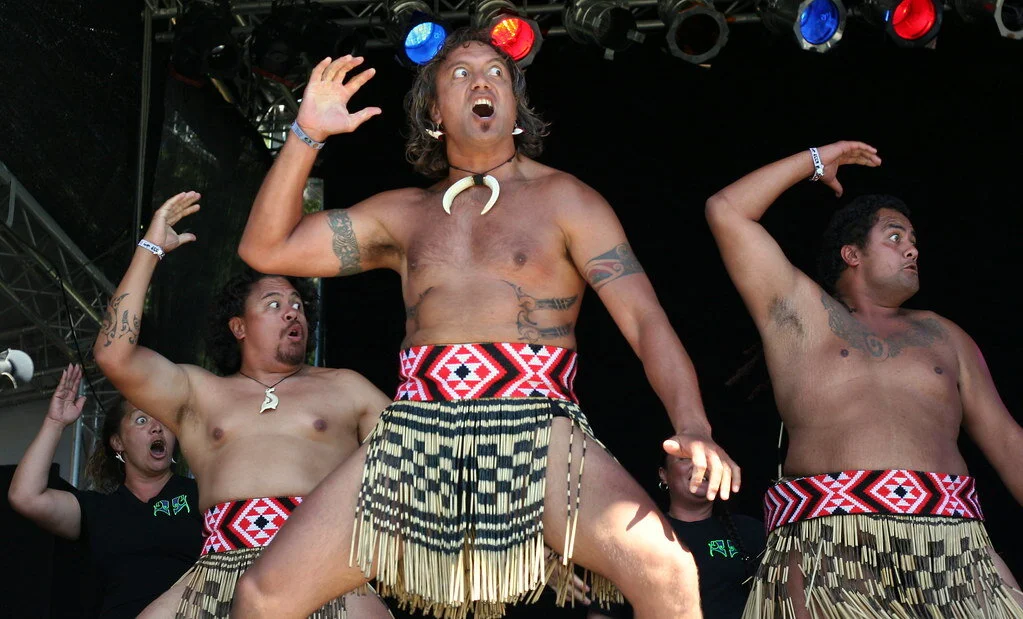
A performance of the haka, a traditional Maori dance. Matthieu Aubry. CC BY-NC-SA 2.0.
New Zealand is an island country known for its scenic views, its native kiwi bird and its iconic role as the fictional Middle Earth. The country, named Aotearoa (meaning “long white cloud”) in the Maori language, is also steeped in rich history and culture.
Before European settlement, New Zealand was home to the Maori, one of the region’s many Polynesian ethnic groups. According to their oral histories, the Maori first voyaged from present-day Tahiti. They arrived and began inhabiting Aotearoa as early as 1300 A.D. Once settled, the Maori formed tribal societies. Their culture revolves around respect for the natural environment. The Maori also possess elements of a warrior culture—they craft unique performative arts such as the haka, a war dance turned into a ceremonial celebration.
Although the first Europeans—Dutch navigators—made contact with the Maori in 1642, the Maori way of life was not significantly impacted until the late 1700s. With the arrival of British Capt. James Cook, the scramble for New Zealand ensued. As nearby French voyagers and ungoverned sealers and whalers reaped profits from the islands’ natural resources, the British moved to make New Zealand a colony in 1840.
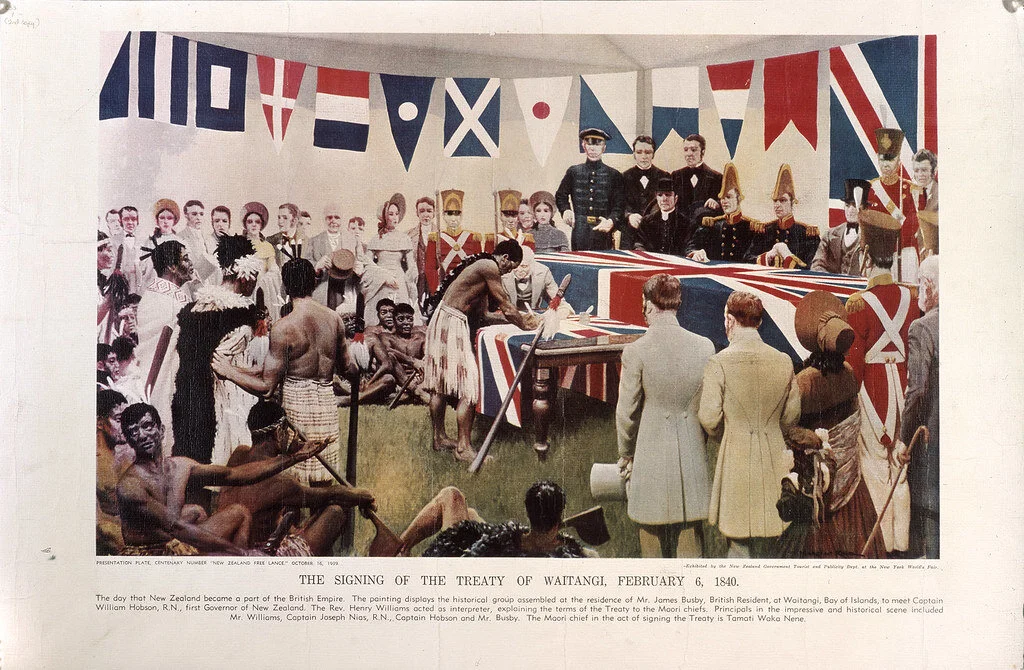
Reconstruction of the signing of the Treaty of Waitangi. Archives New Zealand. CC BY 2.0
In that same year, the Treaty of Waitangi was created. This artifact is not only recognized as a founding document but also as one that acknowledges Maori rights to the land. Despite its contentious nature, the Treaty of Waitangi is still considered a key success for the treatment of Indigenous people in New Zealand. In countries like Canada and Australia, Indigenous groups suffer a lower quality of life and enjoy less autonomy than their counterparts in New Zealand. These disparities can be traced back to the absence of a document acknowledging Indigenous people’s land rights.
Although the status of the Maori in New Zealand may be considered a model for Indigenous treatment across the globe, there are still discrepancies that prevent them from fully embracing their dual identities. Though Maori is considered one of the national languages and has been celebrated every September since 1975, a national study found that only 148,000 people in New Zealand can hold a conversation in it.
In a piece for The Guardian, Leigh-Marama McLachlan explains her rejection of Maori culture to sustain success in New Zealand. She writes, “Back then, almost no one in my family spoke [Maori]. My grandmother was like so many Maori of that generation who were led to believe that our language would be of no use to their children.” Although McLachlan possesses some rudimentary Maori, she laments the overwhelmingly monolingual sentiment of the country.
The personal rejection of Maori culture can be traced back to the early stages of New Zealand’s modernization. In a 2015 study, Maori education professors Lesley Rameka and Kura Paul-Burke found that education for children dismissed the value of Maori. Textbooks failed to frame Maori history in a positive light, rendering the culture and language as “unintellectual, trivial and strange.”
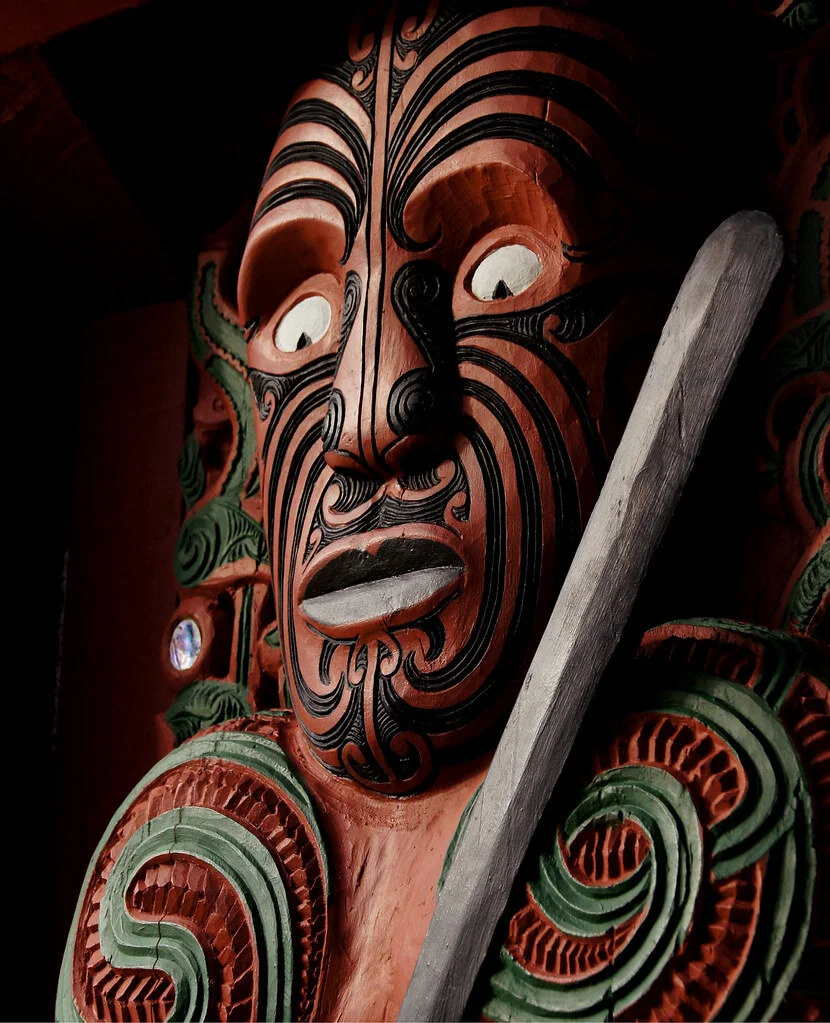
A Maori carving. Bernard Spragg.
Since the last Maori Language Week in September, some feel that it is time to restore places to their rightful Maori names. Since the protests against racial injustice in the United States, policymakers and stakeholders were forced to reexamine New Zealand’s racist past of colonialism and disenfranchisement. With an overall renewed interest in Maori rights and treatment, several telecommunications firms in the country have already changed their names to include “Aotearoa.”

Rhiannon Koh
Rhiannon earned her B.A. in Urban Studies & Planning from UC San Diego. Her honors thesis was a speculative fiction piece exploring the aspects of surveillance technology, climate change, and the future of urbanized humanity. She is committed to expanding the stories we tell.
Locked Up: Unmasking Australia’s Aboriginal Youth Prison Crisis
The Aboriginal people have been severely marginalized by Australia’s government, but among the most impacted are the group’s children.
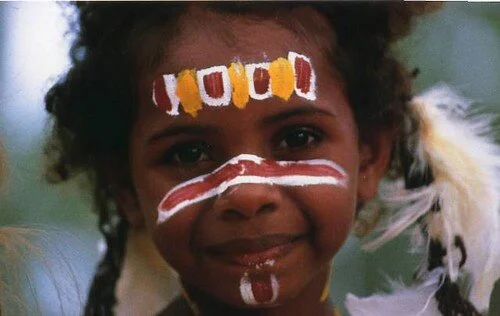
A young Aboriginal girl. mingzhuxia. CC BY-NC-SA 2.0
Indigenous people make up approximately 3% of Australia’s overall population and are considered the country’s most disadvantaged group. It is believed that the Aboriginal people lived in Australia for over 47,000 years prior to European colonization. Even today, the Aboriginal people continue to suffer some of the consequences of violent colonization such as low literacy rates, low life expectancy and a high unemployment rate.
Aboriginal children in particular are 30 times more likely to be stopped and prosecuted than other Australian youths. This reveals a pattern of racial profiling and stereotyping that has been called out by protests affiliating with the U.S.’s Black Lives Matter movement.
Progress was made in 2018, when police in Western Australia apologized for practicing “forceful removal,” the separation of Indigenous children from their families. Forceful removal was popular throughout the late 19th century and was legal until 1969. Many refer to those impacted by forceful removal as the “Stolen Generation.”
Since May 26, 1998, Australians have observed “National Sorry Day” as a way to apologize to the Aboriginal people for the harmful practice. It is a nationwide campaign committed to paying homage to affected groups while teaching youth of Australia’s harmful past actions. In 2008, former Prime Minister Kevin Rudd made a proposal in front of Parliament to help bridge the gap between Indigenous and non-Indigenous people.
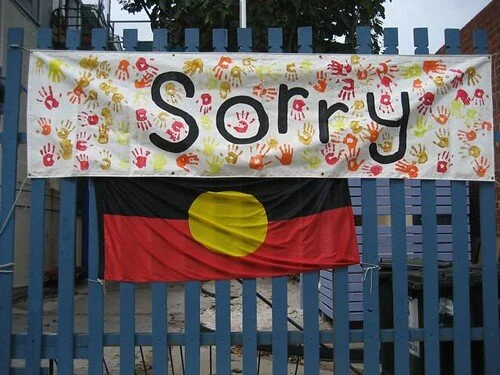
Australia’s National Sorry Day in 2015. butupa. CC BY-NC-ND 2.0
Yet, the gap between the Aboriginal community and other Australians remains as wide as ever. In February, the police of New South Wales revealed details about the Suspect Targeting Management Plan, which is intended to prevent future crimes by targeting likely or repeat offenders. Reports from 2016 to 2018 show that up to 72% of targeted children were likely from Indigenous descent. The youngest child identified was 9 years old.
The minimum age of criminal responsibility in Australia is one of the lowest in the world, allowing children as young as 10 to be sentenced to jail. Additionally, Aboriginal children are 17 times more likely to be jailed than non-Indigenous youth. Statistics from Western Australia say that 60 to 70% of children currently being held in the state’s detention centers are of an Aboriginal background.
As of now, very little research proves that locking up children reduces criminal activity in the future. In fact, youth already in the criminal justice system are far more likely to be repeat offenders, challenging the original intent of New South Wales’ Suspect Target Management Plan.
There is a push by lawyers and advocacy groups to raise the age of criminal responsibility in Australia to at least 14. Others believe that an alternative is to provide better health care and other social services in an attempt to elevate Aboriginal children’s socioeconomic standing. The end goal would be to improve their overall quality of life, allowing for better employment opportunities and an end to the societal obstacles currently facing the group.

Eva Ashbaugh
Eva is a Political Science and Gender, Sexuality, and Women's Studies double major at the University of Pittsburgh. As a political science major concentrating on International Relations, she is passionate about human rights, foreign policy, and fighting for equality. She hopes to one day travel and help educate people to make the world a better place.
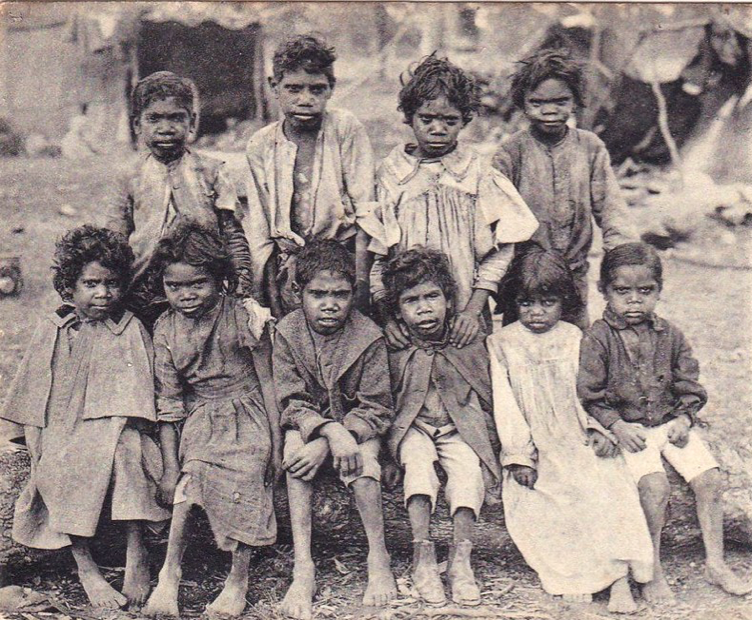
Group of Aboriginal children in the early 1900s. Kay- Aussie~Mobs. Public domain
The Continued Abuse of Australia’s ‘Stolen Generation’
The term “Stolen Generation” was coined after deeply discriminatory government policies were passed in Australia between 1910 and 1970. This was due to the fact that many Indigenous children were forcibly removed from their homes under the pretense of “assimilation” into “white society.” Assimilation was based on the “assumption of Black inferiority and white superiority, which proposed the Indigenous people should be allowed to ‘die out’ through a process of natural elimination or, where possible, assimilation into the white community.” This tragedy led to children being torn from their families, taught to reject their culture, forced to not speak their native languages and required to adopt white culture in new white families they were brought into.
Aboriginal people of white parentage, known at the time by the derogatory term “half-castes,” were most at risk of being removed from their homes since it was thought they would be easier to assimilate into white culture because of their lighter skin. Many were abused and neglected, and they received minimal education due to the assumption that the highest they would go was indentured servitude or work as manual laborers. The ensuing trauma has caused both the children and families mental trauma while the continued societal abuse such as stolen wages and racial discrimination was and still is prevalent. This is especially evident in statistics such as incarceration numbers and yearly wages. After George Floyd’s death, “debate raged about Australia’s own history.” By looking into the Australian national statistics, it was revealed the distrimination from back in the early 1900s has continued into the present.
Stolen Wages Still Prevalent Today
“Back in the early 1970s, Aboriginal people living in remote areas were being paid as little as 19% of the non-Aborginial population.” The average Indigenous income is roughly only 44% of the median non-Indigenous income, though the gap is starting to close for the 37% of the Indigenous population living in Australia’s major cities. 20% of the Indigenous population living in cities is still living in poverty, though, along with more than half of those living in rural areas. Even more concerning, “about 10% of the Indigenous population also received no income at all and that includes government payments. It is unclear how these people survive.”
Largest Incarcerated Population in the World
An even more shocking statistic was found in 2018 that “100% of children being held in youth detention in the (Northern) Territory are Aborginal.” They are currently the most incarcerated people in the world - not always for committing crimes. Tanya Day was arrested for sleeping on a train, later dying from repeated head injuries in jail. Additionally, a woman named Ms. Dhu was found dead in jail due to untreated injuries caused by prior family violence and abuse. The coroner said her medical care was “deficient” since the police refused to treat her, believing she was “faking it.” There have been serious concerns about racial profiling that have been directly correlated to arrests made - and the arrests not made. It was found that “Aboriginal and Torres Strait Islander people made up about 2% of the general population but represent 28% of those in prison.” It has been estimated that in the last 29 years, one Aboriginal or Torres Strait Island person has died every three weeks in jail.
Higher Levels of Domestic Violence, Abuse and Poverty
Another impact of Aboriginals being forced to assimilate into white communities is a staggering amount of domestic violence and abuse. Aboriginal women are 34 times more likely to be hospitalized from domestic abuse; however, when Aboriginal women try to call police for help, they are often arrested instead for defending themselves. This has also led to the statistic that Indigenous people have a lower life expectancy than the average non-Indigenous person, by an estimated 9 years. This has been blamed on factors such as poverty, poor health care, lack of healthy food, low living standards and more.
The reality of today’s society in Australia is the hidden discrimination that started in the early 1900s and prevails even today. With the recent global reaction to racial discrimination and slavery, a closer look into Australia’s history has revealed these revelations that have often been covered up and disputed. Efforts to increase awareness of the current state of affairs in the country have been underway and protests continue despite an absence of widespread media coverage.

Elizabeth Misnick
Elizabeth is a Professional Writing and Rhetoric major at Baylor University. She grew up in a military family and lived in Europe for almost half her life, traveling and living in different countries. She hopes to continue writing professionally throughout her career and publish her writing in the future.
7 Whimsical Outdoor Adventures Sure to Pique Your Interest in New Zealand
From natural wonders such as glowworm caves and geothermal pools (considered Maori sacred waters) to whimsical spots such as Teapotland, home to a garden of 1,200 quirky teapots—New Zealand will not disappoint.
Read MoreNew Zealand: Aotearoa
“Rich greenery, rough landscapes and unreal scenery. Footage shot over a time period of eight months features New Zealand in a way never seen before. German electronic music artist “The Road up North” exclusively created surreal soundscapes to accentuate the unique mood of this journey through territory and changing seasons.” -Birk Poßecker
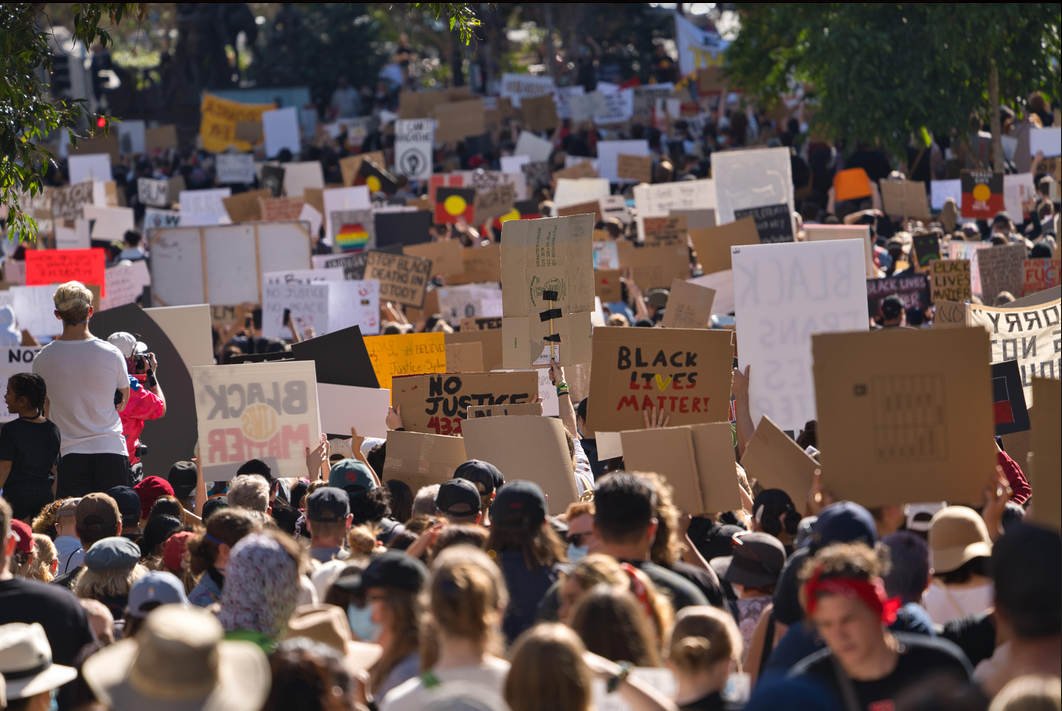
A June 6 anti-racism protest in Brisbane, Australia. Andrew Mercer. CC BY-SA.
‘Same Story, Different Soil’ as Police Brutality Hits Home for Indigenous Australians
Joining millions of activists around the globe, tens of thousands of Australians have taken to the streets over the past two weeks to stand in solidarity with the Black Lives Matter movement. However, for many of these protesters, the demonstrations are about more than standing in solidarity with their American counterparts — Australian activists have used the movement to place an international spotlight on Indigenous Australian deaths in police custody.
According to The Guardian’s database on Indigenous Australians’ deaths in custody from 2008 until today, 164 Aboriginal and Torres Strait Islander people had died while in police custody. As of June 2018, Aboriginal and Torres Strait Islander people made up 28% of Australia’s prison population, despite making up 2.8% of the country’s total population as of the 2016 census.
This widespread issue draws parallels to police brutality against African Americans in the United States. While no official data has been released on deaths in police custody in the U.S. despite the passage of the 2013 Death in Custody Reporting Act, African Americans in 2019 were 2.5 times more likely than white Americans to be killed by police officers. Broken down, 24% of all police killings in the U.S. in 2019 were of African Americans, despite only 13% of the nation’s population identifying as black.
Many Australian activists were further galvanized to take to the streets after a video surfaced of a Sydney police officer slamming an Indigenous boy to the ground on June 1. This video is similar to the countless ones in the United States which have documented instances of police brutality.
These activists have expressed how the issues in the United States and in Australia are one and the same. “It’s the same story on different soil,” 17-year-old activist Ky-ya Nicholson Ward said during a June 6 rally in Melbourne.
Justin Grant, an activist who attended the Melbourne rally, spoke on the historical relationship between the police and Indigenous Australians in an interview with Al-Jazeera. “[The police] are breaking our trust and scaring our people ... they [don't] respect our culture, our laws or our practices."
These parallels have been emphasized during the protests, with chants such as “I can’t breathe” taking on new meanings outside of their American context. Several protesters’ signs have echoed this sentiment, with phrases such as “Same Story, Different Soil” popping up on protest materials throughout the country.
However, others have diminished the similarities between the motivations behind the Black Lives Matter movement and Indigenous Australian deaths in police custody. Prime Minister Scott Morrison said during an interview with local Sydney radio station 2GB that: “There’s no need to import things happening in other countries here to Australia … Australia is not the United States.”
Black Lives Matter protests both within Australia and around the world are expected to continue throughout the coming weeks. As of this article’s publication, there have been no major responses to the protests within the Australian Parliament House to address Indigenous deaths in police custody.

Jacob Sutherland
Jacob is a recent graduate from the University of California San Diego where he majored in Political Science and minored in Spanish Language Studies. He previously served as the News Editor for The UCSD Guardian, and hopes to shed light on social justice issues in his work.
New Zealand’s “Headscarf for Harmony” Effort
Women wear headscarves to stand in solidarity with New Zealand Muslim community.

Photo of headscarves by 𝚂𝚒𝚘𝚛𝚊 𝙿𝚑𝚘𝚝𝚘𝚐𝚛𝚊𝚙𝚑𝚢 on Unsplash
This week, women in New Zealand are wearing hijabs to stand in solidarity with the Muslim community following the shooting of 50 people at two mosques in Christchurch.
The effort, called “Headscarf for Harmony”, was created by Auckland doctor Thaya Ashman. After hearing a Muslim woman say that she was afraid to leave her house wearing a hijab, Ashman wanted a way to show her support and solidarity. “I wanted to say: We are with you, we want you to feel at home on your own streets, we love, support and respect you,” she told Reuters.
Ashman spoke with the Islamic Women’s Council of New Zealand and the Muslim Association of New Zealand before putting the effort into action. She told the New Zealand Herald that she used the word headscarf instead of hijab to recognize the cultural difference present for non-Muslims.
The Headscarf for Harmony hashtag continues to spread across social media. where New Zealanders are posting pictures of themselves in headscarves accompanied by captions offering their support for the Muslim community.
"These people are New Zealanders, just like I am,” twenty four-year-old Cherie Hailwood told CNN. “I understand that one day is very different to wearing it all the time, but I am honored to be given the permission of the Muslim community to walk in their shoes. Even just for a day.”
Prime Minister Jacinda Ardern wore a black headscarf when meeting with members of the Muslim community. Even news anchors and reporters joined the effort, wearing headscarves on live television. At an open prayer at the Al Noor mosque where the attack had taken place, New Zealand women wore head scarves as a gesture of respect and solidarity.
“Being a Muslim, I’m overwhelmed,” one man tweeted, “I have never seen this kind of solidarity in my entire life—the vigils, the Haka performances, the scarves. It’s just amazing and heartwarming.”
Not all supported the effort. On Stuff.co.nz a Muslim woman published an unsigned article saying that while the movement may mean well, it is no more than “cheap tokenism”.
She wrote that the effort, “stinks of white savior mentality, where Muslim women need to be rescued by (largely) white folk. This type of ideology plays a part in the pyramid of white supremacy and must be acknowledged so people can stop virtue signaling and understand the impact of their actions.”
She went on to say that the attack, “was not just about Muslims, it was against any person of colour in a 'white' country so this focus on hijabs is derailing the examination of white supremacy, systematic racism, orientalism and bigotry. We don't want to be turned into a caricature.”
EMMA BRUCE is an undergraduate student studying English and marketing at Emerson College in Boston. While not writing she explores the nearest museums, reads poetry, and takes classes at her local dance studio. She is passionate about sustainable travel and can't wait to see where life will take her.

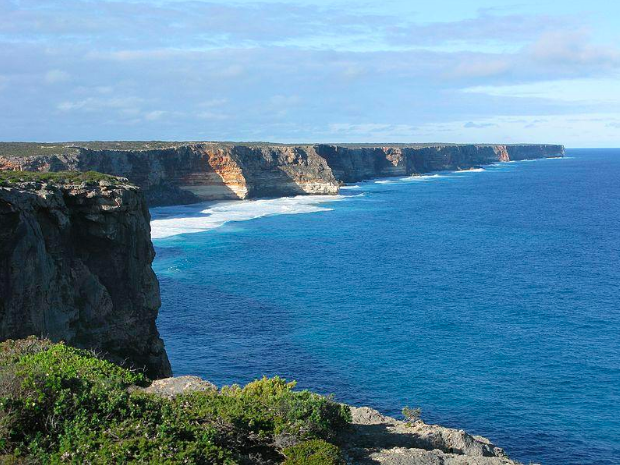
The Great Australian Bight, South Australia. Aussie Oc at English Wikipedia. CC 3.0
This is Not a Drill: Keep Australia’s Coasts Oil-Free
The Great Australian Bight is known worldwide for its beautiful oceanic environment,home to diverse forms of marine life, and its coastline lined by the longest sea cliffs in the world. A bight is a large open bay; this specific bay runs from Cape Carnot in South Australia, all the way to Cape Pasley in Western Australia: over 700 miles of ocean and sky that thousands of whales, seals, fish, birds, plants, and surfers call home.
Equinor, a Norwegian oil company, has plans to carry out a drilling operation in the Great Australian Bight, ultimately turning it into a deepwater oil field. This operation would devastate the 85% of rare marine life that exists in the Bight. Not only is it endangering the various species that live among the coasts, but the increase in pollution could disrupt the people of Australia. A potential spill in the Bight could result in the death of several endangered species: killer whales, southern right whales, blue whales, dolphins, endemic Australian sea lions, and many more. The Bight also supports multi-billion dollar fishery, aquaculture, and tourism industries. Drilling would, most likely, halt if not destroy this economy altogether. Not unlike BP’s drilling expedition, the proposal for drilling in the Great Australian Bight could have severe consequences, and ultimately the same catastrophic ending as BP’s drilling operation could incur. 8 years after the BP oil spill, the Gulf is still experiencing significant impacts, and scientists expect them to continue. Scientists say that they may not know for another 30 or 40 years the extent of the effects. If the Equinor drilling operation resulted in another massive oil spill in our current environmental state, our economy and Earth would take much longer to bounce back than the BP oil spill. If this were to occur in summer, it would also not only affect Australia but also places as far away as northeastern Europe. If it were to happen in winter, the oil would most likely impact Kangaroo Island, the Eyre Peninsula and the Spencer Gulf in South Australia. It could also potentially reach the Victorian and Tasmanian coastline, heading towards New Zealand. Known the remarkable economic and environmental values that would be put at risk from Equinor’s drilling operation in the Great Australian Bight, this project should not be considered.
Equinor’s drilling plan has led activists and surfers worldwide to strike and start a viral movement, ‘#Fightforthebight,’ to save this Australian coastline. Surfers have paddled out in peaceful protests displaying signs with slogans like “Big oil has no future” or “Kill the Drill.” Several worldwide famous surfers that call Australia home, like Stephanie Gilmore, Nat Young, Mick Fanning, and many more, have signed an open letter concerning the Equinor’s drilling proposition and its potential impact on their coasts. To take action and help keep Australia’s coasts oil-free you can sign a Statement of Concern or donate here: https://www.fightforthebight.org.au/take-action-1 .
AMELIA BAUMANN is an aspiring writer and editor from New Jersey. I love to travel and am intrigued with the diversity of culture around the world. I am passionate about our environment and especially keeping our oceans clean.

Abstract Australia from Above
“The real voyage does not consist in seeking new landscapes, but in having new eyes.” — MARCEL PROUST
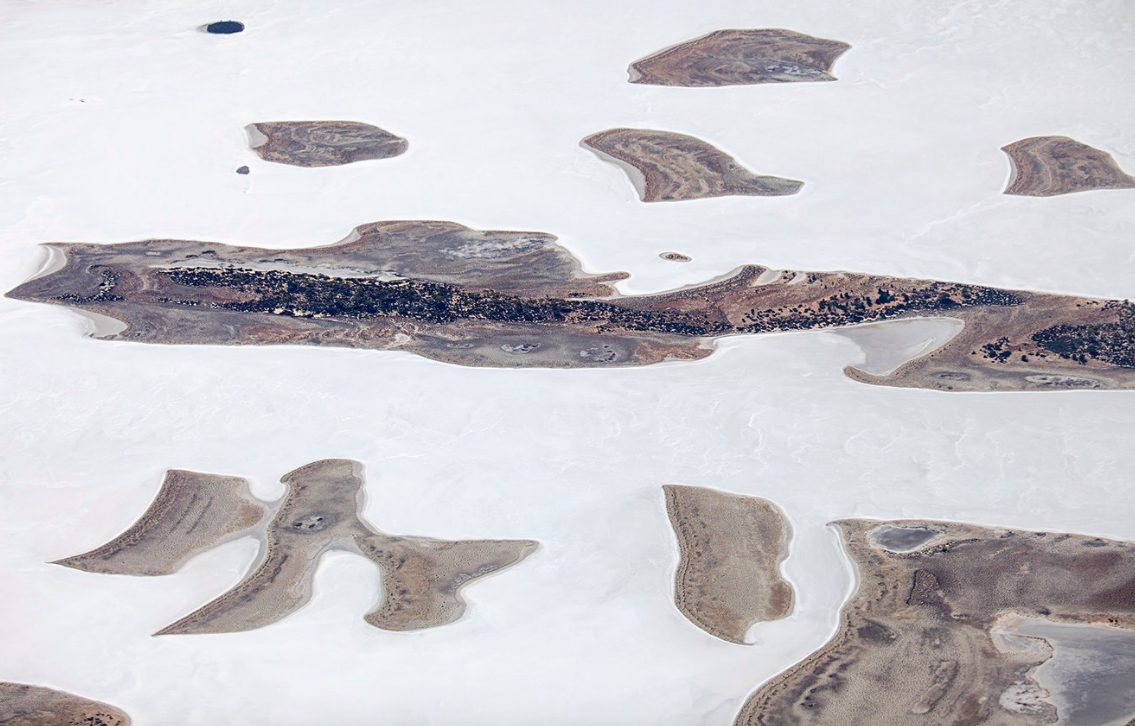
Islands on natural salt lake, Lake Johnston, north of Esperance, in Western Australia. (Taken 2014)
I have been attracted to the Australian landscape because of its size and subtle differences — a sense of wonderment, how it all came about, the evolution of the landscape. Like the rest of the world it has gone through many stages to be what it is today — uniquely Australian. But it also is a very old landscape. It is the flattest and driest continent, which compared with other countries, does not manifest itself in grandeur as we know it; large rivers, large mountains and the dramatic changes of the seasons.
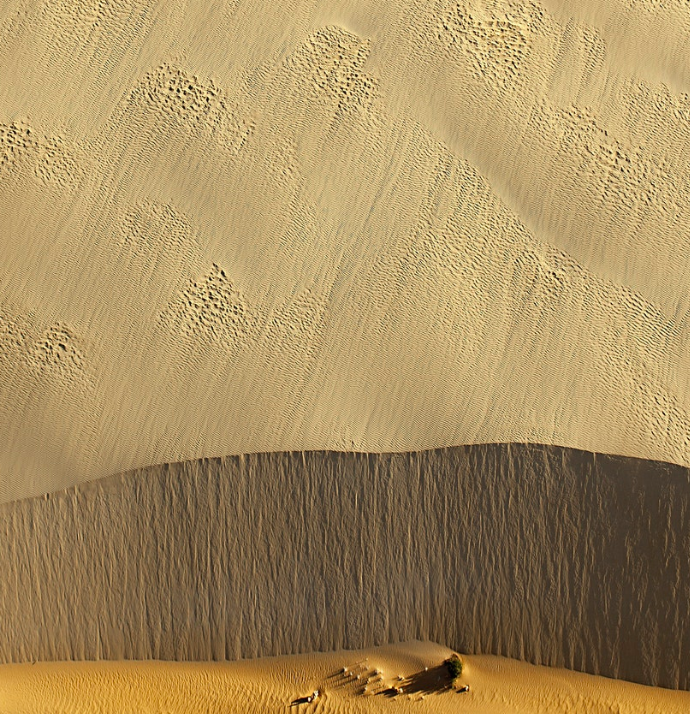
The Pinnacles. Limestone formations, Nambung National Park. (Taken 2009)
However, I found that by looking at the landscape from the air, many natural characteristics revealed themselves much better, showing the evolution and the geographical variations. Nature is a great teacher. Observing and experiencing it can stimulate our creative senses which in turn is beneficial to ourselves and our environment.
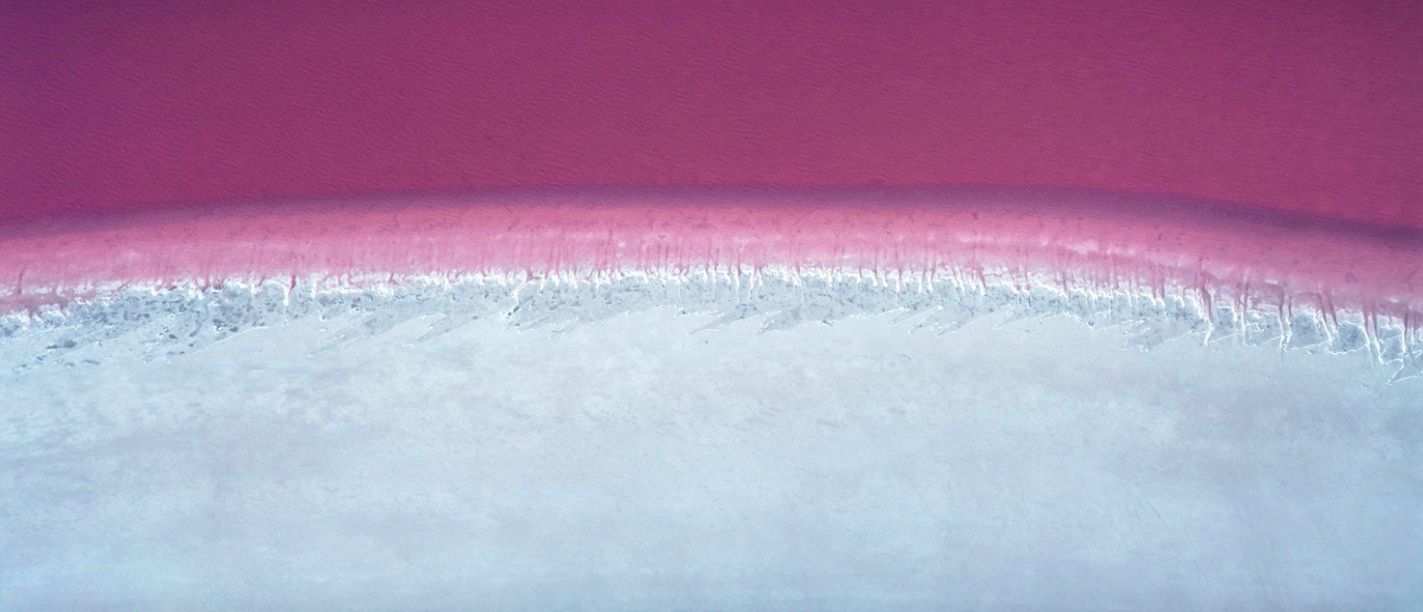
Pink Lake, north-west of Esperance, Western Australia. This is the natural colouration of the salt lake. (Taken 1988)
It was in 1955 that I bought my first camera, and this was the beginning of a long association with photography. Intrigued by the unusualness of the Australian landscape, I became a landscape photographer with a strong bias for aerial photography, which I felt captured the vastness of the outback best — each flight became a flight of discovery.
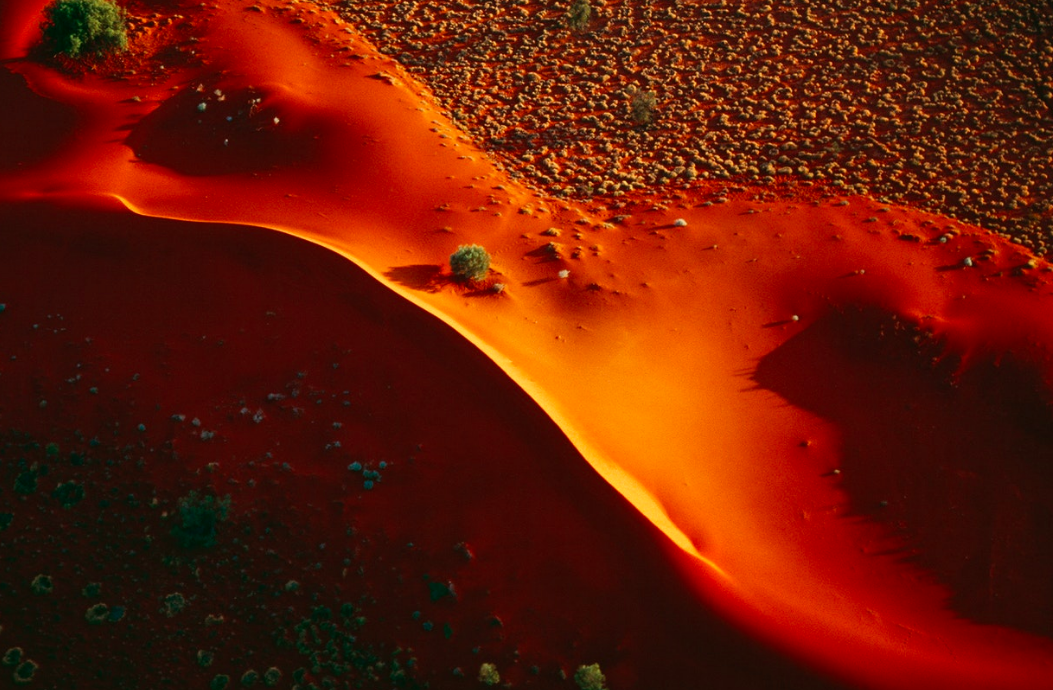
Late light on a drifting sand dune, Windorah, south east Queensland. (Taken 1994)
There are so many Australian landscapes worthy of consideration whether they be rivers, coastal plains or deserts — all of which vary seasonally and at different times of the day. As much as possible I like to be inspired by what I see and this is where I experience a sense of wonderment of a world so complex, varied and beautiful.
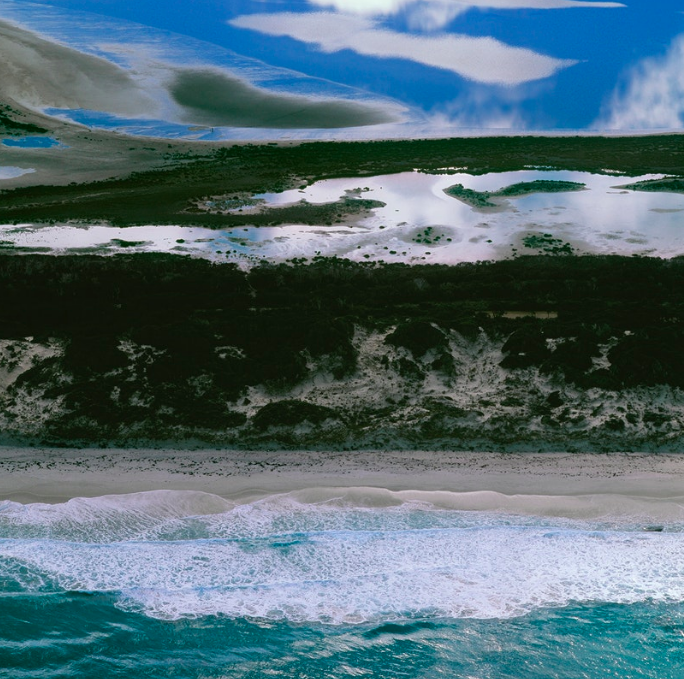
Coastline between Esperance and Cape Arid, in Western Australia. This shows the reflection of the clouds in the lake, with the beach and ocean in the foreground. (Taken 2006)
Of course there are many ways to appreciate the landscape. My own involvement is to photograph the highlights and to interpret them with the camera in a painterly way. I emphasise these highlights by pointing the camera down and focussing on the subject, excluding the horizon so one looses a point of reference and the reality often takes on an abstract view. I hope that the character of the subject is enhanced and that it reveals more through isolation by the camera angle.
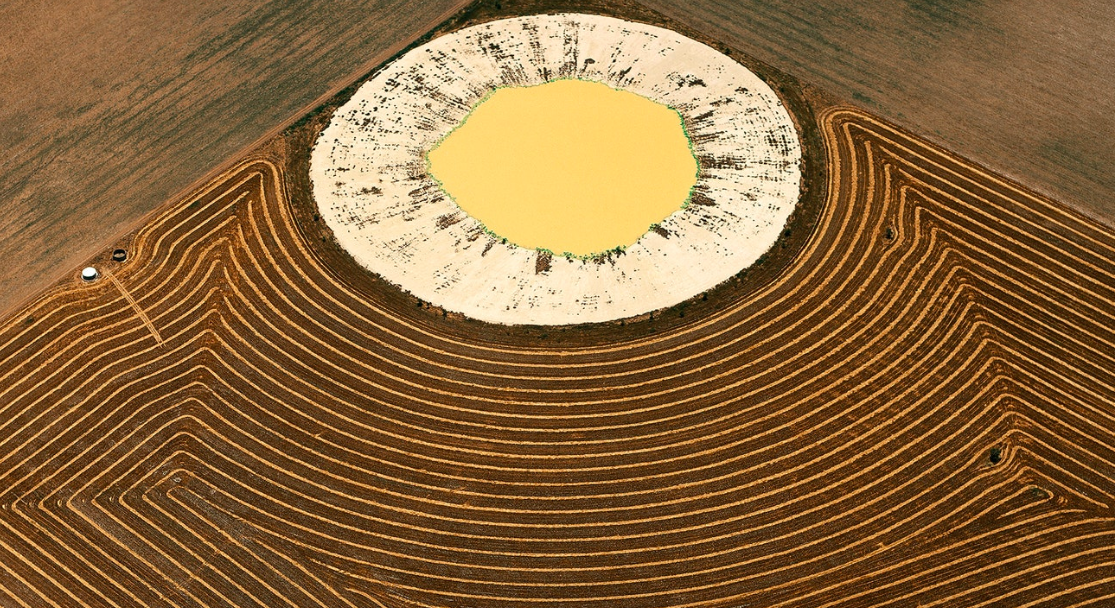
A turkey nest dam near Newdegate, Western Australia, contrasts against the ploughed fields. (Taken 1994)
The aerial point of view also allows us to examine the impact of humanity on Earth. There is a beauty in the man made landscape which takes on a relationship beyond the form as we know it. Certain subjects such as mining dumps, industry and farming look mundane at ground level, but from above my eye begins to recognise a gratifying order in the chaos — crops, paddocks and ploughed fields become masterpieces in abstraction often unknown to their creators. Simultaneously, the aerial perspective can also indicate the abuse and destruction that has taken place.
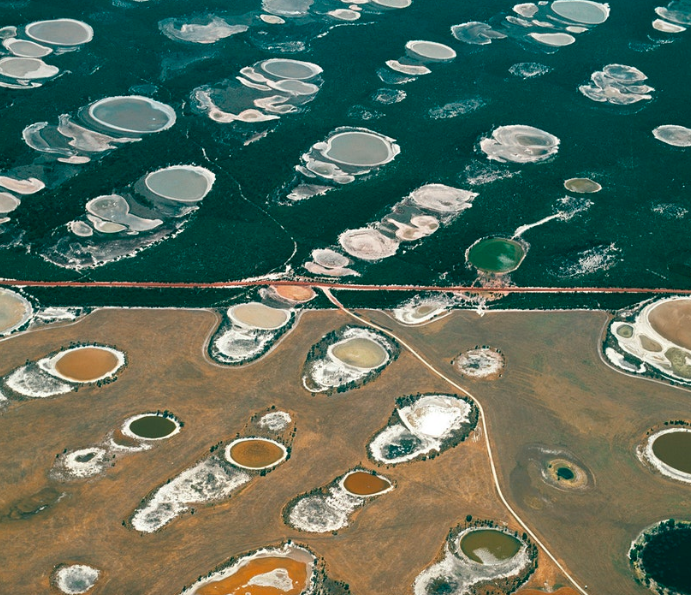
Salt lakes surrounded by wheat fields, 50 kilometers north east of Esperance, Western Australia. (Taken 1994)
At all times, I take a very personal approach to my work, but I also take great care to retain the optical reality. There are a million pictures out there. I am the only limitation. I can tune in and absorb the reality of the variations, combined with my way of seeing and my attitude. The older I get the harder it becomes, and the more I am drawn to nature. It is the creation of all life and matter that appeals to me now. Maybe I can make a small contribution to its well being which is in jeopardy. If beliefs in eternity are formed, nature is a great catalyst. I often feel intimidated by a great outback landscape, but also inspired by it.
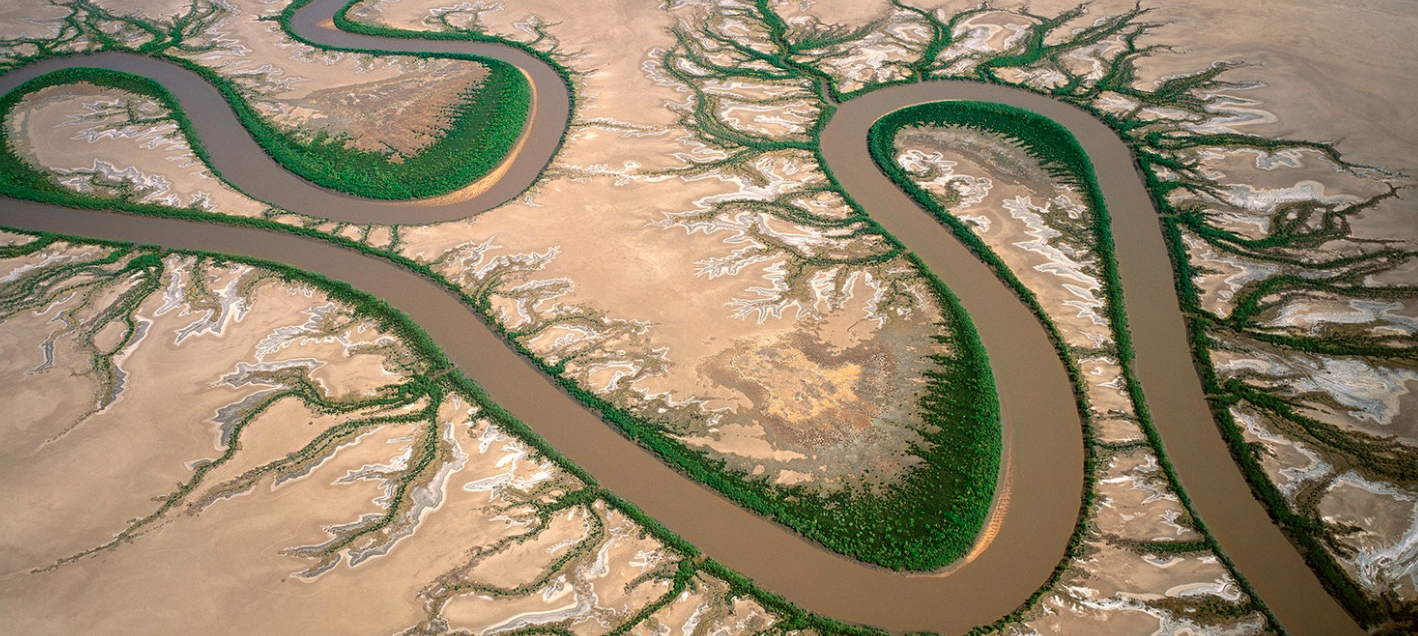
Forrest River, Kimberley, Western Australia. A tidal river system, north-west of Wyndham. (Taken 2003)
We now have more technical gadgetry at our disposal and there is no doubt it can help us to get a better photograph. But that in itself means little unless it enhances our understanding of the world around us. It is more important to use our creative spirit and gain wisdom than purely use it as a tool. Today in our digital age we have Photoshop with its possibility to enhance or to completely distort or create our own image using photographic components. We have become so image conscious that we often forget the beauty of reality.
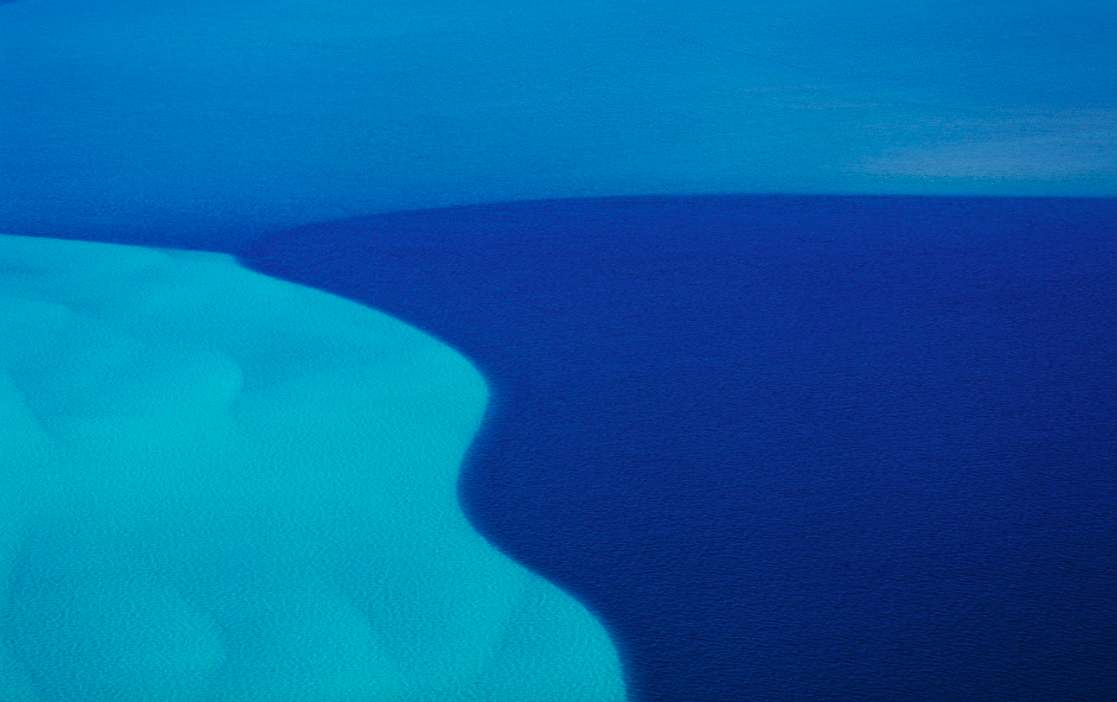
Ocean between Ningaloo Reef and Coral Bay, Western Australia. The blue variation is due to the ocean’s floor level. (Taken 2006)
The subject of photography can either be concrete or intangible. In the first case the picture is basically realistic, where as in the latter case it is essentially abstract. But what makes photography so interesting is that by combining both we can introduce creativity in the subject and have the best of both worlds.
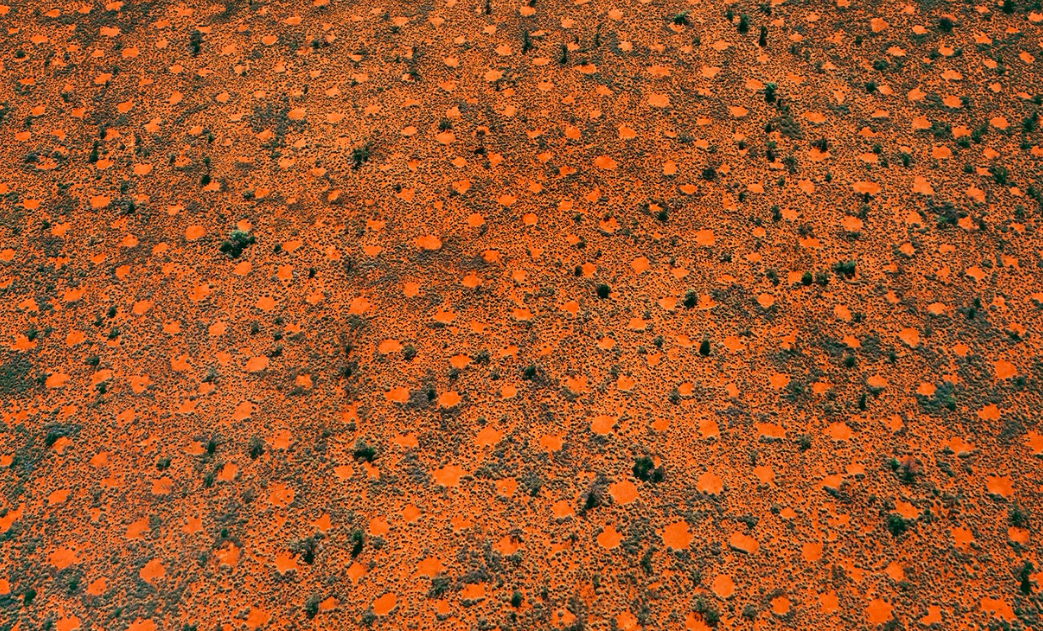
Ant clearings approx. 4–5 metres across, Great Sandy Desert, Pilbara, Western Australia. (Taken 2003)
Although many photographers can take photographs and do it well, it is work done in the full utilization of that creative spirit that stands out. It should be influenced by the subject itself and come from within oneself.
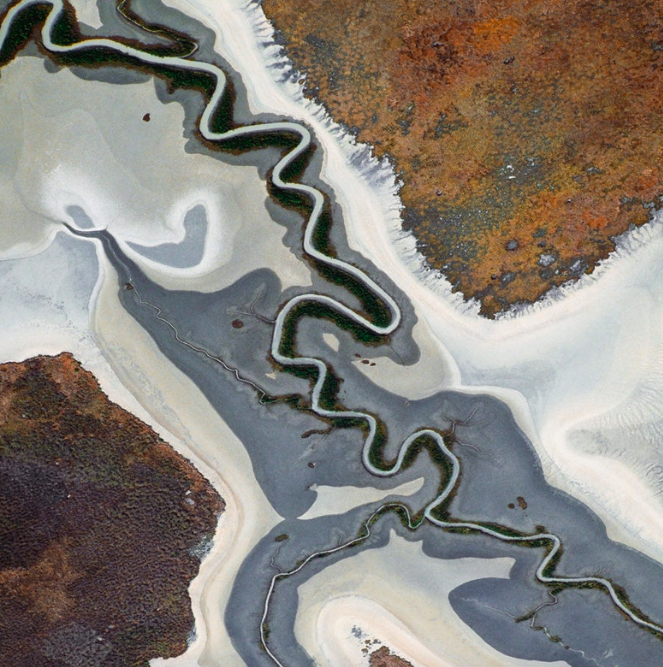
Tidal variations result in a coastal river pattern, Northern Territory. (Taken 2004)
“I still can’t find any better definition for the word Art, than this. Nature, Reality, Truth, but with a significance, a conception, and a character which the artist brings out in it and to which he gives expression, which he disentangles and makes free.” — VINCENT VAN GOUGH
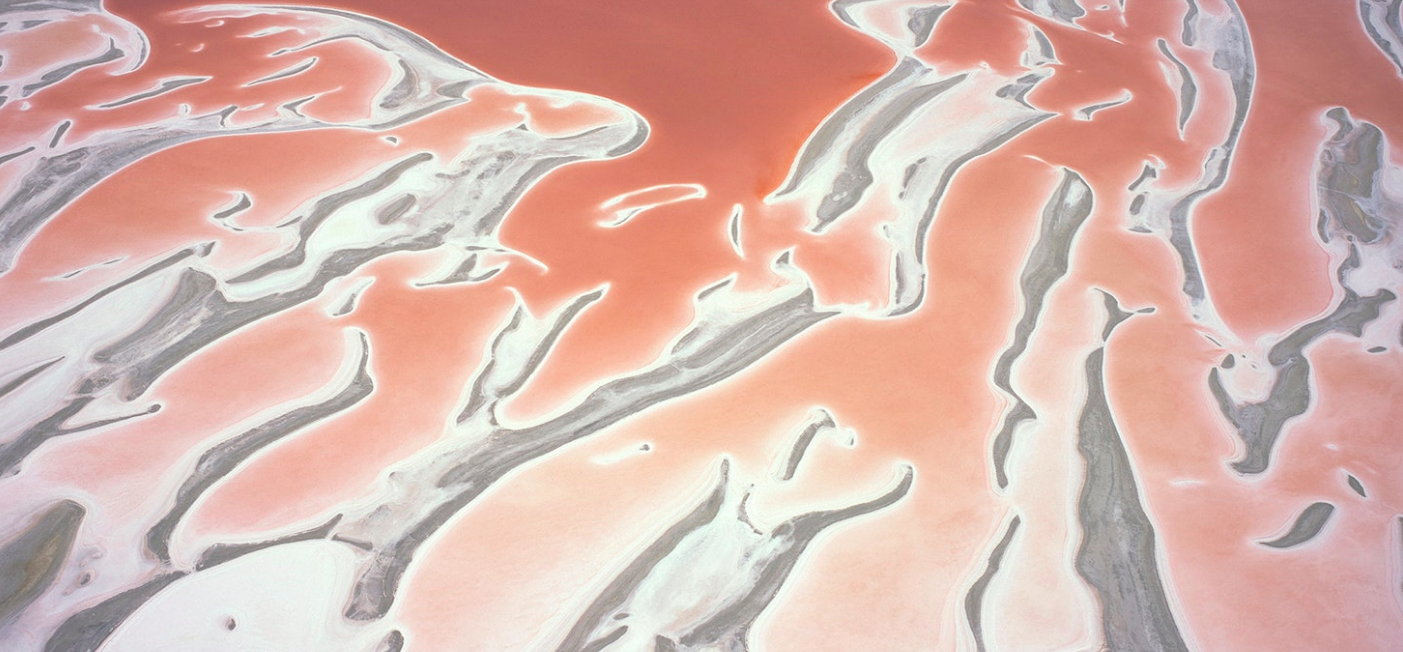
Lake Dumbleyung, Wagin, Western Australia. Affected by farming this natural lake has become saline. After the first rains, it turns pink. (Taken 2005)
We do not always appreciate the aerial point of view. People regard the landscape as something you fly over. But in reality it is an opportunity to see the landscape from a different perspective. I never cease to marvel at the natural variations in the Australian landscape and although I value what is there photographically, in the end it is the observation and appreciation of the diversity that is the reward.
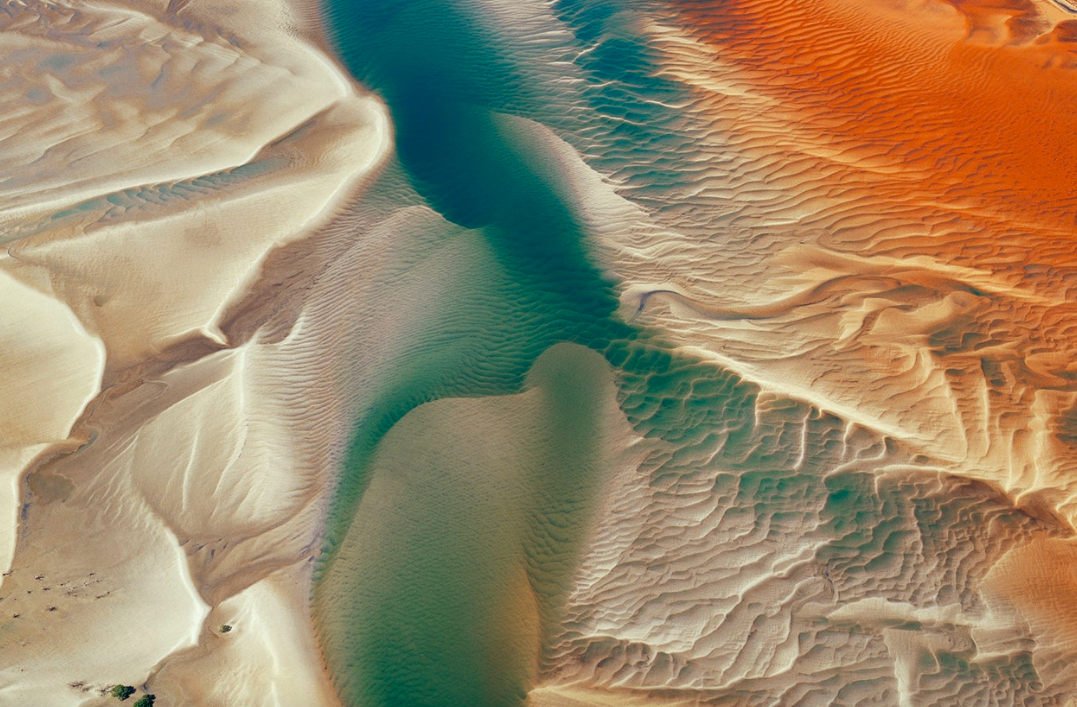
Top of Curtis Island, Cape Capricorn, north-east of Gladstone, Queensland. An estuary with sand banks. (Taken 1997)
Postscript — All of my photographs are as seen from the air and are not manipulated. I feel that the beauty, colours, and uniqueness of the Australian landscape is complete and needs no enhancing.
RICHARD WOLDENDORP is a Dutch-born Australian landscape photographer, with a focus on the aerial perspective. Appointed the Order of Australia in June 2012, “For service to the arts as an Australian landscape photographer.”
THIS ARTICLE WAS ORIGINALLY PUBLISHED ON MAPTIA
The Origins of Pama-Nyungan, Australia’s Largest Family of Aboriginal Languages
The approximately 400 languages of Aboriginal Australia can be grouped into 27 different families. To put that diversity in context, Europe has just four language families, Indo-European, Basque, Finno-Ugric and Semitic, with Indo-European encompassing such languages as English, Spanish, Russian and Hindi.
Australia’s largest language family is Pama-Nyungan. Before 1788 it covered 90% of the country and comprised about 300 languages. The territories on which Canberra (Ngunnawal), Perth (Noongar), Sydney (Daruk, Iyora), Brisbane (Turubal) and Melbourne (Woiwurrung) are built were all once owned by speakers of Pama-Nyungan languages.
All the languages from the Torres Strait to Bunbury, from the Pilbara to the Grampians, are descended from a single ancestor language that spread across the continent to all but the Kimberley and the Top End.
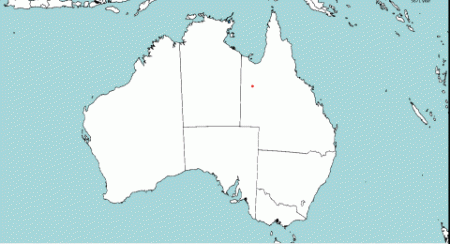
Where this language came from, how old it is, and how it spread, has been something of a puzzle. Our research, published today in Nature Ecology and Evolution, suggests the family arose just under 6,000 years ago around what is now the Queensland town of Burketown. Our findings suggest this language family spread across Australia as people moved in response to changing climate.
Aboriginal Australia is often described as “the world’s oldest living culture”, and public discussion often falsely assumes that this means unchanging. Our research adds further evidence to Australia pre-1788 being a dynamic place, where people moved and adapted to a changing land.
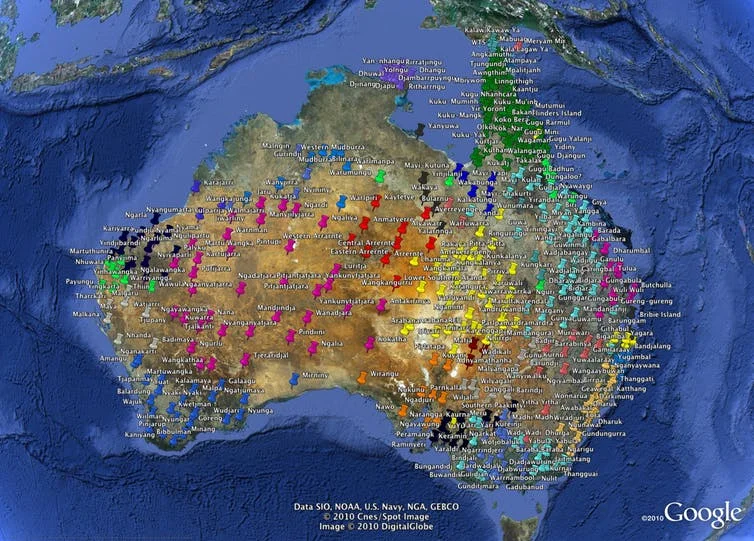
Map of Pama-Nyungan languages, coloured by their main groupings. Compiled by Claire Bowern using data from National Science Foundation grant BCS-0844550.
Tracing Pama-Nyungan
We used data from changes in several hundred words in different languages from the Pama-Nyungan family to build up a tree of languages, using a computer model adapted from those used originally to trace virus outbreaks.
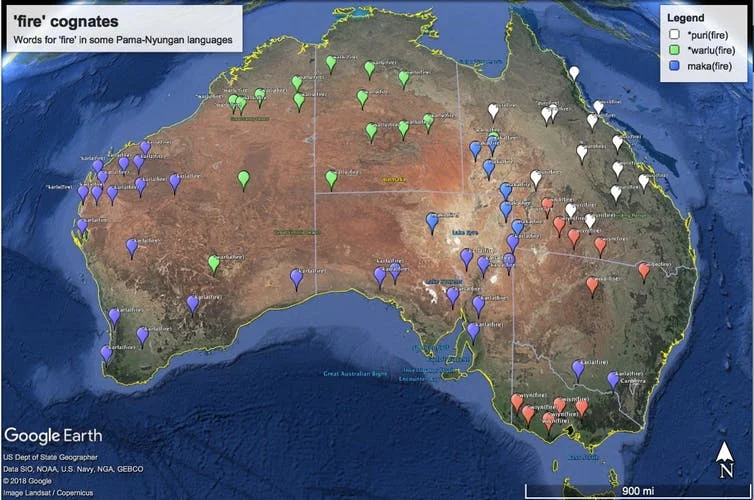
Different related words for ‘fire’ in certain Pama-Nyungan languages. Green dots show languages with a word for ‘fire’ related to *warlu; white has *puri; red has *wiyn; blue has *maka, and purple *karla. Chirila files (http://chirila.yale.edu) and google earth for base image.
Because our models make estimates of the time that it takes for words to change, as well as how words in Pama-Nyungan languages are related to one another, we can use those changes to estimate the age of the family.
We found clear support for the origin of Pama-Nyungan just under 6,000 years ago in an area around what is now the Queensland town of Burketown. We found no support for the theories that Pama-Nyungan spread earlier.
The timing of this expansion is consistent with a theory that increasingly unstable conditions caused groups of people to fragment and spread. But correlation is not causation: just because two patterns appear related, it does not mean that one caused the other.
In this case, however, we have other evidence that access to ecological resources has shaped how people migrated. We found that, in our model, groups of people moved more slowly near the coast and major waterways, and faster across deserts. This implies that populations increase where food and water are plentiful, and then spread out and fissure when resources are harder to obtain.
You can see a simulated expansion here. The spread of Pama-Nyungan languages mirrored this spread of people.
What languages tell us
Languages today tell us a lot about our past. Because languages change regularly, we can use information in them to work out who groups were talking to in the past, where they lived, who they are related to, and where they’ve moved. We can do this even in the absence of a written record and of archaeological materials.
For places like Australia, the linguistic record, though incomplete, has more even coverage across the continent than the archaeological record does. At European settlement, there were about 300 Pama-Nyungan languages. Because there are at least some records of most of them we are able to work with these to uncover these complex patterns of change.
There are approximately 145 Aboriginal languages with speakers today, including languages from outside the Pama-Nyungan family. Many of these languages, such as Dieri, Ngalia and Mangala, are spoken by only a few people, many of whom are elderly.
Other languages, however, are actively used in their communities and are learned as first languages by young children. These include the Yolŋu languages of Arnhem Land and Arrernte in Central Australia. Yet others (such as Kaurna around Adelaide) are undergoing a renaissance, gaining speakers within their communities.
Nathan B. performing “Yolŋu Land” using English and Yolŋu Matha.
Finally, though not the focus of our study, there are also new languages, such as Kriol spoken across Northern Australia, Palawa Kani in Tasmania, and Gurindji Kriol. Many Aboriginal and Torres Strait Islanders also know English, and most Indigenous Australians are multilingual.
Without records of all these languages, and without ongoing work to support speakers and communities, we aren’t able to do research like this, and Australia loses a vital link to its history. After all, European settlement of Australia is a tiny chunk of the time people have lived on this land.
This article was originally published on The Conversation.

CLAIRE BOWERN
Claire Bowern is Professor of Linguistics at Yale University. Her 2004 PhD is from Harvard University and examined the historical morphology of complex verb constructions in a family of non-Pama-Nyungan (Australian) languages. Her research focuses on the Indigenous languages of Australia, and is concerned with language documentation/description and prehistory.
Into the Outback
An epic and ancient landscape, deeply entwined with the artistic, musical, and spiritual traditions of Indigenous Australians, the Outback is one of the largest remaining, intact natural areas on Earth. A cultural, ecological, and geological wonder, I explore and capture these vibrant regions on foot and from the air.
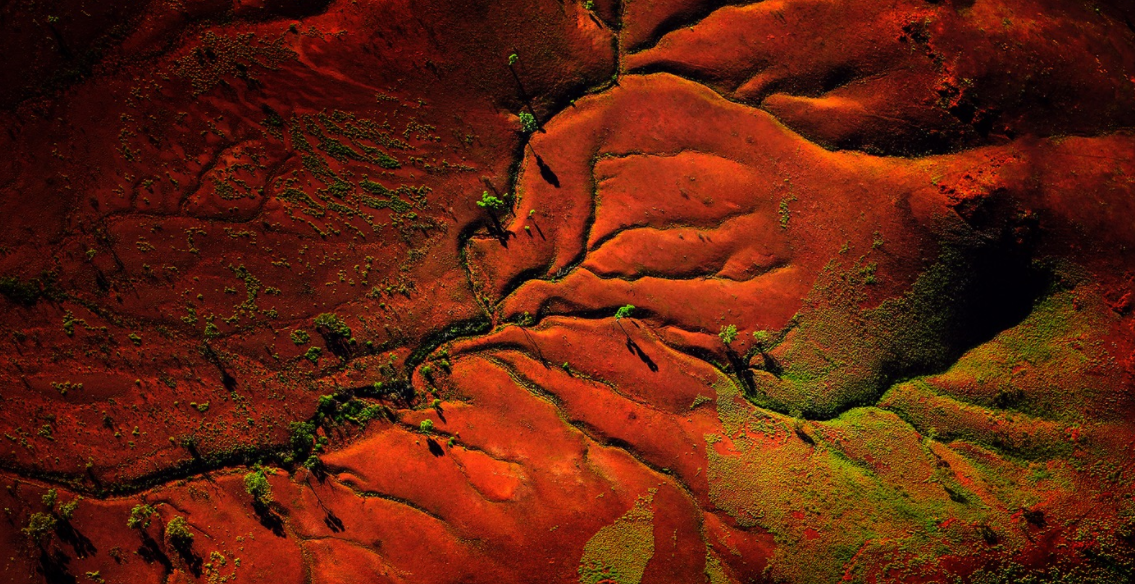
Known for its Aboriginal peoples and its vast, ancient landscapes, the Outback is an incredibly special place for me. I think that once you get that distinctive red dust in your blood it never comes out.
My roots are deeply connected to the rural areas of western Queensland and from a very young age, the never-ending expanse of inland Australia has been something that has captivated me. Ever since I can remember, we would take long road trips out to a family-run cattle station, and there was always this great sense of wonder and adventure. In the Outback, you can travel for days in any direction and stumble across places that are unique, untouched, and rarely visited. It was on these early trips that I fell in love with the bush, the people, and its landscape. I’ve never stopped venturing back.

Pannawonica Hill, near the small town of Pannawonica, a tiny iron-ore mining settlement in the Pilbara region of Western Australia. // © Dan Proud
Drawn to remote, wide open spaces, to the dusty and the desolate, I have found that there are countless unique rocky outcrops and ridges to explore. From the arid and ancient regions of Kimberly and Pilbara in Western Australia, to the rugged, weathered peaks and dramatic rocky gorges found in the Flinders Ranges of South Australia, to the red centre and Australia’s most famous monolith, Uluru — it is not only the sheer size of the Outback that is astounding (it could encompass almost all of Europe), it is also home to some of the world’s most spectacular and untouched landscapes. Over the past few years, I’ve been lucky enough to photograph, film, and fly over these regions — both in light aircraft, and more recently, with drones.
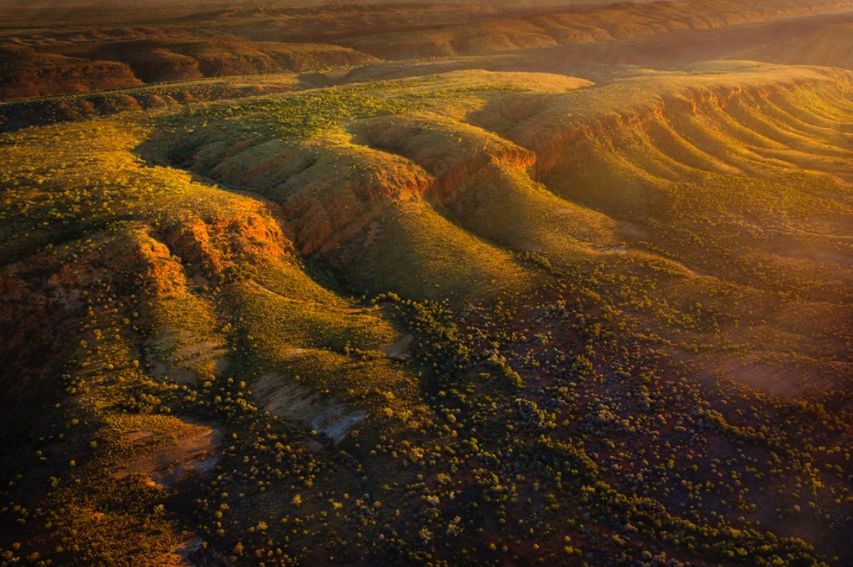
The West MacDonnell Ranges, known as the West Macs, seen from the air. Found in Australia’s Red Centre, west of Alice Springs. // © Dan Proud
Deeply entwined with the landscape itself are the artistic, musical, and spiritual traditions of the Indigenous Australians, among the longest surviving cultural traditions in human history. Some 30,000 to 70,000 years ago — many millennia before the European colonisation that would come to threaten and profoundly disrupt many Aboriginal communities — the first inhabitants of Australia arrived from the north, making them amongst the world’s earlier mariners. They spread throughout the landmass, surviving even the harsh climatic conditions of the Last Glacial Maximum.
Evidence of ancient Aboriginal art is found all over the Outback, most notably at Uluru and Kakadu National Park in the Northern Territory. An impressive sandstone rock formation, Uluṟu — as it called by the Pitjantjatjara Anangu, the Aboriginal people of the area — or Ayers Rock, still holds great sacred and cultural significance for the local indigenous population. Appearing to change color at different times of year, this natural monolith is quite magnificent as it glows a deep red or purple at sunrise and sunset.
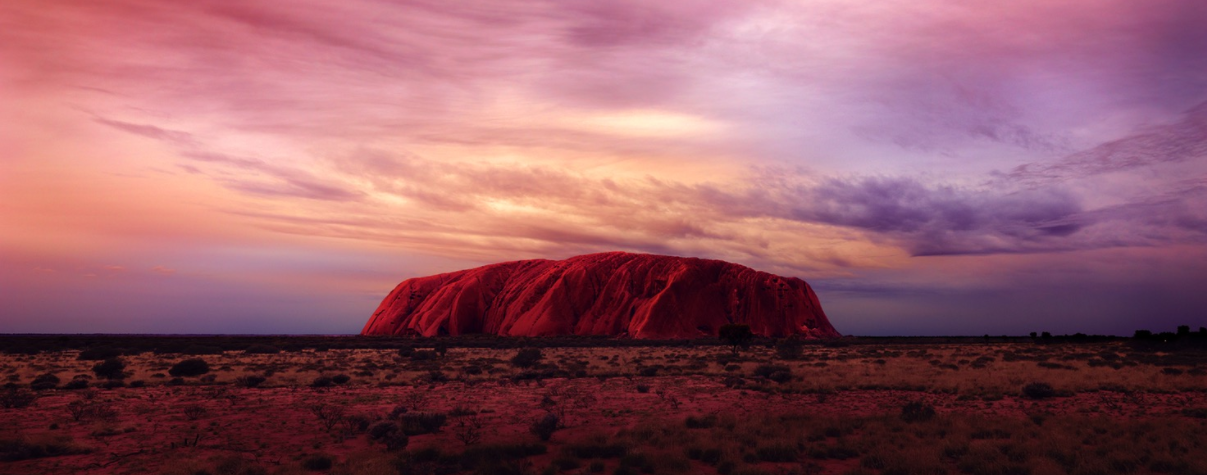
Uluru, or Ayers Rock, the huge sandstone monolith in Australia’s Red Centre, glows deep red at sunset. // © Dan Proud
It was only in 1606, little over four centuries ago, that the first known European landing was made by Dutch navigator Willem Janszoon on the western shore of Cape York, in Queensland. This discovery was closely followed by that of Dirk Hartog, another Dutch explorer, who sailed off course during a voyage in 1616 and landed on what is now known as Cape Inscription, thus discovering the coast of Western Australia.
For many decades to come, the true extent of the continent would not be known, and with the exception of further Dutch visits to the west, Australia remained largely unvisited. Although a number of shipwrecks are evidence that other Dutch and British navigators did encounter the coast during the 17th century, usually unintentionally, it would be over 150 years before the crew of HMS Endeavour, under the command of British explorer Lieutenant James Cook, sighted the east coast of Australia in 1770 and Europeans widely came to believe that the great, fabled southern continent existed.
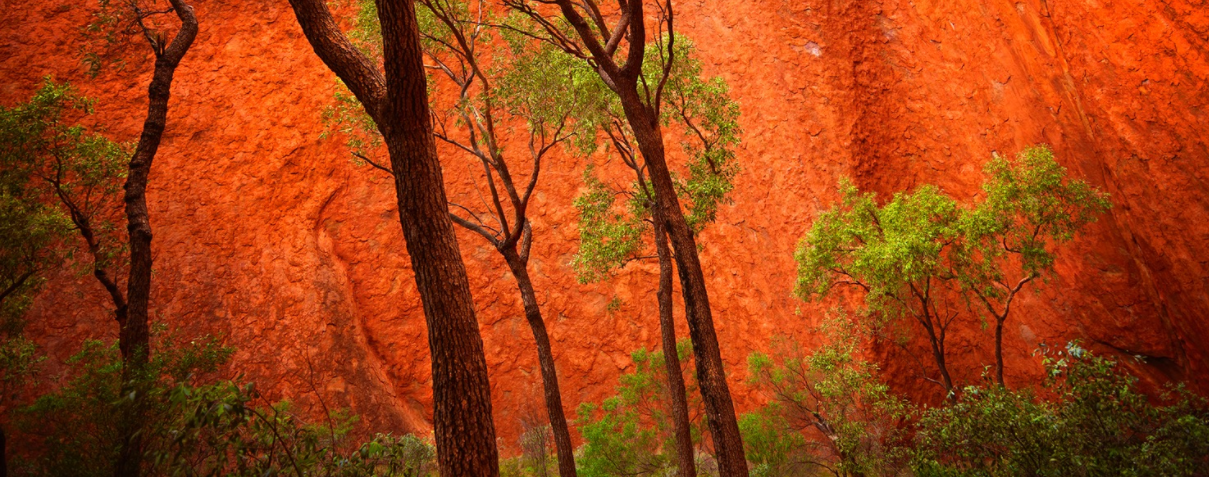
Trees in stark contrast with the vibrant orange of Uluru, or Ayers Rock. // © Dan Proud
Running in parallel ridges to the east and west of Alice Springs, through Australia’s Red Centre, lie the East and West MacDonnell Ranges, also known as the Macs. Most people imagine the Outback to be completely flat, but these mountains run for more than 600 kilometres and in places reach heights of over 1,500 metres. Formed 300 to 350 million years ago, folding, faulting, and erosion have since shaped the Macs to form numerous narrow gaps and gorges, and they contain many areas of cultural significance. Seen from the air, their undulating and intricate rock formations are spectacular.
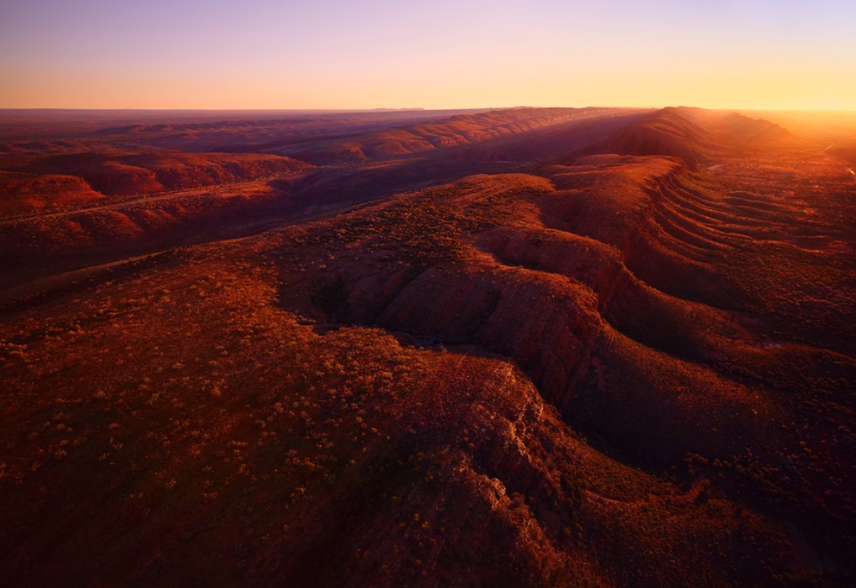
The West MacDonnell Ranges seen from the air, in Australia’s Red Centre, west of Alice Springs. // © Dan Proud
Weather patterns in the Outback are also something that surprises many people. While often envisaged as a uniformly arid area, the Outback regions stretch from the northern to southern Australian coastlines, and encompass a number of climatic zones — including tropical and monsoonal climates in northern areas and temperate climates in the southerly regions. At times, dramatic dust and thunder storms roll in, soaking the dry ground and often causing flash flooding. Witnessing these storms is an incredible experience.
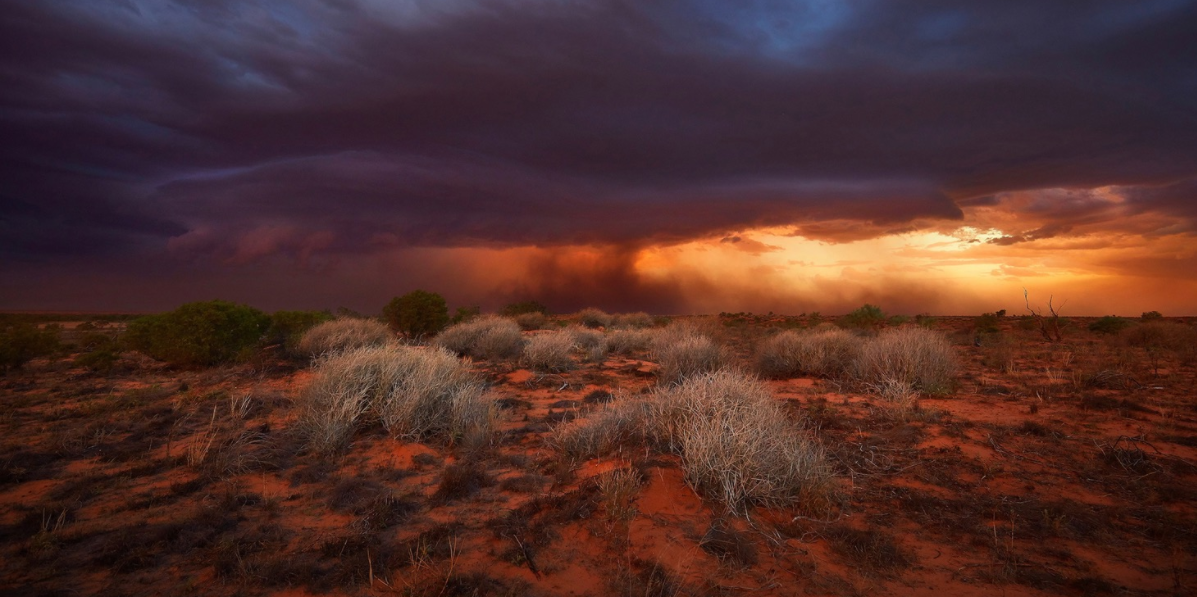
Dust and thunder storm meet near the tiny settlement of Innamincka, Southern Australia. Situated on the banks of Cooper Creek, it is surrounded by the Strzelecki, Tirari and Sturt Stony Deserts. // © Dan Proud
Reflecting its wide climatic and geological variation, the Outback contains a number of distinctive and ecologically-rich ecosystems, along with many well-adapted animals, such as the red kangaroo, the emu, and the dingo, which are often to be found hidden in the bushes to keep cool during the heat of the day. Recognised as one of the largest remaining, intact natural areas on Earth, the Outback is home to many important endemic species.
One such species is Adansonia gregorii, known locally as the boab tree, which is found nowhere else in the world but the Kimberley region of Western Australia, and east into the Northern Territory. With their striking swollen trunks, boab trees can reach up to five metres in diameter at their base, and amazingly, some individual trees are more than 1,500 years old, making them the oldest living beings in Australia, and among the oldest in the world.
For thousands of years, Indigenous Australians have used these giants for shelter, food and medicine; often collecting water from hollows within the tree, and using the white powder that fills the seed pods as food. Decorative paintings or carvings were also made on the outer surface of the fruit.
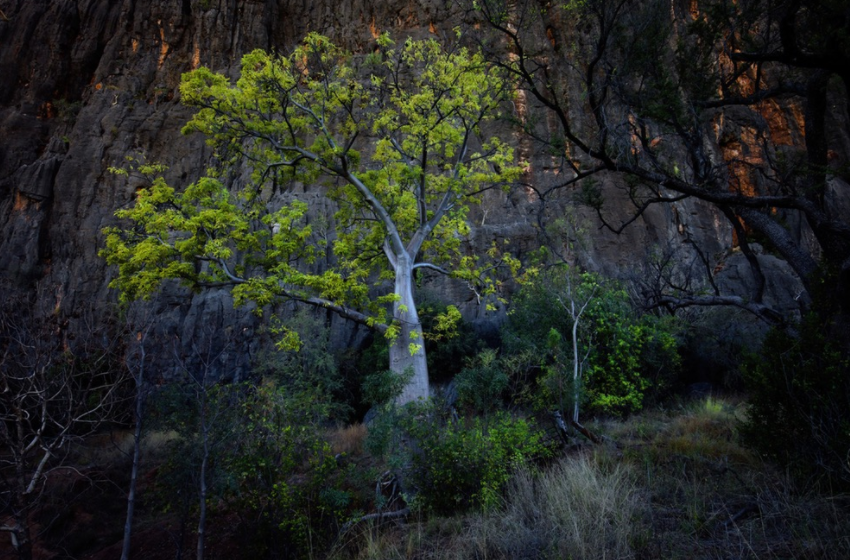
A boab tree growing in the Kimberly region of Western Australia. // © Dan Proud
Also found in the Kimberly region is the Cockburn Range, a magnificent sandstone escarpment that rises for 600 metres above the surrounding plains. Shaped like a vast fortress with towering orange cliffs, many rivers have cut through the formation to form steep-sided gorges. Flying above the Range at sunset, when the western face is lit up with a brilliant red glow, reveals another of the Outback’s epic and ancient landscapes.
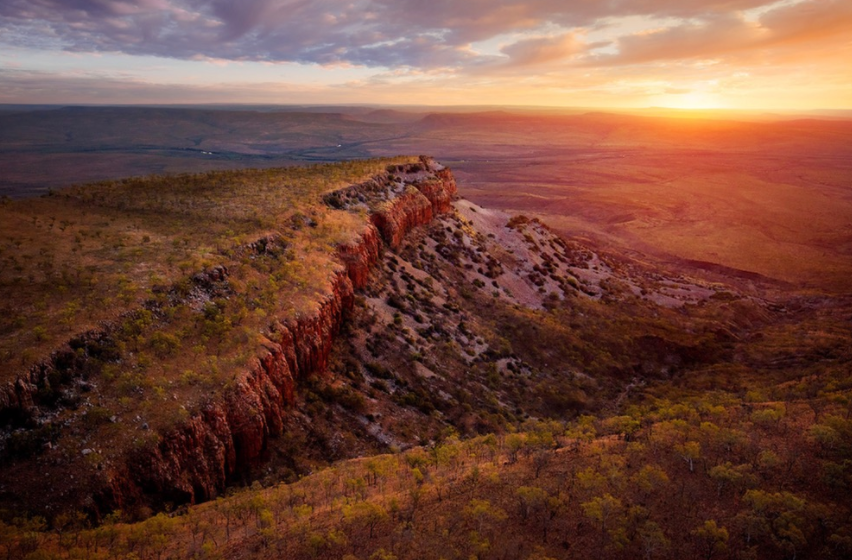
Sunset flight over the Cockburn Ranges in Kimberley, Western Australia. // © Dan Proud
The geology of South Australia’s Outback is no less dramatic, and among the rugged, weathered peaks and rocky gorges of the Flinders Ranges, some of the oldest fossil evidence of animal life was discovered in 1946, in the Ediacara Hills. Similar fossils have been found in the Ranges since, but their locations are kept a closely guarded secret to protect these unique sites.
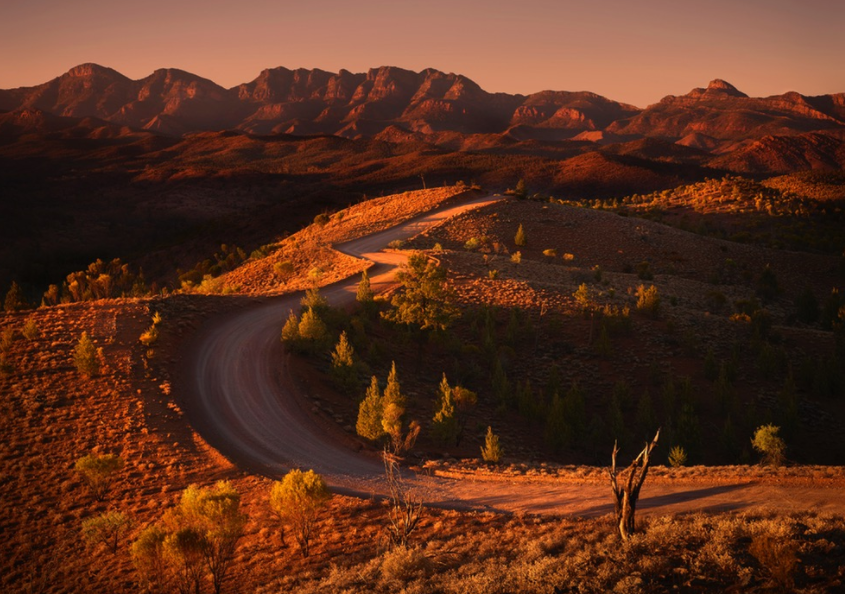
Cast in golden light, Bunyeroo Valley in Southern Australia. // © Dan Proud
The first humans to inhabit the Flinders Ranges were the Adnyamathanha people — meaning “hill people” or “rock people” — whose descendants still reside in the area, and also the Ndajurri people, who no longer exist. Cave paintings and rock engravings tell us that the Adnyamathanha have lived in this region for tens of thousands of years. Though my perspective is usually broad and from the air, in the nooks and crannies of these arid landscapes live the yellow-footed rock-wallaby, which neared extinction after the arrival of Europeans due to hunting and predation by foxes, and also two of the world’s smallest marsupials — the endangered dunnart, and the nocturnal, secretive planigale, smallest of all, often weighing less then five grams.
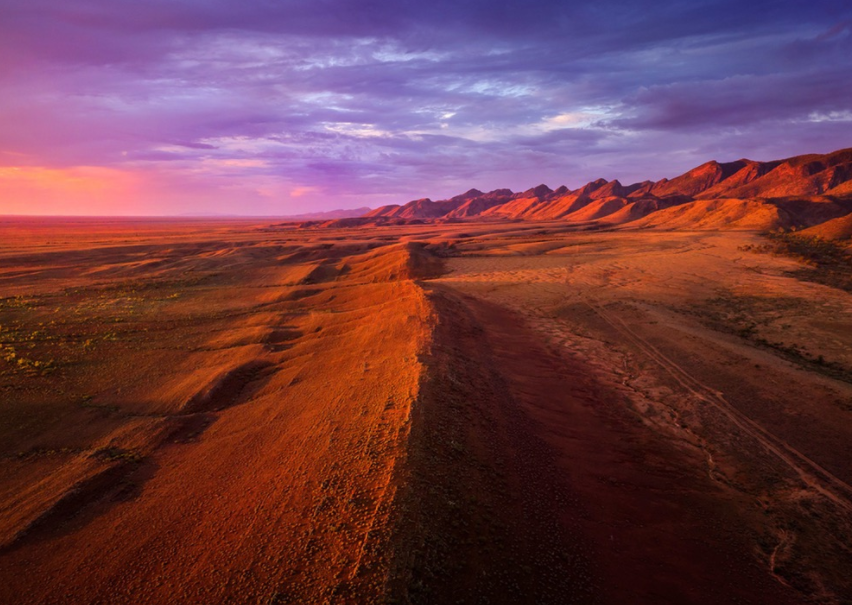
The dramatic Flinders Ranges of Southern Australia seen from above, photographed by drone. // © Dan Proud
Last but certainly not least, we come to the spectacular Pilbara region of Western Australia. Stretching over a vast area of more than 500,000 square kilometres in the north of Western Australia, it is home to some of Earth’s oldest rock formations, dating back an impressive two billion years.
Seen from the air, parts of the Pilbara can sometimes resemble another planet. Yet the greens and yellows of the acacia trees, the hardy shrubs, and the drought-resistant Triodia spinifex grasses — contrasting so spectacularly with the brilliant orange and ochre of the land itself — remind us that life can flourish and adapt even in the most challenging of conditions.
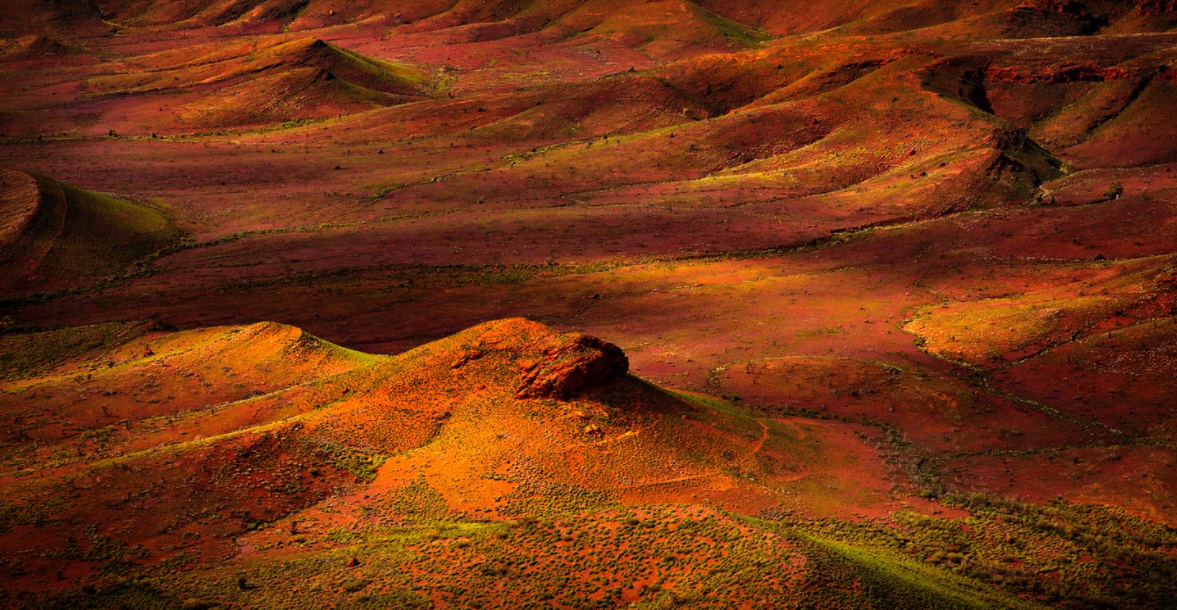
The vibrant colors and unusual contours of the mineral-rich Pilbara landscape in Western Australia. // © Dan Proud
Known also for its vast mineral deposits, for many years the Pilbara has been a mining powerhouse for crude oil, natural gas, salt, and iron ore. Today, although the fragile ecosystems of this area have been damaged by these extractive industries, a number of Aboriginal and environmentally sensitive areas now have protected status in the Pilbara — including the stark and beautiful Karijini National Park with its deep gorges and striking canyons.
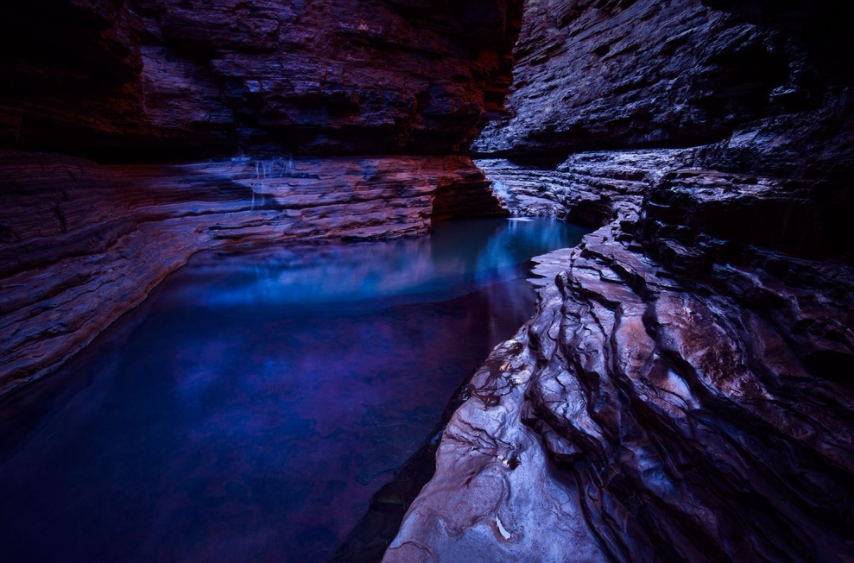
Stunning displays of rock layers at Hancock Gorge in the Pilbara. // © Dan Proud
Culturally, Australia’s Outback regions will always be deeply ingrained in our country’s heritage, history, and folklore. For Indigenous Australians, creation of the land itself is believed to be the work of heroic ancestral figures who traveled across a formless expanse, creating sacred sites on their travels. Ecologically, it is one of the most untouched and intact natural areas we have left on the planet, and home to a plethora of important endemic species. Geologically, it represents a vast and ancient landscape — one of the most unique on Earth and one that I could never tire of exploring. Every time I head up into the air or set out to photograph the Outback, I’m blown away.
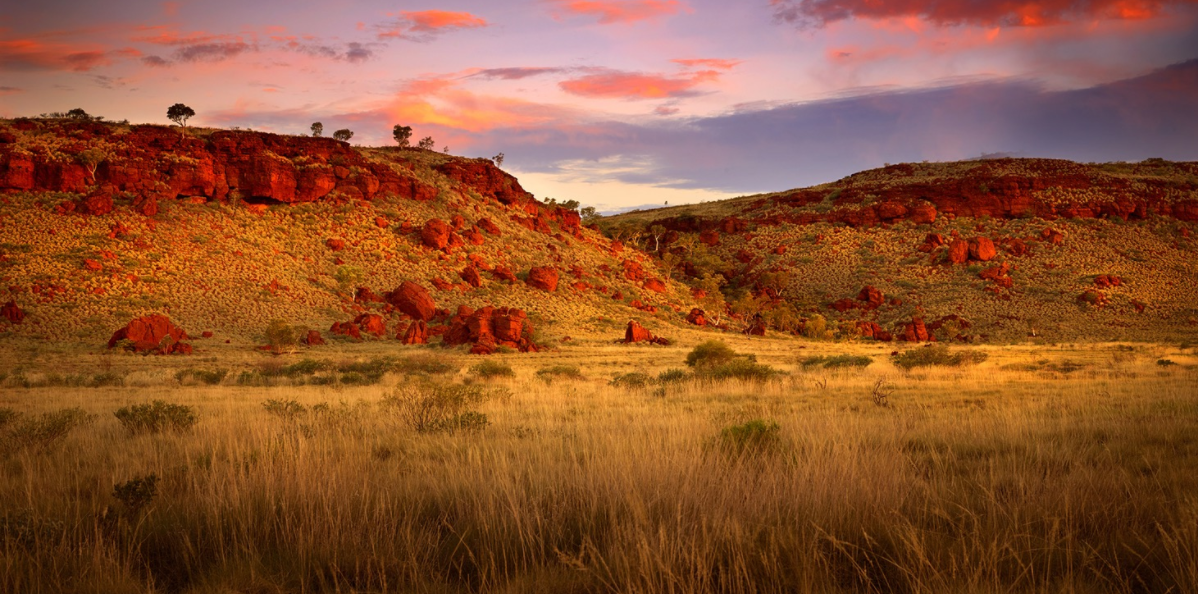
Dotted with acacia trees, the striking landscape of Pilbara’s Outback region at dusk. // © Dan Proud
THIS ARTICLE WAS ORIGINALLY PUBLISHED ON MAPTIA.
DAN PROUD
Dan Proud is a Queensland-based photographer and film maker with a passion for aerial cinematography and capturing the magical wide open spaces of Australia.
Explore Aotearoa with Ludovic Gilbert
Aotearoa is the Maori name for New Zealand. Ludovic Gilbert and his wife spent 3 weeks there for their honeymoon, and traveled more than 4,000 miles through Christchurch, Akaroa, Lake Tekapo, Te Anau, Wanaka, Fox Glacier, Punakaiki, Kaiteriteri, Wellington, Tongariro, Taupo, Whengamata and Auckland. Here are the fantastic landscapes, beautiful people and lakes with amazing colors they found.
VIDEO: Scuba Diving in the Heart of Yap
Julie Hartup, part of Manta Trust, a non-profit organization, recently went to Yap to begin a long-term monitoring and research program. This footage was complied over four days of scuba diving at a shallow cleaning station with help from the Manta Ray Bay Resort.