
By Jeremy Gordon
Remnants of the Wagner Group have used tramadol, a prescription opioid, to seize control of the Central African Republic.
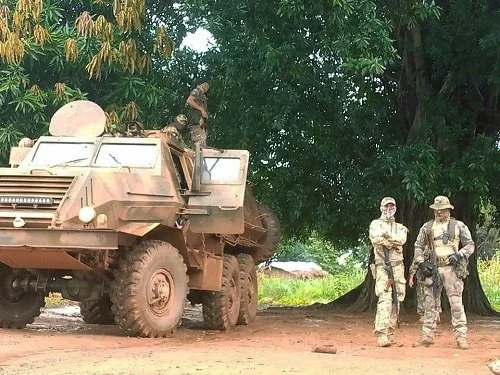
Wagner Group members in the Central African Republic. Corbeau News Centrafrique. CC BY-SA 4.0.
In the Central African Republic, along the banks of the upper Ubangi River, remnants of the Russian mercenary Wagner Group have created an opioid empire. By trafficking the narcotic painkiller tramadol, which functions as a stimulant in high doses, they have expanded their influence over the country, as well as the profits they extract from its natural resources. The surviving network is led by Pavel Prigozhin, the son of Wagner’s former leader, Yevgeny Prigozhin, who died under suspicious circumstances in 2023.
The Wagner Group was founded by Yevgeny Prigozhin and Dmitry Utkin in 2014, during the Russian annexation of Crimea. A private military company, they were funded and tasked by Moscow to serve as a proxy for the government in armed conflict. Beyond Russia’s invasion of Ukraine, they have been deployed to Belarus, Venezuela, Syria, Sudan, Libya, Mali and the Central African Republic. Its members have been accused of war crimes, including robbery, torture, rape and murder.
In June 2023, Yevgeny Prigozhin led the group in an armed rebellion against the Russian government over its mishandling of the war in Ukraine, seizing the city of Rostov-on-Don and marching toward Moscow. An agreement was quickly reached, ending the shocking mutiny. But as befalls many of Vladimir Putin’s adversaries, Yevgeny wound up dead shortly after. On August 23, 2023, a plane carrying him and nine other Wagner members, including Dmitry Utkin, crashed en route from Moscow to St. Petersburg, killing everyone aboard. Western intelligence suggests that the crash was most likely the result of an explosion on board. With their leadership dead, most of the group's assets were absorbed by the Kremlin.
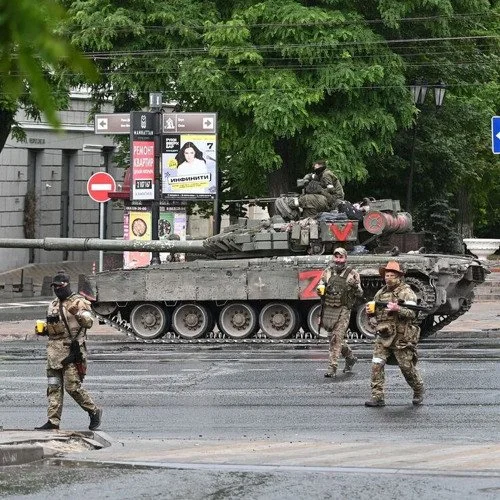
Wagner Group members in Belarus. BelTA News Agency. CC BY 3.0.
Some key remnants of the group have survived, led now by Pavel Prigozhin, Yevgeny’s son. It is estimated that about 500 of these mercenaries have created a base of operations in the Central African Republic. According to a June 2026 report by the Global Initiative Against Transnational Organized Crime, the group has embedded itself in key government ministries and security forces. Their interests control the country’s largest goldmine at Ndassima, which extracts about five metric tons of gold a year, worth up to $500 million. Cargo aircraft registered to the Central African Republic’s military carry their gold, weapons and soldiers throughout the region.
The source of their influence and funding is tramadol, a narcotic analgesic often prescribed to treat minor ailments. But in high doses, the drug acts as a stimulant, earning it the nickname “the cocaine of the poor.” The drug comes mostly from pharmaceutical manufacturers in India. It is legally exported to the Republic of Congo, where it is smuggled across the Ubangi River into the Central African Republic. The Wagner Group has spread the drug, turning a staggering profit while using its stimulant properties to unlock increased productivity in its miners and suppress fear in its fighters.
Research from Uppsala University has linked increased tramadol consumption to a nearly 20% rise in fatalities from fighting over mining areas. There have been around 500 deaths linked to this increase in violence in the last year. In February 2025, a Wagner-aligned militia attacked Fulani pastoralists near the Cameroon border, killing 130 people.
The remnants of the Wagner Group’s activity in the Central African Republic are a troubling harbinger of what is to come. From their jungle stronghold, they are expanding their influence over the region, including into Sudan, where a civil war has been raging since 2023. Widespread disorder and corruption have allowed for private military corporations and foreign governments to gain power over resource-rich regions throughout the continent. Gold, oil and rare earth metals are all up for grabs as the groups with the most money and military capability seek to expand their influence and profits.
Jeremy Gordon
Jeremy is a graduate student at Johns Hopkins University studying Creative Writing. He graduated from the University of Maryland with a bachelor's in Criminology and Criminal Justice and worked for four years as an Investigative Specialist with the Public Defender Service for DC.