
By Julia Sassaman
Hamas’s decision to relinquish its civilian governing responsibilities marks the latest attempt to revive the stalled peace process in Gaza.
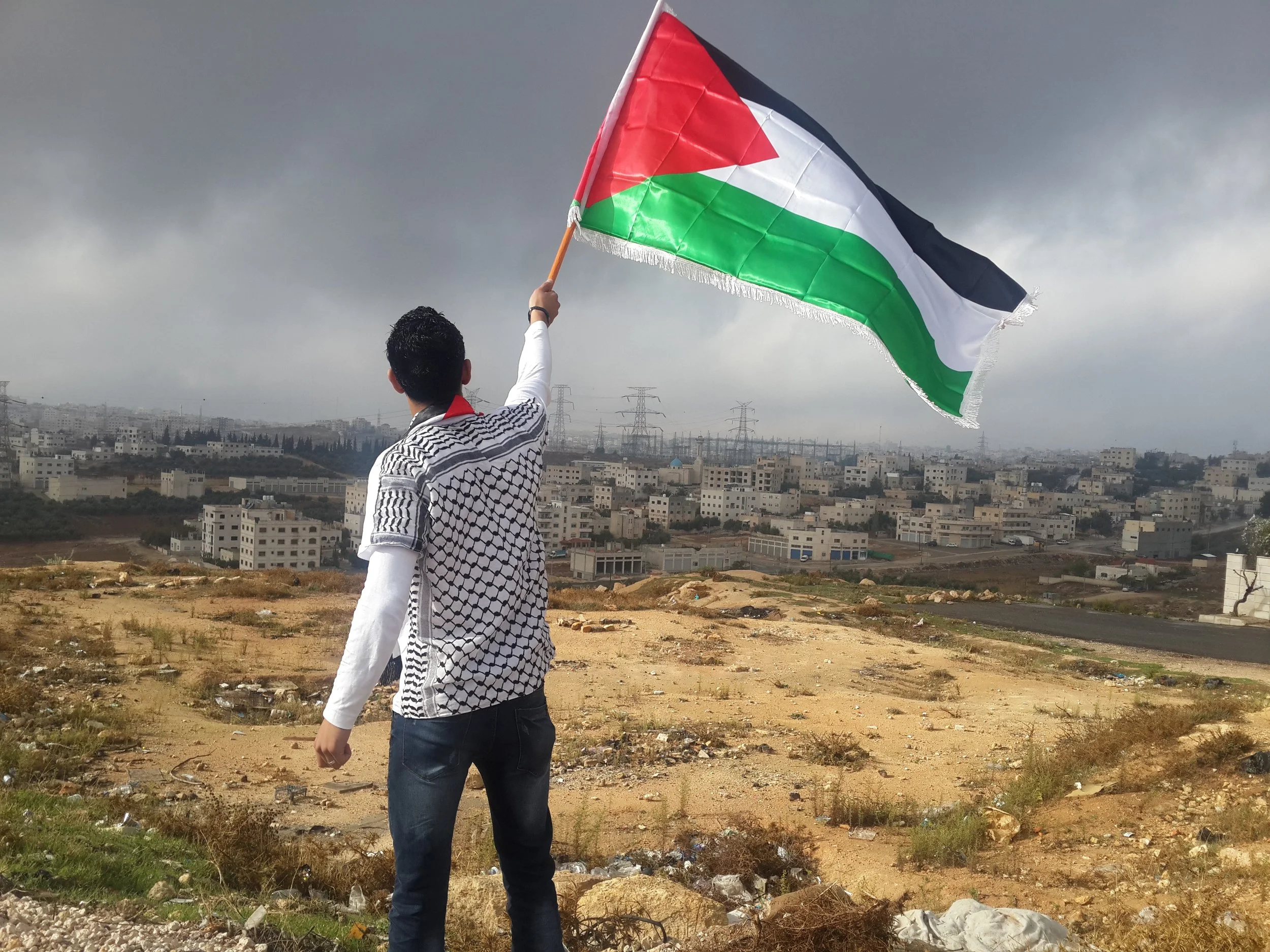
A man waving the Palestinian Flag. Ahmed Abu Hameeda. Unsplash.
On July 6, Hamas announced the dissolution of its Government Emergency Committee. The decision is intended to transfer civilian administrative responsibilities to the National Committee for the Administration of Gaza, or NCAG, established by the Board of Peace. Hamas spokesperson Hazem Qassem said the transition would “remove any pretext for the occupation,” allowing the peace plan to move forward. This move is part of the second phase of the 20-point Comprehensive Plan to End the Gaza Conflict, a framework presented by the United States in September 2025.
Established under the same U.N. Security Council resolution that endorsed the Comprehensive Plan and authorized the Board of Peace, the NCAG is intended to serve as a temporary technocratic committee to administer public services in Gaza. For now, the transition remains stalled because the committee has been unable to enter Gaza. Amjad Iraqi, senior Israel-Palestine analyst at the International Crisis Group, believes that “even if the NCAG did enter Gaza, the conditions are not ripe for any of these governing institutions to properly function.”
The plan calls for a ceasefire, Israel’s withdrawal from Gaza and Hamas’s disarmament. According to the World Health Organization, a total of 73,233 Palestinians have been killed and 173,707 injured in the Gaza Strip as of July 2026. Israeli forces now control nearly 70% of Gaza, although the agreement called for a withdrawal to 50%. Meanwhile, Hamas continues to oversee security and policing in the territory.
Save the Children’s regional director for the Middle East, Ahmad Ahendawi, said, “Even nine months since a ‘ceasefire’ when over 275 children have been killed by the Israeli forces, the world continues to ignore the voices and needs of children as they simply demand that they be treated like any other child in the world.”

President Trump ratifies the Board of Peace Charter in January 2026. Press Service of the President of the Republic of Azerbaijan. CC BY 4.0.
Critics of the dissolution include Israel’s Foreign Minister Gideon Saar, who described the move as a political maneuver that would allow Hamas to retain military power while publicly handing municipal administration to the NCAG. The Board of Peace said it would judge Hamas by its future actions, but declared that consolidating all weapons under NCAG control was necessary to establish “one authority, one law and one weapon.”
Beyond political commitments, the Gaza peace plan has struggled to secure the personnel and funding needed for implementation. President Trump had pledged 20,000 international peacekeeping troops to secure Gaza, yet as of July 2026, only 10 to 20 are expected to deploy in the next few months. The Board of Peace has also received only a fraction of its proposed $17 billion reconstruction fund from member states.
Despite these setbacks, international support for Palestinian statehood has continued to grow. Of the U.N.’s 193 member states, 157 formally recognize the sovereign State of Palestine, and the broader international community has repeatedly called for an immediate ceasefire.
The stalled implementation of the Comprehensive Plan echoes concerns raised by Nathan J. Brown, senior analyst at the Carnegie Middle East Center, who warned of the dangers of a stagnant peace process. Brown argues that a continued stalemate could harden the fragmentation of Gaza and the West Bank, and “a positive future trajectory hinges on a coherent push from external powers.”
Hamas's decision to transfer civilian governing authority represents one of the most significant recent political developments in Gaza, but major obstacles remain. Israel continues to maintain an extensive military presence, Hamas retains its weapons and the NCAG remains unable to enter Gaza. With key international commitments still unmet, the future of Palestinian governance will depend on whether Israel, Hamas and international mediators successfully implement the remaining provisions of the Gaza peace plan.

Julia Sassaman
Julia is a fourth-year student at the University of Michigan studying political science and international studies. She recently studied abroad in Geneva, Switzerland, researching post-conflict tourism and international human rights law. After graduation, she hopes to move to Europe to pursue a career centered on global human rights. In her free time, she enjoys painting, baking, journaling, and reading.