I Met Bashar Al Assad. He Was Pretty Cool.

In May of 2008, as a 24-year-old student at Harvard's Kennedy School of Government, I went on a two-week, student-led trip to Lebanon and Syria. As part of that trip, we had unprecedented access to Bashar Al Assad and his wife Asma.

The 20 of us on the trip stayed in a boutique hotel in downtown Damascus, a dusty stones' throw from the massive Umayyad Mosque, dating back to the pre-Christian days of Aramea. We spent the first day exploring the chaotic, ancient city. Conde Nast would a year later call Damascus a must-see destination, and our hotel was on their recommendation list.

My family is half Turkish Jews, and a few of my friends and I made our way to the Jewish quarter, where I connected with a group of Jewish Syrians whose families had been living there since the days of Jesus. We took a photo together underneath the domineering gaze of Bashar, his father Hafez, and the early Jewish scholar Maimonedes. The elderly Jewish men and women showed us thousand year-old Torah scrolls, and they described how they felt safe as a tiny minority in a land dominated by Islam. Under Bashar Al Assad, Syrian citizens of all stripes traded privacy for security. These people were oppressed, but they were free and safe to practice their religion openly -- not the case under many other regimes. But the silence and fear were palpable. The oppression showed in their tight smiles, and in the hardened stares behind their eyes.

The morning we met Bashar and Asma, we all put on suits and ties, and boarded a private bus. Surrounded by armored SUVs and stiff looking dudes on 1200 CC motorcycles, we rumbled our way out of downtown Damascus, and up to Bashar's palace. Perched on top of a nearby mountain like a dictatorial acropolis, we passed through multiple checkpoints as we ascended a deserted four-lane road that felt more like a military runway than a driveway. All 20 of us sat in hushed silence as the enormity of both the building, and this opportunity, dawned on us.

The country's more recent past was grim. Bashar's father, Hafez Al Assad took power in 1970. For the next 30 years, he ran the country as if he had trained in the school of torture, death, and oppression. He was an Alawite, a religious minority. He handled the Sunni majority like a sadist. In 1982, he put down a Muslim Brotherhood uprising in the city of Hama by indiscriminately slaughtering 20,000 of its men, women, and children. He then paved over their mangled and mixed remains with concrete in order to avoid being charged with war crimes.

Bashar was studying ophthalmology in London in 1994 when his older brother, the heir to the presidency, died in a car accident. Hafez called Bashar back from the UK, expedited him through the country's military schools, and prepared him to inherit the realm. At Hafez's death in 2000, Bashar became president. His wife Asma Al Assad was generally referred to as a "bright," "energetic," "fashionable," "smart," and "modern" woman. She was born in London to a Syrian cardiologist and his diplomat wife, she drove herself everywhere (rare for a first lady in a conservative regime), and she turned down Harvard Business School (my alma mater) to marry Bashar.

Since taking power eight years prior, Bashar and Asma had done zero non-Arabic interviews. They almost never left Syria. And they certainly had never sat down with a group of American, European and Asian Harvard students prepped to the nines with tough questions. This was an unprecedented opportunity.

We pulled up to Bashar's palace. The structure looked like an enormous Arabian genie had mashed together the Pentagon, Disney's Aladdin, and Saddam Hussein's architectural wet dream. A Middle Eastern Ivan Drago with perfectly coiffed hair dressed in a five thousand dollar custom suit greeted us as we got off the bus. The guy could have been a male model or top-flight investment banker, but I could see the bulge of some weapon system underneath his suit jacket. He calmly asked us to follow him, and our group of 20 wandered into the entrance. No pat down, no metal detector. We just strode right in.

The building was designed by famed Japanese architect Kenzo Tange. The foyer was the size of a football field, with a 10-story gold inverted bowl chandelier hovering over what looked like a school bus-sized terracotta volcano. Eighty-foot tall marble columns reflected off the mirror smooth floor. Ornate tile patterns adorned the walls, and at the far end of the foyer 30-foot-tall bronze doors were shut tight. You couldn't imagine a more perfect dictator's lair.

We were ushered into a side room, all marble, mother of pearl, and intricate tile. Our 20 seats were aligned on two sides of the space, and at the head of the room were two mahogany upholstered thrones. Above the thrones hung a six-foot-tall imperial eagle, also carved out of mahogany. We were served bottled water and some sort of juice from concentrate, but before I could take a preservative-riddled sip, there he was. We all stood as Bashar Al Assad entered the room.

He strode to the thrones, shaking hands with all of us along the way. Smiling, saying "Hello, thank you for coming, nice to meet you" in his nerdy, unobtrusive, borderline lisp. He took his seat.

We spent the next two hours asking him every possible question we could imagine. We started off friendly, asking about development goals, banking reforms, gross domestic product, international trade, and his family. Bashar talked about democracy, raising three children, missing London. We then started playing rough.

"How can you in good conscience preside over a brutal intelligence apparatus?"

"What was your involvement in the murder of Raafik Hariri in Beirut?"

"Why do you support Hezbollah?"

"What is your relationship with Iran?"

We were not friendly. We were downright confrontational.

And he responded to every question with measured, well-reasoned, very convincing answers. He was straight up amazing. He parried our hardest punches, he acknowledged the massacres and pain caused during his father's era, and he eloquently laid out his vision for a reformed Syria, for a modern, healthy, happy Syria. We ate it up.

Two hours into our inquisition, as we lost our venom and began to come around, he brought in Asma. She was beautiful. She wore a fashionable dress that looked like it was made from strips of marble and cloud. She sat in the other throne next to Bashar, and she too answered our questions. She spoke about her passion, the future youth of Syria, bringing Syria's magnificent culture into the twenty-first century. She spoke with an enchanting British accent, about her plans to open local development centers throughout the country, where she would extend education and extracurricular support to the millions of her citizens who needed her help.

We all left the session thrilled. There was hope! These were enlightened monarchs! They just needed to get their story out to the world!

And then, the icing on the cake -- he invited us all to his private box at the opera. That evening we kept on our suits and ties, and we attended the Syrian National Symphony Orchestra's Annual Gala Concert. Bashar and Asma were announced, we all rose, and then our "delegation" from Harvard was announced to the crowd of several thousand in the gilded opera hall. We were all enchanted.

In May 2008, there was no way of knowing that the Arab Spring would erupt, and that it would take down the dictators of Tunisia, Libya, and Egypt. There was no way of knowing that Assad, the nerdy ophthalmologist with a long neck and bad mustache, would kill reportedly over one hundred thousand of Syria's citizens. There was no way of knowing that he would launch SCUD missiles, and chemical weapons, at his own people. There was no way of knowing that he would torture hundreds of thousands more, many of them children.

As Joan Juliet Buck reported:

On April 29, 2011, a chubby 13-year-old boy named Hamza Ali al-Khateeb was arrested during a protest in Saida, near Daraa. On May 24, Hamza's mutilated body was returned to his parents. The report by Al Jazeera said: "The child had spent nearly a month in the custody of Syrian security, and when they finally returned the corpse, it bore the scars of brutal torture: lacerations, bruises and burns to his feet, elbows, face, and knees. Hamza's eyes were swollen and black and there were identical bullet wounds where he had apparently been shot through both arms, the bullets tearing a hole in his sides and lodging in his belly. On Hamza's chest was a deep, dark burn mark. His neck was broken and his penis cut off."

Today I wonder about Asma and Bashar Al Assad. The friendly, smart, kind parents who cared so much about the youth and future of Syria. The English accent, and the unobtrusive lisp. How could they not know what was happening? How could they stand by and do nothing while the Syrian regime mutilated the future?

I'd like to think that Bashar has no power, that it's really his generals who have wrested all control and are tearing apart that beautiful ancient land. I'd like to think that I'm a better judge of character. I'd like to think that there is a part of this story that I'm missing, something that ties it all together so that my time with Bashar Al Assad and his wife makes sense.

But that's not the case. We were duped by a monster.

ORIGINALLY PUBLISHED IN THE HUFFINGTON POST.


NICK TARANTO

@NickTaranto

Nick is co-founder of Plated.com where he runs all non-technical aspects of the e-commerce gourmet recipe kit delivery business. Nick graduated from Dartmouth College and then started a microfinance institution in Central Java, Indonesia while on a Fulbright grant. Nick is a US Marine Corps infantry officer, and has spent time consulting with McKinsey & Co and as a private wealth advisor with Goldman Sachs. He received his MPA and MBA from the Harvard Kennedy School and Business School. He has six brothers and sisters, is married, and loves peaty whiskey and esoteric endurance sports. 
Am I Making a Difference?

Mingling in hostels you tend to meet many adventurous spirits finding their way in the world. Among those I met a young girl with similar interests in the social work/humanitarian field in Chennai, India. She was nearing the end of her yearlong journey and as we talked we reminisced about the hardships and victories we found along the way. She told me of her 1st day working at an HIV positive orphanage in Bangalore where a child fell and cut herself. My new found friend's immediate reaction was to clean the wound, which she instinctively did, as everyone watched open mouthed, too afraid to say a word. After numerous blood tests she found out she had not contracted HIV, but it was a wake up call. She had forgotten she was in a different place, without the luxury of basic necessities. Finally we got to the point I asked  what she felt her biggest accomplishment was during this trip? She looked me straight in the eye's and said, "I feel like I have accomplished absolutely nothing, I have made no difference in this place." Here was a girl who had been devoting her life for the past year to HIV positive orphans, trafficked girls, and battered women yet she felt like she had accomplished nothing. I was floored and thought if she hasn't made a difference have I? I proceeded to make a list of how I felt when I was impacted by volunteers when I was younger, and what difference they made in my life today. As I thought, I realized we need to look at our small victories. Realize we can't change a country overnight, but we can provide a motherless child with love. We can let these children see what else there is in the world. We can give them the confidence to succeed. We can open their minds. Whether it be for 2 days or 2 years, that child is going to remember the love they felt from you. This is why we started Humanitarian Travel Tips doing medical screenings and vocational training. We can't change a country overnight, but by providing glasses to a child who can't see a chalk board we are changing their opportunities and their life forever.

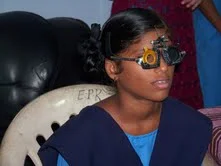
Without glasses these children can't learn. They are put into the lowest classes of children deemed unfit for learning, given little to no teacher supervision, and leftover books (if there are any). With glasses they are able to move up in school, they won't fall through the cracks, they have the opportunities to reach their full potential. The girls who got the glasses go on to be educated women who as a whole have fewer children and take better care of those children. On the same token teaching women a vocation like sewing gives her the ability to provide for her family, send her children to school, and give the children the nutrition they need to concentrate during school. They raise educated children, thus changing a generation. Too often we underestimate the power of the good we are doing and we shouldn't. Every smile, every friendship, every amount of love you give to a person makes a difference to that person. I have been at orphanages long term and you don't realize how long after you leave those children still talk about you, or the pictures you give them they will hold onto forever. Don't underestimate the power of good in this world you can do. 


CHAMBREY WILLIS

@chambreyw

Chambrey is the founder of Humanitarian Travel Tips an organization that raises the standard of living to people in developing countries through health screenings and vocational training. We are excited to announce that we are now welcoming volunteers to join with us on these initiatives this summer. Chambrey is an avid yogi, got her undergrad in Finance and is working on a  guidebook outlining step by step how to best fundraise for your next big adventure. You can find her on facebook or follow her blog.

The Peace Corps in Rwanda, Part 2

A Peace Corps Christmas in Rwanda

In my last update, I talked a bit about the path that led me to the Peace Corps and the basics of the three-month training program that was my day-to-day life. For a while, most of that remained unchanged. After returning from visiting my final site outside Nyungwe National Park, I was back to the grind of daily Kinyarwanda lessons; classroom management sessions, and any other miscellaneous bit of training that the Peace Corps deemed necessary for its education volunteers.

I mentioned in my first post how the community-based training program, while undeniably effective when it comes to integration and language acquisition, can quickly leave you desperate for just a small taste of the familiar. As soon as we had the chance, we all embraced that ideal wholeheartedly with the help of surprise birthday parties, pumpkin carving for Halloween, a massive collaborative Thanksgiving dinner, and most recently coming back together for Christmas and New Year’s celebrations.

Admittedly, some of the days have felt long and drawn out, but it’s amazing how fast the weeks have flown by. As I write this, my training has finished and I have been officially sworn in as an official Peace Corps Volunteer. After three months of training as a group, we are now scattered around the country in the communities that we will be working in for the next two years. The whole transition is a somewhat bittersweet. While I’m experiencing a freedom that I haven’t had for what seems like an eternity, it also means separating myself from the people, both in my host family and training group, that I’ve grown close to over the past months. In addition, as an education volunteer, I was installed on site during the holiday break. This meant that for a while there was little for me to do but hang out in the school offices or walk around and introduce myself (a bit of a challenge since most of the people in the community assume, at first glance, that I’m the same volunteer that has been working here the past two years).

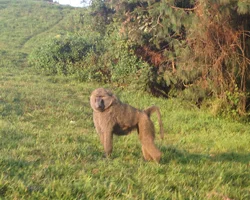
On top of the conflicts that come from simultaneous feelings of freedom, boredom, and missing friends, I’ve been finding that my site is in an unusual limbo of classic Peace Corps life and unexpected luxury. I can start my day with a bucket bath and hand washing a load of laundry, followed by browsing the web in my school’s modern offices. I can then head up a partially eroded hillside staircase past a couple troops of baboons and struggle to light a charcoal stove in order to cook dinner. I can lounge in my tile-floored house and watch a movie, only to be woken up in the middle of night to chase mice out of the room.

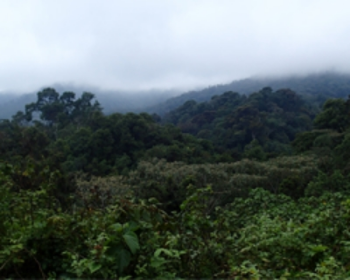
To be clear, none of these are meant as complaints; just the opposite. I was all set to be handling all these things and more, but my assignment here is most definitely not what I was expecting from the Peace Corps (in the best possible way). Just walking around the campus is an experience in itself, with forested hills stretching into the distance as far as the eye can see. 

I cannot wait to get started with my work here, although that still seems to be a long way off. While the semester for the rest of my colleagues started last week, I’m here to teach at a school for conservation and environmental management that has the students completing internships around the country for their first month. As a result, I’ve got a nice, long, and quite possibly cabin fever-inducing chunk of time off before I can begin teaching in February.

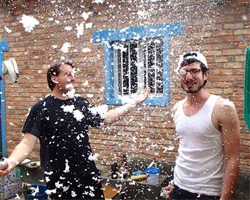
Thankfully, I’ve been able to stave off boredom by traveling for the holidays, visiting friends and getting to see a bit more of Rwanda in the process. The festivities made it a little more like home with the help of cheap Christmas decorations bought in the capital, a tiny plastic tree, and a can or two of white foam marketed as ‘fake snow’ (a surprisingly good substitute for a white Christmas, once you get past the lingering soap smell in the air). But now the holidays have come and gone and everyone is getting to work for the New Year, so it’s back to site for me. With any luck I’ll be able to find some projects to pass the time and supply me with some good stories moving forward.
READ SCOTT'S FIRST UPDATE ON THE PEACE CORPS IN RWANDA.


SCOTT JENKINS

Scott Jenkins grew up in Ridgewood, NJ and graduated from NYU in 2012 with a degree in Anthropology and Linguistics. His passion for travel, adventure, and helping others led him to apply to the Peace Corps in September of 2012. He was invited to teach in Rwanda, where he is currently serving for the next two years. 

Why You Should Ski in Afghanistan

Afghanistan.

Just the mention of the word sends images into the mind. Military units driving through deserts, windswept mud brick villages and broken arid urban landscapes. When I mention the possibility of going skiing in Afghanistan it can get some strange responses. Forget about the risk, the first question is, “Is there any snow?”

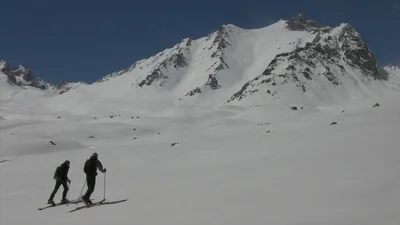
Whilst it is true that much of Afghanistan is desert or semi-desert and that it hardly ever rains, it does snow. In the mountains it snows a lot. The snow is the lifeblood of Afghanistan. As it melts, it flows through the rivers that fill the canals that irrigate the fields.  A good snowfall ensures that the people of small rural communities will have a good harvest and can feed their families and livestock. A poor snowfall often leads to a drought and a famine. However, the snow in Afghanistan is both a blessing and a curse. Heavy snow cuts off villages in the mountain and every winter people freeze to death or are crushed by avalanches.

Families wait for the snow to melt hoping to survive the winter until they can reap the reward that the snow will bring in the summer. For thousands of years there has been nothing for the people to do in the winter except wait for the spring... until now.

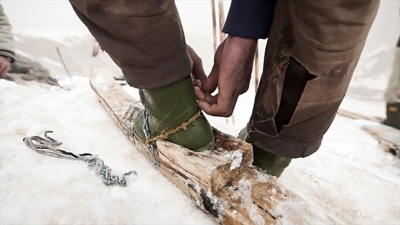
This winter young men from the villages of Kushkak, Jawzari, Ali Baig, and of the valleys of Qazan and Dukani and Foladi will pull on home made skis, crafted from wooden planks, with edges made from flattened tin cans and with poles snapped from a nearby tree. Some will be selected for training to represent their valley in a competition to see which valley can produce the best skier. They will be given modern ski gear to use. They’ll be taught how to ski, and they’ll receive basic training in first aid and avalanche awareness — skills they can take back to their village and potentially use to save lives.

A handful of young men from Bamian, in Central Afghanistan have already begun guiding foreign skiers—both ex-pats from Kabul and visitors from around the world who are trickling into the region to try out Afghan skiing first hand.

So how did this happen? 

At the beginning of the winter of 2010 almost no one had skied in the province of Bamian. The valley's chief claim to fame had been the giant Buddha statues carved into the cliffs overlooking the town of Bamian. Tragically the two statues—which were about 1400 years old—were destroyed by the Taliban in 2001 robbing the world of two of its most important ancient Buddhist relics, and robbing the people of Bamian of one of their key sources of tourist income. For Afghans, Bamian province was also well known for the lakes of Band e Amir  —a series of five lakes formed by natural travertine dams, that appear like a mirage in this high, arid landscape. In the summer Kabuli families come here to picnic and to escape the dust and heat.

Bamian is also home to the Hazara people. The Hazaras are recognisable by their Mongoloid features. They’re Shia Muslims, unlike most Afghans, who are Sunni. In popular tradition they are reputed to be the remnants of the Mongol armies who came to the region with Genghis Khan. Historically they have been looked down upon by the ethnic Pushtuns and Tajiks who make up most of Afghanistan’s population. Some radical Sunnis—such as the Taliban—have seen them as heretics because of their Shia faith. Modern Afghanistan has always been ruled by Pushtun kings or Pushtun dominated governments who have tended to overlook the Hazaras. However, there have been important changes in Bamian since the fall of the Taliban in 2001. It is no Shangri-La—there is little electricity, the province is one of the poorest in the country and by any standard it ranks as one of the least developed places on the planet. However, for the first time in decades there are signs of progress and positive change.

Ten years ago, Bamian province had never had a hospital, a paved road, or a university. Now these all exist. There are still many problems, of course, but the Bamian valley is relatively secure and there is none of the anti-government fighting that plagues large parts of the rest of Afghanistan.

An international development agency, the Aga Khan Foundation, saw the potential of promoting tourism in Bamian as a way of giving the people of the province an additional source of income. The Foundation has helped to develop guest houses, organise cultural festivals and provide information about the places of interest in and around Bamian.

That’s fine in the summer when tourists come to the valley, but what about the winter, when guest houses lie empty? Well, the people of Bamian fall back on their timeless winter pastime of just surviving and waiting until the Spring.

But taking their cue from other mountainous developing countries it was clear that any winter income was better than none so the Aga Khan Foundation began the Ski Bamian programme. With no infrastructure or lifts, the idea was to make the Koh-e-Baba mountains a new destination for ski-touring. 

In 2010 two American skiers were employed for the winter to map out potential routes. They brought only their own equipment so the Afghans had to get creative if they too wanted to ski along with them. Anyone with a small knowledge of Afghan military history will tell you that not having state of the art equipment never stopped the Afghans with competing with foreign powers.  Skiing with no ski equipment was not an insurmountable problem. Strips of wood with battered oil tins for edges were formed—so, the bazaar ski was born.

It quickly became clear that the mountains of Bamian were perfect for skiing and in 2011 a foreign ski trainer arrived to train the first batch of Afghan ski guides. It was early in 2011 that Ali Shah met Nando the Italian ski trainer at his village of Khushkak. Ali Shah was fit, young and spoke good English. Nando asked him what he wanted to be?

“An engineer” said Ali Shah.

“Why you wanna be an engineer? In Kabul there are a thousand engineers. You shoulda be a mountain guide. It's the best job in the world. You spend your whole life in the mountains with beautiful women.”

It may not have been a textbook interview but Ali Shah is now Afghanistan’s best ski guide and Nando's singular teaching style set the basis for the success of the project.

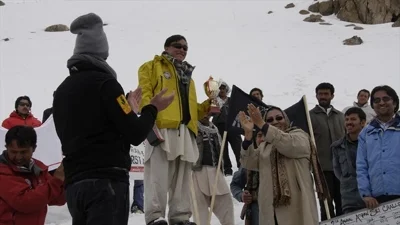
During 2011 and 2012 the annual Afghan Ski Challenge race (Rule number one — no weapons) was organised by a Swiss journalist and has became a focal point for the ski season (www.afghanskichallenge.com). With most Afghan Challengers having only one month’s ski training the Swiss organisers thought it an unfair challenge. They divided the race into Afghan and non-Afghan categories. The challenge is a classic ski touring route which includes skinning up as well as skiing down. They were right to divide the competition as most of the Afghans had finished before the foreigners had even got to the top.

With donations from western organisations like gear4guides (www.gear4guides.com) there is now a well equipped ski rental shop in Bamian serving the local community and the ex-pat and international skiers that trickle in.

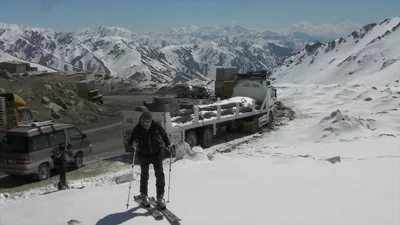
My connection with skiing in Afghanistan began in 2009 when I bumped into a Scottish lad who worked for an Afghan aid agency. Ken was hiking with his girlfriend in the Wakhan region of Afghanistan in the far North East and I was leading a group of trekkers. The Wakhan region is the only other part of Afghanistan safe enough to consider these types of outdoor trips.

He told me of a group of British and French skiers working in Afghanistan who regularly skied near Kabul in the winter and if I was serious about being an Afghan tour operator then I should be offering ski trips to Afghanistan. I said I'd join him on a trip that winter.

On the first trip I made we took one of our regular drivers, Ali. For someone who has never skied it is quite hard to explain what we planned to do. Once we loaded up the poles and skis he had a rough idea of what we were up to and wanted to help. At the bottom of the Salang Pass, which crosses the spine of the Hindu Kush, Ali stopped at a small teahouse and ordered food for all of us. As any Afghan will tell you the best thing for breakfast if you are going to spend all day in the snow is Cow’s Foot. Boiled for hours, this gelatinous lump of bone, fat and gristle is never appealing to non-Afghans and the French skiers particularly do not like it. We made a quick note that for the commercial trips, we wouldn’t let the drivers choose the dining options.

But it was then that I saw how skiing was something that really appealed to all the Afghans who saw it. Standing next to Ali as we watched Ken fly down the slopes, he was awestruck. “He is a Djinn,” was Ali's response. Hazaras believe there are mountain spirits and clearly Ken was one. 

In the tea house where we stopped on the way back, Ali regaled the owners with the tale of Ken's exploits. Ken was described as a Djinn and I as a Boz (a goat). I hoped it was a way to describe my sure footedness in the mountains but I think it was more to do with my erratic skiing style. 

In keeping with Afghan tradition, the story was heavily exaggerated but it started a long discussion about skiing, mountains, snow conditions, avalanches and Afghanistan’s future.

It was not only Ali who became a convert. I realised that, Cow’s Foot aside, this was an awesome way to experience Afghanistan in the winter. Skiing was something that was very foreign but the snow and the mountains was a common factor that could bring people together as it had done in that tea house. I also thought Bamian could be the perfect place for skiing. 

It has not always been smooth. A few elders in one or two villages are suspicious about the skiing fuss. They worry the young men will hurt themselves—preventing them from doing the hard farming work—or that skiing will be the thin end of the wedge and they'll get caught up in other foreign un-Islamic ways. This generally does not stop the young boys from hiking up the hills and skiing. “The only say it is bad because they don't know how to ski,” said one boy from Jawzari village.
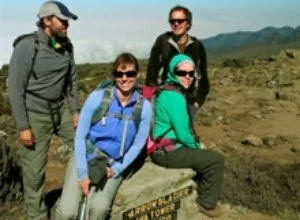
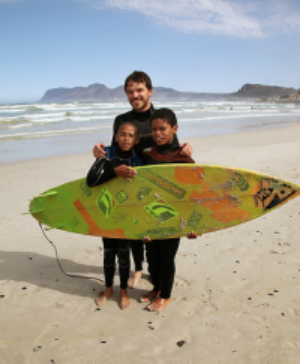
All the trailheads start from the villages and we have a code of conduct to help ensure that skiers behave properly. The Aga Khan programme representatives have discussed the skiing idea with all the local villages. We pay our respects to the village leaders and maybe take a cup of tea. There are many ways in which thoughtless skiers can cause offence, generally to do with women. In a country where the majority of people are illiterate and there is very limited access to the media, in these isolated rural communities, rumour is often taken as fact. If someone tells a man that the foreigners took a photo of his wife and put it on display in Kabul he will probably believe it. So Rule Number One is—Don’t take pictures of the women. Ever. 

Cultural sensitivity is key to the future of skiing in Afghanistan.
 
When guiding a group of snowboarders last winter we spent a good hour discussing with the headman of one village what we wanted to do in their valley. The snowboarders were professional and were heading to a steep area that had not been ridden, so the villagers were suspicious. It took a great deal of persuasion until he agreed and let us pass around his village. 

As we walked around the village we were watched closely by the men on the rooftops, with no smiles or handshakes. We travelled far up the valley and soon the snowboarders were making jumps from the top of large cliffs. On the second attempt one of them failed to make his landing and crashed in a huge cloud of snow. Suddenly huge cheers rang out from the village below. All the village stood watching on the house rooftops. They liked all the action, but they liked the crashes best of all.

On the way back down there was still staring and silence but we knew the ice had been broken.

We went back to that area for three days and by the end we were inside drinking tea and joking with the local people. 

The key to a successful trip is that the Afghan villagers have a positive experience as well as the visiting skiers.

Afghanistan has always presented a contrast of lifestyles. An abiding memory of my first visit back after years away was of an old man and a young boy herding sheep down an unmade road. With his turban and billowing shalwar-kameez—a long, loose shirt and trousers, the man looked almost Biblical. A closer inspection revealed that his son was wearing a Megadeath t-shirt (presumably a charitable donation). The road they were walking along had a traffic calming feature—a half buried tank caterpillar track to stop cars speeding through the village. Introducing skiing to a small valley in the Hindu Kush seems to build on such contrasts. 

A typical night is spent in rooms heated by wood fire stoves called Bukharis. These are very efficient heaters. You fill them to the maximum before bedtime. It might be -25C outside but we would be sitting in our rooms in shorts and a t-shirt. As the night passes and the fire burns out the temperature plummets in the room and at dawn we'll be inside sleeping bags and the glass of water by the bed will have a layer of ice.

Breakfast could be eggs or pancakes. Where we stay, the cook was trained at a US agency guesthouse. He knows exactly what hungry Westerners like to eat. Recently married, he returned to Bamian from working in Helmand province. The wages are much lower in Bamian but it is safer. In Helmand he always had to carry his ID card to get into the compound. However, if the Taliban stopped him and found this ID card he would be killed.

On a very cold night the diesel will freeze in the vehicles used to take us to the mountains. We'll drink tea whilst a fire is built under the engine to defrost it, and perhaps watch the daily UN helicopter coming in to land at the Bamian military base, managed by the New Zealand army.
 
Once in the villages at the top of the valleys, when we start to skin up we'll be invited in for tea by the village elders. Depending on the weather we'll either accept or continue uphill to make the most of the snow. I'll remind people that they should always remove their shoes when entering a house, never speak directly to the women—and above all, no matter how serious their latest case of Kabul Belly, NEVER to fart in a room with their Afghan hosts. This is perhaps the greatest social faux pas of all.

Often we'll be joined for all or part of the day by the local youths on their home-made skis. Making light work of skinning up and paying little or no attention to our avalanche warnings. they just laugh – “Inshallah” – if God wills it

There is not much to do in the evenings. Alcohol is forbidden, but there is plenty of hearty traditional Afghan food and drink—kebabs, rice and hot drinks. With alcohol forbidden, we like to call this the Apres-Tea scene.

Skiing will not solve all the problems in Afghanistan. It won't solve the problems of Bamian but in a few small valleys in the Hindu Kush they are making a small positive impact to a handful of people and that is something worthwhile.

ORIGINALLY PUBISHED ON TETON GRAVITY RESEARCH


KAUSAR HUSSAIN

Kausar has travelled every inch of Pakistan and Afghanistan and has friends almost everywhere from the bustling bazaars of Kabul to sleepy, poppy growing villages in the Tribal Areas. When not leading tours and running Untamed Borders. Hussain works as a photographer and journalist. He is the chief reporter for "World Problems" magazine and also works freelance. For ten years he has worked with foreign correspondents allowing them access to restricted areas in Afghanistan and Pakistan. He also works with Prince as part of the "World Welfare Organisation", a Peshawar based NGO. He speaks 9 languages and for the last 5 years spends time teaching English to Afghan refugees based in the camps that surround Peshawar. He arranges ski trips to Bamian every year through http://www.untamedborders.com

The Peace Corps in Rwanda, Part 1

I’ve known for a while now that I wanted to work abroad, even though I only recently figured out what I want to do with my life. I studied Anthropology and Linguistics at NYU, traveled when I could, spent a semester in Ghana, and since graduating in 2012 I had been searching high and low for positions in countless NGO’s, volunteer organizations, ecotourism companies, even the Foreign Service. Nothing was working out, until last September when I applied to the Peace Corps.

            Like a lot of people my age, I had heard of the Peace Corps in passing but had never really given it much thought. Young Americans heading off to teach abroad is hardly a novel concept anymore, with more organizations and programs offering that sort of position than you can count. And while I may not have been entirely sure of my future aspirations, being a teacher had never been at the top of my list. Nevertheless, I put in my application and started crossing my fingers to be placed in one of the environmental or agricultural programs run by the Peace Corps. Lo and behold, however, I received my invitation to serve in Rwanda as a secondary school teacher, leaving in September 2013. It wouldn’t have been my first choice, but the more I looked into things and now that I’m here in country, I don’t think I could have asked for better.

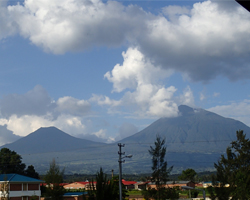
            When most people (my former self included) think of Rwanda, all that comes to mind is the genocide that took place in 1994. It has been nearly twenty years since that tragedy, however, and the strides that Rwandans have been able to make in that time is nothing short of astonishing. Add to that the natural beauty of the country – mountains, volcanoes, rainforests, and rolling green hills as far as the eye can see – and you have a place that I am beyond lucky to be living in for the next 26 months of my life.

            When you join the Peace Corps, you spend three months of training in-country before heading off to your final site. That training is where I am now, about one month into the thick of it. There are 34 volunteers in total here, each of us paired with a different Rwandan host family throughout the district of Kamonyi, a relatively short drive from the capital city of Kigali. I was placed, as were a decent number of my fellow volunteers, with a farming family in one of the many small towns within the district. Most of us have at least limited access to electricity in our homes, although running water is still, and I’m sorry in advance for the pun, a bit of a pipe dream. While this hasn’t been my first brush with bucket baths, hole-in-the-ground latrines, or hand-washing laundry, it still seems surreal to me that this is what life will look like for some time to come.

            Day to day, there’s not much variation to speak of. When I’m not spending the day studying the local language of Kinyarwanda I’m listening to a lecture on Peace Corps policy, safety procedures, or the Rwandan education system. I was warned that training feels like the longest and hardest part of service and I’m always looking at the light at the end of the tunnel, but sometimes that’s easier said than done. After a couple days of complete immersion, it’s amazing what a relief it is just to hear a few simple words of English. On the other hand, however, I can’t deny that the Peace Corps approach to language training works like a dream. On my first night here in the village I sat in awkward silence with my host family, occasionally trying my hand at some cross-cultural charades to try to explain something. Now, less than a month later, I can show up to the dinner table and have a pleasant, albeit simple, conversation with my host parents.

           A lot of things seem to move slowly around here, but one happy exception to the rule was the early announcement of our final site placements. Just this past week, we were each assigned to our permanent positions throughout the country and given a couple of days off to go visit and get a feel for what our actual service will look like. Since training can tend to seem a bit repetitive, this trip has been a much-needed break in the monotony of Kinyarwanda lessons and technical training. I am beyond ecstatic to announce that I will be teaching at the Kitabi College of Conservation and Environmental Management (KCCEM) in the Nyamagabe District down in the Southern Province. Although my primary job description is still teaching English, my post is incredibly different from all of the others in the country. Rather than a crowded secondary school with classes numbering around fifty young students, KCCEM caters to a small class (only around twenty students in total) of park rangers from Rwanda and the surrounding countries. In addition to teaching English, I will have my choice of any side projects that I might want to try my hand at – an especially exciting prospect given our proximity to Nyungwe National Park, a mountainous rainforest that is home to an overwhelming diversity of flora and fauna. I’m also particularly excited to be able to continue one of my hobbies from home and get involved in the large beekeeping cooperative here in the town of Kitabi.

Having finished my site visit, I know that my time in the Peace Corps will be far from the normal experience that most volunteers have. Even so, I wouldn’t change it for the world – this school is a better fit than I could have ever hoped for and I’m looking forward to making the most of every moment I have here. There will be more updates to come as I make my way through my service and I hope that you’ll all be as excited as I am to see what Rwanda has in store for me.


SCOTT JENKINS

Scott Jenkins grew up in Ridgewood, NJ and graduated from NYU in 2012 with a degree in Anthropology and Linguistics. His passion for travel, adventure, and helping others led him to apply to the Peace Corps in September of 2012. He was invited to teach in Rwanda, where he is currently serving for the next two years. 


My Unconventional Cambodian Christmas

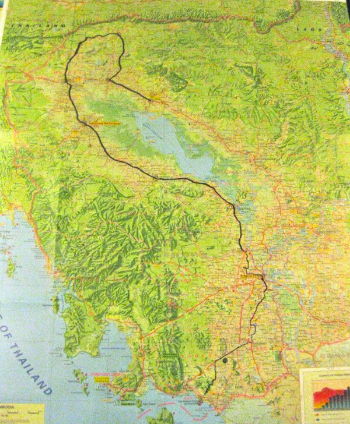
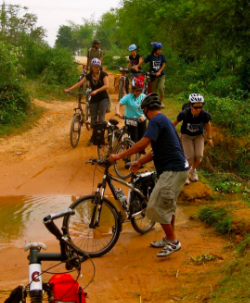
Megan participated in the 2013 PEPY Ride by PEPY Tours. She and her group biked through Cambodia, from Siem Reap to Phnom Penh, and this her story.

The route

Christmas for me normally consists of the following things: flying home to good old England, walking through the door, receiving a suffocating hug from my parents (suffocating is, of course, meant in the most affectionate way possible) and then eating. The eating generally doesn’t ever stop, just ebbs and flows like the tide. So when Christmas 2013 rolled around and I found myself facing a 1000km bike ride across Cambodia — and a whole lot of rice — needless to say I was ever so slightly nervous.

Maybe you’re wondering what on earth drove me to forego the usual food-based festivities in favor of risking a month of inevitable, interminable muscle pain. The honest answer is adventure. I wanted to see something new. To smell something new. To taste something new. But when I signed up for the PEPY Ride XI, I never imagined that, above all of the things I just mentioned, I would feel something new. And that something, whatever it was, has more or less changed the way I look at the world and all of the funny, strange, sad, glorious, confusing and downright brilliant things in it.

Megan's group in action

A 1000km bike ride is in itself one such downright brilliant thing; getting up before the crack of dawn, hopping on the bike and watching the world wake up is unlike anything I’ve ever experienced. It’s like looking at hundreds of different photos for less than a second at a time-the split second you whizz past someone, you get this teeny, tiny snapshot of their life and it’s pretty amazing. Sometimes it’d be a gaggle of kids messing around on the way to school, sometimes an older chap watching us with great bemusement as we blitzed past him, waving and grinning like lunatics, or maybe a group of men herding ducks into a roadside stream (yes, you read that right, duck herding).

Whoever it was, one thing is for sure: Cambodians like to say hello to people on bikes. Every day, and I really mean every day, as we were cycling merrily along, seemingly in the middle of nowhere, and a couple of kids would suddenly come racing out of thin air and ambush us, screaming 'hellohellohellohellohellohello.' This would start a kind of chain reaction and the next half hour would pass in a frenzy of shouting and waving, which is quite dangerous on a road full of potholes. 

But potholes aside, traveling through a country by bike is a very unique experience. Of course, there were times when I debated whether or not it was possible for just my rear end to die, independently from the rest of my body, such was the level of numbness, but there is really no comparison to the feeling of freedom you get from cycling. We saw corners of Cambodia that are more than a world away from our normal lives, corners where the tourist buses or the hoards of backpackers that come with them can’t get to.. Nothing against backpackers, but sometimes it’s nice to escape the masses.

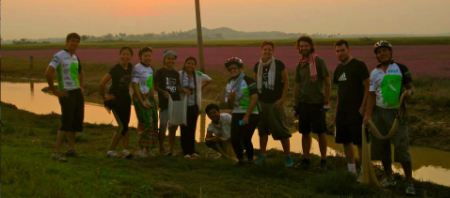
Megan's group

Ok, a three week bike ride is indeed a rather incredible feat, but was it really a life-changing experience? I can almost smell your scepticism! The truth is, it really was. Not in the “I’m going to sell all my worldly possessions and wander the world, touching the lives of everyone I meet” kind of way, it was quieter than that. It wasn’t so aggressively do-goody. It just kind of made me want to smile more. I don’t know about other people, but I am definitely guilty of letting the little things stress me out too much in my so-called normal life.

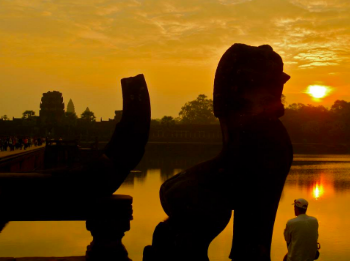
Sunrise in Angkor

Spending three weeks in one of the poorest nations in South East Asia, with its unfathomably devastating recent history, certainly shook me up and made me realise that I have it pretty good. All the daft little problems which I worry about suddenly weren’t problems anymore. What’s the use in using all that energy on something that, in all likeliness, won’t change, no matter how much you kick and scream and tear your hair out? Cambodia is a country on the mend, or at least that’s the impression I had, and sometimes it was all too easy to forget that behind the smiles, many people have seen more ugliness and pain than you or I could ever imagine. Yet, despite the horrors this country has lived through, it seems to radiate an energy and spirit like no other place I’ve ever visited.

I think it’s easy to become disillusioned with the world: You watch the news and you feel a bit hopeless because really, how on earth can you help? To be honest, I don’t know the answer to that question. But Cambodia gave me hope for, well, hope. I know that sounds horrendously schmaltzy, but I can’t describe it in any other way. After seeing all these incredibly cool and inspiring projects, only someone with a heart of stone could refuse to be touched by the optimism. There’s always going to be good and bad in the world, for sure, but now my eyes and heart are more open to the good stuff.

Find out more about how you can participate in a PEPY Ride here!


Megan Skinner

Meg is earning her keep as a freelance English teacher, translator and interpreter in the tropical climes of Northern Germany. As exciting as the world of patent translations is, her mind often wanders to adventures in more exotic locations. Or food. Or both.

Irish Surfer Easkey Britton Discovers Iran

Iran is a place where the stereotypical and the surprising, the ancient and the new co-exist. At every turn a complex, millennia-old Iranian culture, different to the culture of its Arabian neighbours for which it is often mistaken.

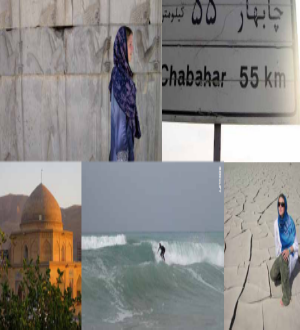
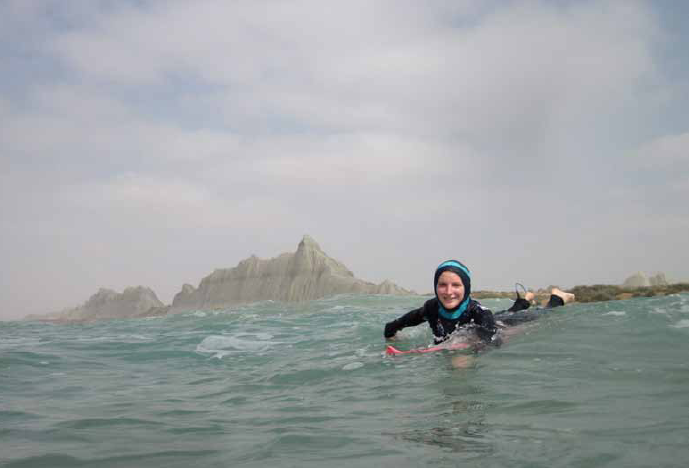
 It is a land of contradictions and a land not known for its surf-exposed coastline. In fact it wasn’t until I got asked to go on the trip that I even realised that Iran had a coast exposed to any swell at all. A very short strip of coast lies in a narrow swell window between Pakistan and the Gulf of Oman, exposed for a few months of the year during Indian monsoon season. This is a part of Iran that doesn’t feature highly in any travel guides, let alone the surf mags. It was a guaranteed adventure in a little understood country. However, the possibility of finding waves there was in fact quite good. Olivier Servaire did a trip there a few years before and scored it pretty good. Although there were no women on that trip and no obstacle of having to surf with your entire body and head covered in a 30-40°C desert climate!

During the European summer when our swell is quite fickle or even flat for weeks the waves can be incredibly consistent in the Arabian Sea thanks to the Indian monsoon which causes gale force southwest winds to blow non-stop out in the ocean between May and late September. The area we were going to was very remote and much of the time we would be completely alone which might make it a little less challenging having to wear a hijab in the surf. It would be a challenge for any woman but would no doubt make the experience much more interesting. As Marie Curie once said, “Nothing in life is to be feared. It is only to be understood”. And I understood so little of this conflicted, misunderstood, former ancient empire and now Islamic Republic of Iran.

TEHRAN

My first day in Iran stripped me of all my assumptions.

The first surprise was the ease of my arrival. I pulled my headscarf tightly around my head, underwear buried at the bottom of my bag, no reading material or books with any depiction of the female body in any form, my passport photo with my uncovered, long blonde locks, my surfboard packed in a camo-print boardbag, a female without a male family companion or husband arriving into Iran, alone. I had imagined all my belongings searched, my tinted lip-balm confiscated. I had expected to cross the threshold into a different frontier.

All my fears were for nothing it seemed. I was waved through immigration with only a cursory glance at my passport, my baggage arrived on time and I walked out of the customs hall with nothing more than some curious glances at my surfboard and into the waiting courtesy bus from the hotel, along with a tourist from America. At the hotel I met my fellow companions, French film-maker Marion, and Ben, a body boarder from Cornwall. Missing from our group was our trip organizer and photographer Stuart Butler. It appeared he’d missed his flight and we would be left to our own devices in a land we knew little about. The adventure had begun.

I felt safe walking down the main streets of Tehran, even the famously dangerous and chaotic traffic of the capital seemed subdued by Ramadan. The one opportunity we had to travel before we lost our swell window happened to land during Ramadan, the Islamic month of fasting where Muslims refrain from eating or drinking from sunrise to sunset. Travellers are exempt from fasting but it does make finding restaurants open and willing to serve food challenging. To escape the heat we went for a walk in one of the many local parks where we met an old shoe-maker, Mohammed, who wanted to practice his fluent English and French with Marion and I. Unbelieving when we tried to explain what it was we hoped to do, find surf in Iran, he showed us a picture in a magazine of a woman surfing asking is that what we do? The surfing world had even filtered into the land-locked capital of the Islamic Republic!

We ate kababs and drank tea sitting on Persian carpets surrounded by young cosmopolitan Tehranis, women in glamorous headscarves perched on beehive hair-dos, wearing tight-fitting belted coats over skinny jeans (a dress code that stays just within the law), and families picnicking in the park after sundown with girls playing volleyball with their fathers and brothers. This place was full of surprise where nothing was quite what it seemed. It’s been a little over 30 years since the revolution, and post-revolution Iran is first and foremost, a theocracy, with Supreme leader Ayatollah Ali Khamenei appointed for life, overriding all other authorities. He is regarded by his supporters as being incapable of error, and only answerable to God. For the ordinary people of Iran, family life is supremely important and education (for girls and boys) is highly regarded. Ironically the level of attendance of girls at third-level education has rocketed post-revolution. Women are allowed to vote, drive, buy property, sit in parliament, and to work. In reality though, post-revolutionary Iran also saw women’s right decline in many positions; banned from the judiciary (too emotional) with the imposition of a strict dress code and being treated as second-class citizens under many of the fundamentalist interpretations of Islamic law. But still Iranian women continue to assert their rights and chip away at the oppressive regime—wearing a defiant splash of red lipstick, making visionary movies, becoming experts at interpreting the law, and winning the Nobel Peace Prize.

CHABAHAR, GATEWAY TO IRAN'S SOUTHEASTERN COAST

The next day we took a two-hour flight to the south-eastern coastline, which borders Pakistan, to Iran’s largest ocean port and free-trade zone, Chabahar.

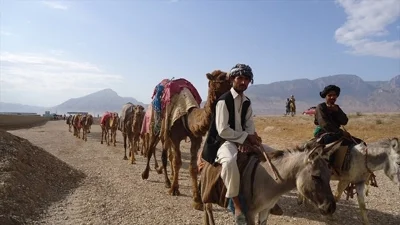
It’s a surprisingly big and developed town on the fringes of Iran in the middle of a desert landscape which is straight out of the Dune series, with a crumbling range of ‘Mars mountains’ and cliffs pock-marked with cave and pinnacles. I pointed in excitement at camel- crossing signs and a herd I saw cruising by the roadside but, as the coming days revealed, they’re the Iranian equivalent of sheep in New Zealand. There used to be camel caravans between all the cities with rest stops every 30 miles for the camels. Women of the house always rode on top of the camel in a special, decorated palanquin while the men had to walk or ride a donkey.

Arriving at Chabahar and we thought we might be camping out in the wilderness, but we pulled up to a three star hotel with sea views. The Iranian tour company were clearly keen to impress their first surf tourists. Arman, our guide, found a ‘Ramadan-free’ restaurant for the less devout as it made communicating with the women very challenging through a male interpreter. Abdullah said most women would not be allowed to speak directly and freely with another man they didn’t know and especially not without a chaperone.

THROUGH THE VEIL

The nature of the coast around southeast Iran means that the local winds are generally light but it catches a good part of the swell breaking primarily on powerful beach breaks with a few potential point-break set-ups.

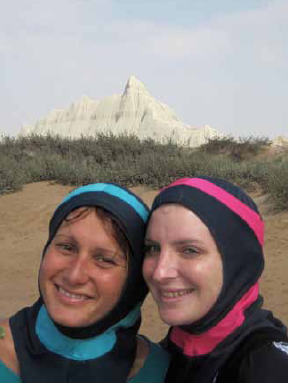
The boss of the tour company showed us some photos from his recon missions along the coast before our arrival. He explained we had come a little too late, having missed the big swell season at the height of summer when he insists the waves get up to 15 feet. Now it was in the three-foot range and we were going to scour the coast. In the early morning we found a little beach outside Chabahar, not far past a military checkpoint. The wind stayed light and glassy until after 10am, the waves still broke close to shore and were difficult to catch—with very short rides and strong undercurrents—but I felt more comfortable in my custom hijab surfwear today without a crowd watching. I wore a long- sleeved black rashvest, with t-shirt over it. Black boardies with leggings underneath and a lycra hijab made by a Dutch company who design sportswear for Muslim women—I didn’t have to worry about sunburn!

We drove through a strange, alien-like desert wilderness; it was like crossing into Mordor. We found some promising set-ups further east of Chabahar, and further away from the swell shadow of Oman. Here there was a vast stretch of beach backed by sand dunes and the Mars Mountains where the waves seemed to peel along a sandbar. We drove to the most south-eastern point of Iran and stood looking across into Pakistan, with a huge fleet of pretty coloured wooden trawlers lining the harbour below. Fishing is the mainstay along this sparsely populated coastline. Marion stopped to take some footage when our guide and driver started shouting and waving wildly at us, I could see a tail of dust rise up out of the desert and a 4x4 pick-up approaching. We jumped back in the van and the truck passed by without stopping. Arman told us the area is rife with smugglers, you can never be too safe.

We stopped for a picnic in a barren ‘truck-stop’ in a desolate little village. Bob, our driver, and Arman cooked a Persian-style BBQ and we all took shelter from the searing heat under a tree to picnic. I still couldn’t get used to wearing a headscarf in the stifling heat. We sipped pomegranate Iranian beer (non-alcoholic of course) and tried Iran’s famous ‘doogh’ the most refreshing yogurt drink flavoured with mint and salt.

Back in Chabahar, after sundown, we decided to check out the local ‘bazaar’. I was expecting what you usually see in those action-movie chase scenes through middle-eastern markets but this was a western-style shopping mall dominated by cheap Chinese electrical goods and lingerie stores, followed by toy and shoe shops. Families came out in force once the sun was down and people were allowed to eat again. It was definitely more traditional here than the capital. People were still very friendly but there were more stares and a lot more women covered in chadors (full-length black coverings) and some even wearing burqas (full face coverings).

TOO BIG TO FISH... 

Only a few days had passed but already it felt like we’d been here much longer, absorbing so many new experiences every day.

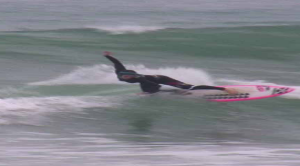
 Our dawn patrol paid off and we scored the most fun surf of the trip at our now regular spot, a surprisingly good sandbar along an empty stretch of beach backed by those stunning Mars Mountains, with fun peaks and some head-high waves. Apart from fishermen passing by on their boats, waving, there was not a soul to be seen. I wondered if we were the first to surf this spot? Later in the afternoon we decided to explore west of Chabahar where there are a series of headlands that show potential for some point-break set-ups. In reality there wasn’t enough swell, but who knows when the Roaring Forties line up briefly in the middle of summer— when the fishermen say the sea is too big to go fish...

We continued to surf ‘our’ beach for the remaining couple of days. The swell stayed a consistent three-to-four feet with light winds, although it felt like the swell was dropping on the last day. During breakfast on the beach, in between surfs, we discussed religion with Arman, whose name means ‘hope’ in Farsi, and is typical of a lot of young, well-educated Iranians from the cities. He says he is not religious and doesn’t actively practice his faith. Unlike Bob, who was kneeling down in prayer facing towards Mecca before he stripped down to his leopard print boxers and decided to go for a dip in the heavy shore-break laughing until the under-tow caught him and pulled him out to sea. Ben paddled out and gave him a lift back to safety on his bodyboard. Despite the language barrier it was clear Bob had loved the experience and we could make a keen waterman out of him yet! Arman says it’s a problem when religion is used as a tool for oppression by those in power, especially to suppress women and blame them for the evils of the world. Despite Iran being a place that celebrates art, creativity and knowledge with a welcoming, warm-hearted people it is still a place where people suffer under an oppressive regime; Arman tells us that you can be sentenced to 75 lashes for being drunk, and be stoned to death for having sex outside of marriage (including rape in many cases). Yet the people are not victims. They are proud, resilient, and hopeful.

Surrounded by the emptiness of the beach and desert it was easy to feel tranquil but we were still out in ‘bandit country’, a place ignored by guidebooks and tourists, very near the Pakistani border where smuggling flourishes.

WATCHFUL EYE

On our way back to Chabahar after our last surf a camo-truck overtook us with a man in a white shirt and rifle slung across his lap and a stern look on his face, waving us to stop.

 They pulled over in front of us, Marion and I could hardly breathe. A military soldier stepped out with him, both fully armed. They came over and shook hands, smiling and chatting to our guide. I let out a big exhalation. It turned out they were our government ‘protection’ and had been keeping an eye on us to ensure our safety, and on our last day they wanted to meet us and say hello. Like I say, nothing is what it seems...

Iran is perhaps most famous amongst travellers for its ancient culture and the stunning art and architecture of its cities. So with the swell weakening and only a few days left we decided to travel inland and visit Shiraz, once the birthplace of the world-famous Shiraz wine. This was Arman’s hometown and he lamented the loss of Shiraz wine-making. He told us when a girl was born to a Shirazi family they made a special pot of wine that they kept until she was married and served it at her wedding.

Our hotel was in a maze of old, twisting alleyways, a traditional Persian-style house with an open courtyard and a cooling fountain in the centre. Shiraz is a city of captivating beauty and vibrant energy and quickly became one of my favourite places in the world. We visited the Citadel and an old bath house, one of Shiraz’s many famous walled gardens, and a maze-like bazaar with vaulted ceilings where I got lost and enjoyed the ancient art of haggling. In the evening we visited the resting place of legendary Sufi poet Hafez, a beautiful memorial to poetry and love called ‘Aramgah’, meaning place of rest, in the heart of Shiraz. Hafez’s poems speak of love, wine and the divine that captures the frailty of human endeavour, the fickle heart and transient nature of all earthly things. His poetry filled the air and there was a fairytale-like quality to the place in the soft evening glow. It was clearly a favourite social gathering place with the local after-work and school crew. I met rebellious tomboy Nasreen and her pretty young friends. A few days with them and I would have picked up Farsi in no time. Nasreen was kitted out in the local football team gear complete with football boots and had just finished practice. One of the girls had a crush on Arman and gave him a rose.

LOOKING BACK...

The next day, my last on all too short a visit, I walked up the same steps as Persian kings Darius and Xerxes and Alexander the Great, to the heart of the once greatest civilization and empire on earth.

A place where records reveal everyone was paid for their work, and there were such things as life insurance and maternity leave. Three kings, 12 palaces, an unfinished ‘gate’ from when Alexander came rampaging through, burning Persepolis to the ground. It’s incredible what still survives today; Giant, detailed sculptures of warriors, lions and bird-gods, 30 foot columns that supported the palace roofs... Full of meaning and symbolism, ancient ‘newspapers’ recording who did what in battle. Built on a huge platform of cut stone rising up out of the desert. All this in 583 BC, over 2500 years ago when the Celts were forging iron and expanding west and north into Ireland and the British Isles.

Before I came to Iran I knew so little. A lack of understanding which gave rise to fear and a perception of Iran through the lens of western media: politics, the oppressive regime, Islamic extremism, axis of evil, generally a violent land and no place for a blonde haired, blue-eyed surfer girl. But there’s two sides to every story isn’t there?

And nothing is quite what it seems. You don’t hear about the people, ordinary people like you and me, in the news. The humanity and heart of the Iranians, their passion and pride for the Persian way of life, descended from the once Greatest Empire on earth. It is a surprising multi-cultural society with a diverse mix of nomadic tribes, religions and nations living together. I came with my own preconceptions too. I thought being a woman here would be very difficult, especially a woman who wanted to surf. When I first arrived in Tehran I found a cosmopolitan vibe and a contemporary city, although since, I have heard there have been further crack-downs with shop owners being ordered to chop the boobs of their plastic mannequins as they are too revealing and a woman’s figure must remain shapeless. Talking with locals and families in the park, girls playing sport with the boys, there was real friendliness and openness towards us strangers, a tolerance for others and happiness that we were visiting their country. They are a social people who love the outdoors (skiing in the mountains, playing in the parks, swimming in the sea), young people smoking hookah and drinking tea or non-alcoholic beer. It is a place full of contrasts. Women rebel in their own way in their fight for equality such as human rights campaigner and lawyer Shirin Edabi and one of the founders of the ‘One Million Signatures’ campaign, who insists that enshrined within Islam are all human rights and all that is needed is more intelligent interpretation. Her hope for Iran’s future lies with women and their powerful social movement, and with young people, over 70% of Iran’s population are under 30.

It’s very unlikely Iran will become the surf destination of the Middle East, especially given the growing political hostilities. However, I wholeheartedly recommend you visit this fascinating land and beautiful people with an open mind and open heart and take in its treasures, while you can. And along the way you may even catch a fun wave or two...

PREVIOUSLY PUBLISHED IN SURFGIRL

EASKEY BRITTON


@easkeysurf 


Easkey has surfing in her blood. She comes from Ireland's first surfing family and grew up in Rossnowlagh surfing. Her Mum and Dad taught her to surf when she was 4 years old and her life has revolved around surfing ever since. She got her first taste for travel when she went to Tahiti and became the first Irish person to surf the infamous hell-wave Teahupoo aged just 16 and hasn't looked back since! Ireland's 5 x National Champion she is leading the charge of the next generation of Ireland's surfers taking on the International surf scene. She has done surf-related humanitarian work in Cuba and East Africa, and is also a founding member of Wellcoast.org, a human wellbeing and coastal resilience network. 

TRIP REVIEW: Climb Mt. Kilimanjaro and Build a Farm Along the Way

We read the news and we learn what’s wrong with the world. I honestly couldn’t care less. Yes, there is war, there is starvation and death. People cheat, organizations lie and the international economy is in need of a stimulus package from God. Now you know everything you need to know about our global shortcomings. Let’s do something to help. There is an ancient Greek proverb that says, “A society grows great when old men plant trees whose shade they know they shall never sit in.” With the amazing amount of interconnectivity and social complexity these days, it’s easy to view Earth as one, big society and I think it’s time we began planting a couple more trees. It’s organizations like Roadmonkey Adventure Philanthropy that are making it easier for us do so.

It started with a passionate New York Times correspondent with an extremely manly name, Paul von Zielbauer. After making a career out of reporting on topics such as the Iraq war, the privatization of prison medical care, state government and more, Paul founded Roadmonkey. Driven by a desire to “give motivated people the chance to dive deep into a foreign culture and work hard for people in need,” Roadmonkey Adventure Philanthropy was born in 2008. The term “adventure philanthropy” now stands as the keystone to Roadmonkey’s philosophy. What is so unique about this organization is that the volunteers are given a chance to help those in need, but they are also getting to explore and get off of the beaten path at the same time.

Roadmonkey’s take on philanthropy is evident in their upcoming Tanzania trip. First off, let’s point out that only 6% of Tanzanians living in rural areas have access to modern electricity services. These people live off of the land and any help offered would probably be appreciated. Participants will fly out to Tanzania and lend a hand in building an organic farm for one of the local communities. A pretty standard, run-of-the-mill volunteer trip, right? Oh, I forgot to mention that the volunteers will also be climbing Mt. Kilimanjaro. The trip starts off with a seven-day trek up and down the mountain, don’t forget to bring your tent. The Participants will literally learn about the country from the ground up, so when it comes time to contribute to the community they will actually have a stake in what is being built. They will have experienced the culture, experienced the people and they will know that they are actually making a change.

There is only one roadblock for this Roadmonkey trip and it’s a particularly common one as well. Money. The best deal is to sign up for the trip with 8-10 other people, which cuts the price down to $5499 per person, not including airfare. No small chunk of change. This limits the trip to the privileged or to those with rigorous budget control. For those of you who are looking to volunteer international without planting your wallet in the community garden, this trip might not be for you. However, if you have the time and the money and are looking to add some spice to your life while bringing change to those less fortunate than you, look no further.

Roadmonkey Adventure Philanthropy is breaking down the border between volunteer work and adventure. If you can afford it, this company will send you all over the world and you can be sure of a good time. For those of you who are enticed by the opportunity, but can’t afford it, check back with Mission.tv for more trip reviews.

LEARN MORE ABOUT ROADMONKEY.NET

Kino Crooke spent the last three years juggling school and travel. He most recently spent the last two months traveling across Spain before moving to New York to work with CATALYST.

TRIP REVIEW: Surfing South Africa to Help Out

The downfall of many volunteer organizations is cost. All too often there will be a $1000+ price tag on a trip that lasts only a week or two, not included airfare. This isn’t news, so it should come as no surprise that there are people out there who are working to fix this. One of these people is Daniel Radcliffe (no, not the actor). After collecting a Masters of Business, Daniel decided that it was time to give back to the world. He began to research volunteer trips. He too ran into this roadblock, but unlike someone like me who will simple notice the problem and then write about it, Daniel decided to do something. International Volunteer HQ was founded upon his return to New Zealand in 2007. “IVHQ was born with the goal of providing safe, affordable and high quality placements in areas where there is a real need for volunteers.” One of these places is South Africa.

It’s easy to read a statistic or to watch a documentary and think that we understand. Sure, we have problems here in the United States, there’s inequality and poverty everywhere, but, honestly, we cannot imagine what some citizens of the world live through. In South Africa the average life expectancy of a white South African is 71 years. The average life expectancy for the black population is 48 years. In 2005 it was estimated that 31% of the female population was infected with HIV, most of them black. There are 1,200,000 orphans. These are numbers and statistics, I could throw them onto a graph and you would see the vast differences, but you still wouldn’t know, you would still be using your imagination. Over there, it’s a reality. South Africa needs help and, if you feel so inclined, you can give it.

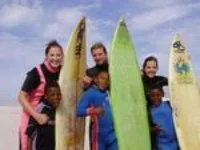
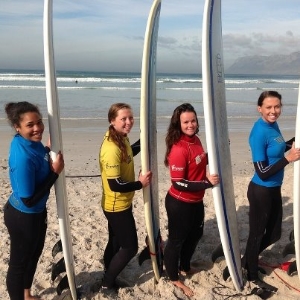
IVHQ sends volunteers to South Africa on the first and third Monday of each month. They normally arrive in groups of twenty to fifty people and the assist the community in an astounding variety of ways. Participants can involve themselves in a teaching project, in childcare, computer training, sports development and, an organization after my own heart, a surf outreach program.

Maybe you’re wondering what good a surf outreach program would do for children when they could be receiving extra medical attention or extra food and shelter. In the words of Ellen Varoy, Marketing and Media Coordinator for IVHQ, “The Surf Outreach program is designed to provide these children with an after school activity, keeping them off the streets of Cape Town and placing them in a safe and encouraging environment. Through the program, these children have the opportunity to learn new skills, take up new challenges, gain confidence and interact with our international volunteers, who the children look up to as role models.” It’s not about whether or not these kids learn to surf. It’s about showing them that there are people who care. It’s about being a ray of light on an otherwise bleak horizon. As a surfer would say, it’s about sharing the stoke. Would these children benefit more from help that focused on their health and nourishment? On the spreadsheet, probably, but where would they go after that? I say give them role models, give them hope and teach them that they can overcome. That, in my opinion, will last much longer than a loaf of bread.

The cost of IVHQ trips is one of the things that makes this organization so great. Prospective volunteers for the surf outreach program only have to pay $320 for one week. Longer periods of time require more money, being capped off at six months for $4580. This does not included airfare or visas or spending money. Also, if you want to participate in the surf outreach program you must know how to swim. I just thought I would point that out. If you are interested in any of the other programs offered for South Africa, you can find more information here

IVHQ is a fantastic option for people who want to volunteer for an affordable price. A full range of trips can be found at their website, http://www.volunteerhq.org/. As usual, if you were interested in the trip, but don’t think it’s for you, check back with Mission.tv next week for the next article in our series of trip reviews.

For testimonials by volunteers who completed the surf outreach program, check out: Testimonials  

To check out a video from the trip click here.

LEARN MORE ABOUT IVHQ


KINO CROOKE spent the last three years juggling school and travel. He most recently spent the last two months traveling across Spain before moving to New York to work with CATALYST.

Who Is Anonymous Street Artist and Parisian, JR?

Not much is known about the semi-anonymous artist who calls himself "JR." We know that he is young — flirting with age 30 — French, and presumably has a name involving the letters "JR."

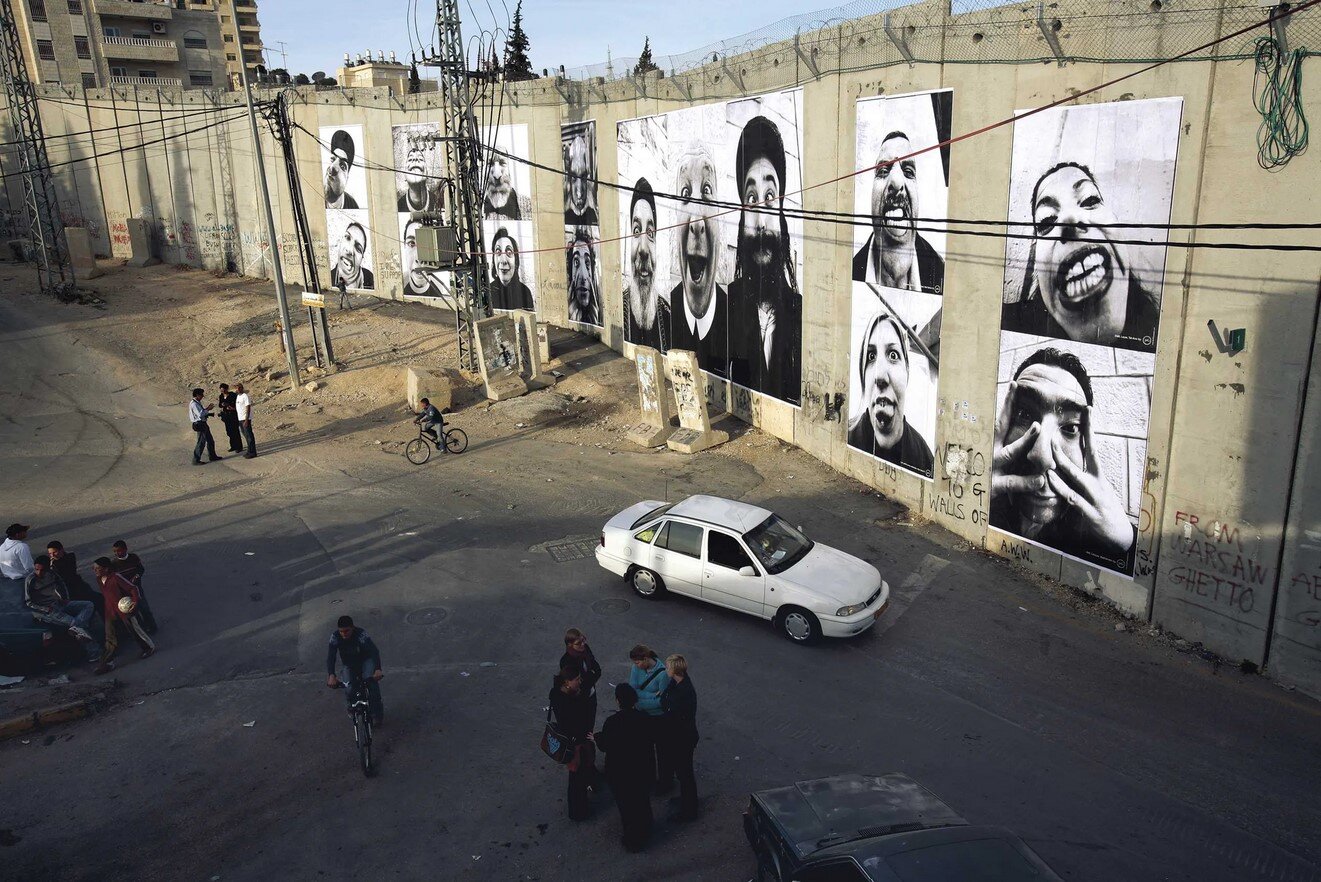
28 Millimètres, Face 2 Face, Separation wall, security fence, Israeli side, Abu Dis, Jerusalem, 2007

However, little else is known about the enigmatic past of the artist who has emerged on the world stage as the most lauded street artist since Banksy. Who Is Anonymous Street Artist and Parisian, JR?

When people hear the words "street art," they immediately picture graffiti: spray-painted images, slogans, or "tags," illegally marked onto the side of derelict urban buildings. This idea of street art must be abandoned when examining the oeuvre of JR. While it is true that JR began as a traditional street artist, using aerosol spray cans to paint on buildings around his native Paris, his artwork and his vision drastically changed when he discovered a camera that had been lost on the Paris metro. He began to document his artistic escapades and those of his friends, and he eventually abandoned traditional graffiti for something more easily duplicable: photocopies of the pictures themselves. Thus began the principle act of JR's craft, the pasting of large copies of his photographs on the sides of buildings. As with most street art, this started out as an illegal act, and one that mainly took place on the sides of run-down urban structures.

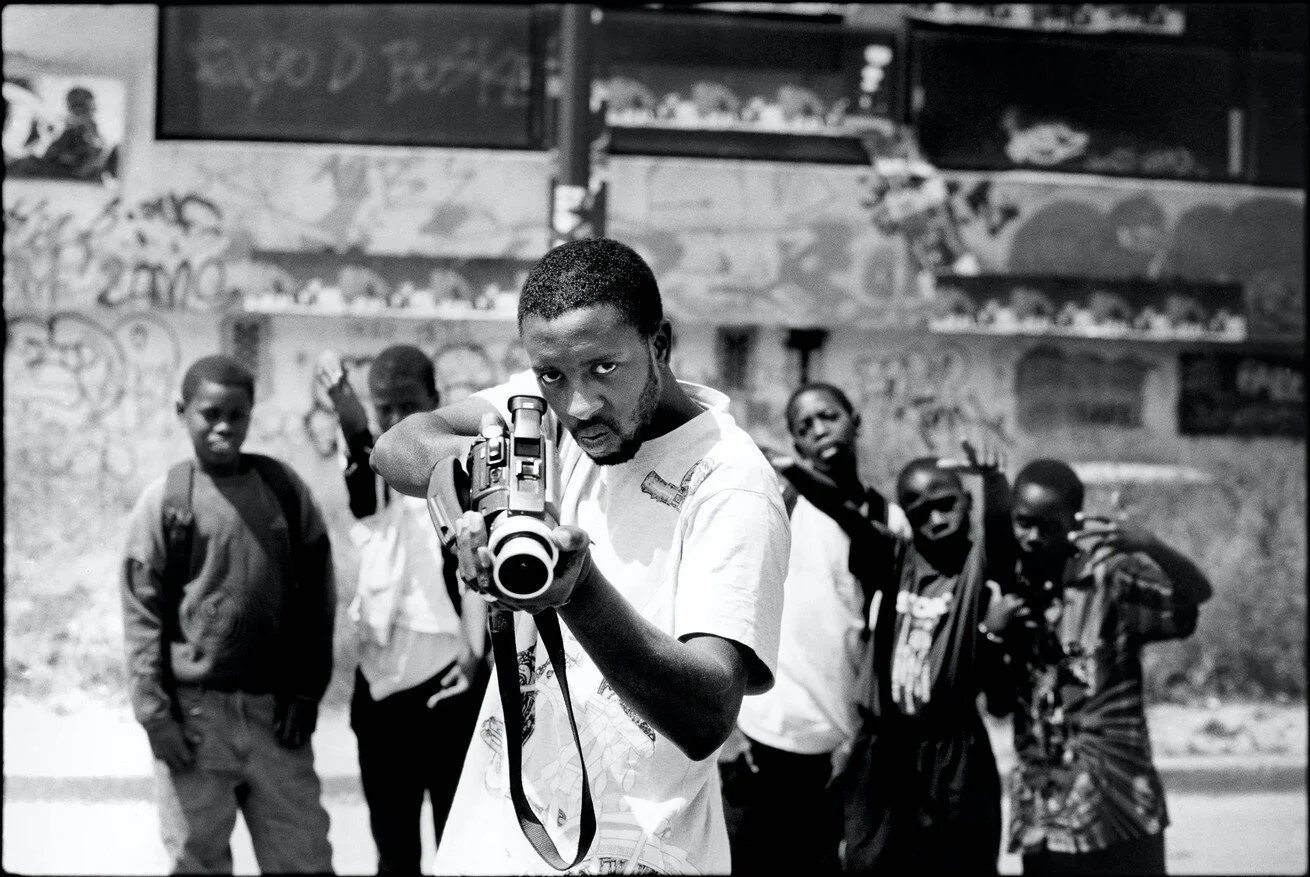
28 Millimeters, Portrait of a Generation, Hold-up, Ladj Ly by JR, Les Bosquets, Montfermeil, 2004

But then something happened: JR's art started to capture things that were extremely relevant to the general public, and capture them in extraordinary ways. His exhibit, Portraits of a Generation spanned the 2006 youth protests and riots, a turbulent period in recent French history. It would've been easy for JR to capture scenes of burning cars, looted stores, or angry teenagers holding weapons — the essential stock photographs of a small-scale revolution, material that would surely gain him some acclaim and media attention. But JR did the opposite: in a time where there was rhetoric about the pervasive lines drawn by race and class in modern French society, JR chose to challenge the paradigms and media representations of the rioting youth. He visited friends in housing projects and captured them in a way the media had not. He captured, perhaps, what the media chose not to: black French youth making funny faces, teenagers of Middle Eastern origin crossing their eyes at the camera, images that were unexpected, light-hearted, honest and above all else, human.

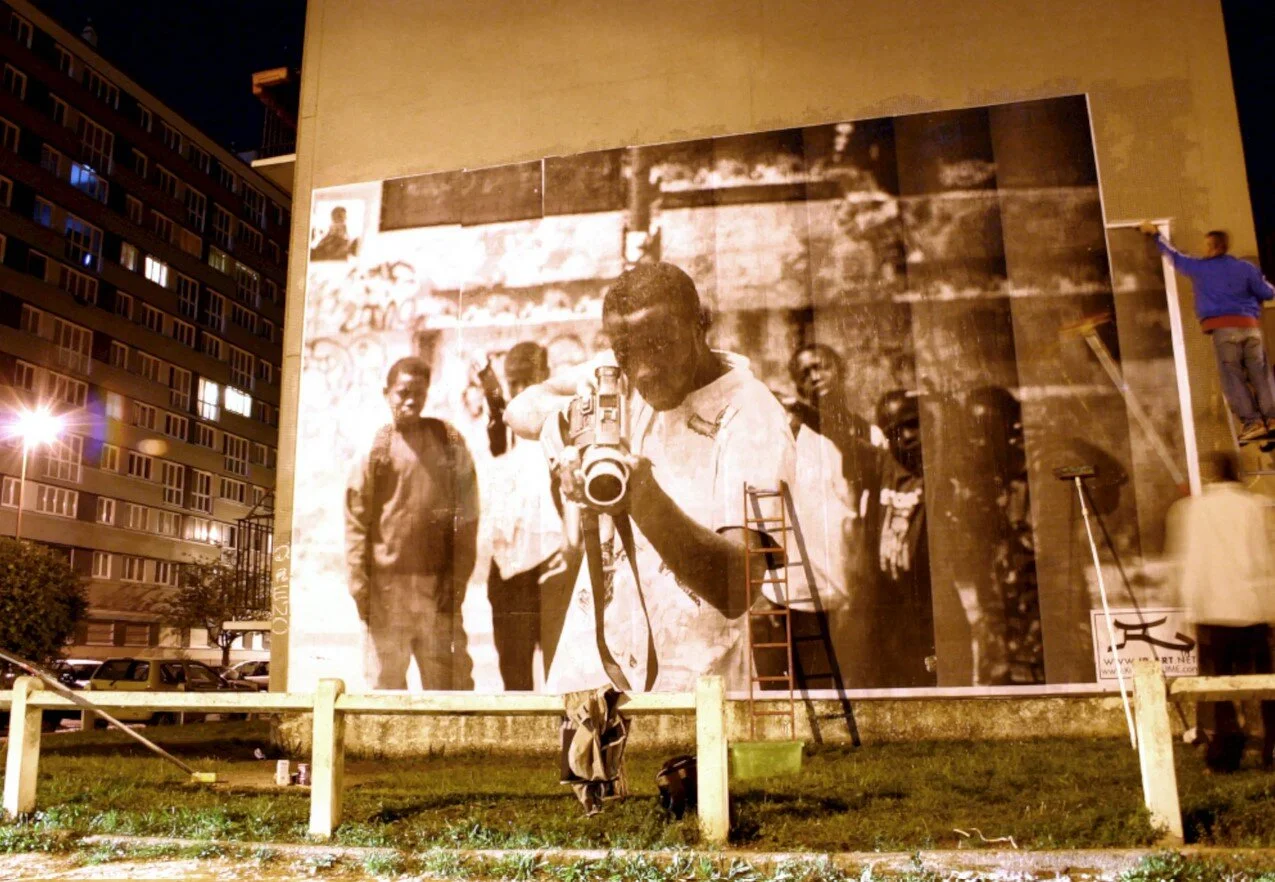
28 Millimeters, Portrait of a Generation, Pasting of Ladj Ly by JR, Montfermeil, Les Bosquets, 2004

JR blew up the photos to huge formats, and pasted them on the walls of the most bourgeois areas of Paris. It was all very illegal… at first. But there was something unmistakably powerful about JR's art: these were giant images of individuals previously viewed to be dangerous thugs, but here they were as kids, fooling around, unthreatening. JR's images worked to diminish the tension inherent in interactions between Parisians in the mainstream and in the margins. And then something happened: His images were wrapped around the buildings of the Paris City Hall. This made JR's street art "official," although he would have continued even if it hadn't.

28 Millimètres, Women Are Heroes, Action in Favela Morro da Providencia, Favela by day, Rio de Janeiro, 2008

From Paris, JR began to work on the largest canvas on earth: the world itself. His work has taken him all around the globe, from his famous Face 2 Face exhibition where he posted pictures of Palestinians and Israelis face to face in a number of Palestinian and Israeli cities and on the Wall itself, to the most dangerous favelas of Rio de Janeiro, Brazil, or the space above the High Line in New York City. His work captures the faces of the world's marginalized groups and populations: women, the extremely poor, the indigenous. He takes those who are often off the radar and makes them a large and profound part of the everyday experience of cities. His art does more than turns heads, it changes perceptions.

JR’s work has won wide international acclaim, even winning him the 2011 TED Prize. At first, he was put off at the notion that he was supposed to save the world, JR sighed when the mandate was clarified: change the world, not save the world. “Oh, alright,” he said. “That’s cool.” In a TED Talk later in 2011, he continued by saying, “Art is not supposed to change the world, to change practical things, but to change perceptions. Art can change the way we see the world.” And his art really has.


Calah Singleton

Calah recently graduated from Yale, where she majored in Political Science. Her interests include urban studies, international development, and learning new languages.

Interview with Taylor Conroy: A New Model for Philanthropy

CATALYST speaks with Taylor Conroy about why it's time to abandon the "broken" traditional model of philanthropy and what it means to "devote his life to the world."

Tell us more about your theory that the traditional model of nonprofit fundraising—as you say the one where "organizations use guilt to make people cough up cash"—is broken. Is it time for us to abandon this model completely? 

Yes. As in it should’ve ended YESTERDAY. That system has been broken since it was devised in the first place. While it may have started from a place of people really just wanting to help, it has been bastardized and overdone to epic proportions. I believe that though this "model” is in place to raise funds to decrease poverty, it actually increases it. The model perpetuates a separateness mentality by making people who are likely proud, beautiful, wonderful people into "them." It makes westerners look at people in poverty as very different from "us," and they are not. 

If we in the developed world knew that one of our siblings was starving, malnourished and exposed to diseases that were easily preventable we wouldn't stand for it. Same as if it was a friend of ours. Why? Because we feel connected to them. We look at our siblings or friends as the same as us—and thus we would never stand for seeing them in unnecessary pain. When we see pictures of people in the developing world, we don't look at them as being the same as us. So we tolerate it. And poverty porn—which is exactly what those images are—is part of the reason we tolerate it.

What made you decide to give 10% of your income away to causes you care about? Especially when you were driving a car with no reverse and only had 3 t-shirts in your outfit rotation? 

My life coach told me to. I had just hired her, and thought she was nuts. I had gone to her to learn how to make money, not give it away. She insisted. She had a nice big house on the ocean… I had a crappy rented basement suite, so I took her advice. I thought I would wait till I made money to give it, until I heard this: "If you won't give 10 cents out of a dollar, you will never give $100,000 out of a million."

As you know, social media can be an incredibly valuable tool for galvanizing money and support. There’s been a lot of debate, especially after the Invisible Children’s Kony video, about how social media is used to bring attention to humanitarian issues. How do you use social media/the internet to make a difference, without oversimplifying or stripping the issues of substance? 

I don't use it to make a difference, and thus I don't have to worry about over simplifying or stripping anything. I use social media to share what I am up to and to be social because that's what it's for. The Kony 2012 video will be getting analyzed up and down for years. People will use it to hear themselves talk and feel like they know what they are talking about by saying it was positive or it was negative, when really, no one can know. We cannot see what is going to happen in the next 10 years because of it, or what will not happen because of it.

You wrote on your website, “I vowed to devote my life to the world for all of 2012.” What does devoting your life to the world mean? 

That I would be of as much service to the world as possible for one year, without thinking about my own profit or advancement whatsoever. I would use, "is this the best thing I could be doing for the world" as my decision maker and only do what was my highest and best use for the world. Keep in mind though, I am a believer that the more fun I am having, the better my work is, and that one needs to be happy personally FIRST, before being able to make others happy. So I concentrate just as much energy on making sure I am very happy.

In your TED talk you mention books that make you think “if everyone read this book, the world would be a better place.” What books have inspired you? 

Half the Sky. I am going to leave it at just that one for now.

What’s the one thing you can’t travel without? 

Audio books. Do you have any idea how much you can learn while in airports?!!?! I crush an audio book or two on every trip. As soon as I get into the airport, the headphones are in and I am learning about ancient spiritual teachings, world issues, great entrepreneurs, or how to have better sex. I love audiobooks… and if you listen to them on an iPhone, you can double the speed and rip through ‘em.

What advice would you give to a young person working full time with a limited salary who wants to make a difference in the world? 

I wouldn't give them advice, because the biggest thing I have learned after doing this stuff is that I don't know anything. Everyone is different, and everyone has their own special thing to give. I just happen to be in a place where I feel I should be doing things on a big scale. But that will pass. I know that within the next 5 years, I will move into a new phase, and to tell you the truth, that phase may involve me meditating in a cave in India for a few years. All I know is I am going to keep doing what I think is right for me to be doing right NOW, ‘cause that's all I got.

Now that you’ve shown the world that you can raise $5000 with a text message, and $10,000 to build a school in 3 hours, what’s next for Taylor Conroy? 

Raising $10,000,000 to build over 1000 schools, libraries, water projects, and more to improve the lives of 1,000,000 deserving people in 10 countries. Then I’m going surfing.


The Serial Volunteer

Looking back, the majority of my most clairvoyant, my most grandiose and my most sincere moments have occurred when I’m flying 30,000 feet in the air. Darting through wispy white clouds, soaring over cerulean blue, and marveling at just how many parking lots we as a species require; also very quickly becomes a time of self-reflection and truth (granted, this is all provided you have a window seat).  On August 7th, 2011 flying home to New York City from the Dominican Republic, my partner had one of these moments. 

“I don’t want to be a serial volunteer,” she said after a particularly long spell spent looking out that magical aperture.  

Unsure of whether she was stating her resolution to never work at a breakfast food production company, I asked what she meant.

“I don’t want to continue jumping from volunteer organization to volunteer organization, never donating more than a few moments of my time,” she said. “How can we truly have a lasting positive impact if we never spend the time getting to know the nuances of an organization and the community that it works with?”

We’d spent the better half of two years volunteering with different organizations, always managing to find something wrong with each—something that would push us to continue our search for the perfect place, the perfect spot, the perfect fit.  At this rate, we were set to continue jumping around the globe merely dipping our toes in the humanitarian aid world.  And, for some people this is fine.  This can actually be an economical way to travel with the added benefit of supporting good organizations.  However our goal from the beginning was to find somewhere that we could help to create lasting and empowering change. 

Remembering this, I realized she was right. If we were serious about helping to create that lasting change, we would need to stop trying to find the perfect organization, because the perfect organization doesn’t exist—they change and evolve the same way people do. The same way our thought process of volunteering was evolving those 30,000 feet above the earth. Maybe if we invested ourselves in one organization and truly took the time to get to know the people of the community we were trying to help; maybe then we would find what we were looking for—impact.  But that wouldn’t happen if we kept jumping around.     

“I don’t want to be a serial volunteer either,” I said. 

And alive with the excitement that comes from life changing realizations, we talked all the way back home of our now imminent return to the Dominican Republic.


Adam Salvitti Gucwa is a seasoned traveler, entrepreneur and student whose volunteer focus centers around education and the Dominican Republic

What's Wrong with a Box of Toys?

It’s December 10th and Tom, Saskia and I have come to the half-completed Karin Children’s Clinic to watch a local women’s group hold a weekly meeting to discuss administrative matters. They manage projects from beadmaking to raising livestock on a pay-it-forward scheme amongst various families in the group. A man from the Heifer Foundation is busy reporting on the status of the cow breeding program. Nobody seems particularly impressed. I feel hot, having decided to stand outside to take pictures of the proceedings. We have arrived in time for what appears to be the last item on the day’s agenda. The opening of a large cardboard box with a Samaritan’s Purse logo on the side. I sigh.

The last memory I have of Samaritan’s Purse was seeing a manicured lawn and suburban house with SP signage square in the middle of an Ethiopian village that appeared wholly undeveloped. I still use that sight as a metaphor for badly-intended aid. Aid spent on the expats, not the community. What little I know of them, they seem to be a faith-based organisation of some kind. With, I suspect, much of the naive worldview that it entails. They are also somehow responsible for the arrival of The Box. The lady leading the meeting reads out a letter that came with The Box. I roll my eyes. 

Everyone applauds. The Box is opened. Pens and pencils are first apportioned out to the various parents in the group, so that they can hand them on to their kids for their school work. Then the remaining toys are handed out to the parents and to some additional children who have taken to looking at the proceedings with wide eyes. There was a huge collection of toys, many of which I would have considered trading my brother for in my youth. 

There was a slinky, and a stuffed green amphibian of some sort, as well as plasticine, koki pens, stickers, bubbles and all manner of other fun things. The toys were warmly received by children and parents alike. The kids who were in attendance went outside immediately to play with their allocated toys. One who had received a toy parachutist would throw it up in the air and catch it again in delight as it floated back down with an open parachute. Then throw it again immediately, over and over. Another who had stickers (but nothing on which to immediately stick them) promptly covered himself and his nearest friend. The point here, is that everyone loved the toys.

I had stopped my ‘holier-than-thou eye rolling at this point, having replaced it with a sort of philosophical confusion that I have still not managed to reconcile. On the one hand, I think that glee boxes full of toys like this are little more than a guilty West trying to salve its conscience with a dollop of God-inspired charity. The structural features in the relationship between the US and places like Uganda that brought about this inequality and sustain it (in the larger sense) remain as strong as they ever were. So you have some toys. Whoop. It would be even nicer if the people in the world with the money and the guns had made sure you had a better life from the beginning. If they had used them more responsibly, more humanely.

And yet.

There is no denying that this lone box, for all my bitching and angst against international politics, really did bring a good deal of joy. That the community of the Fairview Baptist Church probably meant well when they sent it. This box of toys was never intended to make the US get firmer about catching LRA leaders, or stop its corporations buying the minerals from the neighbouring  DRC. The ones which pay for continued bloodletting. Nope. The single, carefully-packed purpose of this box was to reach some children who had no toys, and give them the joy of the parachuting man. The stickers you can stick on your friends. A green frog toy.

So can I judge them wrong for sending it? Would I prefer that the box had never been posted, and that the Fairview Baptist Church had instead gone to picket Congress?

In my heart, honestly, I would have to pick The Box.

And then there are the pictures. I deeply dislike the stereotype that the kids in raggedy-looking clothing looking at the box of toys represents. They are pictures that I would refuse to allow published because they say all the wrong things to people who weren’t there to see them as live, happy, rich individuals. But what other pictures do you take to tell the story of kids waiting on a box of brand new toys? And if those are the pictures you end up with, should you never show them at all?

The pictures lie. Partly because they aren’t everything, and partly because we are so conditioned to respond to photographs like these with pity. Which can be powerfully dehumanizing and completely the wrong response. But rather than nothing at all, take the images as a poor facsimile of reality.

They won’t tell the story, just as that box won’t fix poverty. But they are an innocent effort by people who mean well. And wish to do better.


Richard Stupart is a freelance photojournalist with an interest in postconfilct recovery and representations of Africa. He writes regularly at www.wheretheroadgoes.com

INDIA: 20 Tips on Ashram Life from a NYC Perspective

Traveling to India? AWESOME. 

India is a beautiful country deeply rooted in tradition and culture. Most of my friends travel to India for a spiritual experience… and well, that’s because most of my friends are yogis. Go figure.

Most yogis who travel to India stay at ashrams, which are spiritual monasteries (and really, really, really cheap places to sleep). When I traveled Southern India (Kerala) this past March, I stayed at an Ayurvedic Ashram known worldwide as Amma’s Ashram.

Amma (meaning Mother) is a living saint (yes, a real person) who has the stamina to bless and hug people for 16hrs straight sans lunch or dinner. It’s kind of her thing and she’s been doing it for decades. Her ashram is open to everyone: locals, backpackers, yogis, devotees, travelers, etc. So for my first trip to India, I was looking forward to receiving one massive hug, yoga at sunrise, and one dosa a day. However, my time at Amma’s proved to be more challenging than initially expected.

Sidenote: Dosas are thin crepes that are made of fermented beans, stuffed with spicy potatoes, cooked in ghee, and topped with coconut chutney.

It is imperative that you are aware of this street food item because dosas will lead you to happiness. Or at least it does for me.

If you’re planning to stay at Amma’s Ashram (amma.org) in Kerala, I’ve compiled a list of “need to know info” that you will not find on the main website. These tips will mentally prepare you for your upcoming journey and (hopefully) allow you to embrace life at Amma’s. Please keep in mind that the ashram lifestyle isn’t for everyone but it is an experience that I highly recommend experiencing.

HOW A NEW YORKER PREPARES FOR AMMAS:

 1. Bring toilet paper, buy toilet paper. Carry a fanny pack stocked with toilet paper, tissues, and hand sanitizer. Throw a few bottles of water in there too. Just do it.

 2. What to wear? Most people wear loose white clothing as a statement of simplicity. I wore a typical NY outfit — black on black on black—Amma still embraced me.

3. Avoid a potential argument. Every roommate should have their own key to access their room — pick up extras at the International Center.

4. FACT: Half a year's rent in NYC (or less) will last you a lifetime at Amma's.

5. In the word's of Amma, "some people who come to the ashram are crazy," so just acknowledge that for a sec.

6. You'll find that most people at the ashram are living in savasana and will walk straight into you sans apology. Don't get all NY on them, just smile and move on.

7. Public Service Announcement: The ashram uses communal spoons, plates and cups. After you use your utensils, you are responsible for washing these items in cold water and cheap, watered down soap. Consider buying your own spoon (15 rupees), a food container (180 rupees) and cup (20 rupees) from the shop located inside the ashram. Basically, keep yo' germs to yo'self!

8. On a similar note, avoid contact with ALL left hands at ALL times in India (even expats)... if you don't know what I am talking about, google it.

9. FACT: The ashram provides one sheet, one pillow and one pillow cover for your cot. The room is the same size as a NYC studio apartment.

10. FACT: When you take a shower, hot water is not available. And you’ll need to bring your own towel. If this is a potential problem for you, bring dry shampoo and deodorant.

11. FACT: The shower is positioned directly above the western toilet… so forget the towel, just double up on the dry shampoo and deodorant.

12. Sign up for seva (service) at the office. If you don’t feel like waiting at the seva office, there are plenty of opportunities to volunteer throughout the ashram. No one will refuse your help. They’re uncomfortably kind and welcoming.

13. Seva is optional. You are not obligated to clean toilets. I chopped vegetables and enjoyed it.

14. Dosas are available on-site at the Indian canteen.

15. In case you’re not interested in the complimentary Indian food, there’s a western café where you can purchase grilled cheese, handmade pizza, egg sandwiches, toast, spirulina bars, etc. However, I was told they’ve run out of tator tots until October.

16. NY’ers walk a lot so if you find yourself strolling outside of the ashram walls, you can easily find Amrita University just over the bridge. Keep in mind, this state-of-the-art building does not have western toilets, soap or toilet paper. Hence, fanny pack.

17. Head straight to the beach, just don’t go in for a swim. Their rules, not mine.

18. Take probiotics daily. I recommend hitting up your local JUICE PRESS at least one month before you arrive in India.

19. The ashram is awesome; participate as much as possible.

20. Two full days and one night will give you the opportunity to experience everything… or you can stay for 18 years, your choice. 


JUSTINE MA

@littlemisslocal

Justine is a NYC food & lifestyle blogger who has eaten her way around the world to understand the connection between local culture and cuisine. Follow Justine at LittleMissLocal.com as she explores local food, travel, health and wellness.