
By Dawn Lwakila
See who is redefining the narrative behind India’s vast ecosystems and conservation efforts.

Dr. Latika Nath (left), Dr. Abi Tamim Vanak (center) and Kartick Satyanarayan (right). Courtesy of the pictured conversationalists and Wildlife SOS
Close your eyes and picture India. Are you imagining crowds and chaos? Even though India is a place often defined by its cities, if we step outside that narrative, another India emerges: one that is vast, remote and pristine.
India has dense forests that greet each day with a wild cacophony. Swaying grasslands explode with movement. Expansive wetlands are filled with life. These are not empty spaces; they are systems in constant motion.
As a Canadian who has lived in India for over a decade, this is the country I have come to know, not as a visitor ticking off a checklist of top destinations, but as someone who has spent years moving through its wild spaces, watching, listening and learning.
That journey eventually led me to start my own travel company, Wander International, where I design and lead thoughtfully curated trips to India’s lesser-known landscapes.
For this story, I want to show you something beyond India's picturesque wilderness. Like everywhere in the world, India’s ecosystems face immense pressure. Habitat fragmentation, climate change, invasive species, pollution and escalating human-wildlife conflict are all very real.
And yet, something is shifting.
Across the country, from remote villages to research institutions, people are working, often quietly and without recognition, to protect India’s wildlife and restore balance to its diverse ecosystems.

Gracie at the Agra Bear Rescue Facility. Courtesy of Wildlife SOS.
Some are operating at the highest levels of national conservation. Others are deeply embedded within their communities, safeguarding ecosystems through knowledge passed down over generations. This is a story about them, about the people on the frontlines of conservation in India, people I have had the privilege of connecting with directly. Through their work, they are reshaping not just the future of wildlife but the way the world should begin to see India.
Dr. Abi Tamim Vanak’s journey into conservation began quietly: as a child exploring Guindy National Park with his father. What started as curiosity soon turned into purpose. As a teenager, he began to understand that there was an entire community of people working to protect wildlife, and without fanfare, he joined them, volunteering along the Tamil Nadu coast, rescuing turtles and learning the rhythms of the natural world firsthand.

Dr. Abi Tamim Vanak attaching a GPS collar to golden jackal. Courtesy of Abi Tamim Vanak.
After completing his Ph. D. in wildlife science in the United States and working in South Africa, Vanak returned to India with a global perspective and a clear focus. Today, as the director of the Centre for Policy Design at ATREE, his work sits at the intersection of science, policy and human-wildlife coexistence. But at the heart of it all is a deceptively simple idea, one that challenges how we see landscapes.
Vanak has spent decades advocating for what he calls “open ecosystems,” India’s grasslands and savannas, often dismissed as “wastelands.” Although these dry, scrubby expanses may appear empty, they are anything but. They are home to species like the Indian fox, the endangered Indian wolf and the critically endangered great Indian bustard, animals uniquely adapted to survive in these open environments.
One of the greatest threats to these ecosystems is not neglect but misunderstanding. Well-meaning efforts to “green” these landscapes through tree-planting campaigns have led to the destruction of habitats that depend on openness. As Vanak puts it, “Not all that is green is good, and not all that is brown is bad.” His work has focused on shifting this narrative at both the policy level and within local communities, redefining what conservation should look like in a country as ecologically diverse as India. He is patiently shifting the nation’s perspective toward seeing that these overlooked landscapes are far more precious than we ever imagined.
Dr. Latika Nath’s connection to the wild was forged early, growing up across Kashmir, Assam and Himachal Pradesh, surrounded by forests, wildlife and some of India’s earliest conservation visionaries. With a father on India’s National Board for Wildlife and influences ranging from Indira Gandhi to the legendary ornithologist Dr. Salim Ali, conservation was not just a career path for Nath; it was a way of life.

Dr. Latika Nath working on the frontlines of conservation in India’s wild spaces. Courtesy of Latika Nath.
She told me that she initially set out to study snow leopards in Kashmir. But when terrorism escalated in the region, her world was upended, and her family lost everything, with their home destroyed, lives taken. Continuing that work became impossible. At her lowest point, it was her mentor, Dr. Hemendra Singh Panwar, who redirected her path, urging her to focus on tigers, India’s national animal, which were still lacking a comprehensive scientific study at the time. That moment changed everything.
Nath went on to become the first Indian woman to earn a doctorate on tigers, completing her research at Oxford under renowned biologist David Macdonald. But her work has never been confined to academia. Over more than two decades, she has moved beyond the ivory tower and into the field, working directly with communities, shaping conservation policy and using storytelling and photography to bring the realities of India’s big cats to a global audience.
Her work spans the full spectrum of India’s extraordinary feline diversity, from tigers to leopards to lions, each species facing its own complex challenges in a rapidly changing landscape.
For Nath, conservation is not about recognition or milestones. It is about impact, ensuring that science informs decision-making, that communities are part of the solution and that these animals, so central to India’s natural heritage, continue to survive in the wild landscapes they have called home for centuries.
Kartick Satyanarayan, co-founder and CEO of Wildlife SOS, has spent his life turning outrage into action. As a child, he was drawn to nature, but in the mid-1990s, a single encounter changed everything: He witnessed the illegal “dancing bear” trade, where sloth bear cubs were poached from the wild, with their mothers killed, their teeth smashed and their muzzles pierced so they could be forced to perform on the streets. He could not look away.
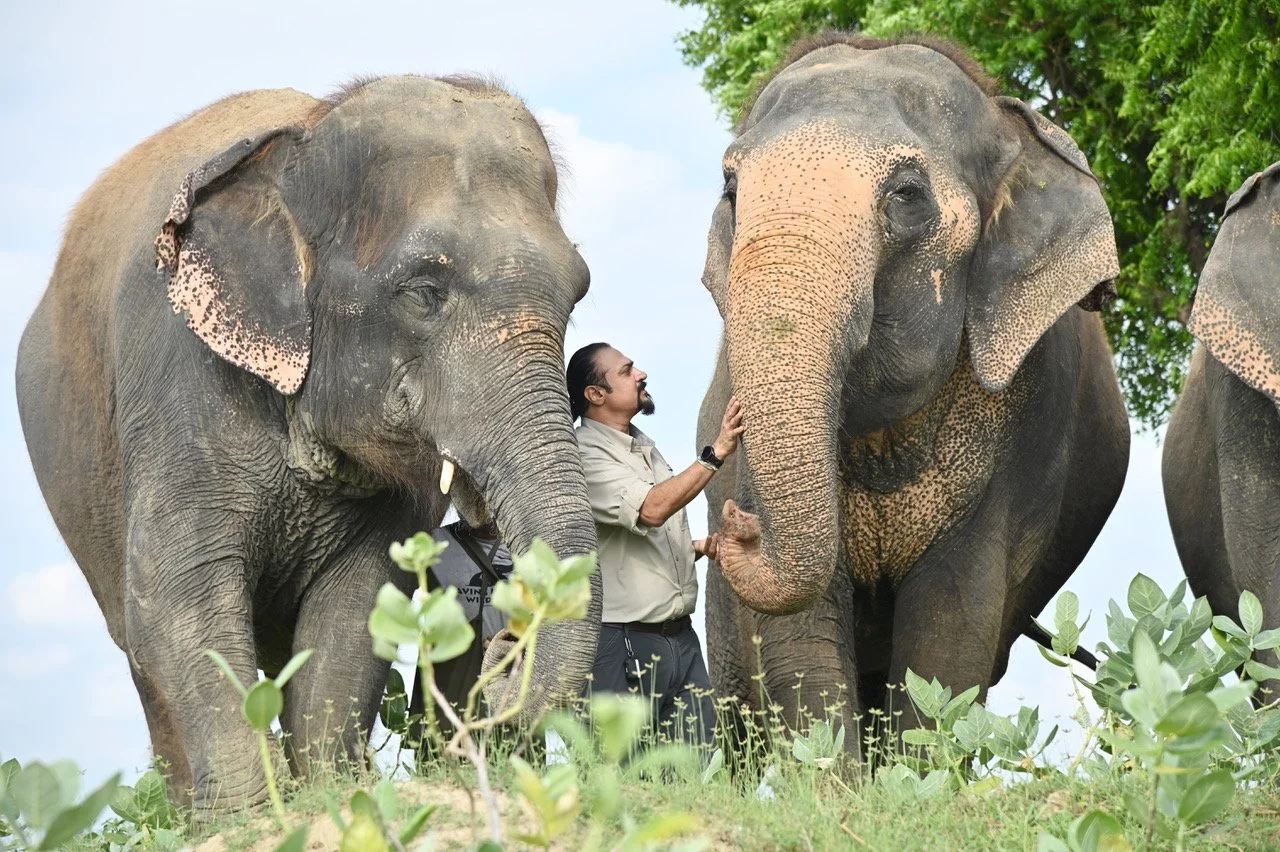
Kartick Satyanarayan with rescued elephants. Courtesy of Wildlife SOS.
Driven by compassion and determination, Satyanarayan spent years investigating the trade from within, uncovering its full scale. But he quickly realized that rescuing bears alone would never be enough. The practice was deeply tied to the livelihoods of the Kalandar community, who had depended on dancing bears for generations. Ending the cruelty meant changing an entire system.
In 1995, he co-founded Wildlife SOS with a bold vision: to protect wildlife while supporting the people whose lives were intertwined with it. Over time, that vision grew into one of Asia’s largest wildlife conservation organizations. Together with his team, Satyanarayan helped bring an end to the 500-year-old dancing bear tradition in India, rescuing hundreds of sloth bears and aiding thousands of Kalandar families in their transition to sustainable livelihoods.
Today, Wildlife SOS rescues and rehabilitates elephants, leopards, reptiles and other wildlife in distress while working with government agencies to combat poaching and reduce human-wildlife conflict. For Satyanarayan, conservation is not just about saving animals. It is about creating lasting change that supports both wildlife and the communities that protect them.
I have been fortunate to experience India’s wild spaces, not as a tourist zipping through, but slowly: on foot, by boat, through forests, mountaintops, wetlands and grasslands. I have silently skimmed through still backwaters in my kayak as flamingos landed all around me, gaped in awe as the elusive and rare “golden tiger” went for a swim just feet away and sat spellbound, surrounded by dense forest, watching the “unicorn” of the Western Ghats, the Nilgiri marten, move through the trees in front of me. These are not one-off moments. They are reminders of how diverse this country truly is, far beyond the well-worn stereotypes.

Dr. Latika Nath’s photography in action. Courtesy of Latika Nath.
The deeper I travel, the clearer it becomes that these landscapes do not exist in isolation. They are shaped, protected and sometimes threatened by the people who live alongside them. And this is where tourism has the power to either help or harm.
“Tourism can play an important role, if done right,” Vanak told me. Done poorly, it reduces nature to a checklist: tigers spotted, photos taken and little thought given to what lies beneath the surface. Done well, it does something far more meaningful. It creates awareness. It builds respect. It allows people to understand that beauty in India is not limited to its iconic species but exists in its grasslands, wetlands and quieter, overlooked ecosystems.
For tourism to truly support conservation, it must extend beyond the experience itself. It must support local communities, guides, naturalists, forest-edge villages and those who live closest to these landscapes and bear the greatest responsibility for their protection. When tourism creates livelihoods, values local knowledge and invests back into these ecosystems, it becomes part of the solution.
The future of conservation in India will not be shaped by policy or science alone. It will also be shaped by the choices we make as travelers, what we seek out, what we support and which narratives we choose to perpetuate.
Dawn Lwakila
Dawn continually takes the path less trodden, both figuratively and literally. She loves to really live in a place and grow some roots there — as well as a good wander and the freedom to explore. Canada is her homeland, but her heart and soul are scattered across the globe. She has journeyed through over 30 countries and still has an ever-growing bucket list of new places to experience. She is currently based out of India. You can keep up to date on her latest adventures on Instagram @dawned_onme and you can purchase her ebook Wander Woman: A Travel Guide For Beginners on Amazon.