
By Sehr Khosla
A word intended to dismiss India’s frustrated youth has instead become the name of a growing political movement.
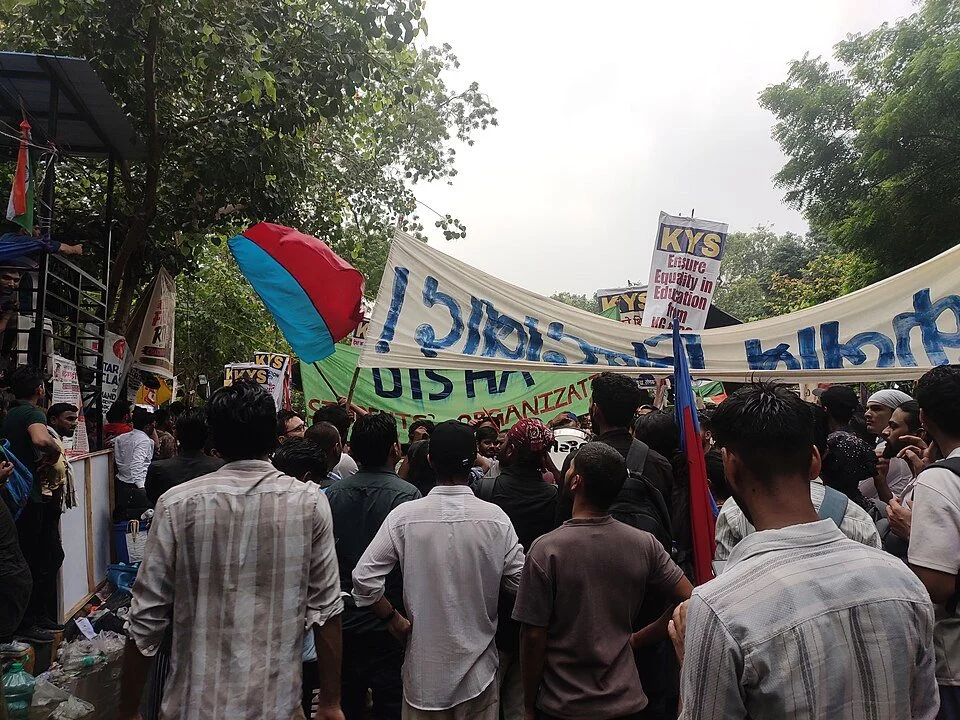
Students in India protesting against the 2026 NEET UG paper leak at the New Delhi observatory Jantar Mantar on July 20, 2026. Sumita Roy Dutta. CC BY-SA 4.0.
Thousands of students and young workers gathered at New Delhi’s Jantar Mantar on July 20 under the banner of the Cockroach Janta Party, the CJP, demanding reforms to India’s education system and action on youth unemployment. When protesters attempted to march toward Parliament, police blocked their path. Clashes followed, with officers using tear gas and batons as demonstrators pushed against barricades.
The movement began online only months ago, founded by political communications strategist Abhijeet Dipke. Its name parodies Prime Minister Narendra Modi’s Bharatiya Janata Party, the BJP, while reclaiming “cockroach,” an insult increasingly embraced by young Indians who feel discarded by the country’s political and economic system.
But what began as a joke tapped into something much deeper.
The movement calls for greater accountability in India’s education system, including reforms to entrance examinations and government recruitment, as well as better employment prospects for graduates. Nearly 2.28 million candidates sat for government recruitment examinations in May 2026, according to government figures cited by the BBC.
CJP supporters say India’s education system has become defined by paper leaks, delayed recruitment, inconsistent entrance examinations and years spent preparing for a shrinking pool of secure jobs. Particular anger has focused on the National Eligibility cum Entrance Test, also known as NEET UG, the fiercely competitive examination used for admission to medical colleges, which has repeatedly faced allegations of irregularities.
“We are here for those kids who died by suicide,” protester Saurav Das told Al Jazeera, referring to students who lost their lives amid the pressure surrounding competitive examinations.
For a generation repeatedly told that education offers a path toward economic security, the gap between qualifications and opportunity has become increasingly difficult to ignore.
That frustration is already producing political consequences. In Maharashtra, the state’s higher education minister resigned in July following sustained student protests over changes to university entrance examinations, giving the growing youth movement a tangible victory.
For many joining the CJP, political protest itself is new. Girish Pawar, a 21-year-old business graduate struggling to find a job that meets his expectations, traveled to the Delhi demonstration with his 20-year-old sister Mahima for their first public protest.
“I think it’s for the greater cause,” Pawar told The Straits Times.
India’s movement also comes amid a wider surge in youth-driven political mobilization. From the resurgence of Gen Z protests in Kenya to Nepal’s anti-corruption demonstrations in 2025, young protesters have used social media to channel their anger over economic insecurity, corruption and political exclusion into street demonstrations.
Whether the CJP can produce lasting reform from viral momentum remains unclear, given that its decentralized, satirical identity may prove difficult to sustain. Yet the thousands who gathered in Delhi suggest something broader is taking shape: Young Indians who once expressed their frustrations largely online are increasingly carrying them into public life.
The cockroach label was supposed to be an insult. Instead, a generation that feels increasingly disposable is turning it into a demand to be heard.

Sehr Khosla
Sehr is a student at Georgetown University studying Classics and Government with a minor in Journalism. In the future, she hopes to combine her passion for social justice with communications to advocate for change. Outside of writing, she enjoys travelling and reading murder mysteries.