
By Jeremy Gordon
Zimbabwe becomes the latest nation to alter its constitution, allowing its 83-year-old president to stay in power until 2030
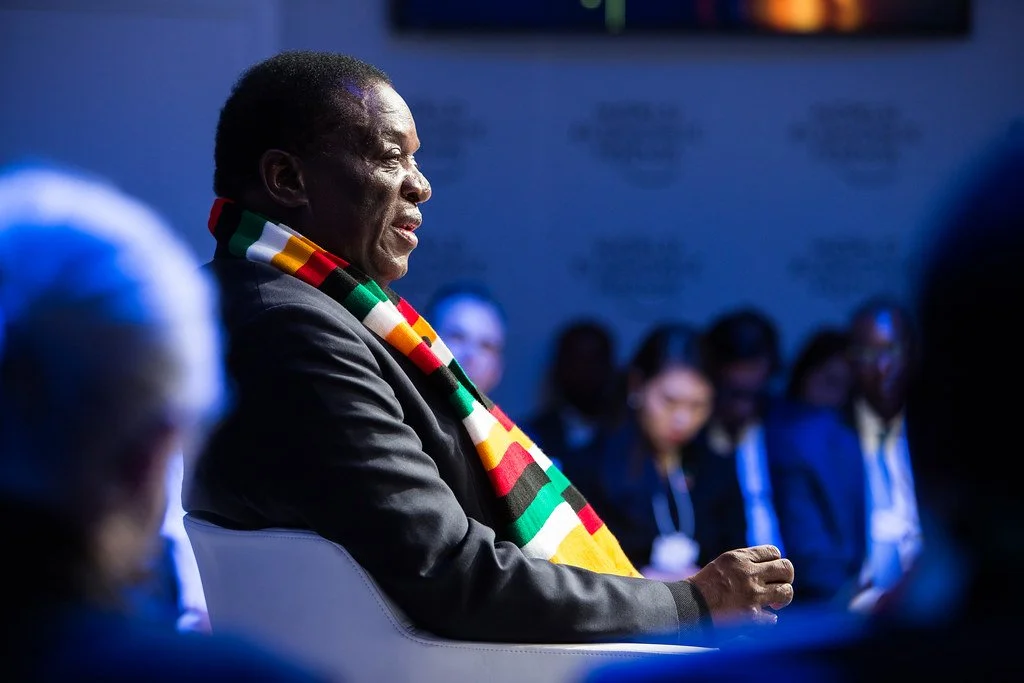
Zimbabwe President Emmerson Mnangagwa. World Economic Forum. CC BY-NC-SA 2.0.
In the decades following World War II, a rash of independence movements swept across Africa. After centuries of European rule, nations across the continent regained self-governance. There was optimism that with sovereignty back in African hands, those nations would prosper and their people would finally be empowered to choose their own destinies. But the ghost of colonialism has been hard to exorcise. That ghost has manifested itself in the form of ethnic divisions, economic inequality, political instability and rampant corruption. It has also left a trend of African leaders clinging to power long past their sell-by dates, often amending their countries’ constitutions to do so.
The latest nation to do so is Zimbabwe. On June 18, the National Assembly voted overwhelmingly to alter the constitution to extend presidential terms from five to seven years, two years after the president explicitly expressed an interest in exceeding his term limit. Another amendment passed by the National Assembly proposes shifting presidential elections from direct popular vote to selection by lawmakers. It has passed the Senate and is pending presidential signature to become law.
President Mnangagwa is 83 years old. He came to power after a military coup in 2017 that ousted another longtime leader, Robert Mugabe. One of Mugabe’s closest allies, serving in top positions, including vice president, Mnangagwa’s political prowess earned him the nickname “The Crocodile.” But he and Mugabe had a falling out, leading to the coup that cleared the way for Mnangagwa’s near-decade-long rule. And now the amendment could extend that rule to accommodate the president’s wishes.
Cameroon, Cote d'Ivoire, Uganda and Equatorial Guinea have also altered or removed constitutional restrictions so that their aging leaders can stay in power beyond their original limits. Cameroon’s Paul Biya is the world’s oldest leader, at 93. Cote d'Ivoire’s election in October 2025 of Alassane Ouattara, 84, was marked by low voter turnout and political unrest. Uganda’s Yoweri Museveni, 81, sworn in for a seventh consecutive term in May, has been branded an authoritarian. And Teodoro Obiang Nguema Mbasogo, 84, of Equatorial Guinea, has held power for 47 years, making him Africa’s longest-serving president. Obiang even appointed his son as vice president, virtually ensuring his bloodline continues to rule the nation.
A recent Pew Research Center analysis found that seven of the 10 oldest leaders in the world are in African nations. A United Nations analysis found that the median age on the continent is 19 years old, and more than 60% of its population is under 30. A notably young continent is largely ruled by remarkably old leaders.
There are, of course, exceptions. A new generation of younger leaders has emerged across the continent. Senegal and Ethiopia both have elected leaders under 50. Chad, Burkina Faso, Mali and Guinea all have younger leaders who came to power as a result of military coups: antithetical to the concept of constitutional rule and the peaceful transition of power. Still, much of the continent is ruled by the elderly.
The concept of world leaders staying on longer than initially intended is not unique to Africa. Both Russia and China have approved amendments to extend the reigns of Vladimir Putin and Xi Jinping. U.S. President Donald Trump has been not-so-subtly hinting at a third term since he was elected for a second term. And there is always a troubling tendency in popular media to treat Africa as one giant monolith instead of a continent of 54 different nations with distinct cultures, histories, demographics, economies and political systems. But among the seven continents, Africa’s leadership trend is the most consistent and pronounced.
The bill in Zimbabwe has faced backlash from citizens, activists and rights groups, who say the circumstances surrounding its adoption reek of violence, intimidation and corruption. Citing assaults on activists who have spoken out against it and alleged bribery by pro-Mnangagwa business leaders, they have taken to the courts. Some citizens are suing their members of parliament for supporting the bill. Human rights activist Youngerson Matete has asked the High Court to stop its enactment without a referendum. But many are pessimistic about these efforts, believing the judiciary to lack independence. And when courts and political efforts fail, violence is often not far behind on the horizon.
This decade has already seen 11 coups in nine African states. The latest, in Guinea-Bissau, came when the military seized control of the government before the results of the 2025 general election, an election that President Umaro Sissoco Embalo had postponed in order to shore up power. When governments fail to address their citizens' concerns and instead enact measures to skirt their constitutions and retain power, unrest can boil over into something darker. By clinging to power, these aging leaders are gambling against the mounting rage of their people. And the price to pay if they lose is steep.

Jeremy Gordon
Jeremy is a graduate student at Johns Hopkins University studying Creative Writing. He graduated from the University of Maryland with a bachelor's in Criminology and Criminal Justice and worked for four years as an Investigative Specialist with the Public Defender Service for DC.