
By Barrington Jayden Henry
Explore Dresden, the Jewel Box of Europe, a city almost lost to war and time.
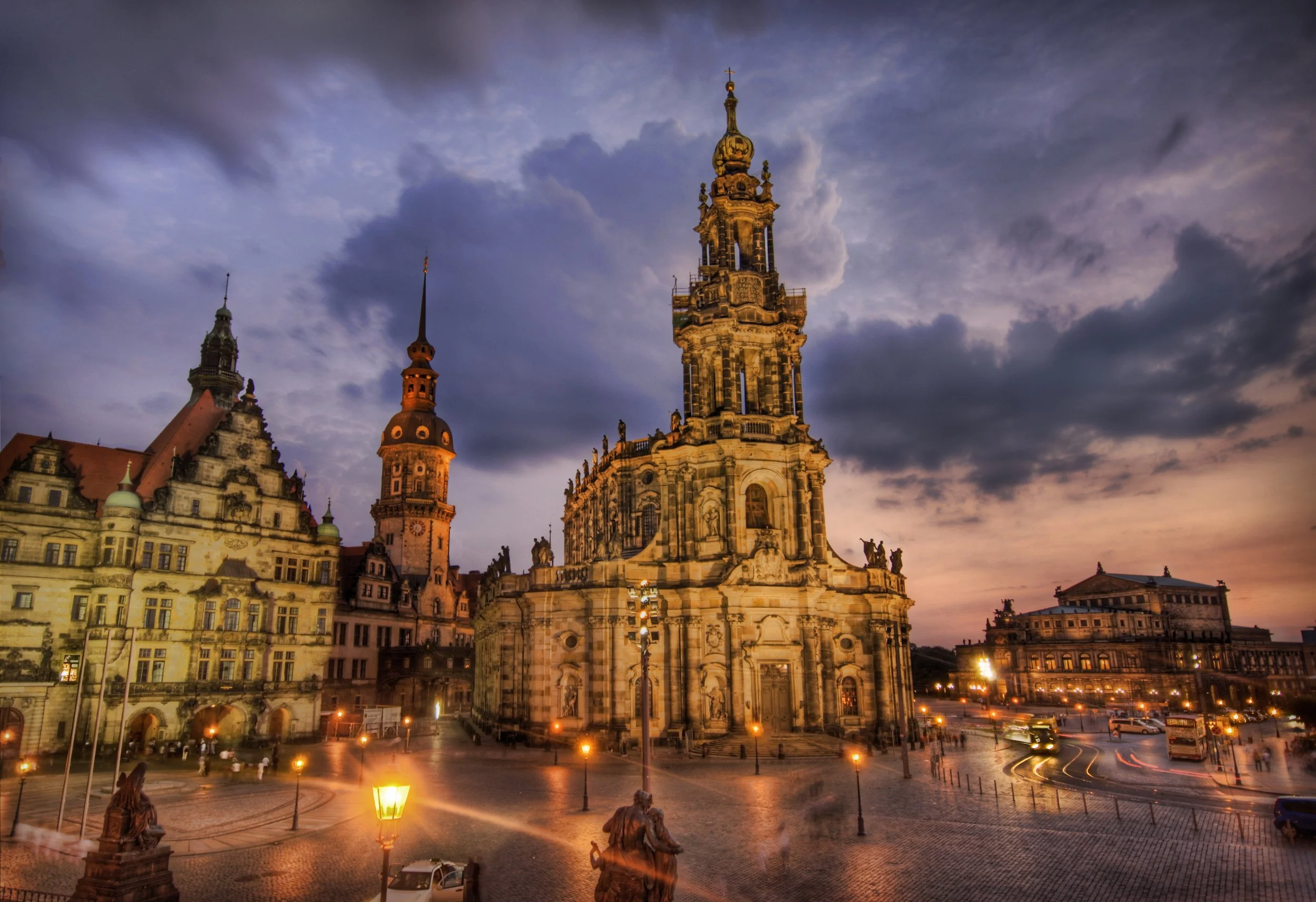
Dresden Castle and Cathedral of the Holy Trinity. Trey Ratcliff. CC BY-NC-SA 2.0.
On a rare weekend free from frost in the center of Europe, I spent 25 hours in Dresden, one of the most beautiful cities on the continent. Dresden has a long, storied history that is reflected in its sumptuous architecture and its expansive museums. It is a fantastic example of what a city can salvage and recreate after total destruction. Its dedication to its urban memory, the historical context that the city holds, is unlike any I have ever visited.
Dresden, lying in the Elbe Valley just beyond the Ore Mountains, has been the capital of Saxony since the 16th century, when the Electorate of Saxony was part of the Holy Roman Empire. During the 18th century, Elector Frederick Augustus I, who also ruled over Poland as King Augustus II, was a great patron of the fine arts and transformed Dresden from a mere provincial capital into a center of high culture. Most of the city’s most celebrated landmarks and institutions date from his reign.
The city’s most renowned feats of architecture are the Zwinger Royal Palace, the Frauenkirche and the Cathedral of the Holy Trinity. The Zwinger, a large palace in the Old Town, is a masterpiece in the Baroque tradition, and was conceived by the king as a venue for Dresden’s celebrated concerts and theatrical performances. Since the mid-19th century, it has held the Dresden State Art Collections’ finest works from the Old Masters. Even on a gray February day, the grounds felt like a walk back in time, and one can easily see how the Zwinger is a prominent example of Europe’s most ostentatious urban palaces. The gardens have only been open to the public for about 75years, and it is truly fortunate that anyone can enjoy them. Only a short walk west is the Frauenkirche, Dresden’s Lutheran church, and the Cathedral of the Holy Trinity, Dresden’s Catholic church. While the Cathedral was built to accommodate Dresden’s Catholic nobility, the Frauenkirche was built by the city for the common people. In the former, Frederick Augustus I’s heart is interred; the rest of his body is in Poland. These hotspots, among others, give Dresden its fitting name of the “Jewel Box of Europe.”
In the 19th and early 20th centuries, Dresden was celebrated as a lavish, refined city alive with art and culture. Artists such as Frederic Chopin and Adam Mickiewicz created some of their greatest works in the city and saw it as a creative haven. The Third Reich, however, turned Dresden from a font of culture into a military target. From Feb. 13 to 15, 1945, during the close of World War II, Allied forces firebombed the city, wiping virtually all of it off the map. The entire Old Town was destroyed, and all the sumptuous buildings from the prior centuries were reduced to rubble. After the war, when Dresden was part of the German Democratic Republic, the Communist government rebuilt some of the old city according to historical record, but chose to build the majority of the city in a socialist style and left other structures, such as the Frauenkirche, destroyed as a memorial to the costs of war. The Frauenkirche and other parts of the old city would not be reconstructed until reunification.
Beyond the River Elbe in Dresden’s Neustadt lies the Military History Museum of Germany. Run by the Bundeswehr, this museum tells the story of the past 700 years of armed conflict in Germany. It was at the top of my list of places to visit in the city because its holistic approach to telling the history of war is unlike most museums. It is a valuable resource for learning more about war and its economic, psychological and societal ramifications. The museum is perhaps the most prominent example of how Dresden reckons with the war that destroyed the city. In my view, the city seems to have made peace with its annihilation and bears its scars to serve as a reminder of the costs of war.
What one sees today in Dresden are palaces, churches and landmarks painstakingly reconstructed, in a sense brought back from history. Today, one can visit and get a true sense of what the city looked and felt like in its prime. It is a testament to the ability of an old city to resurrect itself.

Barrington Jayden Henry
BARRINGTON JAYDEN HENRY is from the Atlanta area and is a senior at Vanderbilt University, studying political science and history. Jayden is also the host of the weekly radio program I Want to Tell You Something on WRVU Nashville. In his free time, he enjoys playing tennis, reading, and going to museums.