The women of Sheroes' Hangout serve coffee and share their personal stories.
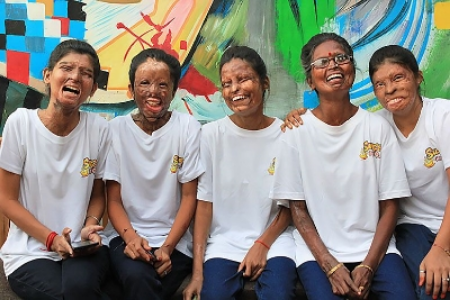
Ritu Saini, Chanchal Kumari, Neetu Mahor, Gita Mahor, and Rupa at the café. (Photo: Courtesy Sheroes’ Hangout)
The Taj Mahal may be one of the world’s top architectural wonders, but just a half mile away, a new destination is gaining attention: Sheroes’ Hangout.
“I was exhilarated the first time a group of Indian tourists who visited the café told me how much they appreciate my courage,” says Rupa (who goes by one name), a 22-year-old survivor of acid violence who, along with four other women, runs the café Sheroes’ Hangout. “Since then, we have had regular customers who come here not only to enjoy a cup of joe but also to talk to us.”
Visitors to Sheroes’ Hangout always leave with a sense of fulfillment. It’s not only because of the cutting-edge coffee and delicious snacks the café serves.
Opened in December 2014 in Agra, a city in the north Indian state of Uttar Pradesh, Sheroes’ Hangout started as a crowdfunding project by Stop Acid Attacks, a group committed to ending acts of violence against women. Its “pay as you wish” contributions go toward the rehabilitation of survivors of acid violence in India.
“Our visitors are mostly people from around the world who hear about us in the news,” says 20-year-old Chanchal Kumari, another survivor who helps operate the café. A man whose marriage proposal she refused attacked Kumari in 2012. “They come here to see how acid attack survivors like us are coping with our lives.”
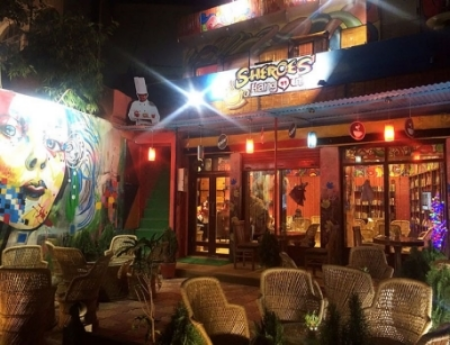
(Photo: Courtesy Sheroes' Hangout)
Kumari, who is recovering from her fifth reconstructive surgery, works alongside Rupa, Ritu Saini, Gita Mahor, and Neetu Mahor, all of whom lived a secluded life in their homes for several years, dealing with the pain of a charred face and a scarred soul. Then they discovered "Stop Acid Attacks," a Facebook campaign that was started on International Women’s Day in 2013. Based in New Delhi, SAA works with acid attack survivors in India, assisting them with legal and medical issues and helping them deal with the trauma of the attack. Sheroes’ Hangout is one of its several initiatives.
Acid attacks are a gruesome reality in India. The National Crime Records Bureau, a government organization that recently began recording acid violence, estimates that more than 1,000 such crimes are committed around the country every year, though the majority of attacks go unreported because of the shame the girl and her family feel and the fear of being attacked again.
SAA has been collecting data through its volunteers across the country and has information on 430 survivors, 350 of whom were attacked in the last two years. It is in touch with, and has assisted, more than 70 of them. According to the data collected, about 70 percent of victims are women, more than 50 percent of whom are attacked by spurned lovers. One of the biggest reasons behind the high rate of acid attacks is the lack of laws against the free sale of acid in India—a liter can be purchased for just 50 cents.
SAA wanted to do something for Gita Mahor, 42, and her daughter Neetu, 26, who were attacked with acid 23 years ago by Mahor’s husband, Neetu’s father. Both were left with mutilated faces and limited vision. Neetu’s one-year-old sister was sleeping next to her during the attack and succumbed to the injuries the acid caused to her. With no one else to support them, mother and daughter were forced to continue living with their assailant. To relieve them from their everyday distress and further domestic violence, SAA found it important to provide them an avenue of earning a livelihood so they could gradually move away from their home and lead a happier life.
“Acid attack survivors’ lives become even more traumatic when they start facing rejection from society due to their disfigured faces. They need someone to hold their hand and restore their self-confidence,” says SAA founder Alok Dixit.
Today, Mahor and Neetu dress up every morning and go to the café to serve coffee and treats—and share their stories with customers.
One of the objectives of SAA at Sheroes’ Hangout was to provide skills training in the subject that each survivor was interested in learning. With SAA’s help, Mahor took a baking course at a hotel in Agra and will soon be serving cookies and cupcakes to customers. Neetu, who is almost blind, is taking singing lessons from an SAA volunteer. “I love to welcome the guests at the café cheerfully, so that they know we are coping well,” she says.
Saini, 19, played volleyball for India before suffering an acid attack by a male cousin in 2012 over a family property dispute, resulting in the loss of her left eye. She is unable to compete in the sport anymore, and she now handles accounts at the café. “My life changed ever since I joined SAA,” she says. “With the emotional support I received, I regained the confidence to go out with my face uncovered. Now I don’t care what people think of my disfigured face.”
Rupa—whose stepmother attacked her with acid when she was just 12—is a skilled tailor and an amateur apparel designer. The outfits she designs are exhibited and sold at the café. “Sheroes’ Hangout is not only giving us a chance to move our lives forward; it is also getting our stories out,” she says.
“True that,” says customer Shikha Singh, 20, a student of fashion design who finds herself in the café at least once a week. “I would never have known about the reality behind acid attack survivors had I not met these women. It is amazing the way they are working to fulfill their dreams despite the hurdles. I now prefer to spend on Sheroes’ Hangout rather than a McDonald’s or KFC. At least I’m sure the money will be used for a good cause.”
ORIGINALLY PUBLISHED ON TAKEPART
PRITI SALIAN
Priti is a Bangalore-based journalist whose work has appeared in The Christian Science Monitor, The Women's International Perspective, The National, Femina.in, Prevention, Discover India, and many other publications.