
By Sehr Khosla
Uganda’s latest media shutdown is about more than press freedom: it offers a glimpse into how power is being exercised, and perhaps transferred, in one of Africa’s longest-serving governments.
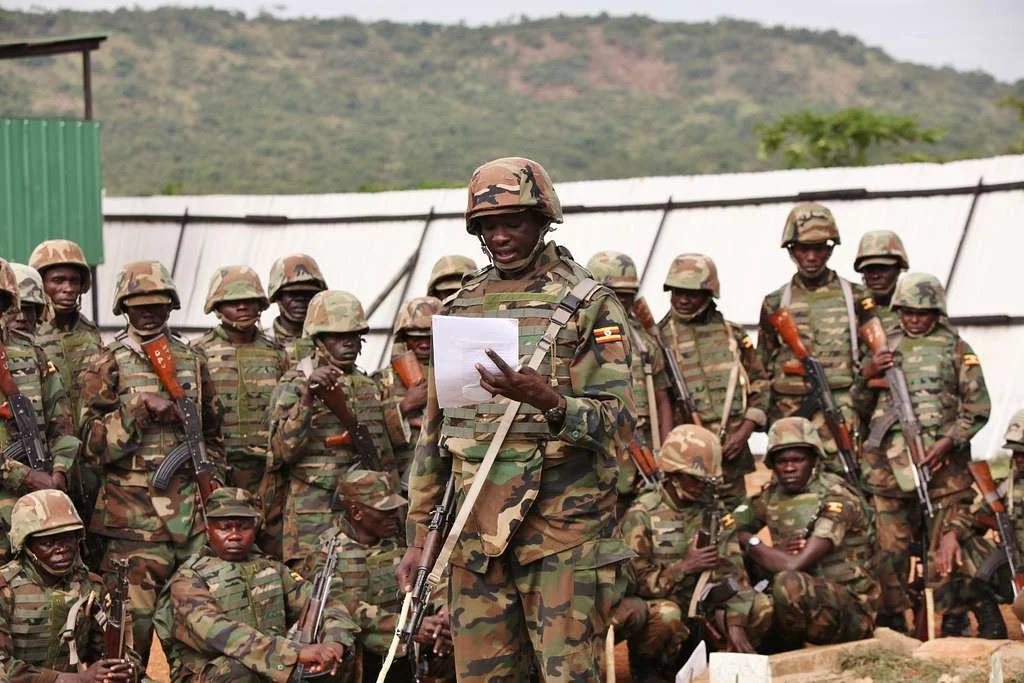
Uganda People’s Defense Force 1st Lt. Jimmy Muhumuza delivers a convoy operations order at the Peace Support Operations Training Center-Singo in Kakola, Uganda. Defense Visual Information Distribution Service. CC0.
On June 28, Gen. Muhoozi Kainerugaba, Uganda’s military chief and the son of President Yoweri Museveni, ordered the closure of Daily Monitor, NTV Uganda and other outlets owned by Nation Media Group, one of East Africa’s largest independent media companies. Armed soldiers surrounded the company’s headquarters in Kampala, preventing journalists from entering while television channels went off the air.
The order came with little explanation, with Kainerugaba justifying the decision himself on X.
"In Uganda, I do not believe in a free press! The press should be guided by cadres of the revolution," he wrote, later adding that the outlets would not reopen without his permission.
The remarks immediately drew condemnation from journalists, broadcasters and opposition figures. Uganda’s National Association of Broadcasters warned in a statement that the group was “deeply concerned about this action and its impact on the media ecosystem,” questioning whether the shutdown violated constitutional protections for press freedom. Similarly, the opposition party National Unity Platform referred to the shutdown as “a primitive attack on press freedom and the citizens’ right to access information,” in a recent statement.
For many observers, however, the significance extends beyond one day’s headlines.
Museveni, now 81, has ruled Uganda for the past 40 years after taking power as a rebel leader. He secured a seventh term in disputed elections earlier this year, but speculation has increasingly focused on whether Kainerugaba is being prepared to succeed him. Already one of the country’s most powerful figures, the general has cultivated a highly visible public profile through inflammatory social media posts and growing political influence.
The media closures appear to reinforce that perception.
"This is the harsh reality we now face, a country under open military rule, where fear replaces law and force replaces accountability," opposition leader Bobi Wine wrote on X after the shutdown.
It is not the first time Museveni’s government has clashed with independent media. Daily Monitor was closed for 10 days in 2013 after reporting on an alleged succession plan known as the “Muhoozi Project,” while NTV Uganda was forced off the air in 2007 following government criticism of its reporting. However, analysts argue this episode is different because the order came directly from the man widely seen as Uganda’s next leader.
That combination of military command, political visibility and public attacks on the media has raised fresh questions about Uganda’s future. The closures do not simply restrict reporting; they narrow the space in which Ugandans can openly debate power, succession and dissent.
In a country approaching four decades under the same president, the battle over independent journalism is becoming inseparable from the question of who writes Uganda’s next political chapter.
Sehr Khosla
Sehr is a student at Georgetown University studying Classics and Government with a minor in Journalism. In the future, she hopes to combine her passion for social justice with communications to advocate for change. Outside of writing, she enjoys travelling and reading murder mysteries.