
By Arianna Kaplan
The story of the submerged Isle de Jean Charles and the residents impacted by rising sea levels, environmental disasters and government actions.
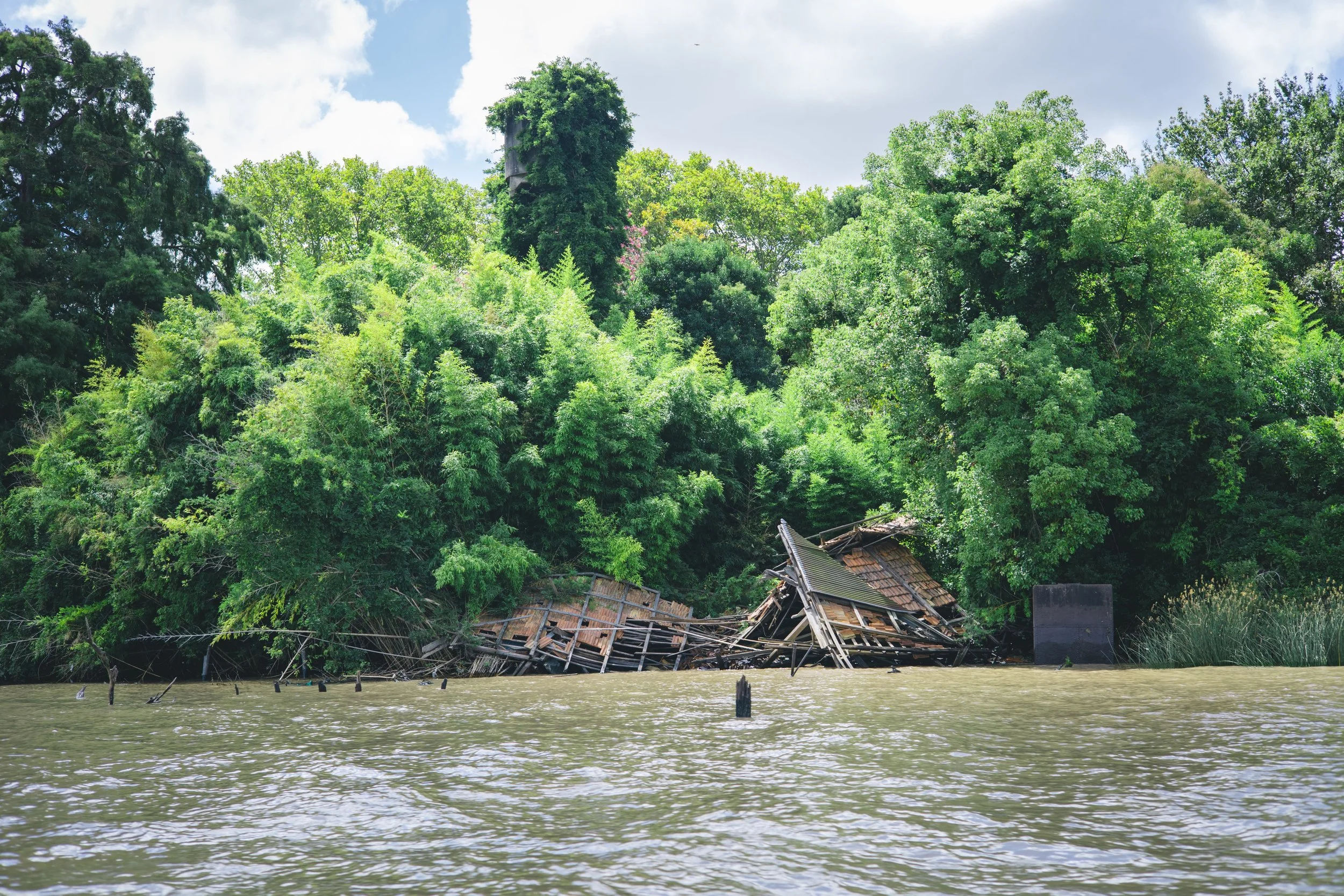
A dilapidated house going underwater. Rafael Rodrigues. Pexels.
About 80 miles southwest of New Orleans lies Isle de Jean Charles, a thin strip of land in Terrebonne Parish that is rapidly disappearing. This island, deep in the bayous of southern Louisiana, is rapidly disappearing and has lost about 98% of its land since 1955. It has become the United States’ first flawed attempt at a federally funded climate relocation event.
The Isle de Jean Charles is a thin strip of land which, for roughly 170 years, was the home of the Biloxi-Chitimacha-Choctaw tribe, now known as the Jean Charles Choctaw Nation. They settled on the island in the 1830s to escape the Indian Removal Act and the Trail of Tears, and are now facing another threat: 98% of the landmass is being lost due to rising sea levels.
Once, the Isle de Jean Charles encompassed more than 22,000 acres. Today, roughly 320 remain, a 98% loss of landmass. Southern Louisiana is highly vulnerable to hurricanes because of its geographic location on the Gulf of Mexico and its extension beyond it. Beginning in the 1940s, oil and gas companies dredged canals for wells and pipelines, causing massive ecological and habitat loss by killing the natural cypress, willows and oaks along the waterline. Canal dredging brings in saltwater from the Gulf of Mexico, which kills the surrounding freshwater marsh, allowing more water to rush in during hurricanes and storms, resulting in more and more land loss. The loss of trees that once helped hold the water back, combined with levees built upriver on the Mississippi that prevent sediment from replenishing wetlands, has led to crushing amounts of water flowing into the Isle.
In 2010, the Deepwater Horizon oil rig exploded, causing the largest marine oil spill disaster in history and sending 134 million gallons of oil into the Gulf of Mexico over 87 days. The incident had, and continues to have, severe impacts on residents’ health, livelihoods and, of course, the surrounding environment. Along with disappearing landmass, residents were exposed to toxic chemicals and changes in subsistence resources, such as marine life with tumors and decimated oyster beds, impacting Tribal members’ income and way of life.
In 2016, Louisiana won $92 million through the federal National Disaster Resilience Competition, with $48 million allocated to the resettlement effort. It was the first time that the federal government fully funded the relocation of an entire community because of climate change. If successful, it would have become a model for future at-risk communities threatened by climate change. The state bought 515 acres of farmland 40 miles north of Isle de Jean Charles for $11.7 million, which the residents renamed the New Isle in 2019. The New Isle promised 37 homes on raised foundations above the floodplain.
Intended as a move to reunite the tribe as a community, it ended up having the inverse effect, as a second tribe was included in deliberations and the state set eligibility by residency and 2012 displacement rather than tribal membership. As a result, tribal leaders were excluded from key decisions, and residents were simultaneously unable to return home. Now, Louisiana’s own officials refuse to call the relocation successful, and the tribe remains split between the Isle de Jean Charles and the New Isle, though the number of residents left on the Isle de Jean Charles is dwindling.
The land of the old Isle is slipping away, but still, some residents choose to stay. I first learned of the Isle de Jean Charles when I studied abroad in Paris, viewing a museum exhibit about climate change. It was an odd experience to see a documentary about my home country, the United States, but about a place I had never heard of, and that seemed to be vanishing without a trace. The short documentary tells the story of Edison Dardar, a native of the isle whose family has lived there for generations. He does the same thing that he did when he was ten: he lives his life and catches shrimp.
In the 1960s, he says, there was no water. In his words, the Island was “green, green, green.” After the dredging of canals for oil pipelines, the water began to rise. When he was young, Dardar remembers around 250 houses, maybe 300. Now, he says, there are perhaps 20.
Dardar doesn’t want the remaining few residents to leave, but his sentiment contrasts with the reality of rising sea levels. Migration may soon become a necessity for many parts of the world as rising temperatures and sea levels push inhabitants to search for cooler temperatures and more stable land to live on. It’s already happening, in fact, but since the populations encouraged to move have primarily been Indigenous, there hasn’t been much conversation around it. Despite being prompted to leave, Dardar refuses.
“Only God’s going to know when the island's going to disappear,” he says. Though only the island’s bare bones remain in the ravaged aftereffects of hurricanes, rising sea levels and oil drilling, the tenacity of its remaining residents lives on.
“Born and raised here, and I’m going to stay here,” he says. “That’s my town.” While the U.S. Army Corps of Engineers has studied the risks to southern Louisiana, there are no plans to build a levee system to protect the island, in part due to the $100 million additional costs needed to include it in ongoing land preservation projects.
For some, such as Dardar, resistance takes the form of claiming what is his and refusing to leave a sacred homeland. Even if there is little hope for the Isle de Jean Charles, these acts of defiance are crucial for preserving its legacy, and other more well-known heritage sites such as New Orleans. The Isle de Jean Charles is quickly going underwater, and it has become the first formal attempt by the government to relocate an entire community. It raises the question: What will it take for climate change to finally get our attention, and what can we do to stop the water?
GET INVOLVED:
You can provide tax-deductible monetary donations through the Isle de Jean Charles Donation Page to aid transition, hurricane relief, youth development and cultural programs. You can also follow along on the Isle de Jean Charles Official Website to learn about their needs, school supply drives and cultural preservation programs.

Arianna Kaplan
Arianna is in her final year at Scripps College, part of The Claremont Colleges in the Los Angeles area. She writes in a variety of genres but most enjoys creative nonfiction and place-rooted narrative. Arianna currently resides in New York, where she won’t rest until she’s walked down every street and peeked into every alley. Writing at Catalyst, along with The Student Life Newspaper and The {C} Magazine, offers a perfect outlet for her zest for life and discovery, and she’s beyond excited to be here. In the future, she plans on pursuing a career in journalism.