
By Arianna Kaplan
Google is funding a $15 billion AI hub in Andhra Pradesh, India, amid concerns about its environmental and human impacts.
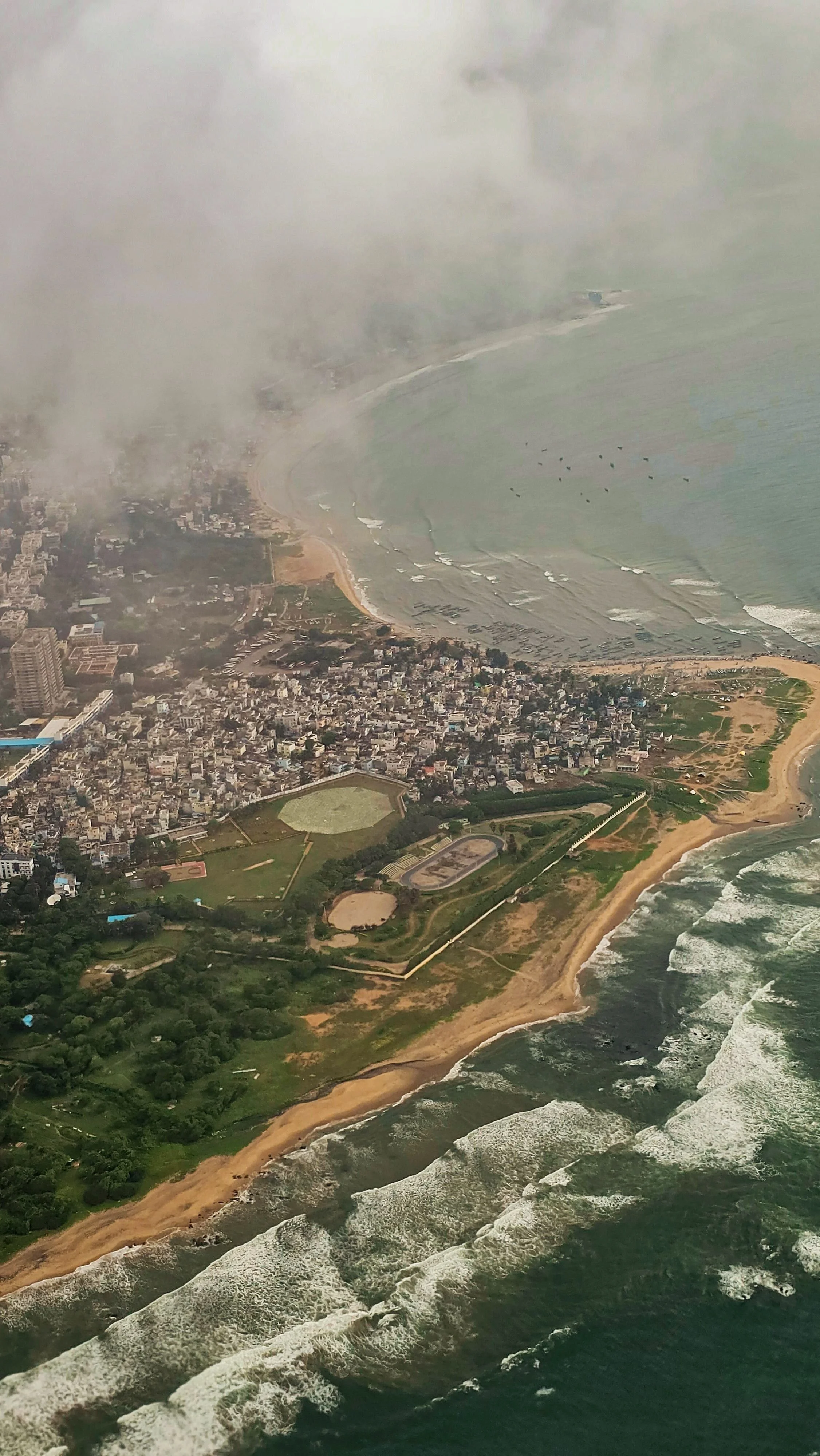
Aerial view of Visakhapatnam. Chandrakanth Tejomurthula. Pexels.
In the southern Indian state of Andhra Pradesh, local Dalit farmers, the lowest caste in India’s historical caste system, are under attack from the Indian government. The plan is simple in theory: Dalit families living in the to-be-developed area were offered 4 million rupees per acre, or around $41,500, to give up their farmland, from which most of their livelihood comes, to build a massive data center. Many residents took the trade, but many others have not, citing concern over being able to stay on their historical farmland.
Google is sponsoring the data center, funneling $15 billion into the project to connect to data centers in Singapore, South Africa, Australia and the U.S. through a network of terrestrial and subsea cables. Google’s project also acts as the kingpin of India’s Viksit Bharat 2047 economy-boosting initiative, though its adverse environmental effects and impacts on human and animal lives are entering the conversation.
Viksit Bharat 2047 is India’s initiative to raise India’s long-term economic growth with artificial intelligence at its center, allowing Google to deploy advanced AI capabilities across India. The IndiaAI Mission plans to build national capability across infrastructure and data, while semiconductor manufacturing is supported through the India Semiconductor Mission. Despite its economic advantages, the project is facing pushback from the Dalit community, the historically lowest-caste group in Indian society, as they have been forced to give up their land to accommodate the project, along with environmental and water usage concerns about the center.
The city of Visakhapatnam is positioned at the center of India’s AI project, and despite the monetary incentive offered by the Andhra Pradesh government to Visakhapatnam’s residents, the relinquishment of farmland was not necessarily consensual. The Dalit community is losing their livelihoods, identities and emotional attachments while gaining a lump sum of money without a guarantee that they will not be forced to relocate again in the future.
Residents are also concerned about the project’s water usage on their already strained drinking water supplies, especially as for many who live in Visakhapatnam, water is already rationed to a few hours each day. Activists have marched in protest of the data center in Visakhapatnam city, holding banners adorned with slogans such as “We cannot drink DATA.”
"Development should not be at the cost of livelihood of the people," said Raja Rama Mohan Roy, the founder of nonprofit Green Visakha, presenting statistics on Visakhapatnam's stressed water supply. Green Visakha has voiced concerns about the government’s promise of "guaranteed" water supplies for 20 years to the AI project, as many of its citizens already have rationed water.
In response to criticisms about its water usage, Google said in a statement that the Andhra Pradesh project will be developed in line with environmental laws, and that it will use “advanced air cooling to protect vital local water resources,” though the details are unclear.
Among growing environmental concerns against the AI project are concerns about its proximity to the Kambalakonda Wildlife Sanctuary, a mere 2,820 feet away, home to the vulnerable Indian leopard and pangolins. Public concern stems from the noise of heavy construction on animal behavior, and also from the environmental impact of the ongoing hill-cutting and forest clearance, which threatens both the wildlife corridor linking the sanctuary with its neighboring Kailasagiri forest and water supplies to the human population of Visakhapatnam.
While Visakhapatnam is successfully transforming into India’s new AI capital, its multi-billion-dollar data center projects are having a very real impact on the human population they are displacing. A human population that has lost its land, with or without a monetary exchange. Beyond humans, the project is raising concerns over energy and water use and its impact on local ecology. Its expansion to connect on an international scale will only exacerbate these effects.
GET INVOLVED:
To follow along with protests by Green Visakha, an environmental NGO in Visakhapatnam, look for reports on advocacy platforms and regional media coverage such as Stop Dirty Data Centers and news outlets like The Hindu.
To help oppose the AI data center in Visakhapatnam, sign this petition at Change.org or tune in to one of Stop Dirty Data Centers’ events to learn more about the anti-AI data efforts in India.
Read about Viksit Bharat 2047 and its vision for a boosted economy based on AI.

Arianna Kaplan
Arianna is in her final year at Scripps College, part of the Claremont College consortium in the Los Angeles area. She writes in a variety of genres but most enjoys creative nonfiction and place-rooted narrative. Writing at Catalyst, along with The Student Life Newspaper offers a perfect outlet for her zest for life, and she's beyond excited to be here. In the future, she plans on pursuing a career in journalism.