• Travel Features
  • Global Action
  • Take A Trip
  • Travel Guides
    • Podcast
    • Courses
    • Bookshop
  • About
  • Sign Up
Menu

CATALYST PLANET

  • Travel Features
  • Global Action
  • Take A Trip
  • Travel Guides
  • Discover
    • Podcast
    • Courses
    • Bookshop
  • About
  • Sign Up

Harajuku, Japan. SkandyQC. CC BY-NC-ND 2.0

Why Fertility Rates Could Halve by 2100

July 30, 2020

The global population growth rate is predicted to take a drastic downward turn, with experts believing that major countries such as Japan and Italy will see their populations halve by 2100. This is an unprecedented problem that could negatively impact society as a whole if the trend continues. The necessity for the world to plan and prepare for this outcome has become increasingly clear as global trends solidify. 

Why the Sudden ‘Baby Bust’?

In the 1950s, women were having an average of about 4.7 children in their life span. In today’s world, women are instead averaging 2.4. The causes for this turnaround include increased educational opportunities, greater numbers of women in the workforce and increased access to contraceptives. There seems to have been an attitude change toward parenthood in recent years. In more developed countries, the roles of women have turned in favor of being outside the home, leaving less time for children. This contrasts starkly with historical norms, where women stayed home to take care of the family and house while men left to go to work. 

What Are the Global Consequences?

While an initial evaluation might suggest that a smaller population would be better for the environment, professor Christopher Murray of the University of Washington suggests that this would lead to an “inverted social structure” where there are more older people than young. This raises questions about who will pay taxes and take care of the elderly. These are issues that the younger generations will have to worry about as they reach adulthood. “We’ll have to reorganize societies,” Murray says, in order to make current population trends sustainable. 

The world’s changing population numbers could lead to a shift in the world’s dominant powers. For example, India is set to replace China as the world’s most populous country as China faces a population decline as soon as 2024.  By 2100, India’s population would be followed by Nigeria’s, China’s and the United States’. 

Why Nigeria?

As COVID-19 and other health challenges ravage developing countries, access to contraceptives and other family planning becomes limited. This leads to more pregnancies in places such as sub-Saharan Africa, which is set to “treble in size.” Africa’s forecast for rapid growth calls attention to the current social situation regarding racism, with Murray stating that “global recognition of the challenges around racism are going to be all the more critical if there are large numbers of people of African descent in many countries.”

This shift in global power is expected to create issues surrounding development, social status and racism. Especially in the current social environment, racism could become one of the largest issues if these predictions prove to be true. 

What is Being Done to Prevent Population Decline?

Countries such as the United Kingdom have incentivized and increased migration. However, this is only a temporary fix as most countries begin to drop in population. Other countries have increased paid maternity and paternity leave, but have still seen few shifts toward larger families. Sweden has managed to “drag its rate from 1.7 to 1.9” while Singapore still has a rate of 1.3. Women simply cannot be expected to increase the number of  children they have due to policy changes, and current trends show that this attempt will not be enough. 

If the global reproductive rate drops to the predicted 1.7 by 2100, population extinction could become more of a legitimate concern. The 2.1 threshold, which is necessary to sustain the world’s current population, is instead being used as a target for future growth. Ultimately, though, young adults need to start  planning for a future where society’s age makeup is inverted.

Elizabeth Misnick

is a Professional Writing and Rhetoric major at Baylor University. She grew up in a military family and lived in Europe for almost half her life, traveling and living in different countries. She hopes to continue writing professionally throughout her career and publish her writing in the future.
Tags fertility, population, baby bust, India, Nigeria, China, developing countries, global power, racism, social status, migration, maternity leave, paternity leave, Sweden, Singapore, Environment, Human Rights, USA, Japan
Comment

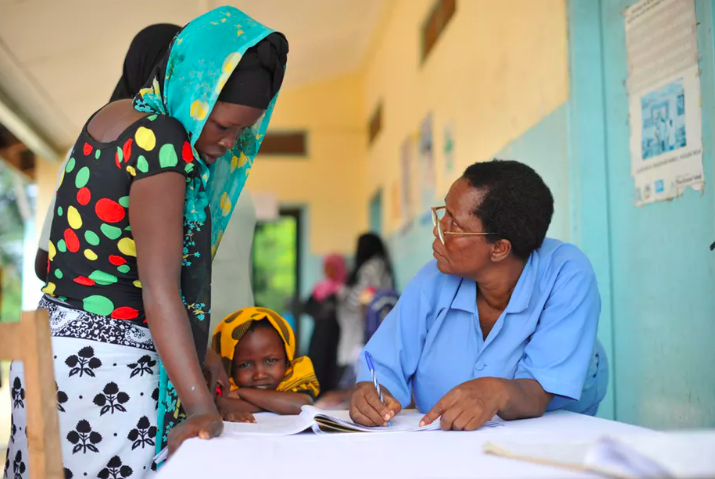
Tanzania was one of the first sub-Saharan African nations to embrace family planning as a national development priority. US Air Force, CC BY-SA

Tanzanian President Bluntly Attacks Contraception, Saying High Birth Rates are Good for Economy

October 29, 2018

Tanzanian President John Magufuli has suspended advertising by family planning organizations until further review, raising outcry among human rights groups and causing unrest within Tanzania’s health ministry.

The move came weeks after Magufuli made international headlines for inflammatory comments calling women who use contraception “lazy” and saying that he does “not see any need for birth control in Tanzania,” one of the world’s fastest-growing countries.

Amnesty International denounced Magufuli’s stance as an attack on the sexual and reproductive rights of Tanzanian women.

Tanzania has a history of promoting family planning, making Magufuli’s sudden opposition to birth control surprising.

But, as my demographic research shows, Magufuli is not the only world leader questioning longstanding population control policies.

Development and fertility

Magufuli, who took office in 2015, earned the nickname “The Bulldozer” during his previous two decades in Tanzanian politics.

His administration garnered early popular support in the East African nation for dismissing corrupt public officials and reorienting government spending, particularly toward anti-cholera operations and other public health services.

But he has also made undemocratic moves, shutting down newspapers critical of his administration and undermining judicial independence.

Many Tanzanians, especially young people and urbanites, have lost patience with his strongman tactics, polling shows.

Now his sudden opposition to birth control has raised concern that Tanzanian women could lose access to contraception.

Since the Industrial Revolution, economic development worldwide has closely correlated with lowering birth rates.

In Africa, the United Nations has documented a relationship between high population growth and lower quality of life. High fertility can exacerbate poverty and strain resource-strapped governments’ ability to provide public services like health care and education.

African leaders have generally acknowledged the connection between demography and development, though their demographic policies have varied. Tanzania, a British colony until 1961, was one of the first countries in sub-Saharan Africa to embrace family planning.

In 1959, the Family Planning Association of Tanzania – now a member of the International Planned Parenthood Federation – was founded to offer sexual education and contraception, though not abortion services.

At the time, the average Tanzanian woman had almost seven children. Cultural attitudes varied among the country’s 100-plus ethnic groups, but children were generally seen a status symbol and a source of labor for the majority who practiced subsistence farming and herding.

Tanzania’s first president, Julius Nyerere, emphasized social and economic development as the basis for his policy agenda. He called his plan “Ujamaa,” which means “familyhood” in Swahili, Tanzania’s national language.

Chart: The Conversation, CC-BY-ND Source: United Nations Get the data

By choosing that term, Nyerere wanted to stress the connection between the newly sovereign nation and the families at its core.

In a 1969 speech introducing his blueprint for development in Tanzania, Nyerere urged citizens to “put emphasis on caring for children and the ability to look after them properly, rather than thinking only about the numbers of children and the ability to give birth.”

Tanzania’s Catholic champion of birth control

President Nyerere was Catholic, like roughly one-third of Tanzania’s population. Then, as now, the Vatican officially opposed birth control.

But Nyerere rallied prominent local Catholic bishops around his efforts to link development and family planning.

“Nobody should have a single child unless he or she is able to take care of it,” said the late Tanzanian Bishop Fortunatus Lukanima in an interviewafter his retirement in 1998. “Let’s discuss family planning, condoms, birth control and so on.”

Tanzania’s first president, Julius Nyerere (center) saw reduced fertility as key to Tanzania’s future as a sovereign nation. UK National Archives, CC BY

Nyerere’s government also enlisted Muslim religious leaders to promote family planning in Tanzania’s predominantly Muslim coastal areas.

After he stepped down in 1985, consecutive administrations have continued to support family planning and pass national population policies aimed at lowering Tanzania’s fertility rates.

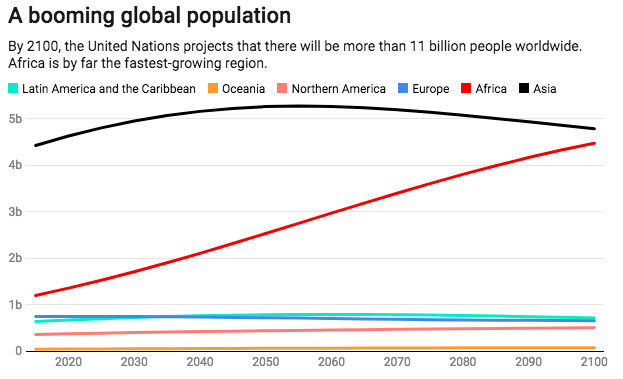
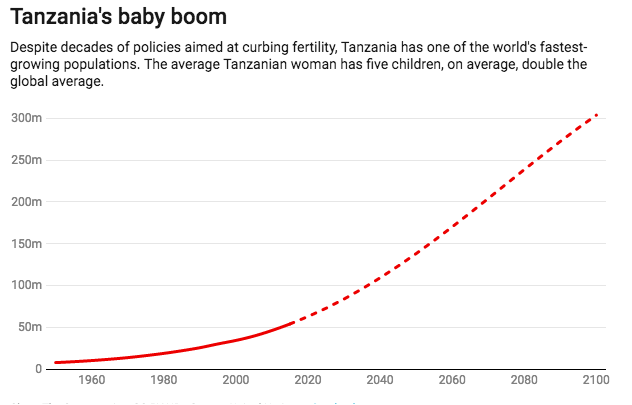
Despite these efforts, Tanzania still has one of the world’s highest birth rates. The average Tanzanian woman has five children, double the global average.

Tanzania’s population has grown from around 10 million at independence in 1961 to almost 60 million today. That’s triple the growth rate of the United States, double that of China and above even Nigeria, Africa’s most populous country.

Is population growth a problem?

This contradiction is seen across Africa.

Family planning programs have nearly universal government support. Yet the continent is still projected to account for 82 percent of the world’s population growth between now and 2100.

Common wisdom sees rapid population growth as a problem for low-income countries. If economic growth doesn’t keep pace, governments struggle to adequately provide services like housing, health care and education.

But the relationship between population growth and economic development is murkier than international organizations like the UN have long thought. And it’s changing with the times.

With fertility rates in Western Europe perilously low – in Spain, two people die for every one person born – some developing countries believe that a huge workforce and consumer pool could give them a global advantage.

Chart: The Conversation, CC-BY-ND Source: United Nations Get the data

China and Russia recently reversed long-standing population-control policies, citing economic reasons.

Ugandan President Yoweri Museveni also sees population growth as a boon to Africa – and global markets.

Magufuli’s anti birth-control comments came in this context. Emboldened by optimistic projections of economic growth in East Africa, he says a booming population could actually benefit Tanzania.

Tanzania has US$10 million earmarked for family planning next year. Magufuli seems to be considering redirecting this money to pay for education, health care and other social programs with a more tangible socioeconomic impact.

Choosing a demographic destiny

Most demographers agree that African countries will eventually experience the same drop in fertility rates that high-income Western democracies in the 20th century.

So far, there is little evidence that government policies promoting women’s reproductive choice and access to contraception will spur that process.

If Magufuli’s rejection of family planning becomes policy, it would be a major setback for Tanzanian women’s rights.

But he is not alone in questioning long-accepted wisdom on population control.

KRISTEN CAREY is a PhD Candidate in History at Boston University.

THIS ARTICLE WAS ORIGINALLY PUBLISHED ON THE CONVERSATION

Tags fertility, Africa, Tanzania, birth control, government, regulations, contraception, birth rates
Comment

Also check out...

Featured
Vietnam’s Floating Markets Are Disappearing
The Supernatural Role of Masks in Nigeria’s Yoruba Tribal Culture
Opening the World to Deaf Travelers with Lily Yu

Featured trips

Featured
Offer NGO Support While Visiting Quito
Experience Life as a Mongolian Nomad
Help Grow Organic Costa Rican Coffee

Sign up for the CATALYST newsletter

Sign up for our newsletter to get the scoop on international travel, global social impact insights, our latest podcast releases, and more from around the world, all delivered right to your inbox!

We respect your privacy.

Thank you!
Newsletter Sign Up | Advertise | Careers + Internships | Privacy Policy | Submissions | Contact Us

Copyright © 2025, MISSION MEDIA LLC. All rights reserved.