
By Sehr Khosla
FIFA’s order for Haiti to redesign its 2026 World Cup jerseys and remove their revolutionary symbolism sparks questions over history, race and political neutrality.
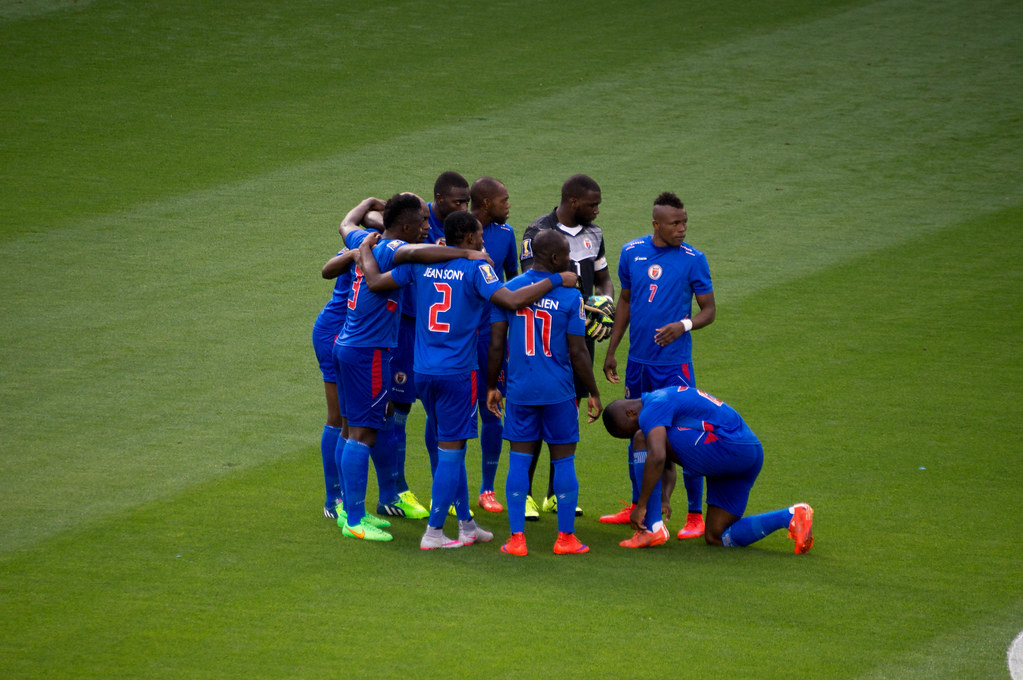
Haiti Team Huddle at 2015 CONCACAF Gold Cup Group Stage at Sporting Park in Kansas City. Brad Tutterow. CC by 2.0
On June 10, just three days before Haiti’s first FIFA appearance at the 2026 World Cup, the national team was forced to redesign its jerseys after FIFA ruled that imagery commemorating the Haitian Revolution was too political to appear on tournament uniforms. The decision has sparked debate over how international sporting bodies interpret political expression and whether symbols of national history should be treated differently from contemporary political statements.
The disputed design, produced by Colombian sportswear manufacturer Saeta, featured imagery inspired by the Battle of Vertieres, the final battle of the Haitian War of Independence in 1803. FIFA officials subsequently instructed the Haitian Football Federation (FHF) to remove imagery depicting the revolutionary leader Jean-Jacques Dessalines and other independence fighters raising the Haitian flag.
Under FIFA equipment regulations, symbols or images that could be interpreted as political are prohibited during its competitions. Haiti ultimately complied with the decision and submitted a revised version of the jersey ahead of the tournament.
The ruling has drawn criticism across social media because the imagery did not reference a contemporary political movement or party. Instead, it commemorated Haiti’s struggle for independence from French colonial rule, leading some observers to question whether FIFA’s definition of political symbolism is being applied too broadly.
A spokesperson for the Haitian team told The Athletic that FIFA’s ruling was a “misinterpretation,” explaining that the design was intended to honor Haiti’s history rather than make a political statement. Saeta echoed that view, saying the jersey was originally designed to celebrate “the pride, resilience and spirit of the Haitian people,” in an official statement.
“Several concepts were developed and refined over a number of months and submitted through FIFA standard approval process,” the company said in its statement. “The final design presented by Saeta was intended as a tribute to the men and women who contribute every day to Haiti’s future and was not intended as a political statement.”
In addition, the jersey originally included a depiction of the final battle of the revolution on the lower portion of the shirt, but this image was rejected by FIFA during its approval process despite the manufacturer’s insistence that it was intended as a historical tribute rather than a political message.
This ruling is not an isolated incident. Earlier this year, the International Olympic Committee (IOC) required Haiti to alter its uniforms for the 2026 Winter Olympics after designers included an image of Haitian revolutionary leader Toussaint Louverture. The IOC similarly determined that the design violated rules governing political symbolism.
Italian-Haitian designer Stella Jean, who created the Olympic uniforms, expressed frustration with the repeated interventions. “Either way, Haiti has to be setting a record: Two rebukes from the highest international sports authorities in just a few months,” she told The Associated Press.
As expressed by many observers on social media platforms, the fact that Haitian revolutionary figures have now been removed from both Olympic and World Cup uniforms within the span of a few months suggests a broader discomfort among international sporting institutions with symbols associated with Black liberation and anti-colonial struggle. Moreover, the decision has led some watchers to question whether anti-colonial historical symbols are being treated differently from other expressions of national heritage that routinely appear in international sport.
One such observer is Dr. Bertrhude Albert, CEO and co-founder of the largest teacher-training nonprofit in Haiti, P4H Global, who took to social media to express these concerns.
“This ruling from FIFA is asinine,” Albert said in her Instagram post. “To label our struggle against slavery as too political is to misunderstand one of the most important freedom movements in human history.”
The nation is competing in its first World Cup since 1974, and the original design sought to connect that achievement to a defining moment in Haitian history, as the nation gained independence in 1804 after the only successful large-scale slave revolution in recent history. The revolution overthrew French colonial rule and established the world’s first Black republic, making it one of the most significant anti-colonial movements of the modern period.
For critics, the dispute raised broader concerns about how governing bodies distinguish between political advocacy and historical remembrance. For FIFA, however, the decision reflects a long-standing commitment to political neutrality. As Haiti prepares to take the field on football’s biggest stage, the debate surrounding its jersey suggests that concerns about history, identity and politics remain difficult to separate from the global game.
“The reality is, if our jersey is too political, then so is our flag, because we ripped out the white part of the French flag, which represented the colonizers and slavery,” Albert said in her post. “If it’s too political, then so is our national anthem.”
Haiti’s players will still take the field at the World Cup. The imagery that once appeared on their jerseys, however, will not. For supporters of the original design, that absence carries particular significance: One of the world’s most celebrated sporting events will feature Haiti, but not the revolutionary history that made the nation possible.
Sehr Khosla
Sehr is a student at Georgetown University studying Classics and Government with a minor in Journalism. In the future, she hopes to combine her passion for social justice with communications to advocate for change. Outside of writing, she enjoys travelling and reading murder mysteries.