
By Mia Gooch
In the Chalan Beel region of Bangladesh, monsoon storms have pushed students out of traditional classrooms and onto floating schools.
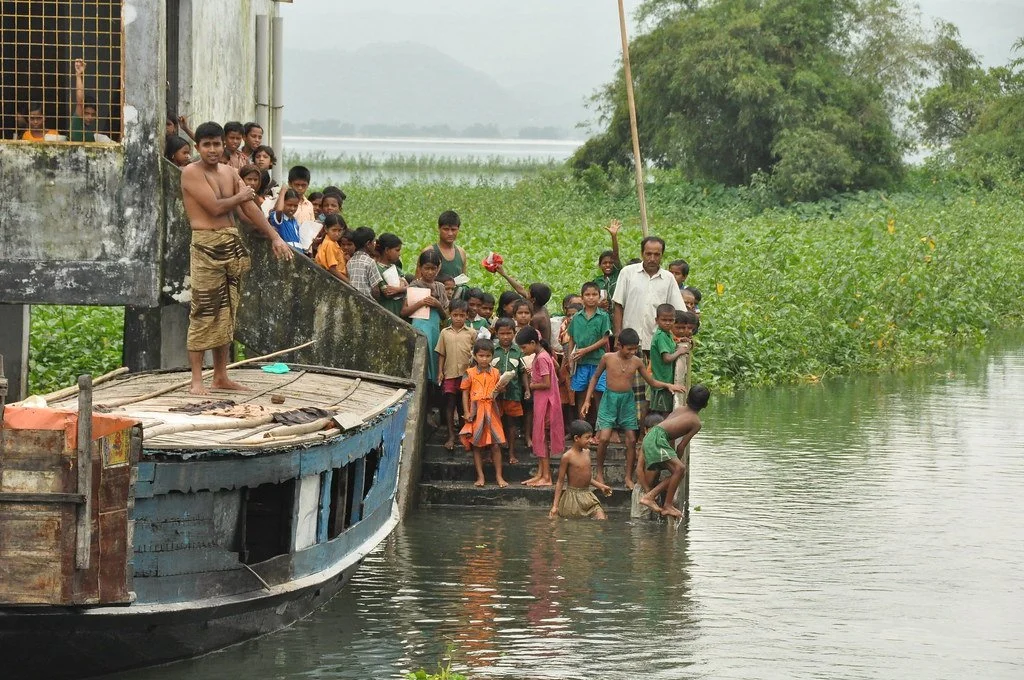
A floating school in Tanguar Haor, Bangladesh. Marufish. CC BY-SA 2.0.
Bangladesh’s position along the Bay of Bengal means that its flattened landscape of waterways is constantly subject to tropical weather. Consequently, the economic success and traditional jobs of Bangladeshi residents are affected by a seasonal force that is very familiar to those in low-lying regions: monsoons.
The monsoon season creates substantial levels of rainfall and river overflow within Bangladesh's inland Chalan Beel region. While these storms eventually dissipate, the water from flooding often remains for much longer. Large portions of Chalan Beel can remain submerged for upwards of four months. In severe cases, roads are overwhelmed with water and turn into rivers themselves. These geographical disruptions have significantly impacted Chalan Beel’s educational systems.
Because public transport can have great difficulties operating in monsoon flooding, many Bangladeshi children are unable to access their physical school buildings. Road blockades and bridge damage empty traditional classrooms of both students and resources, making learning difficult for teachers and children alike. But floating schools have since emerged in response to the challenges of Bangladesh’s flooding.
These floating schools have become a popular method for Bangladeshi residents to continue their schooling post-storm. They function as solar-powered boats that move atop the floodplains, picking up students and educators from the water’s edge. Once they are all on board, the boat is propelled through rivers while the children are learning their lessons on board. In such lesson plans, teachers will cover topics such as Bengali and math, along with other general topics and skills workshops.
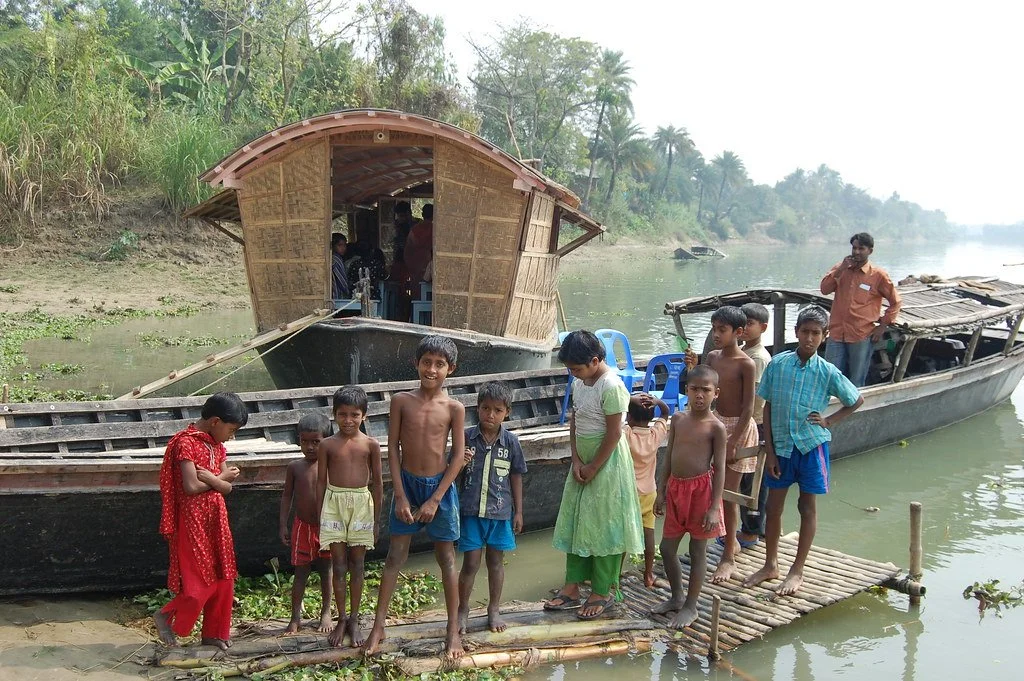
Shidhulai Swanirvar Sangstha School with young students looking on. Direct Relief. CC BY-NC-ND 2.0.
Sufia Khatun is the mother of a young boy who attends floating school. Along with other guardians, she greets her son on the riverbanks as the school day draws to a close. When Khatun was asked about her perspective, she said, “We never had the chance to study, but this boat lets my children dream of a better future.”
The challenges of flooding are felt throughout Bangladesh, but this floating-school initiative started in the Chalan Beel region. In 1998, a Bangladeshi architect named Mohammed Rezwan launched Shidhulai Swanirvar Sangstha, a nonprofit that provides education and other essential services to isolated, flood-prone riverside communities. This was in response to seeing young students struggling to attend school because of reasons beyond their control. This organization has since worked toward expanding its network of floating schools; there is now an entire fleet of these solar-powered boats across the Chalan Beel region.
Mohammed Rezwan explained his philosophy by saying, “I thought that if the children cannot come to the school for lack of proper transportation, then the school should go to them, by boat.”
These floating schools remain an initiative in progress, as the challenges to accessible education remain. Floating schools are not necessarily a final solution to flood damage and isolation, but they are an internationally appreciated adaptation praised by Bangladeshi residents and nonprofits alike.
GET INVOLVED:
Shidhulai Swanirvar Sangstha: The nonprofit founded in direct response to flood-related decline in school participation. It also extends aid to all members of the communities affected by environmental damage. Those interested in getting involved can visit the nonprofit’s contact page, which also has an extensive history of its work. Donors can donate directly to this pioneering organization.
Mia Gooch
Mia a student at the University of North Carolina at Chapel Hill, majoring in Media & Journalism with a double minor in Education and Social & Economic Justice. She’s passionate about informal education and creating fun experiences where people of all ages can explore new perspectives and develop new skills. When she’s not in the classroom, she loves contemporary dance classes, spending time with friends and family, baking, and being outdoors!