
By Grace Williams
Mexico is turning its growing sargassum seaweed problem into clean fuel as it piles up along its eastern coastline.

A serene tropical beach in Playa del Carmen lined with palm trees and seaweed. Matheus Bertelli. Pexels.
Last year, during my summer vacation in Cancun, Mexico, I noticed a large amount of seaweed gathering along the shoreline. The brownish-yellow seaweed seemed to spread for miles along the all-inclusive resort shoreline, emitting a harsh odor. I had noticed seaweed before, but this sight led me to question why this was happening, whether it was happening throughout the Mexican Caribbean and how hotel workers and general laborers may be fighting this situation.
A year later, the answer is becoming increasingly difficult to ignore.
Mexico's Caribbean coast is experiencing a record-breaking sargassum problem. While seaweed has become increasingly prevalent around Mexico’s Yucatan Peninsula since 2011, 2026 has brought record amounts. By mid-August, more than 105,000 metric tons of the seaweed had already been cleared from beaches, surpassing the previous annual record, with the season expected to continue into at least October. The largest concentrations have been reported in Quintana Roo state, including Cancun, Playa del Carmen and Tulum, some of the country’s most popular tourist destinations.
For visitors, the most visible part of the crisis is the seaweed itself. Workers rake it from the sand, haul it away and attempt to keep beaches looking like the postcard-perfect destinations travelers expect.
But the problem goes beyond an unpleasant smell or a less picturesque beach.
As sargassum decomposes, it releases hydrogen sulfide, a gas that can irritate the respiratory system and create health concerns for people exposed to large amounts of the rotting algae. Researchers at Mexico's National Polytechnic Institute have installed monitoring stations in Cancun, Playa del Carmen and other coastal communities to track gases produced as the seaweed decomposes and better understand its effects on residents and workers.
The environmental consequences can also extend beyond the beach.
Large amounts of sargassum can affect coastal ecosystems and create additional challenges for communities whose economies depend heavily on tourism. In a region where hotel chains, restaurants, tour operators and other businesses rely on visitors coming for the Caribbean's clear blue waters, keeping the shoreline clear has become a constant and expensive operation.
And the seaweed keeps coming.
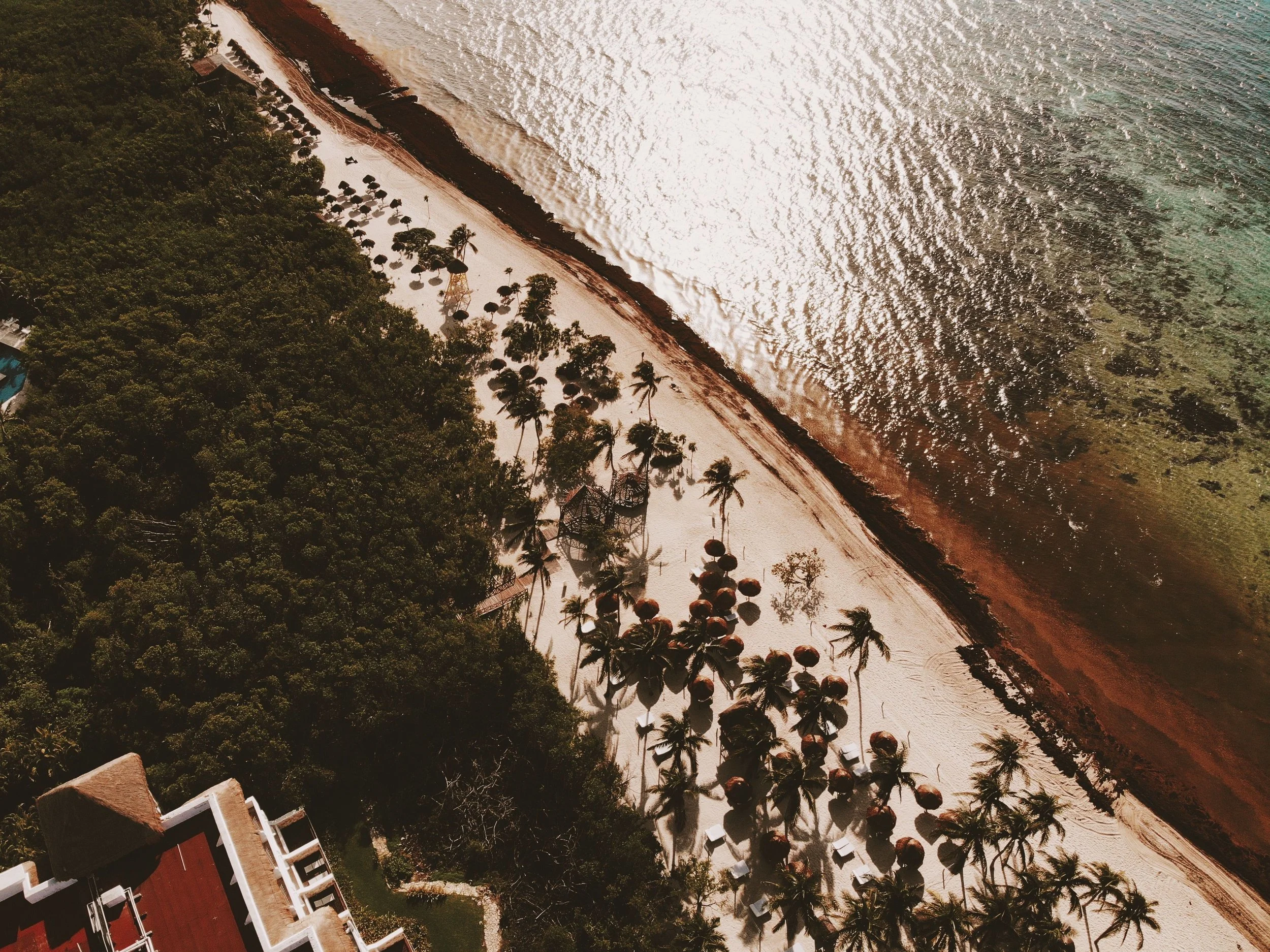
Drone shot of a beachfront resort with lush greenery and ocean views. Hector Muniz. Pexels.
Mexico's federal government has increasingly shifted its focus toward preventing sargassum from reaching the beach in the first place. In July, Environment Secretary Alicia Barcena said that as much as 9,000 tons were reaching Quintana Roo's beaches each day during the peak of the crisis. Government officials are working with the Navy to increase offshore collection, with the goal of containing the algae before it washes ashore and begins to decompose.
But removing sargassum is only part of the challenge. What happens to it afterward?
Scientists, entrepreneurs and government officials are looking at the large quantities of seaweed not simply as waste, but as a potential resource. Companies such as Carbonwave in Quintana Roo are experimenting with turning sargassum into products including biofertilizers, bioplastics and other biomaterials. Mexico's Environment Ministry has highlighted these efforts as part of a broader attempt to create a circular economy around the seaweed.
One initiative involving Mexico's fisheries research institute, hotels and restaurants projects that industrializing sargassum could eventually create as many as 3,500 direct jobs while incorporating products made from the algae into businesses across Quintana Roo.
The shift from removing a nuisance to finding value in a waste product could change how communities approach the crisis.
But it also raises an important question: Can turning sargassum into a resource actually solve the problem, or will it simply make an environmental crisis profitable?
For communities along the Mexican Caribbean, the stakes are much higher than keeping beaches attractive for tourists. Residents and workers are dealing with the health and environmental consequences of decomposing seaweed, while local governments and businesses are spending significant resources trying to keep it under control.
Travelers rarely see that side of Cancun.
To visitors, tons of seaweed can seem like a temporary inconvenience. The other side of the beach tells a different story. Workers are spending hours collecting it, researchers are monitoring the gases it releases and scientists are trying to predict where the next wave will arrive.
The sargassum crisis is forcing Mexico's Caribbean coast to rethink how it balances tourism with the health of its communities. It is no longer enough to remove the seaweed once it reaches the sand. The long-term challenge is figuring out how to protect the ecosystems and communities that make the Mexican Caribbean worth visiting in the first place.
GET INVOLVED:
For travelers, that means looking beyond whether a beach is clean when we arrive. Travelers can support locally owned businesses, choose environmentally responsible tour operators and learn about conservation efforts through organizations like Grupo Ensol Caribe, which provides beach cleanup services designed to preserve turtle nesting zones in Quintana Roo, and Grogenice, which converts collected seaweed into compost. Supporting these organizations can help direct tourism dollars toward the communities confronting the crisis.
Cancun's beaches are still very much a paradise. But there is a growing environmental challenge forcing Mexico to rethink how it protects and profits from the place millions of travelers come to see.

Grace Williams
Grace is a rising junior at Wake Forest University, where she is majoring in Politics and International Relations with minors in Spanish and Latin American Studies. She is passionate about political pluralism, human rights, culture, and journalism. In her free time, Grace enjoys playing tennis, watching movies, and reading.