
By Cove Johnson Rabidoux
With its intricate Islamic architecture, the Alhambra offers a glimpse into Spain’s layered history and is a memorable stop for travelers today.

Alhambra Palace against the mountains. Enrique. Unsplash.
There are some places you visit that just feel historical. The Alhambra in Granada, Spain, is one of those places. Stepping onto the grounds transports you into a world of intricate geometric patterns, peaceful courtyards and gardens framed by the Sierra Nevada mountains.
But the Alhambra is more than just a beautiful palace. Its architecture tells the story of Granada under Muslim rule and the cultural changes that shaped the city over centuries.
The Alhambra was developed extensively between 1238 and 1358 under the Muslim Nasrid dynasty, with construction continuing into the 15th century. During this period, the complex grew into a royal residence, fortress and center of government. Its design reflects the artistic traditions of Islamic Spain, particularly through its detailed decoration, elegant arches and use of water and gardens.
Today, visitors can explore several distinct areas of the complex. After all, the Alhambra is not just one castle, but a large complex of buildings and gardens.
The Nasrid Palaces are known for their intricate carvings, decorative tiles and courtyards. When I visited, I was in awe of the elaborate geometric designs, from stars to triangles. The palace is truly artistic, especially when the sunlight hits the windows, illuminating the intricate designs.
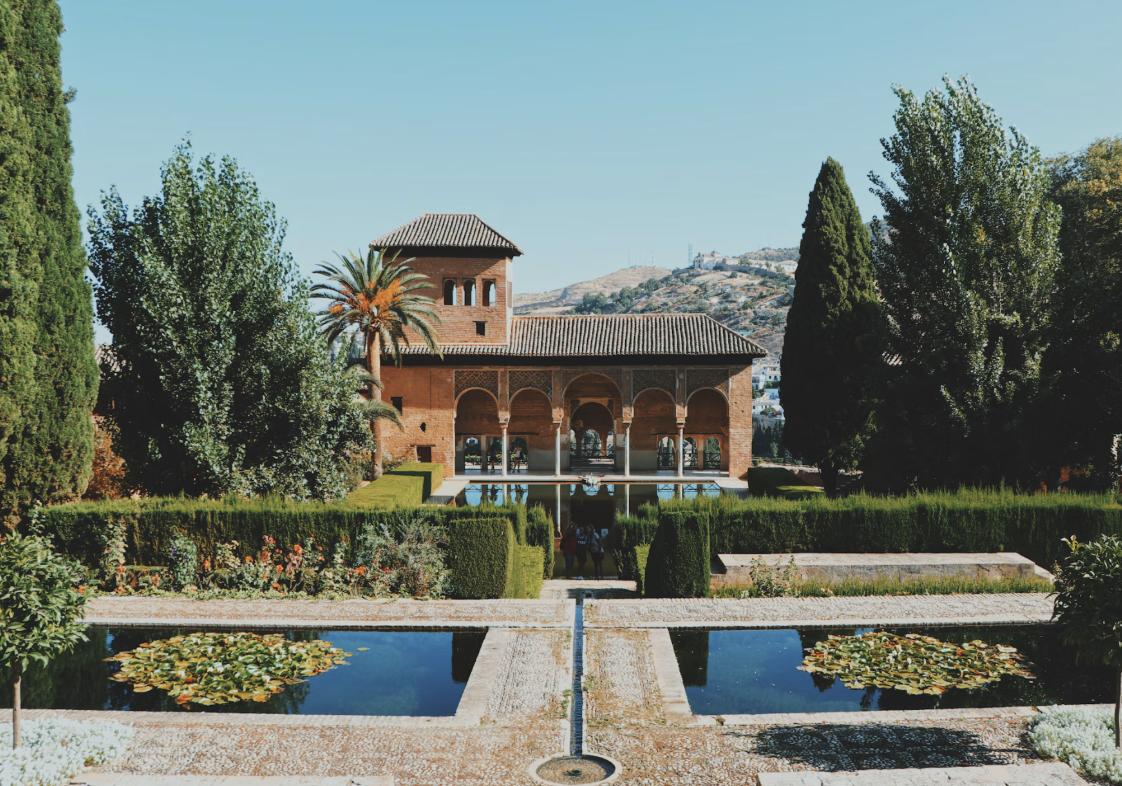
Alhambra Gardens. Wei Huang. Unsplash.
Another recognizable feature is the Court of the Lions, with its famous central fountain. Surrounding the fountain are 12 lion sculptures, all of which spout water. The courtyard was designed as an oasis in the heart of the palace, and its combination of water and detailed architecture certainly achieves that.
Now, the Alhambra is a large complex, so planning ahead is essential for an easy visit. First, it’s best to book tickets in advance. Because of its popularity, tickets can sell out, especially during busy travel seasons, so book early through the official Alhambra ticket website. A general admission ticket typically includes the Nasrid Palaces, the Alcazaba, the Partal and the Generalife.
Because the complex is so large, make sure to allow yourself appropriate time to walk around its entirety. I recommend at least three hours to fully take in the architecture.
Related to that, comfortable walking shoes are a must. The grounds are extensive, with uneven paths and steps, especially in the gardens or outside corridors.
Finally, if you have extra time, spend some time in the city of Granada, particularly the Albaicin neighborhood. This historic neighborhood is the oldest in Granada and teems with character. With its traditional houses, narrow cobblestone streets and viewpoints that overlook the Alhambra, it is well worth a visit.
Overall, the Alhambra’s gorgeous architecture offers a glimpse into Spain’s rich Islamic history. So, whether you spend your time admiring the palace’s geometric designs or wandering through the surrounding gardens, the Alhambra is surely worth slowing down for.

Cove Johnson Rabidoux
Cove is an English student at the University of California, Los Angeles. Her writing can be found in the Daily Bruin, The Teen Magazine, Piece of Cake Magazine, and other publications. In her free time, she enjoys reading and traveling.