
Alex Jung
Hong Kong's reputation as one of the most expensive housing markets in the world has led to more than 200,000 people living in cage homes, bedspace apartments likened to coffins for the living.
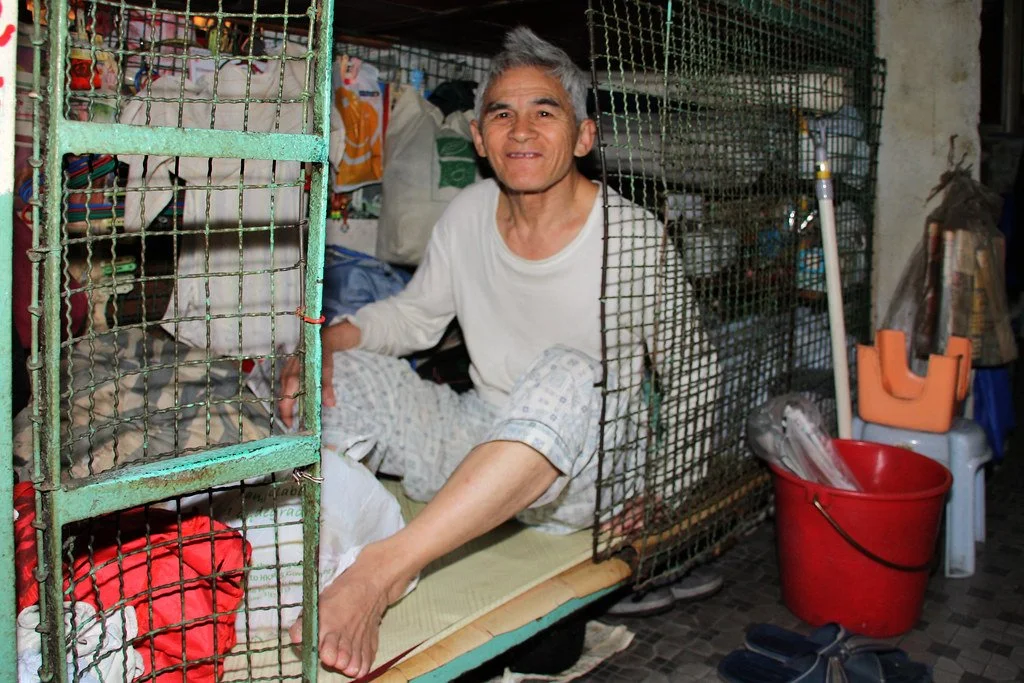
Cage home in Hong Kong. Anne Roberts. CC BY-NC-SA 2.0.
Hong Kong is one of the most densely populated regions in the world. It has a population of 7.5 million people with only 430 square miles of land. In comparison, New York City has a population of over eight million people with over 50,000 square miles of land. Hong Kong has consistently been among the top 10 most expensive cities in the world to buy property. Although Hong Kong takes great pride as a central city in Asia's financial sector and in its large number of skyscrapers, the expensive housing cost has led to as many as 200,000 people living in cage homes. Cage homes, also known as coffin homes, are four by four by six feet spaces. These spaces feature a small bunk for sleeping, with barely enough room to sit up. This ongoing crisis reveals a lesser-known but equally important reality of the wealth disparity in Hong Kong.
Oftentimes, many who live under the poverty line are addicted to drugs, or retirees live in these cage homes. These homes have no natural light and are often plagued by a large number of bedbugs. Despite these conditions, cage homes remain relatively expensive, with the small space costing around US$200 a month. Significantly, 18% of residents in these cage homes are younger than 15 years old. This brings to light the social impact that Hong Kong residents have faced when it comes to renting or buying a house. As housing prices remain high in Hong Kong, the number of residents in cage homes and the duration of stay within these housing facilities increase.
Importantly, only around 30% of Hong Kong is urbanized. The rest of Hong Kong's land is forest. Despite this fact, only 10,000 new houses were built in 2023 by the Hong Kong government, leaving more than 200,000 people to resort to cage homes. On average, the waiting time for public housing in Hong Kong is five years. Not only is the wait time long, but public housing also remains expensive. According to Uptin Saiidi, a journalist and expert, the land available for development is mostly government-controlled. Between 2023 and 2024, the Hong Kong government generated $3.6 billion from property rates. Due to the large amount of revenue housing has generated for the government, housing prices have remained high in Hong Kong, leading to an even more competitive market.
The Hong Kong government has made efforts to improve standards of housing, such as increasing the minimum dimensions of housing. Additionally, more than 13,000 houses are expected to be built by the end of the 2025-2026 fiscal year. However, experts have also proposed various short-term solutions to the issue. Brian Wong, founder of the Oxford Political Review, claims that "a robust education and employment safety net designed to provide a viable ladder out of structural poverty" is an important first step for Hong Kong to make. A sustainable solution suggested by researcher Nanci Lopez is "to reuse old industrial buildings in Hong Kong to provide public housing." This would prevent the native forest from being destroyed while still increasing the space for available housing. Other solutions include increasing the number of houses built each year by the government, more rigorous support from NGOs and turning more rural land into urbanized housing areas.
GET INVOLVED:
For anyone looking to support those affected by the housing crisis in Hong Kong, they can do so by checking out relief organizations such as Habitat for Humanity Hong Kong, the Society for Community Organization and ImpactHK. All these organizations are providing immediate and long-term support.
Alex Jung
Alex is from New Zealand and South Korea, and is currently a student at the University of Chicago. He is majoring in Political Science and International Relations, and minoring in Middle Eastern Studies. He is passionate about social justice for minorities and indigenous communities. In his free time, he enjoys learning languages (Korean, English, Mandarin, and Persian) and writing novels and short stories.