
By Carol Khorramchahi
As food stocks run low and funding dries up, South Sudan is showing what happens when families fleeing war arrive in a country already struggling to feed its own people.
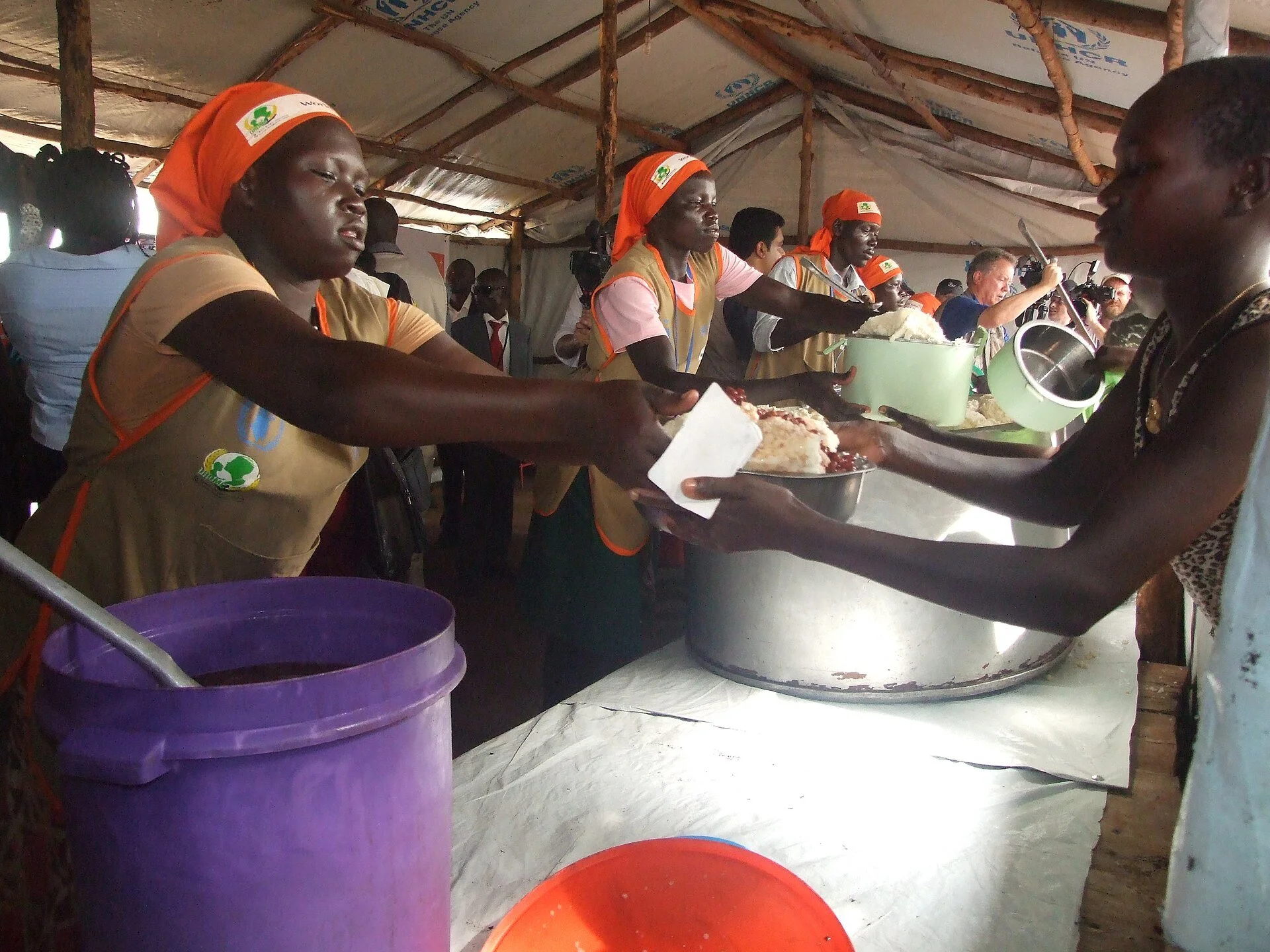
South Sudanese refugees receiving food aid. Felix Warom Okello. CC BY-SA 4.0.
South Sudan is facing a crisis that is difficult to capture in one number. It is not only hunger, not only displacement and not only the war next door in Sudan. It is all of those emergencies meeting at once, just as the aid keeping families alive begins to run out.
More than one million vulnerable people could lose access to lifesaving food and nutrition assistance unless more funding arrives, while food stocks and humanitarian resources continue to shrink. In Renk, near the border with Sudan, about 3,000 people are still crossing into South Sudan each week, many arriving hungry, exhausted and carrying almost nothing. Some arrivals are Sudanese refugees; others are South Sudanese people returning after living in Sudan.
South Sudan was already one of the world’s most fragile countries before this new pressure. Now, it is absorbing people fleeing Sudan’s war while dealing with its own conflict, flooding, drought, high food prices and weak infrastructure. More than 1.4 million refugees and returnees have crossed into South Sudan since war broke out in Sudan in 2023.
The hunger crisis is already severe. The World Food Programme says 77.8 million people, more than half of South Sudan’s population, are facing high levels of acute food insecurity, while over 2.2 million children are acutely malnourished. That means hunger is not a temporary emergency in one region. It is a national condition shaping how families eat, move, work and care for children.
Aid cuts change daily life quickly. WFP and the UN Refugee Agency, UNHCR, warned in August that more than 650,000 refugees and asylum seekers in South Sudan risk losing further access to food, nutrition and other assistance. The final food and nutrition support for the most vulnerable 240,000 refugees was expected to run out in September without additional funding. WFP said it faced an immediate $37 million gap for its refugee response and a broader $258 million shortfall for the rest of 2026.
When food aid disappears, families do not simply eat less for a few days. They change the structure of their lives. Parents skip meals so children can eat. Families borrow money, sell belongings, pull children out of school, delay medical care and move again in search of food. WFP and UNHCR warn that cuts can increase the risks of malnutrition, exploitation and abuse, especially for women and children.
The crisis is also about the strain on host communities. Many South Sudanese families already have too little, yet they are sharing land, water, markets and services with new arrivals from Sudan. WFP Assistant Executive Director Matthew Hollingworth described South Sudan at a Sept. 15 briefing as facing a “collision of crises” as humanitarian resources decline. After visiting Renk, he described women and children who had traveled for days, sometimes weeks, arriving with hunger, grief and no clear path forward.
One mother, Hapsa Hassan, had fled Sudan’s Blue Nile State and walked nearly 125 miles to reach a transit camp in Renk with her children. Hollingworth said her daughter would likely have to leave the camp each day to search for work, food and basic necessities, exposing her to risks no girl should face.
That is what an aid cliff looks like on the ground. It is not only an agency budget problem. It is a mother deciding whether her teenage daughter must take risks outside a camp. It is a child’s nutrition treatment ending too soon. Food assistance is not an abstract safety net here. For many families, it is the difference between staying alive where they are and moving again into even greater danger.
GET INVOLVED:
Follow updates through the World Food Programme’s South Sudan emergency page, UNHCR South Sudan and ReliefWeb South Sudan. Support food, nutrition and protection work through the World Food Programme, UNHCR and the International Rescue Committee.

Carol Khorramchahi
Carol Khorramchahi is a student at Boston University, where she studies English and Psychology and minors in Journalism. She enjoys writing and reporting on stories that bring together culture, identity, and community, and has experience in both newsroom reporting and digital media. She is especially interested in thoughtful storytelling with a global lens.