
By Claire Park
What makes Finland the happiest country in the world, and what can we learn from its way of life?
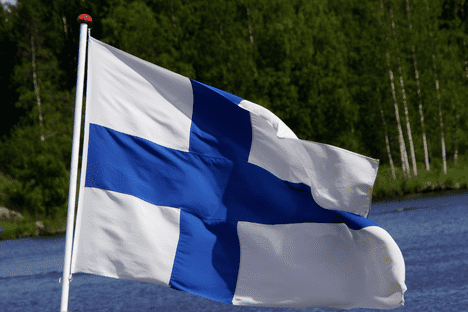
Finnish flag flying freely in the wind. Hietaparta. Pixabay.
For nine consecutive years, Finland has been ranked the “happiest country in the world” according to the World Happiness Report. While this report uses variables like social support and GDP to help explain the differences in well-being, Finnish culture also places strong emphasis on fulfillment as a core value reflected in daily life. Through the complementary relationship between governmental assistance and cultural practices, Finland has fostered and sustained its state of contentment.
Diving deeper into one of the key reasons for Finland’s high happiness ranking, its robust social safety net, the country provides comprehensive welfare benefits. These include publicly funded healthcare, free education, generous family leave and unemployment support. These public services drastically reduce stress and anxiety, allowing people to focus more on their personal growth and community engagement. Additionally, with the assistance provided, Finns generally have strong feelings of trust in their government and fellow citizens, contributing to low levels of corruption and crime as well as high levels of civic participation.
Another factor believed to contribute to Finland's high quality of life includes its clean environment and access to nature through “jokaisenoikeus,” a foundational element of Finnish culture meaning “Everyman’s Right,” which grants people broad freedom to roam so long as they don’t harm the environment or others. The country overflows with natural beauty that invites people to get outside. Its vast forests and numerous lakes in proximity to settlement provide ample opportunities for outdoor activities, relaxation and appreciation of life’s peaceful simplicities. Going outdoors is so integral to Finnish life that nature even serves as an active learning environment. Finnish schools prioritize outdoor lessons, connecting subjects like mathematics and literature with the natural world. In a different form, nature expresses itself in the tradition of wood-and-water saunas central to Finnish culture. Saunas are a cultural necessity and ritual that harmonizes fire, water and wood. The experience involves alternating between the sauna’s intense heat and plunging into cold natural water or snow, grounding Finns physically and mentally in their environment.
Given the importance Finland places on taking time to recenter oneself, its prioritization of work-life balance is another factor contributing to the country’s happiness status. While the Finnish model focuses on high efficiency during working hours, with standard workweeks averaging 37.5 hours, it enables individuals to genuinely disconnect and prioritize family, hobbies and nature when off the clock. The workplace balance is built on cultural trust and flat workplace hierarchies, along with a strong separation between professional duties and private life. Hours are reasonable, overtime is discouraged and employees typically receive 25 to 30 paid leave days annually, with a cultural expectation that workers will take extended time off during the summer months to fully recharge.
Lastly, deeply rooted in Finnish culture is “sisu,” the concept of stoic determination, grit and resilience. Despite being the world’s happiest country, not even Finnish people can escape difficult days, months or years. However, they strive to preserve their well-being by fostering an accepting and courageous mindset when facing adversity. Rather than viewing setbacks as failures, sisu is used to push through hardships, resulting in deep, sustainable life satisfaction even during challenging times. It not only helps people make sustainable life choices and handle conflicts with patience, but it also shifts the focus from chasing superficial joy to valuing contentment, simplicity and inner strength.
So how can the rest of the world be more like Finland? While not all countries have the means to provide such extensive government support, we, as individuals, can all learn from Finland's intentionality and take the time to slow down and smell the roses. This can be as simple as hitting Do Not Disturb once you get home, deciding to spend the weekend outside rather than holed up at your computer or simply readjusting your attitude and strengthening your resolve when faced with complications. If these changes are embraced, we might just see an upward trend in overall well-being across the globe.
Claire Park
Claire Park is a sophomore at the University of California, Berkeley studying English and Media Studies with a minor in Music. Her experience writing lifestyle content for UC Berkeley's The Daily Californian newspaper has inspired her to expand her scope to the realm of travel, pursuing her aspirations of becoming a travel journalist. When not writing, Claire can be found singing, reading romance books, journaling at the beach, or acquiring a sweet, caffeinated beverage.