
Isabella Feraca
Sudan is facing what the U.N. has called the world’s largest humanitarian crisis as a result of its ongoing civil war.
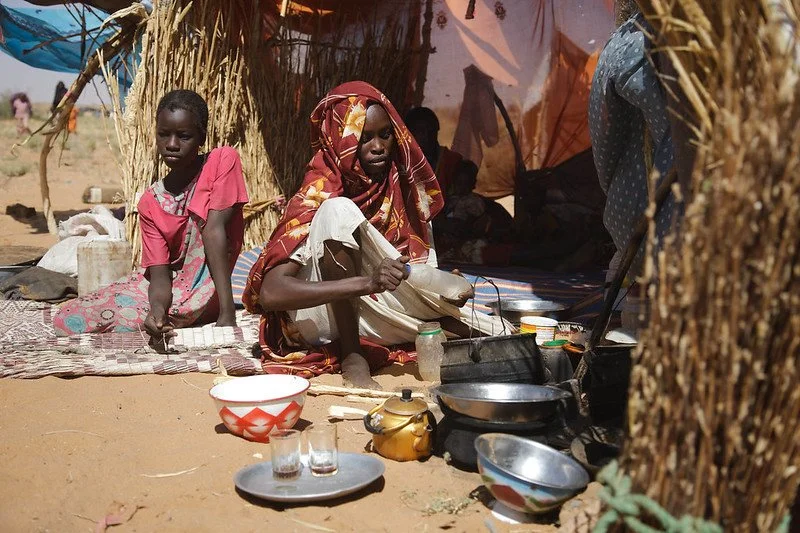
Residents of the Zamzam camp. UNAMID CC BY-NC-SA 2.0.
Sudan has been gripped by a civil war for more than two years now, resulting from a power struggle between the Sudanese Armed Forces and the Rapid Support Forces, a paramilitary group. With about 150,000 people having already died in the conflict, as well as 12 million people having fled their homes, the UN has called it the largest humanitarian crisis in the world right now. Beyond the mounting death and destruction, the war is threatening a large-scale food crisis for its population. In fact, the World Food Program has already confirmed that famine is present in 10 Sudanese locations, and the crisis could spread even more as the conflict deepens.
Famine was first confirmed in the Zamzam refugee camp last year after a report from the Famine Review Committee concluded that its 400,000 displaced residents were facing hunger. Just four months after that, more areas across North Darfur and the Western Nuba Mountains were reportedly experiencing famine conditions as well. More broadly, about half of Sudan’s 50 million-person population is currently experiencing high levels of acute food insecurity, meaning an Integrated Food Security Phase Classification of level 3 and above.
At the root of the issue is the displacement of agricultural workers, as well as the mass destruction of farmland. Indeed, many of the currently 12 million displaced people are farmers. And at the same time, previously useful farmland has seen widespread violence, disruption and abandonment. As a result, essential food prices are currently over 100% more expensive than they were in early 2024. With two-thirds of the population relying on farming for food sources, the blows to the agricultural sector have been catastrophic.
Simultaneously, blocked humanitarian aid has further contributed to the crisis. Not only have large funding cuts led to the closure of many emergency food kitchens, but essential supplies, including food and healthcare items, are being systematically blocked or looted by armed forces, turning hunger and illness into weapons of war. In addition to these blockades, those on the frontlines assisting with aid have been specifically targeted by both warring sides.
Beyond that, external factors are contributing to the lack of aid and awareness of the crisis. U.N. agencies and aid groups, for example, have recently faced substantial funding cuts from major donors, like the U.S. According to Clementine Nkweta-Salami, the Humanitarian Coordinator for the United Nations in Sudan, only about 6.3% of the required $4.2 billion for regional humanitarian aid has been received as of March of this year.
Last month, a brief ceasefire was issued in El Fasher at the request of the U.N. to let urgent aid efforts reach the region. Going forward, the U.N. urgently recommends a cohesive ceasefire as the only measure to prevent the crisis from worsening. They also recommend a restoration of unhindered humanitarian aid, as well as the introduction of vital agricultural inputs to fight malnutrition.
GET INVOLVED:
To support humanitarian efforts in the region, donate to the U.N. Crisis Relief for Sudan. Also donate to the World Food Programme, which has been reporting on the famine and providing aid since the start of the conflict.

Isabella Feraca
Isabella is a junior at Carnegie Mellon University studying professional writing and music technology. In her free time, she can be found reading, making music, and playing shows with her band around Pittsburgh.