
By Carol Khorramchahi
Yemen is often redued to conflict and crisis, but understanding the country means seeing its history, culture and people alongside the war reshaping daily life.
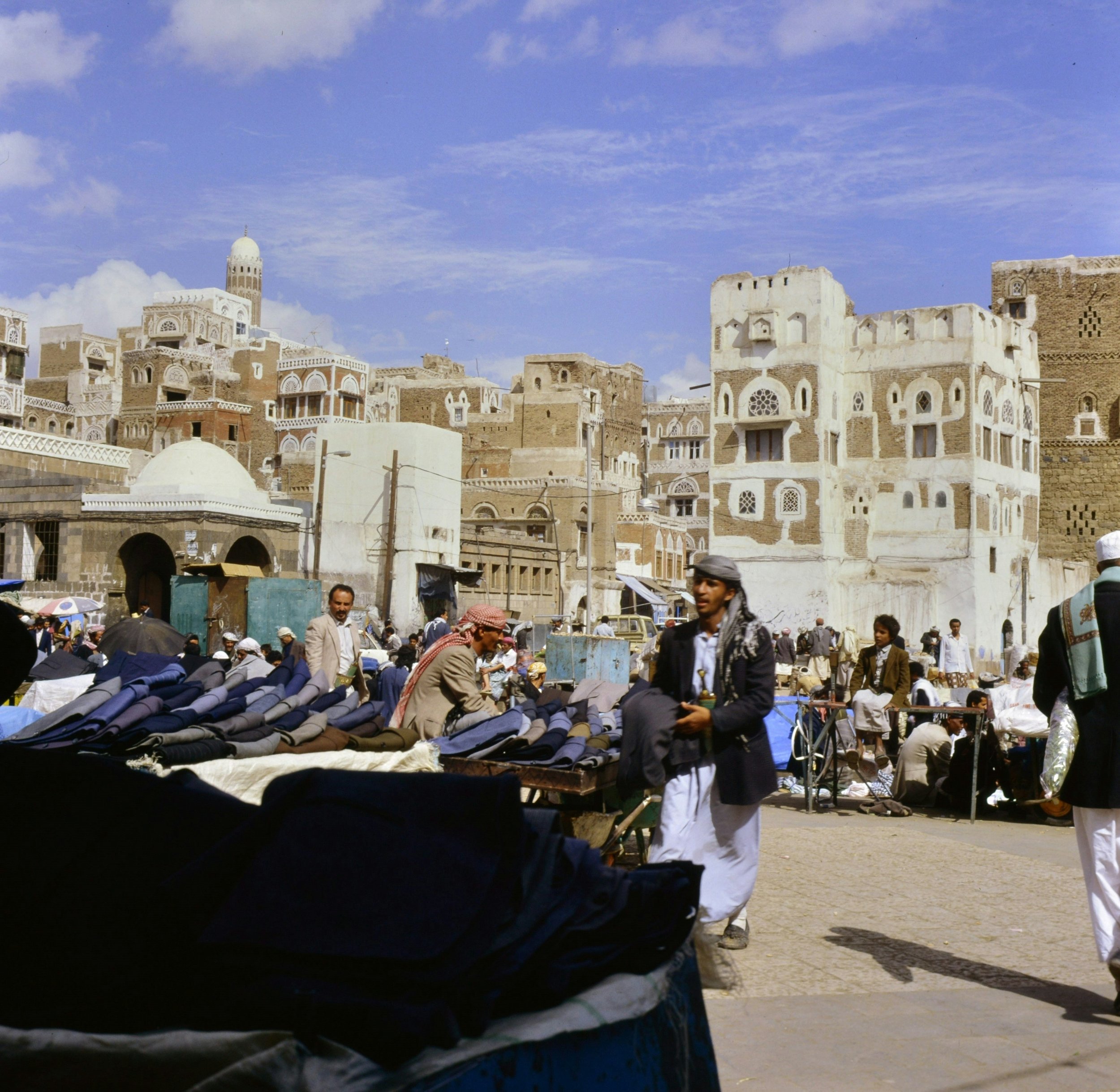
People in a Sana’a marketplace. Thomas Foertsch. Unsplash.
Yemen is often mentioned in the United States only when violence spills into global headlines. A missile attack, a shipping crisis in the Red Sea, a warning about famine. But Yemen is not only a war zone. It is a country of more than 40 million people with ancient cities, a history of coastal trade, mountain villages, coffee traditions and families trying to preserve ordinary life through more than a decade of conflict.
To understand Yemen, it helps to begin with geography. The country sits at the southern tip of the Arabian Peninsula, beside the Bab el-Mandeb Strait, one of the world’s most important maritime chokepoints. Ships moving between the Red Sea and the Gulf of Aden pass near Yemen’s coast, which is why violence there can quickly become a global concern. Recent fighting along the Red Sea has displaced more than 100,000 civilians and raised fears that Yemen could fall back into full-scale civil war.
But Yemen’s importance did not begin with the war. Sanaa, the capital, has been inhabited for more than 2,500 years, and its Old City is a UNESCO World Heritage site known for its decorated tower houses, mosques and dense urban fabric. Yemen is also deeply tied to the history of coffee. The port of Mokha helped give “mocha” its name, linking Yemen to the global history of coffee and trade.
The current conflict grew out of Yemen’s political breakdown after the 2011 Arab Spring, when an uprising forced longtime President Ali Abdullah Saleh out of power. The Houthi movement, which emerged in northern Yemen, later took control of Sanaa in 2014, and a Saudi-led coalition intervened the following year in support of the internationally recognized government. Since then, Yemen has been fractured among armed groups, outside powers and competing authorities.
The cost has been devastating. Years of fighting have killed at least 150,000 people directly and left many more dead from hunger, disease and collapsing services. More than 18 million people need humanitarian assistance, and millions have been displaced. In 2026, the U.N. reported that 18.3 million people, nearly half the population, are acutely food insecure.
For Yemenis, those numbers translate into daily calculations. A mother deciding whether to spend money on bread or medicine. A student missing school because the road is unsafe. A family displaced from the coast to Taiz, leaving relatives behind as fighting cuts through roads and communities. One displaced Yemeni woman, Aisha Muhammad, told Reuters she had fled coastal fighting while five of her children remained trapped at home.
That is the part of Yemen Americans rarely see. The country is not defined only by militias and maps. It is also defined by weddings, poetry, architecture, markets, qat gatherings, fishing communities and families who continue to mark birthdays and religious holidays under impossible conditions. The war has damaged daily life, but it has not erased the society underneath it.
The challenge in writing about Yemen is that the statistics can change quickly. Front lines move. Displacement numbers rise. Aid funding falls short. But the larger truth remains: Yemen is a historic, culturally rich country whose people have been forced to survive one of the world’s most severe humanitarian crises.
Understanding Yemen does not require knowing every faction or every battle. It starts with recognizing that behind the headlines is a society that existed long before the war and will have to rebuild long after the world stops paying attention.
GET INVOLVED:
Follow verified humanitarian updates through OCHA Yemen and UNHCR Yemen Support relief efforts through Doctors Without Borders and the International Rescue Committee
Carol Khorramchahi
Carol Khorramchahi is a student at Boston University, where she studies English and Psychology and minors in Journalism. She enjoys writing and reporting on stories that bring together culture, identity, and community, and has experience in both newsroom reporting and digital media. She is especially interested in thoughtful storytelling with a global lens.