
By Julia Sassaman
Thousands of residents of Makoko, Nigeria’s largest floating village, have been displaced after the Lagos State Government carried out demolitions as part of broader redevelopment efforts.
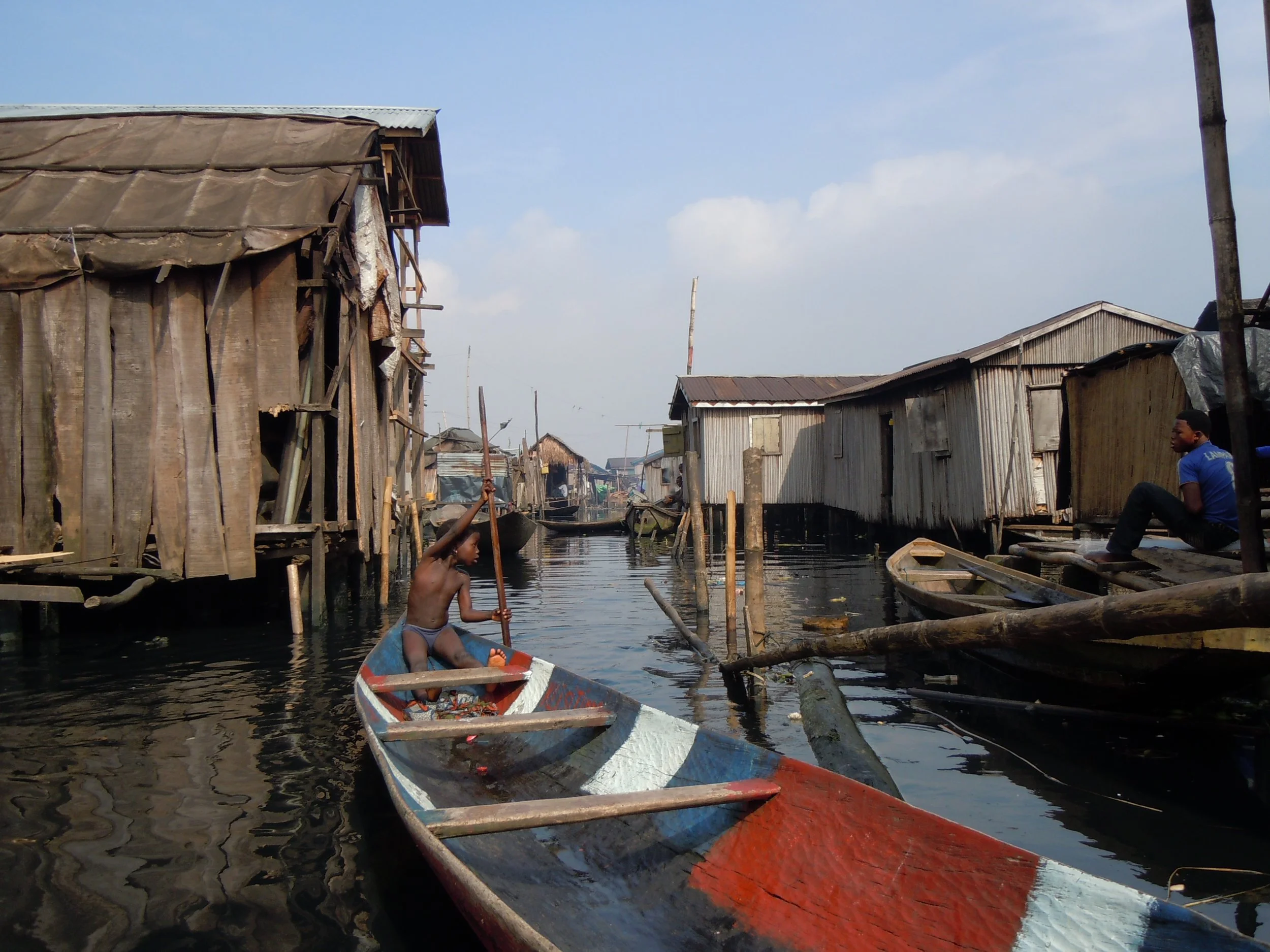
A young boy canoeing through the Makoko canals. Heinrich Boll Stiftung. CC BY-SA 2.0.
Sometimes called the “Dubai of Africa,” Lagos is a rapidly growing city on the Lagos Lagoon in southwest Nigeria, undergoing large-scale construction, tourism and housing development. As Nigeria’s largest city, Lagos is home to more than 14 million residents. Despite increasing investment in high-end developments and infrastructure on its islands, approximately 60% to 75% of residents live in informal settlements. These settlements typically consist of displaced or impoverished individuals who establish communities on state or private land without legal ownership, often lacking clean water, sanitation or basic urban services.
The city struggles to accommodate its growing population alongside high poverty rates and a shortage of affordable housing. Climate-related challenges, such as sea-level rise and coastal erosion, have also increased pressure on the Lagos State Government (LASG) to implement redevelopment projects. However, urban renewal efforts have drawn criticism from many Lagosians, who argue these developments often prioritize the wealthy over the broader population. Demolitions of informal settlement communities have further fueled controversy, prompting questions about the LASG’s redevelopment priorities.
One of the most well-known informal settlements in Lagos is Makoko. Founded in the late 19th century by Egun fishing families, Makoko later became home to immigrants and residents priced out of other areas of the city. Located across land and water, the community’s economy centers on fishing and aquatic commerce. Homes, schools, businesses, churches and medical clinics rest on wooden stilted structures above the Lagos Lagoon, separated by canals and only navigable by canoe. Population estimates are approximate, ranging from 85,000 to over 1 million residents; Makoko lacks formal recognition from the LASG, making accurate census data difficult to obtain. Community members face challenges like inadequate sanitation, unreliable electricity, limited access to education and healthcare and overcrowding.
In an interview with the BBC, Lagos real estate developer Peacemaker Afolabi states, "Everywhere in Lagos is prime land. And waterfront is always prime.” Demolitions of Makoko began in December 2025 and continued into 2026. The LASG has affirmed that the demolitions only targeted structures within a 100 to 250-meter radius of high-voltage power lines, which pose safety risks to residents, and that proper warning was provided beforehand.
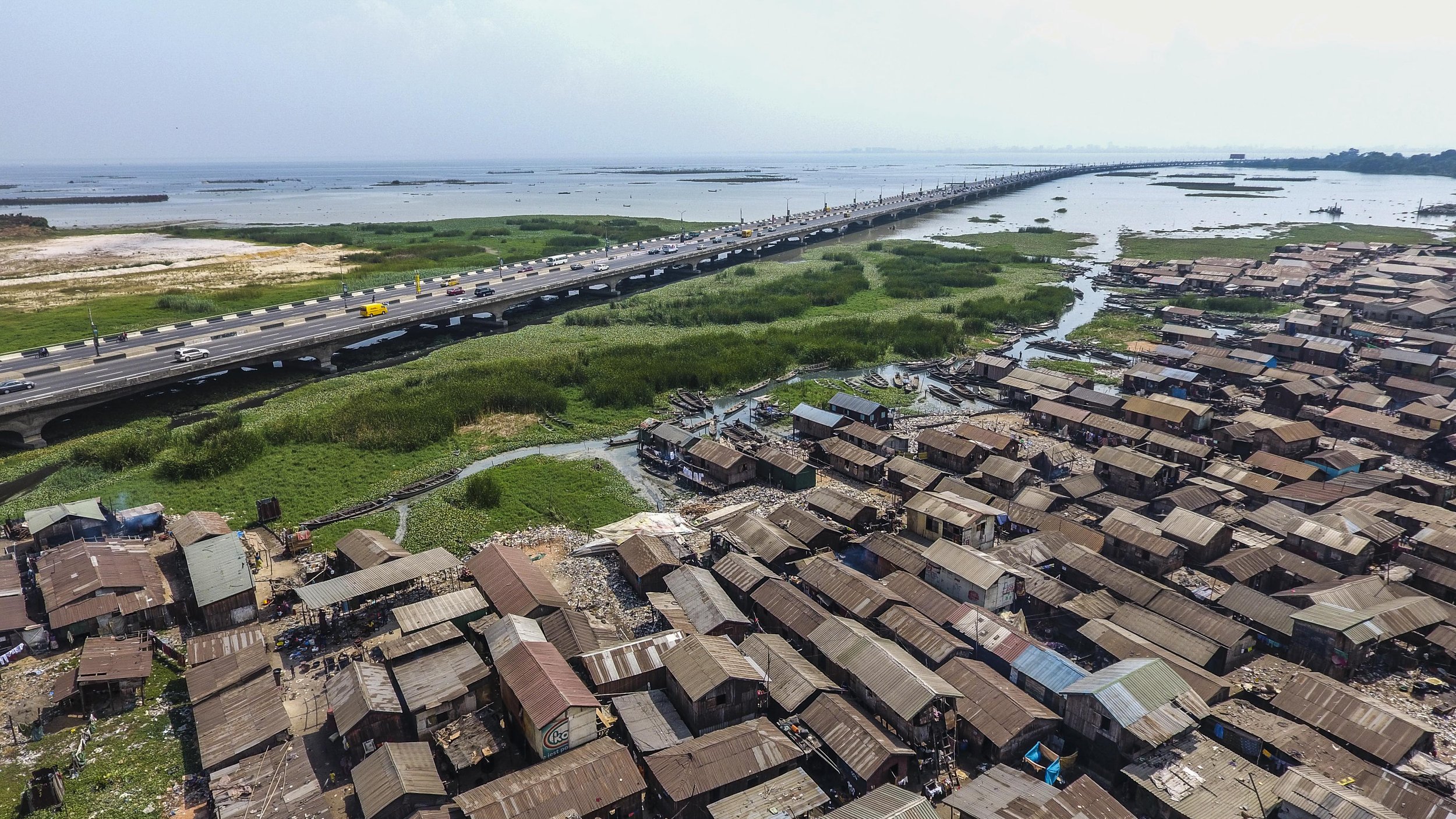
Aerial view of Makoko waterfront settlements on the Lagos Lagoon. S.aderogba. CC BY-SA 4.0.
The demolitions were carried out by bulldozers and armed police, who used force and tear gas against protestors opposing the evictions. Thousands of homes, shops and community sites were destroyed. At least 40,000 people were displaced, sleeping on the demolition debris, under bridges or in canoes without personal belongings, safe shelter or the means to continue their livelihoods. As of May 2026, a resettlement plan to move displaced residents to Agbowa-Ikosi, a community built by refugees, has been proposed by the Lagos State Assembly, but the LASG and Makoko leadership have yet to reach a concrete agreement.
The 2025-2026 demolitions are not isolated incidents. Makoko has experienced demolitions and displacement tied to private development projects dating back to 2005. Similarly, in 2012, residents only received three days' notice before thousands of homes were removed, again citing proximity to power lines. Since then, Makoko residents have proposed sustainable reconstruction plans that preserve the community’s cultural and historical ties to the waterfront, including the Makoko/Iwaya Regeneration Plan, which the LASG has not implemented.
The city government maintains that the demolitions protect both the coastal environment and residents living near high-voltage power lines. However, residents believe that the bulldozing extended beyond the warned radius and that adequate warning was not given. The LASG also faces criticism for failing to recognize generational customary land rights and providing no financial support to displaced residents.
The absence of community-based reconstruction plans and affordable housing options in Lagos has drawn skepticism from the UN, NGOs and Makoko residents. In a 2026 press release, experts from the UN Office of the High Commissioner for Human Rights advised Lagos state authorities to suspend demolitions, provide the necessary assistance to displaced communities and involve Makoko residents in future developments.
GET INVOLVED:
Follow organizations such as the International Network for Economic,
Social and Cultural Rights (ESCR-Net), which frequently posts articles, resources and events focused on global housing and human rights issues. ESCR-Net also released a solidarity letter demanding an end to forced evictions in Makoko, accountability for the resulting harms caused and stronger protections for residents’ rights.
Donate or contribute expertise to JEI, a community-based legal advocacy organization providing paralegal services to Nigerian communities, including Makoko. Additionally, support their YouTube channel, Media4Change, a partnership with storytellers from Nigerian informal settlements that regularly posts video projects documenting the experiences and challenges facing these communities.
Follow, support or volunteer with Nigeria-based organizations empowering local communities, including Home of Mother Earth Foundation, Spaces for Change and the Nigerian Slum/Informal Settlement Federation.
Explore the Slum Dwellers International website to learn more about human rights issues facing informal settlements globally, as well as their advocacy and support in expanding access to economic opportunities and essential services.
Julia Sassaman
Julia is a fourth-year student at the University of Michigan studying political science and international studies. She recently studied abroad in Geneva, Switzerland, researching post-conflict tourism and international human rights law. After graduation, she hopes to move to Europe to pursue a career centered on global human rights. In her free time, she enjoys painting, baking, journaling, and reading.