
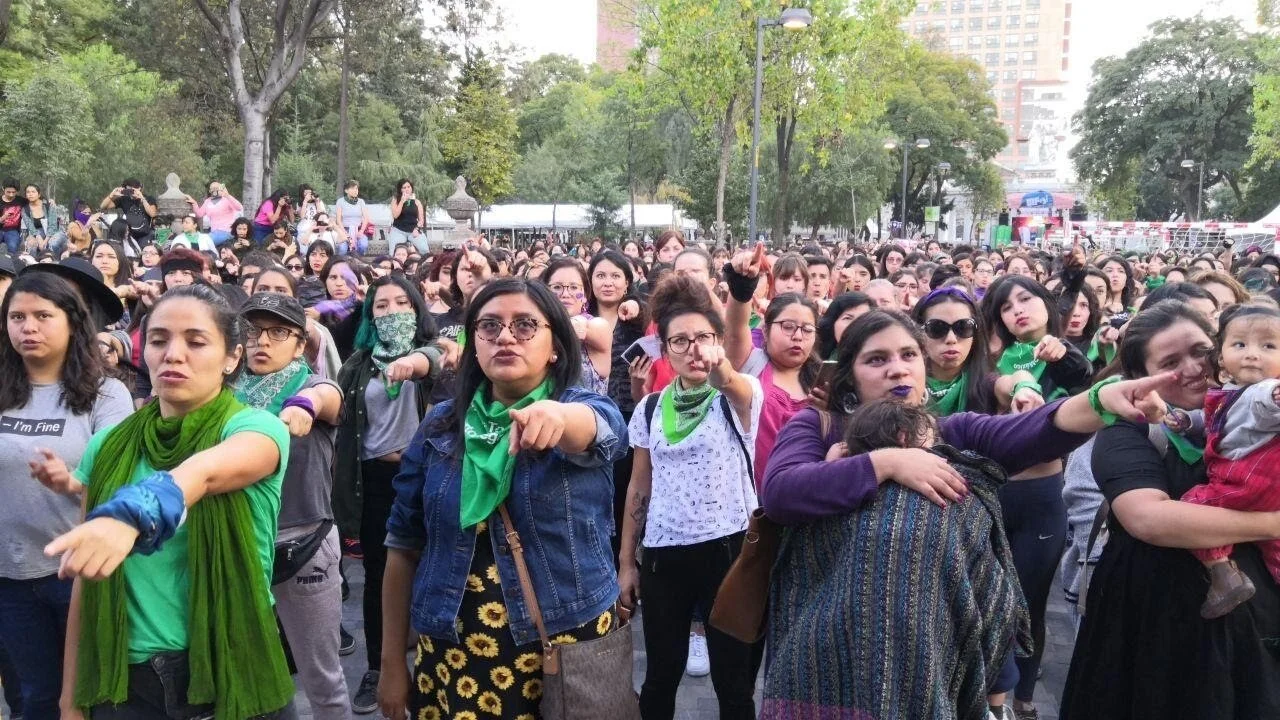
On the 2019 International Day for the Elimination of Violence Against Women, over 10,000 women gathered outside Chile’s Santiago National Stadium, a former detention and torture center from Chile’s military dictatorship. “Patriarchy is our judge/That imprisons us at birth/And our punishment/Is the violence you DON’T see” the group chanted, their clothes and bodies marked with anti-violence slogans. “It's femicide!” they shouted into the frigid air. “It's not my fault, not where I was, not how I dressed!” They placed their hands behind their heads, then squatted up and down, mimicking the movements that Chilean police officials and prison wardens force females to perform while naked.
This is the movement that has globally spread, dismantling the structural forms of gender violence set in place by police and judiciary systems. The protests feature the Chilean song “Un Violador en Tu Camino,” or “A Rapist in Your Path.” Created by the Valparaíso feminist collective Las Tesis, it challenges the gender violence so prominently institutionalized by political structures. Las Tesis works closely with various activists and scholars to demystify rape as an act of pleasure. Specifically, “Un Violador en Tu Camino” is based on the work of Argentine-Brazilian anthropologist Rita Segato, one of Latin America’s most celebrated anthropologists of gender violence. Las Tesis also investigates the sexual violence, homicide and rapes within Chile that are left unaddressed in the criminal justice system.
The song was first publicly performed in front of a Valparaíso police station. As the initial protest, women merely sought to impose small-scale street interventions. However, as the visceral lyrics moved through global media, they inspired similar demonstrations throughout Latin America and beyond.
Thousands of women performed the piece at the Zócalo, Mexico City’s main square, on November 29, 2019, roughly a week after the Valparaíso protest. Since then, Las Tesis’ song has spurred movements in Latin American countries such as Colombia, Venezuela, Peru and Argentina, and has even spread to global protests in London, Berlin, Paris, Madrid, Barcelona, Tel Aviv, New Delhi, Tokyo, Beirut, Istanbul and New York City.
Each protest site transforms the musical base, adapting the movements and song to their national identity. Within Latin America, green scarves represent the campaign for legal abortion. Black blindfolds acknowledge the ways that women are made vulnerable by Chilean police. Brazilian activists add the lyrics, “Marielle is present. Her killer is a friend of our president.” They reference Marielle Franco, an assassinated city council member from Rio de Janeiro. An ongoing investigation will determine if Brazilian President Jair Bolsonaro was involved in her killing.
“It’s the cops. It’s the judges. It’s the system. It’s the president. The rapist is you.” This phrase has been chanted around the world, demanding rectification for years of human rights violations. As female protesters gather in urban areas and repeat these words, they point— physically and metaphorically—to the courthouses, police headquarters, and presidential palaces that have systematically dehumanized women, promoting gender violence and oppression. Media, movement and song give women the platform to insert their collective power and instill political change.

Anna Wood
is an Anthropology major and Global Health/Spanish double minor at Middlebury College. As an anthropology major with a focus in public health, she studies the intersection of health and sociocultural elements. She is also passionate about food systems and endurance sports.