
By Julia Sassaman
Known worldwide for its luxury resorts and cruise ports, the Bahamas was once home to the Lucayan people, a maritime community of skilled agriculturists and innovators.
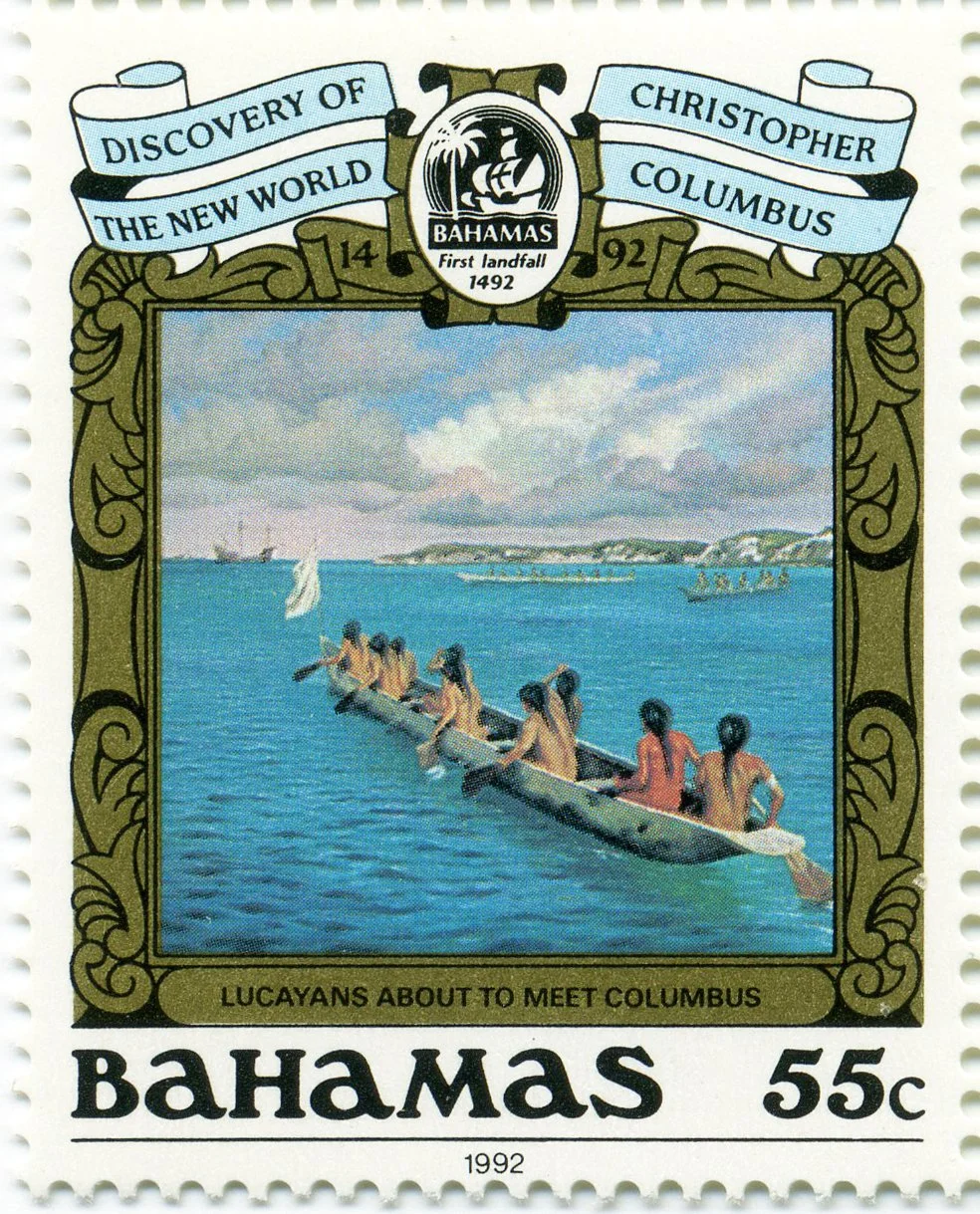
Bahamian stamp from 1992, depicting the Lucayan people in canoes. James St. John. CC BY 2.0.
Long before it became a global travel destination, the Bahamas was home to the Lucayan people, an Indigenous civilization with lasting contributions to agriculture, language and daily life.
In 2025, the country welcomed more than 12.5 million visitors. But commercial tourism has overshadowed the Lucayan legacy, leaving most visitors unaware of the islands’ earliest inhabitants.
The Lucayans were related to the Taino people, indigenous to the Greater Antilles, including present-day Puerto Rico, Cuba, Hispaniola and Jamaica. They settled in the Bahamas and Turks and Caicos between A.D. 500 and 800, likely descending from Arawakan-speaking peoples of northern South America.
Daily Life
The “Lukku-cairi”, which translates as island people, were a maritime community. Diet, rituals, art and trade all centered on the ocean. Roughly half their diet was plant-based, cultivated from crops such as manioc, sweet potato, gourds, maize, tobacco, guava and chili peppers. The rest came from animals like the hutia, a local rodent the size of a rabbit, and conch. Free divers harvested conch and repurposed its shells into tools, musical instruments and even insulation for cooking hearths.
Spirituality was central to Lucayan life. Deities were drawn from the natural world, especially the ocean, and life was believed to have emerged from underwater caves. One spirit, Opiyelguobiran, resembled a dog, which the Lucayans commonly kept as pets and revered as divine.
Body painting and adornment were customary; jewelry and ornaments were crafted from bird feathers, shell, bone, stone and gold. Red, black and white paint decorated the face and body. Infants’ heads were also gently bound to flatten their foreheads, a practice tied to identity and spirituality.
Lasting Contributions
The canoe, or “canoa,” was essential to Lucayan life. Carved from a single tree trunk, it could fit up to 40 people and was essential for trade, fishing and transportation. Chief exports included raw cotton, hammocks, shell beads, parrots, conch and salt.
Woven hammocks, or “hamacas,” were widely used by the Lucayans and later adopted by the Spanish for use aboard ships. The Lucayans also made stools called “duhos,” which were often used ceremonially.
The Taino language contributed many words to Spanish and English, including iguana, potato, barbecue, tobacco, cay, guava, canoe and hurricane. Even the name Bahama comes from the Lucayans, meaning “large upper midland.”
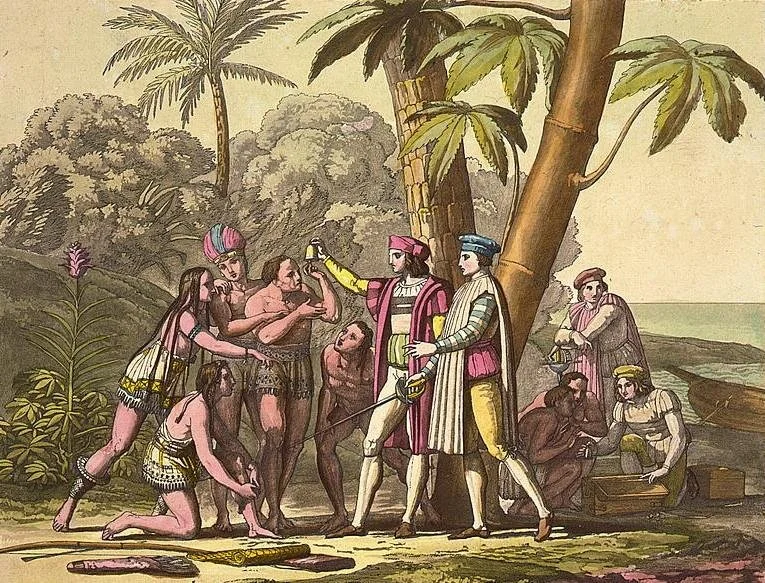
The Lucayans meeting Columbus. Library of Congress. PDM 1.0.
Spanish Colonization and Enslavement
Christopher Columbus first encountered the Bahamas in 1492, mistaking them for the East Indies. Disease, forced labor and Spanish slave raids soon devastated the Lucayan population. Beginning in 1509, raiders captured and enslaved an estimated 40,000 Lucayans, sending them to work in gold mines on Hispaniola and pearl fisheries on Cubagua, off Venezuela’s coast.
By A.D. 1530, the islands were described as uninhabited, and the Lucayan civilization was rumored extinct. But a 2018 study published in the Proceedings of the National Academy of Sciences examined DNA from a Lucayan Taino woman buried in Preacher's Cave who lived nearly 500 years before Spanish arrival, finding that her genome most closely resembled Arawakan-speaking peoples of northern South America. Additionally, modern Puerto Ricans shared a genetic link to her lineage, suggesting the Lucayan ancestry survived colonization. Today, communities in the Dominican Republic, Puerto Rico and parts of the United States identify as Taino descendants, carrying on their legacy.
Bahamas Tourism
According to the International Trade Administration’s 2026 Bahamas Market Overview, tourism generates about 70% of the national GDP and employs more than half the workforce. Resort and cruise tourism make tourism the nation’s leading economic sector, ahead of financial services and trade.
Despite tourism’s significant role in the economy, few travelers learn of the Lucayan history that predates European colonization. The Bahamas is a desirable destination for travel today, but it was also once home to an Indigenous civilization whose innovations still live on in modern language and culture.
Julia Sassaman
Julia is a fourth-year student at the University of Michigan studying political science and international studies. She recently studied abroad in Geneva, Switzerland, researching post-conflict tourism and international human rights law. After graduation, she hopes to move to Europe to pursue a career centered on global human rights. In her free time, she enjoys painting, baking, journaling, and reading.