
By Kate Dawson
When safety is ignored, communities pay the price long after the oil stops spreading which was the case with both Deepwater Horizon and Wakashio spills.
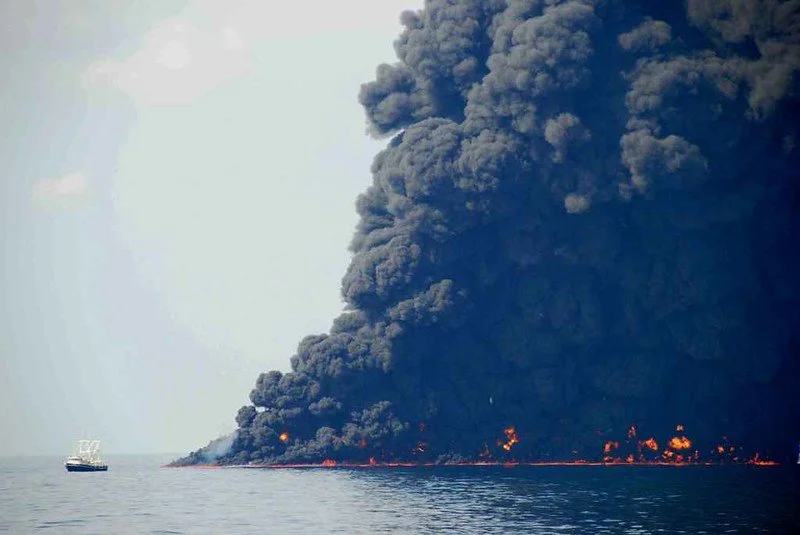
Deepwater Horizon, burning oil. SkyTruth. CC BY-NC-SA 2.0.
On April 20, 2010, the Deepwater Horizon rig exploded in the Gulf of Mexico, killing 11 workers and unleashing the largest marine oil spill in U.S. history. In the weeks that followed, the Gulf witnessed crude spreading across coastlines, fisheries collapsing and cleanup crews battling a substance that was not fully understood.
The disaster was initially framed as an anomaly: a tragic convergence of mechanical failure and bad luck. For those who observed the sequence of decisions leading up to the blowout, it would be clear that Deepwater Horizon’s catastrophe was entirely preventable.
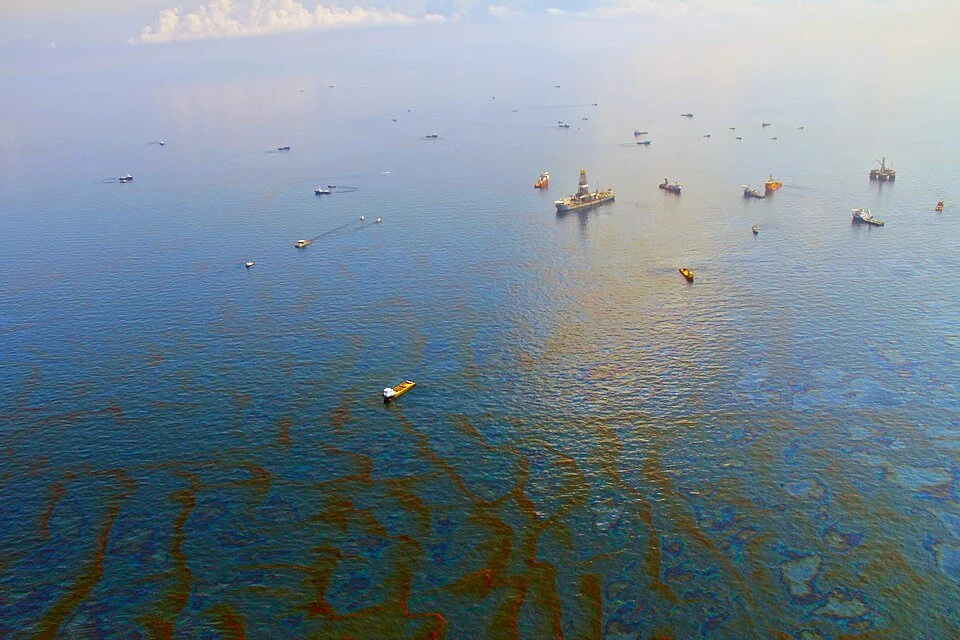
Oil spill site. Green Fire Productions. CC BY 2.0.
A decade later, the same truth resurfaced thousands of miles away. In July 2020, the MV Wakashio, a bulk carrier carrying oil for its own operations, ran aground off the coast of Mauritius. Within days, the ship began leaking and spilled around 1,000 metric tons of oil into one of the world’s most biodiverse marine regions, the Indian Ocean.
Once again, the world watched as governments and corporations scrambled to respond, deploying improvised cleanup strategies that often caused more harm than good. And once again, investigators pointed to a familiar culprit: a culture of cutting corners.
Both Deepwater Horizon and the Wakashio spill were born from decisions made long before the oil touched the water. Workers on the rig had raised concerns about faulty cementing, while pressure-test readings were ignored. The Wakashio’s crew sailed dangerously close to shore, reportedly to access a stronger cell signal. In both cases, safety protocols existed and were bypassed.
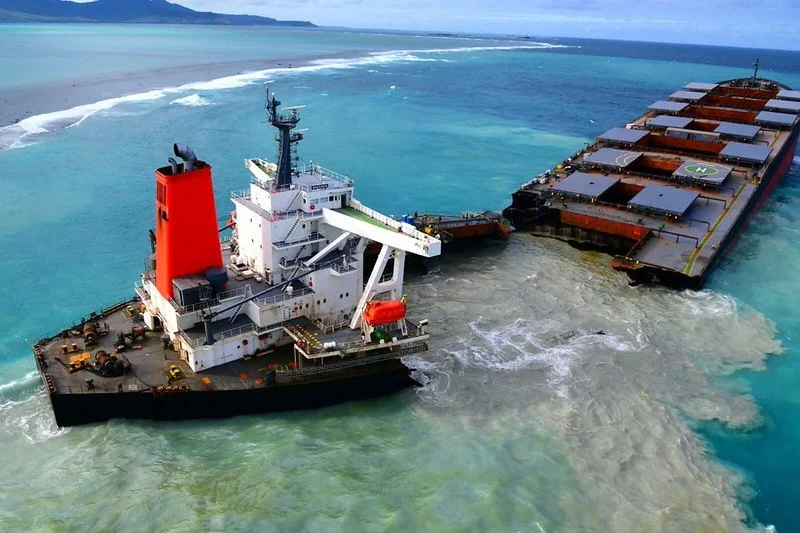
Wakashio ship after running aground off Mauritius, causing oil spill. International Maritime Organization. CC BY 2.0.
What made these failures more dangerous was the chemistry of the products themselves. Modern petroleum products are complex, blended with additives that behave unpredictably when spilled. Cleanup teams in Mauritius reported that the Wakashio’s fuel formed stubborn emulsions that resisted standard containment methods.
During the Deepwater Horizon spill, responders resorted to chemical dispersants whose long-term ecological impacts remain contested. The science had outpaced the regulations, and the people tasked with responding were left improvising in real time.
These disasters expose recurring problems in corporate decision-making where speed, cost-cutting and profit consistently outrank safety. They also reveal how governments often rely on outdated frameworks that cannot keep pace with evolving petroleum chemistry. The result is a cycle of preventable harm where workers are endangered, coastlines are poisoned and communities are left to rebuild without accountability.
The lessons of Deepwater Horizon and the Wakashio spill are not confined to the past. They are warnings and reminders that without structural change, the next disaster is already on the horizon. Preventing it will require a public willing to insist on accountability, a regulatory system willing to evolve and a global industry willing to prioritize safety over shortcuts.
GET INVOLVED:
The NOAA’s Office of Response and Restoration is a U.S. agency that is directly involved with scientific spill response. It supports over 150 oil and chemical spills annually, providing modeling, ecological assessment and restoration planning.
Oil Spill Response Limited (OSRL) provides oil spill preparedness and response services worldwide. The International Maritime Association has lists of organizations and resource providers responsible for preparedness and response for oil spills.
Individuals can learn more about oil spill response and compensation through the International Oil Pollution Compensation Fund (IOPC), the United Nations Environment Programme (UNEP) and the World Bank. The IOPC Funds provide aid in financial payouts to people and businesses who suffer economic loss from oil spills, while UNEP and the World Bank support a broader environmental response, recovery and policy efforts.

Kate Dawson
Kate is a student at the University of North Carolina at Chapel Hill, double majoring in Public Policy and Journalism. Her passion to share stories and love for environmental justice inspires her writing. She hopes to change the world by empowering others.