
By Suzy Song
In September 2026, students in France took to the streets to protest lackluster schooling conditions, sparking a nationwide movement.

A demonstration in Bouches-du-Rhone on October 17, 2026. Gabriel from92. CC0.
In late September, just one week into the start of France’s 2026 school year, thousands of students took to the streets of Paris protesting the country’s deteriorating educational infrastructure. Citing grievances like dilapidated school buildings and facilities, classrooms crowded with over 40 students at once and a teacher shortage such that students frequently miss months of schooling due to unfilled substitute positions, French students have made it clear to national leaders and global audiences alike that they will not be accepting insufficient education. However, while French youth have sparked relevant discussions surrounding formal education, the students have also inspired the emergence of a broader nationwide movement against government inaction.
According to the BBC, “the interior ministry said an estimated 410,000 people protested on Saturday, while the unions put the number at about 800,000,” a substantial increase in the number of demonstrators, expanding beyond just student groups to the general population. So, what is the French population protesting?
Rising living costs and insufficient wages and pensions have been the most commonly cited grievances. Many French people, particularly those from underrepresented groups, feel a disconnect between their quality-of-life concerns and the political priorities of their representatives. This disconnect is only intensifying as inequalities and public debt in the nation skyrocket. Fortune notes that “France’s public debt is now a record $4 trillion, or 119% of GDP—the highest ratio since the immediate aftermath of World War II.”
With this, borrowing costs are the highest they have been in over 20 years.
While French president Emmanuel Macron is the core target of this scrutiny, the near end of his tenure and upcoming presidential election have greatly amplified the tensions and displeasure citizens have about governmental trends and policies.
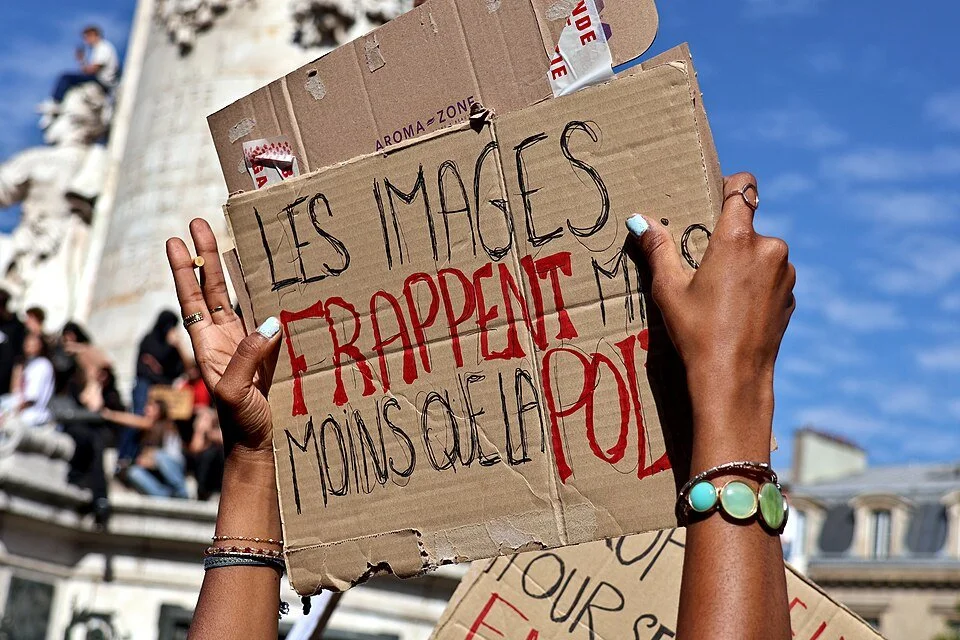
A demonstrator holds up a sign criticizing police violence that translates to: “The images are striking, but not as much as the police”. FreCha. CC BY-SA 4.0.
French police tactics used against predominantly teenage protesters have drawn further unrest. Tear gas, sound grenades and water cannons have been commonly deployed. After coming into contact with a stun grenade, one teenager lost a hand. Many have also denounced violent measures that some protesters have taken, including vandalizing local stores and looting boutiques or grocery stores. Critics underscore the importance of making demands through peace and order, but protesters warn against grouping their largely peaceful marchers with the small group who intended to cause damage and clash with police.
As inspired protests spread in neighboring European countries like Spain, Belgium and Portugal, and Macron prepares to meet with demonstrating student groups, what is becoming increasingly prominent is the resilience of Gen Z, as well as the power of youth voices in large-scale activism.
Gen Z grew up in an environment where being unaware of politics was impossible. Experiencing childhood in the midst of the 2008 Great Recession, Gen Z has been faced with a mound of unprecedented challenges and a uniquely complex path to adulthood due to the Covid-19 pandemic. Though the pandemic complicated the transition to adulthood, the subsequent rise of global inequality, climate change and economic instability exacerbated by AI advancement pose a direct threat to the future of the world that Gen Z will bear the brunt of. These challenges require substantial federal effort and action to address, but a study by the University of Cambridge found that for 18-to-34-year-olds, faith in democracy and government leaders was lower than ever before. When the government won’t help, then who will? Advocacy, in this case, is non-negotiable for Gen Z. “I’m not powered by hope. I’m powered by the fact I have no other choice,” says Gen Z gun control activist and school shooting survivor David Hogg.
In a world growing increasingly digital, the generation that grew up in an already digitized and technologically reliant society has been effective at using it to promote causes. A Harvard Kennedy School study found that “protests with extensive youth involvement are over twice as likely to succeed,” a testament to youth activism both online and offline, globally and locally. This dual field of operation garners greater political participation, reflected in the transnational diffusion of the French protests and the creation of this very article.
France’s youth-initiated national movement sheds light on a worldwide political reality: a global political awakening has struck Gen Z, and as the study notes, “for global democracy’s sake, greater youth engagement cannot come soon enough.”

Suzy Song
Suzy Song is a sophomore at Tufts University, majoring in International Relations on a pre-law track. Passionate about human rights, international law, and global institutional studies, she hopes to bring meaningful discussions on social justice to corporate fields in the future. From Canada’s Pacific Northwest, she loves travelling, hiking, and vintage film and music.