
Kennedy Kiser
In the wake of censorship and arrests, Hong Kong’s artists are quietly preserving protest materials through informal and digital means.
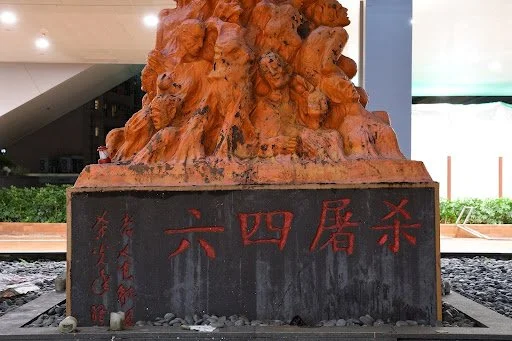
Pillar of Shame in Hong Kong. HK Hongkonger. CC BY 2.0.
In June 1989, Chinese troops opened fire on thousands of unarmed student protestors in Beijing’s Tiananmen Square. The exact death toll remains unknown. In the years that followed, references to the massacre were systematically erased from public memory in mainland China. Hong Kong was long an exception, in part because it remained a British colony until 1997, when sovereignty was transferred to China under a “one country, two systems” arrangement. Even after the handover, annual Tiananmen vigils continued. This made Hong Kong the only place on Chinese soil where open remembrance of the massacre was still publicly tolerated. Each year, on the anniversary of the crackdown, tens of thousands gathered in Victoria Park for a public vigil. They lit candles, repeated slogans and remembered the lives of those lost.
That changed after 2019. Sparked by a proposed bill that would allow Hong Kong residents to be extradited to mainland China for trial (which raised fears about political persecution and the erosion of judicial independence), a massive protest movement swept the city that summer. It quickly expanded into broader demands for police accountability, electoral reform and the defense of civil liberties. Over the next months, millions marched, occupied campuses and formed human chains stretching across city infrastructure. The movement was decentralized, often anonymous and relied heavily on art (posters, graffiti, digital illustrations, etc.) to communicate ideas, build morale and adapt quickly to police tactics.
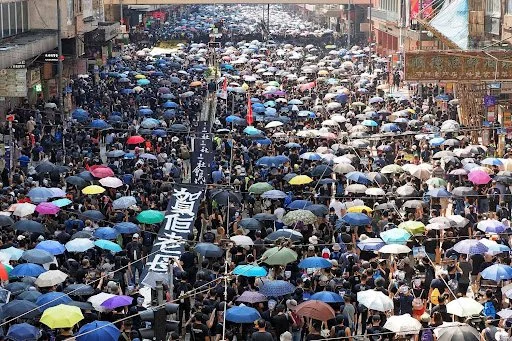
National Day Rally in Hong Kong on Oct. 1, 2019. Etan Liam. CC BY 2.0.
In mid-2020, the Chinese government imposed a national security law on Hong Kong. Protest slogans were banned and dozens of civil society organizations disbanded as journalists, activists and students were arrested. Schools removed books. Libraries pulled volumes from their shelves. The protest movement was not just suppressed. It was made unspeakable.
In December 2021, one of Hong Kong’s most visible public memorials was quietly removed. The Pillar of Shame, a twisted, skeletal sculpture by Danish artist Jens Galschiøt, had stood on the University of Hong Kong’s campus since 1997 as a tribute to victims of Tiananmen. Workers arrived in the middle of the night, shielding the removal with plastic sheets and silence. The statue’s disappearance was part of a broader pattern. Public memory itself had become politically dangerous.
In this climate, artists and organizers have shifted to alternative methods of preservation. Several anonymous collectives now run encrypted online archives containing protest photography, oral testimonies and digital artwork from the 2019 movement. Many of these sites are hosted on offshore servers or disguised behind decoy interfaces. One archive requires visitors to complete a short encryption puzzle before gaining access. Another is distributed as a peer-to-peer download, allowing it to survive even if the original site is blocked or deleted.
Printed materials continue to circulate, but in far smaller, more discreet formats. Zines have become a primary method of distribution, especially among younger artists and students. Organizations like Be Water Journal and Ink & Umbrella collect protest sketches, anonymous essays and scanned posters from the 2019 movement. Physical copies are passed hand-to-hand or left in cafes, hostels or metro stations for others to find. Many are destroyed after use. Some zines contain QR codes that link to temporary digital exhibitions, accessible only through private password networks.
Exhibitions have gone underground—literally. Several small-scale shows have been held in private homes, walk-up apartments or repurposed retail spaces with no formal signage. These often feature re-creations of protest art, walls plastered with slogan stickers, torn backpacks, spent tear gas canisters or broken helmets. Visitors are sometimes asked to leave their phones at the door. Photography is discouraged. The exhibits are designed to be temporary and untraceable.
These efforts are not designed to reignite mass mobilization. They are working within limitations: to document what happened before the materials are lost, and to provide alternate narratives in a city where public discourse has narrowed dramatically. The work is dangerous. Several zine distributors and student curators have been detained for allegedly violating the security law’s broad prohibitions on subversion and incitement.
But for the artists involved, waiting for the right to remember publicly again is not an option. They are archiving not for posterity, but while it is still possible to do so.
GET INVOLVED:
Follow independent outlets like Hong Kong Free Press and Lausan for reliable coverage. When sharing protest materials online, avoid reposting sensitive content without consent, and credit artists only when it’s safe.
Explore public-facing projects like Zine Coop, which documents protest art and zine culture
If you’re outside Hong Kong, learn how digital censorship and surveillance operate. Tools like Tor or other decentralized archiving software help protect both access and anonymity.
Kennedy Kiser
Kennedy is an English and Comparative Literature major at UNC Chapel Hill. She’s interested in storytelling, digital media, and narrative design. Outside of class, she writes fiction and explores visual culture through film and games. She hopes to pursue a PhD and eventually teach literature! @kennedy_kiser