
By Carol Khorramchahi
As Europe tightens enforcement on better-known Mediterranean crossings to Italy, Greece and mainland Spain, more migrants are risking the longer Atlantic passage from West Africa to the Canary Islands.
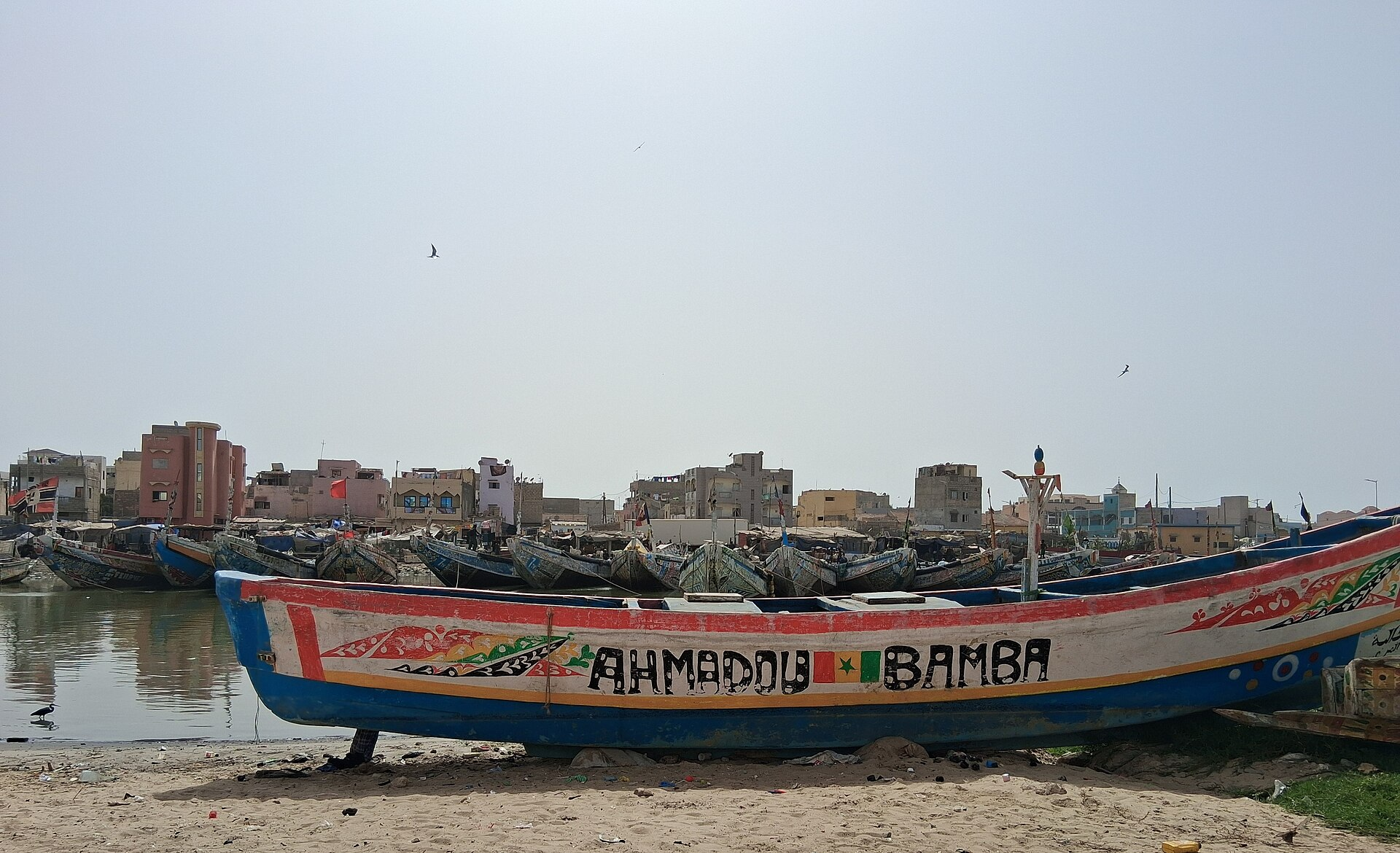
Pirogues in Saint-Louis, Senegal. Adjoajo. CC BY 4.0.
For years, migration to Europe was most often associated with Mediterranean crossings: boats from Libya or Tunisia toward Italy, from Turkey toward Greece, or from Morocco and Algeria toward mainland Spain. Those routes are still active, but they have become more heavily policed through border patrols, surveillance, European Union agreements with transit countries and deportation deals meant to stop people before they reach European shores.
As those corridors tighten, another route has become increasingly important: the Atlantic passage from West Africa to Spain’s Canary Islands. It is not new, but it is longer, more exposed and often deadlier. The route usually begins along the coasts of Senegal, Mauritania, Gambia, Morocco or Western Sahara and ends, if the boat survives, in the Canary Islands. The International Organization for Migration describes departures from West African and North African coasts toward the Canaries, with journeys stretching across hundreds or even thousands of miles of open ocean depending on the departure point.
The route drew renewed attention after arrivals to the Canary Islands reached a record 46,843 people in 2024. Mauritania became one of the main departure points that year, prompting Spain and the European Union to strengthen migration controls with Mauritania and other transit countries. Those controls helped reduce arrivals, but they did not remove the reasons people were leaving. Instead, they pushed some departures farther south.
That shift is what makes the route more dangerous. After Mauritania cracked down on irregular migration, migrants began using more distant and potentially deadlier departure points farther south. Red Cross data cited by Reuters showed boats arriving from Gambia more than doubled in 2025, while boats also began leaving from Guinea. One boat from Conakry, Guinea, traveled about 1,243 miles to reach the Canary Islands, a journey that took 11 days.
The numbers show the contradiction at the center of Europe’s migration policy. From Jan. 1 to Sept. 15, 2026, nearly 60,000 migrants and refugees reached Europe by sea, down nearly 40% from the same period in 2025. But over that same period, nearly 2,300 people died or went missing while trying to cross the Mediterranean or Atlantic, compared with nearly 2,000 during the same period the year before. In other words, fewer people were arriving, but the journey was becoming more lethal.
The Atlantic route has also produced some of the most devastating recent shipwrecks. On July 21, 2026, UNHCR reported that 144 people were dead or missing off West Africa. The agency described the Atlantic corridor as one of the world’s deadliest mixed-migration routes because of long distances, unpredictable ocean conditions, overcrowded boats and limited rescue access.
For readers far from the route, it can be easy to frame the decision to board a small boat as irrational. But for many people leaving West Africa, the choice is made against a backdrop of unemployment, political instability, family pressure, climate stress and shrinking legal pathways. The boat is not chosen because it looks safe. It is chosen because staying can feel like another kind of danger.
That is the deeper problem. Enforcement may reduce arrivals in one place, but it can also push people toward more remote beaches, longer crossings and smugglers willing to take greater risks. The journey becomes less visible, but not less deadly.
The Canary Islands are now part of a larger migration story about how people move when legal pathways are closed and familiar routes become harder to use. Europe may see a falling arrivals chart. Families in West Africa see sons, daughters, brothers and friends making a calculation no one should have to make: whether the risk of the ocean is still better than the risk of no future at home.
The Atlantic does not become safer because fewer people arrive. It becomes safer only when people are not forced to treat it as their best option.
GET INVOLVED:
Follow migration data through the International Organization for Migration’s Missing Migrants Project and IOM Displacement Tracking Matrix Learn more about protection needs through UNHCR and humanitarian updates through ReliefWeb Support migrant assistance and rescue-related work through organizations such as the International Federation of Red Cross and Red Crescent Societiesand Doctors Without Borders.

Carol Khorramchahi
Carol Khorramchahi is a student at Boston University, where she studies English and Psychology and minors in Journalism. She enjoys writing and reporting on stories that bring together culture, identity, and community, and has experience in both newsroom reporting and digital media. She is especially interested in thoughtful storytelling with a global lens.