
Julia Kelley
Summiting Mount Everest has long been the ultimate challenge for mountaineers, but rising death rates and visitor congestion have put a spotlight on its ethics.
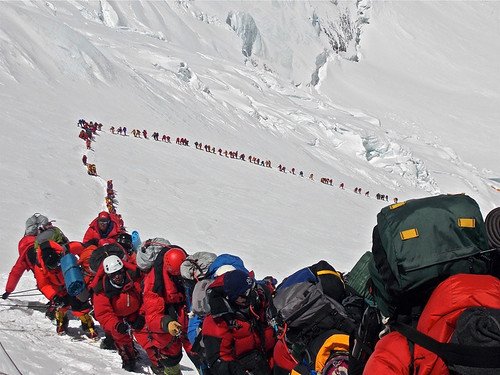
Climbers going up Mount Everest, Nepal. Sam Levin. CC BY 2.0.
Towering over the Himalayan mountain range throughout Nepal and Tibet is Mount Everest, the tallest point on Earth at 29,032 feet. The peak is home to Indigenous groups living in the area, but it has found notoriety as a climbing triumph that many attempt to achieve. On May 29, 1953, Sir Edmund Hillary of New Zealand and his sherpa, Tenzing Norgay, were the first people to accomplish such a feat, almost 100 years after it was first discovered by surveyors charting India. Since then, the mountain range has attracted more and more adventurers each year; with this, however, comes into question the ethics of making such an ascent. Critiques centering on high death rates, environmental impacts and negative effects on local populations have become prominent, as more than 12,500 people have summited Everest between 1922 to 2024.
In this same amount of time, more than 340 people have died while attempting the climb. The trek is known to be dangerous due to the extreme altitude, harsh weather conditions and complex terrain. This ruthless mix of conditions additionally makes way for physiological problems, including fatal altitude sickness or sudden extreme weather events, such as blizzards or high winds. Moreover, death rates appear to be rising with an increase in those attempting the climb, demonstrated in 2023 when the mountain recorded a record high of 18 deaths in a season. In the face of overcrowding and traffic jams, mountaineers have called for fewer climbing permits to be given out each year by the Nepalese government, which the country’s supreme court supported by reaching a similar verdict in 2024.
The Sagarmatha National Park, where Mount Everest is located, faces negative consequences from this congestion; with hundreds of thousands of visitors a year, many of whom are hiking through Everest’s base camp, climbers are straining the natural environment. In particular, deforestation and the destruction of local landscapes have been caused by such high volumes and eroding footpaths. On the ascent up the mountain, hundreds of climbers waiting in long lines and slowly hiking for weeks are leaving mounds of waste behind them. Each person, on average, produces about 18 pounds of trash from their expedition, including abandoned tents and tools, empty oxygen canisters and used food containers. Sherpa teams working to collect garbage and dig up frozen bodies have noted that the cleanup will take years to complete, as even waste from old expeditions continues to litter the area.
Local communities are strained by Everest’s intense commercialization as well. Indigenous groups still call the mountain range their home, with Sherpas being one of the area’s largest native ethnic groups. Imperative for their knowledge of the terrain, many Sherpas are employed to guide climbers, but exploitation through harsh physical working conditions and unfair financial compensation has become more pronounced. Furthermore, their work, including carrying heavy loads, is hazardous, and Sherpa deaths account for about one-third of Everest-related fatalities. The overcrowding of the area and the environmental impacts that come with it also pose a high risk to the local rivers, which thousands in the region rely on for drinking water and crop irrigation.
Over the centuries since the mountain was discovered, Mount Everest has found distinction worldwide for its awe-inspiring beauty and adventure challenge opportunities. However, overcommercialization of the peak and sharp increases in visitor numbers have brought more waste and damage to natural landscapes, as well as strong impacts on native communities. As death rates rise and the environment deteriorates, many now ask whether Mount Everest expeditions continue to be ethical.

Julia Kelley
Julia is a recent graduate from UC San Diego majoring in Sociocultural Anthropology with a minor in Art History. She is passionate about cultural studies and social justice, and one day hopes to obtain a postgraduate degree expanding on these subjects. In her free time, she enjoys reading, traveling, and spending time with her friends and family.