
By Azhar Kantayeva
From singing sand dunes and colorful desert hills to peaceful forest lakes, Kazakhstan, the largest country in Central Asia, offers a world of unexpected natural wonders waiting to be explored.

Horses graze on the green mountain pastures of Assy Plateau in southeastern Kazakhstan. Rinat Mouratov, Exxocette. CC BY-SA 4.0.
As someone born and raised in Kazakhstan, I have always felt that my country has much more to offer than people usually hear about. Since moving abroad, I have noticed that many people know very little about Kazakhstan, and some struggle to imagine what traveling there might look like. Growing up there gave me a personal connection to its culture, people and traditions, and through this article, I want to introduce readers to a different side of my home country. Imagine hearing a desert sing, walking between enormous red cliffs and discovering mountains that look like layers of tiramisu. Surprisingly, these types of places can be found in Kazakhstan.
Located in Central Asia, Kazakhstan is the world’s ninth-largest country and the largest landlocked nation. It is often associated with vast steppes, nomadic traditions and long, cold winters.
However, across the country, ancient geological formations, mountain lakes, pine forests and even a coastline offer visitors completely different experiences. Some of these destinations remain relatively unfamiliar to international travelers, making them especially interesting for those looking beyond conventional tourist routes.
Kazakhstan is also attracting growing international interest. According to government statistics, the country welcomed 15.7 million foreign visitors in 2025, compared with 9.2 million in 2023.
Where the Mountains Meet the Desert
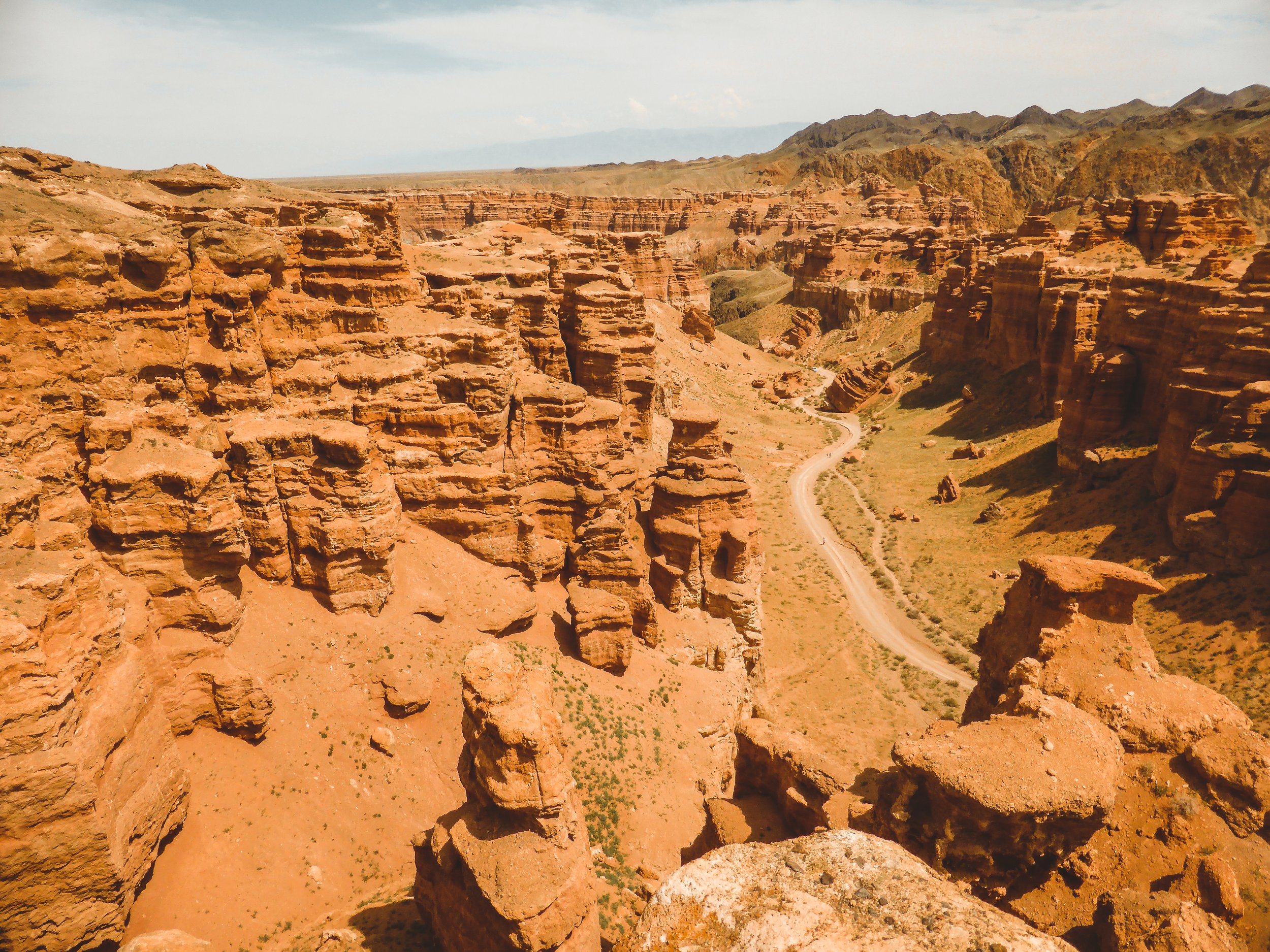
Charyn Canyon’s towering red rock formations in southeastern Kazakhstan. Kalpak Travel. CC BY 2.0.
Almaty, Kazakhstan’s largest city and former capital, is surrounded by the Tian Shan mountains, a major mountain range extending across Central Asia. The city provides a convenient starting point for exploring some of the country’s most remarkable natural landscapes.
Around 124 miles east of Almaty lies Charyn Canyon, where enormous red cliffs form narrow passages and unusual rock formations. Its most famous location, the Valley of Castles, resembles an ancient fortress, with natural towers rising above the canyon floor.
Although the scenery may remind American visitors of the Grand Canyon, Charyn has a character of its own. Millions of years of erosion have shaped its rocks, while the nearby Charyn River supports a rare grove of Sogdian ash trees.

Visitors climb the Singing Dune in Kazakhstan’s Altyn-Emel National Park. Jjm2311. CC BY-SA 4.0.
The landscape changes dramatically at Altyn-Emel National Park, approximately 155 miles from Almaty, where visitors can encounter the Singing Dune, a massive sand formation that produces a low humming sound when dry sand moves down its slopes.
The sound is caused by moving sand vibrations, but hearing it in the middle of an otherwise quiet desert can feel almost unreal.
Altyn-Emel is also home to the colorful Aktau Mountains, whose layers of pale pink, white and red rock reveal the region’s ancient geological history.
A Different Side of the North

Lake Burabay, surrounded by pine-covered mountains and distinctive rock formations in northern Kazakhstan. Azhar Kantayeva.
Farther north, Kazakhstan offers a landscape that feels entirely different from its southern deserts.
Burabay National Park, approximately 160 miles from Astana, the country’s capital, is known for its pine forests, freshwater lakes and unusual granite formations.
Having visited Burabay myself, I wanted to include it as a side of Kazakhstan that international travelers may not expect. Rather than endless open grasslands, the region offers forested hills and lakes surrounded by rocky shores.
One of its most recognizable landmarks is Zhumbaktas, meaning “Riddle Stone,” a rock formation rising from Lake Burabay. Its unusual shape appears to change when viewed from different angles, inspiring local stories and interpretations.
The area is sometimes nicknamed Kazakhstan’s Switzerland, although its combination of forests, lakes and surrounding steppe gives it a distinct identity.
From the Caspian Coast to the Tiramisu Hills
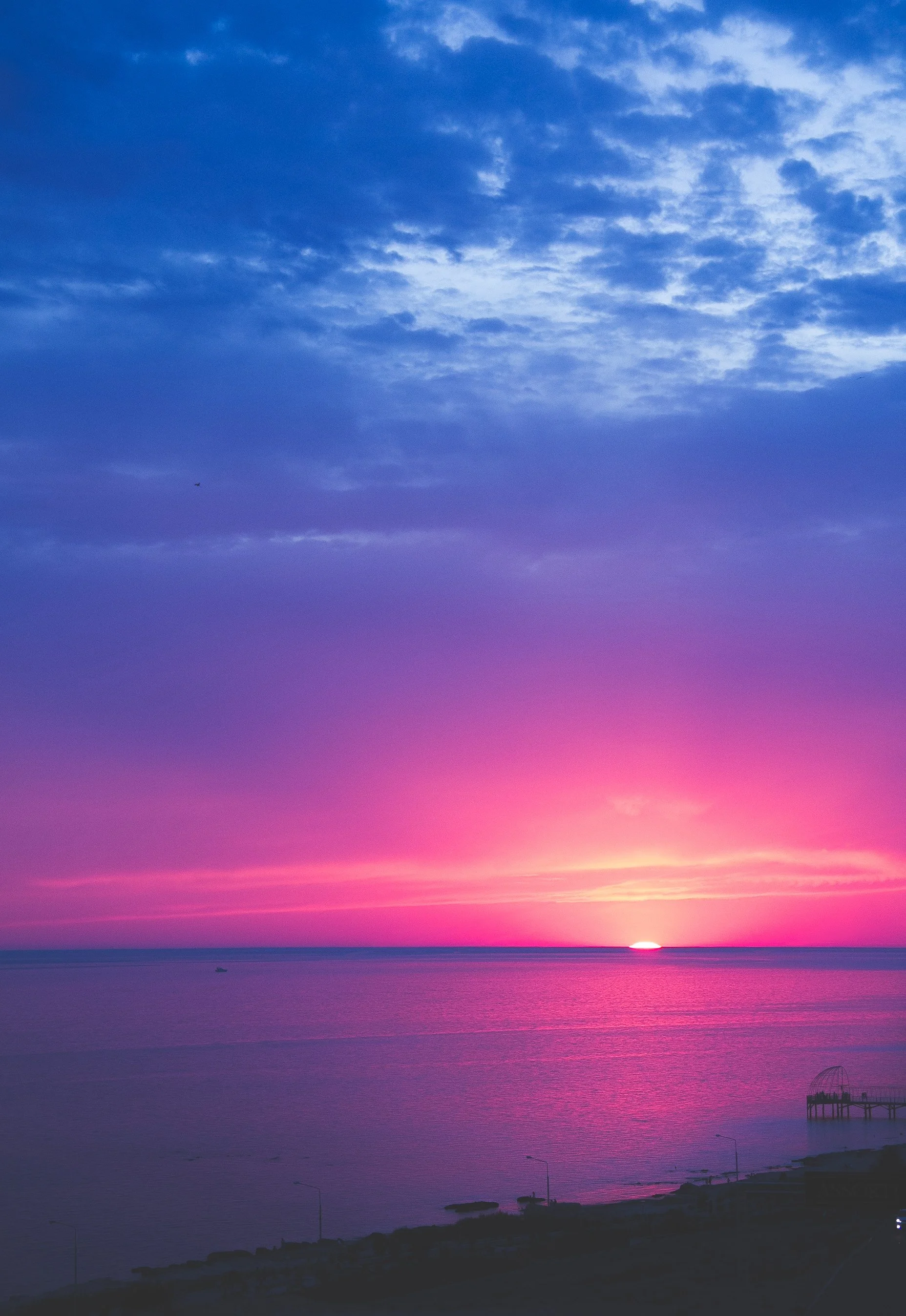
The sun sets over the Caspian Sea in Aktau, western Kazakhstan. Chmeruk Vladislav. CC BY-SA 3.0.
Perhaps one of Kazakhstan’s most unexpected features is its coastline. Although the country has no access to the open ocean, its western border meets the Caspian Sea, the world’s largest enclosed inland body of water.
The coastal city of Aktau offers beaches, waterfront walks and views of the sea meeting the dry landscapes of western Kazakhstan. The Caspian Sea is also home to the endangered Caspian seal, a species found nowhere else in the world. Yet the most surprising scenery lies farther inland.

The colorful layers of Kyzylkup Hills, also known as the Tiramisu Hills, in Kazakhstan’s Mangystau region. Maksat Bisengaziev. CC BY-SA 4.0.
Approximately 155 miles from Aktau, in the Mangystau region, the Kyzylkup Hills stand out for their extraordinary red-and-white stripes. Nicknamed the “Tiramisu Hills,” they resemble layers of the famous Italian dessert.
Their colors come from ancient sedimentary deposits, including chalk and iron-rich material. Over millions of years, geological processes shaped these deposits into the curved, colorful hills visible today.
The contrast between the blue Caspian coastline and Mangystau’s striped desert formations shows just how much the landscape can change within a single region.
More Than One Image of Kazakhstan

The Bear Waterfall cascades through the rocky landscape of Turgen Gorge, southeastern Kazakhstan. Islam Mirsaitov. CC BY-SA 4.0.
Kazakhstan’s landscapes cannot be understood through a single photograph or a familiar description of Central Asia.
In the southeast, rivers and erosion have created enormous canyons, while shifting sands produce unexpected sounds. In the north, pine forests surround quiet lakes, and in the west, ancient geological deposits have formed colorful hills not far from the Caspian Sea.
These places are separated by great distances, and some require more planning than a typical sightseeing trip. Yet they offer travelers an opportunity to experience the country’s remarkable geographical diversity.
Kazakhstan may be widely recognized for its open steppes, but its lesser-known landscapes reveal a much richer natural story, one that continues to surprise even those familiar with the country.

Azhar Kantayeva
Azhar is International Relations student at Dokuz Eylül University in Türkiye and an emerging writer with a passion for journalism, travel, culture, and global affairs. She has experience writing about international issues, destinations, and cultural perspectives. Alongside her studies and writing, she works as an English and Turkish teacher. Her work is driven by curiosity, cultural exchange, and a desire to connect people through stories.